All you need to know for the Calculation of Claim in the Motor Accident Claims Tribunal
Creditor and contributor of this article:
Patra’s Law Chambers:
About Us:
Patra’s Law Chambers is a law firm with offices in Kolkata & Delhi, offering comprehensive legal services across various domains. Established in 2020 by Advocate Sudip Patra (Advocate, Supreme Court of India & Calcutta High Court) an alumnus of the Prestigious Rajiv Gandhi School of Intellectual Property Law, IIT Kharagpur ,with Post Graduate diploma in Business Law from IIM Calcutta, the firm specializes in Civil, Criminal, Writs,High Court Matters, Trademark, Copyright, Company, Tax, Banking, Property disputes, Service law, Family law, and Supreme Court matters.You can know more about us in here
Kolkata Office:
NICCO HOUSE, 6th Floor, 2, Hare Street, Kolkata-700001 (Near Calcutta High Court)
Delhi Office:
House no: 4455/5, First Floor, Ward No. XV, Gali Shahid
Bhagat Singh, Main Bazar Road, Paharganj, New Delhi-110055
Website: www.patraslawchambers.com
Email: [email protected]
Phone: +91 890 222 4444/ +91 7003 715 325
The adjudication of motor accident claims in India is governed by the principles of social welfare and the pursuit of “just compensation,” a concept enshrined in Sections 166 and 168 of the Motor Vehicles Act, 1988.1 The legal landscape for these claims has undergone a radical transformation over the last two decades, moving from a discretionary, often arbitrary system of assessment to a structured, rule-based methodology primarily defined by the Supreme Court’s landmark rulings in Sarla Verma v. Delhi Transport Corporation and National Insurance Company Ltd. v. Pranay Sethi.4 At the core of this framework is the “Multiplier Method,” which serves as the mechanism to quantify the loss of dependency in death cases and the loss of earning capacity in personal injury cases.2 This report provides an exhaustive analysis of the three pillars of claim calculation: the assessment of basic compensation, the mandatory inclusion of future prospects, and the complex determination of the disability factor, specifically distinguishing between physical impairment and functional incapacity.
The Philosophical and Statutory Foundation of Just Compensation
The term “just compensation” is not defined within the Motor Vehicles Act, 1988, yet it forms the heartbeat of the Claims Tribunal’s mandate. The judiciary has interpreted this to mean an award that is fair, reasonable, and equitable, aiming for restitutio in integrum—the restoration of the victim or their dependents to the financial state they would have enjoyed had the accident not occurred.10 While no amount of money can truly compensate for the loss of human life or the permanent loss of mobility, the law attempts to bridge the gap by calculating the economic loss based on evidence and standardized benchmarks.5
The jurisdiction of the Motor Accident Claims Tribunal (MACT) is distinct from traditional civil trials. Under Sections 168 and 169, the proceedings are considered “inquiries” rather than adversarial trials, emphasizing a proactive role for the judge in ascertaining the truth to ensure social justice for victims, many of whom belong to the lower strata of society.1 This social purpose underpins the mandatory requirement for the police to file a Detailed Accident Report (DAR) or Accident Information Report (AIR), which the Tribunal must treat as a claim petition.1
The Multiplier Method: The Arithmetic of Earning Potential
The calculation of the “Loss of Dependency” in fatal accidents or “Loss of Future Earnings” in disability cases follows a tripartite logic: Determining the multiplicand, selecting the multiplier, and applying the conventional heads.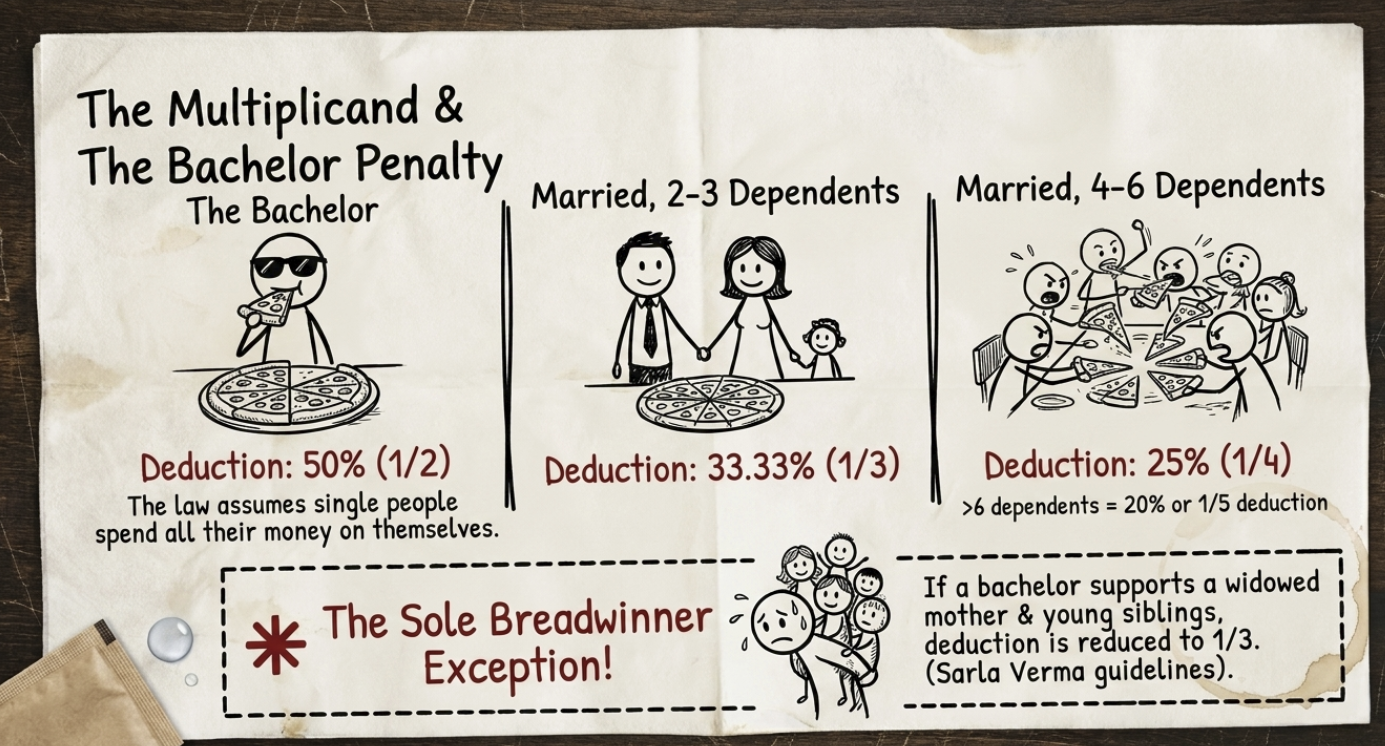
Determining the Multiplicand
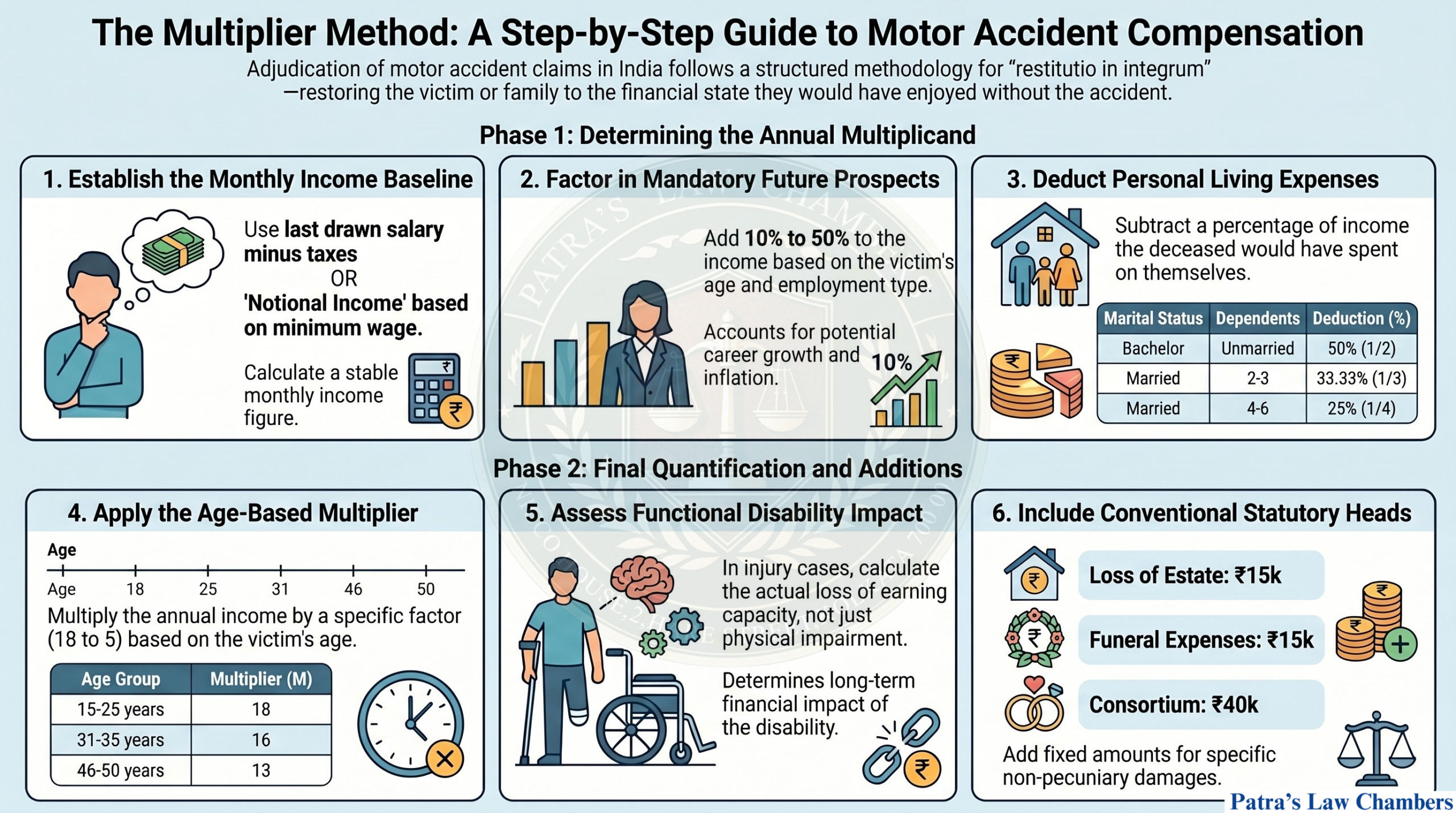
The multiplicand represents the annual contribution of the deceased to their family. It is calculated by taking the monthly income, adding future prospects, and then deducting a percentage for the deceased’s personal and living expenses.2 For salaried employees, the last drawn salary minus statutory taxes serves as the baseline.2 In cases where the income is not proved by documentary evidence, the Tribunal relies on “Notional Income,” often indexed to the minimum wages prevalent in the respective state for the relevant category of labor (unskilled, semi-skilled, or skilled).1
The deduction for personal expenses is a critical variable. The law assumes that a bachelor would have spent a greater portion of their income on themselves compared to a married person with multiple dependents.4
| Marital Status and Number of Dependents | Deduction for Personal Expenses | Percentage Deduction |
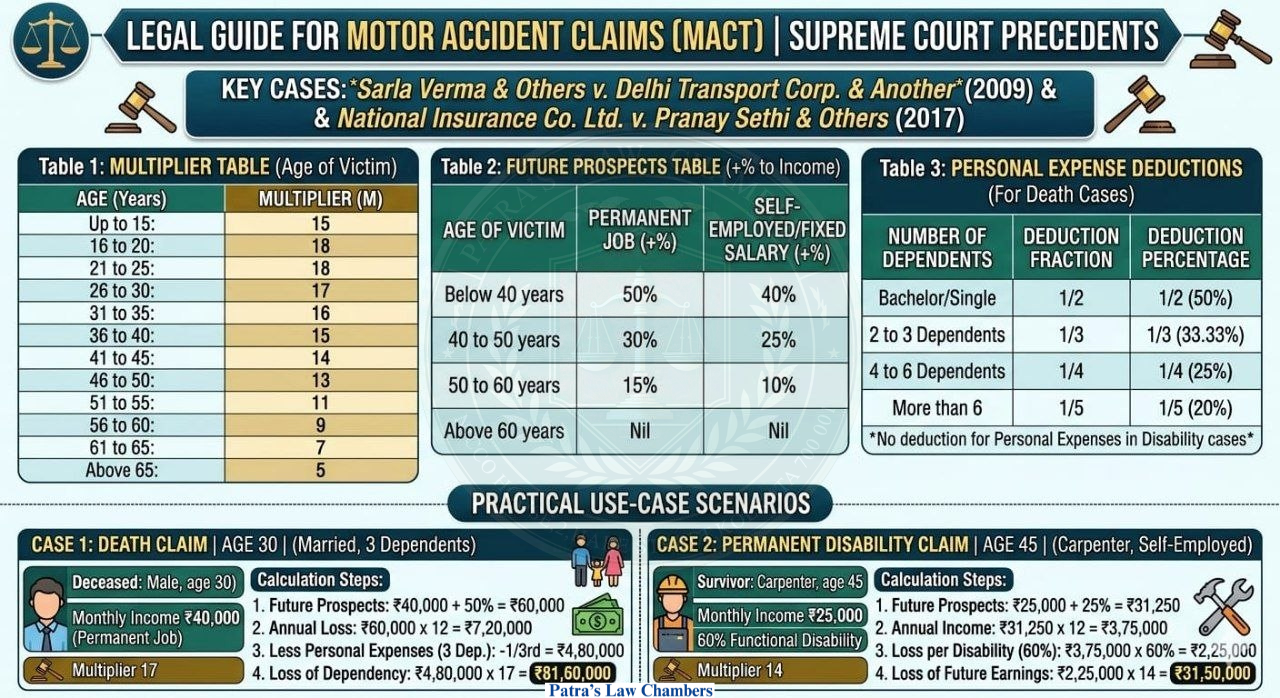
| Bachelor (Unmarried) | 1/2 | 50% |
| Married with 2 to 3 dependents | 1/3 | 33.33% |
| Married with 4 to 6 dependents | 1/4 | 25% |
| Married with more than 6 dependents | 1/5 | 20% |
In exceptional cases involving a bachelor who was the sole breadwinner for a large family—such as a widowed mother and several non-earning younger siblings—the court may restrict the deduction to 1/3rd, recognizing the higher degree of familial dependency.7
The Standardized Multiplier Table
View this post on Instagram
The selection of the multiplier is strictly age-based, reflecting the remaining years of active earning capacity the victim would have had. The Supreme Court in Sarla Verma (2009) established a table that remains the binding norm, as affirmed by the Constitution Bench in Pranay Sethi (2017).5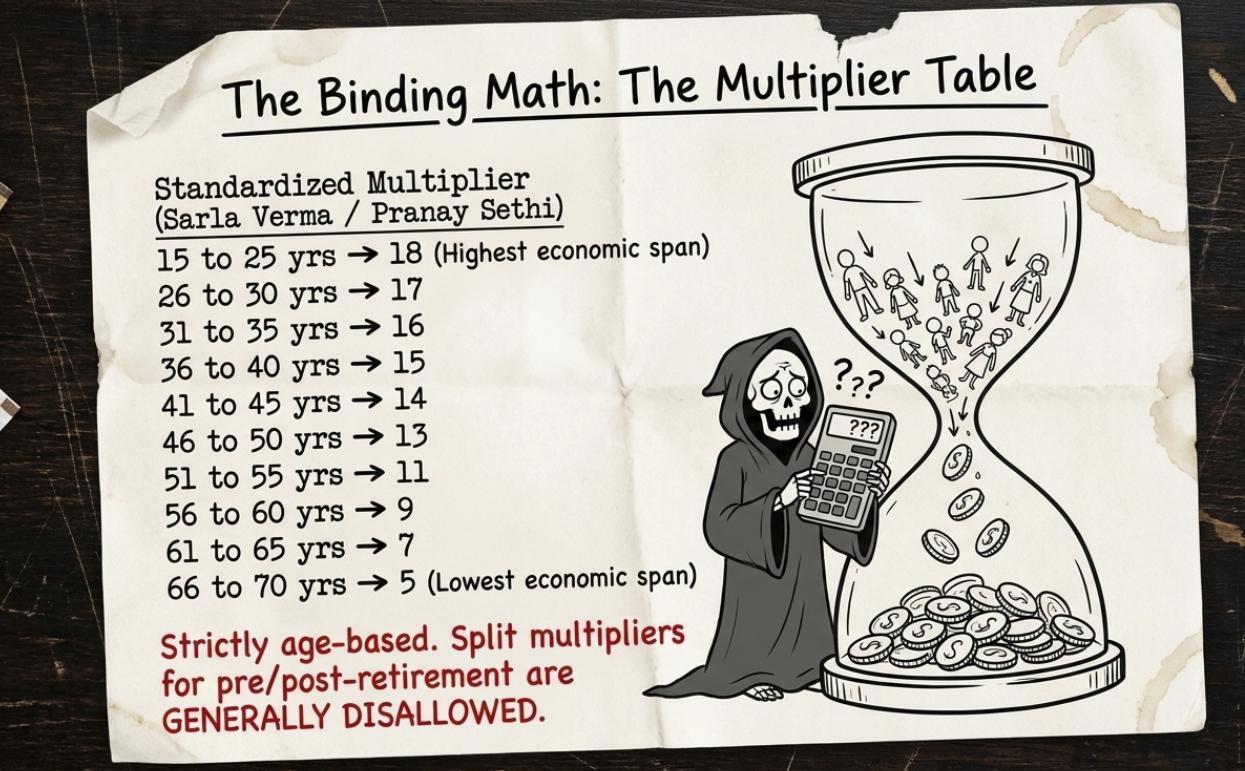
| Age Group of the Deceased | Multiplier (M) |
| 15 to 25 years | 18 |
| 26 to 30 years | 17 |
| 31 to 35 years | 16 |
| 36 to 40 years | 15 |
| 41 to 45 years | 14 |
| 46 to 50 years | 13 |
| 51 to 55 years | 11 |
| 56 to 60 years | 9 |
| 61 to 65 years | 7 |
| 66 to 70 years | 5 |
The multiplier starts at 18 for the youngest age groups and decreases progressively as the victim’s age increases, acknowledging the shorter span of future economic productivity.20
The Doctrine of Future Prospects: Accounting for Growth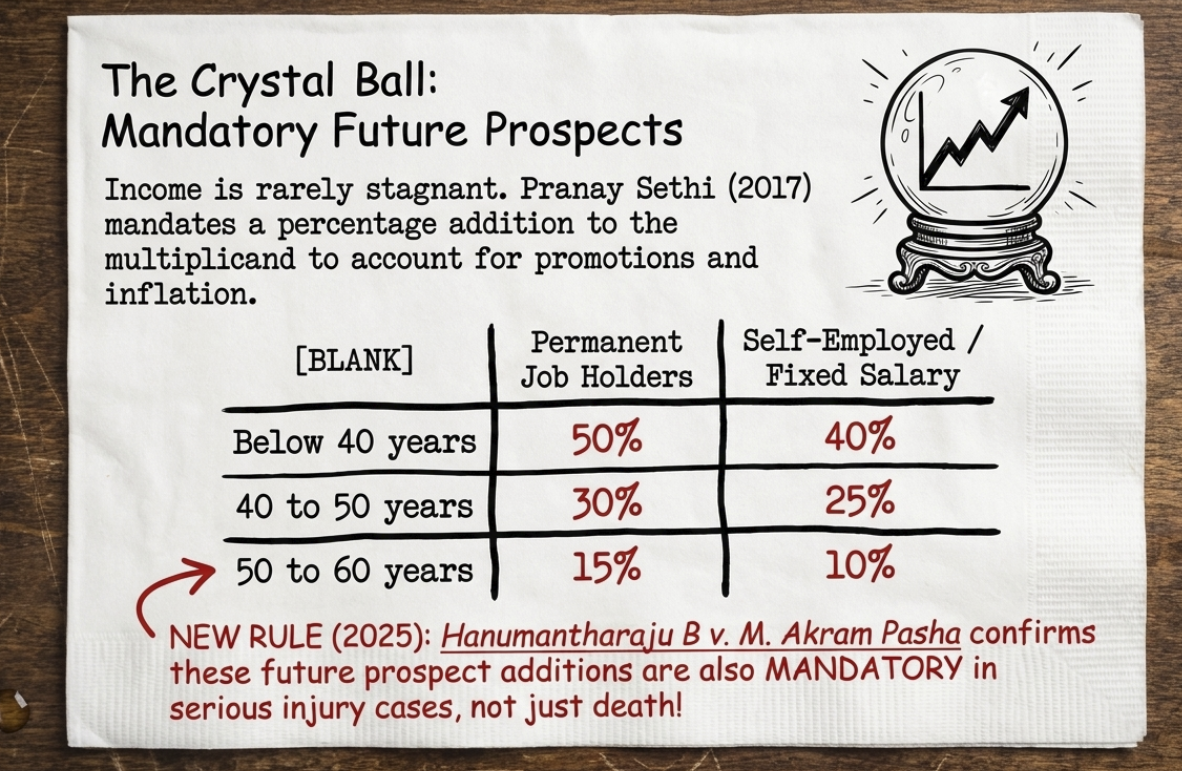
A person’s income is rarely stagnant. Promotions, increments, and the general inflationary rise in earnings are foreseeable economic realities. The Pranay Sethi judgment mandated that future prospects must be added to the current income of the victim to arrive at a “just” multiplicand.5 This addition applies not only to permanent government employees but also to those with fixed salaries or self-employed individuals.5
Standardized Percentage for Future Prospects
| Age of the Victim | Permanent Job Holders | Self-Employed / Fixed Salary |
| Below 40 years | 50% | 40% |
| 40 to 50 years | 30% | 25% |
| 50 to 60 years | 15% | 10% |
The rationale for this tiered addition is that younger individuals have a longer career path ahead and thus a higher potential for income growth compared to those nearing retirement.5 In 2025, the Supreme Court clarified in the case of Hanumantharaju B v. M. Akram Pasha that these additions for future prospects are also mandatory in serious injury cases where a permanent disability interrupts the victim’s promotional avenues and career trajectory.12
The Disability Factor: Physical vs. Functional Impairment
In personal injury claims, the most significant challenge for the Tribunal is the assessment of “permanent disability.” The seminal authority is Raj Kumar v. Ajay Kumar (2011), which distinguishes between a medical assessment of physical impairment and the legal assessment of functional disability.8
Principles of Functional Disability
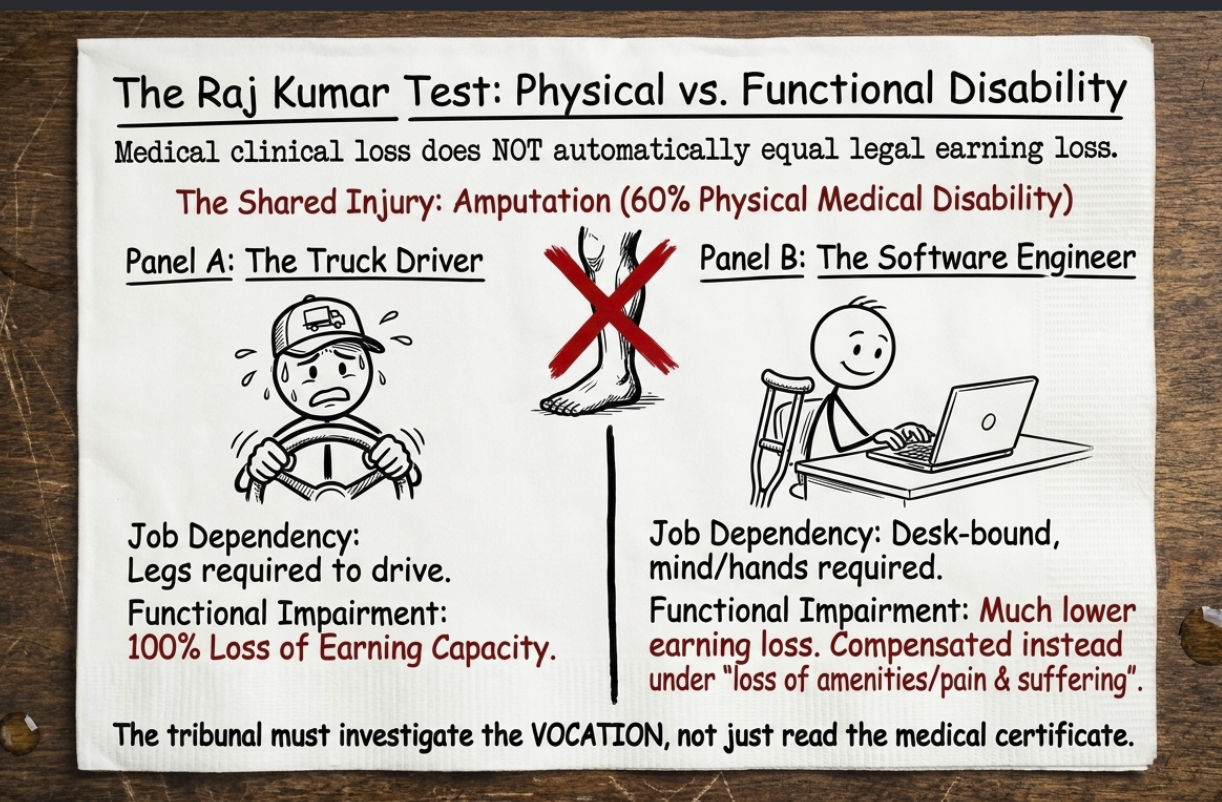
Physical disability is the clinical loss of use of a body part as determined by a medical professional.9 Functional disability, however, is the actual impact of that impairment on the claimant’s earning capacity, considering their specific vocation.8
The assessment requires a nuanced, evidence-based inquiry rather than a mechanical application of medical certificates.8 If a professional driver loses a leg, the physical disability might be 60% (as per the medical board), but the functional disability is 100% because they can no longer drive to earn their livelihood.8 Conversely, the same 60% leg impairment might result in a much lower functional disability for a desk-bound software engineer, although they are still compensated for “loss of amenities” and “pain and suffering”.8
The 75% Rule and Neurocognitive Sequelae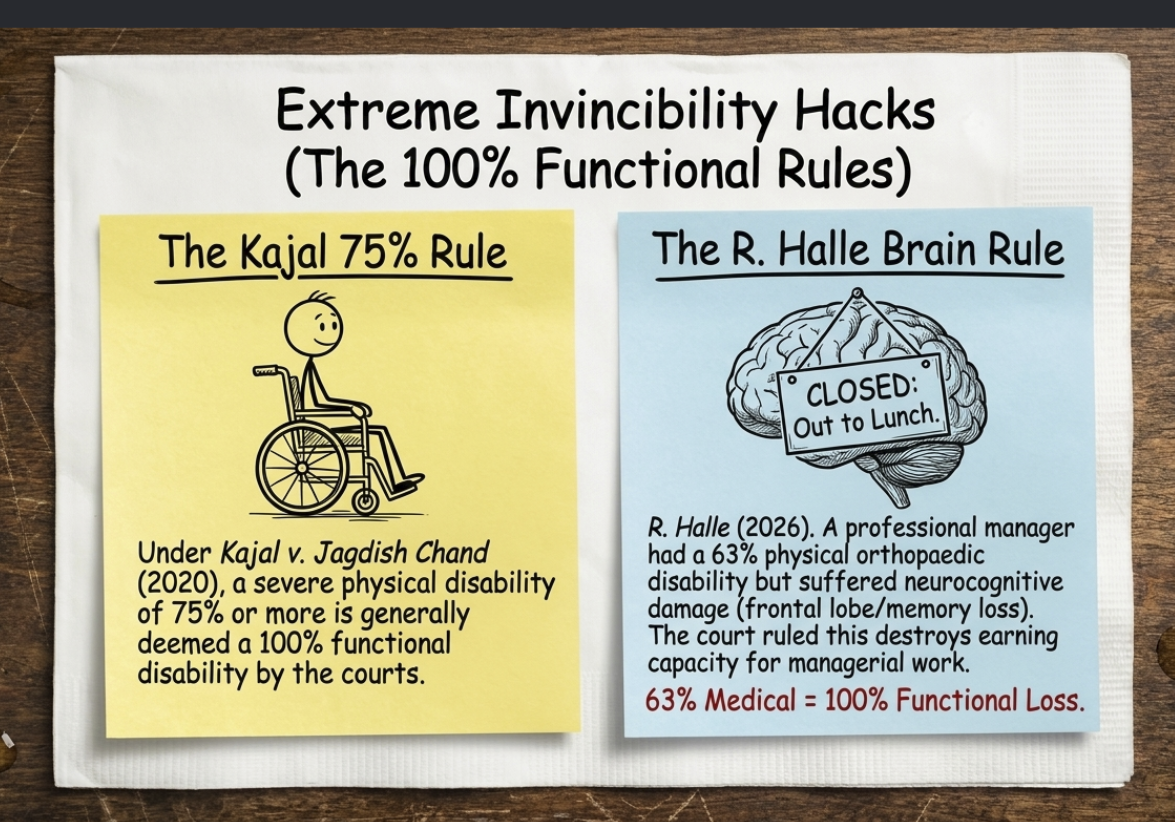
Recent judicial trends have reinforced the principle that severe physical impairments should be treated as total for the purpose of compensation. In Kajal v. Jagdish Chand (2020), the Supreme Court held that a physical disability of 75% or more should generally be deemed as 100% functional disability.28
Furthermore, in R. Halle v. Reliance General Insurance (2026), the Supreme Court emphasized that neurocognitive impairments—such as memory loss, frontal lobe dysfunction, and IQ reduction resulting from head injuries—can lead to 100% functional disability even if the orthopaedic physical disability is lower (e.g., 63%), as these impairments destroy the victim’s ability to engage in managerial or professional work.30
Conventional Heads and the Expansion of Consortium
Beyond the purely economic loss of income, the law awards non-pecuniary damages under “Conventional Heads.” The Pranay Sethi judgment standardized these amounts, directing a 10% enhancement every three years to keep pace with inflation.5
| Conventional Head | Standard Base Amount | Enhancement Clause |
| Loss of Estate | ₹15,000 | 10% hike every 3 years 5 |
| Funeral Expenses | ₹15,000 | 10% hike every 3 years 5 |
| Loss of Consortium | ₹40,000 | Per dependent/spouse 5 |
The Compendious Term “Consortium”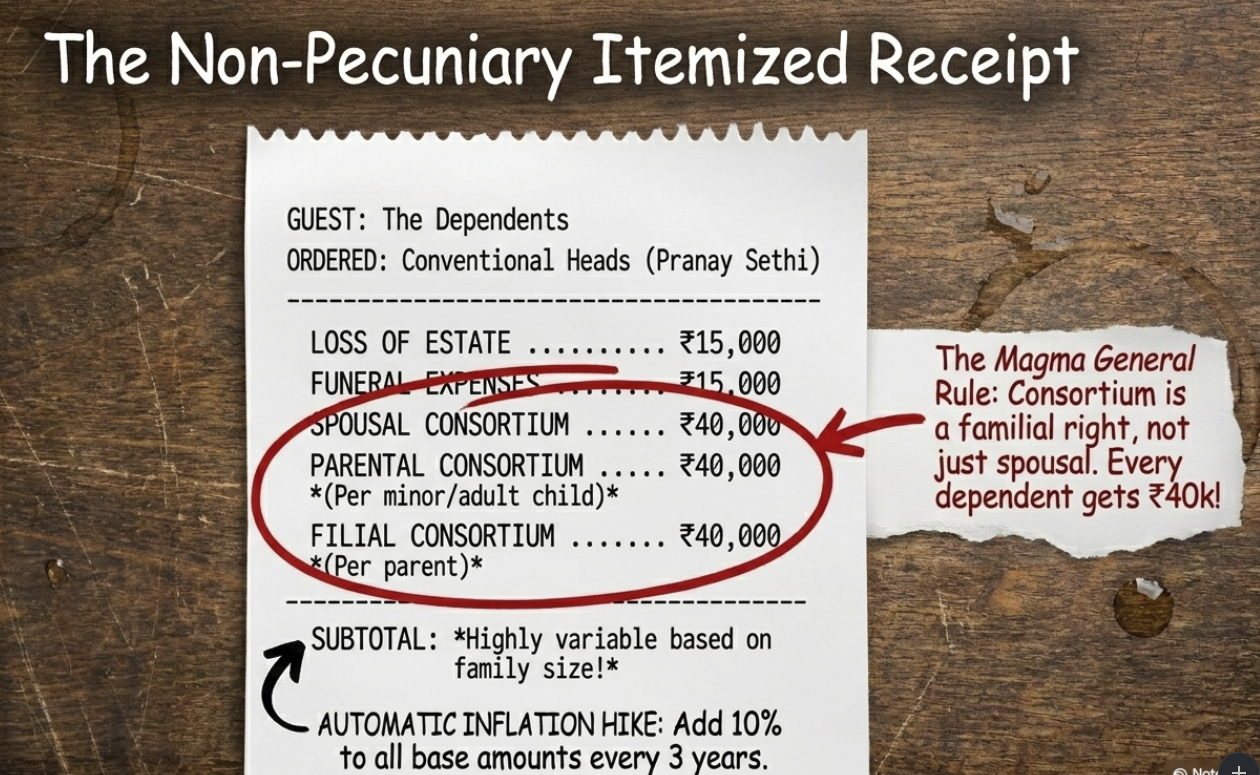
The definition of consortium has evolved from a spousal right to a familial right, as clarified in Magma General Insurance Co. Ltd. v. Nanu Ram (2018) and United India Insurance Co. Ltd. v. Satinder Kaur (2020).10
- Spousal Consortium: For the loss of a partner’s companionship, society, and affection.32
- Parental Consortium: For minor or adult children who lose a parent, compensating for the loss of guidance, protection, and parental care.32
- Filial Consortium: For parents who lose a child (minor or unmarried), recognizing the loss of love and companionship.32
Courts now grant ₹40,000 (plus inflation adjustments) to each dependent under these specific heads of consortium, leading to a significant cumulative portion of the total award in cases with large families.10
Compensation for Special Categories
Deceased Children and Students
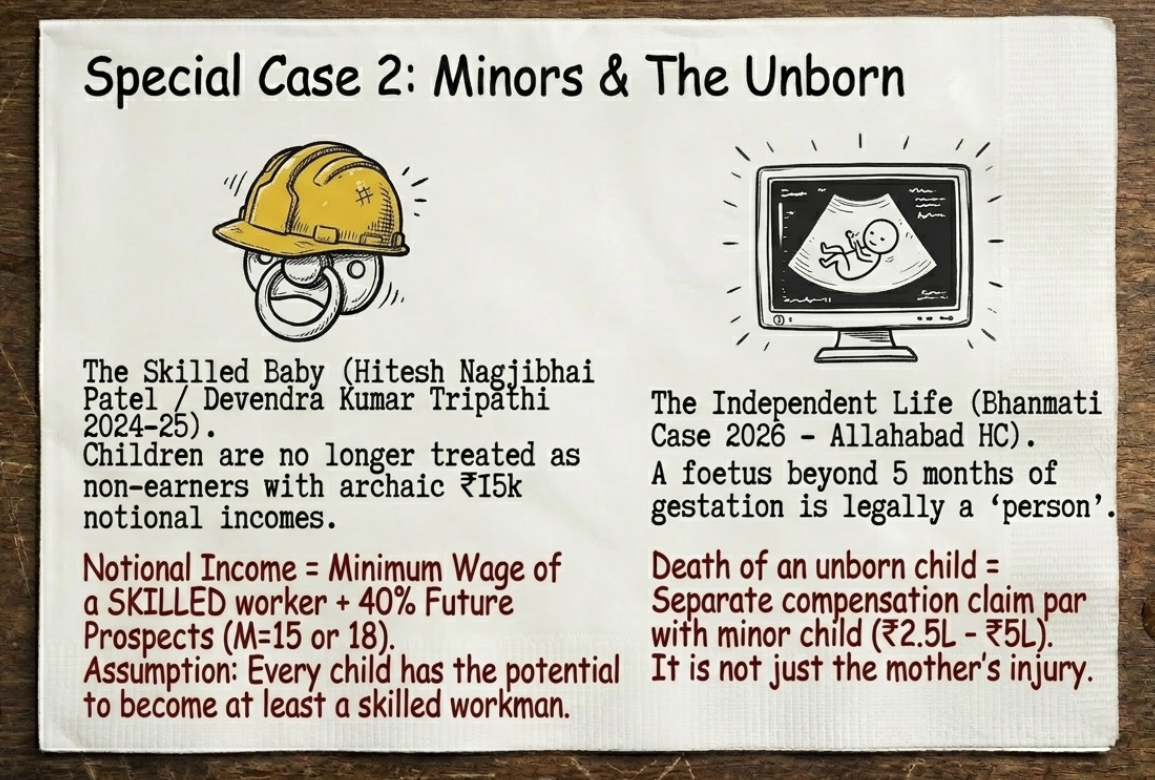
The death of a child is one of the most difficult claims to calculate because there is no established income. Historically, Courts applied a low notional income (e.g., ₹15,000 or ₹30,000 per annum).35 However, a corrective shift occurred in 2024 and 2025. The Supreme Court in Hitesh Nagjibhai Patel and Devendra Kumar Tripathi held that children cannot be treated as non-earners.18 The benchmark for a child’s notional income is now the minimum wage of a skilled worker in the relevant state, plus 40% for future prospects, using a multiplier of 15 or 18.34 This recognizes that every child has the potential to achieve at least the status of a skilled workman upon attaining majority.18
Homemakers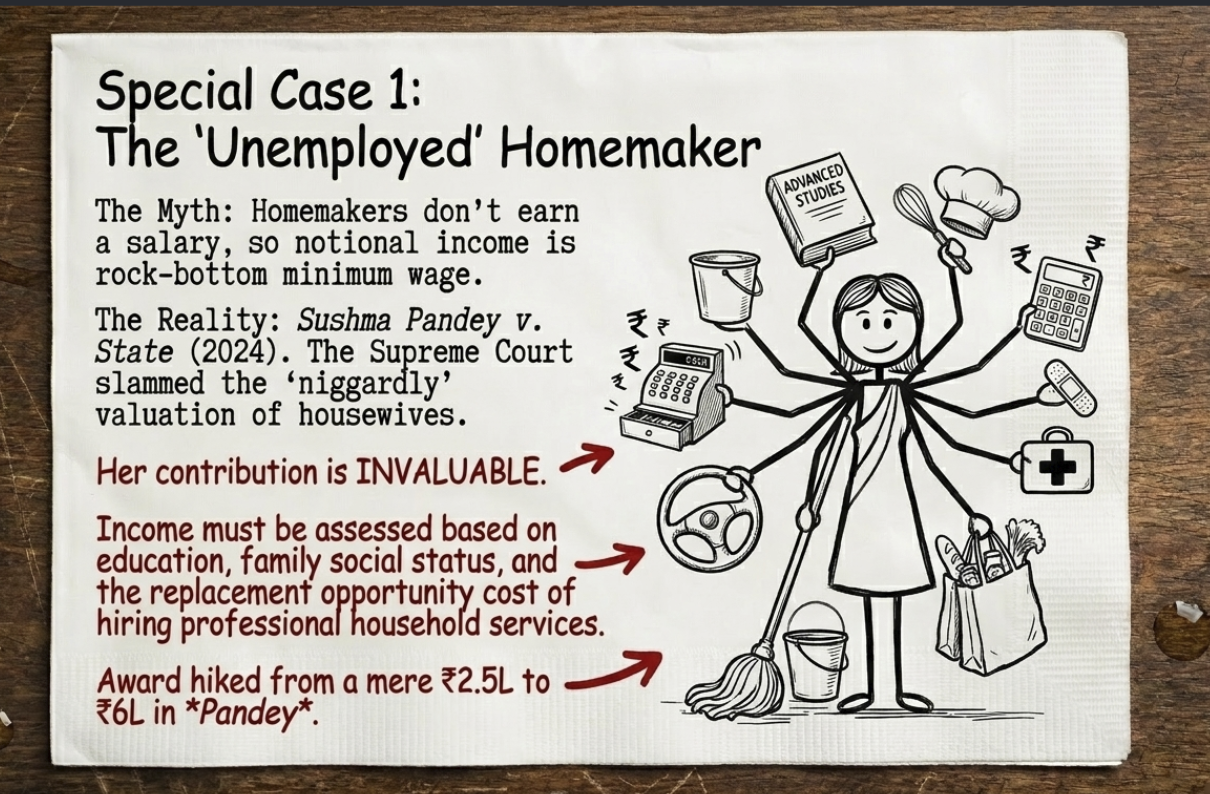
The Supreme Court in Sushma Pandey v. State (2024) criticized the “niggardly” approach of Tribunals in assessing the loss of a housewife.39 The contribution of a homemaker—performing duties of a cook, cleaner, tutor, and manager—is invaluable and cannot be measured purely in tangible income.39 The current standard is to assess a homemaker’s notional income based on their education, the family’s social status, and the prevailing cost of hiring professional services for household management.39
Unborn Children and Foetus
In a groundbreaking development in 2024/2025, the Allahabad High Court and Delhi High Court have recognized a foetus beyond five months of gestation as a “person” in the eyes of the law.40 The death of an unborn child in an accident entitles the family to separate compensation, treated at par with the death of a minor child (approx. ₹2.5 lakh to ₹5 lakh), acknowledging that the loss of an independent life in the womb is as tragic as the loss of a child who has already been born.40
Retired Persons and the Pension Rule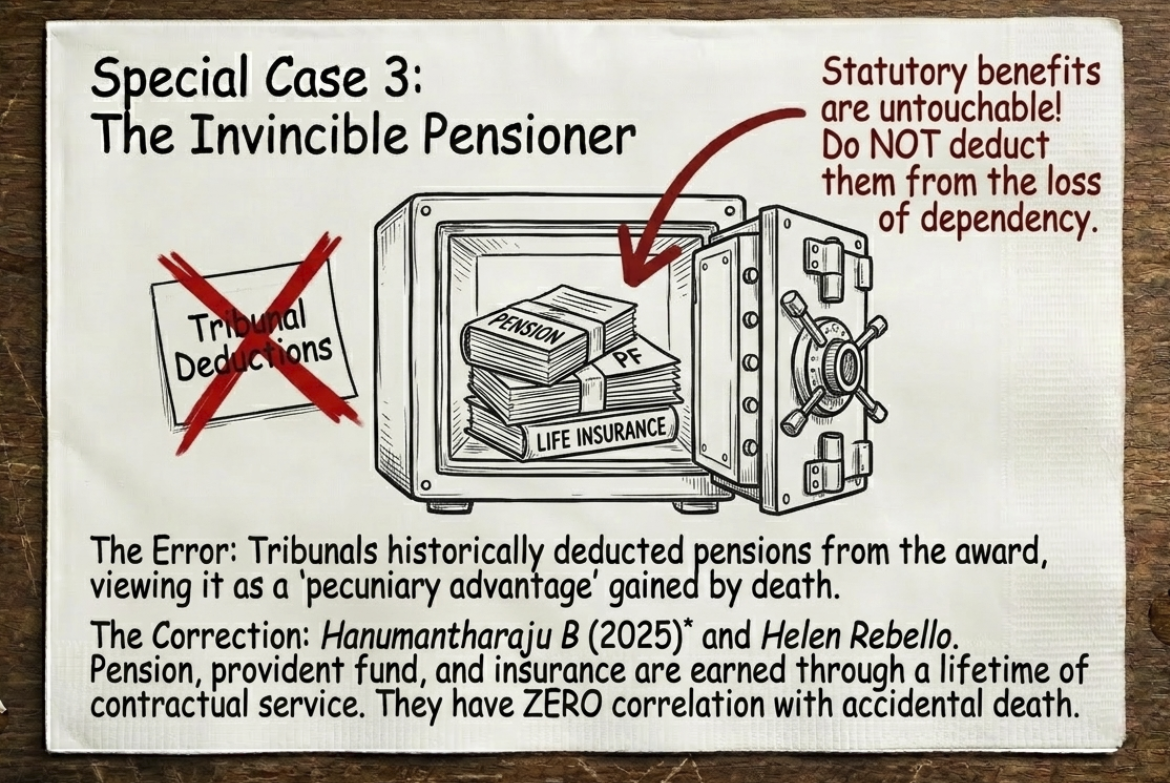
A common error among Tribunals was the deduction of pension from the compensation amount, assuming it was a “pecuniary advantage” gained by death. The Supreme Court in Hanumantharaju B v. M. Akram Pasha (2025) and earlier in Helen Rebello (1999) settled that pension, provident fund, and insurance are earned through contractual/statutory service and have no correlation with accidental death.12 Therefore, these benefits cannot be deducted while calculating the loss of dependency or earning capacity.12
Case Laws: The Pillars of MACT Jurisprudence
- Sarla Verma v. DTC (2009): Standardized the multiplier table and the rules for personal expense deductions.4
- National Insurance Co. Ltd. v. Pranay Sethi (2017): Finalized the law on future prospects for self-employed/fixed-salary victims and standardized conventional heads.5
- Raj Kumar v. Ajay Kumar (2011): Established the distinction between physical and functional disability for personal injury claims.8
- Magma General Insurance Co. Ltd. v. Nanu Ram (2018): Recognized filial and parental consortium as valid heads of damage.10
- Kajal v. Jagdish Chand (2020): Held that medical expenses should not be capped strictly at bills and that high disability (75%+) equates to 100% loss.28
- Baby Sakshi Greola v. Manzoor Ahmad Simon (2024): Mandated the use of skilled-workman wages as a benchmark for child death cases.18
- Hanumantharaju B v. M. Akram Pasha (2025): Reaffirmed the non-deductibility of pension and extended future prospects to disability cases.12
- S Ettiappan v. D Kumar (2025): Treated a 70% physical disability (leg amputation) as 100% functional disability for a manual loader.26
- R. Halle v. Reliance General Insurance (2026): Recognized neurocognitive impairment as 100% functional disability for professional managers.30
- Sushma Pandey v. State (2024): Recognized the invaluable contribution of a homemaker, hiking compensation significantly for the family.39
Real-Life Examples of Compensation Calculation
#image_title
The following 15 cases illustrate the application of these principles in various life scenarios:
- The Scientist (Rajinder Prakash, 1988/2009): A 38-year-old scientist with the Indian Council of Agricultural Research was killed. The court averaged his current salary with his potential retirement salary to determine income, deducted 1/4th for his six dependents, and applied a multiplier of 13. This case became the foundation for the Sarla Verma guidelines.20
- The High-Earning Professional Driver (Pathmavathi, 2026): The victim was a 37-year-old driver earning ₹10,000 monthly. The Supreme Court added 40% for future prospects (total ₹14,000), deducted 1/4th for personal expenses (leaving ₹10,500), and applied a multiplier of 15. The final award was modified to ₹20.8 lakh.13
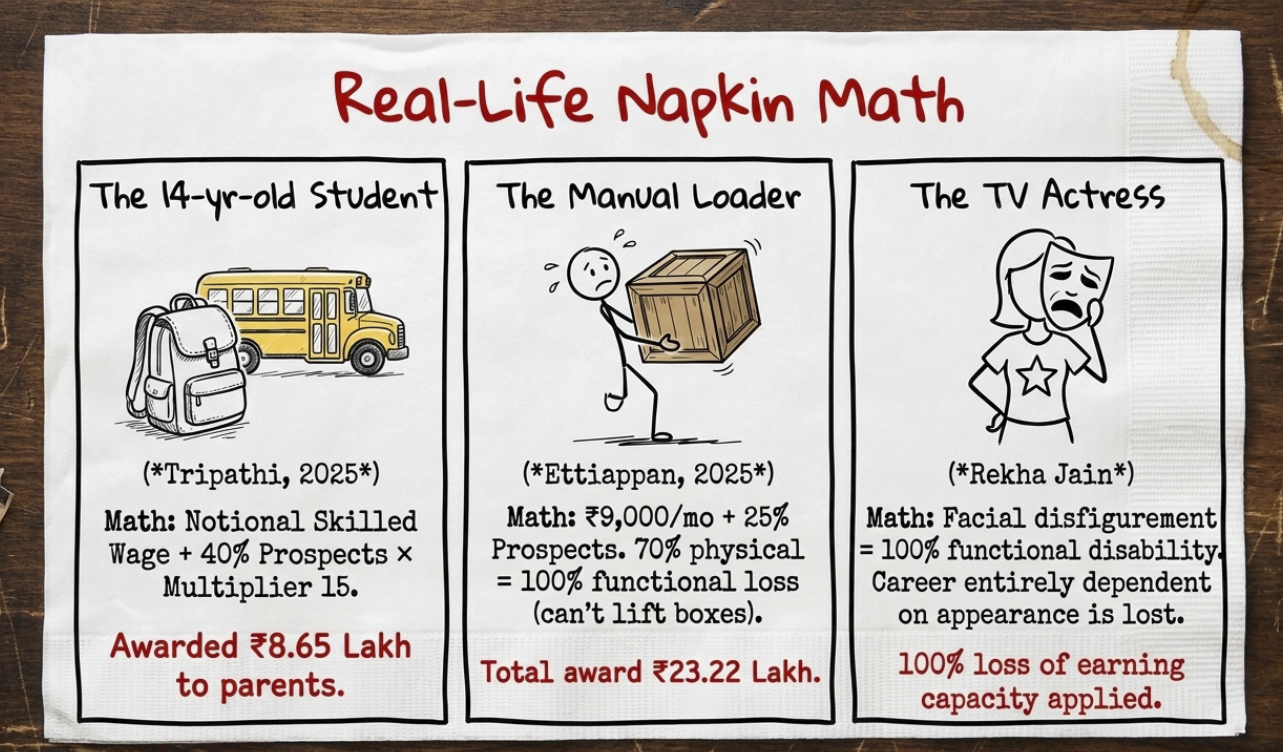
- The 14-Year-Old Student (Tripathi Case, 2025): A 14-year-old boy was killed by a truck on his way to school. The Supreme Court adopted the notional income of a skilled worker, added 40% for future prospects, applied a multiplier of 15, and awarded a total of ₹8,65,400 to the parents.34
- The Manual Loader (Ettiappan Case, 2025): A labourer lost his right leg (70% medical disability). The Supreme Court held his functional disability was 100% because he could no longer perform manual labour. With a monthly income of ₹9,000 and 25% future prospects, the loss of income was calculated at ₹18.9 lakh, with a total award of ₹23.22 lakh.26
- The Homemaker (Sushma Pandey, 2024): A 50-year-old housewife died in a car crash. The initial award was a mere ₹2.5 lakh. The Supreme Court hiked it to ₹6 lakh, emphasizing that her services to her husband and two student children could not be undervalued.39
- The Professional Manager with Brain Injury (R. Halle, 2026): A manager suffered neurocognitive deficits (memory loss, frontal lobe impairment) despite 63% physical disability. The Supreme Court restored his functional disability to 100%, awarding ₹97,73,011 after the High Court had slashed it by half.30
- The Computer Operator/Engineer (Fahad Siddiqui, 2025): An engineering student working as a computer operator lost his leg. The Delhi High Court assessed his loss of future potential as a Civil Engineer rather than just a clerk, applying minimum wages and 40% prospects.27
- The 25-Year-Old Software Engineer (Thane MACT, 2025): The parents were awarded ₹49.4 lakh. While the engineer lost control of his bike, the truck driver was 75% liable. The final award accounted for his high earning potential but deducted 25% for contributory negligence.14
- The Unborn Child (Bhanmati Case, 2026): A woman 8-9 months pregnant died in a railway incident. The Allahabad High Court awarded separate compensation for the foetus, treating it as an independent life lost, modifying the Tribunal’s denial of relief.41
- The Retired Principal (Hanumantharaju B, 2025): A 43-year-old Principal suffered 78% disability leading to forced retirement. The Supreme Court recalculated his award to ₹67.36 lakh, specifically barring the deduction of his pension and adding 30% for future prospects.12
- The 66-Year-Old Road Victim (Patricia Mahajan, 2001/2023): For an elderly deceased, the court used a lower multiplier of 5-7. The focus shifted from future prospects to the proven dependency of the surviving spouse.25
- The Minor with 100% Paralysis (Abhimanyu Partap Singh): A child suffered 100% paralysis in an accident. The court applied a multiplier of 18 to notional skilled-worker wages and awarded significant amounts for life-long attendant care.29
- The Professor and Tutor (Karuna Parmar, 2024): A former professor who was providing private tuitions at the time of the accident. The Supreme Court accepted her combined income (salary + tuition) and reversed the Tribunal’s exclusion of her professorial capacity.38
- The Autorickshaw Driver (Mumbai MACT, 2024): In the absence of proof of income, the Tribunal treated the deceased as a skilled labourer, fixing notional income at ₹6,000 per month and awarding ₹14.14 lakh to his wife, children, and parents.46
- The TV Actress (Rekha Jain): A 24-year-old actress suffered facial disfigurement. The Supreme Court held her functional disability was 100% because her career in film and TV was entirely dependent on her appearance, which was lost.47
Procedural Safeguards: Police and Insurance Duties
The Motor Accident Claims Tribunal operates as a “beneficial legislation” court.
- Police Duties: The SHO must file an Accident Information Report (AIR) within 30 days of the FIR.1 This must include a site plan, photographs, fitness certificates, and the victim’s socio-economic profile.1
- Insurance Company Responsibilities: Insurers are required to investigate the claim immediately upon receipt of the AIR. If no statutory defense exists, they must deposit the “admitted amount” as per their calculation within 30 days to provide immediate relief.1
- Protection of Award Amount: Many victims are from vulnerable backgrounds. The Tribunal often orders that a major portion of the award be kept in Fixed Deposits with monthly interest credited to the claimant’s savings account, preventing the money from being wasted or the victim being cheated.1
Interest Rates and Tax Reforms
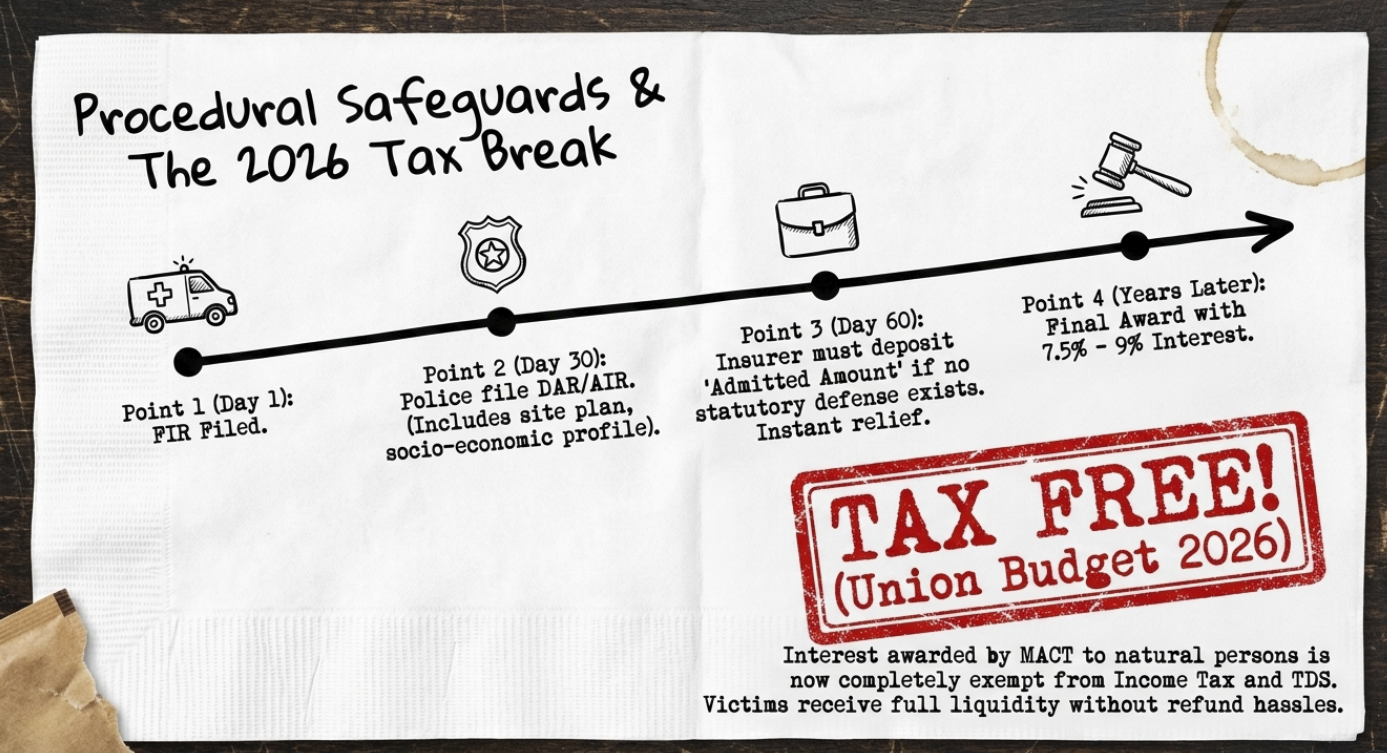
Interest is usually awarded at 7.5% to 9% from the date of the claim petition till realization.2 A significant policy shift in the Union Budget 2026 proposed to exempt interest awarded by the MACT to natural persons from income tax and TDS.49 This ensures that victims, many of whom wait years for compensation, receive the full liquidity of the award without the burden of filing for refunds.49
Frequently Asked Questions (FAQ)
Q.1 What is the primary role of the Motor Accident Claims Tribunal (MACT)? Ans. The MACT is a district-level judicial authority established under Section 165 of the Motor Vehicles Act to determine liability and calculate “just compensation” for injuries or deaths arising from motor accidents.14
Q.2 How is the “Multiplier” selected? Ans. It is selected based solely on the age of the deceased as per the table provided in the Sarla Verma and Pranay Sethi judgments.5
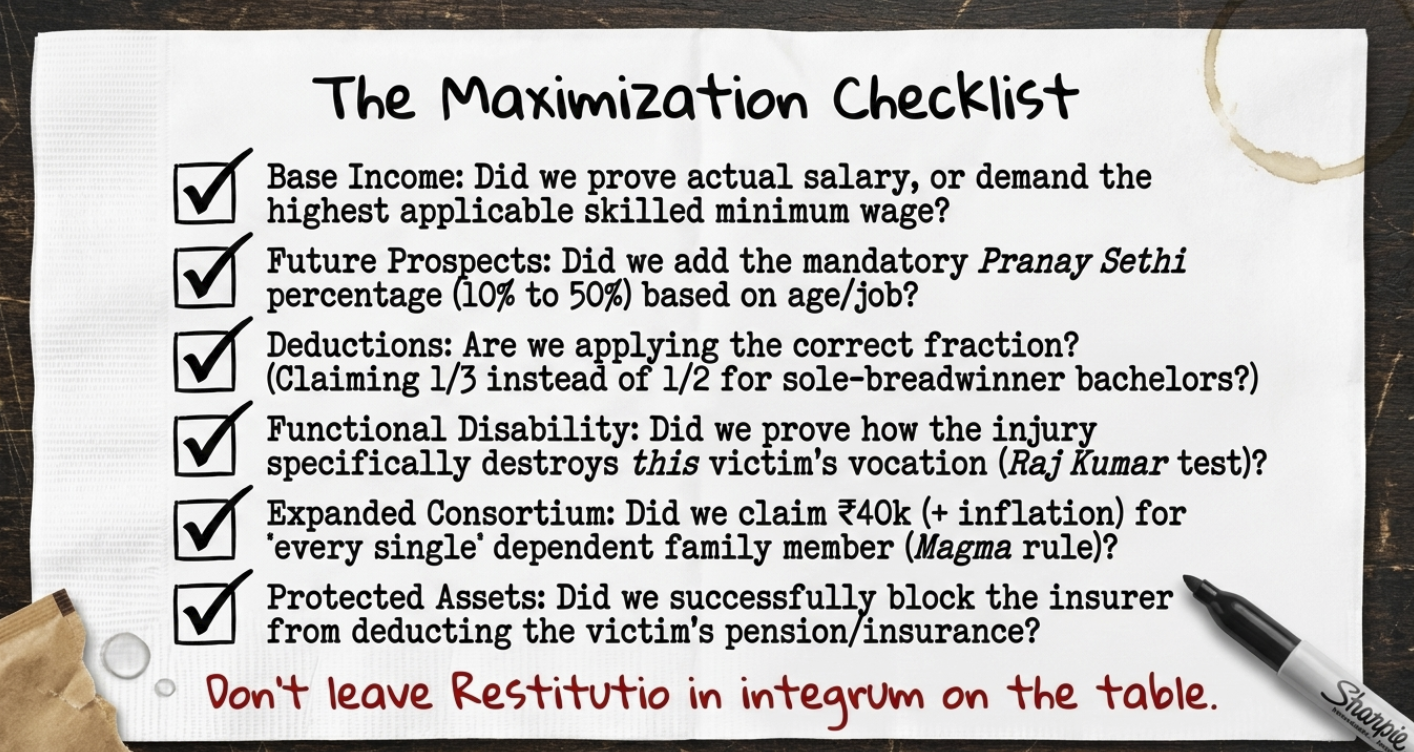
Q.3 What are “Future Prospects”? Ans. It is a mandatory percentage addition to the victim’s income (ranging from 10% to 50% based on age and job type) to account for potential career growth and inflation.5
Q.4 Is there a time limit to file a MACT claim? Ans. Under the current amendment, a claim petition should be filed within six months of the date of the accident.14
Q.5 What is “Functional Disability”? Ans. It refers to the actual loss of earning capacity a victim suffers based on their specific vocation, which may be higher than the clinical/physical disability percentage.8
Q.6 Can a bachelor’s family get full compensation? Ans. For bachelors, 50% is standardly deducted for personal expenses. However, if they had a large dependent family, the deduction may be reduced to 1/3rd.7
Q.7 Who is considered a “Legal Representative”? Ans. It includes all heirs who suffer from the loss, such as parents, spouse, and children. Even a married son may be a legal representative, though his “dependency” must be proved for certain heads.46
Q.8 Can an unborn child claim compensation? Ans. Yes, a foetus beyond five months of gestation is considered a “person,” and the family is entitled to separate compensation for its loss.40
Q.9 Is a pension deductible from the award? Ans. No. Statutory benefits like pension, provident fund, and insurance are not “pecuniary advantages” and cannot be deducted from the compensation.12
Q.10 What is “Consortium”? Ans. It is compensation for the loss of companionship and love. It includes spousal, parental (for children), and filial (for parents) consortium.31
Q.11 What are “Conventional Heads”? Ans. These are non-pecuniary awards for Loss of Estate, Funeral Expenses, and Consortium.5
Q.12 How is the income of a housewife assessed? Ans. It is assessed notionally based on her educational background, the family’s social status, and the “opportunity cost” of the household management services she provided.39
Q.13 Can the Tribunal award more than the amount claimed? Ans. Yes. The Tribunal’s mandate is to provide “just” compensation, and if the evidence justifies a higher amount, the Tribunal can exceed the initial claim.3
Q.14 What is the “Pay and Recover” principle? Ans. If a policy term is breached (e.g., driver had no license), the insurer pays the victim first and then recovers the amount from the vehicle owner.30
Q.15 Is interest on the award taxable? Ans. As per the Budget 2026, interest awarded to a natural person is exempt from income tax and TDS.49
Q.16 What happens if the driver of the offending vehicle has a fake license? Ans. The insurance company remains liable to the third-party victim but can recover the amount from the owner/driver after paying the award.1
Q.17 What is the duty of the police in motor accident cases? Ans. The police must file a Detailed Accident Report (DAR) within 30 days, collecting all evidence regarding the accident and the victim’s socio-economic status.1
Q.18 What is “Contributory Negligence”? Ans. If the victim was also partially responsible for the accident, the compensation is reduced in proportion to their percentage of fault.14
Q.19 Can “Sovereign Immunity” be pleaded by the Government? Ans. No. The Government cannot avoid liability under the Motor Vehicles Act by pleading sovereign immunity for its vehicles on official duty.1
Q.20 How is the income of a student or minor child assessed? Ans. In 2024/2025, the Supreme Court has mandated using the minimum wage of a skilled worker as the notional income benchmark for children.18
Q.21 What interest rate is typically granted by the MACT? Ans. The interest rate generally ranges from 7.5% to 9% per annum from the date of the petition till realization.2
Q.22 Can a married sister claim for the loss of her brother? Ans. She is a legal representative but is generally not considered a “dependent” unless she can prove actual financial reliance on the deceased.22
Q.23 What is the difference between Section 166 and Section 163-A? Ans. Section 166 requires proof of negligence, whereas Section 163-A (Structured Formula) provides for compensation without proof of fault.1
Q.24 What happens if the vehicle owner has no insurance? Ans. The owner is personally liable. The police may also prosecute the owner under Section 196 and the vehicle may be seized and sold to pay the award.1
Q.25 Is “Loss of Amenities” awarded in death cases? Ans. No. It is a non-pecuniary head awarded in injury cases to compensate for the loss of enjoyment of life.26
Q.26 What is the “Golden Hour”? Ans. It is the one-hour period following a traumatic injury during which there is the highest likelihood of preventing death through prompt medical care.20
Q.27 Can I claim for the cost of an artificial limb? Ans. Yes. Future medical expenses, including the initial cost and subsequent replacements of prosthetic limbs, are compensable.26
Q.28 How does the number of dependents affect the deduction? Ans. A higher number of dependents leads to a smaller deduction for personal expenses (e.g., 1/4th for 4-6 dependents vs. 1/3rd for 2-3).4
Q.29 Is compensation for “Pain and Suffering” standardized? Ans. No. It varies based on the severity of the injury, the duration of treatment, and the impact on the victim’s life, typically ranging from ₹40,000 to over ₹1,00,000 in severe cases.26
Q.30 What is a “Split Multiplier”? Ans. It is a method of applying different multipliers for pre-retirement and post-retirement years. The Supreme Court has generally disallowed this, insisting on a single multiplier based on age.23
Final Narrative Summary
The adjudication of motor accident claims in India has reached a level of sophistication that balances the mathematical precision of the “Multiplier Method” with the humane considerations of social welfare law. By mandating the inclusion of future prospects for all categories of workers and strictly differentiating between physical and functional disability, the judiciary has ensured that victims are compensated for their actual loss of livelihood. The expansion of the concept of consortium to cover all family members and the landmark recognition of foetal life as compensable further strengthen the protective umbrella of the Motor Vehicles Act. As the legal framework moves toward 2026, the integration of tax-free interest and streamlined police reporting (DAR/AIR) ensures that the “just compensation” promised by the statute is delivered with speed and fairness, fulfilling the foundational objective of the law to provide timely financial support to those in distress.
Works cited
- FAQ.pdf
- MACT Compensation Calculation: Complete Guide, accessed on April 16, 2026, https://supremetoday.ai/issue/mact-compensation-calculation:-complete-guide
- MACT Claim for 14-Year-Old Child: Compensation Guide – Supreme Today AI, accessed on April 16, 2026, https://supremetoday.ai/issue/mact-claim-14-year-old-child-compensation
- Sarla Verma v DTC: Key Motor Accident Compensation Rules – Supreme Today AI, accessed on April 16, 2026, https://supremetoday.ai/issue/sarla-verma-dtc-compensation-guidelines
- SUPREME COURT OF INDIA – Orissa High Court, accessed on April 16, 2026, https://orissahighcourt.nic.in/uploads/ilr_cuttack/1581680397.pdf
- (Delivered by Hon’ble Bala Krishna Narayana, J. & Hon’ble Shamim Ahmed, J.) 1. Heard learned counsel for the appellant – Allahabad High Court, accessed on April 16, 2026, https://www2.allahabadhighcourt.in/ahcr/english/ILR%20Case%20Wise/PDF%20January%202022/1012%20of%202015.pdf
- Sarala Varma Case: Multiplier Table for Accident Claims – Supreme Today AI, accessed on April 16, 2026, https://supremetoday.ai/issue/sarala-varma-case-multiplier-table
- Rajkumar v Ajaykumar: Disability Compensation Guide – Supreme Today AI, accessed on April 16, 2026, https://supremetoday.ai/issue/rajkumar-v-ajaykumar-case-summary
- Raj Kumar vs Ajay Kumar & Anr on 18 October, 2010 – Indian Kanoon, accessed on April 16, 2026, https://indiankanoon.org/docfragment/153578069/?big=2&formInput=permanent%20disablement
- Future Prospects are Mandatory for Fixed-Salary Victims; “Love and Affection” Not a Separate Head—Compensation to be Channelled Through Expanded Consortium – CaseMine, accessed on April 16, 2026, https://www.casemine.com/commentary/in/future-prospects-are-mandatory-for-fixed-salary-victims-love-and-affection-not-a-separate-head%E2%80%94compensation-to-be-channelled-through-expanded-consortium/view
- Counsel for the Appellant: Sri Sharve Singh Counsel for the Respondents – Allahabad High Court, accessed on April 16, 2026, https://www2.allahabadhighcourt.in/ahcr/english/ILR%20Case%20Wise/PDF%20July%202022/1241%20of%202021.pdf
- Supreme Court Clarifies Non-Deductibility of Pension and …, accessed on April 16, 2026, https://www.casemine.com/commentary/in/supreme-court-clarifies-non-deductibility-of-pension-and-mandatory-addition-of-future-prospects-in-motor-accident-injury-claims-%E2%80%93-commentary-on-hanumantharaju-b-(dead)-by-lr-v.-m.-akram-pasha-(2025)/view
- Elements of Compensation under Motor Vehicles Act – Supreme Court Observer, accessed on April 16, 2026, https://www.scobserver.in/supreme-court-observer-law-reports-scolr/pathmavathi-v-bharati-general-insurance/
- Motor Insurance Tribunal Claims Process in India, accessed on April 16, 2026, https://www.shriramgi.com/article/motor-insurance-tribunal-claims-process-in-india
- $~P-1 * IN THE HIGH COURT OF DELHI AT NEW DELHI Reserved on: 05.12.2025 Pronounced on: 29.01.2026 Uploaded on: 29.01.2026 + MAC., accessed on April 16, 2026, https://delhihighcourt.nic.in/app/showFileJudgment/PRJ29012026MACA9992013_203842.pdf
- 06-12-2025 (txt) – Delhi High Court, accessed on April 16, 2026, https://delhihighcourt.nic.in/app/showFileJudgment/PRJ06122025MACA3562013_184943.txt
- MACT awards ₹18.32 lakh compensation to kin of man killed in road accident| India News, accessed on April 16, 2026, https://www.hindustantimes.com/india-news/mact-awards-rs-18-32-lakh-compensation-to-kin-of-man-killed-in-road-accident-101763186814973.html
- Wages of skilled workman to be computed in compensation to minor child in motor accident cases: Supreme Court – LawBeat, accessed on April 16, 2026, https://lawbeat.in/supreme-court-judgments/wages-of-skilled-workman-to-be-computed-in-compensation-to-minor-child-in-motor-accident-cases-supreme-court-1517844
- MAC.APP. 30/2025 & Connected Matters – Delhi High Court, accessed on April 16, 2026, https://delhihighcourt.nic.in/app/showFileJudgment/PRJ20122025MACA302025_210129.pdf
- Sarla Verma & Ors vs Delhi Transport Corp.& Anr on 15 April, 2009, accessed on April 16, 2026, https://indiankanoon.org/doc/837924/
- Non-Reportable IN THE SUPREME COURT OF INDIA CIVIL APPELLATE JURISDICTION Civil Appeal No. of 2025 (@ SLP (C) No. 30491 of 2, accessed on April 16, 2026, https://api.sci.gov.in/supremecourt/2018/36903/36903_2018_9_1505_58236_Judgement_02-Jan-2025.pdf
- IN THE HIGH COURT OF JUDICATURE AT BOMBAY CIRCUIT BENCH AT KOLHAPUR CIVIL APPELLATE JURISDICTION FIRST APPEAL NO. 279 OF 2025 1., accessed on April 16, 2026, https://bombayhighcourt.nic.in/generatenewauth.php?bhcpar=cGF0aD0uL3dyaXRlcmVhZGRhdGEvZGF0YS9rb2xqdWRnZW1lbnRzLzIwMjYvJmZuYW1lPTIwMDIwMDAwMjc5MjAyNV8xMy5wZGYmc21mbGFnPU4mcmp1ZGRhdGU9JnVwbG9hZGR0PTEwLzA0LzIwMjYmc3Bhc3NwaHJhc2U9MTQwNDI2MTMxMDUxJm5jaXRhdGlvbj0yMDI2OkJIQy1LT0w6MjY4OCZzbWNpdGF0aW9uPSZkaWdjZXJ0ZmxnPVkmaW50ZXJmYWNlPU8=
- Can Courts Reduce Sarla Verma Multiplier? Key Rules – Supreme Today AI, accessed on April 16, 2026, https://supremetoday.ai/issue/can-court-reduce-sarla-verma-multiplier
- REPORTABLE – Supreme Court of India, accessed on April 16, 2026, https://api.sci.gov.in/supremecourt/2014/30220/30220_2014_32_1501_22704_Judgement_30-Jun-2020.pdf
- MACT Factors for 66-Year-Old’s Road Accident Death – Supreme Today AI, accessed on April 16, 2026, https://supremetoday.ai/issue/mact-compensation-66-year-old-road-death
- Functional Disability, Not Physical Percentage, Decides Compensation under MV Act: Supreme Court Clarifies – LawBeat, accessed on April 16, 2026, https://lawbeat.in/supreme-court-judgments/functional-disability-not-physical-percentage-decides-compensation-under-mv-act-supreme-court-clarifies-1538127
- Fahad Ahmed Siddiqui vs Mahesh Kumar & Anr ( State Bank Of India … on 8 December, 2025, accessed on April 16, 2026, https://indiankanoon.org/doc/47300811/
- 75% Disability in MACT: Deemed 100% for Compensation? – Supreme Today AI, accessed on April 16, 2026, https://supremetoday.ai/issue/mact-75-percent-disability-deemed-100-percent
- 75% Disability in MACT: Deemed 100% for Compensation? – Supreme Today AI, accessed on April 16, 2026, https://supremetoday.ai/issue/75%25-disability-in-mact%3A-deemed-100%25-for-compensation%3F
- Functional Disability May Be Treated as 100% Where Neurocognitive Sequelae Destroy Earning Capacity; Appellate Interference with MACT Must Be Reasoned – CaseMine, accessed on April 16, 2026, https://www.casemine.com/commentary/in/functional-disability-may-be-treated-as-100percent-where-neurocognitive-sequelae-destroy-earning-capacity-appellate-interference-with-mact-must-be-reasoned/view
- Road Accident Compensation Calculator, accessed on April 16, 2026, https://hcstagingapps.ap.gov.in/mact/
- Loss of Consortium for Child Death: Parents’ Rights – Supreme Today AI, accessed on April 16, 2026, https://supremetoday.ai/issue/loss-of-consortium-for-child-death:-parents’-rights
- Understanding Loss Of Consortium Claims For Family Members, accessed on April 16, 2026, https://attorneyandrew.com/2025/11/05/understanding-loss-of-consortium-claims-for-family-members/
- Supreme Court Enhances Compensation for Death of Minor Child …, accessed on April 16, 2026, https://lawgico.in/law-updates/supreme-court-enhances-compensation-for-death-of-minor-child-applies-minimum-wages-future-prospects-and-filial-consortium/
- MACT Minors: How Loss of Earning is Calculated – Supreme Today AI, accessed on April 16, 2026, https://supremetoday.ai/issue/mact-minor-loss-earning-calculation
- Sheelarani vs Sasirekha on 6 December, 2024 – Indian Kanoon, accessed on April 16, 2026, https://indiankanoon.org/doc/67959796/
- IN THE HIGH COURT OF DELHI AT NEW DELHI % Reserved on: 17th January 2026 Pronounced on, accessed on April 16, 2026, https://delhihighcourt.nic.in/app/showFileJudgment/59729012026MACA5602025_175837.pdf
- MACT Compensation Must Reflect Earning Capacity, Reasonable Medical Costs Beyond Bills, and Minimum-Wage Benchmark for Deceased Child Income: Supreme Court Of India | CaseMine, accessed on April 16, 2026, https://www.casemine.com/commentary/in/mact-compensation-must-reflect-earning-capacity,-reasonable-medical-costs-beyond-bills,-and-minimum-wage-benchmark-for-deceased-child-income/view
- Family of deceased housewife wins Rs 6 lakh in SC; homemaking not a valid ground for low payout to accident victim – The Economic Times, accessed on April 16, 2026, https://m.economictimes.com/wealth/personal-finance-news/family-of-deceased-housewife-wins-rs-6-lakh-in-sc-homemaking-not-a-valid-ground-for-low-payout-to-accident-victim/articleshow/108016614.cms
- Foetus older than 5 months would be treated as ‘person’ in eyes of law: HC – Daily Pioneer, accessed on April 16, 2026, https://dailypioneer.com/news/foetus-older-than-5-months-would-be-treated-as-person-in-eyes-of-law-hc
- Unborn child is eligible for compensation, rules Alld HC | Lucknow News, accessed on April 16, 2026, https://timesofindia.indiatimes.com/city/lucknow/unborn-child-is-eligible-for-compensation-rules-alld-hc/articleshow/129708513.cms
- Vehicle Implantation Claims: Standard Proof Guide – Supreme Today AI, accessed on April 16, 2026, https://supremetoday.ai/search/vehicle-implantation-claims:-standard-proof-guide
- child death compensation – Indian Kanoon, accessed on April 16, 2026, https://indiankanoon.org/search/?formInput=child%20death%20compensation
- Antar Devi And Ors vs Deen Dayal And Ors on 21 January, 2025 – Indian Kanoon, accessed on April 16, 2026, https://indiankanoon.org/doc/196767747/
- IN THE SUPREME COURT OF INDIA CIVIL APPELLATE JURISDICTION CIVIL APPEAL NO. OF 2025 (Arising out of SLP (C) No. 26620 of 202, accessed on April 16, 2026, https://www.sci.gov.in/sci-get-pdf/?diary_no=447582023&type=o&order_date=2025-04-08&from=latest_judgements_order
- Versus – Bombay High Court, accessed on April 16, 2026, https://bombayhighcourt.nic.in/generatenewauth.php?bhcpar=cGF0aD0uL3dyaXRlcmVhZGRhdGEvZGF0YS9qdWRnZW1lbnRzLzIwMjQvJmZuYW1lPTIwMDIwMDAwNTcxMjAyM18xOS5wZGYmc21mbGFnPU4mcmp1ZGRhdGU9JnVwbG9hZGR0PTMxLzA3LzIwMjQmc3Bhc3NwaHJhc2U9MDEwODI0MTMyMTA1Jm5jaXRhdGlvbj0yMDI0OkJIQy1BUzoyOTk1MCZzbWNpdGF0aW9uPSZkaWdjZXJ0ZmxnPVkmaW50ZXJmYWNlPU8=
- cites: 175011718 – Indian Kanoon, accessed on April 16, 2026, https://indiankanoon.org/search/?formInput=cites:175011718
- IN THE HIGH COURT OF JUDICATURE AT BOMBAY CIVIL APPELLATE JURISDICTION FIRST APPEAL NO.1660 OF 2025 Reliance General Insurance C, accessed on April 16, 2026, https://bombayhighcourt.nic.in/generatenewauth.php?bhcpar=cGF0aD0uL3dyaXRlcmVhZGRhdGEvZGF0YS9qdWRnZW1lbnRzLzIwMjUvJmZuYW1lPTIwMDIwMDAxNjYwMjAyNV8yLnBkZiZzbWZsYWc9TiZyanVkZGF0ZT0mdXBsb2FkZHQ9MDUvMTIvMjAyNSZzcGFzc3BocmFzZT0xNjEyMjUwMjQ0MzUmbmNpdGF0aW9uPTIwMjU6QkhDLUFTOjUzMjQ1JnNtY2l0YXRpb249JmRpZ2NlcnRmbGc9WSZpbnRlcmZhY2U9Tw==
- Budget 2026: Accident victims to get full claim amt without tax deductions – CAalley.com, accessed on April 16, 2026, https://www.caalley.com/news-updates/budget-2026/budget-2026-accident-victims-to-get-full-claim-amt-without-tax-deductions
- Supreme Court MACT Compensation Ruling | PDF | Doha | Salary – Scribd, accessed on April 16, 2026, https://www.scribd.com/document/394585215/SC-Judgement-That-There-is-No-Bar-on-MACT-to-Award-Compensation-More-Than-the-Claimed-Amount-2018
- In cases of motor accident compensation, it is customary for no instruction to “pay and recover” for the event where the insurance company is not liable: Supreme Court. – Bimabazaar.com, accessed on April 16, 2026, https://bimabazaar.com/knowledge-research/caselaws/in-cases-of-motor-accident-compensation-it-is-customary-for-no-instruction-to-pay-and-recover-for-the-event-where-the-insurance-company-is-not-liable-supreme-court
- REPORTABLE IN THE SUPREME COURT OF INDIA CIVIL APPELLATE JURISDICTION CIVIL APPEAL NO(S). OF 2025 [Arising out of SLP (C) No, accessed on April 16, 2026, https://api.sci.gov.in/supremecourt/2022/26302/26302_2022_7_1502_59845_Judgement_28-Feb-2025.pdf
- R E P O R T A B L E IN THE SUPREME COURT OF INDIA CIVIL APPELLATE JURISDICTION CIVIL APPEAL NO.______ OF 2025 HANUMANTHAR, accessed on April 16, 2026, https://api.sci.gov.in/supremecourt/2020/28339/28339_2020_3_1503_61757_Judgement_13-May-2025.pdf
- IN THE SUPREME COURT OF INDIA CIVIL APPELLATE JURISDICTION CIVIL APPEAL NO. 2322 OF 2025 (Arising out of SLP(C)No.21766 of 2, accessed on April 16, 2026, http://api.sci.gov.in/supremecourt/2024/37515/37515_2024_16_1508_59247_Judgement_11-Feb-2025.pdf
- 2025 INSC 161 – Supreme Court of India, accessed on April 16, 2026, https://api.sci.gov.in/supremecourt/2019/43280/43280_2019_8_1501_59227_Judgement_07-Feb-2025.pdf