GST Return Filing in Kolkata: GSTR-1, GSTR-3B and Annual Returns Explained
A plain-English guide to GSTR-1, GSTR-3B, GSTR-9 and GSTR-9C: what each return is, when it falls due, and what happens if a return is missed. If a notice, late fee or registration cancellation follows, Patra’s Law Chambers advises and appears for you before the GST authorities and the courts.
What GST return filing involves under the CGST Act, 2017
Every registered taxpayer must furnish returns electronically on the official GST portal. Outward supplies are reported in GSTR-1 under Section 37 of the CGST Act, 2017. The summary return with payment of tax is GSTR-3B under Section 39, filed every month, or quarterly under the QRMP scheme where the taxpayer is eligible. An annual return is required under Section 44, and it is filed in Form GSTR-9. Please verify the due dates for the relevant period, because they are changed by notification from time to time.
A return is not a formality. Mismatches between GSTR-1, GSTR-3B and the auto-populated input tax credit statement are what usually lead to scrutiny and to notices under Sections 73 and 74. Delay brings a late fee under Section 47 and interest under Section 50. Continued default can lead to cancellation of registration under Section 29. Our GST lawyer page explains how we handle notices and disputes, and our note on the GST second appeal before the Appellate Tribunal covers the later stage of a dispute.
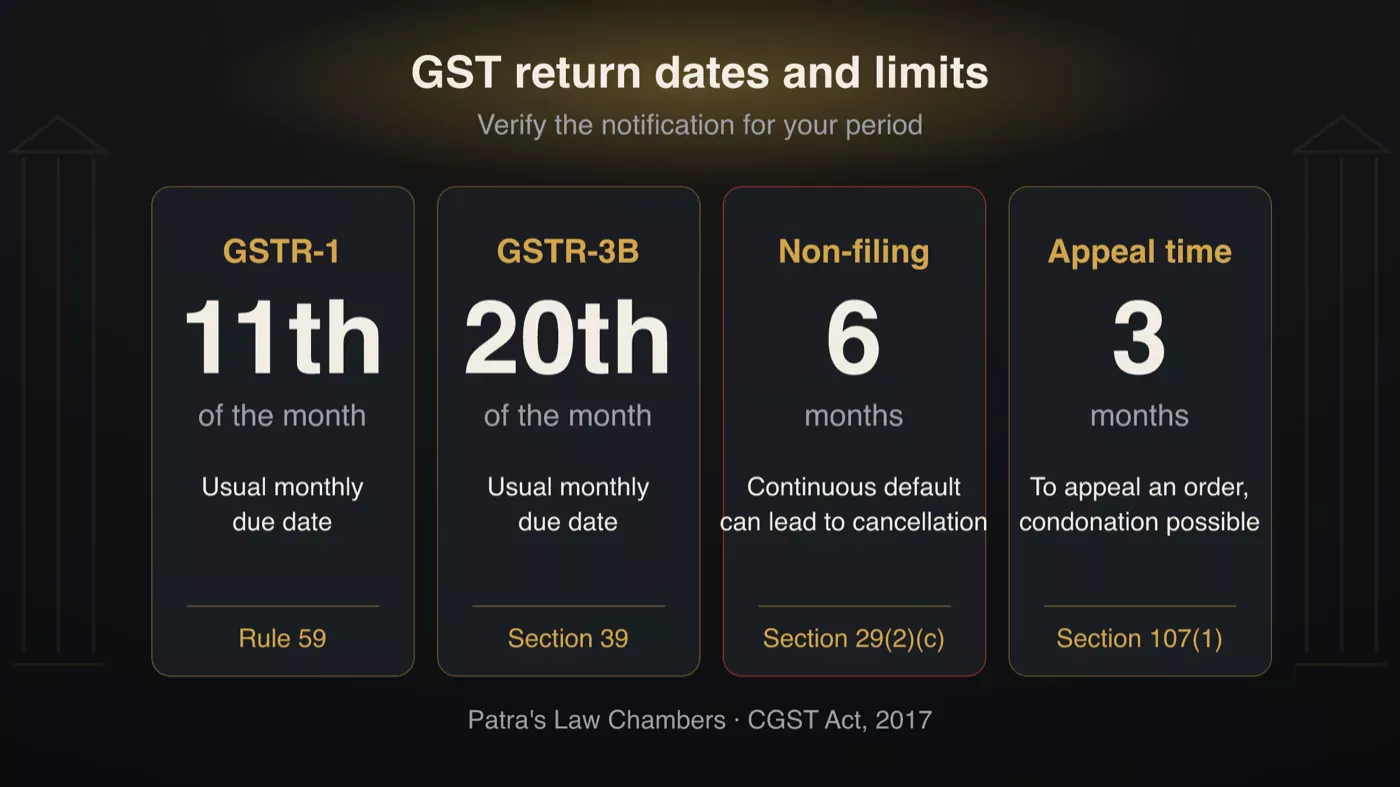
GST time limits that decide your options
These are the statutory periods most often involved when returns are missed or an order is passed.
Short explainers from Adv. Sudip Patra
More short explainers on our YouTube channel: Patra’s Law Chambers on YouTube ↗
Which GST return problem are you facing?
Pick the situation closest to yours to see the usual forum and the usual next step. This is general information, not advice on your file.
Choose one of the options above.
How a GST return cycle runs, and what follows a default
A registered business normally moves through these stages. Due dates can change by notification, so always verify on the official portal.
Invoices, credit notes and purchase bills are matched to your books. Clean records at this stage prevent most later mismatches.
Section 37 requires details of outward supplies. Quarterly filers under the QRMP scheme follow a different schedule, so verify yours on the portal.
Tax is paid through cash and credit ledgers, and input tax credit is claimed subject to section 16. Late payment attracts interest under section 50.
Section 44 requires an annual return, with reconciliation (GSTR-9C) where the law applies it. Where a notice follows, our GST notice advocate page explains the next steps.
Non-filing can lead to a GSTR-3A notice, a section 62 assessment and, later, cancellation. An order can be challenged under section 107, as covered on the GST appeal page.
Where a statutory remedy is not effective or a clear jurisdictional error appears, a writ may be considered. See Calcutta High Court matters for the forum.
Three GST return points people often mix up, tap a card
No. GSTR-1 reports your outward supplies invoice-wise, while GSTR-3B is the summary return through which tax is paid. They are meant to reconcile, and mismatches often draw notices.
Yes, if you are a registered person with no transactions, the return is still due. A nil return carries a smaller late fee, but ignoring it can still lead to cancellation under section 29.
No. Section 16(4) sets a time limit for claiming credit, tied to a date in November after the financial year. Verify the exact date for the year in question before relying on it.

Returns, notices and appeals: where we help
Monthly returns: GSTR-1 and GSTR-3B
We help you reconcile sales, tax liability and input tax credit before a return is filed. We also help correct mistakes in the next return where the law allows. The aim is to keep GSTR-1, GSTR-3B and the GSTR-2B statement consistent, so that fewer mismatches reach the department.
Annual return GSTR-9 and reconciliation GSTR-9C
The annual return consolidates the year’s figures. Where the turnover threshold applies, a reconciliation statement in Form GSTR-9C is also required. We help you prepare the data and check the figures against the books. Please verify the threshold and the due date for the year concerned.
Late fee, interest and registration cancellation
Missed returns attract a late fee and interest, and continued default may lead to a show-cause notice for cancellation of registration. We advise on the dues, on reply to the notice, and on an application for revocation of cancellation where the law permits it.
Notices, orders and appeals
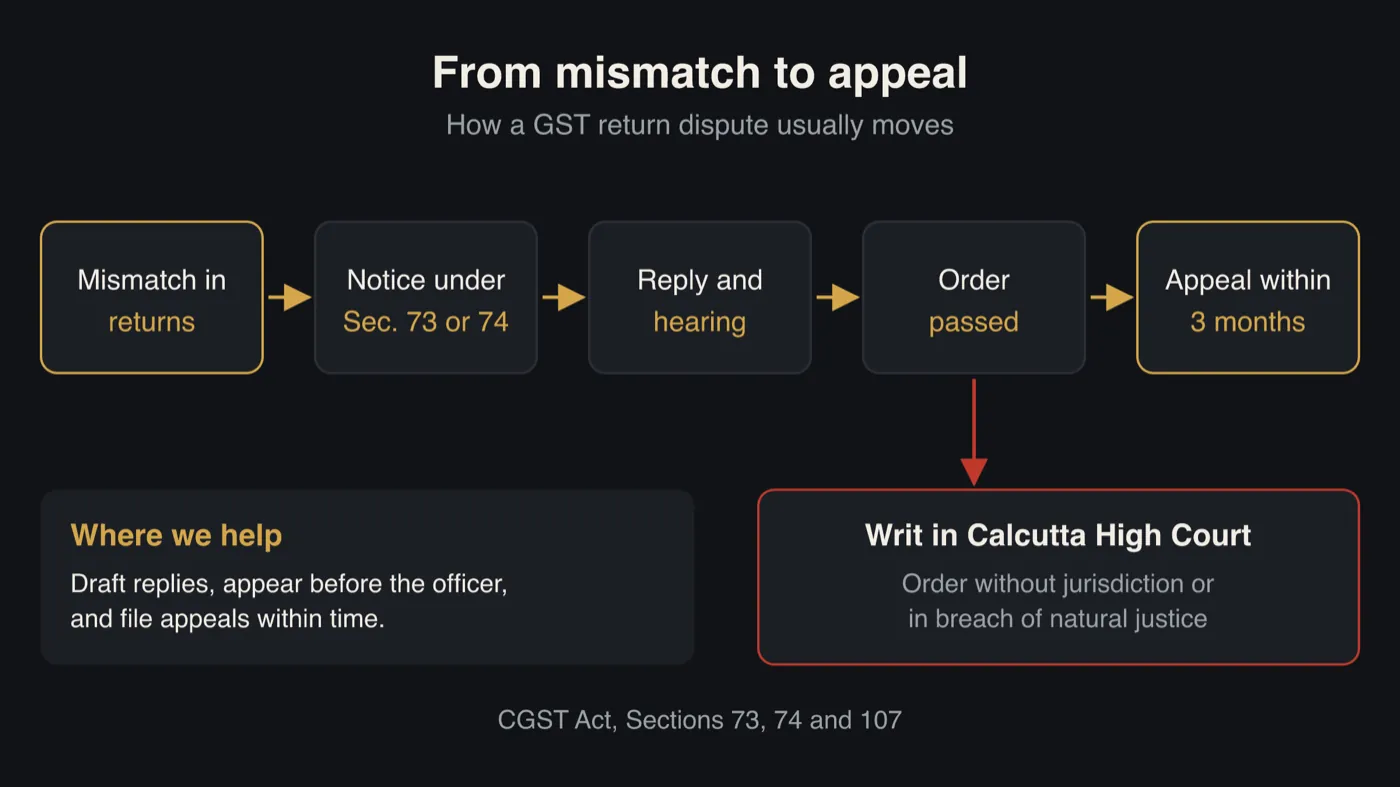
A mismatch in returns often ends in a demand notice. We draft replies, appear before the proper officer, and file appeals within time. Where required, we move the Calcutta High Court in writ jurisdiction against an order passed without jurisdiction or in breach of natural justice.
What the chambers can do for a taxpayer
- Review of past returns and mismatches in GSTR-1, GSTR-3B and GSTR-2B
- Advice on registration, amendment and cancellation matters
- Replies to show-cause notices and demand orders
- Appeals and representation before appellate forums
- Writ petitions in the High Court in suitable cases
- Advice on penalties, interest and late fee, to be verified against the current notifications
What the courts have said about GST returns
Your GST returns are your own assessment of your tax, and courts expect them to be right and on time. These decisions show when a mistake can still be corrected and when the law shuts the door.
2021
GSTR-3B cannot be rewritten later on your own
The Supreme Court set aside a Delhi High Court order that had let the company correct its GSTR-3B returns for July to September 2017 and claim a refund of about Rs. 923 crore. It held that GSTR-3B is a self-assessment return, that GSTR-2A only helps with that assessment, and that a taxpayer cannot correct a return on its own outside the time the law allows.
2022
Portal reopened for TRAN-1 and TRAN-2
Deciding a batch of about 400 appeals, the Supreme Court told GSTN to reopen the common portal for two months so that taxpayers could file or revise TRAN-1 and TRAN-2 to claim transitional credit. This applied to every taxpayer, whether or not they had gone to court. When the portal fails a taxpayer, the courts can step in.
2025
Honest GSTR-1 errors can be corrected
The Bombay High Court had allowed a supplier to correct clerical errors in GSTR-1 after the deadline, because the errors caused no loss of revenue and the buyer’s input tax credit depended on them. The Supreme Court declined to interfere. It said software limits are no reason to refuse a correction and asked CBIC to look again at rigid timelines for honest mistakes.
2022
Registration cancelled for non-filing can be restored
The registration had been cancelled because returns were not filed for six months in a row. The Madras High Court allowed it to be restored on conditions: file all pending returns, pay the tax, interest, penalty and late fee, and accept that any input tax credit for that period will be checked by an officer. Later Madras benches have often followed this order.
2023
Section 16(4) time limit on ITC upheld
The Patna High Court upheld section 16(4) of the CGST Act, which bars input tax credit claimed after the time limit. It held that the provision does not breach Article 19(1)(g) or Article 300A of the Constitution. An appeal against this judgment is pending before the Supreme Court, where notice was issued in January 2024, so check its current status before relying on it.
How GST returns are filed, month by month and year by year
Collect invoices and report sales in GSTR-1
Monthly filers report outward supplies in GSTR-1 by the 11th of the next month. Small taxpayers under the QRMP scheme file it every quarter and may upload B2B invoices through IFF. Each GSTIN, invoice number and tax amount must be correct, because your buyers’ input tax credit depends on these details.
Match your purchases with GSTR-2B
GSTR-2B is a fixed statement of the input tax credit your suppliers have reported for you. Compare it with your purchase register before claiming any credit. Under section 16(2)(aa) of the CGST Act, credit is generally available only when the supplier has reported the invoice.
File GSTR-3B and pay the tax
GSTR-3B is the summary return that sets off input tax credit against output tax. Any balance is paid in cash through the electronic cash ledger. Monthly filers file by the 20th of the next month. QRMP filers file by the 22nd or 24th after the quarter, depending on their State.
Pay interest and late fee on any delay
Tax paid late attracts interest under section 50 of the CGST Act. A return filed late attracts a late fee under section 47. The portal works out the late fee when you file the delayed return. Interest is charged on the tax paid late, so work it out and pay it to avoid a later demand.
File the annual return GSTR-9, and GSTR-9C where required
The annual return under section 44 is due by 31 December after the end of the financial year. It is optional for taxpayers with turnover up to Rs. 2 crore, as notified. Above Rs. 5 crore, a self-certified reconciliation statement in GSTR-9C is also required.
Reply in time if a notice arrives
Differences between GSTR-1, GSTR-3B and GSTR-2B often lead to scrutiny notices in ASMT-10 or demand notices under section 73 or 74. Reply within the time given, with reconciliations and documents. For a reply or an appeal, talk to a GST notice advocate.
From a missed return to cancellation
Continued non-filing can lead step by step to these consequences.
Return missed
The due date passes, and interest and late fee start to run.
Notice in GSTR-3A
The officer asks you to file the return within the time given.
Best-judgment assessment
If you still do not file, tax can be assessed under section 62.
Registration action
Suspension or cancellation may follow under section 29.
Appeal or revocation
You can appeal under section 107 or seek revocation under section 30.
Interest on GST paid late, section 50 of the CGST Act (18% a year on tax paid late; 24% a year on input tax credit wrongly availed and utilised, section 50(3))
Common GST return mistakes that lead to notices
Claiming credit from your books instead of GSTR-2B Credit the supplier has not reported is usually refused, with interest. Reconcile with GSTR-2B every month before you file GSTR-3B.
Thinking a wrong GSTR-3B can be fixed whenever you like In Bharti Airtel the Supreme Court held that GSTR-3B is a self-assessment return that cannot be corrected on your own at any time. Correct the error in a later return within the time section 39(9) allows.
Not filing in months with no sales A nil return is still required. Six months of non-filing can lead to cancellation of registration under section 29, and restoring it means filing every pending return and paying all the dues.
Leaving old returns pending for years Since the Finance Act, 2023, sections 37(5), 39(11) and 44(2) of the CGST Act bar filing a return more than three years after its due date. Late input tax credit also runs into the time limit in section 16(4).
Speak to the chambers about your GST return or notice
If you have missed a return, received a notice about a mismatch, or want your returns reviewed by an advocate, you can book a consultation at our Kolkata or Delhi office. Please bring the returns filed, the notice or order, if any, and your GST registration details. We will explain the legal position and the options before you decide the next step. Outcomes depend on the facts and the law, and nothing here is a promise of result.
Book a ConsultationEstablished by a distinguished alumnus of IIT Kharagpur, Patra’s Law Chambers stands as a beacon of legal expertise in Kolkata & Delhi. Know more →

Kolkata Office
NICCO House, 6th Floor, 2 Hare Street
Kolkata-700001 (Near Calcutta High Court)
Delhi Office
4455/5, First Floor, Gali Shahid Bhagat Singh
Main Bazar Road, Paharganj, New Delhi-110055
Contact
[email protected]
+91 890 222 4444 / +91 7003 715 325
GSTR-1 and GSTR-3B side by side
They are filed by the same taxpayer but serve different purposes.
Frequently asked questions about GST return filing
Regular taxpayers file GSTR-1 for outward supplies and GSTR-3B as the summary return with payment, usually every month. They also file an annual return in GSTR-9. Composition and QRMP taxpayers follow different schedules, so verify yours.
Late filing attracts interest under section 50 on unpaid tax and a late fee under section 47 for each day of delay, up to a cap. The amounts depend on the return type and turnover, so check the portal.
It is a notice under section 46 and Rule 68 asking you to file a return you have missed, usually within 15 days. If you still do not file, the officer can assess your liability under section 62.
Yes. Section 29(2)(c) allows cancellation where a registered person has not filed returns for the prescribed period, which is six continuous months for a regular taxpayer. Revocation under section 30 may be possible, within the time allowed.
GST has no general revision of a filed return. Errors are corrected through amendments in a later return or GSTR-1 within the limits in sections 37 and 39(9). Check the time limit before acting.
No. The reconciliation statement applies only where the law and notifications require it for that year and turnover. Self-certified reconciliation may be accepted now, so verify the current position for your year.
You can reply to the proper officer with documents, and if an order follows, file an appeal under section 107 within the time allowed. Our GST notice page explains the process in plain terms.
No. GST returns are filed on the GST portal under the CGST Act, while income tax returns are filed under the Income-tax Act. For income tax matters, see our income tax page.