Filing of e-Form INC-20A: Declaration of Commencement of Business
A company with share capital that was incorporated after 2 November 2018 must file e-Form INC-20A within 180 days of incorporation. Until it does, it should not commence business or exercise borrowing powers. Here is who must file, what the form needs, what a delay can cost and how our chambers assists.
What is e-Form INC-20A and who must file it?
e-Form INC-20A is the declaration required by Section 10A of the Companies Act, 2013. It applies to a company that has a share capital and was incorporated after 2 November 2018. A director, or another officer authorised by the Board, declares that every subscriber to the memorandum has paid the value of the shares agreed to be taken. The declaration is made to the Registrar of Companies (ROC) through the MCA portal. A company without share capital, such as a Section 8 company limited by guarantee, is not covered by this requirement. Please verify your own company’s category before relying on this.
The declaration must be filed within 180 days of incorporation. A company that has not filed should not commence business or exercise borrowing powers. Verification of the registered office under Section 12(2) must also be on record with the ROC. The form is filed with the company’s digital signature and a professional’s certificate, so the supporting papers should be in order before the filing window closes. The statutory text and current form requirements are available on the Ministry of Corporate Affairs website. Our comprehensive legal services for business page explains how we handle the wider post-incorporation compliance.
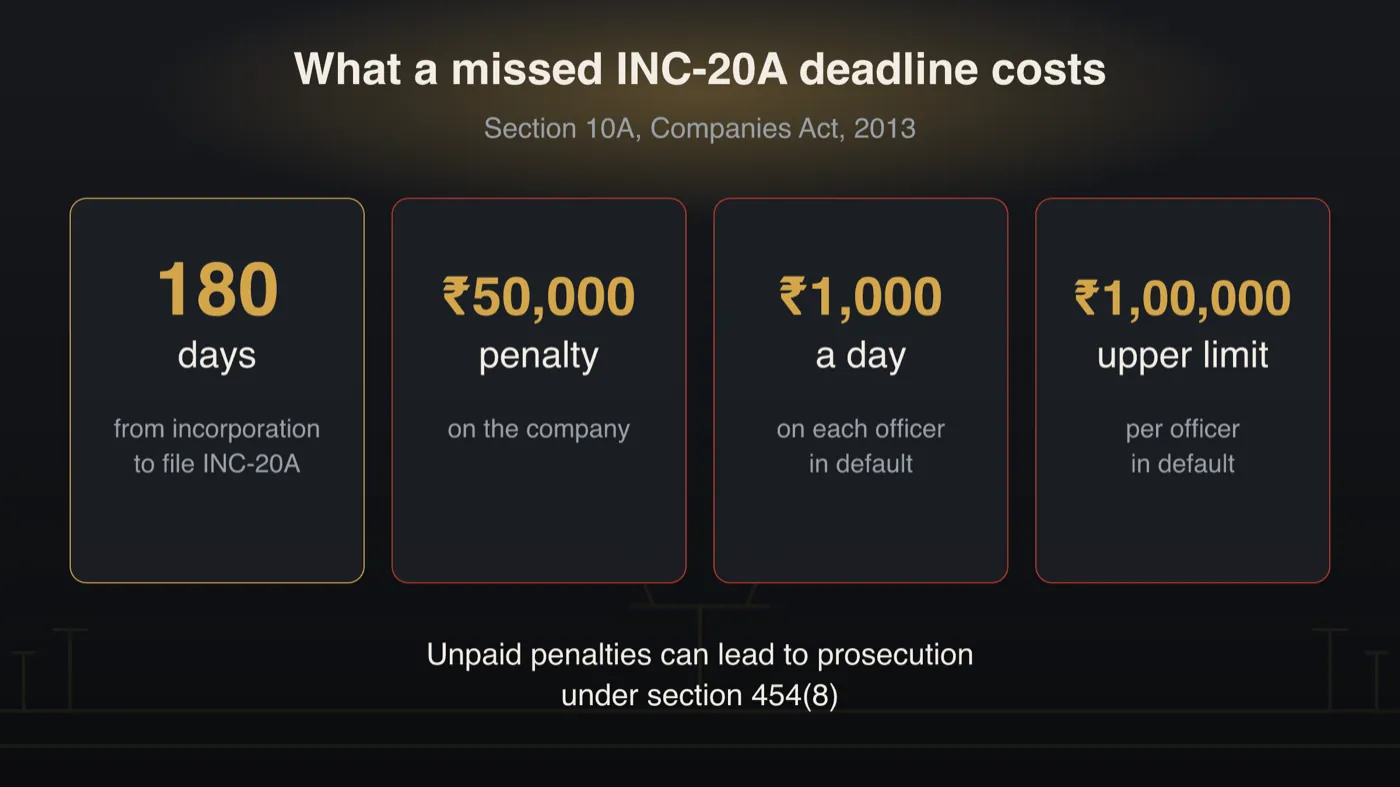
The time limits around INC-20A at a glance
These periods run from different starting points, so check each date against the certificate or the notice you hold.
Videos from Adv. Sudip Patra
More short explainers on our YouTube channel: Patra’s Law Chambers on YouTube ↗
Which of these describes your company today?
Section 10A of the Companies Act, 2013 applies only to companies that have share capital and were incorporated on or after 2 November 2018. This is general information, not advice. Pick the closest situation to see the usual next step.
Choose one of the options above.
From incorporation to a compliant INC-20A
A typical order of work for a newly incorporated company that has share capital. Dates run from the date on the certificate of incorporation.
The Registrar issues the certificate and the 180-day clock under section 10A starts. Note the date and keep the certificate, PAN and the memorandum and articles together.
Section 12(2) requires the company to verify its registered office through e-Form INC-22 within 30 days of incorporation. A business compliance checklist helps keep these early filings in order.
Each subscriber to the memorandum pays the value of the shares agreed to be taken. The payment should go into the company’s bank account so that the statement can be used as proof.
The Board authorises the filing and a director verifies the declaration. The form must be digitally signed, and a practising professional’s certification is also required, so check the current MCA requirements.
File e-Form INC-20A with the attachments and the prescribed fee, then keep the SRN and the filing acknowledgment. Until it is filed, section 10A(1) bars commencing business or exercising borrowing powers.
File the delayed form and expect a penalty under section 10A(3). If the ROC has already begun strike-off, a company may need tribunal help in NCLT to revive its name.
Three things people often get wrong, tap a card
Section 10A applies to a company having a share capital that was incorporated on or after 2 November 2018. Companies incorporated before that date, and companies without share capital, are outside it.
The form is a declaration by a director that the subscribers have paid for their shares. It is not a licence or registration, and it does not replace GST, shop or other business registrations.
Section 10A(3) provides a penalty on the company and on each officer in default. Section 10A(2) also lets the Registrar consider removing the company’s name if it appears not to be carrying on business.
How our chambers assists with INC-20A and related company compliance
Document review before filing
We read the certificate of incorporation, the memorandum and articles, the share subscription details and the bank record of the subscription money. We check that every subscriber has actually paid and that the registered office verification under Section 12(2) is on file, before the form is prepared.
Preparing and filing e-Form INC-20A
We prepare the declaration, arrange the Board resolution and the required certification, and file it on the MCA portal within the statutory window. We also keep a copy of the filing acknowledgement with your company records.
Delayed filings and penalty exposure
If the 180 days have passed, we assess the delay, explain the penalty position for the company and the officers in default, and prepare the late filing. We do not promise any outcome on penalty, as the amount follows the statute and the facts of each company.
Strike-off and revival questions
A company that has not commenced business may face removal of its name from the register under Section 248. Where a name has already been struck off, revival is a matter for the tribunal. Our NCLT advocate page explains that route.
Papers usually needed for INC-20A
- Certificate of incorporation issued by the Registrar of Companies
- Bank statement or bank certificate showing receipt of the subscription money from every subscriber
- Board resolution authorising the filing of the declaration
- Proof of registered office, for the Section 12(2) verification where not already filed
- PAN of the company and digital signature of the director or authorised officer
- Memorandum and articles, with the list of subscribers and shares taken
What the High Courts have said on an INC-20A default
Few court rulings deal directly with section 10A, so most INC-20A disputes are decided in Registrar of Companies adjudication orders. These two High Court decisions, both checked against reported text, show how courts have treated a strike-off and an unpaid penalty.
2023
Running company restored on depositing the penalty
The Registrar struck off three companies under section 248(5) because the section 10A declaration was not filed. The companies were still running, so the Court did not send the petitioner to the NCLT. It restored their names once Rs. 1 lakh per company was deposited as a pro tem penalty under section 10A(2). The Court said its order should not be treated as a precedent.
2025
No prosecution while the penalty appeal is pending
The Registrar penalised the company and its directors for filing INC-20A late, then filed a criminal complaint under section 454(8) while their appeal under section 454(5) was still pending. The High Court quashed the complaints as premature. When an appeal is filed, a complaint can be made only 90 days after the appellate order. The Registrar may proceed afresh once the appeal is decided.
How e-Form INC-20A is filed under section 10A
Collect the subscription money
Every subscriber to the memorandum pays the full value of the shares they agreed to take into the company’s bank account. Keep the bank statement or bank certificate showing each payment. INC-20A cannot be filed without this proof. The duty applies to companies with a share capital incorporated on or after 2 November 2018.
Check registered office and approvals
Make sure the registered office is in place and verified under section 12. If the business needs a licence or registration from a sector regulator, such as RBI registration for an NBFC, get it first. That approval must also be attached to the form.
Prepare and certify the form
A director fills in INC-20A on the MCA V3 portal, attaches the proof of subscription, and signs it with a Digital Signature Certificate. A practising Company Secretary, Chartered Accountant or Cost Accountant certifies it. Read the current form instructions on the MCA portal before you upload.
File within 180 days
Upload the form and pay the fee within 180 days of the date in the Certificate of Incorporation. Until it is filed, the company must not start any business or use its borrowing powers under section 10A(1). Keep the SRN and the challan for your records.
If the deadline is missed
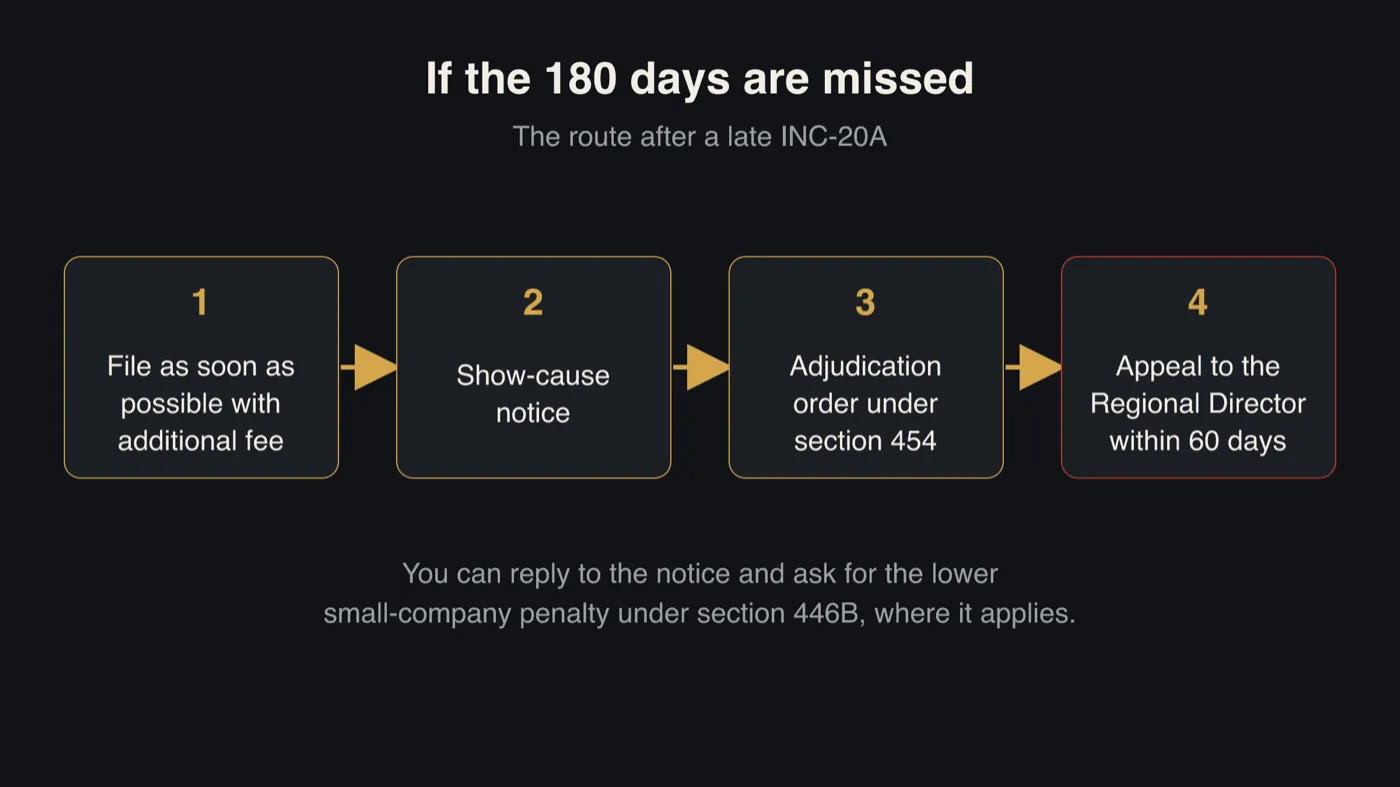
File as soon as possible with the additional fee. Expect a show-cause notice and an adjudication order under section 454. You can reply, ask for the lower penalty for small companies under section 446B where it applies, and appeal to the Regional Director within 60 days of the order.
Before and after filing INC-20A
Section 10A(1) draws a clear line around what the company may do on each side of the filing.
Mistakes that turn a simple filing into a penalty or a strike-off
Starting business or borrowing before filing Section 10A(1) bars a new company from starting business or exercising borrowing powers until the declaration is filed. Contracts and loans taken before then put the company and its officers in default.
Assuming the late fee is the only cost Late filing brings a penalty of Rs. 50,000 on the company and Rs. 1,000 a day on each officer in default, up to Rs. 1,00,000 each, under section 10A(2). Unpaid penalties can lead to prosecution under section 454(8).
Ignoring the Registrar's strike-off notice Under section 248(1)(c), the Registrar can strike off a company that has not filed this declaration within 180 days. Restoring it then takes an appeal to the NCLT under section 252, so speak to an NCLT advocate early.
Filing without proper proof of subscription Bank entries that do not match each subscriber’s name and amount can lead to the form being sent back for resubmission. Get the bank certificate right before you file, and plan the related post-incorporation filings with the firm’s business legal services.
Discuss your company's INC-20A filing
If your company was incorporated after 2 November 2018 and you are not sure whether INC-20A has been filed, or the 180 days have already passed, bring the incorporation papers and bank record to a consultation. We will check the position under Section 10A, explain the filing steps and the possible consequences of delay in plain terms, and tell you what the law allows. Every matter depends on its own facts, so no result can be promised.
Book a ConsultationEstablished by a distinguished alumnus of IIT Kharagpur, Patra’s Law Chambers stands as a beacon of legal expertise in Kolkata & Delhi. Know more →

Kolkata Office
NICCO House, 6th Floor, 2 Hare Street
Kolkata-700001 (Near Calcutta High Court)
Delhi Office
4455/5, First Floor, Gali Shahid Bhagat Singh
Main Bazar Road, Paharganj, New Delhi-110055
Contact
[email protected]
+91 890 222 4444 / +91 7003 715 325
How a strike-off usually unfolds
Non-filing of INC-20A can lead the Registrar down this route under section 248, if it believes the company is not carrying on business.
INC-20A not filed
The 180 days under section 10A(1) pass without a declaration.
Registrar's reasonable cause
Under section 10A(2), the Registrar may believe the company is not carrying on business.
Notice to the company
A notice under section 248 asks the company to show cause.
Public notice and strike-off
If there is no satisfactory reply, the name may be removed and notified.
Restoration before NCLT
An aggrieved person may apply under section 252, generally within three years.
Frequently asked questions on e-Form INC-20A
Under section 10A of the Companies Act, 2013, a company having a share capital and incorporated on or after 2 November 2018 must file it. The filing is due within 180 days of incorporation. Check your company’s date of incorporation and its capital structure.
Section 10A(3) provides a penalty of ₹50,000 on the company. Every officer in default faces ₹1,000 for each day the default continues, subject to the cap in the section, which I understand to be ₹1,00,000. Verify the current wording before relying on it.
Usually the certificate of incorporation, a bank statement or bank certificate showing the subscription money received, the Board resolution authorising the filing, and the company’s PAN. The form must also be digitally signed, so check the current MCA requirements.
No. Section 10A(1) says a company shall not commence any business or exercise borrowing powers until the declaration is filed. Until then, the company should not start trading or borrow funds.
The form can still be filed, but the delay can attract the section 10A(3) penalty. The Registrar may also take action if the company seems inactive. Filing sooner is generally better than waiting for a notice.
Yes. Section 12(2) requires verification of the registered office through e-Form INC-22 within 30 days of incorporation. It is a separate filing from INC-20A and is easy to miss, so track both dates from the incorporation certificate.
Section 248 allows the Registrar to remove a name in certain cases. Section 252 allows an aggrieved person to apply to the NCLT, generally within three years of the order. Verify the dates and grounds from the order itself.