Trademark Renewal in India: Keep Your Brand Protected, Before It Lapses
A registered trademark in India is protected for 10 years and can be renewed for further periods of 10 years each. Patra’s Law Chambers prepares and files renewal applications, tracks them at the Trade Marks Registry, and advises on restoration where a mark has already expired.
What is trademark renewal, and why does the date matter?
Under Section 25 of the Trade Marks Act, 1999, a trademark is registered for 10 years from the date of application. Renewal extends that protection for a further 10 years, counted from the date the earlier period expires. There is no limit on the number of renewals, so a mark in continuous use can remain on the register indefinitely, provided each renewal is filed in time. The procedure and fees are set by the Trade Marks Rules, 2017, and the filing is made with the Trade Marks Registry. The official portal is IP India.
The renewal date is easy to miss because it is counted from the filing date, not the date the certificate was issued. If renewal is not filed, the Registrar can remove the mark from the register once the prescribed time and the surcharge period have passed. A removed mark may still be restored on application, but that adds cost and uncertainty, and another person may meanwhile have applied for a similar mark. Brand owners should therefore note the expiry date, check it against the register, and file well ahead of time. Our Patent and IP filing services page explains the other intellectual property work we handle.
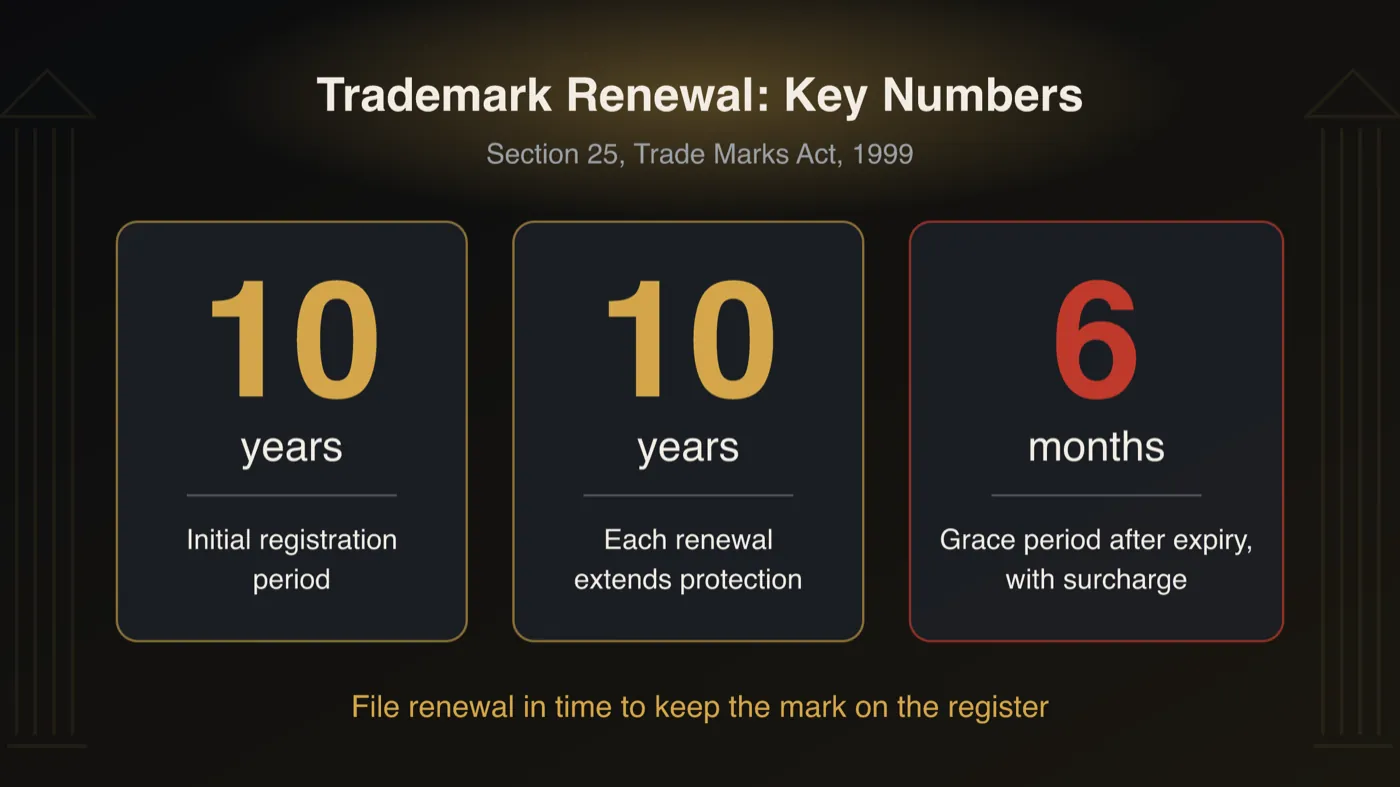
The three time periods every trademark owner should know
These periods decide whether a mark is renewed normally, renewed late, or has to be restored.
Videos from Adv. Sudip Patra
More short explainers on our YouTube channel: Patra’s Law Chambers on YouTube ↗
What is the position of your trademark today?
Pick the option closest to your situation. This is general information on the Trade Marks Act, 1999, not advice on your mark. Check the dates on your registration certificate and on the Trade Marks Registry’s online record.
Choose one of the options above.
How a trademark renewal moves from start to finish
Most renewals are simple, but each step has a date attached. Missing one can cost a surcharge or the registration itself.
Confirm the registration number, class, date of registration, owner details and the date to which the mark stands renewed. Correct any mismatch in the owner’s name or address before renewal.
The renewal application is made on Form TM-R with the prescribed fee for each class. The Registry also sends a renewal notice before expiry, but the proprietor should not wait for it.
Filing and paying on time avoids a surcharge. The fee depends on the mode of filing and the number of classes, so verify the current fee schedule on the Registry website before paying.
If the date is missed, renewal is still possible for a limited period after expiry with an additional fee. Use this route only if the date has already passed.
Section 25(3) allows restoration and renewal of a removed mark after six months and within one year from expiry. Restoration is a more involved filing. A trademark lawyer can help (trademark advice in Kolkata).
Once the Registrar renews the mark, the register shows the new expiry date, 10 years on. Keep the acknowledgement and the updated record with your other business legal documents.
Three things owners often miss, tap a card
A registration runs for 10 years from the date of registration, and each renewal adds another 10 years (Section 25). Count from the registration date, not from the date the certificate was received.
If the owner, company name or address has changed, the Registry record should be corrected. A mismatch can cause objections to the renewal application.
A removed mark can be restored if the application is made after six months and within one year of expiry (Section 25(3)). Past that date, a fresh application may be the only option.
Trademark renewal and related services
Renewal filing
We check the registration details and expiry date, prepare the renewal application, pay the prescribed fee for the class, and file it with the Trade Marks Registry. We then track the application to the renewal certificate and update your records.
Expired or removed marks
If the grace period has passed and the mark has been removed from the register, restoration may still be possible on application with the prescribed fee. We review the facts and tell you honestly whether restoration is worth pursuing. Results depend on the Registrar’s decision.
Register clean-up
Renewal is often the right time to correct errors or update details such as the proprietor’s name or address. Where records need changing, we prepare the rectification or change application so that the register reflects the current position.
Protecting a renewed mark
A mark that stays on the register can be enforced against infringement and passing off. We advise on notices and proceedings in the appropriate court, including the Calcutta High Court where the matter requires it.
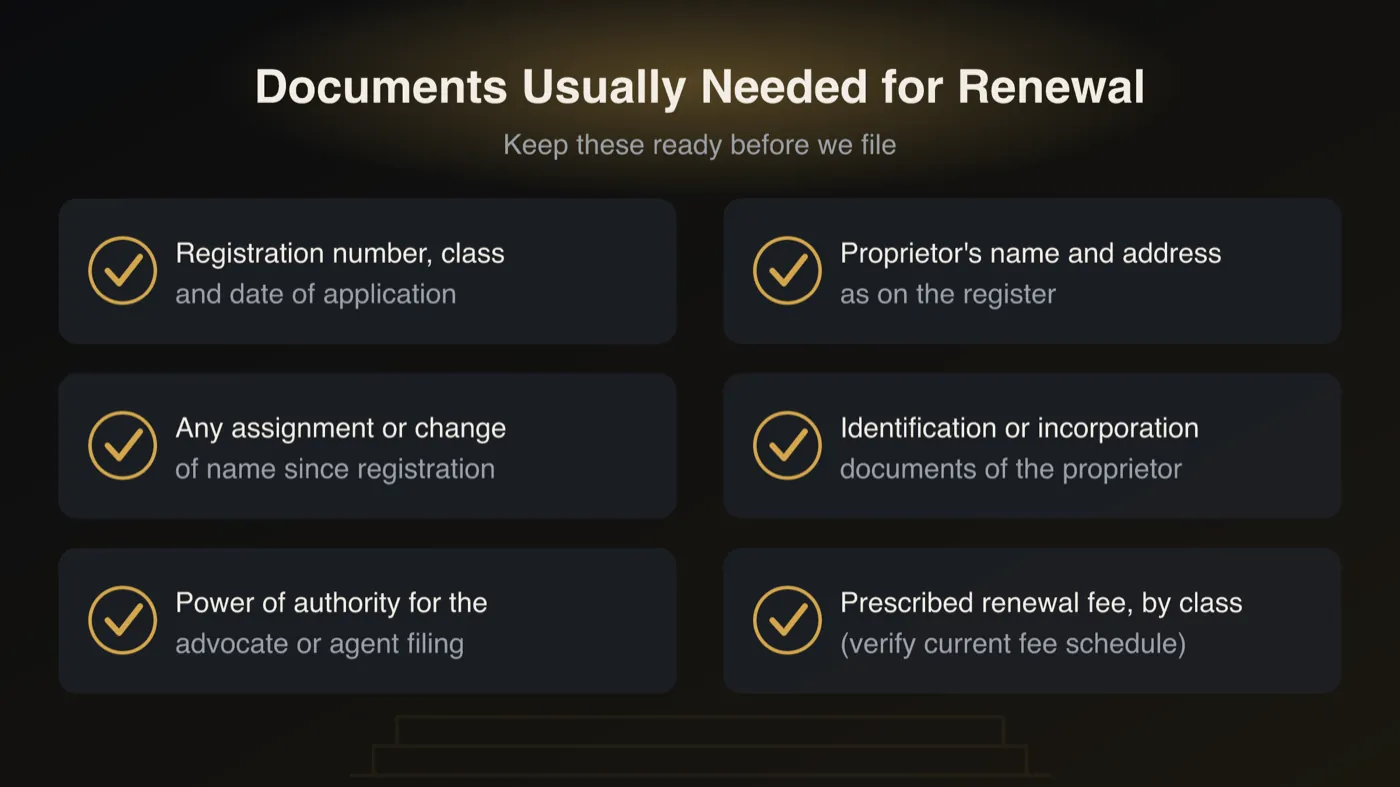
Documents usually needed for renewal
- Registration number, class and date of application of the trademark
- Name and address of the registered proprietor, as on the register
- Details of any assignment or change of name since registration
- Identification or incorporation documents of the proprietor
- Power of authority for the advocate or agent filing the application
- Payment of the prescribed renewal fee (verify the current fee schedule for the class)
What the courts say about trademark renewal and removal notices
Under Section 25 of the Trade Marks Act, 1999, a lapsed registration can be saved more often than owners think, because the High Courts treat the Registrar’s renewal notice as compulsory. Each decision below was checked against published reports. Read them with the full text before you rely on them, and for advice on a particular mark see our trademark and copyright lawyer page.
2012
No removal without Section 25(3) notice
The Delhi High Court held that the Registrar cannot remove a registered trademark for non-renewal without first sending the proprietor the notice required by Section 25(3). A removal made without that notice is bad in law, and the mark has to be restored. The Division Bench upheld this view on appeal, and later courts follow it as the starting point.
2018
Owner not punished for Registry's lapse
The surcharge for late renewal was paid after the six-month grace period, but the Registrar had not followed the notice and advertisement steps in Section 25 and the Rules. The Division Bench upheld the single judge’s finding that the renewal was valid. The proprietor cannot lose a registration because the Registry did not follow the statute.
2024
Delay alone cannot defeat renewal
The owner found years later that its marks showed as lapsed, though no Section 25(3) notice had ever been issued. The Division Bench held that without that notice the marks were never validly removed, so the right to renew survived. The Registrar could not refuse renewal just because the application came long after expiry.
2024
Registrar told to decide renewal promptly
Following Motwane, the Bombay High Court allowed renewal of the VOMISET mark well past the usual deadline because the statutory notice had not been received. The court directed the Registrar to decide the pending renewal applications within four weeks. Where the notice is missing, the court will both allow the renewal and set a date for the Registry to act.
2025
Form O-3 notice is a mandatory precondition
The Delhi High Court ordered the MILTON mark (Class 9) restored to the register. It held that issuing a Form O-3 notice under Section 25(3), read with the Trade Marks Rules, must happen before a mark can be removed for non-renewal. A removal made without that notice is illegal, and the mark goes back on the register.
How a trademark is renewed under Section 25 of the Trade Marks Act, 1999
Check the expiry date and the record
A registration lasts 10 years and can be renewed for further periods of 10 years each (Section 25(1) and (2)). Look up the mark on the IP India portal. Confirm the expiry date, the class or classes, and that the owner’s name and address on the register are correct, because the Registrar’s notice goes to that address.
File the renewal request in Form TM-R
The renewal application can be filed in the period before expiry that the Trade Marks Rules allow, with the official fee for each class. Filing online on the IP India portal gives an instant receipt. Check the current fee in the official schedule before filing.
Watch for the Registrar's Form O-3 notice
Before the registration expires, the Registrar has to send the registered owner a notice of the expiry date and the conditions for renewal (Section 25(3)). If you receive this notice, act on it at once. If the mark is later removed and no notice was ever sent, keep a record of that fact.
Use the six-month grace period with surcharge
If the renewal was not filed before expiry, it can still be filed within six months after expiry by paying the renewal fee plus the prescribed surcharge. If the application is made within that time, Section 25(3) says the Registrar shall renew the registration.
Apply for restoration if the mark was removed
Once a mark has been removed for non-renewal, Section 25(4) lets the Registrar restore it and renew it if the application is made in Form TM-R within one year of expiry, on payment of the fee. Restoration is at the Registrar’s discretion, so explain the delay in writing and verify the time limit before filing.
Approach the High Court if no notice was sent
If the time limits have passed but the Registry never issued the Form O-3 notice, a writ petition or an IP petition before the High Court can seek restoration and renewal, following the decisions above. Ask the Registry for the dispatch record. Courts have given relief where the Registry could not prove the notice was sent.
Renewing on time compared with renewing late
The same mark is easier and safer to protect when the renewal is filed before expiry.
Common mistakes that put a trademark renewal at risk
Leaving an old address on the register The Form O-3 notice goes to the address on record. If that address is out of date and the notice was properly sent there, a court may presume it was served, and the ‘no notice’ argument then fails.
Assuming the grace period has no limit The six-month surcharge period and the one-year restoration window under Section 25 are firm limits. The court decisions on missing notices help only where the Registry did not follow the procedure, not where the owner simply forgot.
Renewing only some of the classes Renewal is filed and paid for each class. If one class is left out, protection for those goods or services can lapse while the rest of the registration stays alive.
Ignoring a removal notice in the Trade Marks Journal Removal of a mark for non-renewal is published in the Trade Marks Journal. Not checking the Journal, or not acting quickly once a removal appears, gives someone else room to apply for a similar mark. Every month of delay also makes restoration harder to justify.
Check your renewal date before it passes
If you are unsure when your trademark expires, or it has already lapsed, send us the registration number and the class. We will check the status on the register and explain the options in plain terms. Where a business has several marks or other compliance needs, see our business legal services. Fees and timelines are confirmed after we see your records, and we make no promise about the outcome of any application.
Book a ConsultationEstablished by a distinguished alumnus of IIT Kharagpur, Patra’s Law Chambers stands as a beacon of legal expertise in Kolkata & Delhi. Know more →

Kolkata Office
NICCO House, 6th Floor, 2 Hare Street
Kolkata-700001 (Near Calcutta High Court)
Delhi Office
4455/5, First Floor, Gali Shahid Bhagat Singh
Main Bazar Road, Paharganj, New Delhi-110055
Contact
[email protected]
+91 890 222 4444 / +91 7003 715 325
Checklist for a trademark renewal
Have these ready so Form TM-R can be filed without delay.
Take them from the registration certificate or the Registry’s online record.
Count 10 years from the date of registration, and verify it against the register.
Check the name, constitution and address of the registered proprietor.
Keep the assignment, merger or name-change paper if the owner is not the original applicant.
The application must be signed by the proprietor or an authorised agent.
Check the current fee on the Registry website before paying.
Frequently asked questions about trademark renewal in India
A registered trademark is valid for 10 years from the date of registration (Section 25(1), Trade Marks Act, 1999). Renew it before that period ends, inside the window the Trade Marks Rules, 2017 allow. Verify the opening date of that window on the Registry website.
If the mark is not renewed on time, it can be removed from the register, and the exclusive rights under registration are lost. A late renewal with a surcharge is allowed for a limited period after expiry. Restoration may still be possible within one year.
Yes. Renewal is made on Form TM-R before the expiry date. The Rules allow it a period in advance, and the older six-month window has changed over the years, so verify the current window. Filing well before the date leaves time to correct any objection.
There is a limited period after expiry when renewal is still accepted with a surcharge, generally six months. After it, the mark may be removed. Section 25(3) allows restoration after six months and within one year of expiry. Verify the dates on the Registry record.
The registration may be removed from the register. You then lose the statutory remedy for infringement of a registered mark, and others may apply to register a similar mark. Common-law passing off may still be available, depending on your actual use.
Usually the registration number and date, the details of the registered proprietor, Form TM-R, and the fee. Where the owner has changed, proof of the change is also needed. Confirm the exact requirements for your mark before filing.
Yes. A registered trademark can be renewed for successive periods of 10 years each, with no overall limit, so long as each renewal is made on time and the fee is paid.
Renewal under Section 25 does not turn on proof of use. A mark that has not been used for a long period can, however, face a non-use challenge (cancellation or removal) under Section 47 by another party. Keep records of use.