SIR Tribunal Appeal Advocate in West Bengal
Received a notice for a “logical discrepancy”, found your name unmapped, or had an objection rejected in the Special Intensive Revision? Patra’s Law Chambers, Kolkata, helps you understand the notice, prepare documents and put your case before the SIR Appellate Tribunals. Every matter turns on its own facts, and no outcome can be promised.
SIR tribunal appeal in West Bengal: what an appeal involves
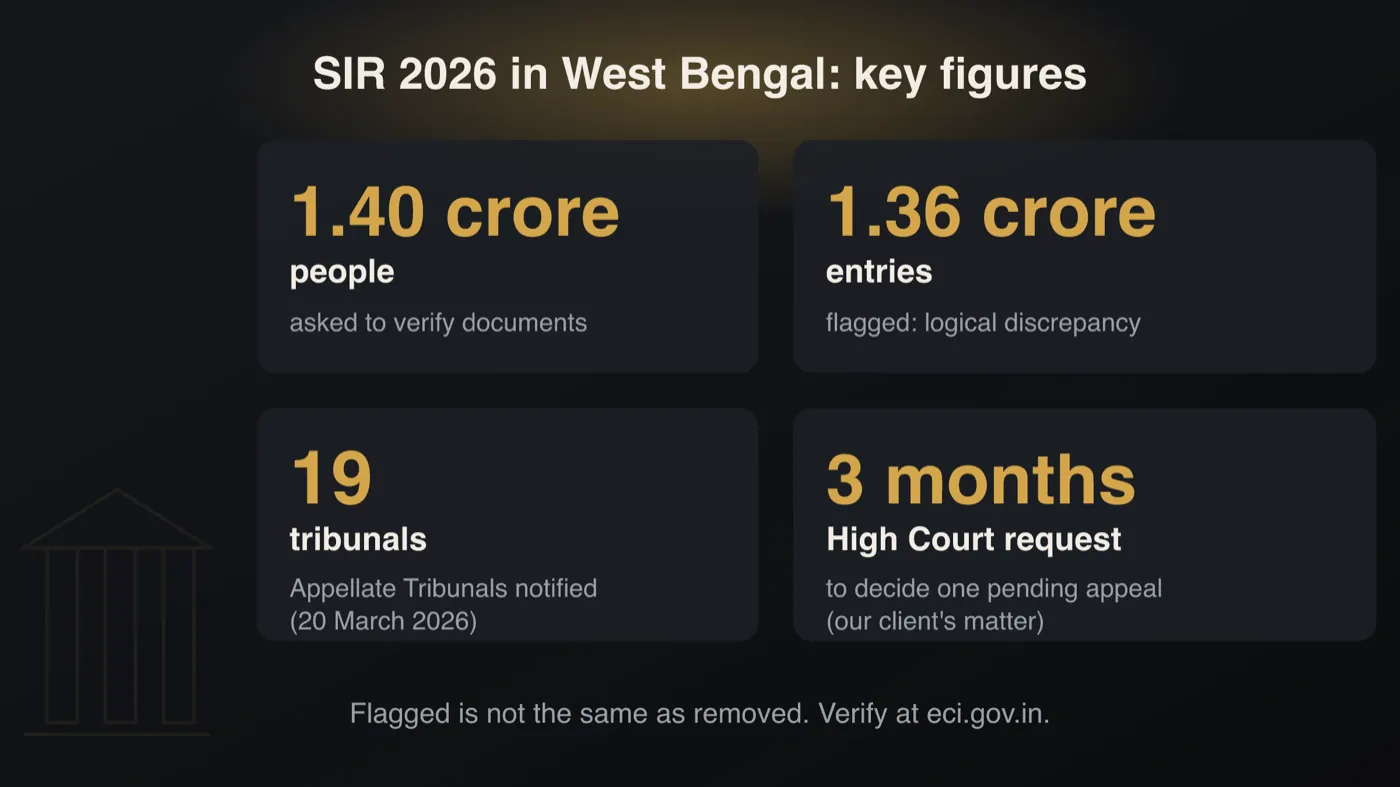
The Special Intensive Revision (SIR) 2026 in West Bengal has led to roughly 1.40 crore people being asked to verify documents. Voters have been grouped as mapped (linked with the 2002 SIR), unmapped (not linked), or flagged for a “logical discrepancy”, a category of about 1.36 crore entries where the data showed internal inconsistencies. Being flagged is not the same as being removed, but the next step must be handled with care and on time. The official position, forms and notices are published by the Election Commission of India, and every client should verify the latest notification there.
The Election Commission has notified 19 Appellate Tribunals across West Bengal, presided over by former Chief Justices and senior Judges of the High Court. An affected person may be heard in person or through an authorised representative, and the absence of stated reasons for a rejection can be raised as a ground. Our work is to read the notice, identify the actual discrepancy, assemble the documents the Court has accepted, such as the Madhyamik (Class-10) Admit Card and Pass Certificate as proof of birth, and present the appeal clearly. Read our guide to the Special Intensive Revision in West Bengal for the background, and our Calcutta High Court advocate page if your matter needs a writ petition.
From notice to High Court at a glance
The usual path of an SIR matter, from first notice to the last forum.
Notice or flag
Document verification, unmapped or logical discrepancy.
Hearing before the officer
You or your authorised representative show documents.
Order on your name
Ask for a copy and check whether reasons are stated.
Appellate Tribunal appeal
File on ECI NET or with the DM, SDM or SDO and keep the receipt.
Calcutta High Court
For long delay or a tribunal rejection, subject to the grounds and time limits.
Short explainers from Adv. Sudip Patra
More short explainers on our YouTube channel: Patra’s Law Chambers on YouTube ↗
Which SIR paper or status have you received?
Pick the option closest to your situation to see the forum and the usual next step. This is general information, not legal advice, and each case turns on its own papers.
Choose one of the options above.
How an SIR matter moves in West Bengal
This is the usual order of events. Details can change with Election Commission notifications and Supreme Court directions, so verify the latest position for your case.
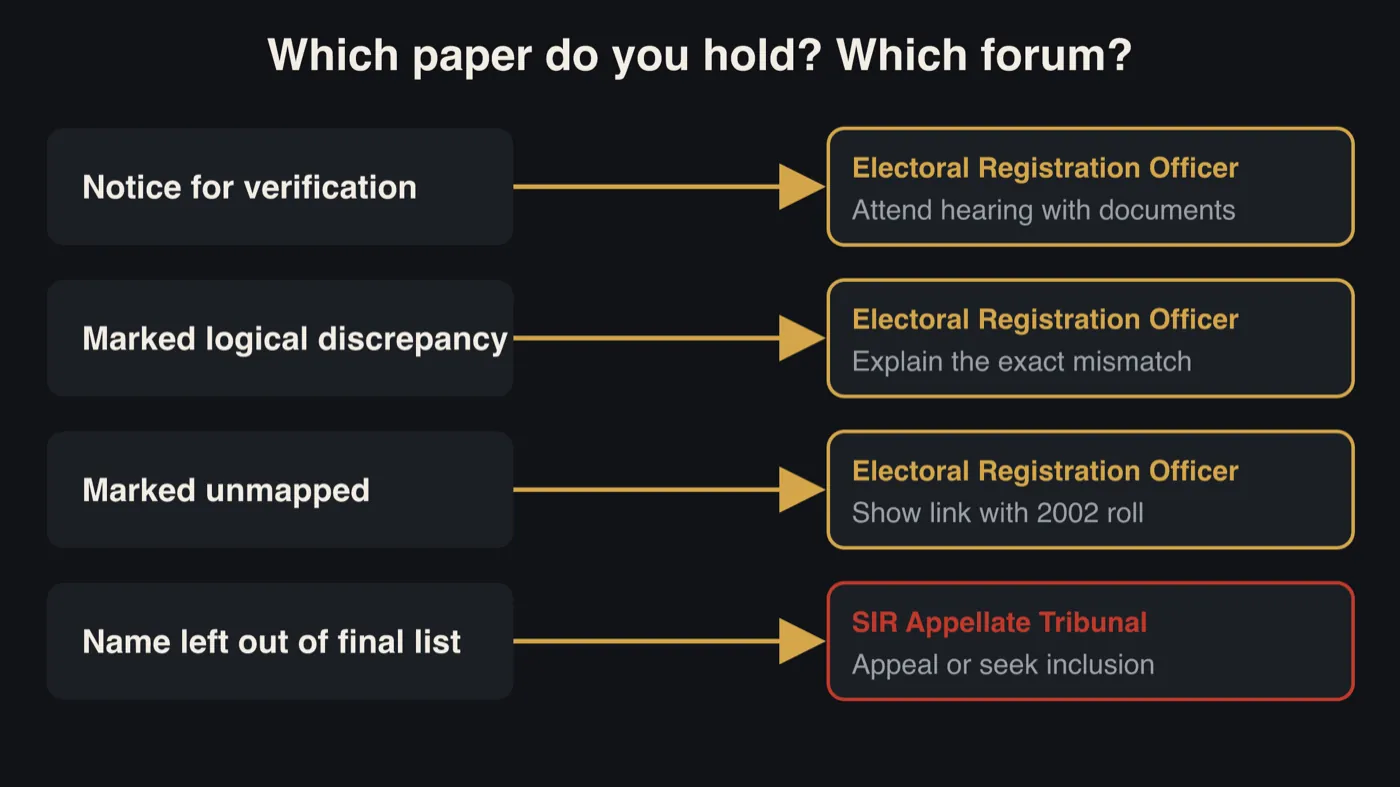
You are called for document verification, or your record is marked ‘unmapped’ or as a ‘logical discrepancy’. Keep every notice and note the date you received it.
You are heard in person or through an authorised representative. Documents such as the Madhyamik Admit Card and Pass Certificate are accepted as proof of birth, and other documents may be accepted under Election Commission notifications.
The officer decides whether your name stays on the list. If the order is against you, ask for a copy and check whether it states reasons.
The Election Commission has notified 19 Appellate Tribunals in West Bengal. Appeals can go online through ECI NET or in writing to the DM, SDM or SDO, where you should get a receipt. The steps are set out in our guide to SIR tribunal rejections and appeal in the High Court.
If the appeal is pending for long, a writ petition may ask for early disposal. A tribunal rejection may also be taken to the High Court. See our Calcutta High Court advocate page for how such matters are handled.
Three things voters often get wrong, tap a card
No. A logical discrepancy flag only says the data looks inconsistent. You still get a chance to explain and show documents.
Not so. An affected person may be heard through an authorised representative, who should carry written authority.
Usually the tribunal decides that. In a writ for early disposal the High Court may only request the tribunal to decide the appeal within a time, without ruling on the deletion.

How we assist in SIR tribunal appeals and electoral-roll matters
Appeals against rejection
We study the rejection order, check whether reasons were recorded, and prepare the appeal with the documents on record. Appeals can be filed online through the ECI NET platform or physically at the DM, SDM or SDO office, with a receipt kept.
Logical discrepancy notices
Mismatched parents’ names, unusual age gaps between generations, or more than six progeny can trigger a flag. We identify which discrepancy applies to you and what documentary explanation is available.
Name deletion and correction
If your name has been deleted, left unmapped or entered wrongly, we advise on how to seek inclusion or correction, including the supplementary list and continuous verification process described by the Supreme Court.
Early disposal of pending tribunal appeals
If your appeal against deletion has been pending for some time, we assess whether a writ petition asking for a time-bound decision suits your facts. In one matter the Court requested the tribunal to decide preferably within three months. Results depend on each case.
SIR tribunal website, list, address, how to apply and documents
- Website and list: the Election Commission notified 19 Appellate Tribunals in West Bengal; check the Election Commission of India and the Chief Electoral Officer, West Bengal, for the current list and verify before travelling.
- Address: tribunal locations can change, so confirm the address of your tribunal in the official notification before you go.
- How to apply: file online through ECI NET, or in writing at the office of the DM, SDM or SDO, and keep a signed receipt or acknowledgment.
- Documents to submit: your notice and the adverse order, EPIC, Aadhaar (accepted as proof of identity, not citizenship), the Madhyamik Admit Card with Pass Certificate for date of birth and parentage, and papers linking you to the 2002 roll.
- Step-by-step help: read how to appeal before the SIR Appellate Tribunals and our guide to SIR tribunal rejections and appeal in the High Court.
Supreme Court rulings that shape an SIR tribunal appeal in West Bengal
These decisions set the rules on fair hearing before a name is deleted, the reasons an order must carry, and the documents an SIR Appellate Tribunal may accept. Each is on electoral-roll revision, so your appeal can rely on it. Read them with the latest Supreme Court orders.
1995
No deletion on suspicion without a hearing
The Supreme Court held that the Electoral Registration Officer cannot delete a name already on the roll only on suspicion or a police report. The voter must get a fair chance to be heard and to produce documents, and the officer must decide on their own. In 2026 the Court read this as a rule of fair procedure. It does not stop a revision.
1978
An order stands on its own reasons
A Constitution Bench held that an order made by a statutory authority must be judged by the reasons written in it. The authority cannot add fresh reasons later by affidavit or otherwise. In an SIR appeal, an exclusion or rejection order that gives no reasons, or only vague ones, can be questioned on this ground before the Appellate Tribunal.
2026
Former High Court judges hear exclusion appeals
In the West Bengal SIR case, the Supreme Court directed that appeals against exclusion and deletion go to Appellate Tribunals of former High Court Chief Justices and Judges. The Election Commission notified 19 tribunals on 20 March 2026. Later orders allowed out-of-turn hearings where urgency is shown, and gave liberty to approach the Calcutta High Court or the tribunals with pending grievances.
2026
Class-10 admit card supports date of birth
The Court clarified that the Madhyamik (Class-10) admit card, which shows the date of birth, may be taken together with the pass certificate to check both age and parentage. The admit card adds to the pass certificate and does not replace it. Bring both papers to the hearing or attach both to the appeal.
2025
Aadhaar accepted as the twelfth document
In the Bihar SIR challenge, a Bench of Justices Surya Kant and Joymalya Bagchi directed the Election Commission to accept Aadhaar as a twelfth document, along with the eleven already listed. Aadhaar proves identity, not citizenship, and the Commission may check whether a card is genuine. The Court called this an interim order.
2026
SIR upheld; fair procedure still required
The Supreme Court upheld the Election Commission’s power to conduct the Special Intensive Revision and held that the exercise meets the proportionality test. It read Lal Babu Hussein as requiring fair procedure for each voter, not as a bar on verification. So an appeal should rest on documents and on fair-procedure grounds, not on a challenge to the SIR itself.
How to apply to the SIR Tribunal: website, address and documents
Read the order and note the date
Get a copy of the order that excluded or deleted your name, or rejected your claim. Note the date you received it and check whether it gives reasons. A missing or vague reason is a ground the Appellate Tribunal can look at. Keep the original notice, the order and any hearing slip together.
Find your tribunal on the official website
The Election Commission has notified 19 SIR Appellate Tribunals in West Bengal. Check the current list, addresses and the districts each one covers on the Chief Electoral Officer, West Bengal website or the notice of the Election Commission of India. Check again before you travel, as arrangements can change.
Collect the documents to submit
Usually you need the order you are appealing against, your EPIC (voter card), proof of identity such as Aadhaar, and proof of age and parentage such as the Madhyamik admit card with the pass certificate. Add any paper that explains the flagged discrepancy, for example a parent’s name or an age gap. Keep self-attested copies.
File online or in writing, and keep the receipt
You can file the appeal online through the ECI NET platform, or in writing at the office of the DM, SDM or SDO. For a paper filing, ask for a dated receipt or acknowledgment. Our step-by-step SIR appeal guide explains each field.
Attend the hearing, in person or through a representative
You may be heard in person or through an authorised representative who carries your written authority. Under the Supreme Court’s orders, the tribunal may give an out-of-turn hearing where you show real urgency. Explain the discrepancy simply and point to the document that answers it.
If the appeal is delayed or rejected
If your appeal has been pending for a long time, or the tribunal rules against you, the Calcutta High Court may be asked to request an early decision or to examine the order. Read our guide to SIR tribunal rejections and appeal in the High Court and check the position for your own case.
Papers to keep ready for an SIR appeal
Check your own notice, as the list of accepted documents can change.
Keep the original and note the date you received it.
The Madhyamik (Class-10) Admit Card and Pass Certificate have been highlighted by the Supreme Court.
It shows your existing entry on the roll.
It proves when and where the appeal was filed.
For example, documents that clear a parents’ name mismatch.
Needed if someone appears for you.
Common mistakes in an SIR tribunal appeal
Filing without a receipt. A paper appeal handed in at the DM, SDM or SDO office without a dated acknowledgment is hard to trace later. The receipt is also the first document needed if you later ask the High Court for an early decision.
Sending the admit card alone. The Supreme Court said the Madhyamik admit card goes with the pass certificate and does not replace it. Attach both, and keep the originals ready for the hearing.
Not answering the actual discrepancy. A general appeal that does not deal with the specific flag, such as a parent’s name mismatch or an unusual age gap, leaves the tribunal with nothing to correct. Name the discrepancy and match each one to a document.
Relying on unofficial tribunal lists. Addresses and jurisdiction lists passed around on social media may be out of date. Use the Chief Electoral Officer, West Bengal or Election Commission notification, and check before you travel.
Talk through your SIR notice or tribunal appeal
If you have an SIR notice, an adverse order or an appeal pending before an Appellate Tribunal, bring the papers and the date you received them. We will read the notice, explain the forum and time limits, and tell you which documents matter. This is general information, not a promise of any result; each matter is assessed on its own facts, and you should verify the current Election Commission notification for your case.
Book a ConsultationEstablished by a distinguished alumnus of IIT Kharagpur, Patra’s Law Chambers stands as a beacon of legal expertise in Kolkata & Delhi. Know more →
Kolkata Office
NICCO House, 6th Floor, 2 Hare Street
Kolkata-700001 (Near Calcutta High Court)
Delhi Office
4455/5, First Floor, Gali Shahid Bhagat Singh
Main Bazar Road, Paharganj, New Delhi-110055
Contact
[email protected]
+91 890 222 4444 / +91 7003 715 325
Tribunal appeal or High Court writ
The two forums do different jobs in an SIR matter.
Frequently asked questions about SIR tribunal appeals in West Bengal
Appeals can be filed online through the ECI NET platform, or in writing at the office of the DM, SDM or SDO. For a physical filing, obtain a formal receipt or acknowledgment. Check the official tribunal list for the right tribunal.
The Election Commission has notified 19 Appellate Tribunals across West Bengal. Use the official notification, the ECI website or the website of the Chief Electoral Officer, West Bengal, for current locations. Verify before travelling, as arrangements can change.
The Supreme Court has highlighted that the Madhyamik (Class-10) Admit Card and Pass Certificate are valid proof of birth for these proceedings. Other documents may also be accepted under Election Commission notifications. Check the list in your notice.
It is a flag for data that looks inconsistent. Examples are a mismatch in parents’ names, an age gap between parent and child of more than 50 years, grandparents’ age gaps under 40 years, or more than six progeny.
Yes. Affected persons may be heard through an authorised representative. This helps where a ‘logical discrepancy’ needs a clear explanation backed by documents. The person who appears should carry written authority.
The Supreme Court has clarified that the lack of stated reasons for rejection is a valid ground to raise before the Appellate Tribunal. Keep a copy of the order and the date you received it.
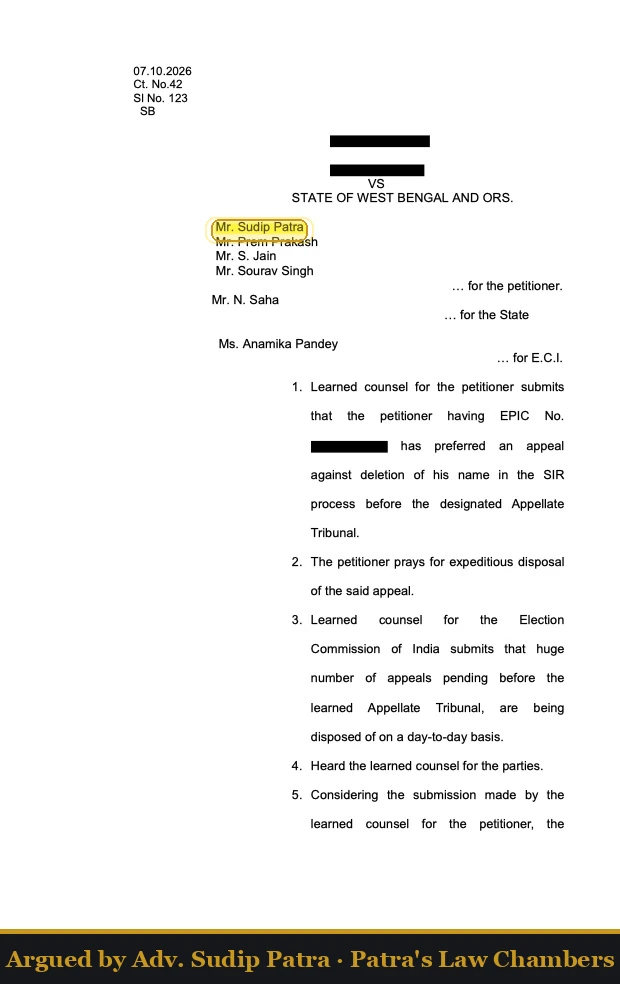
If an appeal has been pending for long, a writ petition may be filed in the Calcutta High Court for early disposal. In one matter argued by Adv. Sudip Patra, the Court requested the tribunal to decide preferably within three months, without ruling on the deletion. Results depend on facts.
A tribunal order may be taken to the High Court. The grounds and time limits depend on the order, so read it carefully. Our guide on appeal in the High Court covers the usual route.