Detailed guidelines on how to appeal in West Bengal SIR Appellate Tribunals 2026
Creditor and contributor of this article:
Patra’s Law Chambers:
About Us:
Patra’s Law Chambers is a law firm with offices in Kolkata & Delhi, offering comprehensive legal services across various domains. Established in 2020 by Advocate Sudip Patra (Advocate, Supreme Court of India & Calcutta High Court) an alumnus of the Prestigious Rajiv Gandhi School of Intellectual Property Law, IIT Kharagpur ,with Post Graduate diploma in Business Law from IIM Calcutta, the firm specializes in Civil, Criminal, Writs,High Court Matters, Trademark, Copyright, Company, Tax, Banking, Property disputes, Service law, Family law, and Supreme Court matters.You can know more about us in here
Kolkata Office:
NICCO HOUSE, 6th Floor, 2, Hare Street, Kolkata-700001 (Near Calcutta High Court)
Delhi Office:
House no: 4455/5, First Floor, Ward No. XV, Gali Shahid
Bhagat Singh, Main Bazar Road, Paharganj, New Delhi-110055
Website: www.patraslawchambers.com
Email: [email protected]
Phone: +91 890 222 4444/ +91 7003 715 32
Resources: detailed notification of the Election Commission of India.pdf
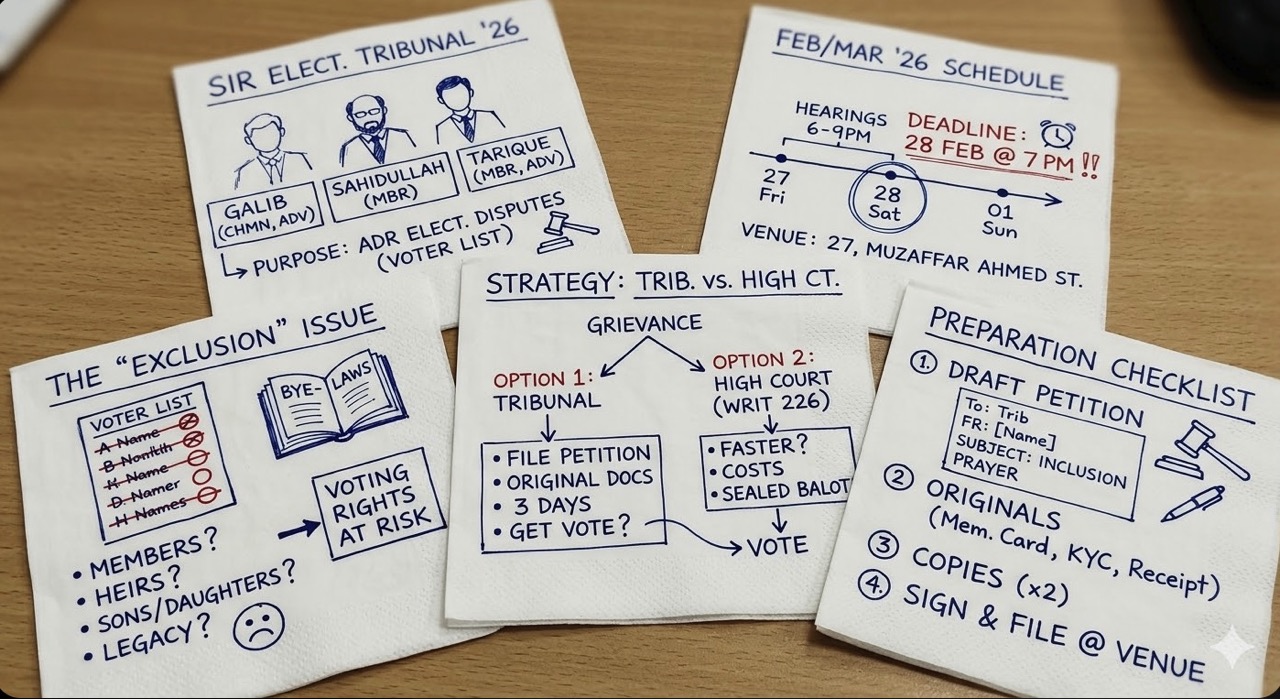
This exhaustive report provides a professional-grade overview of the 2026 Special Intensive Revision (SIR) Appellate Tribunals in West Bengal. It covers the constitutional mandate, the detailed list of 19 tribunals and their presiding judges, the procedural roadmap for filing appeals, the evidentiary standards for documentation, and critical legal insights regarding the exclusion of family units and the viability of writ jurisdictions to expedite hearings.
The 2026 Legislative Assembly elections in West Bengal are being conducted under the shadow of one of the most significant administrative and judicial interventions in the history of Indian electoral management. The Special Intensive Revision (SIR) of electoral rolls, initiated by the Election Commission of India (ECI) following complex litigation in the Supreme Court of India, has transitioned from a routine administrative update into a massive quasi-judicial exercise.1 At the heart of this transition is the establishment of 19 Appellate Tribunals, mandated by the Supreme Court to provide a final recourse for millions of citizens whose names were omitted during the preliminary and adjudication phases of the revision.3 This report delineates the structural, procedural, and legal dimensions of these tribunals, offering a comprehensive guide for legal professionals, political stakeholders, and aggrieved petitioners.
The Genesis and Constitutional Imperative of SIR 2026
The Special Intensive Revision (SIR) 2026 was necessitated by perceived and documented inaccuracies in the existing voter database, which had not undergone a full intensive revision in over two decades.5 Unlike a Summary Revision (SR), which relies largely on voluntary applications for inclusion or deletion, an SIR involves a 100% physical verification strategy where Booth Level Officers (BLOs) visit every household to identify eligible electors and remove ineligible ones.7 The 2026 exercise in West Bengal was particularly fraught with controversy due to the initial deletion of over 58 lakh names and the subsequent placement of 60 lakh cases in a state of “Under Adjudication”.7
The judicialization of this process began when the Supreme Court of India, in the matter of Mostari Banu v. Election Commission of India (W.P. Civil No. 1089/2025), identified a “trust deficit” between the state administration and the ECI.10 To bridge this gap, the Court invoked its plenary powers under Article 142 of the Constitution, directing that judicial officers—rather than purely executive officials—oversee the adjudication of claims and objections.11 This led to the deployment of over 700 judicial officers, including approximately 200 drawn from the neighbouring states of Jharkhand and Odisha, to ensure impartiality and legal rigor in the revision process.13
Ambit and Structural Organization of the SIR Appellate Tribunals
The Appellate Tribunals were formally constituted through Notification No. 39/WB/2026 (SIR), dated March 20, 2026, issued by the Election Commission of India.3 This notification followed a Supreme Court order dated March 10, 2026, which recommended that the decisions of judicial officers acting as Electoral Registration Officers (EROs) should be appealable to an independent judicial body rather than an administrative superior.4 These tribunals are single-member bodies presided over by former High Court judges and Chief Justices, ensuring that the highest level of legal scrutiny is applied to electoral disputes.16
Geographical Jurisdiction and Presiding Authorities
The ECI has established 19 distinct tribunals to cover the 23 districts of West Bengal. The distribution of these tribunals reflects the volume of adjudication cases in each region, with specific emphasis on high-density areas and districts with significant numbers of rejected claims.
| S. No. | Name of Appellate Authority (Mr./Ms.) | Assigned District(s) / Jurisdiction |
| 1 | T.S. Sivagnanam, former Chief Justice | 24-Parganas North (AC-Wise) & Kolkata |
| 2 | Pradipta Ray, former Judge | 24-Parganas North (AC-wise) |
| 3 | Tapen Sen, former Judge | Purba Medinipur |
| 4 | Pranab Kumar Deb, former Judge | Coochbehar |
| 5 | Prabhat Kumar Dey, former Judge | Purba Bardhaman |
| 6 | Raghunath Ray, former Judge | Nadia |
| 7 | Ashoke Kumar Dasadhikari, former Judge | Howrah |
| 8 | Dipak Saha Ray, former Judge | Darjeeling, Kalimpong, Jalpaiguri and Alipurduar |
| 9 | Anindita Roy Saraswarti, former Judge | Paschim Medinipur & Jhargram |
| 10 | Toufique Uddin, former Judge | Dakshin Dinajpur |
| 11 | Indrajit Chatterjee, former Judge | Murshidabad (AC wise) |
| 12 | Ranjit Kumar Bag, former Judge | 24-Parganas South |
| 13 | Samapti Chatterjee, former Judge | Hooghly |
| 14 | Md. Mumtaz khan, former Judge | Purulia and Bankura |
| 15 | Mir Dara Sheko, former Judge | Paschim Bardhaman |
| 16 | Debi Prosad Dey, former Judge | Uttar Dinajpur |
| 17 | Biswajit Basu, former Judge | Murshidabad (AC wise) |
| 18 | Manojit Mondal, former Judge | Birbhum |
| 19 | Siddhartha Roy Chowdhury, former Judge | Malda |
The tribunals are headquartered in the respective districts, with administrative support provided by the District Election Officers (DEOs) and the Chief Electoral Officer (CEO) of West Bengal.17 For Kolkata-based appeals, the documents and hearings are traditionally centered around major administrative buildings such as the Jessop Building or the Survey Building in Gopal Nagar.18
Procedural Protocols for Filing Petitions
The procedure for moving a petition before the SIR Appellate Tribunal is designed to be accessible yet rigorous, adhering to the framework provided by Rule 27 of the Registration of Electors Rules, 1960.7 A petitioner must understand that the window for filing these appeals is critically linked to the publication of the supplementary electoral rolls.
Timeline and Filing Mechanism
Appeals may only be filed once the supplementary electoral roll is published.16 In the context of the 2026 election, the first supplementary list is scheduled for publication on Monday, March 23, 2026, which will incorporate approximately 27 lakh cases that have successfully passed judicial adjudication.15
Petitions can be moved through two primary channels:
- Online (ECI NET Platform): Petitioners are encouraged to use the electronic filing system via ecinet.eci.gov.in. This portal allows for the digital submission of the appeal memorandum and supporting documentation, providing a trackable reference number for the appellant.17
- Physical Filing: For those unable to access digital services, appeals can be filed physically at the offices of the District Magistrate (DM), Sub-Divisional Magistrate (SDM), or Sub-Divisional Officer (SDO).3 These administrative offices act as receiving centers and are legally mandated to ensure the digitisation and uploading of the appeal onto the ECI NET platform “at the earliest” to facilitate remote review by the presiding judge.16
Content of the Appeal Petition
An effective petition before the tribunal must clearly articulate the grounds for inclusion. It should not merely be a plea for mercy but a structured legal argument demonstrating that the ERO or the designated judicial officer erred in their assessment of the evidence provided during the preliminary revision phase.10 The petition must include:
- The unique serial number or part number of the voter in the draft or previous rolls.
- A copy of the order of rejection passed by the judicial officer (if available) or details of the notice received during the Logical Discrepancy (LD) phase.4
- Specific rebuttal to the grounds of exclusion (e.g., proving residency if marked as “Shifted” or proving existence if marked as “Dead”).9
Evidentiary Standards and Required Documentation
The Supreme Court has issued strict guidelines on the types of documents that must be accepted by the tribunals and adjudicating officers. This was done to prevent administrative arbitrariness and ensure that the “burden of proof” does not become an insurmountable barrier to the franchise.12
Primary and Indicative Documents
The following table summarizes the core documentation recognized by the ECI and the Supreme Court for the purposes of the West Bengal SIR 2026.
| Document Type | Specific Requirement / Usage | Legal Basis |
| Aadhaar Card | Accepted as proof of identity across all categories. | SC Order in Mostari Banu.8 |
| Madhyamik Admit Card | Used for verifying date of birth and parentage. | SC Clarification dated Feb 25, 2026.13 |
| Madhyamik Pass Certificate | Must ideally be presented along with the Admit Card for birth proof. | SC Clarification dated Feb 25, 2026.23 |
| EPIC (Old) | Essential for “Mapped Voters” to show previous registration. | ECI SIR Instructions.6 |
| Form 6 / Declaration | Mandatory for new inclusions; must include the signed declaration. | ECI Form Requirements.7 |
| Government ID / PPO | Identity proof for regular employees or pensioners of PSUs/Govt. | ECI Indicative List.22 |
The Supreme Court specifically emphasized that documents received on or before February 14, 2026, must be considered, even if they were not successfully uploaded to the ECINet portal due to technical disruptions reported by the Calcutta High Court.10
The Role of Advocates and Authorized Representation
The SIR process acknowledges that the complexity of quasi-judicial hearings can be overwhelming for individual citizens. Therefore, the framework allows for several levels of representation.11
Legal Counsel and Booth Level Agents
Advocates are permitted to represent petitioners before the 19 Appellate Tribunals. Their role is to argue the legal merits of the case, ensure that the prescribed documents are admitted into evidence, and challenge any procedural lapses by the EROs.11
Additionally, the ECI allows for representation by Booth Level Agents (BLAs) appointed by recognized political parties.5 A BLA can submit documents and raise objections on behalf of an affected person, provided they carry a signed or thumb-marked authority letter.28 This is a crucial provision for large-scale exclusions in specific communities or remote areas where access to legal counsel may be limited.
Authorized Representatives
In an “extraordinary situation” where a voter cannot physically attend a hearing due to illness, age, or distance, the Supreme Court has permitted the conduct of hearings through authorized representatives.28 The representative must be able to present the original documents for verification as required by the tribunal.
The “Sons and Daughters” Exclusion: Legal Challenges and Issues
One of the most contentious aspects of the 2026 SIR is the systematic exclusion of family units. Petitioners have raised alarms regarding a perceived “inherited disenfranchisement,” where the exclusion of a parent leads to the automatic rejection of the claims of their children (sons and daughters).8
The Mechanism of Exclusion
The issue arises primarily through the “Logical Discrepancy” (LD) and “Unmapped” categories. If a parent’s record is flagged for a logical discrepancy—such as an age gap of less than 15 years with a child, or more than 50 years—the ECI’s algorithm often flags all connected progeny.28 Similarly, if a head of a household is deleted from the roll on the grounds of being “Shifted” or “Dead,” and their sons or daughters rely on that household link for their residency proof, their names are often marked as “uncollectible” or “duplicate”.29
Socio-Legal Implications
For the 2026 election, the ECI has faced allegations that these family-based exclusions target specific communities or socioeconomic groups.3 The “income/wealth test” mentioned in certain editorial reports suggests that children of individuals who fail to meet certain property or professional criteria are more susceptible to being purged during the house-to-house enumeration phase.24 If these individuals cannot cast their votes, the primary issue is the loss of the fundamental right to choose their representatives, which is the “biggest right” in a democracy.3 Legally, if a family unit is excluded erroneously, the children face a “remediless” situation where they must prove not only their own citizenship but also the legitimacy of their parental lineage to a high degree of technical perfection.26
Expediting Hearings: The Viability of Writ Petitions
With the polls scheduled for April 23 and April 29, 2026, and counting on May 4, the time for administrative appeals is incredibly short.3 Many petitioners seek to file writ petitions under Article 226 of the Constitution in the Calcutta High Court to expedite their tribunal hearings.
The Argument for Mandamus
A writ of mandamus may be viable if a petitioner can demonstrate a clear legal right to inclusion that is being neglected by the administrative machinery. For instance, if a judicial officer has already cleared a name but the ECI has failed to publish the supplementary list, the High Court may be moved to compel the immediate update of the roll.3
The Barrier of Article 142
However, potential writ petitioners must be wary of the fact that the entire SIR mechanism is currently being overseen by the Supreme Court of India under Article 142.11 The Supreme Court has stated that individuals should not “overburden” the High Court and should instead use the designated appellate mechanism.10 The apex court has already invoked its plenary powers to declare that any supplementary lists published between now and the last date of nomination will be “deemed” to have existed as of February 28, 2026.13 This “deeming provision” is intended to make most individual writ petitions redundant, as it provides a retroactive legal cure for the delay in publication.
Model Petition for Appeal to the SIR Appellate Tribunal
The following is a draft petition designed to be submitted to one of the 19 Appellate Tribunals listed in Notification No. 39/WB/2026 (SIR).
DISTRICT:
BEFORE THE HON’BLE APPELLATE TRIBUNAL FOR ELECTORAL ROLLS (SIR 2026)
APPEAL UNDER SECTION 24 OF THE REPRESENTATION OF THE PEOPLE ACT, 1950
IN THE MATTER OF:
[Full Name of Petitioner]
Son/Daughter/Wife of [Name]
Residing at
EPIC No.: [Insert EPIC Number if available]
… APPELLANT
VERSUS
- The Electoral Registration Officer (ERO) / Designated Judicial Officer,
[Name of Assembly Constituency],. - The District Election Officer (DEO),.
- The Election Commission of India,
Nirvachan Sadan, Ashoka Road, New Delhi-110001.
… RESPONDENTS
CHALLENGE TO THE ORDER DATED PASSED BY THE DESIGNATED JUDICIAL OFFICER IN RESPECT OF THE APPELLANT’S EXCLUSION FROM THE SUPPLEMENTARY ELECTORAL ROLL.
MOST RESPECTFULLY SHEWETH:
- That the Appellant is a permanent resident of [Address] and has been a registered voter in the West Bengal Electoral Rolls for the past [Number] years.
- That during the Special Intensive Revision (SIR) 2026, the Appellant’s name was placed under the category of in the draft roll published on December 16, 2025.8
- That the Appellant appeared before the designated Judicial Officer on in response to a hearing notice and presented valid original documents, including the Aadhaar Card and Madhyamik Admit Card, proving residency and parentage.11
- That despite the submission of these valid documents, the Appellant’s name has not appeared in the Supplementary List published on March 23, 2026, or has been marked as rejected vide order dated.15
- That the Appellant is aggrieved by this exclusion on the following grounds: a. The Judicial Officer failed to consider the Madhyamik Admit Card as valid proof of parentage, contrary to the Supreme Court’s clarification in Mostari Banu v. ECI.13 b. The Appellant has been excluded solely due to a technical suffix mismatch in the husband’s/father’s name, which the CJI-led Bench has directed the EC to rectify.8 c. The exclusion leads to a violation of the Appellant’s fundamental right to vote in the upcoming Assembly Election scheduled for [April 23/29, 2026].32
- That the Appellant seeks the immediate inclusion of their name in the next supplementary list to be published before the last date of nomination.
PRAYER
In light of the above, it is prayed that this Hon’ble Tribunal be pleased to:
- Quash the order of rejection passed by the Judicial Officer.
- Direct the Respondent No. 2 and 3 to include the Appellant’s name in the Supplementary Electoral Roll with immediate effect.
- Any other relief as the Tribunal deems fit.
Date:
Place: [Place]
Detailed FAQ: All You Need to Know About the SIR Tribunal
Who is this tribunal relevant to? This tribunal is relevant to any person in West Bengal whose name was present in the 2025 electoral roll but has been deleted in the 2026 SIR, or those whose names were marked as “Under Adjudication” but were subsequently rejected by the judicial officers.3 It is also vital for first-time voters (those turning 18 as of January 1, 2026) whose applications were rejected.1
What is the “First Appeal” and “Second Appeal” process? Under Section 24 of the RP Act, 1950, a first appeal against an ERO’s decision normally lies with the District Magistrate. A second appeal lies with the Chief Electoral Officer.5 However, for the 2026 SIR, the Supreme Court has created these Special Appellate Tribunals headed by former judges to hear appeals against the judicial officers who performed the ERO functions, bypassing the usual executive route.4
Where can I find the addresses of the tribunals? The tribunals operate out of the District Magistrate’s offices and Sub-Divisional offices across the 23 districts.3 Specific administrative inquiries can be directed to the Office of the Chief Electoral Officer at 21, N.S. Road, Kolkata – 700 001.7
Can my son or daughter vote if I have been excluded? Only if they have been independently verified and included in the roll. If they were excluded because their credentials were linked to yours (the “sons and daughters” issue), they must also file an appeal to the tribunal using their own documents, such as their birth certificate or school admit card, to prove their independent eligibility.8
What happens if the tribunal decides my case after the election? The Supreme Court has mandated that the tribunals be staffed and resourced to decide cases “day and night” to finish before the polls.10 However, if a decision is delayed past the last date of nomination (April 6/9, 2026), the voter may unfortunately be unable to cast their vote in the current 2026 cycle.32
Are advocates mandatory? No, you can appear in person or through a Booth Level Agent (BLA). However, given the high stakes and the presence of a former judge, professional legal representation is recommended for complex cases involving “Logical Discrepancies”.11
Conclusion: Ensuring Democratic Integrity through Judicial Oversight
The establishment of 19 Appellate Tribunals under the leadership of eminent jurists like former Chief Justice T.S. Sivagnanam signifies a watershed moment for Indian electoral law.16 While the 2026 Special Intensive Revision has caused significant anxiety due to the scale of deletions and the “sons and daughters” exclusion issue, the tribunal framework offers a robust mechanism for rectification. For the petitioner, the keys to success are timely filing—following the March 23 supplementary list publication—and the presentation of recognized documents such as Aadhaar and Madhyamik certificates.11 As West Bengal moves toward its two-phase polling on April 23 and 29, these tribunals serve as the final guardians of the universal adult franchise, ensuring that no genuine citizen is left behind in the quest for a “pure” electoral roll.1
Works cited
- Press Note dated 15.03.2026 for AS, KL, WB, TN & PUDU-Final – CEO West Bengal, accessed on March 23, 2026, https://ceowestbengal.wb.gov.in/Downloads/Election/GE2026/Press%20Note%2015.03.2026.pdf
- West Bengal Begins Judicial Scrutiny of Voter List – Drishti IAS, accessed on March 23, 2026, https://www.drishtiias.com/state-pcs-current-affairs/west-bengal-begins-judicial-scrutiny-of-voter-list
- EC forms 19 appellate tribunals in West Bengal for appeals on electoral rolls – The Hindu, accessed on March 23, 2026, https://www.thehindu.com/elections/west-bengal-assembly/ec-forms-19-appellate-tribunals-in-west-bengal-for-appeals-on-electoral-rolls/article70769503.ece
- Form special tribunals to hear appeals of people left out of Bengal SIR, says Supreme Court, accessed on March 23, 2026, https://www.thehindu.com/news/national/west-bengal/supreme-court-asks-for-special-tribunals-to-hear-appeals-of-voters-excluded-in-west-bengal-sir/article70727502.ece
- SPECIAL INTENSIVE REVISION, accessed on March 23, 2026, https://www.eci.gov.in/eci-backend/public/api/download?url=LMAhAK6sOPBp/NFF0iRfXbEB1EVSLT41NNLRjYNJJP1KivrUxbfqkDatmHy12e/zX/LARKC1lI3JwqUiIIk3e9a5deFn8sYeCGEvmhY1eKxnvxsalQ0d0BNaW1QGwL8b5dWfC0v6WB9pbj6BhsnOvg==
- SPECIAL INTENSIVE REVISION, accessed on March 23, 2026, https://www.eci.gov.in/eci-backend/public/api/download?url=LMAhAK6sOPBp/NFF0iRfXbEB1EVSLT41NNLRjYNJJP1KivrUxbfqkDatmHy12e/zX/LARKC1lI3JwqUiIIk3e9a5deFn8sYeCGEvmhY1eKxnvxsalQ0d0BNaW1QGwL8b5dWfC0v6WB9pbj6BhsnOvg%3D%3D
- Office of the Chief Electoral Officer West Bengal, accessed on March 23, 2026, https://ceowestbengal.wb.gov.in/Downloads/News/Final%20Press%20Note%20CEO-PN-05-2026.pdf
- West Bengal SIR hearing updates: ‘Why only Bengal and not Assam?’ Mamata Banerjee questions the hurry in conducting SIR exercise – The Hindu, accessed on March 23, 2026, https://www.thehindu.com/news/national/west-bengal-sir-hearing-supreme-court-mamata-banerjee-live-updates-february-4-2026/article70590299.ece
- West Bengal SIR: Over 58 lakh deletions in draft roll; Kolkata North records highest percentage of deletions – The Hindu, accessed on March 23, 2026, https://www.thehindu.com/news/national/ec-publishes-list-of-voters-deleted-from-draft-electoral-rolls-in-bengal-under-sir-2026/article70401624.ece
- West Bengal SIR | SC directs creation of appellate body as …, accessed on March 23, 2026, https://www.scobserver.in/reports/west-bengal-sir-sc-directs-creation-of-appellate-body-as-verification-exercise-continues/
- WB SIR | SC permits deployment of Judges from Jharkhand & Odisha and WB Civil Judges for SIR claims adjudication – SCC Online, accessed on March 23, 2026, https://www.scconline.com/blog/post/2026/02/24/directions-on-west-bengal-sir-claims-adjudication-sc/
- West Bengal SIR test: reading the Supreme Court’s order – The Hindu, accessed on March 23, 2026, https://www.thehindu.com/news/national/west-bengal/west-bengal-sir-test-reading-the-supreme-courts-order/article70722401.ece
- West Bengal SIR | SC suggests deploying judicial officers from Jharkhand and Orissa, accessed on March 23, 2026, https://www.scobserver.in/reports/west-bengal-sir-sc-suggests-deploying-judicial-officers-from-jharkhand-and-orissa/
- West Bengal SIR hearing Updates: Chief Justice of Calcutta HC writes to SC, says over 10 lakh objections decided – The Hindu, accessed on March 23, 2026, https://www.thehindu.com/news/national/west-bengal/west-bengal-sir-hearing-supreme-court-live-updates-march-10-2026/article70725581.ece
- EC likely to publish SIR supplementary voter list for West Bengal on March 23, accessed on March 23, 2026, https://www.hindustantimes.com/india-news/ec-likely-to-publish-sir-supplementary-voter-list-for-west-bengal-on-march-23-101774199683237.html
- ECI sets up 19 Appellate Tribunals in West Bengal for voter roll appeals | DD News On Air – Newsonair, accessed on March 23, 2026, https://www.newsonair.gov.in/eci-sets-up-19-appellate-tribunals-in-west-bengal-for-voter-roll-appeals/
- ECI constitutes 19 Appellate Tribunals for Bengal, first supplementary list of SIR after adjudication likely on Monday, accessed on March 23, 2026, https://m.economictimes.com/news/elections/assembly-elections/west-bengal/eci-constitutes-19-appellate-tribunals-for-bengal-first-supplementary-list-of-sir-after-adjudication-likely-on-monday/articleshow/129713297.cms
- Supreme Court mandates publication of West Bengal’s incomplete voter list – Newsonair, accessed on March 23, 2026, https://www.newsonair.gov.in/supreme-court-mandates-publication-of-west-bengals-incomplete-voter-list/
- g FEt 2025 – National Green Tribunal, accessed on March 23, 2026, https://www.greentribunal.gov.in/sites/default/files/news_updates/1740205404_pagenumber.pdf
- EC constitutes 19 appellate tribunals to hear SIR cases, accessed on March 23, 2026, https://timesofindia.indiatimes.com/india/ec-constitutes-19-appellate-tribunals-to-hear-sir-cases/articleshow/129708834.cms
- Appeals.docx – W.B.L.L.R.O.A – West Bengal Land & Land Reforms Officers’ Association, accessed on March 23, 2026, https://wbllroa.in/wp-content/uploads/2021/10/Appeals.docx
- SPECIAL INTENSIVE REVISION – CEO West Bengal, accessed on March 23, 2026, https://ceowestbengal.wb.gov.in/Downloads/TrainingMaterial/SIRPPT.pdf
- SC issues fresh directions on SIR of electoral rolls in West Bengal – Legal News, accessed on March 23, 2026, https://legal.economictimes.indiatimes.com/news/litigation/supreme-court-issues-fresh-directions-on-west-bengal-electoral-roll-revision-ahead-of-final-publication/128791603
- English News Editorial of 19/08/2025 – Jammu University, accessed on March 23, 2026, https://jammuuniversity.ac.in/sites/default/files/inline-files/All%20English%20Editorials%2019–8.pdf
- SIR hearing highlights: SC orders Calcutta Chief Justice to additionally deploy civil judges for SIR process, if necessary – The Hindu, accessed on March 23, 2026, https://www.thehindu.com/news/national/sir-hearing-special-intensive-revision-supreme-court-live-updates-february-24-2026/article70669821.ece
- Know Thy Judge | Supreme Court of India: Chief Justice Surya Kant – SCC Online, accessed on March 23, 2026, https://www.scconline.com/blog/post/2026/02/10/know-your-judge-chief-justice-surya-kant-supreme-court/
- Draft Roll of SIR 2026 – CEO West Bengal, accessed on March 23, 2026, https://ceowestbengal.wb.gov.in/asd_sir
- Supreme Court issues directions for voters flagged in West Bengal Special Intensive Revision (SIR) – SCC Online, accessed on March 23, 2026, https://www.scconline.com/blog/post/2026/01/22/sc-directions-west-bengal-sir-electoral-rolls/
- West Bengal Voter List Shake-Up: EC Deletes Over 58 Lakh Names Ahead of 2026 Polls, accessed on March 23, 2026, https://www.youtube.com/watch?v=hgiqj6sdQHI
- LIVE: West Bengal Draft Rolls 2026 | Over 58 Lakh Voters Deleted | S.I.R 2026 Voter List, accessed on March 23, 2026, https://www.youtube.com/watch?v=plEcwK6VJPQ
- Nineteen Appellate Tribunals Established in West Bengal by Election Commission, accessed on March 23, 2026, https://www.indianewsnetwork.com/en/nineteen-appellate-tribunals-established-west-bengal-election-commission-20260322
- West Bengal assembly election: Voting in 2 phases on April 23 and 29, result on May 4, accessed on March 23, 2026, https://timesofindia.indiatimes.com/city/kolkata/west-bengal-assembly-election-voting-in-2-phases-on-april-23-and-29-result-on-may-4/articleshow/129598255.cms
- First supplementary list of Bengal voters to be published by end of this week: Special Roll Observer, accessed on March 23, 2026, https://indianexpress.com/article/cities/kolkata/first-supplementary-list-of-bengal-voters-to-be-published-by-end-of-this-week-special-roll-observer-10587635/
- SIR Exercise: Bengal on high alert as EC to release first supplementary voter list on Monday, accessed on March 23, 2026, https://indianexpress.com/article/cities/kolkata/bengal-sir-eci-to-release-first-supplementary-voter-list-tomorrow-all-23-districts-on-high-alert-10595225/