A law firm in Kolkata & Delhi that argues your matter from tribunal to Supreme Court
Patra’s Law Chambers handles civil, criminal, service, banking, tax and property disputes before the Calcutta High Court, the Supreme Court of India and tribunals such as AFT, CAT, DRT, CESTAT and NCLT. Matters are drafted with an engineer’s precision, from the first notice to the final appeal.
One chamber, two cities, every forum that matters
Choosing a law firm in Kolkata starts with the forum your dispute belongs to. A cheque bounce complaint, a bank recovery under SARFAESI, a service dispute of a government employee and a bail application each go to a different court or tribunal, under a different Act and with a different limitation period. Patra’s Law Chambers, established in 2020 by Advocate Sudip Patra, works from NICCO House beside the Calcutta High Court and from Paharganj, New Delhi, so that one team handles the file at both places.
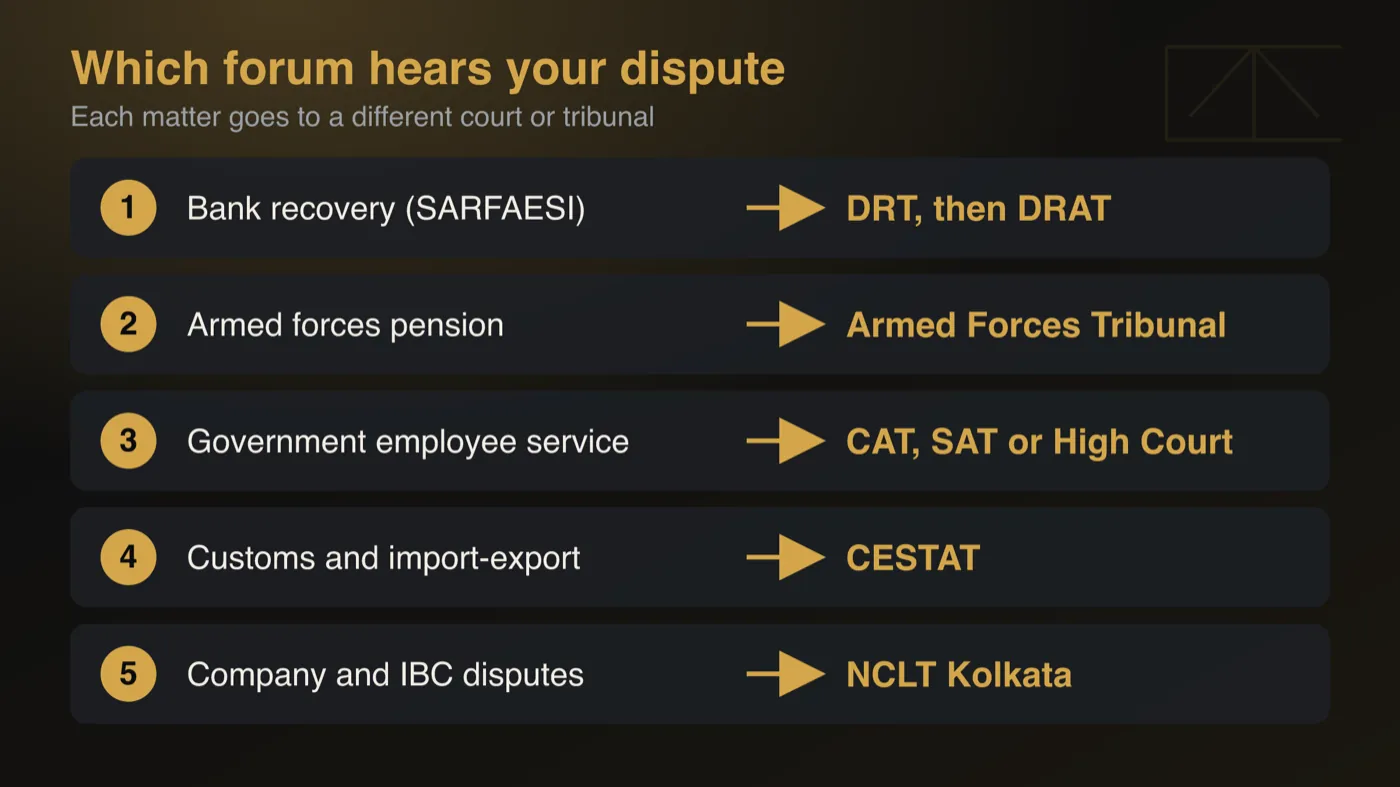
The chamber appears before the Supreme Court of India, the Calcutta High Court, the Armed Forces Tribunal, the Central Administrative Tribunal, the Debts Recovery Tribunal, CESTAT and NCLT, along with the district, sessions, family and consumer courts of West Bengal. Every matter begins with a timeline, a document index and grounds drafted against the actual section. See the Calcutta High Court advocate consultation page or read more about us. Outcomes depend on the facts and the law; nothing here is a promise of result.

Four deadlines that decide whether a case survives
These common statutory periods are strict, so always check the dates on your own paper.
Videos from Adv. Sudip Patra
More short explainers on our YouTube channel: Patra’s Law Chambers on YouTube ↗
What is the latest paper you have received?
Indian disputes go to different forums depending on the paper in your hand. This is general information to help you orient yourself, not advice on your case.
Choose one of the options above.
From a notice or order to the Supreme Court
Most disputes climb one ladder. Knowing which rung you are on tells you what to do next.
Every matter begins with a paper. Note its date, who issued it and what it asks of you, because limitation usually runs from here.
A written reply, or a departmental representation in service cases, often settles the matter or builds the record. The consultation page explains how to bring your papers.
The matter is argued before the Magistrate, civil court, DRT, CAT, AFT, NCLT or consumer commission that has jurisdiction. Interim relief is usually sought at this stage.
An adverse order is challenged by appeal, revision or a writ petition under Article 226 before the Calcutta High Court. Appeal periods are short, so act early.
A Special Leave Petition under Article 136 can be filed against High Court and tribunal orders. See the Supreme Court page for how the chamber briefs these matters.
Three habits behind every file. Tap a card
Every file starts with a verified list of dates. Limitation is checked before anything else is drafted.
A petition in the wrong court is lost time. The forum and the governing section are fixed before drafting.
The same record moves from the tribunal to the High Court and the Supreme Court. Nothing needs re-briefing at each step.
Litigation services across courts and tribunals
Writs, revisions and appeals
Writ petitions under Article 226, criminal revisions, first and second appeals, PILs and contempt before the Calcutta High Court, Original and Appellate Side. See the Calcutta High Court advocate consultation page for the process.
Criminal cases and bail
Trial defence, quashing of FIRs under Section 528 BNSS, regular and anticipatory bail, and complaints under Section 175(3) BNSS. Read the criminal lawyer in Kolkata page for details.
Banking, tax and company disputes
Section 13(2) and 13(4) SARFAESI notices and Securitisation Applications before DRT, IBC petitions and defences before NCLT Kolkata, and replies to GST and income-tax notices. See the DRT advocate in Kolkata page.
Service and defence matters
Disability pension, ACR challenges and promotions before the Armed Forces Tribunal, and transfers, seniority and disciplinary proceedings of government employees before CAT, SAT and the High Court.
More matters taken up by the chamber
- Civil cases, title suits, partition and land records in West Bengal
- Cheque bounce cases under Section 138 of the Negotiable Instruments Act
- Divorce, maintenance and child custody before the Family Court
- Customs and import-export proceedings before CESTAT
- Consumer complaints, motor accident claims and SIR tribunal appeals
- Cyber, trademark, copyright, YouTube and NRI legal matters
Five Supreme Court rulings that decide where and how your case is heard
Choosing the right forum is the first question in Indian litigation. These Supreme Court decisions set out when a High Court will hear a writ, when you must go to a tribunal first, and what the police and the government must prove.
1997
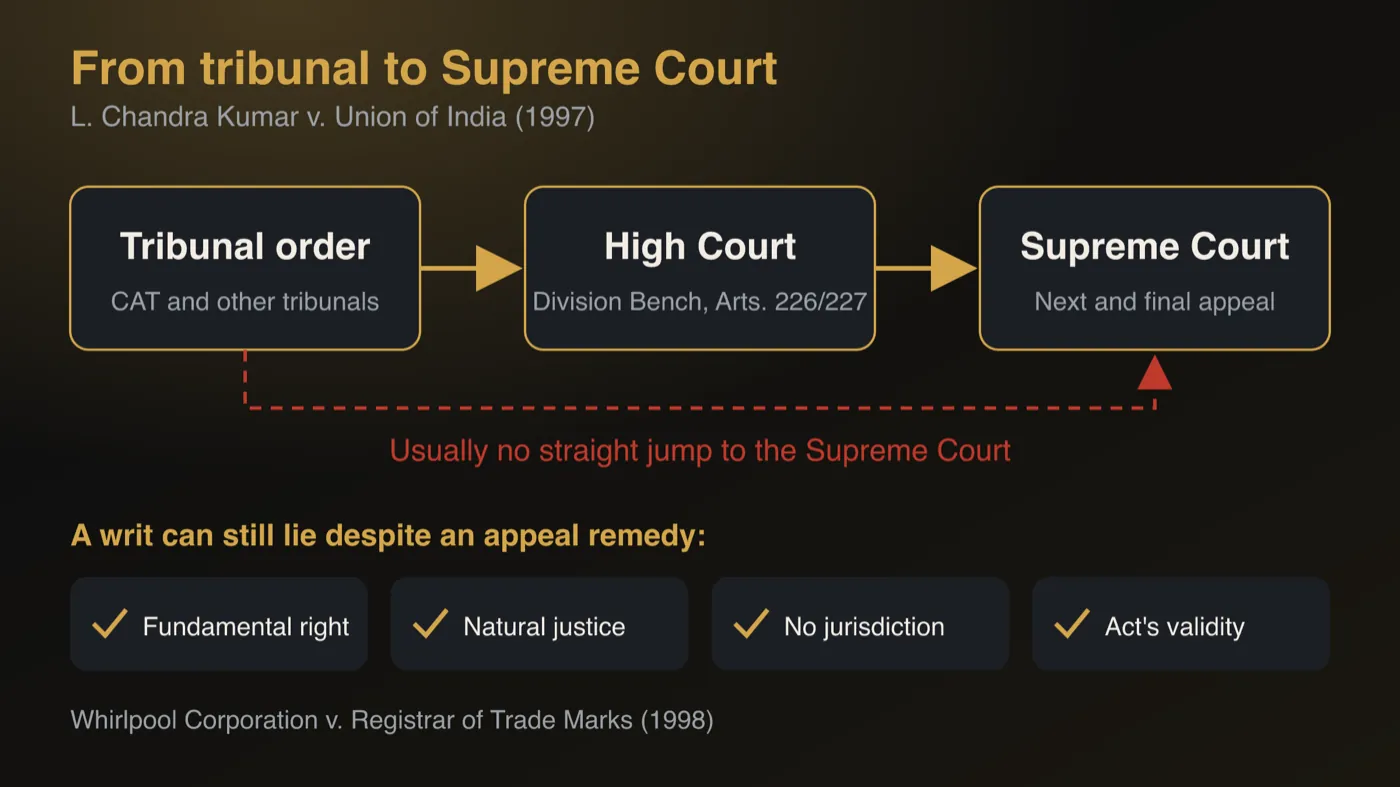
Tribunal orders remain open to High Court review
A seven-judge Constitution Bench held that judicial review by the High Courts under Articles 226 and 227 is part of the basic structure. Tribunals such as the CAT can support the High Courts but cannot replace them. Their decisions can be challenged before a Division Bench of the High Court, so a litigant usually cannot go straight to the Supreme Court.
1998
When a writ lies despite an appeal remedy
A statutory appeal does not always shut the door on a writ. The Supreme Court named the situations in which a High Court may still hear a writ petition: enforcement of a fundamental right, breach of natural justice, an order passed wholly without jurisdiction, and a challenge to the validity of an Act. Outside these, the statutory remedy comes first.
2010
Borrowers must go to the DRT first
Borrowers had skipped the DRT and filed a writ in the High Court against a bank’s SARFAESI action. The Supreme Court held that the remedy under Section 17 before the Debts Recovery Tribunal, followed by an appeal to the DRAT under Section 18, must ordinarily be used. High Courts should not grant interim stays that bypass this statutory route. See our DRT and SARFAESI service page.
2013
Soldiers are presumed fit on enrolment
If no disease or disability was recorded when a member of the Armed Forces joined, the law presumes they were in sound health at entry. If a disability appears later, the employer must show it is not linked to service. Disability pension under Regulation 173 depends on the disability being attributable to or aggravated by service and assessed at 20% or more. See our Armed Forces Tribunal service page.
2014
No routine arrest for offences under seven years
For offences punishable with imprisonment of up to seven years, the police must record why an arrest is necessary against the statutory factors. Where it is not necessary, they must issue a notice of appearance, formerly under Section 41A CrPC and now under Section 35 BNSS. Ignoring these directions can lead to departmental action and contempt. Read our guide to the Section 35 BNSS notice.
How a matter proceeds, from first call to final order
Consultation and document review
Contact the chamber by phone, WhatsApp or a visit to the Kolkata or New Delhi office and share the notice, order, FIR or agreement. The chamber reads every page before giving a view on the remedy, the correct forum and the limitation period.
Synopsis and course of action
You receive a one-page synopsis with the facts in one paragraph and the course of action in the next. It names the forum, the governing statute, a realistic timeline and the likely cost, so you can decide with the full picture.
Pre-litigation notice or representation
Where the law requires it, a legal notice, statutory representation or departmental appeal is sent first. Examples are the 15-day reply period after a cheque-bounce notice under Section 138 of the NI Act, and a representation against a Section 13(2) SARFAESI notice. This step sometimes settles the matter without a court filing.
Drafting, annexures and filing
The petition, indexed annexures, affidavits and vakalatnama are prepared and e-filed or presented before the correct court or tribunal. Interim relief, such as a stay, protection from arrest or a bar on coercive steps, is sought on the first date.
Hearing, order and appeal
Pleadings are exchanged and the matter is argued until the court gives a reasoned order. If a further challenge is needed, the same chamber files the writ in the Calcutta High Court, the appeal or the Special Leave Petition before the Supreme Court of India, so the record stays in one place.
Papers that help at a first consultation
A complete set of papers lets the advocate give a clearer view on forum and limitation.
Bring the original or a clear copy showing its date and issuing authority.
Keep the envelope, speed-post slip, e-mail or message, since limitation often runs from receipt.
Loan papers, sale deeds, cheques, bank statements or service records that relate to the dispute.
Anything you have already sent or received, including representations and acknowledgements.
Needed for the vakalatnama and for filing in any court or tribunal.
A one-page timeline of what happened and when helps the advocate read your file quickly.
Mistakes that cost litigants their case before it is heard
Filing in the wrong forum A SARFAESI dispute filed as a writ, or a service dispute taken to a civil court, is usually dismissed or returned. By then the time limit for the correct forum may have run out.
Letting the limitation period lapse Many remedies have short, fixed deadlines. For example, a Securitisation Application under Section 17 of the SARFAESI Act must be filed within 45 days of the measure taken. Check the date on the order or notice the day you receive it.
Ignoring a notice or summons An unanswered Section 35 BNSS notice, GST show-cause notice or demand notice under Section 8 of the IBC can lead to arrest, an ex parte demand or admission of insolvency proceedings. Reply in time, in writing, and keep proof of delivery.
Skipping the statutory appeal Unless the case falls within the Whirlpool exceptions, the High Court will ordinarily send you back to the appeal or tribunal the statute provides. Use that remedy first, or show clearly why it is not effective in your case.
Speak to an advocate in Kolkata or New Delhi
Share the notice, order, FIR or agreement by call, WhatsApp or e-mail. The chamber reads the documents and gives a view on the forum, the governing statute and limitation before any step is taken. Consultations are available in person at either office and online for clients elsewhere in India and abroad. Every case turns on its own facts, and no result can be promised.
Book a ConsultationEstablished by a distinguished alumnus of IIT Kharagpur, Patra’s Law Chambers stands as a beacon of legal expertise in Kolkata & Delhi. Know more →
Kolkata Office
NICCO House, 6th Floor, 2 Hare Street
Kolkata-700001 (Near Calcutta High Court)
Delhi Office
4455/5, First Floor, Gali Shahid Bhagat Singh
Main Bazar Road, Paharganj, New Delhi-110055
Contact
[email protected]
+91 890 222 4444 / +91 7003 715 325
From a dishonoured cheque to a complaint in court
Section 138 of the Negotiable Instruments Act, 1881 works as a chain of strict steps. Check each date against your own papers.
Cheque dishonoured
The bank returns the cheque unpaid, within its validity period, for insufficient funds or because it exceeds the arrangement with the bank.
Demand notice within 30 days
The payee must send a written demand to the drawer within 30 days of receiving the bank’s information of dishonour (Section 138(b)).
15 days to pay
The drawer has 15 days from receipt of the notice to pay the amount (Section 138(c)).
Complaint within one month
If payment is not made, the complaint is filed before the Magistrate within one month of the day the 15 days end (Section 142(1)(b)).
Frequently asked questions about choosing a lawyer and a forum in Kolkata and Delhi
The chamber appears before the Supreme Court of India, the Calcutta High Court, the Armed Forces Tribunal, CAT, DRT and DRAT, CESTAT, NCLT, consumer commissions, family courts and the district and sessions courts of West Bengal.
The Kolkata office is at NICCO House, 6th Floor, 2 Hare Street, Kolkata-700001, near the Calcutta High Court. The New Delhi office is at Paharganj. Online consultation is also available for clients elsewhere in India and abroad.
Bring the notice, order, FIR, agreement or any other paper you received, with its envelope or date of receipt. Add earlier replies, identity proof and any related correspondence. The advocate reads everything before suggesting a forum and remedy.
It depends on the subject and the paper issued. Bank recovery goes to the DRT, government service disputes to CAT, defence service disputes to the AFT, and cheque bounce to the Magistrate. Verify the forum with an advocate before filing.
A Section 35 BNSS notice, which replaced Section 41A CrPC, generally requires you to appear and cooperate. Arrest is restricted if you comply. Read the chamber’s guide on the notice and take advice on your facts.
A Securitisation Application under Section 17 of the SARFAESI Act must be filed within 45 days of the measure taken under Section 13(4). The period is strict, so check your dates against the notice immediately.
Yes. Matters are briefed from Kolkata and filed from New Delhi, including Special Leave Petitions, transfer petitions, criminal appeals and review petitions. The same chamber that argued below can carry the appeal.
No. Outcomes depend on facts, evidence and the court, and the Bar Council of India rules do not permit promises. The chamber gives a view on remedy, forum and limitation, and explains the risks in plain terms.