One Person Company (OPC) Registration in India: Own It Alone, Limited Liability
A One Person Company lets a single founder run a business as a separate legal entity with limited liability. Patra’s Law Chambers, with offices in Kolkata and Delhi, handles the DSC, DIN, name approval, MOA and AOA, SPICe+ filing, PAN and TAN, and later compliance.
One Person Company under the Companies Act, 2013
A One Person Company is defined in Section 2(62) of the Companies Act, 2013 as a company with only one person as its member. Section 3(1)(c) permits it to be formed as a private company. It suits a solo founder, consultant, freelancer or small trader who wants a company’s limited liability and separate legal identity without bringing in a partner. The company, not the owner, holds the assets and owes the debts, and it can sue and be sued in its own name. The Act and the Companies (Incorporation) Rules, 2014 set the conditions, and the Ministry of Corporate Affairs publishes the forms and filing procedure on the MCA portal.
Only a natural person can be the sole member, and that person must be an Indian citizen and resident in India, meaning someone who has stayed in India for at least 120 days in the preceding financial year. A minor cannot be the member or the nominee. The member must name a nominee in the memorandum, who steps in if the member dies or becomes incapacitated, which gives the company perpetual succession. Because these rules have been amended more than once, we check the current text before every filing. If you are also weighing other structures, see our page on comprehensive legal services for business.
Time limits an OPC should keep in mind
The key periods that decide how a new OPC schedules its meetings and filings.
Short explainers from Adv. Sudip Patra
More short explainers on our YouTube channel: Patra’s Law Chambers on YouTube ↗
Which of these describes your plan?
Pick the line closest to your situation to see the usual route. This is general information, not advice on your facts.
Choose one of the options above.
How an OPC is registered, from documents to certificate
The usual sequence on the MCA portal. Actual time depends on document readiness and the Registrar’s queries.
Pick a name that is not identical or too similar to an existing company or trademark. The company name carries ‘(OPC)’ in brackets. Choose a nominee who is an Indian citizen and resident in India and who consents in writing. See our trademark advice to check the name does not clash with a registered mark.
The proposed director needs a DSC to sign the forms online. The DIN is allotted through SPICe+ for first-time directors. Identity proofs and address proofs must match the application.
The Memorandum states the objects and the nominee. The Articles set the internal rules. The registered office needs a utility bill, a rent agreement and an NOC from the owner.
SPICe+ is a combined form for incorporation, DIN, PAN, TAN and other registrations, supported by the MOA, AOA and nominee consent. Stamp duty and fees depend on the State and the authorised capital, so verify them at the time of filing.
On approval, the Registrar issues the Certificate of Incorporation with the Corporate Identity Number, PAN and TAN. Open the current account, then consider GST registration if the business needs it. For wider company-law support, see our business legal services page.
Appoint the first auditor, hold the required board meetings and file the annual accounts and return. Keep the register of members and the nominee details up to date.
Three things people get wrong about OPCs, tap a card
No. An OPC is a separate legal entity, and the owner’s liability is generally limited to the capital put in. A proprietorship has no separate identity from its owner, so personal assets are exposed to business debts.
Not so. An OPC must have at least one director and can have up to fifteen under Section 149 of the Companies Act, 2013. Only the number of members is fixed at one.
Not quite. An OPC cannot carry on non-banking financial investment activities, including investing in securities, and cannot be formed for a charitable purpose under Section 8. Check the Rules before settling the objects clause.

OPC registration and compliance services
DSC, DIN and name approval
We obtain the Digital Signature Certificate and Director Identification Number, then check availability and propose a name that follows the Companies (Incorporation) Rules, 2014 and does not conflict with an existing company or trademark. The name is submitted to the MCA for approval.
Memorandum, Articles and nominee
We draft the Memorandum and Articles of Association with the company’s objects and internal rules. We also record the nominee’s name and written consent, so the succession arrangement is in order from the first day.
Incorporation filing, PAN and TAN
We file the SPICe+ form with the supporting documents, including proof of the registered office. On approval the Certificate of Incorporation is issued, and PAN and TAN are applied for through the same process.
Annual filings and conversion
We prepare financial statements and annual returns for filing with the Registrar of Companies, and help with conversion into a private limited company when the business grows. See also our GST lawyer page for tax registration questions.
Documents usually needed for OPC registration
- PAN and Aadhaar of the member and of the director
- Address proof such as a recent electricity, water or gas bill (not older than two months)
- Registered office proof: utility bill or rent agreement with NOC from the owner
- Identity and address proof of the nominee, with the nominee’s written consent
- Passport-size photographs and a valid email address and mobile number
What the courts have said about a company that has only one owner
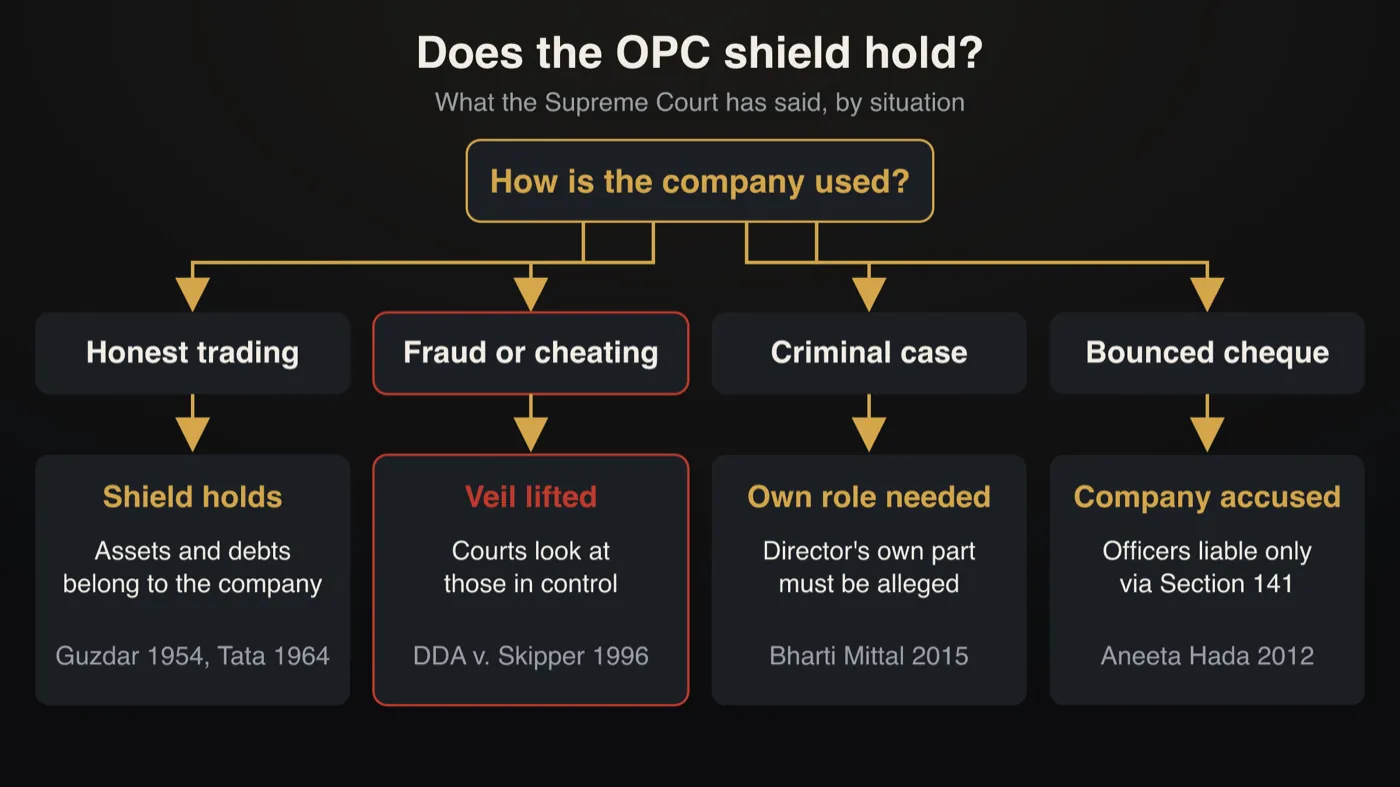
A One Person Company is still a company under the Companies Act, 2013, so the Supreme Court’s rulings on companies apply to it in full. These decisions show where your personal shield holds and where it does not.
1954
The company is separate from its shareholder
The Supreme Court held that a shareholder does not own the company’s property and that the company is a separate legal person. Dividend paid to a shareholder is the shareholder’s own income, not the company’s income passed through. For an OPC, this means the business assets, bank account and contracts belong to the company, not to the sole member personally.
1964
The veil is not lifted for the owner's convenience
The Court refused to treat a company as just a group of its shareholders so that it could claim their fundamental rights. Separate personality applies both ways: the owner of an OPC cannot set the company aside when that suits them, just as creditors usually cannot reach the owner’s personal assets.
1996
Fraud lets courts look behind the company
Where the corporate form is used to commit an illegality or to cheat others, the court will ignore it and look at the people actually in control. The Court attached property held by a related company to recover the money. Limited liability in an OPC protects honest business losses, not the use of the company as a device for fraud.
2015
No automatic criminal liability for directors
The Supreme Court held that a director cannot be made an accused just because the company is accused. That needs either a statute that expressly creates vicarious liability or specific allegations of the director’s own part and intent. This matters in an OPC, where the sole member is usually also the only person in charge.
2012
The company must be made an accused
A three-judge Bench held that under Section 141 of the Negotiable Instruments Act, 1881, the officers of a company can be prosecuted for a bounced company cheque only if the company itself is made an accused. If your OPC signs cheques, the company is the drawer, and the person in charge is liable only through Section 141.
How an OPC is registered with the Ministry of Corporate Affairs
Check eligibility and choose a nominee
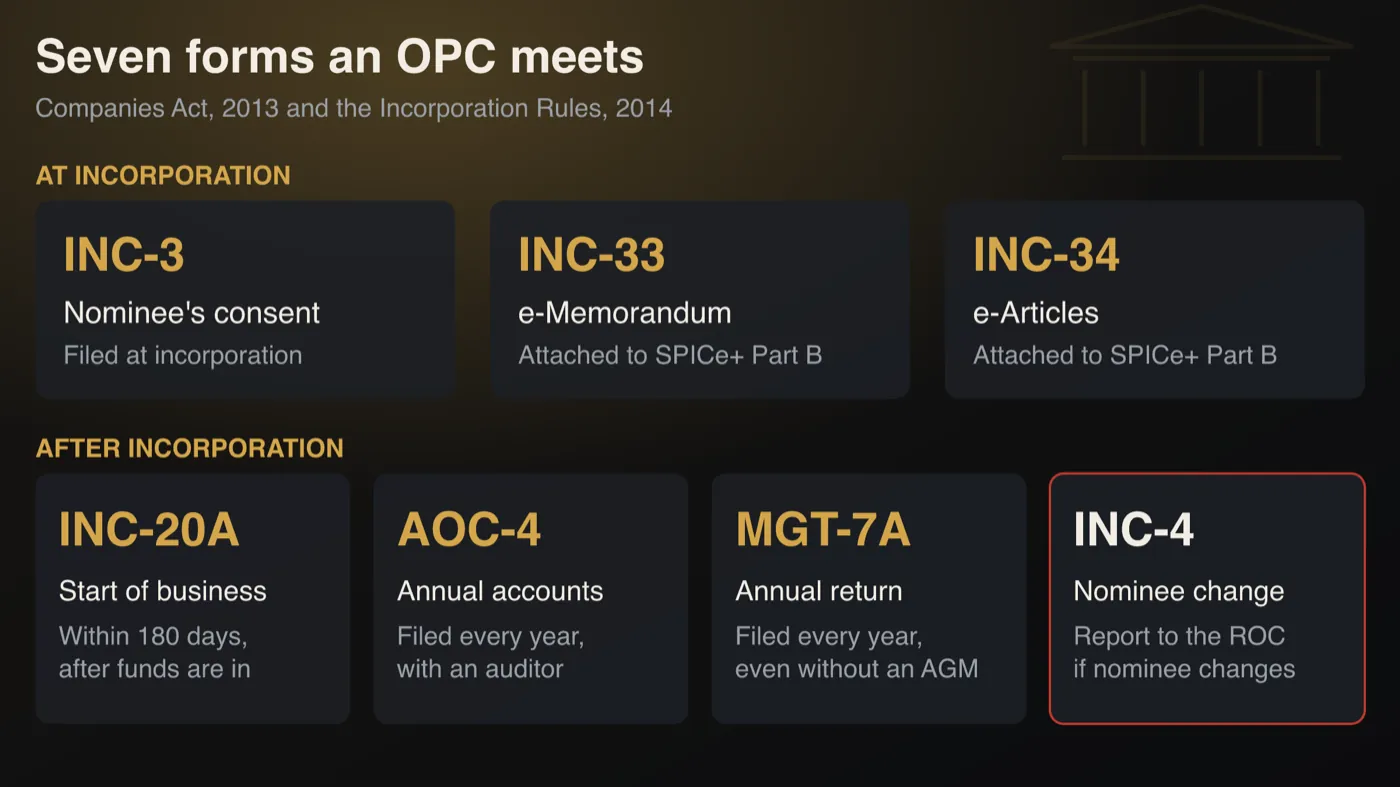
Only a natural person who is an Indian citizen, whether resident in India or not, can form an OPC, and one person can form only one OPC (Section 2(62) and Section 3(1)(c), Companies Act, 2013, read with Rule 3, Companies (Incorporation) Rules, 2014). A minor cannot be a member or a nominee. Choose a nominee who gives written consent in Form INC-3.
Obtain a Digital Signature Certificate
The proposed director and the subscriber need a Class 3 Digital Signature Certificate (DSC) to sign the electronic forms. If the person does not yet have a Director Identification Number (DIN), it is allotted through the SPICe+ form itself, so a separate DIN application is usually not needed.
Reserve the name in SPICe+ Part A
Apply for the name through SPICe+ Part A on the MCA portal. The name must end with “(OPC) Private Limited” and must not be identical or too close to an existing company name or a registered trademark. Check the trademark register before you apply, since a name that clashes with a trademark can lead to a direction to change it later.
File SPICe+ Part B with the e-MoA and e-AoA
Fill in the registered office, capital, subscriber and director details, and attach the nominee’s INC-3 consent, the e-Memorandum (INC-33), the e-Articles (INC-34) and proof of the office address with the owner’s NOC. The linked AGILE-PRO-S form covers GSTIN where needed, EPFO, ESIC and the opening of a bank account.
Receive the Certificate of Incorporation
Once the Registrar of Companies approves the filing, it issues the Certificate of Incorporation with the Corporate Identity Number (CIN), along with the company’s PAN and TAN. Time taken depends on whether the documents are complete and whether the ROC raises any queries, so verify the current status on the MCA portal rather than assume a fixed date.
Complete the first compliances
Appoint the first auditor within 30 days of incorporation (Section 139(6)). File the declaration of commencement of business in Form INC-20A within 180 days, once the subscription money is in the company’s bank account (Section 10A). Our business legal services page sets out the help we give with ongoing compliance, and the Trademark Advice page covers protecting the OPC’s name.
One-Person Company vs sole proprietorship
How the two structures differ on the points that matter most to a solo founder.
Mistakes that cause trouble for a new OPC
Choosing a nominee without valid written consent The nominee’s consent in Form INC-3 has to be filed with the incorporation papers. A nominee who later withdraws must be replaced, and the change must be reported to the ROC in Form INC-4, or the company falls out of compliance.
Missing the INC-20A commencement filing An OPC that does not file the commencement declaration within 180 days cannot lawfully start business or borrow money. Under Section 10A it attracts a penalty and can even be struck off by the Registrar.
Treating company money as personal money The OPC is a separate person, so drawing funds without records weakens the limited-liability shield. Under Section 193, a contract between the OPC and its sole member who is also a director must be in writing or recorded in the minutes of the first board meeting after it is made, unless it is in the ordinary course of business.
Assuming an OPC has no annual filings An OPC still files its financial statements in Form AOC-4 and its annual return in Form MGT-7A every year, and it needs a statutory auditor. Late filing carries additional fees for each day of delay, and for a GST-registered OPC tax returns are a separate obligation (see our GST notice advice page).
Planning to register a One Person Company?
Tell us about your business, whether you will be the only director, and who your nominee will be. We will explain the steps, the documents and the compliance that follows, and flag anything that needs checking against the current rules. We can also advise on trademark registration for your company name and logo. Fees and timelines depend on the facts of your case and are confirmed after we review your papers.
Book a ConsultationEstablished by a distinguished alumnus of IIT Kharagpur, Patra’s Law Chambers stands as a beacon of legal expertise in Kolkata & Delhi. Know more →

Kolkata Office
NICCO House, 6th Floor, 2 Hare Street
Kolkata-700001 (Near Calcutta High Court)
Delhi Office
4455/5, First Floor, Gali Shahid Bhagat Singh
Main Bazar Road, Paharganj, New Delhi-110055
Contact
[email protected]
+91 890 222 4444 / +91 7003 715 325
Documents to keep ready for OPC registration
A short list of what the Registrar’s forms usually ask for.
Identity proof of the sole member and director, as applicable.
Electricity, water or gas bill not older than two months.
Utility bill or rent agreement with an NOC from the property owner.
Written consent of the nominee, with identity and address proof.
Needed to sign the forms electronically on the MCA portal.
Define the objects, capital and internal rules of the company.
Alternative names, checked for similarity to existing companies and trademarks.
Frequently asked questions on OPC registration
The Companies Act, 2013 does not prescribe any minimum paid-up capital for an OPC. You can start with the amount your business needs. The authorised capital you choose affects stamp duty and registration fees, so check the current State and MCA fee slab before filing.
No. Only a natural person who is an Indian citizen and resident in India can incorporate an OPC, and a minor cannot be a member or nominee. The nominee must also be a natural person who is an Indian citizen and resident in India.
The main difference is separate legal identity and limited liability. An OPC is a company with its own legal personality, so the owner’s liability is generally limited to the capital invested. A proprietor and the business are the same person, so personal assets can be reached.
Yes. An OPC must have at least one director and may have up to fifteen under Section 149 of the Companies Act, 2013. It can have only one member, so additional directors are appointed for management, not ownership.
It typically takes about 10-15 working days, depending on the readiness of documents, the DSC and DIN, name approval and any query raised by the Registrar. This is a typical range, not a fixed period set by law.
The nominee is named in the MOA and takes over membership if the sole member dies or becomes incapable of contracting. The nominee’s written consent is filed at incorporation. The member can change the nominee and the nominee can withdraw, by filing the prescribed forms with the Registrar.
Yes. An OPC can be converted into a private limited or public company by following the Companies (Incorporation) Rules, 2014, with the required resolutions and alteration of the MOA and AOA. Earlier mandatory conversion thresholds were removed in 2021, so verify the current Rule 3 and Rule 7.
No. Section 96 does not require an OPC to hold an annual general meeting. It must still hold at least one board meeting in each half of the calendar year, with a gap of not less than 90 days (Section 173(5)), and file its accounts and annual return.