Register Your NGO the Right Way: Section 8, Society or Trust
Choosing the right legal form is the first decision for any non-profit. We help with the documents, registration and the 12A and 80G tax approvals for a Section 8 Company, a Society or a Trust. Our advice is based on how you intend to raise funds and run your work.
How to Form an NGO in India: Legal Provisions, Benefits and Tax Exemptions
India has no single law called the NGO Act. A non-governmental organisation is formed under one of three laws: a Section 8 Company under the Companies Act, 2013, a Society under the Societies Registration Act, 1860 (or the West Bengal Societies Registration Act, 1961 for societies in West Bengal), or a Trust under the Indian Trusts Act, 1882 or a state public-trust law. The right form depends on who will run the organisation, how much oversight you accept and where the money will come from. A Section 8 Company is incorporated through the Ministry of Corporate Affairs; see the MCA portal for the official forms and fees.
This page keeps everything that was already here: the Section 8 Company explainer, its legal basis, benefits and the documents required. We have added a plain comparison of the three forms, the tax approvals and the compliance that follows registration. Fees, timelines and forms change from time to time, so please verify them with the official portals or with us before you file. A well-drafted Memorandum, Articles, Society bye-laws or Trust Deed is the foundation of everything that comes later, from opening a bank account to applying for tax exemption. Our business legal services cover this drafting and the filings that follow.
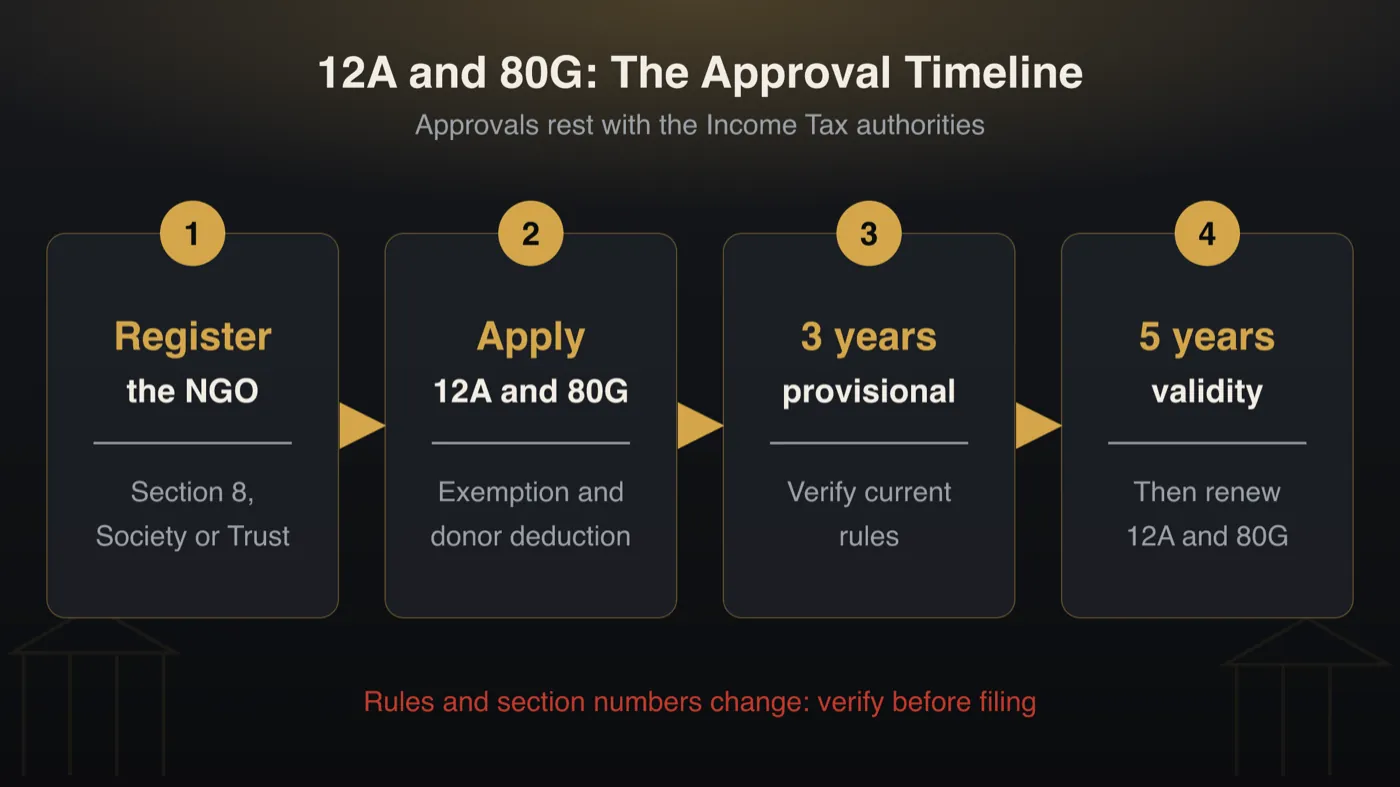
Key periods for 12A and 80G registration
These are the usual periods under the Income-tax Act; verify current rules and section numbers before filing.
Short explainers from Adv. Sudip Patra
More short explainers on our YouTube channel: Patra’s Law Chambers on YouTube ↗
What kind of NGO are you planning?
Pick the line that fits your group. This is general information, not advice, and the right structure depends on your members, funds and plans.
Choose one of the options above.
How an NGO is set up and made tax-ready
The route differs slightly for a company, a society and a trust, but the usual order is the same.
Decide between a Section 8 company, a society or a trust based on how many people are involved, how funds will flow and how much compliance you can manage. A comprehensive business legal advice session can help compare them.
Fix a name that is available and not misleading, and write clear charitable objects. Collect identity and address proof of founders or directors and the office address proof with the owner’s no-objection letter.
A Section 8 company applies through the MCA SPICe+ forms with the licence application (INC-12) and the MoA and AoA. A society is registered with the Registrar of Societies, and a trust deed is executed and registered under the Registration Act, 1908.
Obtain the entity’s PAN and open a bank account in its name. Start books of account, minutes and member or trustee registers from day one.
Apply for tax exemption and donor deduction through the Income Tax portal. Provisional registration is generally for three years and regular registration for five. For tax questions, see our income tax advice page.
File annual returns, audited accounts and income tax returns on time, and keep to the objects in your governing document. Disputes about management or funds may need court help, such as through the Calcutta High Court.
Common NGO questions, tap a card
Forming a society, trust or Section 8 company does not by itself give 12A or 80G. Those are separate applications to the Income Tax Department.
An NGO’s income must be applied to its objects and not distributed to members, directors or trustees. Reasonable pay for real work is a separate matter, so verify before fixing any.
Annual filings, audited accounts and renewal of tax registrations continue for the life of the NGO. Missing them can lead to penalties or loss of exemption.
Section 8 Company, Society or Trust: Which Fits Your NGO
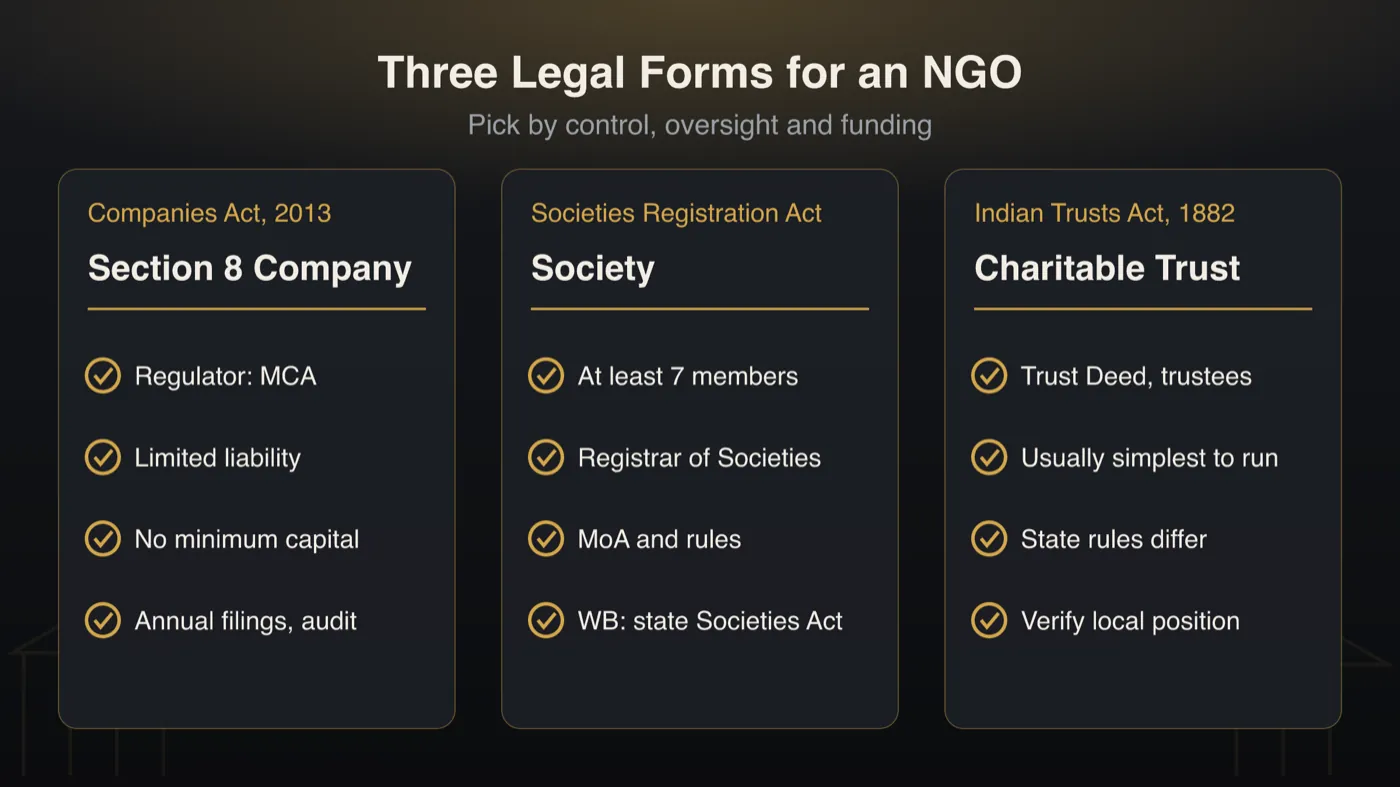
Section 8 Company
Regulated by the Ministry of Corporate Affairs. Members have limited liability and no minimum capital is needed. It is generally seen as more credible with donors and banks, but it carries annual company law filings and audit.
Society Registration
Formed by at least seven members with a Memorandum of Association and rules and regulations. Registered with the Registrar of Societies. Suited to membership-based and community organisations. In West Bengal, the state Societies Act applies.
Public Charitable Trust
Created by a Trust Deed with one or more trustees holding property for a charitable purpose. It is usually the simplest to set up and run. Registration rules for public trusts differ from state to state, so verify the local position.
12A and 80G Approvals
Registration under section 12A lets an NGO’s income be treated as exempt, subject to conditions. Section 80G can give donors a deduction. The Income-tax Act, 2025 now governs; verify the current section numbers and Form 10A or 10AB process.
Compliance an NGO Should Plan For
- Annual accounts, audit and return filing as required by the form chosen
- Section 8 Company: annual filings with the Registrar of Companies
- Society or Trust: annual returns or changes-in-management filings, as the state law requires
- Income tax returns and renewal of 12A and 80G approvals
- FCRA registration only if you intend to receive foreign contributions
What the Supreme Court has said about NGO registration and tax exemption
These Supreme Court decisions decide whether a trust, society or Section 8 company gets 12A/80G registration and keeps its income-tax exemption. They interpret the Income Tax Act, 1961. From 1 April 2026 the Income-tax Act, 2025 applies, so verify the matching new provisions before you rely on any of them.
2020
A new trust can be registered on its objects
A three-judge Bench held that a newly formed trust may apply for registration under Section 12AA before it has carried out any activity. At this stage the Commissioner checks whether the trust’s objects and its proposed activities are genuine. Registration is not a review of past work. For a newly registered NGO, a short track record alone is not a valid reason to refuse registration.
2022
General public utility bodies must limit trade receipts
The Court read the proviso to Section 2(15). A charity whose object is the advancement of general public utility loses its exemption if it carries on trade, commerce or business, unless that activity is part of carrying out its objects and the receipts stay within the statutory limit. An NGO that charges fees or sells goods should keep its accounts in a way that shows those receipts separately.
2022
Educational NGOs must exist solely for education
To get approval under Section 10(23C), a trust, society or Section 8 company that runs an educational institution must exist solely for education and must not exist for profit. Objects unrelated to education in its trust deed, bye-laws or Memorandum can lead to refusal. The Court applied this reading prospectively. Draft the objects clause carefully before you register.
2014
Charitable-religious trusts can claim Section 11 exemption
A public trust with both religious and charitable objects can claim exemption under Section 11. Section 13(1)(b) does not apply unless the trust is created or established for the benefit of a particular religious community or caste. The decision is useful for a trust or society that combines worship, welfare and education. Read the objects as a whole and test them against the statute.
How to register an NGO in India, step by step
Choose the legal form
There are three options. A trust is created by a trust deed. A society is registered under the Societies Registration Act, 1860, or in West Bengal under the West Bengal Societies Registration Act, 1961. A Section 8 company is incorporated under the Companies Act, 2013. Choose by how the NGO will be governed, how much liability its members can accept, and where its funds will come from.
Draft the objects and the founding document
Write charitable objects that are clear and not commercial: education, relief of the poor, medical relief, environment, or another object of general public utility. Put them in the trust deed, the society’s Memorandum and bye-laws, or the company’s MoA and AoA. As the Supreme Court decisions show, poorly drafted objects can cost the NGO its tax exemption later.
Register or incorporate
A trust deed is registered with the Sub-Registrar under the Registration Act, 1908. A society files with the Registrar of Societies. A Section 8 company applies to the Ministry of Corporate Affairs for a licence and for incorporation, with DIN and DSC for its directors, office proof and an NOC from the owner of the premises. Check the current MCA forms and fees before you file.
Obtain PAN, TAN and a bank account
Get a PAN and TAN in the NGO’s own name and open a bank account in that name. From the first day, keep the NGO’s money separate from the founders’ personal money. Proper books of account, receipts and minutes of meetings help at every later stage, including the 12A/80G application and any scrutiny by the tax department.
Apply for provisional 12A and 80G registration
A new NGO can apply online for provisional registration (12A) and approval (80G) in Form 10A. Under the 1961 Act this provisional registration ran for three years. Since 1 April 2026 the Income-tax Act, 2025 applies, so check the current section, form and time limits on the Income Tax portal before you file.
Convert to regular registration and stay compliant
Apply for regular registration in time, before the provisional registration expires or within the deadline after activities begin. Then file the NGO’s audit report and income-tax return every year, along with the annual MCA or Registrar filings. If the NGO needs government grants or foreign contributions, it must also register separately on NGO Darpan or under the FCRA.
Section 8 company or society/trust?
A broad comparison to start the discussion, since details vary by state and facts.
Send Us Your NGO Registration Enquiry
Fill in the enquiry form below and we will get back to you.
Send us your query
Tell us briefly about your matter. We usually call back the same working day.
Mistakes that cost NGOs their registration or exemption
Writing mixed or commercial objects Business-style objects, or objects unrelated to the main charitable purpose, can lead to refusal of 12A/80G or of Section 10(23C) approval. Draft the objects narrowly and charitably from the start.
Letting provisional registration lapse Provisional 12A/80G registration has a fixed life. If you miss the date for converting it to regular registration, the NGO can lose its exemption, and donors can lose their deduction.
Mixing personal and NGO funds Paying founders’ expenses from the NGO account, or taking donations into a personal account, weakens the NGO’s claim to be genuine. It also invites questions under the rules that bar benefits to interested persons.
Taking foreign money without FCRA clearance Accepting a foreign contribution without FCRA registration or prior permission can bring serious penalties. Check the current eligibility conditions before you accept any donation from abroad.
Plan Your NGO Registration With a Lawyer
Each legal form has different consequences for control, liability, tax and compliance. Before you file, it helps to have the objects clause, the governing body and the funding plan reviewed. Share your proposed objects, the number of founders and how you plan to raise funds, and we will explain the options and the documents needed under the Act that applies. We do not promise outcomes, since approvals rest with the Registrar and the Income Tax authorities. You can also read about our Income Tax advocate services and our Calcutta High Court consultation if a dispute over registration or exemption arises.
Book a ConsultationEstablished by a distinguished alumnus of IIT Kharagpur, Patra’s Law Chambers stands as a beacon of legal expertise in Kolkata & Delhi. Know more →

Kolkata Office
NICCO House, 6th Floor, 2 Hare Street
Kolkata-700001 (Near Calcutta High Court)
Delhi Office
4455/5, First Floor, Gali Shahid Bhagat Singh
Main Bazar Road, Paharganj, New Delhi-110055
Contact
[email protected]
+91 890 222 4444 / +91 7003 715 325
Documents for a Section 8 company
Keep these ready before the incorporation filing begins.
Each proposed director needs a Director Identification Number.
Directors sign the online forms with their DSC.
Identity proof of every director.
Passport, voter ID or driving licence.
Rent agreement or ownership proof of the registered office.
A no-objection certificate for use as registered office.
The Memorandum and Articles stating the non-profit objects.
Frequently asked questions about NGO registration in India
The three common forms are a Section 8 company under the Companies Act, 2013, a society under the Societies Registration Act, and a public charitable trust. Each has its own law, registration authority and compliance. The right choice depends on your size, funding and plans.
It is a non-profit company formed under Section 8 of the Companies Act, 2013 to promote objects such as art, science, education, social welfare or environment. Its profits must go to those objects, and members cannot take dividends.
No minimum paid-up capital is required for a Section 8 company, as the page’s earlier guidance also notes. You still need at least the minimum number of directors and members for the company type, and a registered office address.
Usually the DIN, digital signature, PAN and Aadhaar of directors, address proof, passport photographs, registered office proof with the owner’s NOC, and the draft MoA and AoA. The exact list is checked on the MCA portal at filing.
12A registration lets the NGO’s income be treated as exempt, subject to conditions. 80G approval lets donors claim a deduction on their donations. They are separate applications to the Income Tax Department. Section numbers may change under the Income-tax Act, 2025, so verify.
Provisional registration is generally granted for three years, and regular registration for five years, after which it must be renewed. Regular registration should be applied for at least six months before the provisional one ends. Please verify current rules before filing.
Only if you wish to receive foreign contributions. FCRA registration or prior permission under the Foreign Contribution (Regulation) Act, 2010 is separate from forming the NGO and has its own conditions.
Yes, the firm assists with documentation, filings and compliance for NGOs, and advises on which structure may suit your purpose. Each case is assessed on its own facts, and no outcome or approval can be promised.