Customs Lawyer in Kolkata: Seizure, Show Cause Notice and CESTAT Appeals
A detained consignment, a seizure, a DRI summons or a Show-Cause Notice can stop a business within days. Patra’s Law Chambers represents importers, exporters and individuals under the Customs Act, 1962, from the adjudicating authority to CESTAT, the Calcutta High Court and the Supreme Court.
When customs holds your goods or serves a notice
A delay at the port or airport, a notice questioning the value or classification of goods, or a seizure under Section 110 of the Customs Act, 1962 can freeze a shipment and a cash cycle together. The Act gives the department wide powers of search, seizure and adjudication. It also gives you clear rights: a written Show-Cause Notice and a hearing under Section 124 before goods are confiscated or a penalty is imposed, provisional release under Section 110A, and a chain of appeals. The Central Board of Indirect Taxes and Customs publishes the Act, rules and circulars at cbic.gov.in.
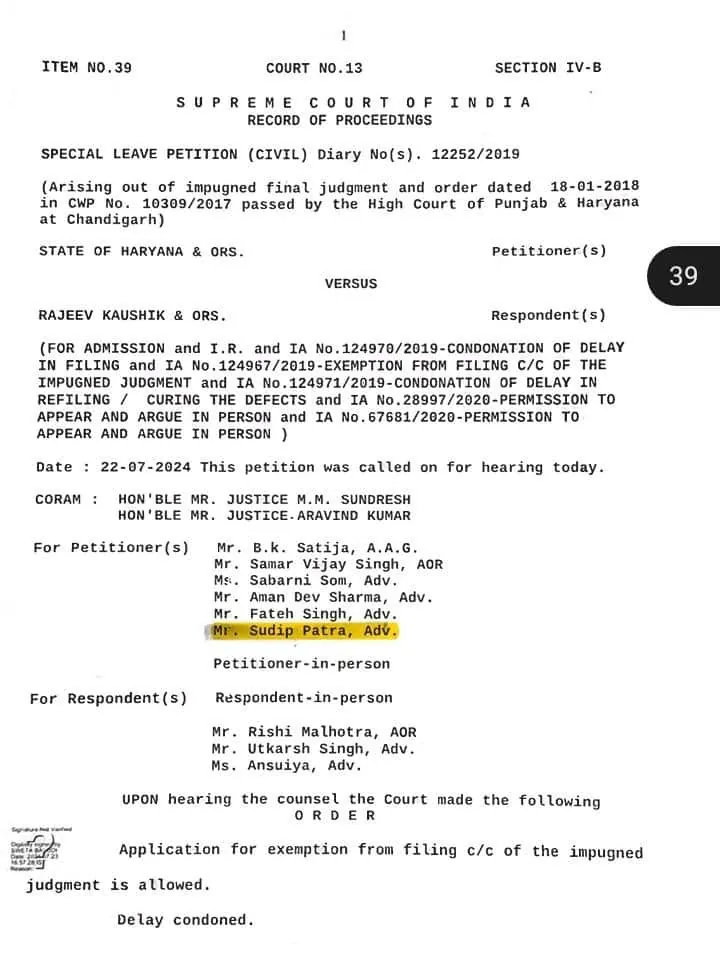
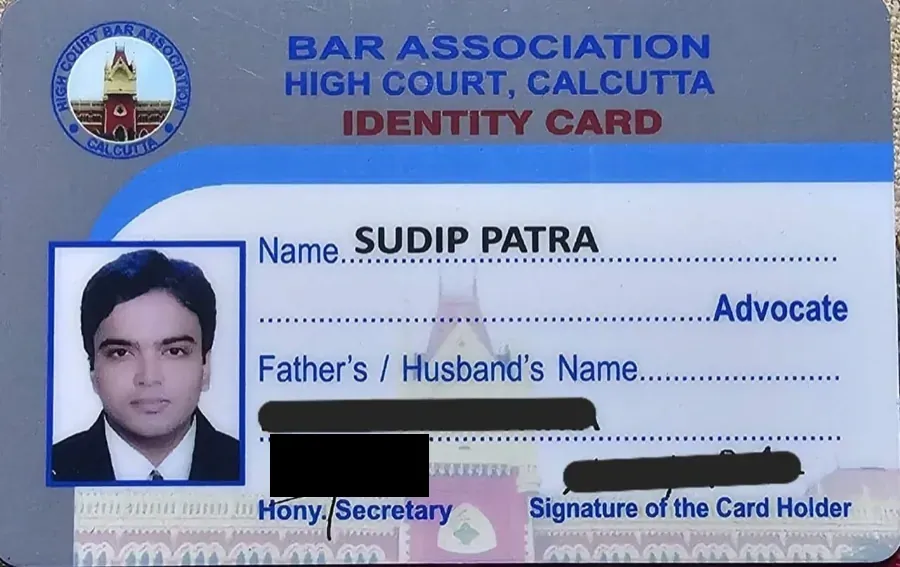
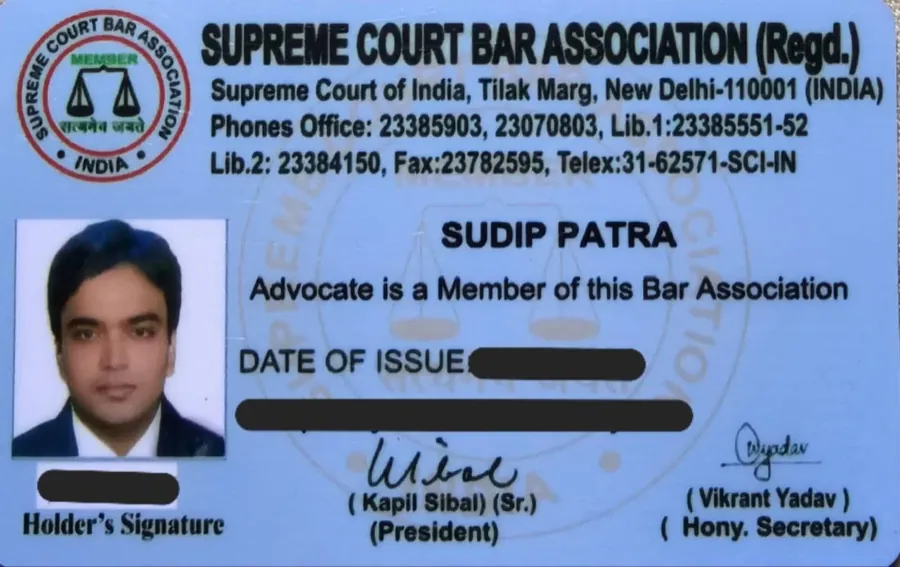
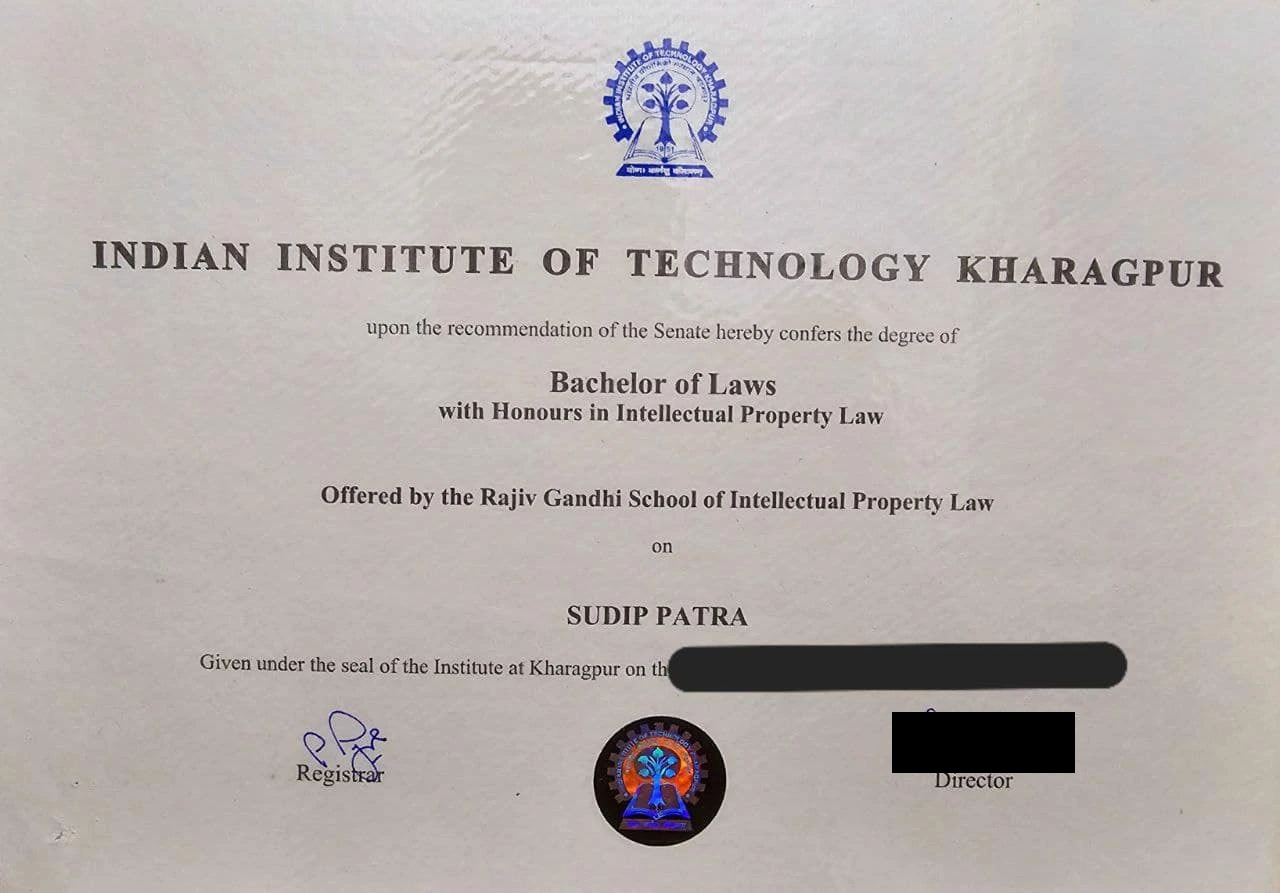
Our chambers handles customs advisory, replies to Show-Cause Notices, provisional release of seized goods, appeals before the Commissioner (Appeals) and the Customs, Excise and Service Tax Appellate Tribunal (CESTAT), and writ petitions where a customs action is without jurisdiction. Tax disputes that run alongside, such as IGST on imports, are covered on our GST notice page and our income tax page. Where an allegation carries criminal exposure, we advise on arrest and anticipatory bail. Advocate Sudip Patra holds B.Tech, LL.B. (IIT Kharagpur), LL.M. and a P.G.D. from IIM Calcutta, with more than ten years at the Bar. Each matter is assessed on its own papers.

Commissioner (Appeals) and CESTAT side by side
The first two appeals follow different sections, time limits and pre-deposit rates.
Videos from Adv. Sudip Patra
More short explainers on our YouTube channel: Patra’s Law Chambers on YouTube ↗
Which customs paper or action have you received?
Pick the situation closest to yours. This is general information to help you understand the usual path under the Customs Act, 1962, not advice on your own file.
Choose one of the options above.
How a customs dispute usually moves
Every case differs, but most disputes under the Customs Act, 1962 pass through these stages in this order.
Officers may search premises, seize goods under Section 110 and summon you under Section 108. Ask for copies of the panchnama and the seizure memo, and note the date and time of each step.
Statements are recorded and documents collected. If you fear arrest at this stage, read about anticipatory bail and arrest advice on the criminal law side of the matter.
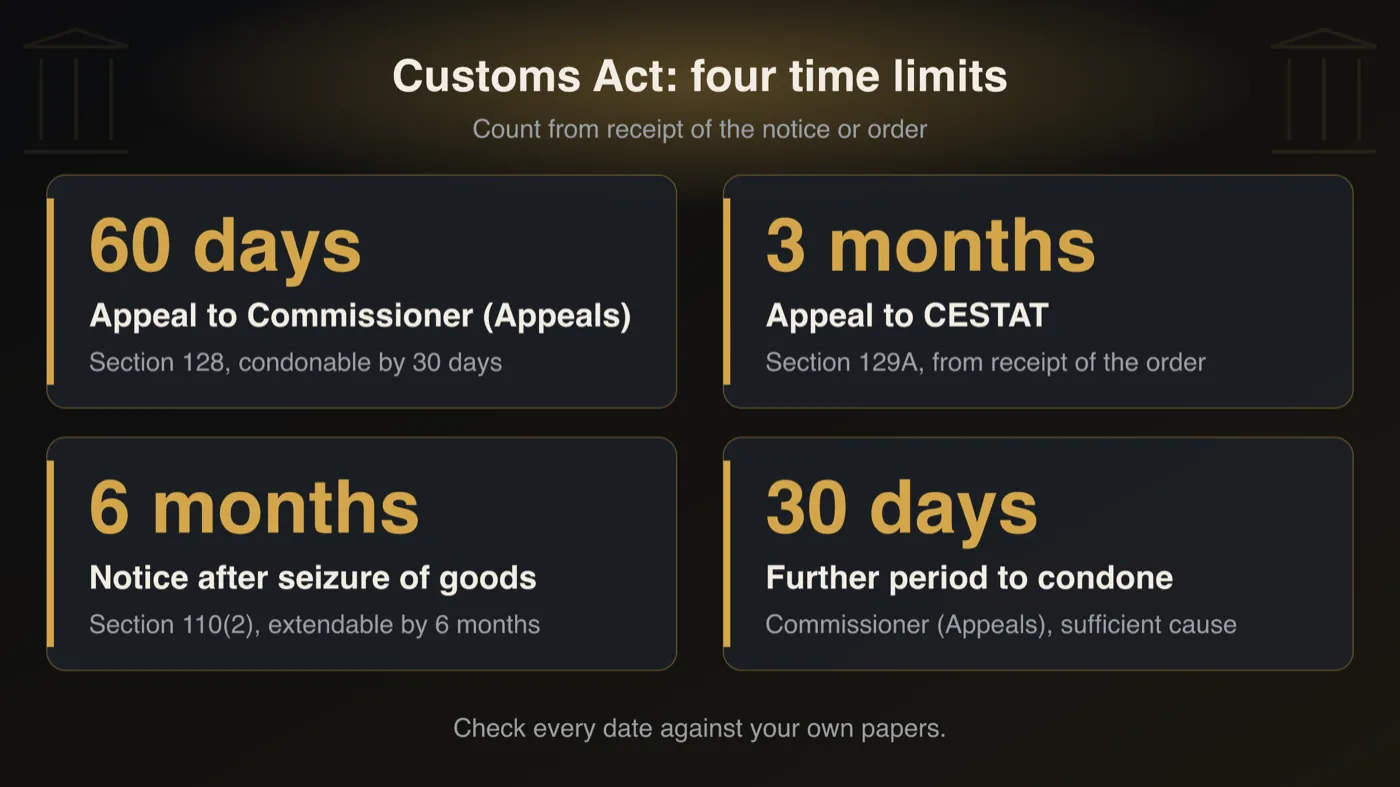
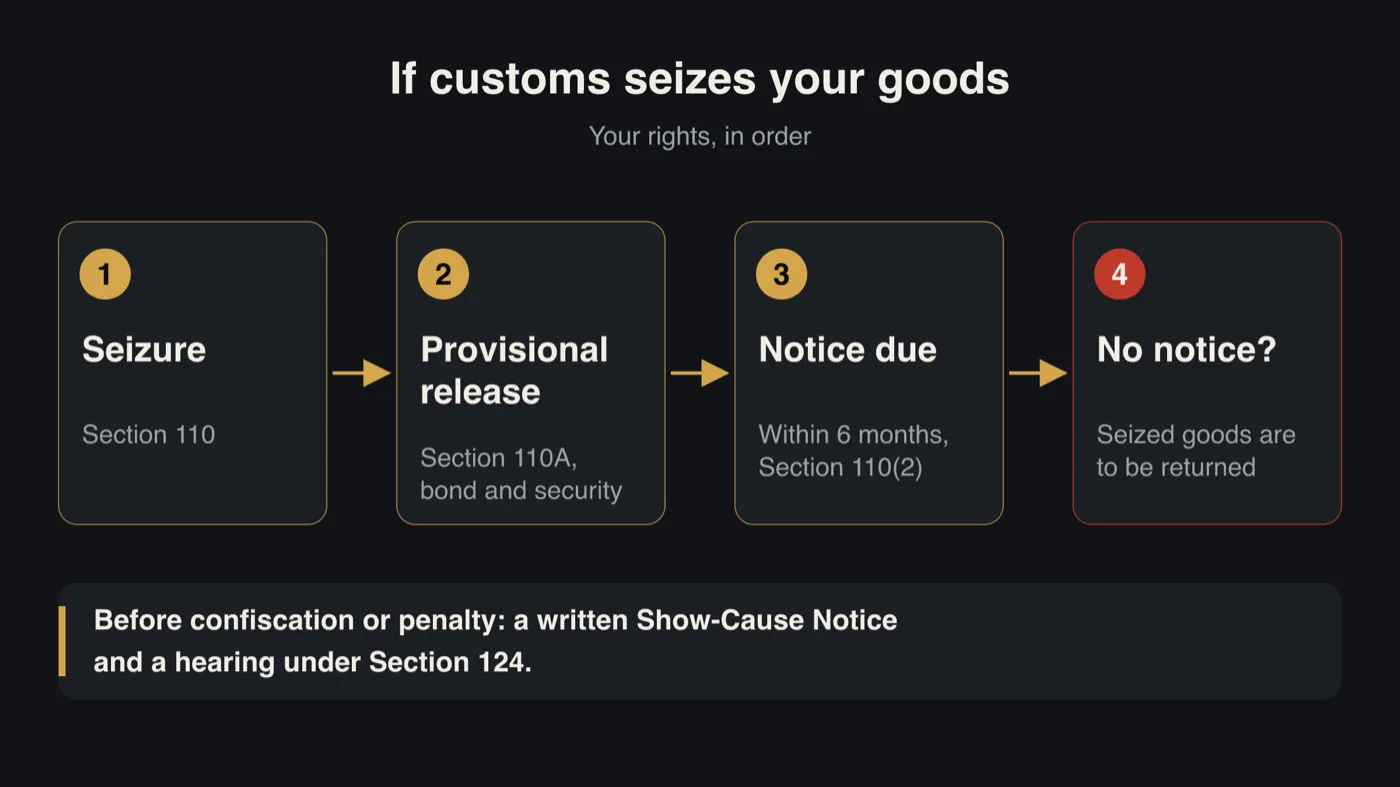
After a seizure, the notice is ordinarily due within six months under Section 110(2), extendable by up to six months for sufficient cause. If it is not issued in time, the seized goods are to be returned.
You file a written reply and appear before the Adjudicating Authority. Valuation, classification, exemption notifications and procedural lapses are usually raised here. Where IGST is also in question, see the GST notice page.
The authority decides on duty, confiscation, redemption fine and penalty. Section 28(9) fixes outer time limits for deciding certain duty notices.
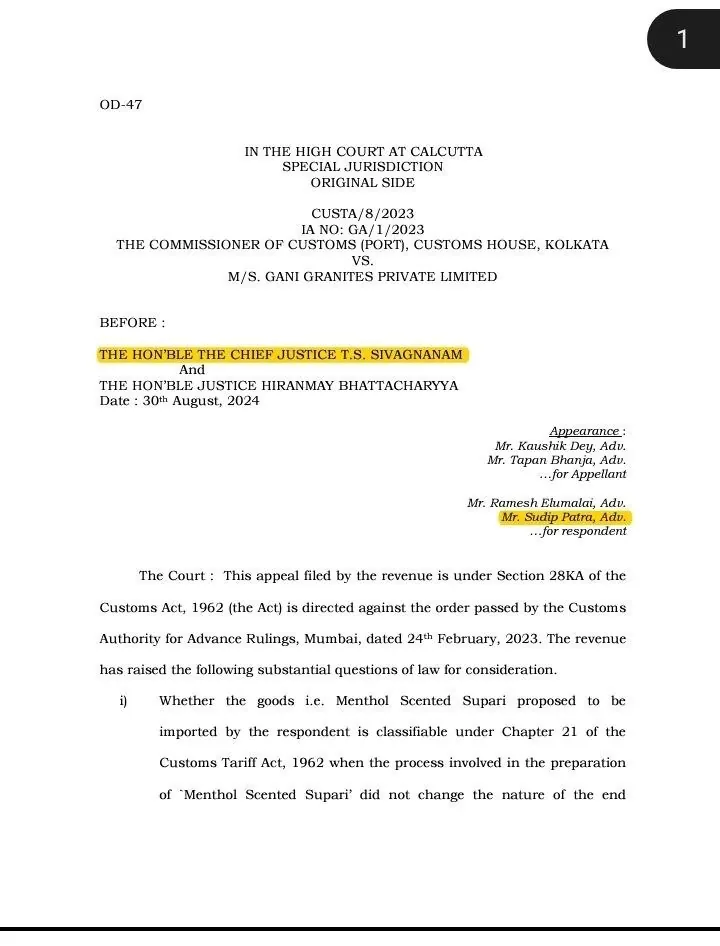
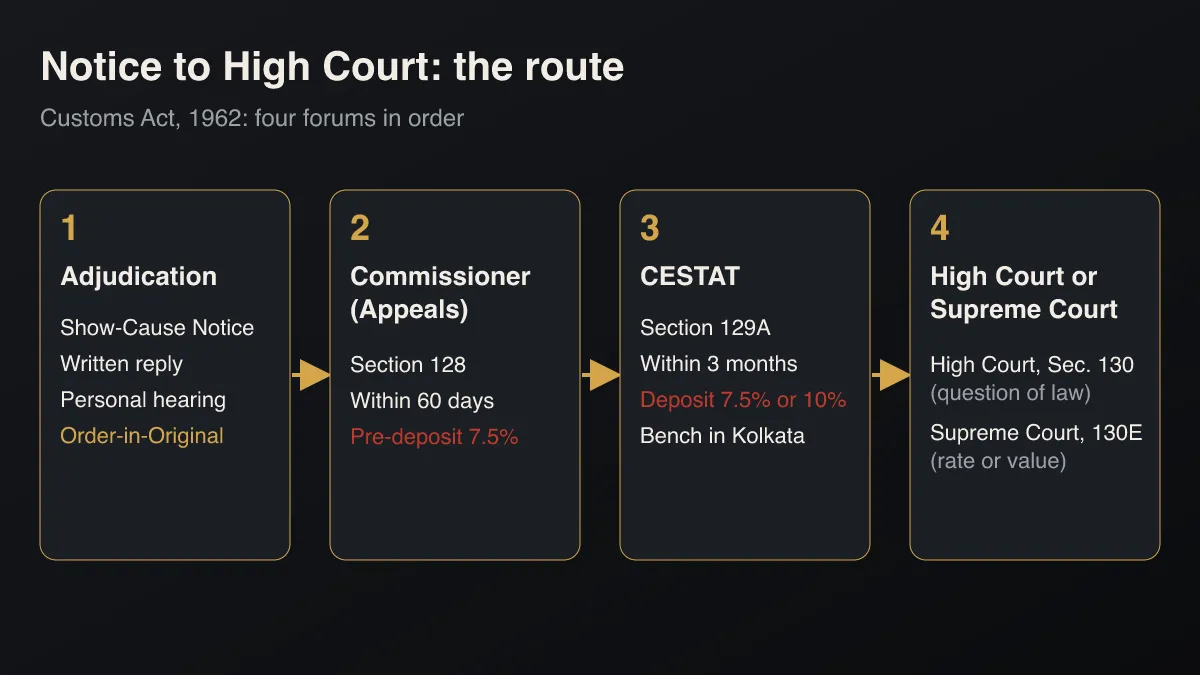
The first appeal is to the Commissioner (Appeals), then to CESTAT. A further appeal on a substantial question of law lies to the Calcutta High Court, and then to the Supreme Court.
Three things to keep in mind. Tap a card
A statement given to a customs officer under Section 108 can be relied on later, subject to Section 138B. Read it fully and correct anything wrong before you sign.
Section 124 requires a written Show-Cause Notice and a chance to be heard before goods are confiscated or a penalty is imposed. A missing or defective notice is a ground to challenge the order.
Provisional release can be sought under Section 110A on a bond and security. If no notice follows within the Section 110(2) period, the goods are to be returned.
Customs and import-export matters we handle
Detained or seized consignments
Challenging detention or seizure at the Kolkata port or airport, seeking provisional release on bond and security under Section 110A, and watching the six-month notice period under Section 110(2), after which seized goods are to be returned if no notice is issued.
Show-Cause Notices and adjudication
Replies to notices demanding duty under Section 28 or proposing confiscation and penalty under Section 124, with a request for relied-on documents, cross-examination where needed, and a personal hearing before the Adjudicating Authority.
Appeals and writ petitions
Appeals to the Commissioner (Appeals) under Section 128 and CESTAT under Section 129A, with the pre-deposit under Section 129E, and High Court or Supreme Court proceedings on a question of law, jurisdictional error or breach of natural justice.
DRI summons, statements and arrest
Representation during summons under Section 108, review of panchnamas and search authorisations, and advice on arrest under Section 104 and anticipatory bail under Section 482 of the BNSS, in light of the Supreme Court’s 2025 ruling on arrest safeguards.
Classification, valuation and trade policy
- Tariff classification and valuation disputes, including exemption notifications
- Import-Export Code (IEC) registration and maintenance
- Advice on the Foreign Trade Policy (FTP) and related schemes
- Matters involving the Directorate of Revenue Intelligence (DRI), including gold and duty-evasion allegations
- Quashing of proceedings, stay of arrest and release of seized assets
- Related GST notices arising from the same trade transactions
Supreme Court rulings a customs lawyer relies on in Kolkata
These decisions settle who may issue a customs notice, when an old demand can be reopened, how exemptions and prohibited goods are read, and what protects a person facing arrest. Each citation below has been checked against published reports.
2025
Arrest safeguards apply to customs officers
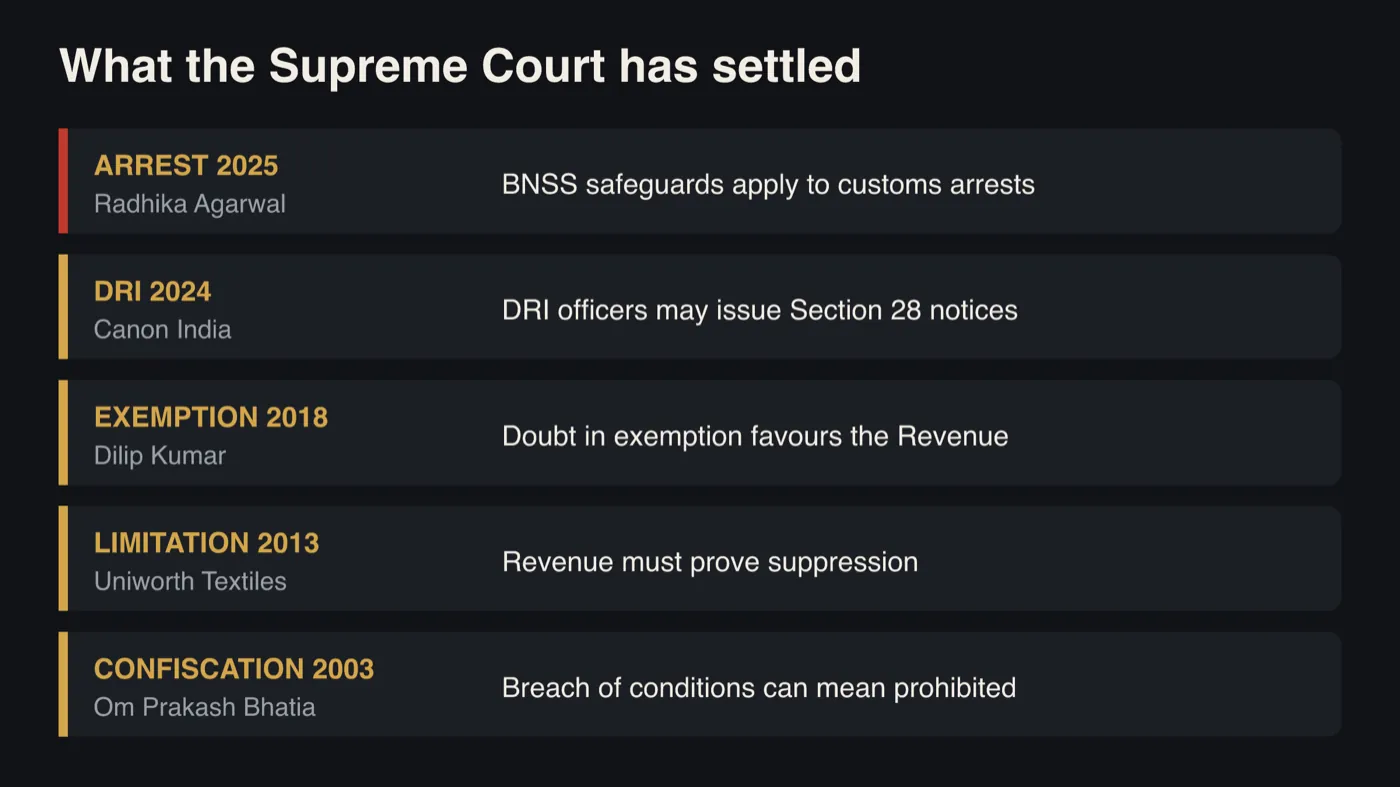
A three-judge Bench upheld the power of arrest under Section 104 of the Customs Act, 1962 but bound it with safeguards. The officer must record a reason to believe in writing, based on material and not suspicion, and must give the grounds of arrest in writing. The CrPC, now the BNSS, applies unless expressly excluded. Customs officers are not police officers.
2024
DRI officers may issue Section 28 notices
On review, the Supreme Court set aside its 2021 Canon India ruling and held that officers of the Directorate of Revenue Intelligence are proper officers who can issue show cause notices under Section 28. The Court left the earlier observations on limitation untouched, so a challenge to a DRI demand now has to rest on limitation, the facts or the merits.
2018
Exemption notifications are read strictly
A Constitution Bench overruled Sun Export Corporation. The importer who claims an exemption or concessional rate must prove that the goods fall within it. Where the wording of a notification is ambiguous, the benefit of the doubt goes to the Revenue, not the importer. A classification or exemption claim therefore needs complete papers from the day the Bill of Entry is filed.
2021
Release of restricted goods is discretionary
Pulses imported after the notified cut-off were held to be prohibited goods liable to confiscation under Section 111(d). The Court set aside a High Court order releasing them and held that an importer who lacks bona fides cannot claim relief in equity. It allowed re-export only after a redemption fine was paid, so the discretion under Section 125 has to be used on reasons.
2003
Breach of import conditions makes goods prohibited
Section 11 lets the Central Government prohibit imports or exports absolutely or subject to conditions. The Court held that goods imported or exported without meeting the prescribed conditions can be treated as prohibited goods under Section 2(33). Customs still relies on this ruling to confiscate gold and restricted goods, so the import conditions have to be proved before clearance is argued.
2013
Revenue must prove suppression for extended period
The case arose under the proviso to Section 28 of the Customs Act. The Supreme Court held that mere non-payment of duty is not collusion, wilful misstatement or suppression of facts. The burden of proving deliberate conduct lies on the Revenue, and the show cause notice must state specific allegations. Without them, a demand beyond the normal period fails on limitation.
How a customs case moves from the port to the High Court
Detention or seizure under Section 110
Officers at the Kolkata port or airport may detain or seize goods under Section 110 of the Customs Act, 1962. Ask for the seizure memo and panchnama and check every date and item. Provisional release can be sought under Section 110A, usually on a bond and security or bank guarantee set by the officer.
Show cause notice under Section 124 or Section 28
After a seizure, the notice is ordinarily due within six months under Section 110(2), extendable by up to six months for sufficient cause. If it is not issued in time, the goods are to be returned. A duty demand is made under Section 28, normally within two years, or five years where suppression is alleged.
Written reply and personal hearing
File a complete reply with invoices, contracts, test reports and earlier assessments. Ask for every document relied on, and for cross-examination where the notice rests on another person’s statement. Section 124 requires a hearing before confiscation or penalty, and the adjudicating authority must deal with each point in the order-in-original.
Appeal to Commissioner (Appeals) under Section 128
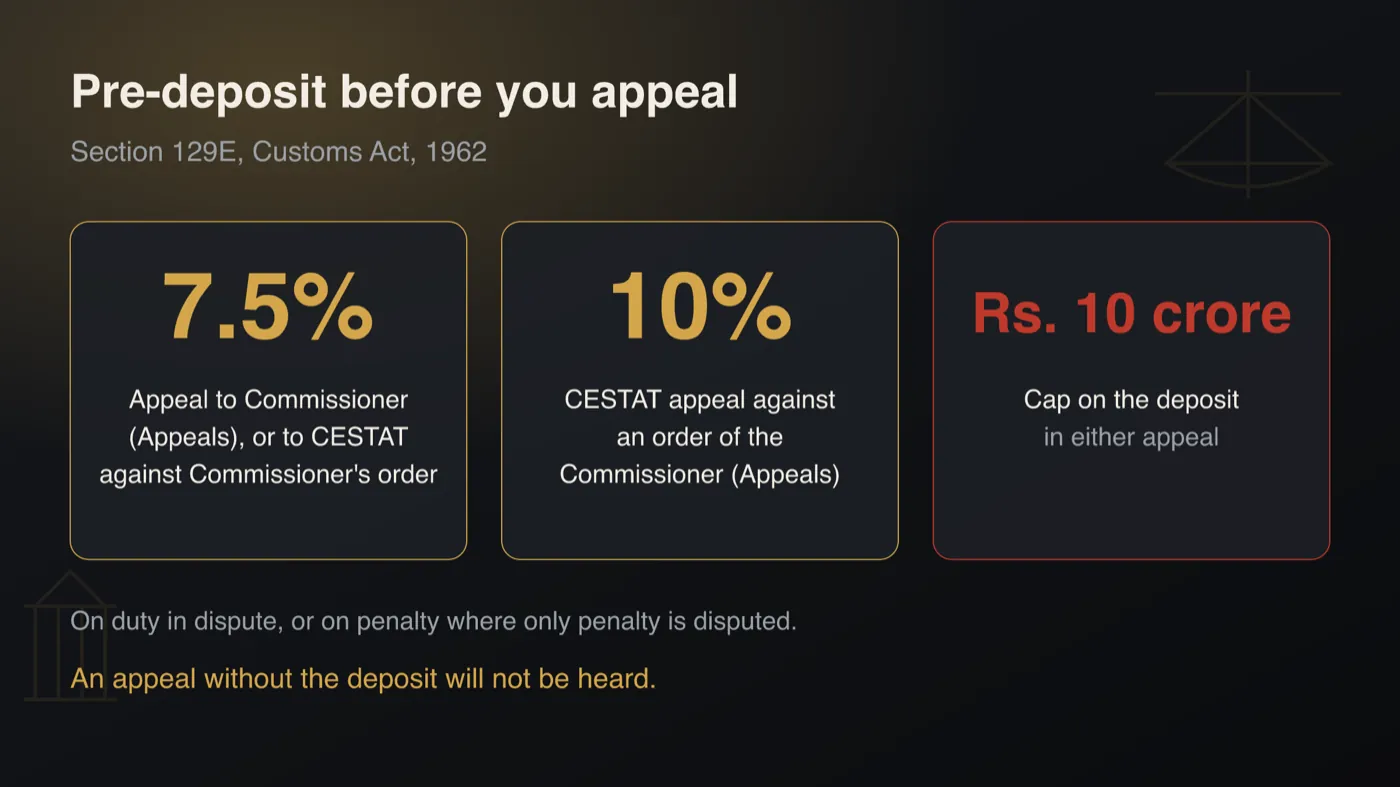
An order of an officer below the rank of Commissioner is appealed to the Commissioner (Appeals) within 60 days of communication. A further 30 days can be allowed for sufficient cause. Under Section 129E, 7.5% of the disputed duty, or of the penalty where only penalty is disputed, must be deposited before the appeal is heard.
Appeal to CESTAT Kolkata under Section 129A
An appeal against an order of the Commissioner or the Commissioner (Appeals) goes to the Eastern Zonal Bench of CESTAT at Kolkata within three months. The pre-deposit is 7.5% against a Commissioner’s order and 10% against an order of the Commissioner (Appeals), capped at Rs. 10 crore. Verify the current rule on your order.
High Court, Supreme Court or writ
An appeal on a substantial question of law lies to the High Court under Section 130. Rate of duty and valuation questions go to the Supreme Court under Section 130E; see Supreme Court matters. A writ in the Calcutta High Court suits a lack of jurisdiction or a breach of natural justice.
Papers to gather when a Show-Cause Notice arrives
Having these at hand makes a reply faster and more accurate.
Note the sections invoked, the date for reply and the date of any hearing.
The declaration of value, classification and exemption claimed is the starting point.
These support the declared value and the description of the goods.
Check the date, time, witnesses and list of goods against what actually happened.
Compare it with the allegations and mark anything you wish to explain.
Ask in writing for every document the notice depends on, including test reports.
Proof of payment and duty already paid can answer valuation allegations.
Mandatory pre-deposit for a customs appeal, Section 129E of the Customs Act, 1962 (on the duty in dispute, or on the penalty where only penalty is in dispute; capped at Rs. 10 crore)
Mistakes that weaken a customs case
Signing a Section 108 statement without reading it A statement given to a customs officer can be used later as evidence. Read it in a language you understand, ask for corrections before signing, and record in writing anything you disagree with.
Letting the Section 110(2) period pass unnoticed If no show cause notice follows a seizure within six months, or within an extension granted for sufficient cause, the goods are to be returned. Keep the seizure date and ask in writing for release once the period ends.
Missing the appeal limit or the pre-deposit The 60-day limit under Section 128 can be extended only by 30 days, and an appeal without the Section 129E deposit will not be heard. Count the days from the date the order was communicated, not the date it was signed.
Going straight to a writ instead of the statutory appeal The High Court usually expects the appeal route to be used first, unless the officer lacked jurisdiction or natural justice was breached. A writ filed on merits alone may be dismissed, and the appeal time keeps running meanwhile. Where the same import also raises a tax notice, see our GST notice page.
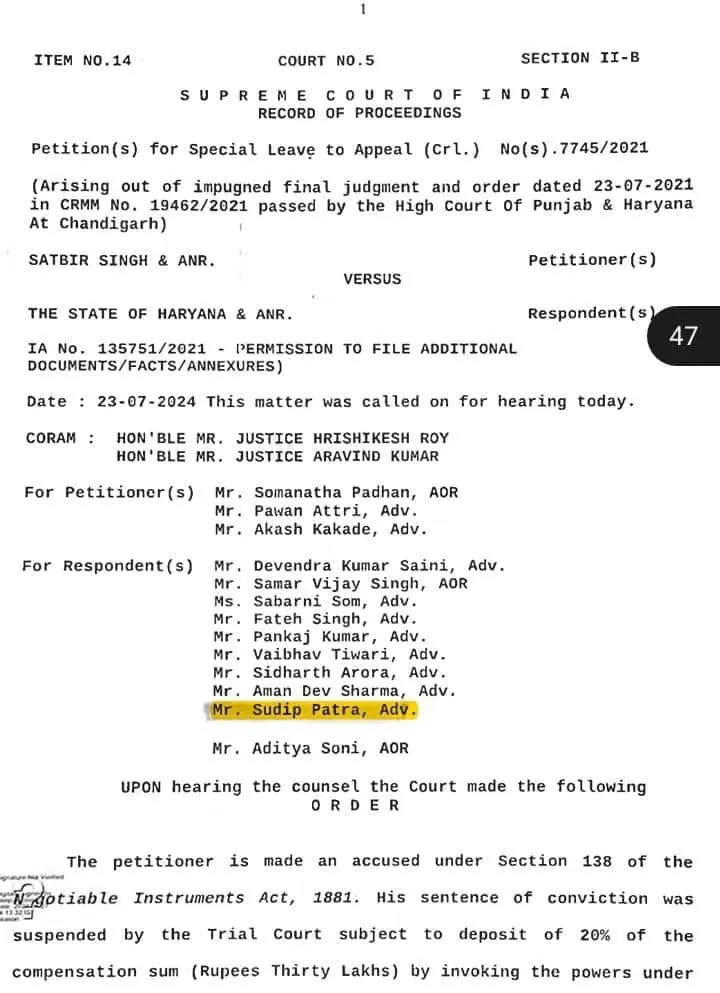
From our practice



Speak to a customs lawyer about your notice or consignment
If goods are detained, a Show-Cause Notice has arrived or an order is about to cross its appeal limit, bring the papers to chambers. We read the notice, the seizure memo and the order, explain the forum, the time limits and the usual route, and tell you plainly what the documents show. Offices in Kolkata, near the Calcutta High Court, and in Delhi. No result can be promised, and advice follows only after the papers are seen.
Book a ConsultationEstablished by a distinguished alumnus of IIT Kharagpur, Patra’s Law Chambers stands as a beacon of legal expertise in Kolkata & Delhi. Know more →

Kolkata Office
NICCO House, 6th Floor, 2 Hare Street
Kolkata-700001 (Near Calcutta High Court)
Delhi Office
4455/5, First Floor, Gali Shahid Bhagat Singh
Main Bazar Road, Paharganj, New Delhi-110055
Contact
[email protected]
+91 890 222 4444 / +91 7003 715 325
The longest windows at each customs step
Periods are counted from the dates set in the Act, so verify the start date on your own order.
Frequently asked questions about customs matters in Kolkata
Read the allegations, the sections invoked and the listed documents. Note the date for reply or hearing and do not ignore it. Section 124 requires a hearing before penalty, so file a written reply on time and ask for the documents relied on.
In many cases, yes. Section 110A allows provisional release of seized goods, usually on a bond and security or bank guarantee. The conditions are set by the officer and depend on the goods and the allegation, so verify them for your case.
To the Commissioner (Appeals), generally 60 days from communication of the order under Section 128, with up to 30 more days if sufficient cause is shown. To CESTAT under Section 129A, generally 3 months. Verify the dates on your order.
Generally yes. Section 129E requires a percentage of the disputed duty or penalty to be deposited: 7.5% for the Commissioner (Appeals) and 10% for CESTAT, each subject to a cap. Check the current rule and your order’s figures.
Section 104 of the Customs Act, 1962 allows arrest where an officer has reason to believe an offence has been committed. Whether the offence is bailable depends on its nature. Anticipatory bail can be sought under Section 482 of the BNSS.
A statement under Section 108 can be used as evidence, so read it carefully in a language you understand. Ask for corrections before signing and note in writing if you disagree. Speak to a lawyer before you attend if you can.
Yes. Customs duty and GST on imports often arise together, and IGST is levied at the time of import. For the tax-side notices, see the GST notice page. Each matter is assessed on its own papers.
Writ petitions on customs matters can be filed in the High Court under Article 226 in suitable cases, such as a jurisdictional error or breach of natural justice. Courts usually expect the statutory appeal route to be used first.