GST Cancellation in India: REG-16, REG-17 and Revocation
Cancellation of GST registration can be applied for by the taxpayer or started by the tax officer. This page explains how each route works under Section 29 of the CGST Act, 2017, which forms apply, and what to do after a cancellation order. Our advocates in Kolkata and Delhi advise on replies to notices, revocation and appeals.
What GST cancellation means and who can start it
Under Section 29 of the Central Goods and Services Tax Act, 2017, a registration can be cancelled in two ways. A registered person may apply for it, usually by Form GST REG-16 under Rule 20 of the CGST Rules, 2017, when the business is closed, transferred, merged or the person is no longer liable to be registered. The proper officer may also cancel it on their own (suo moto), but only after a show cause notice in Form GST REG-17 and a chance to reply. The steps are filed on the official GST portal.
Cancellation has real consequences. The final return in Form GSTR-10 must be filed, and input tax credit on stock and capital goods must be reversed or paid under Section 29(5). Dues stay recoverable even after the registration ends. If a registration is cancelled without a fair hearing or on a thin ground, remedies exist: revocation under Section 30, an appeal under Section 107, and, where there is a clear breach of natural justice, a writ before the Calcutta High Court. For notices and demands connected with GST, see our GST notice advocate page. Dates and forms change by notification, so verify the current position for your case.
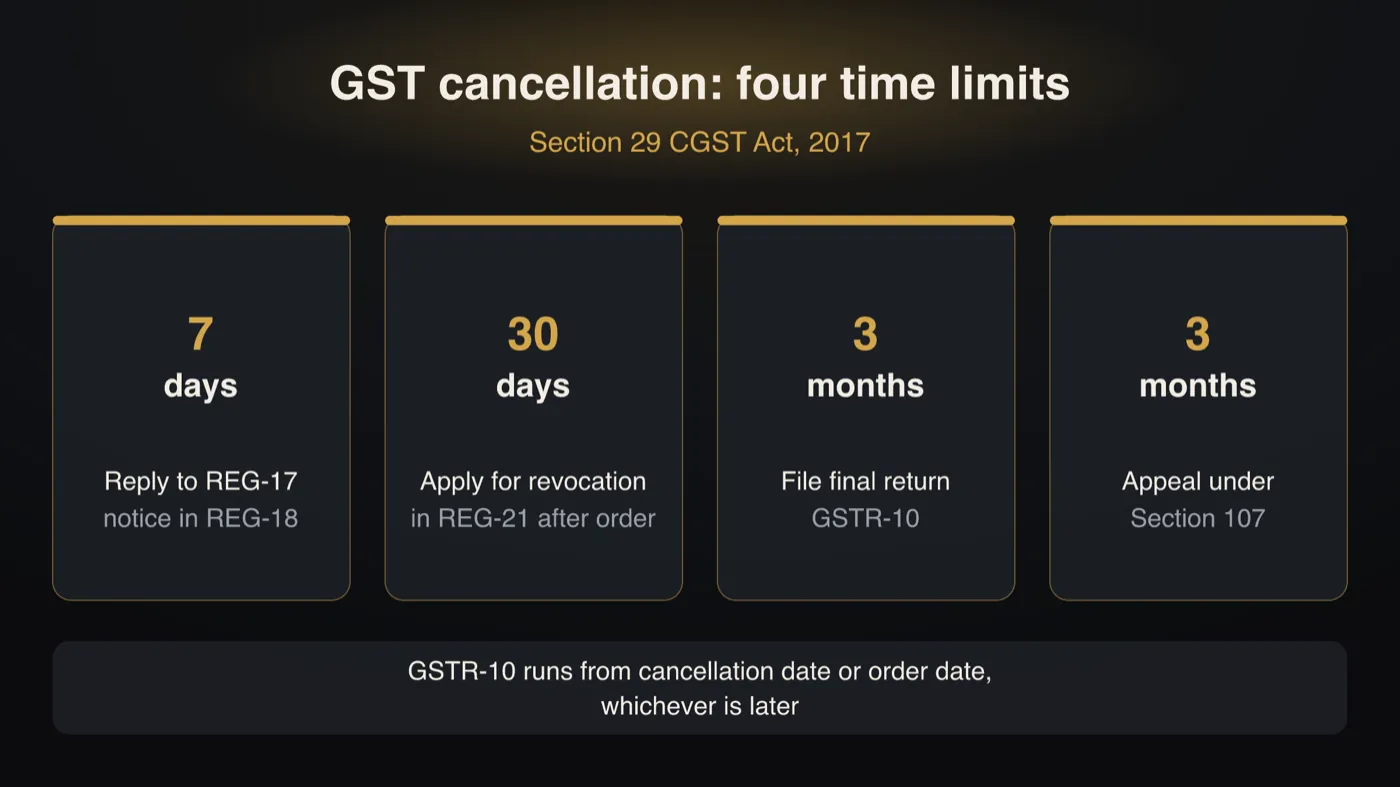
The clocks that start running in GST cancellation
Each period below runs from a different event, so note the date on your own notice or order.
Short explainers from Adv. Sudip Patra
More short explainers on our YouTube channel: Patra’s Law Chambers on YouTube ↗
What is your GST registration situation right now?
Pick the line that matches your latest position on the GST portal. This is general information, not advice, and the exact remedy depends on your papers.
Choose one of the options above.
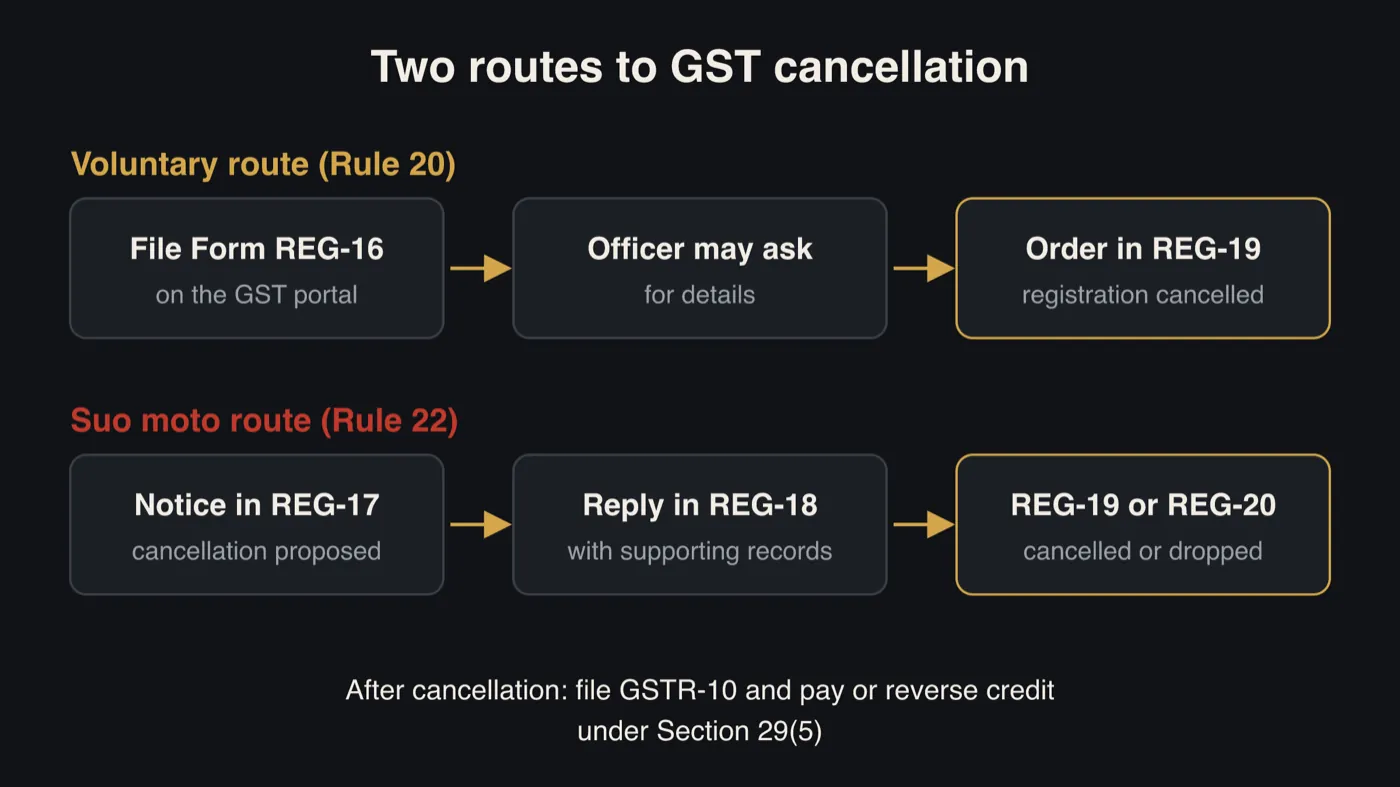
How GST cancellation usually moves
The path differs for voluntary and officer-initiated cancellation, but the stages below are the common ones. Dates depend on your own notice and order.
You apply in Form GST REG-16, or the officer finds a ground under Section 29(2) such as non-filing of returns for six continuous months. Registration may be suspended in the meantime.
For officer-initiated cases, a notice in Form GST REG-17 states the grounds and the hearing date. Our GST notice advocate page explains how notices of this kind are handled.
A reply in Form GST REG-18 is due within seven working days of service of the notice. Filing the pending returns and attaching proof of business activity are the usual steps.
The officer passes an order cancelling the registration, or drops the proceedings in Form GST REG-20. A cancellation order should give reasons and the effective date.
Form GSTR-10 must be filed and any tax payable cleared. Input tax credit on stock is reversed under Section 29(5).
Revocation in Form GST REG-21 is available within 30 days of the order. If it is refused, an appeal lies under Section 107, and in a fitting case a writ before the Calcutta High Court may be considered.
Three things people often miss, tap a card
Section 29(3) says cancellation does not affect liability for tax or other dues for the period before cancellation. Pending returns and demands still have to be dealt with.
If you do not reply to Form GST REG-17 within seven working days, the officer can decide on the material available. Replying with documents keeps your side on record.
An e-way bill can generally be cancelled within 24 hours of generation if goods are not moved as stated, and not once verified by an officer. It is different from cancelling the registration.

How we assist with GST registration cancellation
Voluntary cancellation
We review whether cancellation is the right step, prepare the REG-16 application with the reason, date and stock and credit details, and respond to any query from the officer. Pending returns and dues are checked first, since an application can be held up until they are cleared.
Reply to a show cause notice
A REG-17 notice gives the grounds on which cancellation is proposed. We study the notice, collect the supporting records, draft the reply and, where needed, appear at the personal hearing so the taxpayer’s case is properly placed before the officer.
Revocation of cancellation
If the officer cancelled a registration on their own, an application for revocation can be made within the time allowed. We check the order, the ground relied on, the date of service and whether any delay can be explained, then prepare the application.
Appeals and writ remedies
Where revocation is refused or the order was passed without a proper hearing, an appeal before the Appellate Authority may be the route. In suitable cases a writ petition before the High Court is considered. The forum depends on the facts and the order.
Typical GST cancellation process
- Voluntary route: file Form GST REG-16 on the portal; the officer may call for details before passing an order in Form GST REG-19.
- Suo moto route: show cause notice in Form GST REG-17, reply in Form GST REG-18, then an order in Form GST REG-19 or REG-20 (proceedings dropped).
- Common grounds for suo moto action under Rule 21: non-filing of returns for the prescribed period, no business at the declared place, or registration obtained by fraud or wilful misstatement.
- After cancellation: file GSTR-10, pay or reverse credit under Section 29(5), and clear outstanding tax.
- Cancelled by the officer: consider revocation in Form GST REG-21 within the time allowed by Section 30.
- Check status on the GST portal using the ARN or by logging in to your account.
What the High Courts have said on GST cancellation
Most GST cancellation disputes turn on two questions: did the show cause notice and the order give real reasons, and can the registration be restored once the taxpayer has made good the default? These High Court decisions are the ones taxpayers and officers rely on most often.
2022
A cancellation order with no reasons fails
The Gujarat High Court quashed a show cause notice and a cancellation order because neither gave any reasons or details. A taxpayer cannot answer a notice that does not say what is alleged. The Court sent the matter back for a fresh hearing and said that notices and orders under Section 29 of the CGST Act must contain reasons. Many later decisions follow this ruling.
2022
Restoration allowed on conditions even after time ran out
Registrations had been cancelled for not filing returns, and the time for revocation or appeal had passed. The Madras High Court still allowed restoration if the taxpayers filed every pending return and paid the tax, interest and late fee. The Court said cancelling a registration outright, with no route back, does more harm than good. Later orders often impose the same conditions.
2024
Backdated cancellation needs notice and reasons
The Delhi High Court set aside a registration cancelled with backdated effect. The show cause notice had never proposed backdating, and the order gave no reasons for it. The Court also said that missed returns alone do not justify cancelling a registration from a past date. The officer may still recover tax, interest or penalty in accordance with law.
2024
Small trader given a chance to restore registration
A small retailer’s registration had been cancelled for not filing returns for more than six months. The Division Bench allowed restoration if all overdue returns were filed and the tax, interest, fine and penalty were paid within the time it fixed. Single judges of the Calcutta High Court regularly follow this decision in cancellation writs from West Bengal.
2024
Revocation allowed after the amnesty window closed
The registration had been cancelled for not filing returns. The petitioner missed the 30 June 2023 deadline for the special revocation window under CBIC Notification No. 03/2023-Central Tax. The Jharkhand High Court still allowed a revocation application to be filed within a fixed time, subject to clearing the dues. Read the order itself for the exact conditions before relying on it.
The GST cancellation process, step by step
1. Apply in Form GST REG-16 (voluntary cancellation)
Under Section 29(1) of the CGST Act and Rule 20 of the CGST Rules, you apply on the GST portal in Form GST REG-16. The form asks for the reason (closure, transfer, change of PAN, or turnover below the limit), the date you want the cancellation to take effect, and details of stock held, whether inputs, semi-finished or finished goods. Keep the ARN to track the application.
2. Show cause notice in Form GST REG-17 (officer's action)
If the officer believes the registration should be cancelled under Section 29(2), for example because returns have not been filed for the period set in the rules, or because the registration was obtained by fraud, the officer must first issue a show cause notice in Form GST REG-17 under Rule 22(1). The registration may be suspended in the meantime under Rule 21A. Check that the notice states its reasons.
3. Reply in Form GST REG-18 within 7 working days
Answer the notice in Form GST REG-18 within seven working days of service, attach the documents that support you, and ask for a personal hearing. If the default is late returns, file the pending returns and pay the dues before you reply. If the reply is accepted, the officer drops the proceedings by an order in Form GST REG-20.
4. Cancellation order in Form GST REG-19
If the officer cancels the registration, whether on your application or on their own action, the order is issued in Form GST REG-19. Under Rule 22(3) it should come within 30 days of your application or of your reply. Check the date from which the cancellation takes effect. Backdated cancellation without reasons is open to challenge.
5. Pay what Section 29(5) requires and file GSTR-10
Under Section 29(5), you must pay back the input tax credit on stock and capital goods held on the day before cancellation, or the output tax on them, whichever is higher. Under Section 45, file the final return in Form GSTR-10 within three months of the date of cancellation or of the order, whichever is later. If you do not, a notice and late fee follow.
6. Revocation in Form GST REG-21, or an appeal
If the officer cancelled the registration on their own action, you can apply for revocation in Form GST REG-21 under Section 30 and Rule 23 after filing the pending returns and paying the dues. Check the current time limit on the portal before you file. An appeal under Section 107 lies to the Appellate Authority, and a writ lies to the High Court. Speak to a GST notice advocate or a Calcutta High Court advocate before the time runs out.
From notice to revocation at a glance
The usual order of events when the officer starts the proceedings.
Notice REG-17 issued
The officer states the ground and the date for reply or hearing.
Reply in REG-18
You answer within seven working days with supporting documents.
Order passed
The registration is cancelled in REG-19, or the case is dropped in REG-20.
Revocation in REG-21
You apply within 30 days of service of the order.
Appeal if refused
An appeal under Section 107 lies against the rejection order.
Mistakes that cost GST taxpayers their registration
Ignoring the REG-17 notice or replying late The reply window is only seven working days. If you do not reply, the officer can cancel and record that no reply was received, and a remedy may then mean an appeal or a writ.
Not checking the date the cancellation takes effect Backdated cancellation can undo the input tax credit your buyers have claimed and lead to demands against them. Read Form GST REG-19 for the effective date, and challenge it if the notice never proposed backdating or gave reasons for it.
Treating cancellation as the end of GST liability Cancellation does not wipe out tax, interest or penalty for earlier periods (Section 29(3)). You still have to file GSTR-10 and make the Section 29(5) payment.
Letting the revocation and appeal deadlines pass Revocation under Section 30 and an appeal under Section 107 both have time limits. Courts have sometimes helped late applicants on strict conditions, but relief is discretionary, so act within time and keep proof of service. For tax matters linked to the same business, see the income tax lawyer page.
Discuss your GST cancellation with our advocates
Whether you want to close a registration properly, have received a REG-17 notice, or your registration has already been cancelled, the first step is to read the notice or order and note the dates. Bring the notice, return history and portal screenshots to a consultation. We will explain the options under the CGST Act. You can also read about our wider business legal services. Offices: Nicco House, 2 Hare Street, Kolkata 700001, and Paharganj, New Delhi 110055. Email [email protected]. No result can be promised in any matter.
Book a ConsultationEstablished by a distinguished alumnus of IIT Kharagpur, Patra’s Law Chambers stands as a beacon of legal expertise in Kolkata & Delhi. Know more →

Kolkata Office
NICCO House, 6th Floor, 2 Hare Street
Kolkata-700001 (Near Calcutta High Court)
Delhi Office
4455/5, First Floor, Gali Shahid Bhagat Singh
Main Bazar Road, Paharganj, New Delhi-110055
Contact
[email protected]
+91 890 222 4444 / +91 7003 715 325
Voluntary cancellation or officer-initiated cancellation
The starting point, form and follow-up differ in the two cases.
Frequently asked questions about GST cancellation
You can apply for voluntary cancellation by filing Form GST REG-16 on the GST portal under Rule 20 of the CGST Rules. State the reason for cancellation and give details of inputs held in stock, semi-finished goods or finished goods on the date of cancellation.
Section 29(2) of the CGST Act lists the grounds. They include not filing returns for a continuous period of six months, not starting business within six months of voluntary registration, and registration obtained by fraud or wilful misstatement. A notice in Form GST REG-17 is issued first.
It is the show cause notice issued when the officer believes your registration is liable to be cancelled. Under Rule 22, you can reply in Form GST REG-18 within seven working days of service, explaining why the registration should not be cancelled.
You stop collecting tax and filing regular returns, but must file the final return in Form GSTR-10 within three months of the date of cancellation or of the order, whichever is later. Pending dues remain payable, and input tax credit on stock is reversed.
Yes. Section 30 of the CGST Act allows an application in Form GST REG-21 within 30 days of service of the cancellation order. The time can be extended in limited cases by senior officers. The application must show sufficient reasons, and returns should be brought up to date.
Log in to the GST portal and use the application status option with your ARN (Application Reference Number), or check the notices and orders section of your dashboard. The cancellation order itself is issued in Form GST REG-19 or REG-20.
Cancellation does not remove past liability. Not filing GSTR-10, leaving dues unpaid or not reversing input tax credit on stock can lead to interest, penalty and recovery action under the CGST Act. Verify the exact consequence against your own case.
Not necessarily. If the closure is short, you can continue to file nil returns while the registration stays active. Where the closure is long or indefinite, cancellation may be considered. Check your turnover, stock and pending returns before deciding.