Income Tax Filing in India: Accurate, On-Time Returns
Patra’s Law Chambers helps individuals, professionals and businesses prepare and e-file income tax returns, and stands by them if a notice or demand follows. We explain each step in plain English so you know what is being filed in your name.
What income tax filing means and why accuracy matters
Income tax filing is the yearly process of reporting your income, deductions and tax paid to the Income Tax Department by filing a return. Under the Income-tax Act, 1961, the return is filed under section 139 for the assessment year that follows the financial year in which you earned the income. The Income-tax Act, 2025 has replaced the 1961 Act for tax years beginning on or after 1 April 2026, so the section numbers depend on the year being filed. Please verify the correct provision for your year before relying on any section number. The official e-filing portal is incometax.gov.in.
A return that is accurate and filed on time protects you from late fees, interest and avoidable notices. It also supports refund claims, loan and visa applications, and proof of income. A mismatch between your return and the data the department already holds (Form 26AS, the Annual Information Statement, TDS and bank interest) is a common reason for a notice. If you have already received one, see our page on income tax lawyer consultation in Kolkata. Each case turns on its own facts, and we do not promise any outcome.
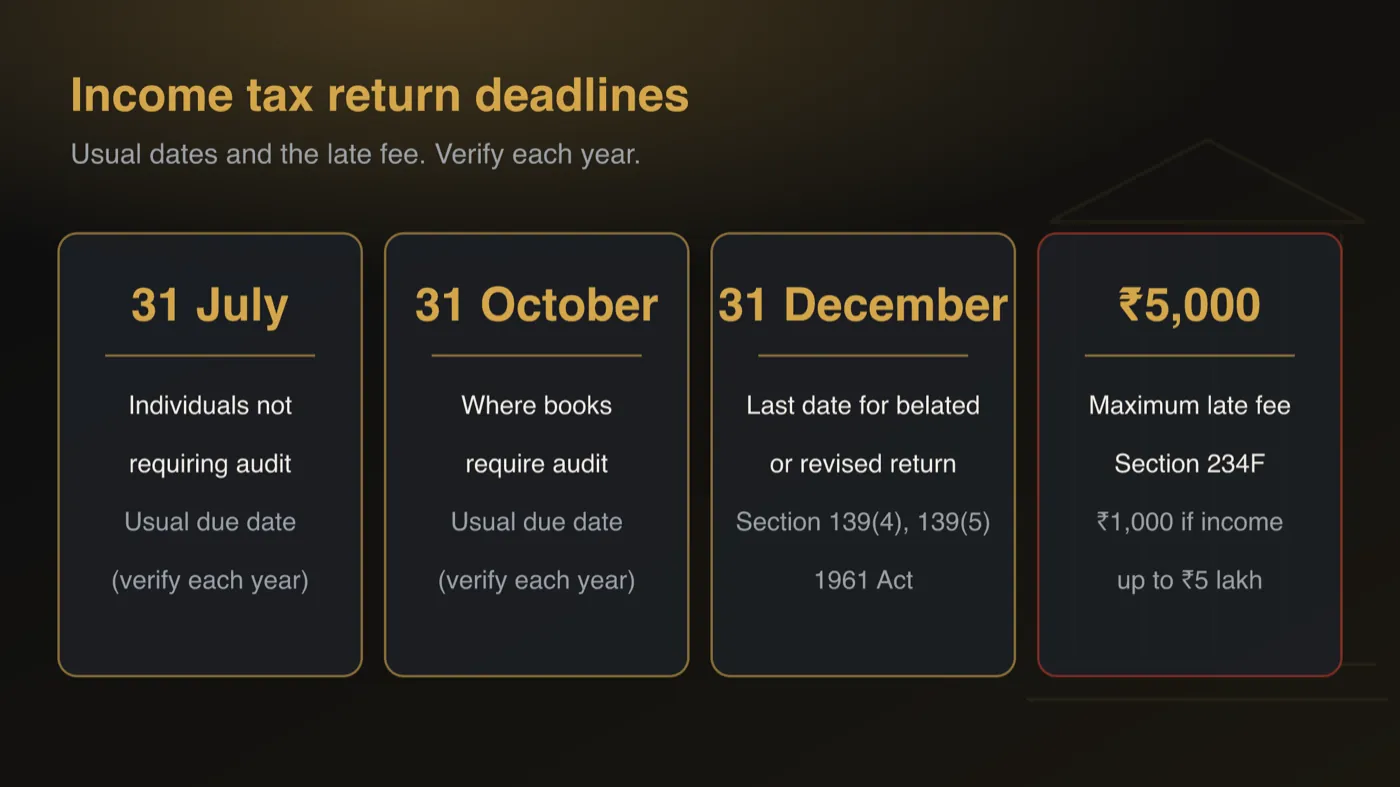
Four income tax time limits worth remembering
These are the main statutory periods; each runs from a different starting point, so verify yours.
Short explainers from Adv. Sudip Patra
More short explainers on our YouTube channel: Patra’s Law Chambers on YouTube ↗
What is your income tax return situation right now?
Pick the one that is closest to your position. This is general information, not advice. Dates and forms change, so verify on the official portal or with a lawyer before acting.
Choose one of the options above.
How an income tax return moves from filing to closure
A general outline for a salaried or small business taxpayer under the Income-tax Act, 1961. Your case may differ, so verify the timelines for your year.
Gather Form 16, Form 26AS, the Annual Information Statement (AIS), bank interest certificates, rent and investment proofs. Match them against each other before choosing the return form (ITR-1 to ITR-7).
File online under section 139(1) on the official e-filing portal. Taxpayers needing a tax audit under section 44AB generally have a later date, usually 31 October.
A return is not treated as valid until it is verified by Aadhaar OTP, net banking, EVC or a signed ITR-V. Missing this step is a common reason a return is treated as not filed.
The Centralised Processing Centre processes the return and sends an intimation with any refund or demand. If you disagree, you can file a rectification under section 154 or respond to the demand.
A notice under section 143(2) or section 148 needs a timely, documented reply. Our Income Tax Lawyer Kolkata page explains how notices and appeals are handled, and our GST lawyer page covers indirect tax notices.
An adverse assessment order can be appealed to the Commissioner of Income Tax (Appeals) in Form 35. Further appeals lie to the Income Tax Appellate Tribunal and, on a substantial question of law, the High Court.
Three points that often surprise taxpayers, tap a card
A return that is filed but not e-verified within the time allowed can be treated as invalid. Always keep the acknowledgement and the verification confirmation.
Apart from the section 234F fee and section 234A interest, filing after the due date can mean certain losses cannot be carried forward. Verify how this affects your income heads.
The intimation is based on the department’s data, which can differ from yours. Check it against Form 26AS and AIS before paying or accepting.

How we help with income tax returns
Preparation and e-filing of ITR
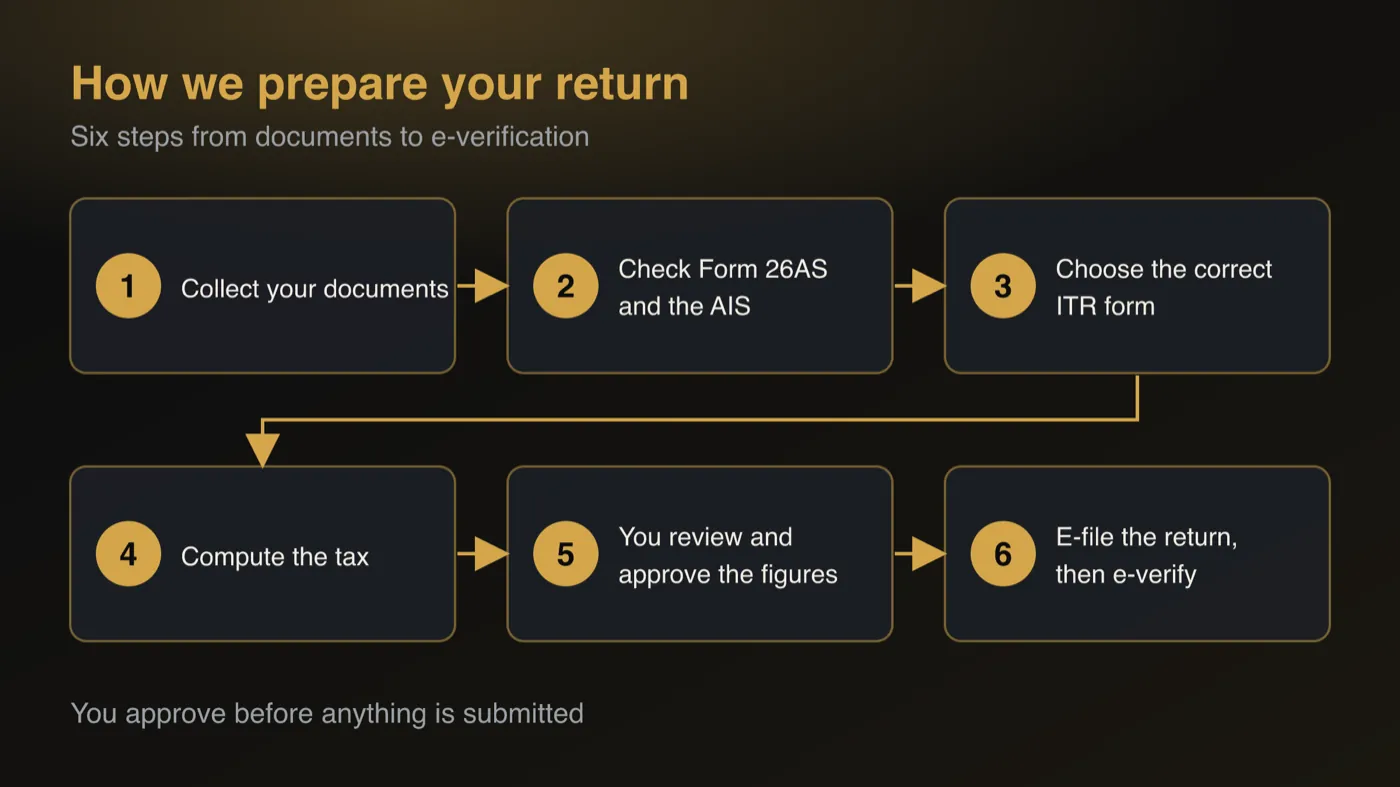
We collect your documents, check them against Form 26AS and the Annual Information Statement, choose the correct ITR form, compute the tax and e-file the return. You review and approve the figures before anything is submitted, and we then help with e-verification.
Revised and belated returns
If you missed the due date or noticed an error or omission after filing, a belated or revised return may be possible within the time the Act allows. We explain the late fee under section 234F and the interest under sections 234A, 234B and 234C before you file.
Replies to income tax notices
Intimations under section 143(1), defective return notices, mismatch queries and demand notices all carry short response periods. We read the notice, check the facts and prepare a reply. See also our video on income tax demand notices from our own channel.
Planning, audits and appeals
We advise on lawful deductions and the choice between tax regimes, assist with tax audit queries, and support appeals against assessment orders. Where a High Court writ becomes necessary, we coordinate with our Calcutta High Court advocate consultation service.
Documents usually needed for filing
- Salary slips, Form 16, and bank statements showing interest and other income
- TDS certificates (Form 16A and others) and Form 26AS / Annual Information Statement
- Proof of investments and deductions: LIC, PPF, EPF, medical insurance, education loan, home loan interest
- Rental income details, capital gains statements, and business or professional books where applicable
- Copies of earlier returns and any notices or intimations received
- Details of foreign assets or income, if any, for correct disclosure
What the Supreme Court has said about filing, revising and missing an income tax return
These rulings decide what happens when a return is filed late, when it can be corrected, and when a missed due date becomes a criminal matter. Each one is cited as reported. Read the full judgment before relying on it in your own case.
1996
A belated return could not be revised
The Supreme Court held that a return filed late under section 139(4) of the Income-tax Act, 1961 could not be revised under section 139(5). Under the law as it then stood, only returns filed under section 139(1) or 139(2) could be revised. The Finance Act, 2016 later allowed belated returns to be revised. Still, the ruling shows why filing on time and getting it right the first time matters.
2004
Due time means the section 139(1) date
The Court held that “in due time” in section 276CC means the time fixed by section 139(1), not the extended window for a belated return under section 139(4). Filing a return before the assessment is made does not undo the default of missing the original due date. The officer may still consider prosecution, subject to the conditions in the section.
2006
New deductions need a revised return
The Supreme Court held that an Assessing Officer cannot allow a new deduction claimed only by letter during assessment. A fresh claim has to be made by filing a revised return. The Court made clear this does not limit the Income Tax Appellate Tribunal’s powers under section 254. Every deduction you are entitled to should be in the return itself.
2014
Wilful non-filing can be prosecuted
Section 139(1) is a statutory duty. The Court held that a wilful failure to file a return on time can lead to prosecution under section 276CC, and that prosecution can begin even while assessment proceedings are still pending. A taxpayer who claims the failure was not wilful has to prove that defence in the criminal case.
2025
Late filing can still be compounded
The Court repeated that the section 276CC offence is complete once the section 139(1) due date passes. It then held that a default committed before the first show-cause notice can count as a “first offence” under the 2014 Compounding Guidelines. This opened the way to compounding instead of a criminal trial. Each compounding application still turns on its own facts.
How an income tax return is filed, step by step
Match your income with AIS, TIS and Form 26AS
Before you start, download the Annual Information Statement, Taxpayer Information Summary and Form 26AS from the e-filing portal. Check salary, interest, rent, capital gains and TDS against your Form 16, Form 16A and bank statements. A mismatch you leave unexplained is a common reason for a notice later.
Choose the right ITR form and tax regime
The right form depends on your income: salary, house property, capital gains, business or professional income. Compare the new and old tax regimes, because deductions such as section 80C and 80D are mostly available only under the old regime. A return filed on the wrong form can be treated as defective.
Compute tax and pay any balance before filing
Work out total income, deductions and tax, then subtract TDS, TCS and advance tax. Pay any balance as self-assessment tax under section 140A with interest under sections 234A, 234B and 234C where these apply, and enter the challan details in the return.
File by the due date under section 139(1)
Upload the return on the Income Tax Department’s e-filing portal by the due date. For most individuals who do not need an audit, this has been 31 July after the financial year ends. Audit cases have later dates. Check the current year’s date, because CBDT sometimes extends it. Filing late attracts a fee under section 234F and limits some benefits.
Verify the return within 30 days
A return is not complete until it is verified. Use Aadhaar OTP, net banking or an EVC, or send the signed ITR-V to CPC Bengaluru within 30 days of uploading. If you verify late, the date of verification may be treated as the date of filing.
Check the intimation and correct errors in time
Read the section 143(1) intimation carefully. To fix a mistake, file a revised return under section 139(5) within the time allowed, or seek rectification under section 154. From tax year 2026-27, section 263 of the Income-tax Act, 2025 governs returns. If a notice arrives, speak to an income tax lawyer in Kolkata before you reply.
Filing by the due date versus filing late
A general comparison; the exact result depends on your income and the year.
Additional tax on an updated return (ITR-U) under section 140B of the Income-tax Act, 1961, now section 263(6) of the Income-tax Act, 2025: a percentage of the tax and interest due on the extra income disclosed
Mistakes that turn a simple return into a notice
Thinking a late return clears the default In Prakash Nath Khanna, the Supreme Court held that filing late does not wipe out the failure to file by the section 139(1) date. You still pay the late fee and interest, and some losses cannot be carried forward.
Claiming a missed deduction by letter Under Goetze (India), the Assessing Officer cannot allow a fresh claim made only by letter. Put it in a revised return within the time allowed.
Uploading but never verifying A return that is not verified within 30 days is treated as never filed. Check the portal to confirm the return shows as verified.
Ignoring AIS entries that do not match Interest, dividends or share sales reported in AIS but left out of the return often lead to an adjustment under section 143(1) or a later notice. Report the income, or give feedback on the AIS entry if it is wrong.
Talk to us about your return or notice
Whether you need to file a return, correct one already filed, or respond to a notice from the Income Tax Department, you can discuss it with our chambers in Kolkata or New Delhi. Bring your documents and any notice received. We will explain your options, the time limits and the likely steps in plain language. We do not guarantee any result, and every matter is advised on its own facts. For GST matters linked to your business, see our GST lawyer page.
Book a ConsultationEstablished by a distinguished alumnus of IIT Kharagpur, Patra’s Law Chambers stands as a beacon of legal expertise in Kolkata & Delhi. Know more →

Kolkata Office
NICCO House, 6th Floor, 2 Hare Street
Kolkata-700001 (Near Calcutta High Court)
Delhi Office
4455/5, First Floor, Gali Shahid Bhagat Singh
Main Bazar Road, Paharganj, New Delhi-110055
Contact
[email protected]
+91 890 222 4444 / +91 7003 715 325
What happens to your return after filing
A simple path from filing to the department’s response.
Return filed on the portal
You receive an acknowledgement with a number for your records.
E-verification completed
Verify within 30 days using Aadhaar OTP, net banking or EVC.
Processing by CPC
The Centralised Processing Centre checks the return against its data.
Intimation under section 143(1)
It shows tax payable, a refund due, or no change.
Refund or demand
Accept it, or file a rectification or a response if you disagree.
Frequently asked questions on income tax filing in India
For individuals and others who do not need an audit, the usual due date under section 139(1) is 31 July after the financial year. Where a tax audit is required, it is generally 31 October. The Government can extend dates, so verify each year on the official portal.
Yes, in many cases. A belated return under section 139(4) can generally be filed up to 31 December of the assessment year. A fee under section 234F and interest under section 234A may apply, and some losses may not be carried forward.
You may still be able to file an updated return under section 139(8A) within the period the law allows, with additional tax. This is not available in every case, so verify eligibility for your year before relying on it.
You can claim deductions the Income-tax Act allows, such as health insurance premium under section 80D, education loan interest under section 80E and home loan interest. Some deductions are not available under the new tax regime, so check the regime you choose.
File a revised return under section 139(5), generally by 31 December of the assessment year. For a small apparent error in an intimation, a rectification request under section 154 may be enough. Keep supporting proof ready.
Usually Form 16, Form 16A, Form 26AS, the Annual Information Statement, bank statements, interest certificates, rent receipts, investment and insurance proofs, loan interest certificates and the previous year’s return. Business income needs books and, where required, an audit report.
Read it carefully, note the section, the date and the reply deadline, and reply on the portal with documents. Do not ignore it. Our Income Tax Lawyer Kolkata page explains the usual steps.
Yes. A return must be verified, normally within 30 days of filing, by Aadhaar OTP, net banking, EVC or a signed ITR-V sent to Bengaluru. An unverified return can be treated as not filed, so keep the confirmation.