Motor vehicle accident claims before the Claims Tribunal
If you or a family member was injured, or a loved one died, in a road accident, the Motor Vehicles Act, 1988 gives a right to claim compensation before the Motor Accident Claims Tribunal (MACT). Patra’s Law Chambers explains the steps in plain English and appears for claimants from Kolkata and Delhi.
How a motor accident claim works in India
A claim for compensation after a road accident is filed as a claim petition under Section 166 of the Motor Vehicles Act, 1988 before the Motor Accident Claims Tribunal. The injured person, the legal representatives of a person who died, or an authorised agent may apply. Compensation is meant to be “just”: it looks at medical costs, loss of income, future earning capacity, pain and suffering, and, in a death case, the loss of dependency of the family. The insurer of the offending vehicle, the owner and the driver are usually made parties. The statute and the Rules are published by the Ministry of Road Transport and Highways.
Not every claim follows the same path. If the offending vehicle was insured, the insurer is ordinarily the party that pays, subject to the policy and the law. If the driver fled (hit and run) or the vehicle had no valid insurance, the Act also provides for fixed relief from the Motor Vehicle Accident Fund and the Solatium Scheme. Rash or negligent driving may also lead to a criminal case under the Bharatiya Nyaya Sanhita, 2023 (for example Sections 281 and 106), which is separate from the compensation claim. Rules and time limits have changed over the years, so please verify the current position for your accident before relying on any date.
From accident to award at a glance
A MACT claim usually passes through these stages in this order.
Accident and FIR
Medical care first, then police report and accident details.
Papers gathered
Medical, income, vehicle and insurance records are collected.
Claim before MACT
Application under Section 166 against owner, driver and insurer.
Evidence and hearing
Witnesses, doctors and police officers give evidence.
Award
The tribunal decides fault and the compensation amount.
Appeal if needed
High Court appeal under Section 173, generally within 90 days.
Short explainers from Adv. Sudip Patra
More short explainers on our YouTube channel: Patra’s Law Chambers on YouTube ↗
What kind of accident is yours?
Pick the option closest to your situation. This is general information, not advice on your own facts, and every case needs its papers checked.
Choose one of the options above.
How a motor accident claim usually moves
The order below is the general path in a MACT claim. Timing varies from case to case and tribunal to tribunal.
Get medical care first, then see that the police are told and an FIR or accident report is recorded. Note the vehicle number, take photographs and keep hospital papers.
Gather the FIR, medical bills, discharge summary, proof of income, the vehicle’s insurance details and, for a death, the death certificate and proof of relationship. Our civil and criminal practice page explains the wider support we offer.
The claim application is filed before the Motor Accident Claims Tribunal with the papers and details of the vehicle, owner and insurer. Since the 2019 amendment, the Act no longer carries the old six-month cut-off, but delay can still make proof harder.
The tribunal calls the owner, driver and insurer, who may file written statements. The insurer can only contest on grounds the Act allows.
The claimant, witnesses, doctors and investigating officer may give evidence. The tribunal decides negligence, income, injury or dependency and the amount.
The tribunal passes an award. An appeal to the High Court under Section 173 of the Motor Vehicles Act is generally to be filed within 90 days, so verify the date of the award quickly.
Three things people often miss: tap a card
Section 140 allows an interim payment on a no-fault basis, without first proving who was at fault. The amounts stated in the Act are ₹50,000 for death and ₹25,000 for grievous hurt, so verify the current figures.
The police are required to prepare an accident report and send it to the tribunal and the insurer. Check that your FIR and report carry the correct vehicle number and details.
A criminal case for rash driving and a compensation claim run on different tracks. An acquittal or pending trial does not by itself decide the MACT claim.

Accidents we handle
Car, bus and truck accidents
Collisions involving cars, buses and trucks often cause serious injury and several victims. We help gather the FIR, medical record and vehicle papers, and file the claim petition against the owner, driver and insurer.
Motorcycle and pedestrian accidents
Two-wheeler riders and pedestrians are the most exposed road users. A claim looks at the cause of the accident, the nature of the injury, medical expenses, loss of income and any permanent disability.
Hit and run cases
Where the vehicle cannot be traced, the Act provides relief through the Solatium Scheme and the Motor Vehicle Accident Fund. We explain who may apply, how, and which papers the police and hospital must supply.
No insurance on the vehicle
If the vehicle had no valid insurance, the owner may be made liable, and the statutory scheme may apply. We help you plan the claim and the evidence so that the Tribunal can decide it on the facts.
Papers to keep ready for the Tribunal
- FIR or police report, and the site plan or charge-sheet if available
- Medical records, bills, discharge summary and disability certificate
- Proof of income: salary slips, income tax returns or other records
- Post-mortem report and death certificate, in a death case
- Vehicle registration, driving licence and insurance details, if known
- Identity and relationship proof of every claimant
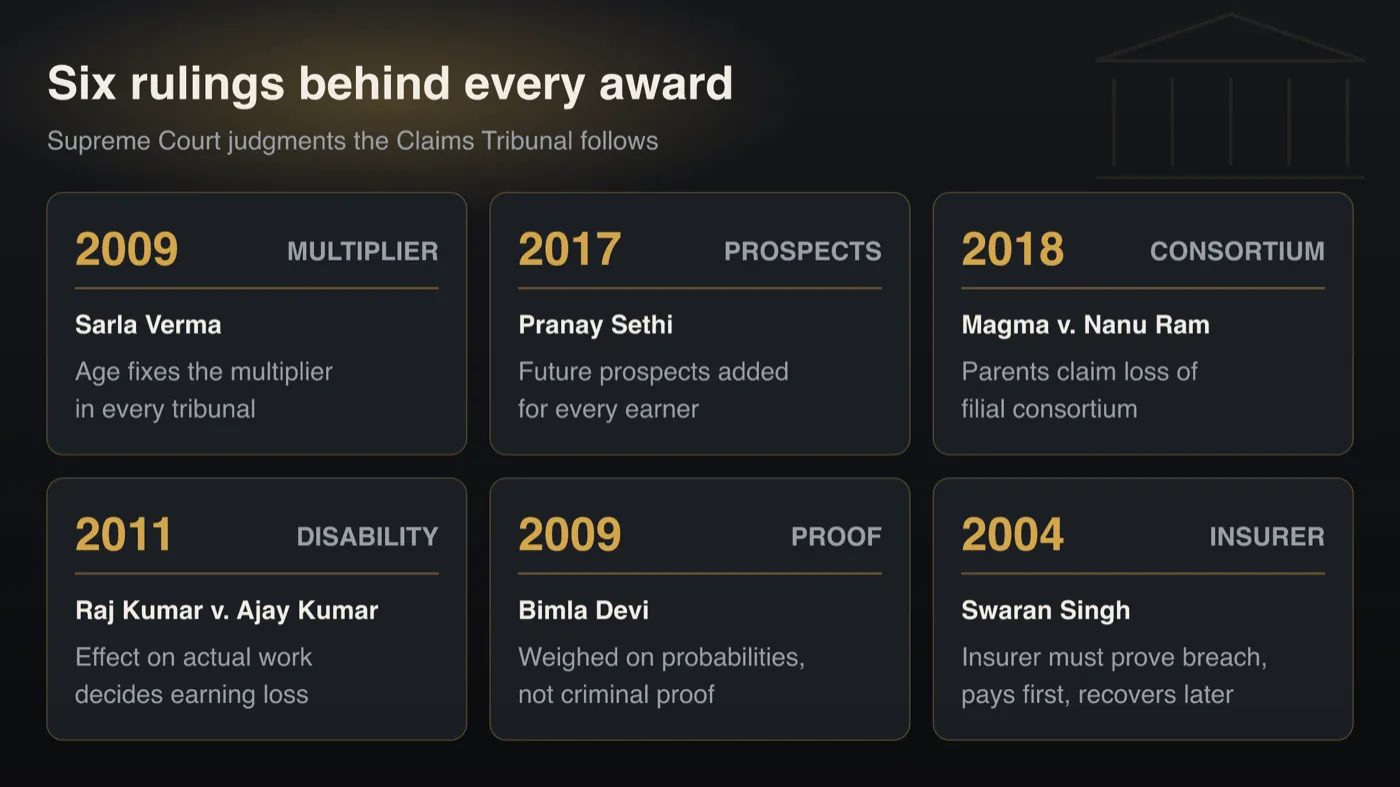
Supreme Court rulings that decide accident claims compensation
A Motor Accident Claims Tribunal (MACT) does not pick a compensation figure on its own. It follows a small set of Supreme Court rulings on proof, income, multiplier, future prospects and insurer liability.
2009
One age-based multiplier for all tribunals
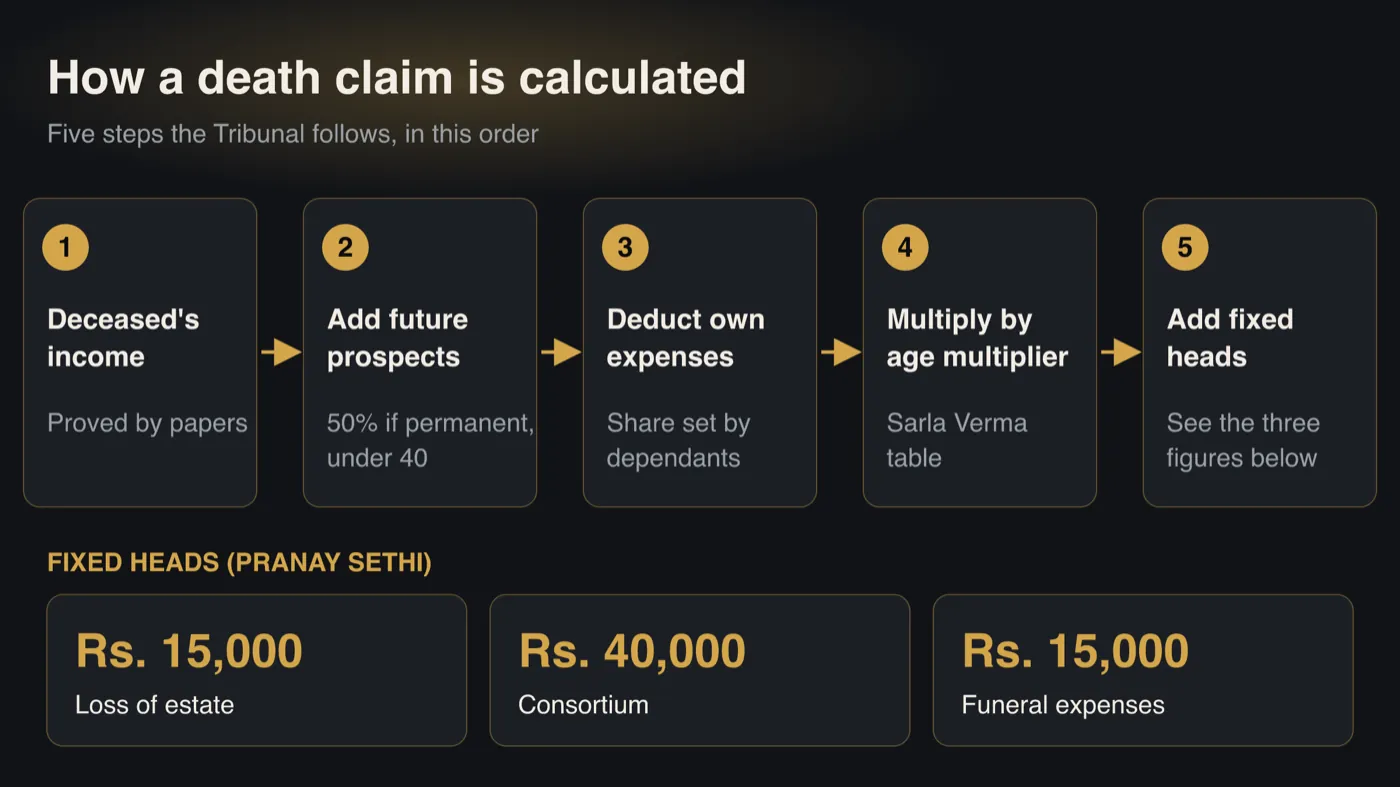
The Supreme Court made death-claim calculations uniform. The tribunal takes the deceased’s income, deducts a share for the deceased’s own personal expenses (the share depends on the number of dependants) and applies a multiplier fixed by the deceased’s age. Tribunals across India are still told to use the Sarla Verma multiplier, so guesswork and large differences between cases are avoided.
2017
Future prospects added for every earner
A Constitution Bench held that future prospects must be added to income for salaried and self-employed people alike. For a person below 40, 50% is added for a permanent job and 40% for self-employment or a fixed salary, with lower rates in older age groups. It fixed the conventional heads at Rs. 15,000 for loss of estate, Rs. 40,000 for consortium and Rs. 15,000 for funeral expenses, to be raised over time.
2018
Parents and children also lose consortium
The Supreme Court explained that consortium is a wide term covering spousal, parental and filial consortium. Parents who lose a child in a road accident can claim for loss of filial consortium (love, care and companionship), and the Court awarded it in this case. Later rulings following it award consortium to each eligible family member, not only to a widow or widower.
2011
Functional disability decides loss of earning
In injury cases, the percentage on a medical certificate is not copied straight into the award. The tribunal must find how far the permanent disability actually reduces the person’s ability to earn in their own work. The same injury can mean a small loss for a desk worker and a total loss for a mason or a driver.
2009
Negligence is judged on probabilities
A claim before the MACT is not a criminal trial. The claimant does not have to prove rash or negligent driving beyond reasonable doubt. The tribunal weighs the whole evidence and asks whether the claimant’s account is more probable. Minor gaps or the absence of an eyewitness do not, by themselves, defeat a genuine claim.
2004
Insurer must prove breach, then pay and recover
An insurer that says the driver had no valid licence must prove it, and must also show the owner was at fault in allowing that driver. Even where the defence succeeds, the tribunal may direct the insurer to pay the third-party victim first and recover the amount from the owner later, so the victim is not left without payment.
How a motor accident claim moves from the road to the award
Treatment first, then the police report
Get the injured person to hospital at once. The Cashless Treatment of Road Accident Victims Scheme, 2025 (Section 162, Motor Vehicles Act) covers treatment up to Rs. 1.5 lakh per victim for up to seven days after the accident. Inform the police, make sure an FIR is registered and keep its copy and the medical papers.
Police send the accident reports to the Tribunal
Under Rule 150A of the Central Motor Vehicles Rules, applied by the Supreme Court in Gohar Mohammed v. UPSRTC (15 December 2022), the investigating officer files a First Accident Report within 48 hours, an Interim Accident Report within 50 days and a Detailed Accident Report within 90 days. The tribunal can treat the Detailed Accident Report as a claim.
File the claim petition under Section 166
The injured person, or the legal heirs in a death case, can file before the MACT where the accident took place, where the claimant lives or works, or where the defendant lives. Section 166(3) says the claim must be filed within six months of the accident, so file early. Its validity is under challenge before the Supreme Court.
Collect proof of income, dependency and loss
Collect the FIR, chargesheet, post-mortem or injury report, disability certificate, hospital bills, salary slips or income tax returns, age proof, and the vehicle’s registration, insurance and driving licence details. These papers decide the income, multiplier, future prospects and each head of compensation the tribunal will allow.
Evidence, settlement talks and the award
The owner, driver and insurer file written statements and both sides lead evidence. The insurer may offer a settlement, and the tribunal can record an agreed figure. Otherwise the tribunal decides the claim and passes an award, which usually carries interest and is paid into the claimant’s bank account.
Appeal to the High Court under Section 173
If the award is too low, or wrongly fixes liability, an appeal lies to the High Court within 90 days of the award. For West Bengal claims that is the Calcutta High Court. A claimant’s appeal can ask for a higher award on the correct multiplier, future prospects and conventional heads.
Fixed relief amounts under the Motor Vehicles Act
These are the sums the Act and the hit-and-run scheme name; please verify the current figures before relying on them.
Future prospects added to the established income (National Insurance Co. Ltd. v. Pranay Sethi, (2017) 16 SCC 680)
Common mistakes that reduce accident claims compensation
Waiting too long to file Section 166(3) of the Motor Vehicles Act sets a six-month period from the date of the accident. Even while its validity is being tested in the Supreme Court, a late filing invites an objection that is easy to avoid.
No proof of income Without salary slips, income tax returns or business records, the tribunal may assume a notional minimum income. That one change can cut the final award by a large amount, so collect the documents early.
Accepting the first insurance offer without checking it Check any settlement figure against the Sarla Verma multiplier, the Pranay Sethi future-prospects rate and the conventional heads, including consortium for every eligible family member, before you sign a discharge.
Relying only on the disability percentage Under Raj Kumar v. Ajay Kumar, the effect of the disability on the person’s actual work decides the loss of earning capacity. Lead evidence about the job, not only the medical certificate.
From our practice
Speak to the chambers about your accident claim
A claim is decided on evidence, and the early weeks after an accident decide how well that evidence is kept. Patra’s Law Chambers can review your papers, explain the likely forum, parties and documents, and appear before the Tribunal. Every case turns on its own facts, and no result can be promised. Reach us by phone, WhatsApp or email to book a consultation at our Kolkata or Delhi office.
Book a ConsultationEstablished by a distinguished alumnus of IIT Kharagpur, Patra’s Law Chambers stands as a beacon of legal expertise in Kolkata & Delhi. Know more →

Kolkata Office
NICCO House, 6th Floor, 2 Hare Street
Kolkata-700001 (Near Calcutta High Court)
Delhi Office
4455/5, First Floor, Gali Shahid Bhagat Singh
Main Bazar Road, Paharganj, New Delhi-110055
Contact
[email protected]
+91 890 222 4444 / +91 7003 715 325
Papers that strengthen a motor accident claim
Keep these together from the first week; missing papers can usually be asked for later.
Shows when, where and how the accident happened and which vehicle was involved.
Discharge summary, prescriptions and receipts prove injury and expense.
A medical board certificate matters if there is a lasting disability.
Salary slips, tax returns or business records support the loss-of-income claim.
Registration number, owner and policy number identify who must pay.
For a death claim, the death certificate and proof of who the dependants are.
Frequently asked questions about motor vehicle accident claims
A claim is made before the Motor Accident Claims Tribunal under Section 166 of the Motor Vehicles Act, 1988. The injured person, the owner of damaged property or the legal representatives of a deceased person can file, and the tribunal’s territorial limits depend on the place of accident or residence.
The six-month limit that was once in Section 166 was removed by the 2019 amendment. Even so, filing without delay is sensible because evidence, witnesses and records fade. An appeal against an award, though, generally has a 90-day limit under Section 173.
Hit and run victims can seek fixed compensation under Section 161 and the scheme made under the Act. The amounts are set by the scheme and have been revised, so verify the current figure for death and grievous hurt before relying on it.
The claim can still be filed before the MACT against the owner and driver, who are then liable to pay. The page on the uninsured vehicle and the Solatium Scheme explains the related relief that may be available where the vehicle is not identified.
The legal representatives of the deceased, such as spouse, children and parents, can claim. The tribunal looks at the deceased’s age, income and the number of dependants, so proof of income and relationship is important.
Keep the FIR, medical and discharge records, bills, proof of income, driving licence and registration details if available, insurance policy number, photographs and, for a death, the post-mortem report and death certificate. Originals should stay safe, with copies for the file.
Yes, but the tribunal may reduce the compensation in proportion to a claimant’s share of negligence, which is called contributory negligence. How much is reduced depends on the evidence. Please do not assume the outcome without the papers being reviewed.
The tribunal works out a figure on the evidence for medical expenses, loss of income and, in a death case, the loss to dependants, plus the heads recognised by the Supreme Court. Each case is different, so no amount can be promised in advance.