HomeGuide to SIR Tribunal Rejections & Appeal in the High CourtElection LawGuide to SIR Tribunal Rejections & Appeal in the High Court

Guide to SIR Tribunal Rejections & Appeal in the High Court

Key takeaways
  • The ECI SIR used algorithmic matching against 2002 rolls, triggering millions of verification notices and large-scale deletions.
  • Three categories: Mapped, Unmapped, and Logical Discrepancies require separate, evidence-specific tribunal appeals.
  • Definitive documents like Madhyamik certificates, land deeds, and passports outweigh Aadhaar, which is only proof of identity.
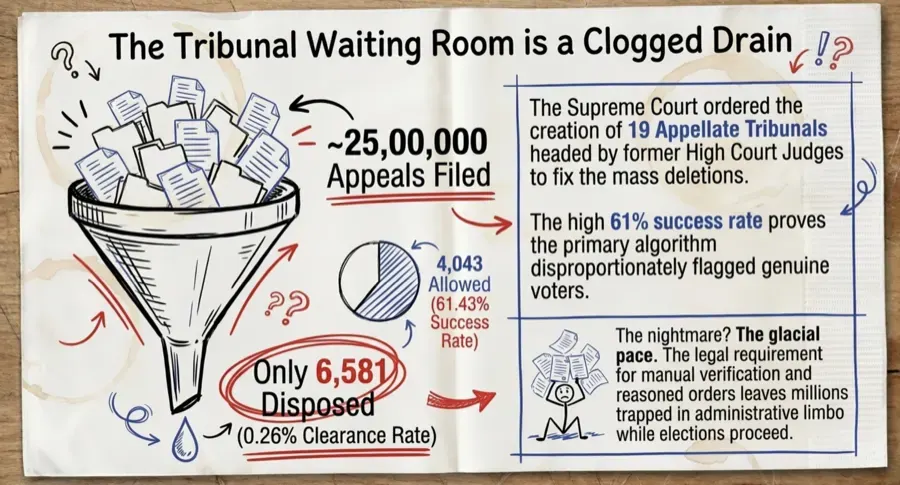
  • The Supreme Court formed 19 Appellate Tribunals; disposals were ~0.26% while allowed appeals exceeded ~61%, exposing verification defects.
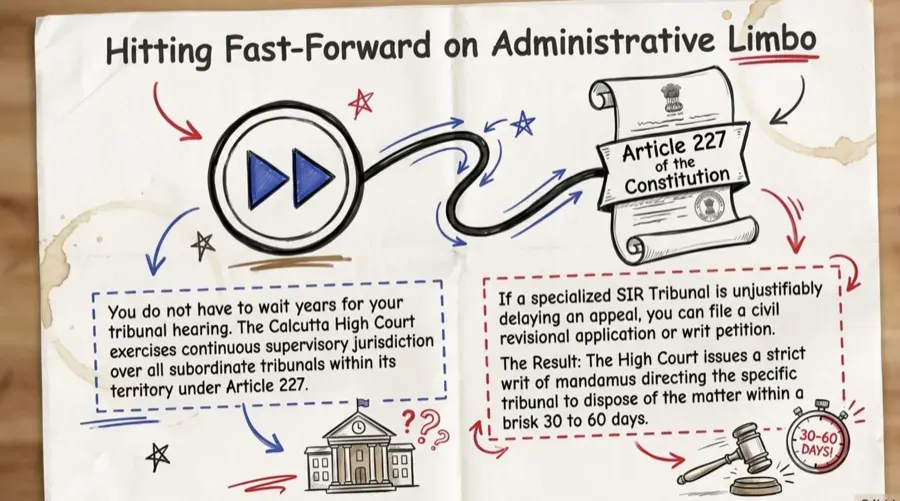
  • Aggrieved parties can seek expedited tribunal directions from the Calcutta High Court under Article 227 for time-bound hearings.
  • Rejected tribunal orders may be challenged by filing a Group IX writ petition in the Calcutta High Court under Article 226 and Article 227.
  • Missed deadlines can be condoned under the Limitation Act; alternatively file Form 6 under continuous revision to restore electoral entry anytime.

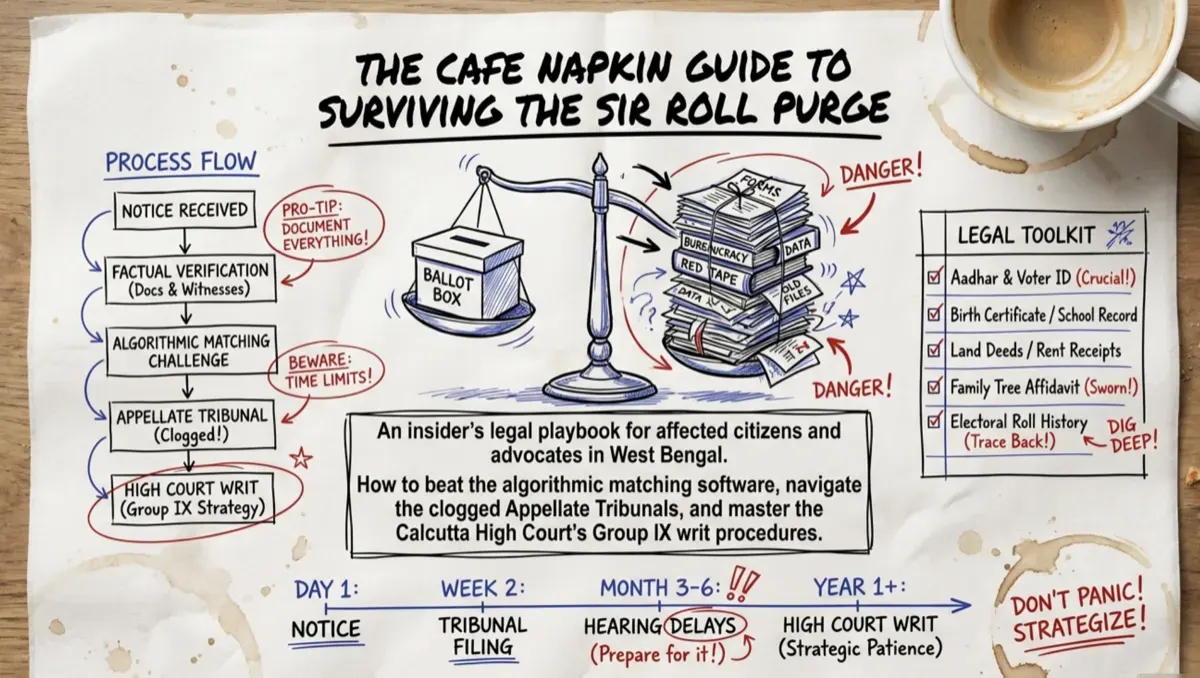
Comprehensive Legal Guide to SIR Tribunal Rejections, Appeals, and Calcutta High Court Writ Procedures

AUDIO OVERVIEW:


SIR TRIBUNAL rejection advocate

Creditor and contributor of this article:

Patra’s Law Chambers:

About Us:

Patra’s Law Chambers is a law firm with offices in Kolkata &  Delhi, offering comprehensive legal services across various domains. Established in 2020 by Advocate Sudip Patra (Advocate, Supreme Court of India & Calcutta High Court) an alumnus of the Prestigious Rajiv Gandhi School of Intellectual Property Law, IIT Kharagpur ,with Post Graduate diploma in Business Law from IIM Calcutta, the firm specializes in Civil, Criminal, Writs, High Court Matters, Trademark, Copyright, Company, Tax, IT, GST &  Customs, Banking & DRT, Property disputes, Service law & CAT & High Court related service matters, Military Law, Family law, and Supreme Court matters. You can know more about us in here

Kolkata Office:

NICCO HOUSE, 6th Floor, 2, Hare Street, Kolkata-700001 (Near Calcutta High Court)

Delhi Office:

House no: 4455/5, First Floor, Ward No. XV, Gali Shahid

Bhagat Singh, Main Bazar Road, Paharganj, New Delhi-110055

Website: www.patraslawchambers.com

Email: [email protected]

Phone: +91 890 222 4444/ +91 7003 715 325


SIR Tribunal rejection advocate in Kolkata, Calcutta High Court lawyer for Election Commission disputes,

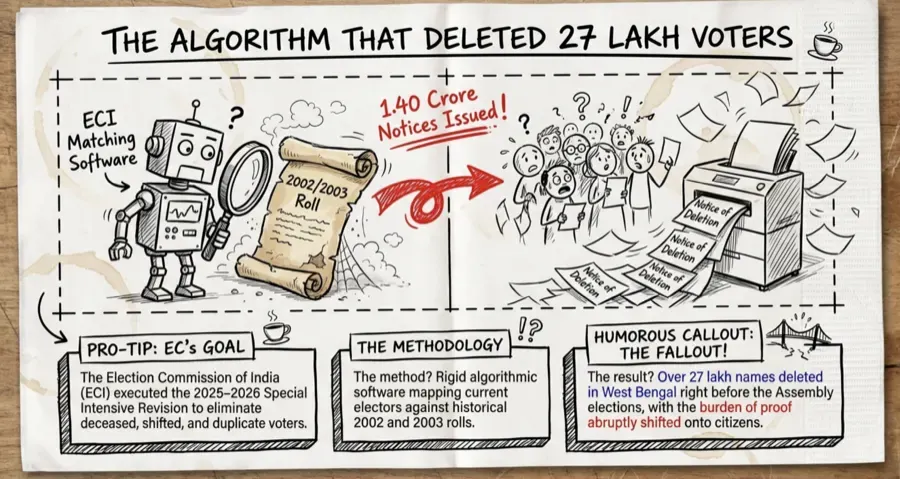
The Special Intensive Revision (SIR) of electoral rolls, executed by the Election Commission of India (ECI), serves as a fundamental constitutional mechanism intended to preserve the absolute integrity of the democratic electoral process. Designed to achieve a pristine voter list by eliminating deceased, permanently shifted, and duplicate voters while enrolling newly eligible citizens, the 2025–2026 SIR exercise became the epicenter of unparalleled judicial and administrative scrutiny, particularly within the state of West Bengal.1 Driven by the deployment of algorithmic matching software mapping current electors against historical 2002 and 2003 rolls, millions of genuine citizens found their electoral status categorized under suspicious flags such as “logical discrepancies” or “unmapped”.3

This exhaustive research report provides an expert-level legal examination of the holistic matter of SIR tribunal rejections, the taxonomic division of electoral discrepancies, the meticulous procedure for appealing tribunal rejections via writ petitions in the Calcutta High Court under the Group IX classification, and the precise legal mechanisms available to expedite time-bound hearings under Article 227 of the Constitution of India.

1. The Genesis and Constitutional Framework of the Special Intensive Revision (SIR) 2026

SIR Tribunal rejection advocate in Kolkata, Calcutta High Court lawyer for Election Commission disputes,

The statutory foundation of the electoral roll revision is anchored deeply in the Representation of the People Act, 1950, which mandates the preparation and periodic updating of electoral rolls under the overarching superintendence, direction, and control of the ECI, as guaranteed by Article 324 of the Constitution.1 In states characterized by rapid demographic shifts, complex urbanization, high migration rates, and sensitive border geographies, the ECI authorized the SIR to conduct rigorous house-to-house verifications managed by Booth Level Officers (BLOs) and supervised by Electoral Registration Officers (EROs).1 The constitutional validity of this intensive exercise was upheld by the Supreme Court of India in the landmark Bihar SIR challenge (Association for Democratic Reforms v. Election Commission of India), which established that adopting a specialized procedure for electoral roll purification does not inherently violate fundamental rights, provided it is not manifestly arbitrary.1

However, the implementation of the 2026 SIR in West Bengal generated immense friction. The exercise resulted in the issuance of approximately 1.40 crore notices for document verification, ultimately culminating in the deletion of over 27 lakh names from the final electoral rolls immediately prior to the state Assembly elections.8 Affected voters and civil rights advocates argued that the algorithmic methodology shifted the burden of proof abruptly onto the citizenry, requiring stringent, historical documentary evidence within impossibly narrow deadlines.1 Consequently, the Supreme Court, particularly in the matters stemming from Mostari Banu v. Election Commission of India, recognized that the sheer volume of these exclusions necessitated quasi-judicial oversight to prevent mass, systemic disenfranchisement.9

2. The Taxonomic Divide: Mapped, Unmapped, and Logical Discrepancies

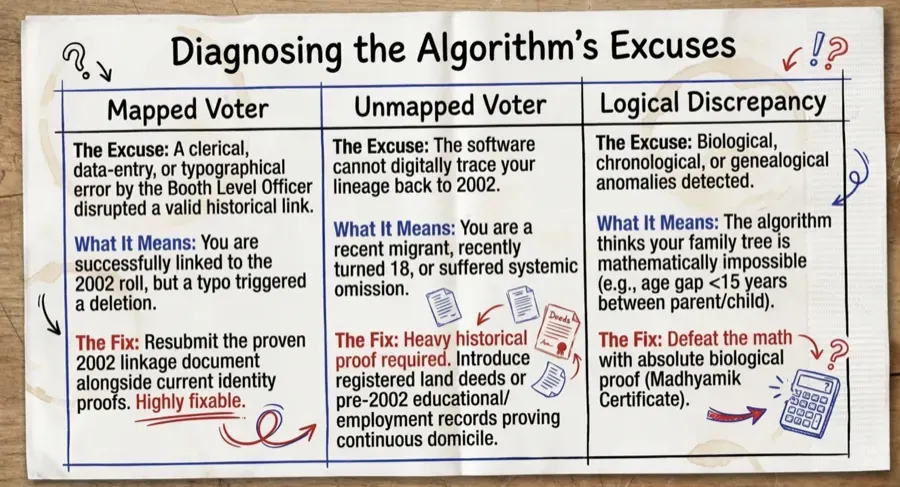
The technological architecture of the West Bengal SIR relied heavily on matching software. The core objective was to trace the lineage of current voters back to the baseline of the 2002 SIR electoral rolls. This rigid algorithmic approach resulted in the flagging of voters into three distinct categories, each triggering specific verification notices and requiring distinctly tailored appellate strategies.12

When navigating the tribunal process, it is paramount to understand that these three types of matters require separate, highly specific cases to be presented before the adjudicating authority.

The Strategy for Appealing Mapped Voter Cases

Mapped voters are those electors who were successfully linked to the 2002 SIR roll or whose direct ancestors were traced successfully.4 Generally, these voters were exempted from intense scrutiny unless subsequent clerical or systemic errors disrupted their status. In the rare event that a mapped voter faces rejection or deletion, the appeal process in the tribunal is relatively straightforward. The legal strategy involves demonstrating that the linkage is intact and that the deletion was merely a typographical, data-entry, or clerical error by the BLO. The appellant must simply resubmit the proven 2002 linkage document alongside current identity proofs to swiftly overturn the erroneous deletion.

The Strategy for Appealing Unmapped Voter Cases

Unmapped voters are individuals whose names, or whose ancestors’ names, could not be traced back to the 2002 electoral roll by the ECI’s software.3 This category heavily impacted recent migrants, individuals who attained voting age recently without prior localized family registration, or those suffering from complete systemic omission. Appealing an unmapped rejection in the tribunal is highly evidence-intensive. The separate case presented here must transcend the ECI’s algorithm by introducing external, irrefutable historical evidence. Appellants must introduce registered land deeds, decades-old educational certificates, or historical employment records that predate the statutory cutoff, proving continuous domicile and citizenship status independent of the 2002 voter list.

The Strategy for Appealing Logical Discrepancy Cases

SIR Tribunal rejection advocate in Kolkata, Calcutta High Court lawyer for Election Commission disputes,

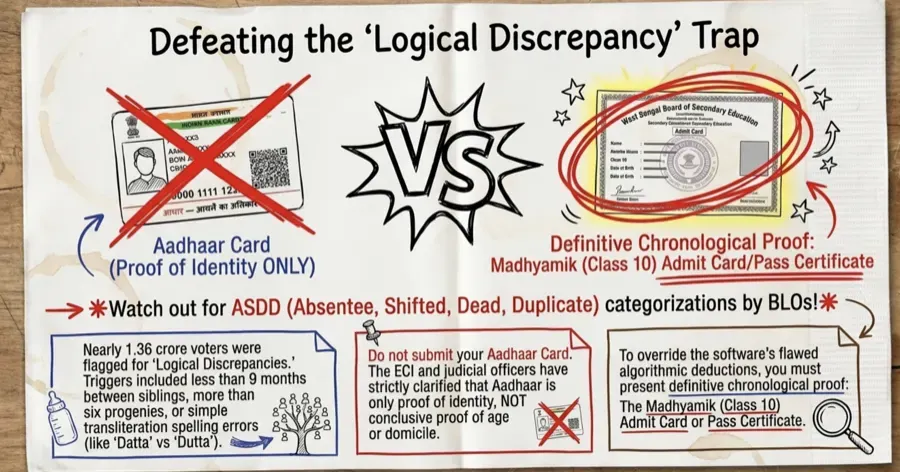
The category of logical discrepancies was arguably the most controversial, encompassing approximately 1.36 crore voters.12 The software flagged electors for biological, chronological, or genealogical anomalies despite being mapped or enrolled. Triggers included an age gap of less than 15 years or more than 50 years between parent and child, less than 9 months between siblings, or more than six progenies linked to a single ancestor.13 Furthermore, systemic transliteration errors—such as minor spelling variations in Bengali surnames (e.g., “Datta” translated to “Dutta”)—caused thousands to be flagged.4 An appeal in the tribunal for a logical discrepancy must directly attack the software’s mathematical rigidity. The appellant must present definitive biological and chronological proof, such as a Madhyamik (Class 10) Admit Card or Pass Certificate, birth certificates, or medical records, which legally supersedes the software’s flawed algorithmic deductions.9

3. Primary Adjudication and Rejections by Judicial Officers

Before the creation of the specialized tribunals, initial adjudications of the flagged entries were conducted by EROs and subsequently overseen by a cohort of around 700 judicial officers assigned upon the recommendation of the Calcutta High Court.8 These officers faced a monumental task of verifying millions of documents within highly compressed timelines.10

Rejection by these judicial officers was widespread and predominantly occurred due to documentary insufficiency. A critical point of contention was the submission of the Aadhaar card. The ECI and the adjudicating officers clarified that Aadhaar serves exclusively as a proof of identity and cannot be accepted as conclusive evidence of age or residential address.15 Furthermore, many electors were classified as Absentee, Shifted, Dead, or Duplicate (ASDD) because they failed to return Enumeration Forms or could not appear via authorized representatives (such as Booth Level Agents) during the physical verification drives.13

While the judicial officers executed their duties under severe time constraints, the rigid evidentiary standards and the sheer volume of cases inevitably led to a high incidence of seemingly arbitrary exclusions. It was this systemic bottleneck that compelled the Supreme Court to mandate the establishment of specialized appellate tribunals.10

4. Inception, Venues, and Mechanics of the 19 Appellate Tribunals

Recognizing the imminent threat of mass disenfranchisement, the Supreme Court, exercising its plenary powers under Article 142 of the Constitution, ordered the formation of 19 Appellate Tribunals in West Bengal on March 10, 2026.10 The objective of the tribunal is explicit: to ensure that persons who are genuinely clearing their names will be definitively present in the 2026 SIR final electoral roll.

Tribunal Composition and Standard Operating Procedure (SOP)

The ECI constituted a high-level committee headed by Justice T.S. Sivagnanam, the former Chief Justice of the Calcutta High Court, alongside other distinguished former High Court judges such as Justice Pradipta Ray and Justice Tapen Sen, to formulate a uniform Standard Operating Procedure (SOP).11 The remuneration for these adjudicators was meticulously structured, providing Rs. 1,60,000 for former Chief Justices and Rs. 1,50,000 for former High Court Judges for a base period, demonstrating the state’s investment in resolving the crisis.19

The physical venues of these tribunals were strategically dispersed across critical districts, with places of hearing established in Kolkata, North 24 Parganas, Purba Medinipur, Cooch Behar, and Howrah to ensure regional accessibility.18

Modalities of Appeal and Document Submission

The tribunal process allows for significant procedural flexibility. Appeals against the orders passed by the designated judicial officers can be submitted physically at the localized offices of District Magistrates, Sub-Divisional Magistrates, or Sub-Divisional Officers. These statutory authorities are legally bound to digitize the physical applications and upload them to the centralized ECI NET platform.18 Alternatively, appellants possessing digital literacy can execute online hearings by filing directly through the portal.18

Crucially, regarding document submission, the SOP mandates that appellants explain their specific documentations. It is not sufficient to merely upload raw files; the appellant, or their authorized representative, must provide a cohesive narrative linking the submitted documents to the specific discrepancy flagged by the algorithm. The tribunal reviews the full record previously submitted to the judicial officers but also retains the discretionary power to accept supplementary documentation if it serves the interests of substantive justice.9

Statistical Realities and Disposal Rates

SIR Tribunal rejection advocate in Kolkata, Calcutta High Court lawyer for Election Commission disputes,

Despite the robust administrative setup, official data from the Election Commission reveals a severe operational bottleneck within the appellate mechanism. Out of the nearly 25 lakh appeals filed against primary rejections, the 19 tribunals managed to dispose of only 6,581 cases by late May 2026, representing a negligible 0.26% clearance rate.8

Tribunal Adjudication Status Number of Cases Percentage of Disposed
Total Appeals Filed ~25,00,000 N/A
Total Appeals Disposed 6,581 100%
Appeals Allowed (Restored to Roll) 4,043 61.43%
Appeals Rejected 1,267 19.25%
Status Unclear / Pending Execution ~1,271 19.32%

This data generates a profound analytical insight: the exceptionally high success rate of appellants (over 61%) fundamentally indicates that the primary verification mechanism was inherently flawed, disproportionately flagging and deleting genuine voters. However, the glacial pace of tribunal disposals acts as a de facto mechanism of disenfranchisement, leaving millions trapped in administrative limbo while elections proceed.1

5. Expediting Tribunal Hearings under Article 227how to appeal voter card deletion west bengal, voter card deleted logical discrepancy, eci logical discrepancy voter notice, how to prove unmapped voter status, sir tribunal appeal procedure wb, calcutta high court group ix residuary writ, how to expedite tribunal hearing article 227, calcutta high court writ petition for voter card, voter list appeal deadline condonation of delay, section 5 limitation act voter card appeal, represent voter card deletion in tribunal, 19 appellate tribunals west bengal list, voter list correction online portal ecinet, advocate sudip patra calcutta high court, patras law chambers kolkata office, how to fix spelling error on voter card, voter card deleted asdd list, booth level officer verification process, voter id card restoration supreme court, mostari banu vs election commission of india, association for democratic reforms eci, continuous revision of electoral rolls form 6, how to file fresh form 6 after rejection, can i vote if tribunal appeal is pending, interim voting rights supreme court sir, calcutta high court mentioning practice writ, e filing cis 3.0 calcutta high court, check voter tribunal appeal status online, sdo sdm dm office voter appeal wb, voter identity proof vs age proof aadhaar, madhyamik admit card voter id proof, registered land deeds for unmapped voter, ancestral heritage proof citizenship voter list, west bengal assembly elections voter list, bypass voter tribunal backlog high court, writ of mandamus voter card restoration, writ of certiorari quash tribunal order, civil revisional application article 227 wb, supervisory jurisdiction calcutta high court, voter card correction kolkata lawyers contact, top supreme court lawyers in kolkata, IIT IIM alumnus law firm kolkata, patras law chambers delhi office, voter list verification manual 2026, voter card cancel correction bangla, voter list appeal form download, how to restore deleted voter id card, voter card verification sms not received, delayed voter appeal limitation condonation, calcutta high court appellate side rules group 9, Residuary matters calcutta high court lawyers, draft writ petition voter card format, save your democratic vote lawyer west bengal

Given the staggering backlog depicted by the statistics, affected citizens possess the legal right to seek an expedited hearing. While the Supreme Court declined to grant blanket interim voting rights to those with pending appeals—reasoning that such an action would entirely negate the verification exercise and allow potential non-citizens to vote—it explicitly affirmed that aggrieved parties could approach the Chief Justice of the Calcutta High Court for appropriate, case-by-case relief.1

Grounds for Expediting the Hearing

how to appeal voter card deletion west bengal, voter card deleted logical discrepancy, eci logical discrepancy voter notice, how to prove unmapped voter status, sir tribunal appeal procedure wb, calcutta high court group ix residuary writ, how to expedite tribunal hearing article 227, calcutta high court writ petition for voter card, voter list appeal deadline condonation of delay, section 5 limitation act voter card appeal, represent voter card deletion in tribunal, 19 appellate tribunals west bengal list, voter list correction online portal ecinet, advocate sudip patra calcutta high court, patras law chambers kolkata office, how to fix spelling error on voter card, voter card deleted asdd list, booth level officer verification process, voter id card restoration supreme court, mostari banu vs election commission of india, association for democratic reforms eci, continuous revision of electoral rolls form 6, how to file fresh form 6 after rejection, can i vote if tribunal appeal is pending, interim voting rights supreme court sir, calcutta high court mentioning practice writ, e filing cis 3.0 calcutta high court, check voter tribunal appeal status online, sdo sdm dm office voter appeal wb, voter identity proof vs age proof aadhaar, madhyamik admit card voter id proof, registered land deeds for unmapped voter, ancestral heritage proof citizenship voter list, west bengal assembly elections voter list, bypass voter tribunal backlog high court, writ of mandamus voter card restoration, writ of certiorari quash tribunal order, civil revisional application article 227 wb, supervisory jurisdiction calcutta high court, voter card correction kolkata lawyers contact, top supreme court lawyers in kolkata, IIT IIM alumnus law firm kolkata, patras law chambers delhi office, voter list verification manual 2026, voter card cancel correction bangla, voter list appeal form download, how to restore deleted voter id card, voter card verification sms not received, delayed voter appeal limitation condonation, calcutta high court appellate side rules group 9, Residuary matters calcutta high court lawyers, draft writ petition voter card format, save your democratic vote lawyer west bengal

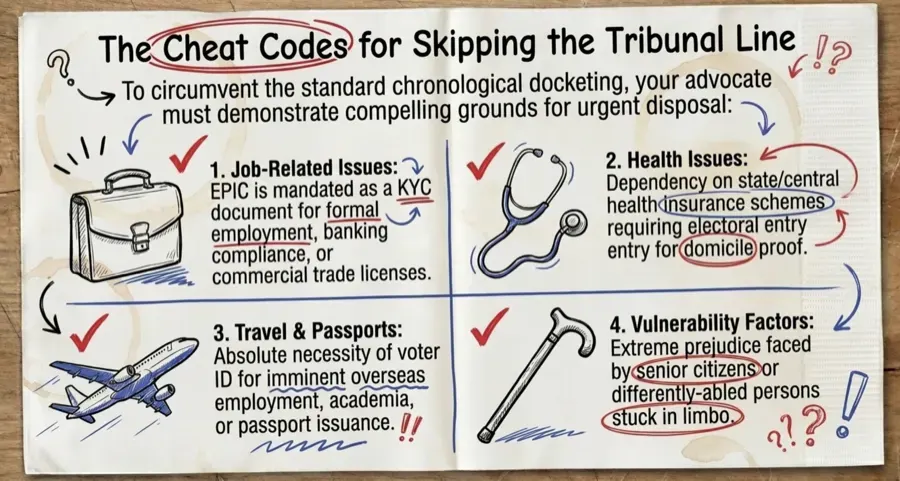
To circumvent the standard chronological docketing of the tribunal, an appellant must demonstrate cogent, compelling, and reasonable grounds for urgent disposal. Acceptable reasons that courts recognize for expediting the matter include:

  1. Job-Related Issues: The stringent requirement of an Electors Photo Identity Card (EPIC) as a mandatory KYC document for formal employment, securing government contracts, banking compliance, or obtaining commercial trade licenses.
  2. Health Issues: Dependency on state or central health insurance schemes, which stringently require the electoral roll entry as non-negotiable proof of regional domicile for urgent, life-saving medical treatments.
  3. Traveling and Passports: The absolute necessity of the voter ID card for passport issuance or renewal, particularly for citizens facing imminent overseas employment, academic deadlines abroad, or urgent international travel.
  4. Vulnerability Factors: Appellants who are senior citizens, differently-abled, or facing extreme socio-economic disabilities that render prolonged administrative limbo severely prejudicial to their survival.22

The Mechanism of Direction via Article 227

The High Court exercises continuous supervisory jurisdiction over all subordinate courts and tribunals within its territorial limits under Article 227 of the Constitution.23 If an SIR Tribunal is unjustifiably delaying an appeal despite the presence of cogent reasons, a citizen can file a civil revisional application or writ petition in the High Court under Article 227, praying for a judicial direction upon the tribunal to conclude the hearing in a time-bound manner.25

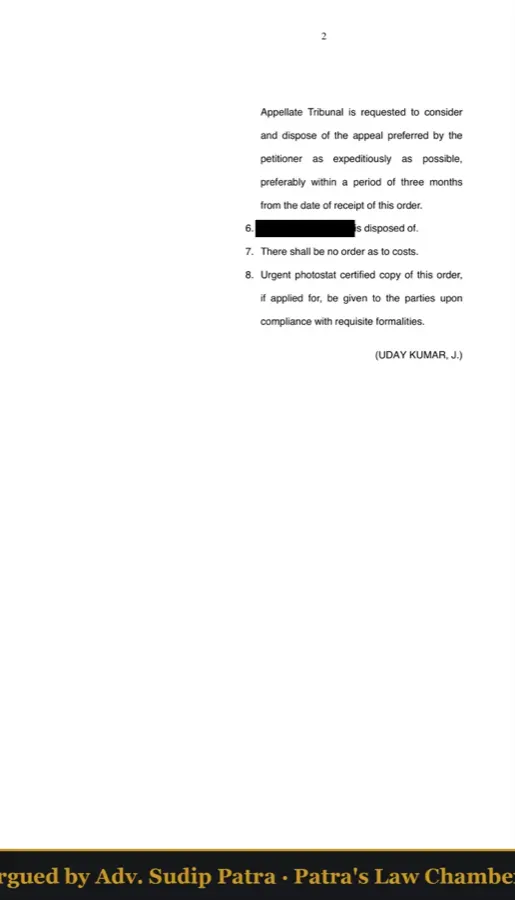
Judicial precedent from the Calcutta High Court establishes that while this power is exercised sparingly to avoid micromanaging subordinate dockets, the High Court will intervene to prevent severe prejudice or a miscarriage of justice. Upon being satisfied with the urgency, the High Court issues a strict writ of mandamus directing the specific tribunal to dispose of the matter within a legally specified timeframe, frequently mandating resolution within 30 to 60 days.22

6. Filing a Writ Petition in the Calcutta High Court: Group IX (Residuary) Jurisdiction

how to appeal voter card deletion west bengal, voter card deleted logical discrepancy, eci logical discrepancy voter notice, how to prove unmapped voter status, sir tribunal appeal procedure wb, calcutta high court group ix residuary writ, how to expedite tribunal hearing article 227, calcutta high court writ petition for voter card, voter list appeal deadline condonation of delay, section 5 limitation act voter card appeal, represent voter card deletion in tribunal, 19 appellate tribunals west bengal list, voter list correction online portal ecinet, advocate sudip patra calcutta high court, patras law chambers kolkata office, how to fix spelling error on voter card, voter card deleted asdd list, booth level officer verification process, voter id card restoration supreme court, mostari banu vs election commission of india, association for democratic reforms eci, continuous revision of electoral rolls form 6, how to file fresh form 6 after rejection, can i vote if tribunal appeal is pending, interim voting rights supreme court sir, calcutta high court mentioning practice writ, e filing cis 3.0 calcutta high court, check voter tribunal appeal status online, sdo sdm dm office voter appeal wb, voter identity proof vs age proof aadhaar, madhyamik admit card voter id proof, registered land deeds for unmapped voter, ancestral heritage proof citizenship voter list, west bengal assembly elections voter list, bypass voter tribunal backlog high court, writ of mandamus voter card restoration, writ of certiorari quash tribunal order, civil revisional application article 227 wb, supervisory jurisdiction calcutta high court, voter card correction kolkata lawyers contact, top supreme court lawyers in kolkata, IIT IIM alumnus law firm kolkata, patras law chambers delhi office, voter list verification manual 2026, voter card cancel correction bangla, voter list appeal form download, how to restore deleted voter id card, voter card verification sms not received, delayed voter appeal limitation condonation, calcutta high court appellate side rules group 9, Residuary matters calcutta high court lawyers, draft writ petition voter card format, save your democratic vote lawyer west bengal

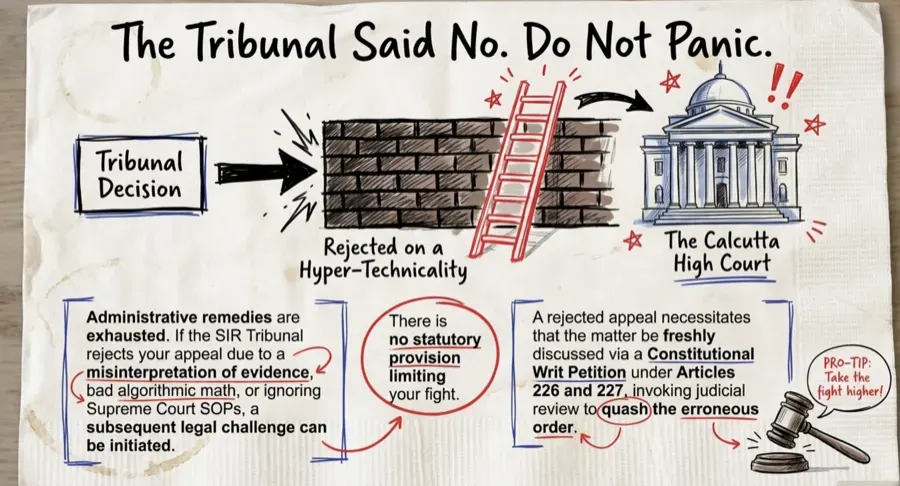
In the event of a rejection by the tribunal, the citizen is not left remediless. A profound legal principle applies here: if there is any kind of wrong appeal that has been done, or if the tribunal rejects the appeal due to a hyper-technicality or misinterpretation of evidence, a subsequent legal challenge can be initiated. While there is no explicit statutory provision limiting the internal appellate mechanisms, a rejected appeal necessitates that the matter be freshly discussed before the Calcutta High Court via a constitutional writ petition. Administrative and quasi-judicial rejections are subject to judicial review under Article 226 (writ jurisdiction) and Article 227 (supervisory jurisdiction) of the Constitution.24

Identifying the Correct Appellate Roster (Group IX)

how to appeal voter card deletion west bengal, voter card deleted logical discrepancy, eci logical discrepancy voter notice, how to prove unmapped voter status, sir tribunal appeal procedure wb, calcutta high court group ix residuary writ, how to expedite tribunal hearing article 227, calcutta high court writ petition for voter card, voter list appeal deadline condonation of delay, section 5 limitation act voter card appeal, represent voter card deletion in tribunal, 19 appellate tribunals west bengal list, voter list correction online portal ecinet, advocate sudip patra calcutta high court, patras law chambers kolkata office, how to fix spelling error on voter card, voter card deleted asdd list, booth level officer verification process, voter id card restoration supreme court, mostari banu vs election commission of india, association for democratic reforms eci, continuous revision of electoral rolls form 6, how to file fresh form 6 after rejection, can i vote if tribunal appeal is pending, interim voting rights supreme court sir, calcutta high court mentioning practice writ, e filing cis 3.0 calcutta high court, check voter tribunal appeal status online, sdo sdm dm office voter appeal wb, voter identity proof vs age proof aadhaar, madhyamik admit card voter id proof, registered land deeds for unmapped voter, ancestral heritage proof citizenship voter list, west bengal assembly elections voter list, bypass voter tribunal backlog high court, writ of mandamus voter card restoration, writ of certiorari quash tribunal order, civil revisional application article 227 wb, supervisory jurisdiction calcutta high court, voter card correction kolkata lawyers contact, top supreme court lawyers in kolkata, IIT IIM alumnus law firm kolkata, patras law chambers delhi office, voter list verification manual 2026, voter card cancel correction bangla, voter list appeal form download, how to restore deleted voter id card, voter card verification sms not received, delayed voter appeal limitation condonation, calcutta high court appellate side rules group 9, Residuary matters calcutta high court lawyers, draft writ petition voter card format, save your democratic vote lawyer west bengal

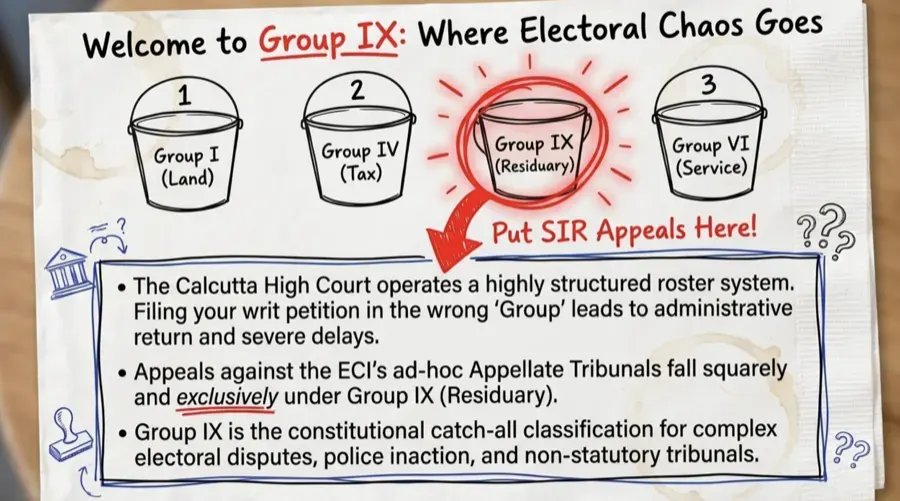
The Calcutta High Court operates a highly structured roster system, categorizing its Appellate Side writ petitions into various subject-matter specific “Groups.” For instance, Group VI is reserved for service matters of state employees, Group IV handles taxation, and Group I manages land disputes.30 Appeals and grievances against the ECI’s ad-hoc Appellate Tribunals regarding electoral roll inclusion fall squarely and exclusively under Group IX (Residuary).31

Group IX functions as the comprehensive catch-all classification for constitutional writs not explicitly designated to other specialized benches. It is the designated legal venue for complex electoral disputes, police inaction grievances, and challenges against orders passed by non-statutory or specially constituted tribunals.33

Step-by-Step Filing Procedure in the Calcutta High Court

how to appeal voter card deletion west bengal, voter card deleted logical discrepancy, eci logical discrepancy voter notice, how to prove unmapped voter status, sir tribunal appeal procedure wb, calcutta high court group ix residuary writ, how to expedite tribunal hearing article 227, calcutta high court writ petition for voter card, voter list appeal deadline condonation of delay, section 5 limitation act voter card appeal, represent voter card deletion in tribunal, 19 appellate tribunals west bengal list, voter list correction online portal ecinet, advocate sudip patra calcutta high court, patras law chambers kolkata office, how to fix spelling error on voter card, voter card deleted asdd list, booth level officer verification process, voter id card restoration supreme court, mostari banu vs election commission of india, association for democratic reforms eci, continuous revision of electoral rolls form 6, how to file fresh form 6 after rejection, can i vote if tribunal appeal is pending, interim voting rights supreme court sir, calcutta high court mentioning practice writ, e filing cis 3.0 calcutta high court, check voter tribunal appeal status online, sdo sdm dm office voter appeal wb, voter identity proof vs age proof aadhaar, madhyamik admit card voter id proof, registered land deeds for unmapped voter, ancestral heritage proof citizenship voter list, west bengal assembly elections voter list, bypass voter tribunal backlog high court, writ of mandamus voter card restoration, writ of certiorari quash tribunal order, civil revisional application article 227 wb, supervisory jurisdiction calcutta high court, voter card correction kolkata lawyers contact, top supreme court lawyers in kolkata, IIT IIM alumnus law firm kolkata, patras law chambers delhi office, voter list verification manual 2026, voter card cancel correction bangla, voter list appeal form download, how to restore deleted voter id card, voter card verification sms not received, delayed voter appeal limitation condonation, calcutta high court appellate side rules group 9, Residuary matters calcutta high court lawyers, draft writ petition voter card format, save your democratic vote lawyer west bengal

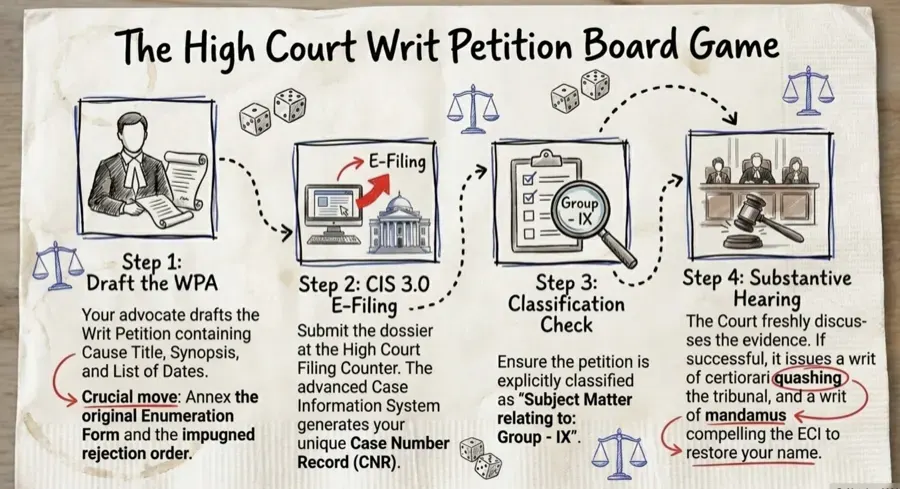
Navigating the Calcutta High Court requires strict adherence to its Appellate Side Rules and specialized filing procedures:

  1. Drafting the Petition: The instructing advocate meticulously drafts the Writ Petition (WPA) containing the Cause Title, a detailed Synopsis, a List of Dates, and the substantive legal pleadings. Crucially, the petition must legally annex the impugned rejection order of the SIR Tribunal, the original Enumeration Form, and all supporting evidentiary documents.9
  2. Filing via CIS 3.0: The physical or e-filing dossier is submitted at the High Court Filing Counter. Here, the advanced Case Information System (CIS 3.0) undergoes preliminary verification, generates a Filing Number, and issues a unique Case Number Record (CNR).37
  3. Classification: The advocate must ensure the petition is explicitly marked and classified as “Subject Matter relating to: Group – IX (Residuary) of the Classification List”.38 Improper classification leads to the matter being assigned to the wrong bench, causing severe delays and potential administrative return of the filing.30
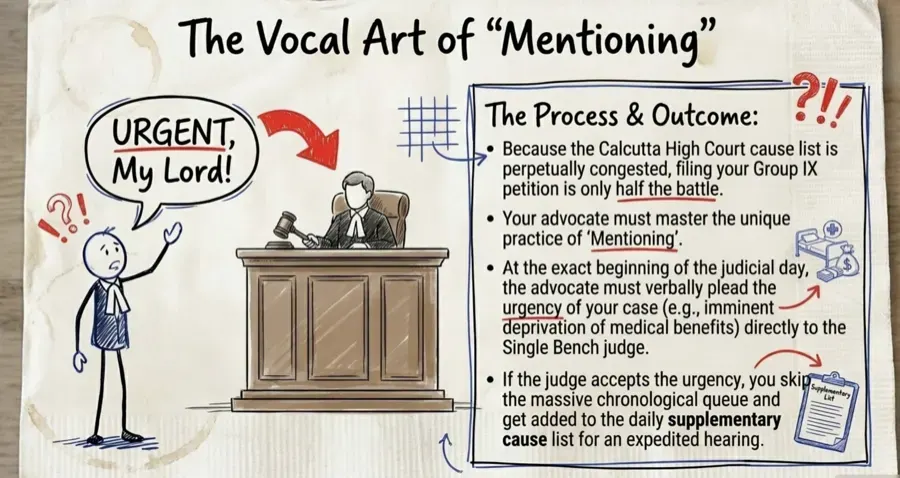
  4. Mentioning for Urgency: how to appeal voter card deletion west bengal, voter card deleted logical discrepancy, eci logical discrepancy voter notice, how to prove unmapped voter status, sir tribunal appeal procedure wb, calcutta high court group ix residuary writ, how to expedite tribunal hearing article 227, calcutta high court writ petition for voter card, voter list appeal deadline condonation of delay, section 5 limitation act voter card appeal, represent voter card deletion in tribunal, 19 appellate tribunals west bengal list, voter list correction online portal ecinet, advocate sudip patra calcutta high court, patras law chambers kolkata office, how to fix spelling error on voter card, voter card deleted asdd list, booth level officer verification process, voter id card restoration supreme court, mostari banu vs election commission of india, association for democratic reforms eci, continuous revision of electoral rolls form 6, how to file fresh form 6 after rejection, can i vote if tribunal appeal is pending, interim voting rights supreme court sir, calcutta high court mentioning practice writ, e filing cis 3.0 calcutta high court, check voter tribunal appeal status online, sdo sdm dm office voter appeal wb, voter identity proof vs age proof aadhaar, madhyamik admit card voter id proof, registered land deeds for unmapped voter, ancestral heritage proof citizenship voter list, west bengal assembly elections voter list, bypass voter tribunal backlog high court, writ of mandamus voter card restoration, writ of certiorari quash tribunal order, civil revisional application article 227 wb, supervisory jurisdiction calcutta high court, voter card correction kolkata lawyers contact, top supreme court lawyers in kolkata, IIT IIM alumnus law firm kolkata, patras law chambers delhi office, voter list verification manual 2026, voter card cancel correction bangla, voter list appeal form download, how to restore deleted voter id card, voter card verification sms not received, delayed voter appeal limitation condonation, calcutta high court appellate side rules group 9, Residuary matters calcutta high court lawyers, draft writ petition voter card format, save your democratic vote lawyer west bengalBecause the High Court cause list is perpetually congested, a distinctive feature of the Calcutta High Court is the “mentioning” practice. The advocate must verbally mention the matter before the specific Single Bench assigned to Group IX matters at the beginning of the judicial day. If the presiding judge accepts the urgency (e.g., imminent deprivation of a fundamental constitutional entitlement), the case is added to the daily supplementary cause list for an expedited hearing.30
  5. Fresh Discussion and Adjudication: During the substantive hearing, the High Court will freshly discuss the matter, evaluating whether the SIR Tribunal violated the principles of natural justice, ignored cogent documentary evidence, or applied algorithmic deductions blindly. If a wrongful rejection is established, the Court can issue a writ of certiorari quashing the tribunal’s order and a writ of mandamus compelling the ECI to restore the citizen’s name to the electoral roll.

7. Condonation of Delay and the Form 6 Continuous Revision Alternative

Two critical procedural safeguards exist for citizens who either miss administrative deadlines or exhaust their tribunal remedies.

Application for Condonation of Delayhow to appeal voter card deletion west bengal, voter card deleted logical discrepancy, eci logical discrepancy voter notice, how to prove unmapped voter status, sir tribunal appeal procedure wb, calcutta high court group ix residuary writ, how to expedite tribunal hearing article 227, calcutta high court writ petition for voter card, voter list appeal deadline condonation of delay, section 5 limitation act voter card appeal, represent voter card deletion in tribunal, 19 appellate tribunals west bengal list, voter list correction online portal ecinet, advocate sudip patra calcutta high court, patras law chambers kolkata office, how to fix spelling error on voter card, voter card deleted asdd list, booth level officer verification process, voter id card restoration supreme court, mostari banu vs election commission of india, association for democratic reforms eci, continuous revision of electoral rolls form 6, how to file fresh form 6 after rejection, can i vote if tribunal appeal is pending, interim voting rights supreme court sir, calcutta high court mentioning practice writ, e filing cis 3.0 calcutta high court, check voter tribunal appeal status online, sdo sdm dm office voter appeal wb, voter identity proof vs age proof aadhaar, madhyamik admit card voter id proof, registered land deeds for unmapped voter, ancestral heritage proof citizenship voter list, west bengal assembly elections voter list, bypass voter tribunal backlog high court, writ of mandamus voter card restoration, writ of certiorari quash tribunal order, civil revisional application article 227 wb, supervisory jurisdiction calcutta high court, voter card correction kolkata lawyers contact, top supreme court lawyers in kolkata, IIT IIM alumnus law firm kolkata, patras law chambers delhi office, voter list verification manual 2026, voter card cancel correction bangla, voter list appeal form download, how to restore deleted voter id card, voter card verification sms not received, delayed voter appeal limitation condonation, calcutta high court appellate side rules group 9, Residuary matters calcutta high court lawyers, draft writ petition voter card format, save your democratic vote lawyer west bengal

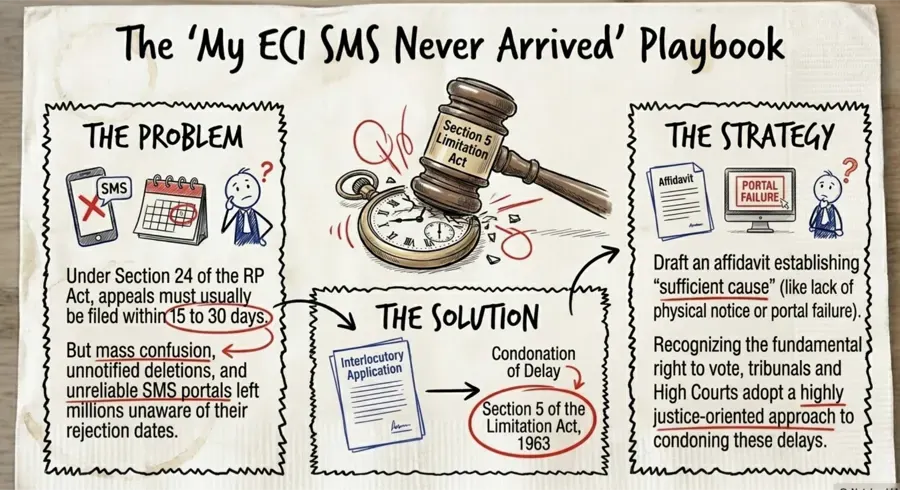
Under Section 24 of the Representation of the People Act, 1950, appeals against ERO orders must be filed within a prescribed limitation period.5 However, given the mass confusion, unnotified deletions, and unreliable SMS-based communications that left millions unaware of their precise rejection dates, appeals are frequently delayed.41 Can the tribunal appeal still be done after the deadline? Yes. The appellant must file an interlocutory application for the Condonation of Delay under Section 5 of the Limitation Act, 1963.43 The applicant must establish “sufficient cause” for the delay—such as lack of physical notice, severe illness, or inability to access the online ECINET portal. Recognizing the fundamental democratic right at stake, tribunals and High Courts generally adopt a liberal, justice-oriented approach to condoning such delays unless expressly barred.44

Form 6: The Principle of Continuous Revision

how to appeal voter card deletion west bengal, voter card deleted logical discrepancy, eci logical discrepancy voter notice, how to prove unmapped voter status, sir tribunal appeal procedure wb, calcutta high court group ix residuary writ, how to expedite tribunal hearing article 227, calcutta high court writ petition for voter card, voter list appeal deadline condonation of delay, section 5 limitation act voter card appeal, represent voter card deletion in tribunal, 19 appellate tribunals west bengal list, voter list correction online portal ecinet, advocate sudip patra calcutta high court, patras law chambers kolkata office, how to fix spelling error on voter card, voter card deleted asdd list, booth level officer verification process, voter id card restoration supreme court, mostari banu vs election commission of india, association for democratic reforms eci, continuous revision of electoral rolls form 6, how to file fresh form 6 after rejection, can i vote if tribunal appeal is pending, interim voting rights supreme court sir, calcutta high court mentioning practice writ, e filing cis 3.0 calcutta high court, check voter tribunal appeal status online, sdo sdm dm office voter appeal wb, voter identity proof vs age proof aadhaar, madhyamik admit card voter id proof, registered land deeds for unmapped voter, ancestral heritage proof citizenship voter list, west bengal assembly elections voter list, bypass voter tribunal backlog high court, writ of mandamus voter card restoration, writ of certiorari quash tribunal order, civil revisional application article 227 wb, supervisory jurisdiction calcutta high court, voter card correction kolkata lawyers contact, top supreme court lawyers in kolkata, IIT IIM alumnus law firm kolkata, patras law chambers delhi office, voter list verification manual 2026, voter card cancel correction bangla, voter list appeal form download, how to restore deleted voter id card, voter card verification sms not received, delayed voter appeal limitation condonation, calcutta high court appellate side rules group 9, Residuary matters calcutta high court lawyers, draft writ petition voter card format, save your democratic vote lawyer west bengal

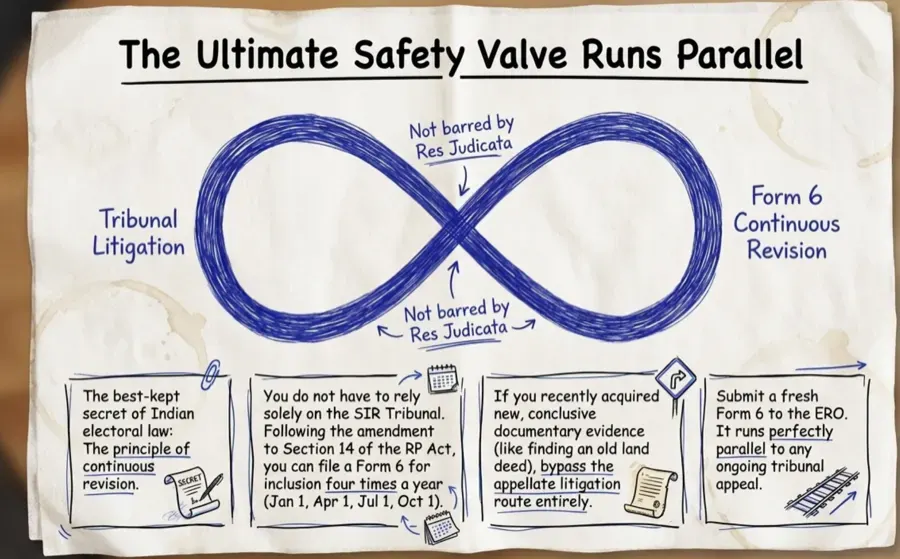
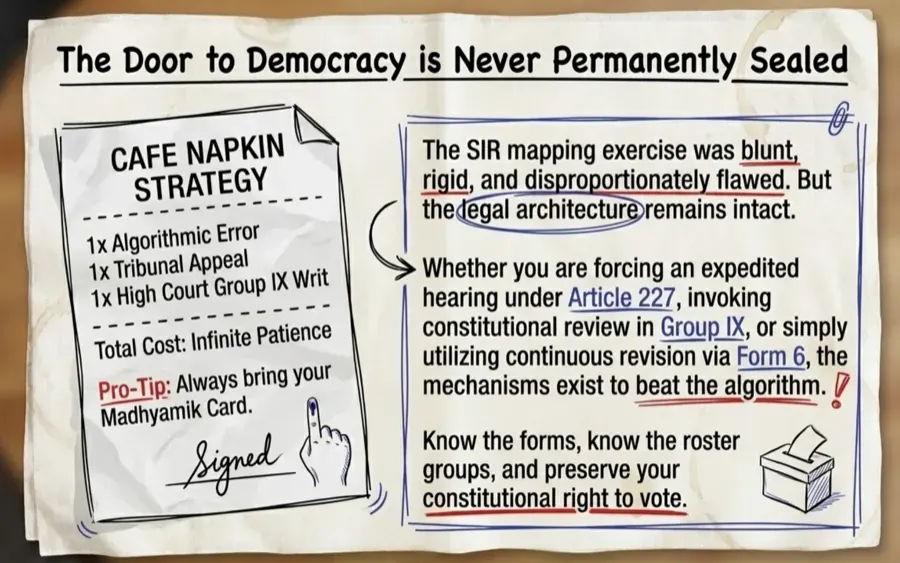
A paramount safety valve in Indian electoral law is the principle of continuous revision. If Form 6 can be filed in case of a tribunal rejection, the answer is a definitive yes; it can be filed at any point of time. Following the amendment of Section 14 of the Representation of the People Act, 1950, there are now four distinct qualifying dates in a single year (January 1, April 1, July 1, and October 1).46 Consequently, Form 6 applications are not barred by the principle of res judicata regarding past SIR exclusions. If an individual acquires new, conclusive documentary evidence, they can bypass the appellate litigation route entirely and submit a fresh Form 6 to the ERO.1 The objective of the tribunal is that the persons who are actually clearing their name will be there in the 2026 SIR, but Form 6 ensures that the door to democracy is never permanently sealed.

8. Comprehensive Frequently Asked Questions (FAQs)

how to appeal voter card deletion west bengal, voter card deleted logical discrepancy, eci logical discrepancy voter notice, how to prove unmapped voter status, sir tribunal appeal procedure wb, calcutta high court group ix residuary writ, how to expedite tribunal hearing article 227, calcutta high court writ petition for voter card, voter list appeal deadline condonation of delay, section 5 limitation act voter card appeal, represent voter card deletion in tribunal, 19 appellate tribunals west bengal list, voter list correction online portal ecinet, advocate sudip patra calcutta high court, patras law chambers kolkata office, how to fix spelling error on voter card, voter card deleted asdd list, booth level officer verification process, voter id card restoration supreme court, mostari banu vs election commission of india, association for democratic reforms eci, continuous revision of electoral rolls form 6, how to file fresh form 6 after rejection, can i vote if tribunal appeal is pending, interim voting rights supreme court sir, calcutta high court mentioning practice writ, e filing cis 3.0 calcutta high court, check voter tribunal appeal status online, sdo sdm dm office voter appeal wb, voter identity proof vs age proof aadhaar, madhyamik admit card voter id proof, registered land deeds for unmapped voter, ancestral heritage proof citizenship voter list, west bengal assembly elections voter list, bypass voter tribunal backlog high court, writ of mandamus voter card restoration, writ of certiorari quash tribunal order, civil revisional application article 227 wb, supervisory jurisdiction calcutta high court, voter card correction kolkata lawyers contact, top supreme court lawyers in kolkata, IIT IIM alumnus law firm kolkata, patras law chambers delhi office, voter list verification manual 2026, voter card cancel correction bangla, voter list appeal form download, how to restore deleted voter id card, voter card verification sms not received, delayed voter appeal limitation condonation, calcutta high court appellate side rules group 9, Residuary matters calcutta high court lawyers, draft writ petition voter card format, save your democratic vote lawyer west bengal

To ensure this legal guide provides exhaustive, SEO-optimized utility for affected citizens, legal practitioners, and researchers, the following 55 detailed FAQs address the micro-specifics of the SIR, tribunal procedures, and High Court litigation.

1. What exactly is the Special Intensive Revision (SIR) 2026?

The SIR is an extensive, nationwide electoral roll cleanup exercise directed by the Election Commission of India (ECI) to identify and remove deceased, shifted, and duplicate voters, while rigorously verifying the citizenship of existing voters using algorithmic historical mapping.

2. On what primary basis was my name removed from the voter list during the SIR?

Names were systematically removed if they failed the algorithmic mapping to the historical 2002/2003 voter lists, if complex logical discrepancies were detected in family tree data, or if the elector was categorized as Absentee, Shifted, Dead, or Duplicate (ASDD) by the Booth Level Officer.

3. What does the term “Mapped Voter” legally signify?

A mapped voter is an individual whose current electoral details successfully and algorithmically match their own, or their direct ancestors’, historical entry in the 2002 SIR electoral rolls, thereby proving long-standing domicile.

4. What does the term “Unmapped Voter” legally signify?

An unmapped voter is a citizen whose lineage, or personal registration entry, cannot be digitally traced back to the 2002 electoral roll by the ECI’s matching software, thus placing the burden of proof heavily on the citizen.

5. How does the ECI define a “Logical Discrepancy”?

Logical discrepancies are algorithmic anomalies flagged by the ECI software, such as an age gap of less than 15 years or more than 50 years between parent and child, less than 9 months between siblings, or an improbable number of progenies linked to one ancestor.

6. Can a simple spelling mistake trigger a massive logical discrepancy notice?

Yes. Minor transliteration errors, such as translating Bengali surnames into English differently over decades (e.g., “Datta” versus “Dutta”), routinely caused the rigid software to fail the mapping process, triggering millions of verification notices.

7. Who were the officials that initially rejected the documents during the SIR?

The initial verification and subsequent rejections were executed by Electoral Registration Officers (EROs) and further verified by around 700 ad-hoc judicial officers specifically assigned by the Calcutta High Court to oversee the document verification process.

8. Is submitting an Aadhaar card sufficient to prove my eligibility and prevent deletion?

No. The ECI and the adjudicating judicial officers have strictly clarified that Aadhaar is only accepted as proof of identity, not as conclusive, legal proof of age (Date of Birth), historical domicile, or residential address.

9. What specific documents are considered valid for clearing a flagged logical discrepancy?

Citizens can submit any of the 12 to 13 ECI-notified documents. Crucially, the Madhyamik (Class 10) Admit Card or Pass Certificate is recognized as absolute proof of age, alongside passports, registered land deeds, and historical voter list extracts.

10. What are the 19 Appellate Tribunals established in West Bengal?

Following a Supreme Court directive invoking Article 142, the ECI established 19 specialized Appellate Tribunals across West Bengal, headed by former High Court Judges, explicitly to hear appeals against the mass rejections made by the judicial officers.

11. Can I still file an appeal before the SIR Appellate Tribunal if the deadline passed?

Yes. If your name was excluded and you missed the standard deadline, you can still file an appeal. However, you must legally accompany your appeal with an interlocutory application for the condonation of delay under the Limitation Act.

12. What are the available methods to file an appeal with the SIR Tribunal?

Appeals can be filed physically at the designated offices of the District Magistrate (DM), Sub-Divisional Magistrate (SDM), or Sub-Divisional Officer (SDO). Alternatively, they can be filed entirely online through the integrated ECI NET platform.

13. Do I legally require an advocate to file an appeal in the SIR Tribunal?

Legal representation by an advocate is not strictly mandatory at the primary tribunal level. An authorized representative, including a recognized Booth Level Agent (BLA), can submit documents and argue on your behalf using a signed or thumb-marked authority letter.

14. If I file a physical appeal, how is it integrated into the digital process?

The SOP mandates that the DM or SDO is legally responsible for digitizing your physical application and formally uploading it to the ECI NET platform, ensuring it enters the tribunal’s centralized digital docket for scheduling.

15. Can I submit brand-new additional documents to the Appellate Tribunal?

Yes. While the tribunal reviews the full historical record, it operates as a quasi-judicial body and possesses the discretionary power to accept supplementary documentation if it comprehensively explains the specific discrepancies previously flagged by the algorithm.

16. How will I be officially notified about my tribunal hearing date?

The system predominantly relies on SMS-based appeal numbers. However, due to documented communication gaps, applicants are strongly advised to proactively check hearing schedules with the local DM/SDO office or the CEO West Bengal website.

17. Are the tribunal hearings conducted physically or virtually?

There is notable variation in hearing formats across the 19 districts. Depending on the tribunal’s specific logistics and regional internet connectivity, hearings may be conducted virtually, physically, or via a hybrid setup.

18. What is the current statistical success rate of appeals in the SIR Tribunals?

Early analytical data indicated that out of the limited cases disposed of, approximately 61.5% of appeals were allowed, resulting in the successful judicial order to restore those names back onto the electoral rolls.

19. Why is the disposal rate of the SIR Tribunals so exceptionally slow?

The tribunals are grappling with an overwhelming backlog, having received nearly 25 lakh complex appeals. Furthermore, the legal requirement to pass detailed, reasoned orders and manually verify complex genealogical data drastically limits their daily disposal capacity.

20. Does the mere pendency of my appeal legally allow me to vote provisionally?

No. The Supreme Court has explicitly and definitively ruled that the mere pendency of an appeal before the Appellate Tribunal does not entitle an excluded person to exercise provisional voting rights.

21. What happens legally if the SIR Tribunal rules in my favor?

If the tribunal allows your appeal, the ECI is statutorily bound to issue a supplementary revised electoral roll to immediately give administrative effect to the tribunal’s order, thereby restoring your voting rights.

22. What is my next legal step if the SIR Tribunal arbitrarily rejects my appeal?

If the specialized tribunal rejects your appeal, you have successfully exhausted all of the ECI’s ad-hoc administrative remedies. Your immediate next legal step is to file a constitutional writ petition in the Calcutta High Court.

23. Under which constitutional articles do I file a case in the Calcutta High Court?

You must file a comprehensive writ petition invoking Article 226 (seeking writs like Certiorari and Mandamus to enforce fundamental rights) and Article 227 (invoking the High Court’s supervisory jurisdiction to correct tribunal errors) of the Constitution of India.

24. Which specific “Group” does this writ petition fall under in the High Court?

Writ petitions challenging the orders of the ECI SIR Appellate Tribunals are strictly classified under Group IX (Residuary) of the Calcutta High Court Appellate Side Rules.

25. Why is this classified under Group IX and not Group VI or Group I?

Group VI is strictly reserved for state service matters, while Group I handles land reforms. Group IX (Residuary) serves as the constitutional catch-all category for statutory bodies, police inaction, and specially constituted electoral tribunals not covered elsewhere in the roster.

26. If a previous appeal had technical errors, can a subsequent appeal or fresh petition be filed?

Yes. There is no such provision strictly limiting the right to appeal. If an appeal is rejected on technical grounds, the matter can be freshly discussed and adjudicated via a comprehensive writ petition before the Calcutta High Court.

27. What is the legal practice of “Mentioning” in the Calcutta High Court?

Mentioning is a highly specific procedural practice where an advocate verbally requests the presiding judge at the start of the judicial day to list a case urgently out of its regular chronological turn due to pressing, prejudicial circumstances.

28. How can I legally expedite my pending, delayed hearing in the SIR Tribunal?

You must first file an urgency application before the tribunal itself. If ignored or denied, you can file a civil revisional application or writ petition under Article 227 in the Calcutta High Court seeking a judicial direction for a time-bound disposal.

29. What are legally valid reasons to request an expedited tribunal hearing?

Courts recognize cogent reasons including urgent job-related verification requiring a Voter ID, imminent foreign travel necessitating a passport, vulnerability due to age (senior citizens), and medical emergencies tied to state health insurance schemes.

30. Can the High Court legally force the tribunal to decide within a specific timeframe?

Yes. Exercising its supervisory jurisdiction under Article 227, the High Court can issue a binding directive for “expeditious disposal,” frequently setting a strict, hard deadline (e.g., 4 to 6 weeks) for the tribunal to conclude the adjudication.

31. What is the ASDD list generated by the BLOs?

ASDD is an administrative acronym standing for Absentee, Shifted, Dead, and Duplicate. Voters categorized under ASDD during the initial door-to-door survey are subject to automatic deletion unless they file aggressive claims countering the BLO’s field report.

32. Can recognized political parties legally assist in the tribunal process?

Yes. Political parties are encouraged to deploy Booth Level Agents (BLAs) who can identify wrongfully deleted voters, act as authorized representatives, and provide vital localized assistance during document submission and tribunal hearings.

33. If my name is deleted, can I just bypass the tribunal and file a new Form 6?

Absolutely. Form 6 is the standard statutory application for inclusion in the electoral roll and, under the principle of continuous revision, it can be filed at any point of time, running parallel to any tribunal litigation.

34. Does filing Form 6 automatically cancel my ongoing tribunal appeal?

No, they are parallel statutory remedies that do not cancel each other. However, if your Form 6 is approved by the ERO and your name is added to the roll, the ongoing tribunal appeal simply becomes legally infructuous (moot) and is disposed of.

35. Is there a specific statutory time limit to file an appeal under Section 24 of the RP Act?

Generally, appeals must be filed within 15 to 30 days of the impugned order. However, due to the fluid nature of the SIR, checking specific ECI state notifications is necessary, as administrative timelines can fluctuate.

36. How do I legally apply for the condonation of delay if I missed the strict deadline?

You must formally file an interlocutory application under Section 5 of the Limitation Act alongside your main appeal, detailing via affidavit the exact, sufficient reasons (such as medical hospitalization or lack of SMS notice) that prevented timely filing.

37. Can the Election Commission be financially penalized for wrongfully deleting my name?

If a deletion is purely an administrative, algorithmic error, there is no direct financial penalty mechanism. However, if malicious, deliberate, or targeted exclusions can be proven, exemplary costs can be sought in the High Court via a writ petition.

38. What is the role of the Chief Electoral Officer (CEO) in this specialized process?

The CEO is the highest state-level authority. In standard roll revisions, the CEO hears second appeals. However, under the Supreme Court’s ad-hoc SIR order, the 19 Appellate Tribunals bypass the standard CEO appeal route, acting as the final fact-finding bodies.

39. Can I submit evidentiary documents in Bengali directly to the Calcutta High Court?

No. The official language of the High Court is English. Any evidentiary documents in vernacular languages (like Bengali) must be accompanied by officially translated and certified English copies when annexed to a writ petition.

40. Are the High Court Group IX writ hearings conducted online or offline?

The Calcutta High Court offers comprehensive hybrid hearing facilities. Advocates have the flexibility to join proceedings virtually via designated Video Conferencing (VC) links or appear physically in the assigned Court Room.

41. What is the fundamental legal difference between Article 226 and Article 227 in this specific context?

Article 226 is a broader power used to quash the tribunal’s final order and enforce your inclusion (via Certiorari and Mandamus). Article 227 is a narrower, supervisory power primarily used to correct procedural illegalities, command tribunals to act within their jurisdiction, or expedite delayed proceedings.

42. How much does it cost in court fees to file a writ petition in the Calcutta High Court?

Statutory court fees for writ petitions are exceptionally nominal (often ranging between Rs. 100 to Rs. 250). However, the overall financial burden depends heavily on drafting, affirmation (notary public) costs, and the engaged advocate’s professional fees.

43. If my parents’ ages are mapped wrongly by the ECI software, how do I prove my eligibility in the tribunal?

You must pivot away from the ECI’s software logic and provide primary, irrefutable evidence of your own age and parentage, such as birth certificates, school leaving certificates, or Madhyamik admit cards, which legally supersede the software’s mathematical errors.

44. What happens if the primary judicial officer marked me as a “foreign illegal immigrant”?

If excluded on severe citizenship grounds, the burden shifts entirely to you. You must provide definitive, historical proof of Indian citizenship (e.g., registered land records pre-dating cutoff dates, ancestral legacy data) to the tribunal to reverse this highly prejudicial finding.

45. Can the Supreme Court directly hear my appeal against the SIR Tribunal’s order?

Generally, no. The Supreme Court expects citizens to exhaust the immediate constitutional remedy available at the High Court (Article 226/227) first. The Supreme Court has explicitly pushed SIR disputes to the Calcutta High Court to manage the nationwide judicial backlog.

46. How do I find out if my name is languishing in the ‘Logical Discrepancy’ or ASDD list?

These critical lists are legally mandated to be displayed transparently at Gram Panchayat Bhawans, Block Development Offices, and urban Ward Offices, and are frequently accessible in digital formats via the CEO West Bengal official website.

47. Can my tribunal appeal be rejected simply because I was absent on the hearing date?

Yes. If you fail to appear or send an authorized representative despite receiving proper notice, the tribunal can dismiss the appeal “for default.” However, you can file a subsequent application to restore the appeal by showing good cause for your absence.

48. Is there a Public Interest Litigation (PIL) route for these mass, algorithmic deletions?

While sweeping PILs have been filed by major organizations (like ADR) to challenge the SIR’s broad constitutionality, individual voters seeking the specific, personal restoration of their names must file private, individual writ petitions under Group IX.

49. If the ad-hoc tribunal is dissolved after the election concludes, what happens to my pending appeal?

The ECI notification explicitly states that the tribunals exist until all appeals are conclusively disposed of. If a tribunal were prematurely dissolved, all pending appeals would legally revert to the standard statutory authorities (DM/CEO) or become subject to High Court intervention.

50. Can I upload supporting documents directly to the online appeal system?

Yes. The digital infrastructure of the ECI NET platform and the integrated voter helpline portal allows for the direct digital uploading of scanned supporting documents in specified digital formats (PDF/JPEG) during the online appeal filing process.

51. What if I shifted my residential address during the prolonged tribunal proceedings?

You should formally intimate the tribunal of your change of address via an application. However, practically, it is highly recommended to bypass the complication and file a fresh Form 8 (for shifting) or a new Form 6 at your newly acquired constituency.

52. Are the High Court’s CIS 3.0 e-filing records accessible to the public?

Basic case status, hearing dates, and final judgments generated through the CIS 3.0 system are accessible to the public via the Calcutta High Court’s official website or the eCourts portal using the CNR number.

53. Does the High Court review the facts of the case, or only the law?

Under writ jurisdiction, the High Court generally does not act as a primary fact-finding forum. It reviews whether the tribunal’s decision-making process was legally sound, unarbitrary, and compliant with the principles of natural justice.

54. What happens if the tribunal ignores the Supreme Court’s SOP guidelines?

If a tribunal violates the established SOP—such as refusing to accept authorized representatives or failing to provide a reasoned order—this constitutes a procedural illegality, which is a prime ground for the High Court to quash the order under Article 227.

55. Ultimately, what is the core strategic objective of expediting the tribunal process?

The core objective is to rapidly mitigate the severe administrative prejudice caused by algorithmic errors, ensuring that genuine citizens who have proven their identities are reinstated swiftly, guaranteeing their presence in the Final Electoral Roll, and securing their fundamental constitutional right to participate in the democratic process.

9. Conclusion

how to appeal voter card deletion west bengal, voter card deleted logical discrepancy, eci logical discrepancy voter notice, how to prove unmapped voter status, sir tribunal appeal procedure wb, calcutta high court group ix residuary writ, how to expedite tribunal hearing article 227, calcutta high court writ petition for voter card, voter list appeal deadline condonation of delay, section 5 limitation act voter card appeal, represent voter card deletion in tribunal, 19 appellate tribunals west bengal list, voter list correction online portal ecinet, advocate sudip patra calcutta high court, patras law chambers kolkata office, how to fix spelling error on voter card, voter card deleted asdd list, booth level officer verification process, voter id card restoration supreme court, mostari banu vs election commission of india, association for democratic reforms eci, continuous revision of electoral rolls form 6, how to file fresh form 6 after rejection, can i vote if tribunal appeal is pending, interim voting rights supreme court sir, calcutta high court mentioning practice writ, e filing cis 3.0 calcutta high court, check voter tribunal appeal status online, sdo sdm dm office voter appeal wb, voter identity proof vs age proof aadhaar, madhyamik admit card voter id proof, registered land deeds for unmapped voter, ancestral heritage proof citizenship voter list, west bengal assembly elections voter list, bypass voter tribunal backlog high court, writ of mandamus voter card restoration, writ of certiorari quash tribunal order, civil revisional application article 227 wb, supervisory jurisdiction calcutta high court, voter card correction kolkata lawyers contact, top supreme court lawyers in kolkata, IIT IIM alumnus law firm kolkata, patras law chambers delhi office, voter list verification manual 2026, voter card cancel correction bangla, voter list appeal form download, how to restore deleted voter id card, voter card verification sms not received, delayed voter appeal limitation condonation, calcutta high court appellate side rules group 9, Residuary matters calcutta high court lawyers, draft writ petition voter card format, save your democratic vote lawyer west bengal

The Special Intensive Revision (SIR) exercise, while fundamentally necessary for maintaining the purity and integrity of the electoral roll, has dramatically exposed severe logistical, administrative, and algorithmic fault lines. The blunt, uncompromising application of software mapping to root out “logical discrepancies” ensnared millions of legitimate citizens in a highly complex web of quasi-judicial adjudication. While the Supreme Court’s intervention to establish 19 specialized Appellate Tribunals in West Bengal was a crucial constitutional safeguard against mass disenfranchisement, the statistical reality of a 0.26% disposal rate underscores a systemic administrative bottleneck that borders on de facto disenfranchisement.

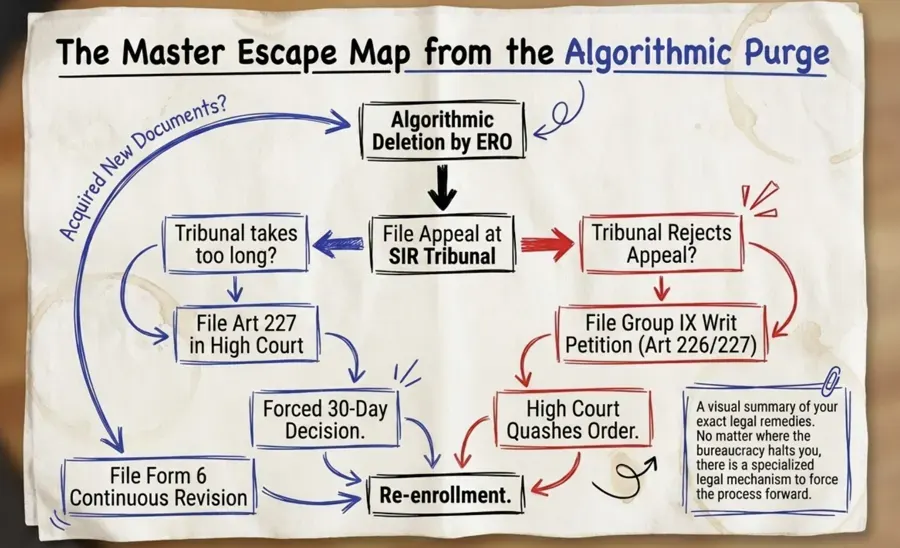
For affected citizens, navigating this legal roadmap requires multi-tiered strategic precision. Engaging with the Appellate Tribunals via physical or online appeals remains the primary statutory remedy. Where these tribunals falter due to sheer backlog, the constitutional supervisory powers of the Calcutta High Court under Article 227 offer a potent, effective tool to force time-bound, expedited hearings—especially when fundamental livelihood, travel, or health access is prejudiced. Furthermore, should the tribunals arbitrarily uphold wrongful exclusions, the Group IX writ jurisdiction of the High Court provides the ultimate judicial review to quash such erroneous orders. Parallel to all this intense litigation, the continuous revision framework allows citizens to constantly assert their democratic rights through the filing of Form 6 at any point in time. Understanding and utilizing this intricate legal architecture ensures that the constitutional guarantee—that no eligible citizen shall be arbitrarily denied the right to vote—remains firmly intact.

Works cited

  1. West Bengal SIR | SC pushes SIR disputes to Calcutta HC as …, accessed on June 10, 2026, https://www.scobserver.in/reports/west-bengal-sir-sc-pushes-sir-disputes-to-calcutta-hc-as-appeal-backlog-mounts/
  2. Special Intensive Revision – Wikipedia, accessed on June 10, 2026, https://en.wikipedia.org/wiki/Special_Intensive_Revision
  3. ECI misled the Supreme Court on SIR in West Bengal – The Reporters’ Collective, accessed on June 10, 2026, https://www.reporters-collective.in/trc/eci-misled-the-sc-on-sir-in-west-bengal
  4. Panel 2: Special Intensive Revision: Contours and Contents of Citizenship, accessed on June 10, 2026, https://lawandotherthings.com/panel-2-special-intensive-revision-contours-and-contents-of-citizenship/
  5. THE REPRESENTATION OF THE PEOPLE ACT, 1950 – Chief Electoral Officer, Delhi, accessed on June 10, 2026, https://ceodelhi.gov.in/WriteReadData/ManualElectionLaw/REPRESENTATION%20OF%20THE%20PEOPLE%20ACT,%201950.pdf
  6. SPECIAL INTENSIVE REVISION – CEO West Bengal, accessed on June 10, 2026, https://ceowestbengal.wb.gov.in/Downloads/TrainingMaterial/SIRPPT.pdf
  7. Rate at which West Bengal tribunals restoring names of deleted electors proves genuine voters not allowed to vote: Prasenjit Bose – The Hindu, accessed on June 10, 2026, https://www.thehindu.com/news/national/west-bengal/rate-at-which-west-bengal-tribunals-restoring-names-of-deleted-electors-proves-genuine-voters-not-allowed-to-vote-prasenjit-bose/article71030409.ece
  8. Bengal SIR: Tribunals dispose of over 6,500 appeals so far, allow 61.5% cases back in voter rolls – The Hindu, accessed on June 10, 2026, https://www.thehindu.com/elections/west-bengal-assembly/bengal-sir-tribunals-dispose-of-over-6500-appeals-so-far-allow-615-cases-back-in-voter-rolls/article71010370.ece
  9. MOSTARI BANU v. THE ELECTION COMMISSION OF INDIA | Supreme Court Of India | Judgment | Law | CaseMine, accessed on June 10, 2026, https://www.casemine.com/judgement/in/69708877e51ff9396610d0c7
  10. Revised ITEM NOS.53 + 55 COURT NO.1 SECTION PIL-W S U P R E M E C O U R T O F I N D I A RECORD OF PROCEEDINGS Writ Pe, accessed on June 10, 2026, https://api.sci.gov.in/supremecourt/2025/64235/64235_2025_1_53_70166_Order_13-Apr-2026.pdf
  11. Mostari Banu vs The Election Commission Of India on 13 April, 2026, accessed on June 10, 2026, https://indiankanoon.org/doc/165721599/
  12. No notices to 88% Tamil Nadu voters facing deletion: Supreme Court to hear plea, accessed on June 10, 2026, https://www.thehindu.com/news/national/tamil-nadu/petitioners-submit-88-not-issued-notices-in-tn-as-objections-phase-ends-on-jan-30-sc-schedules-urgent-hearing-on-jan-29/article70560519.ece
  13. Supreme Court issues directions for voters flagged in West Bengal Special Intensive Revision (SIR) – SCC Online, accessed on June 10, 2026, https://www.scconline.com/blog/post/2026/01/22/sc-directions-west-bengal-sir-electoral-rolls/
  14. Office of the Chief Electoral Officer Altinho, Panaji-Goa 403 001, accessed on June 10, 2026, https://ceogoa.nic.in/PDF/SIR2026/press-note-Final-publication.pdf
  15. Before SIR, Election Commission outlines what can trigger ‘logical discrepancy’, accessed on June 10, 2026, https://timesofindia.indiatimes.com/city/gurgaon/before-sir-election-commission-outlines-what-can-trigger-logical-discrepancy/articleshow/131596214.cms
  16. West Bengal SIR: Supreme Court Orders Safeguards, Allows Voters to Submit Objections Through Representatives – LawBeat, accessed on June 10, 2026, https://lawbeat.in/top-stories/west-bengal-sir-supreme-court-orders-safeguards-allows-voters-to-submit-objections-through-representatives-1557761
  17. West Bengal SIR: SC Big Order on Voter Appeals … – SCC Online, accessed on June 10, 2026, https://www.scconline.com/blog/post/2026/04/17/west-bengal-sir-sc-order-on-voter-appeals-cleared-by-appellate-tribunals/
  18. ECI sets up 19 Appellate Tribunals in West Bengal for voter roll appeals – Newsonair, accessed on June 10, 2026, https://newsonair.gov.in/eci-sets-up-19-appellate-tribunals-in-west-bengal-for-voter-roll-appeals/
  19. The Kolkata Gazette – CEO West Bengal, accessed on June 10, 2026, https://www.ceowestbengal.wb.gov.in/Downloads/Orders/Final%20office%20order%20April%202026/SAR%2028__Honorarium_Judges_07-04-2026.pdf
  20. Precarity, Pain, Protest: In West Bengal, Muslim Women’s, accessed on June 10, 2026, https://behanbox.com/2026/04/28/precarity-pain-protest-in-west-bengal-muslim-womens-citizenship-and-identity-are-on-trial/
  21. Mostari Banu vs The Election Commission Of India on 1 April, 2026 – Indian Kanoon, accessed on June 10, 2026, https://indiankanoon.org/doc/32505722/
  22. 44 Case :- MATTERS UNDER ARTICLE 227 No. – 11864 of 2023 Petitioner – eLegalix, accessed on June 10, 2026, https://elegalix.allahabadhighcourt.in/elegalix/WebDownloadOriginalHCJudgmentDocument.do?translatedJudgmentID=4341
  23. Posts – High Courts in India: A Comprehensive Analysis – BrightCareerMaker, accessed on June 10, 2026, https://www.brightcareermaker.com/posts/high-courts-in-india-a-comprehensive-analysis
  24. Haripada Moitra vs President, Calcutta Improvement … on 27 June, 1969 – Indian Kanoon, accessed on June 10, 2026, https://indiankanoon.org/doc/1434111/
  25. IN THE HIGH COURT AT CALCUTTA CIVIL REVISIONAL JURISDICTION APPELLATE SIDE C.O. 3067 of 2019, accessed on June 10, 2026, https://calcuttahighcourt.gov.in/Show-Judgment-File/2019~co_3067_e.pdf
  26. Dr. Subir Guha Roy and Anr. Vs. Sri Sandip Ghosh and Anr. – Calcutta High Court, accessed on June 10, 2026, https://ibclaw.in/dr-subir-guha-roy-and-anr-vs-sri-sandip-ghosh-and-anr-calcutta-high-court/
  27. Sankar Parui v. Sandhya Mondal | Calcutta High Court | Judgment | Law – CaseMine, accessed on June 10, 2026, https://www.casemine.com/judgement/in/56ea867a607dba36fd0b8386
  28. Sri Susanta Biswas vs Kartick Ch. Ghosh & Ors on 11 July, 2017 – Indian Kanoon, accessed on June 10, 2026, https://indiankanoon.org/doc/62510112/
  29. http://JUDIS.NIC.IN SUPREME COURT OF INDIA Page 1 of 21 PETITIONER: HARI VISHNU KAMATH Vs. RESPONDENT: SYED AHMAD ISHAQUE AND OT, accessed on June 10, 2026, https://api.sci.gov.in/jonew/judis/857.pdf
  30. Writ Petition Calcutta High Court 2026 | Complete Guide | Adv. Siddharth Gupta, accessed on June 10, 2026, https://siddharthgupta.in/blog/writ-petition-calcutta-high-court-guide
  31. IN THE HIGH COURT AT CALCUTTA NOTIFICATION, accessed on June 10, 2026, https://www.calcuttahighcourt.gov.in/Notice-Files/general-notice/3453
  32. Daily Supplementary List Of Cases For Hearing On Wednesday, 13th of May, 2026 – Appellate Jurisdiction, accessed on June 10, 2026, https://www.calcuttahighcourt.gov.in/Notice-Files/CL/17052
  33. Daily Supplementary List Of Cases For Hearing On Wednesday, 10th of June, 2026 – Appellate Jurisdiction, accessed on June 10, 2026, https://www.calcuttahighcourt.gov.in/Notice-Files/CL/17224
  34. Samrat Das – Advocate – HIGH COURT, CALCUTTA – SARTHAC, accessed on June 10, 2026, https://sarthac.gov.in/download-case-file?page=view-case-file&id=22849&year=2023
  35. The Appellate Side Rules of The High Court at Calcutta – Indian Kanoon, accessed on June 10, 2026, https://indiankanoon.org/doc/118343254/
  36. aranya saha – SARTHAC, accessed on June 10, 2026, https://sarthac.gov.in/download-case-file?page=view-case-file&id=17282&year=2023
  37. 5.Filing & Registration – Calcutta High Court, accessed on June 10, 2026, https://calcuttahighcourt.gov.in/downloads/ecourt_files/cis3/filing_and_registration/Filing_and_Registration.pdf
  38. High Court, Calcutta – SARTHAC, accessed on June 10, 2026, https://sarthac.gov.in/download-case-file?page=view-case-file&id=14671&year=2022
  39. Notification on Public Interest Litigation Uploaded:24-Aug-2010 11:03:51 – Calcutta High Court, accessed on June 10, 2026, https://www.calcuttahighcourt.gov.in/Notice-Files/gazette-notification/250
  40. Section 24 in The Representation Of The People Act, 1950 – Indian Kanoon, accessed on June 10, 2026, https://indiankanoon.org/doc/42463674/
  41. Bengal SIR Appeals See Uncertainty As Tribunal Hearing Process Remains Unclear, accessed on June 10, 2026, https://www.youtube.com/watch?v=8NPfSwyAXIA&vl=en-US
  42. SC To Seek Calcutta HC Report On Appellate Tribunals’ Functioning | SIR Bengal, accessed on June 10, 2026, https://www.youtube.com/watch?v=cMfTKGNgvyY
  43. R.P. No.866/2015 (Sanjay Ledwani vs. Gopal Das Kabra and others) R.P. No.950/2015 (Cantonment Board vs. Gopal Das Kabra) R.P. No, accessed on June 10, 2026, https://mphc.gov.in/upload/jabalpur/MPHCJB/2015/RP/866/RP_866_2015_FinalOrder_17-Mar-2016.pdf
  44. Manual on ELECTORAL ROLL, accessed on June 10, 2026, https://www.ceoandaman.nic.in/election/HANDBOOKS/MANUAL%20ON%20ELECTORAL%20ROLLS%202024.pdf
  45. Supreme Court on Election Petition Limitations | PDF – Scribd, accessed on June 10, 2026, https://www.scribd.com/document/947749142/IOS-assignment
  46. Press Note dated 15.03.2026 for AS, KL, WB, TN & PUDU-Final – Chief Electoral Officer, Puducherry, accessed on June 10, 2026, https://ceowestbengal.wb.gov.in/Downloads/Election/GE2026/Press%20Note%2015.03.2026.pdf
  47. West Bengal SIR | SC notes disposal of over 47 lakh objections – Supreme Court Observer, accessed on June 10, 2026, https://www.scobserver.in/reports/west-bengal-sir-sc-notes-disposal-of-over-47-lakh-objections/
  48. BENNETT, COLEMAN & CO. LTD. | Estd. MDCCCXXXVIII | VOL. 76 NO.197 | NEW DELHI | TUESDAY, AUGUST 19, 2025 – Chronicle Club, accessed on June 10, 2026, https://chronicleclub.in/storage/uploads/1755586625-toi.pdf

Leave a Reply

Your email address will not be published. Required fields are marked *