Liquor Licence Writ Petition in the Calcutta High Court: Full Guide
Creditor and contributor of this article:
Patra’s Law Chambers:
About Us:
Patra’s Law Chambers is a law firm with offices in Kolkata & Delhi, offering comprehensive legal services across various domains. Established in 2020 by Advocate Sudip Patra (Advocate, Supreme Court of India & Calcutta High Court) an alumnus of the Prestigious Rajiv Gandhi School of Intellectual Property Law, IIT Kharagpur ,with Post Graduate diploma in Business Law from IIM Calcutta, the firm specializes in Civil, Criminal, Writs, High Court Matters, Trademark, Copyright, Company, Tax, IT, GST & Customs, Banking & DRT, Property disputes, Service law & CAT & High Court related service matters, Military Law, Family law, and Supreme Court matters. You can know more about us in here
Kolkata Office:
NICCO HOUSE, 6th Floor, 2, Hare Street, Kolkata-700001 (Near Calcutta High Court)
Delhi Office:
House no: 4455/5, First Floor, Ward No. XV, Gali Shahid
Bhagat Singh, Main Bazar Road, Paharganj, New Delhi-110055
Website: www.patraslawchambers.com
Email: [email protected]
Phone: +91 890 222 4444/ +91 7003 715 325
 Introduction: When the Excise Department’s Order Goes Against the Licensee
A sudden suspension, an arbitrary refusal to renew, a summarily rejected transfer application, or a punitive cancellation order by the State Excise authorities can immediately cripple a commercial hospitality or retail venture. For retail licensees, wholesale distributors, and bonded warehouse operators in the State of West Bengal, navigating the complex regulatory web of the excise department requires a sophisticated understanding of both local administrative law and constitutional remedies1. When an adverse administrative order is issued by the state authorities, the licensee is often faced with the immediate threat of business closure and severe financial loss1. In such circumstances, filing a liquor licence writ petition Calcutta High Court emerges as the primary constitutional mechanism to challenge the overreach of the excise administration1.
While ordinary business enterprises are protected by robust constitutional guarantees to carry on trade and commerce, the trade in intoxicating liquors occupies a unique and highly restrictive position in Indian jurisprudence5. The state maintains an extraordinary level of control, frequently invoking the doctrine of res extra commercium to limit the rights of private vendors6.
Nevertheless, the power of the state is not absolute. When an administrative authority acts arbitrarily, violates statutory procedures, disregards the principles of natural justice, or exceeds its legal jurisdiction, a constitutional remedy remains accessible2. Through a detailed examination of the Bengal Excise Act, 1909, the West Bengal Excise Rules, and the evolving decisions of the Supreme Court of India and the Calcutta High Court, this report serves as a definitive guide for legal practitioners and aggrieved licensees seeking to challenge excise department order Calcutta High Court1.
The Legal Framework: Bengal Excise Act, 1909 and the Excise Rules
The administration, regulation, and collection of revenue associated with intoxicants in West Bengal are governed by the Bengal Excise Act, 190910. This century-old statutory framework establishes a rigid hierarchical system of control, delegating regulatory and enforcement powers to specific administrative authorities11.
Administrative Hierarchy and Statutory Powers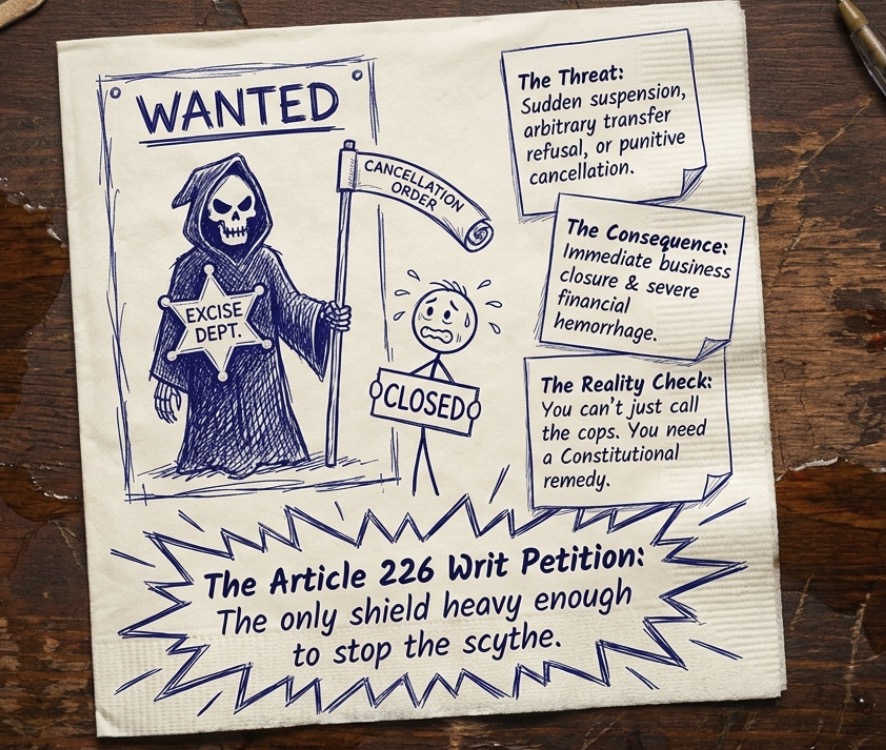
The administrative structure under the Bengal Excise Act, 1909 is organized to maximize regulatory oversight and revenue collection11.
- The State Government: Holds the ultimate executive authority, including the power to formulate policies, determine excise duty rates, and enact rules under Section 85 of the Act9.
- The Excise Commissioner, West Bengal: Serves as the administrative head of the Excise Directorate1. The Commissioner directs the administration of the Act, oversees the collection of excise revenue, and acts as a key appellate authority11.
- The Collector of Excise: Ordinarily the District Magistrate or a specialized officer appointed by the State Government, the Collector is the primary licensing authority within a district1. The Collector possesses the statutory power to grant, refuse, suspend, or cancel retail, wholesale, and bonded warehouse licenses1.
- District Excise Officers and Superintendents: Responsible for field-level enforcement, inspection of licensed premises, and initiation of compounding or penal proceedings3.
Key Rules under the Act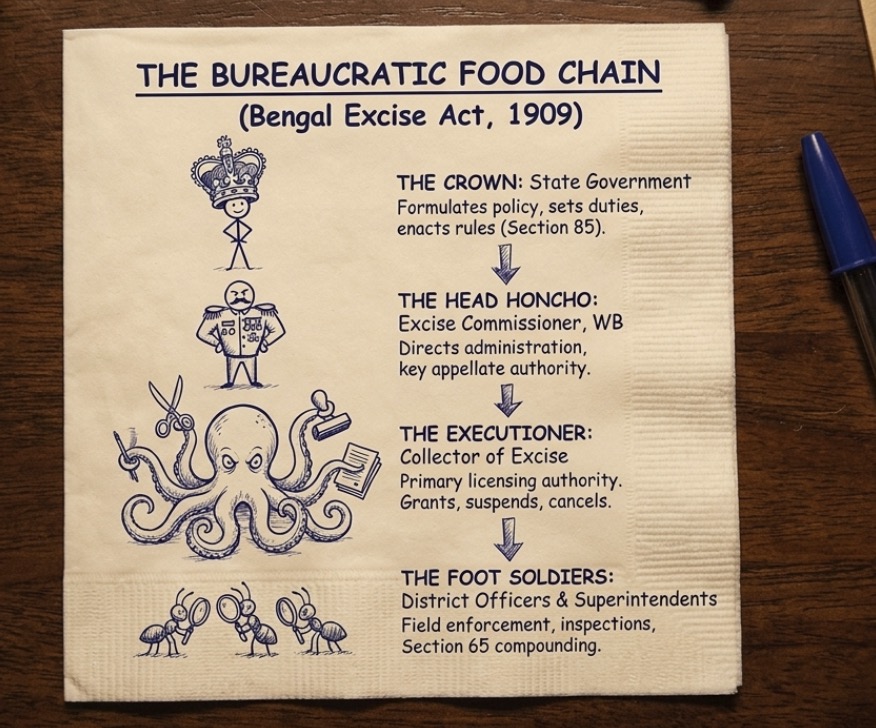
The broad statutory provisions of the Bengal Excise Act, 1909 are supplemented by specialized rules enacted by the State Government9. These rules dictate the micro-operations of the liquor trade:
- The West Bengal Excise (Selection of New Sites and Grant of License for Retail Sale of Liquor and Certain Other Intoxicants) Rules, 2003: Governs the selection of locations, application procedures, eligibility criteria, and distance restrictions for retail vends, such as country spirit (“CS”) shops, foreign liquor (“FL”) “Off” shops, and “On” shops or bars1. Specifically, Rule 9 details the procedure for the grant of retail licenses, Rule 11 establishes the eligibility criteria for applicants, and Rule 8 defines the suitability of new sites for retail establishments13.
- The West Bengal Excise (Transfer of License) Rules, 2023: Establishes the legal procedures and fee structures for transferring retail and wholesale licenses under various ownership configurations, overriding previous notifications regarding changes in management15.
- The West Bengal Excise (Shifting of Existing Site or Change of Premises of Excise License) Rules, 2009: Regulates the relocation of operational liquor shops due to public necessity, environmental constraints, or site-suitability issues4.
Recent Legislative Amendments: The West Bengal Finance Act, 2024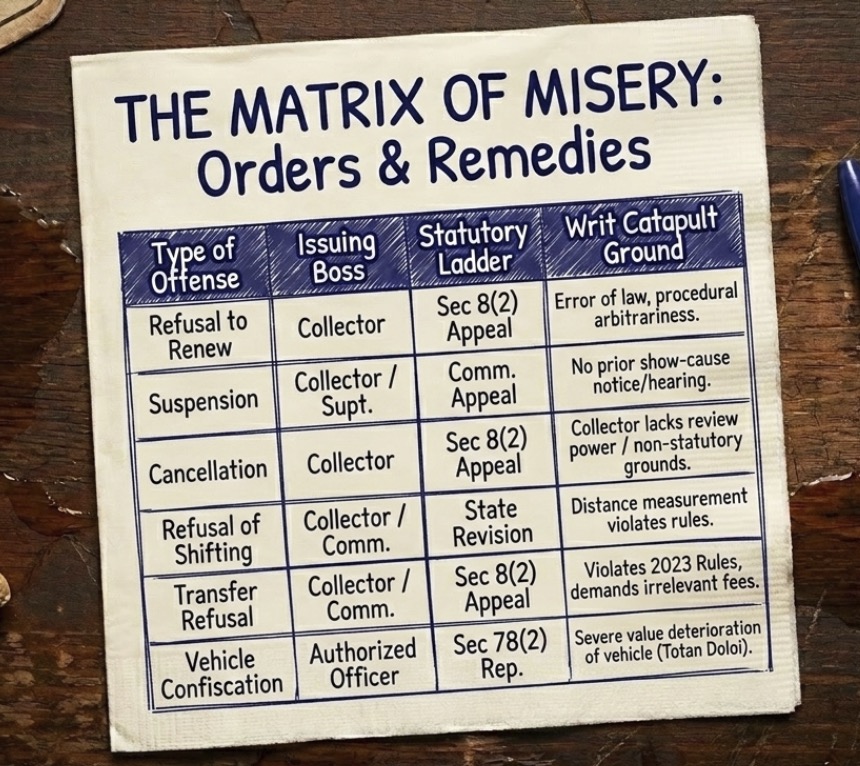
The regulatory regime underwent significant statutory updates with the enactment of the West Bengal Finance Act, 2024, which amended several provisions of the Bengal Excise Act, 190919. Specifically, Section 2 of the principal Act was amended to insert clause (12iaa), defining the term “intermediate quantity” in relation to spirit or intoxicating drugs, bridging the gap between small and commercial quantities for enforcement purposes19.
Furthermore, Section 46A was substituted to scale penal consequences based on the quantity involved, imposing a tiered imprisonment and fine structure for unauthorized manufacture, possession, or transport19. Crucially for transport and logistics operators, Section 78(2) was substituted to detail the procedures for the confiscation of seized vehicles and conveyances, mandating a strict notice and representation process before a final confiscation order is executed by the Collector19.
| Type of Excise Order | Issuing Authority | Primary Statutory Remedy | Alternative Remedy / Authority | Maintainability of Writ under Article 226 |
|---|---|---|---|---|
| Refusal to Grant / Renew Licence
[cite: 1, 9] |
Collector of Excise1 | Appeal under Section 8(2)2 | Revision to State Govt under Section 8(3)2 | Maintainable if there is an error of law, violation of rules, or procedural arbitrariness1. |
| Suspension of Licence
[cite: 2, 3] |
Collector / Superintendent2 | Appeal to Excise Commissioner2 | Revision under Section 8(3)2 | High maintainability if passed without a prior show-cause notice or hearing2. |
| Cancellation of Licence
[cite: 1, 2] |
Collector of Excise1 | Statutory Appeal under Section 8(2)2 | Revision to State Govt under Section 8(3)2 | High maintainability if the Collector lacks the power of review or acts on non-statutory grounds2. |
| Refusal of Shifting / Relocation
[cite: 4, 17] |
Collector / Commissioner17 | Appeal to Excise Commissioner or State Govt4 | Revision under Section 8(3)12 | Maintainable if distance measurements violate statutory rules or similarly placed vends are treated unequally4. |
| Refusal of Transfer of Licence
[cite: 15, 21] |
Collector / Commissioner15 | Appeal under Section 8(2)12 | Revision under Section 8(3)12 | Maintainable if the refusal violates the 2023 Transfer Rules or incorporates irrelevant considerations15. |
| Seizure & Confiscation of Vehicle
[cite: 19, 23] |
Collector / Authorized Officer19 | Representation under Section 78(2)(c)19 | Judicial review / CRR before High Court23 | Maintainable to secure interim release of vehicle if detention causes severe value deterioration23. |
Is There a “Right” to a Liquor Licence? The Res Extra Commercium Doctrine
A fundamental threshold hurdle in any Bengal Excise Act licence dispute is the constitutional characterization of the liquor trade5. Unlike other commercial enterprises where citizens enjoy a fundamental right to carry on trade or business under Article 19(1)(g) of the Constitution of India, the trade in potable alcohol is treated as an exception6.
The Landmark Jurisprudence on Res Extra Commercium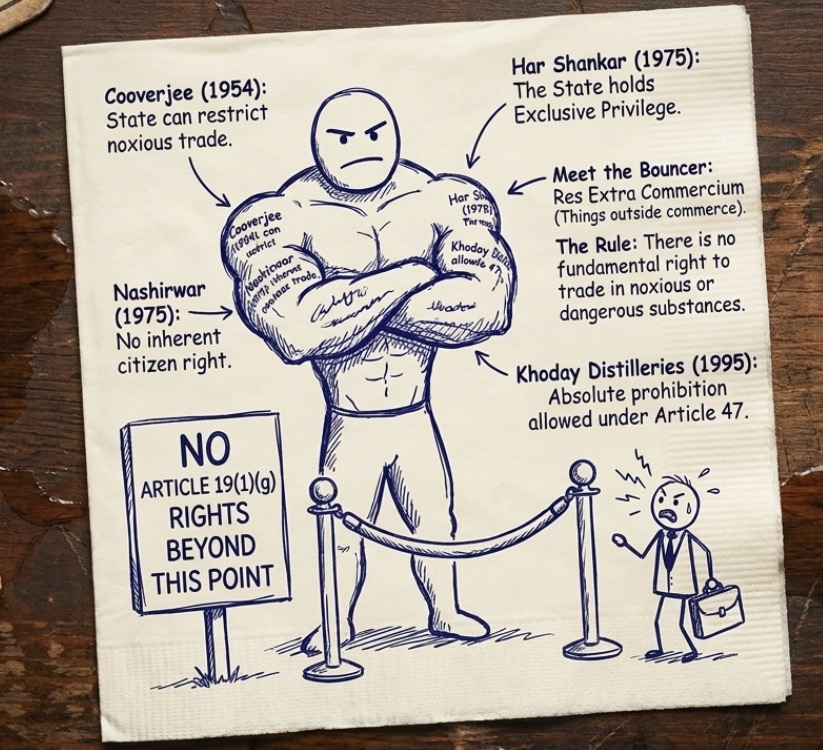
For over seven decades, the Supreme Court of India has consistently applied the Latin doctrine of res extra commercium (things outside commerce) to the liquor trade, holding that certain noxious or inherently dangerous activities cannot claim the status of a fundamental right6.
- Cooverjee B. Bharucha v. The Excise Commissioner, (1954) SCR 873: The Supreme Court first articulated that the state has the power to prohibit or restrict trade in noxious or dangerous substances like intoxicating liquors to protect public health and morals, and such restrictions do not violate Article 19(1)(g)7.
- Nashirwar v. State of Madhya Pradesh, (1975) 1 SCC 29: The Court reinforced the principle that there is no inherent or fundamental right in a citizen to sell intoxicating liquor7. The state holds an “exclusive privilege” to manufacture, possess, and sell intoxicants, which it may choose to delegate or part with for a price or consideration7.
- Har Shankar v. Deputy Excise & Taxation Commissioner, (1975) 1 SCC 737: A Constitution Bench solidified the exclusive privilege theory, holding that the state can regulate the liquor trade through the imposition of fees, levies, or complete bans, and that citizens cannot rely on Article 19(1)(g) to escape contractually accepted licensing conditions6.
- Khoday Distilleries Ltd. v. State of Karnataka, (1995) 1 SCC 574: The Supreme Court synthesized the entire line of authority, confirming that potable liquor is res extra commercium6. The state can impose absolute prohibition under Article 47 of the Directive Principles of State Policy, or it can permit trade under highly regulated licensing conditions6.
- State of Punjab v. Devans Modern Breweries Ltd., (2004) 11 SCC 26: The Supreme Court clarified that while the state possesses the exclusive privilege to control the liquor trade, its regulatory authority must be exercised in a non-discriminatory manner once it decides to permit private trade through licenses6.
The Constitutional Pivot: The Applicability of Article 14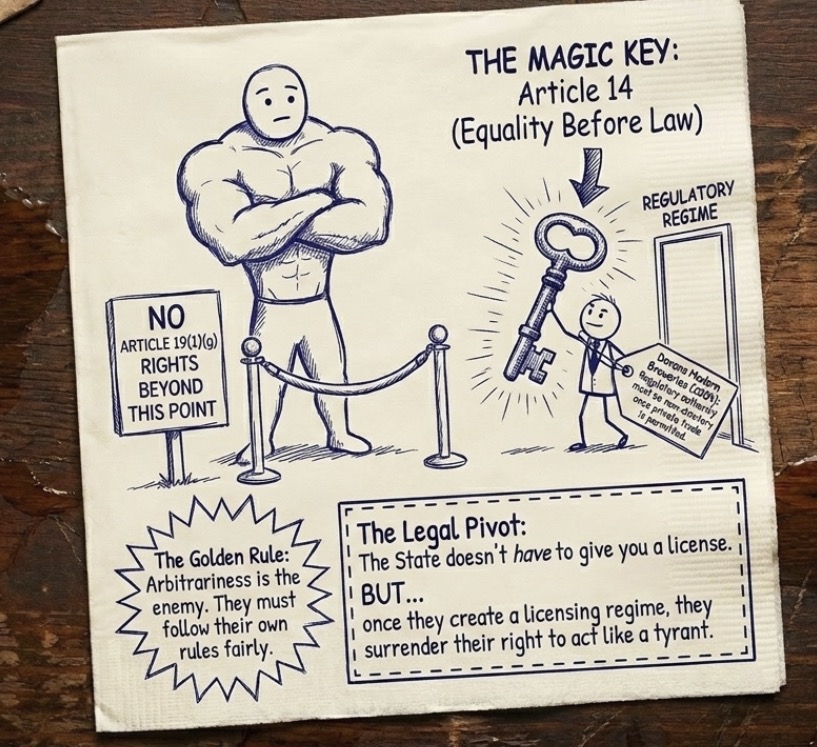
Although the res extra commercium doctrine establishes that there is no fundamental right to obtain a liquor license under Article 19(1)(g), it does not grant the State absolute, unchecked power to act whimsically or discriminatorily6. This is the critical legal pivot upon which successful liquor licence writ petitions are built in the Calcutta High Court1.
Once the State Government elects to permit the trade in liquor and establishes a licensing regime, it is bound by the mandates of Article 14 of the Constitution of India26. The State cannot grant licenses to favored individuals while arbitrarily denying them to similarly situated applicants, nor can it violate its own rules to cancel an existing license2. As the Supreme Court observed in Khoday Distilleries and Devans Modern Breweries, when the state parts with its exclusive privilege through a statutory licensing framework, it must act fairly, transparently, and in strict compliance with the rules it has framed25. Any deviation from these principles constitutes an arbitrary state action, making a writ petition under Article 226 maintainable4. The nuances of this boundary can be explored further in the detailed review of the High Court’s [writ jurisdiction under Article 226]4.
Common Excise Disputes That Reach the Calcutta High Court
Administrative and regulatory disputes arising under the Bengal Excise Act, 1909 frequently require judicial intervention by the Calcutta High Court1. These disputes typically fall into specific categories, each involving distinct rules and grounds for challenge2.
Transfer of Licence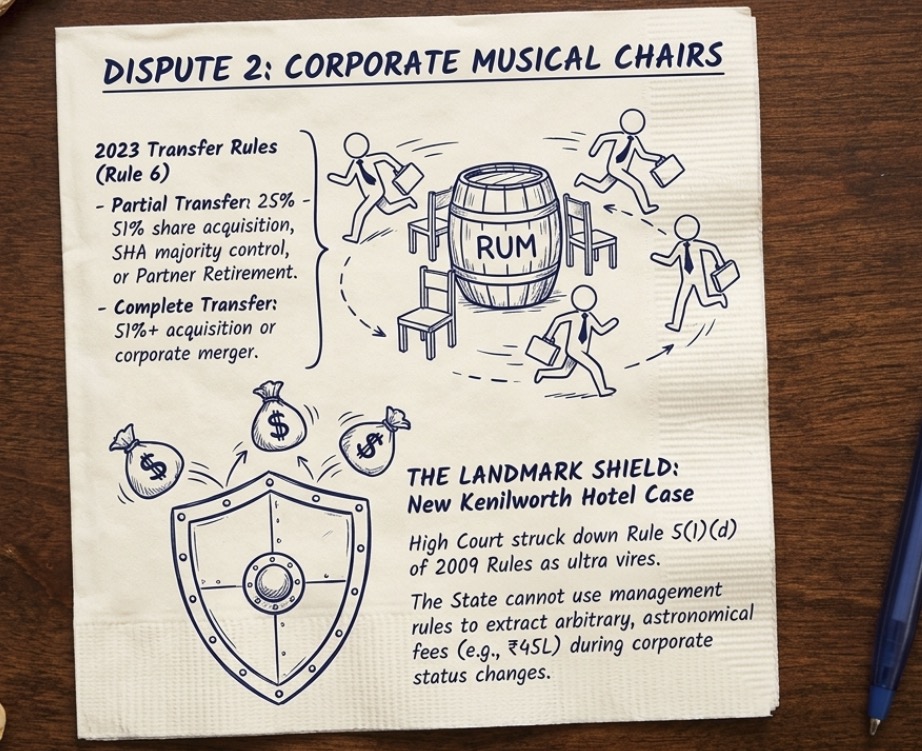
The transfer of an excise license in West Bengal is governed by the West Bengal Excise (Transfer of License) Rules, 2023, which superseded the older West Bengal Excise (Change in Management) Rules, 200915. These rules regulate the transfer of control, management, or ownership of a licensed establishment under various legal structures15.
Rule 6 provides that an application for a change in the name and style of an individual or sole proprietorship license must be submitted to the Collector, who is the competent authority to grant approval15. For partnership firms, LLPs, and co-operative societies, the Excise Commissioner is the competent authority to approve transfers of management or ownership15. For corporate entities holding licenses, the rules establish distinct thresholds15. A partial transfer is triggered if another entity acquires more than 25% but less than 51% of the licensee-company’s shareholdings, or acquires the right to appoint or remove a majority of the Board of Directors through a Shareholders’ Agreement (SHA)21. A complete transfer is triggered if the licensee-company transfers the license entirely to a different entity, or if the transferee entity acquires 51% or more of the company’s total shares, or in cases of non-subsidiary corporate mergers or amalgamations21.
In May 2025, the State Government issued Notification No. 713–F.T., which amended Rule 4 of the 2023 Rules31. This amendment clarified that upon the retirement of a proprietor, partner, or member, if the business continues to be carried on by the remaining partners—with or without the induction of a new partner—it must be treated as a partial transfer of the license31. Disputes frequently arise when the excise department demands full new license fees for routine internal partnership restructurings, or when they delay approvals for corporate mergers15. Legal challenges in this category require a deep familiarity with the broader [transfer-related challenges]22 that arise under West Bengal regulatory systems.
Shifting / Relocation of Shop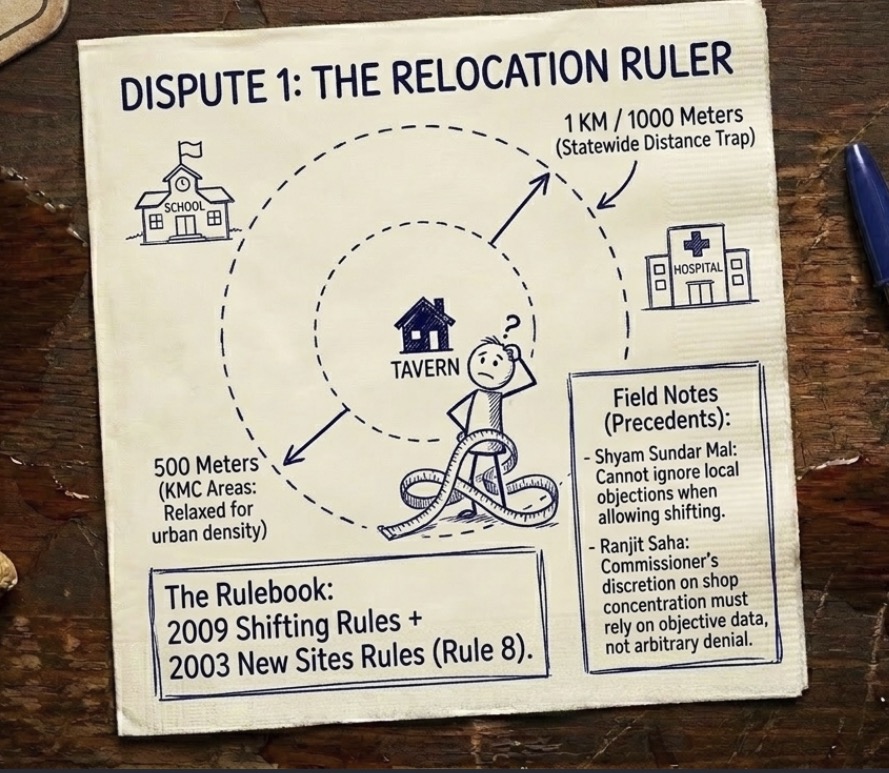
The relocation or shifting of an existing liquor vend is another frequent source of litigation, regulated by the West Bengal Excise (Shifting of Existing Site or Change of Premises of Excise License) Rules, 20094. Under these rules, an existing licensee must apply to the Collector, who acts as the primary processing authority17. If the proposed shifting is within the same district, the Excise Commissioner forwards the application with an opinion to the State Government for final approval18.
Historically, Rule 8 of the West Bengal Excise (Selection of New Sites) Rules, 2003 prohibited retail vends from operating within close proximity—defined as 100 meters, and later amended to 305 meters (1,000 feet)—of educational institutions, hospitals, and places of public worship33. In a major policy shift, the West Bengal State Budget introduced strict new restrictions36. The state barred the grant of any new liquor licenses (and by extension, the shifting of existing vends) within a one-kilometre (1,000 meters) radius of schools, colleges, hospitals, or religious places across the state33. To account for density and space constraints in urban settings, the budget provided a relaxed minimum distance requirement of 500 meters specifically for areas falling under the jurisdiction of the Kolkata Municipal Corporation (KMC)36. Crucially, this 1 km/500m restriction applies to future licensing decisions and pending proposals, but does not retrospectively apply to existing operational liquor shops unless they seek to shift their location33.
In cases such as Shyam Sundar Mal v. State of West Bengal & Ors. (WPA 907 of 2019), the High Court has ruled on disputes where the excise department allowed shifting without considering objections regarding the presence of local educational institutions4. Additionally, in Ranjit Saha v. State of West Bengal (WPA 29228 of 2023), the Court evaluated a refusal of shifting based on the concentration of existing shops in the proposed area (e.g., three licenses within a 1.5 km radius and seven within a 5 km radius)17. While the court acknowledged the broad regulatory discretion of the Excise Commissioner, it held that the discretion must be backed by an objective evaluation of local demand and revenue potential, rather than arbitrary denials17.
Settlement / Lottery / E-Tender Disputes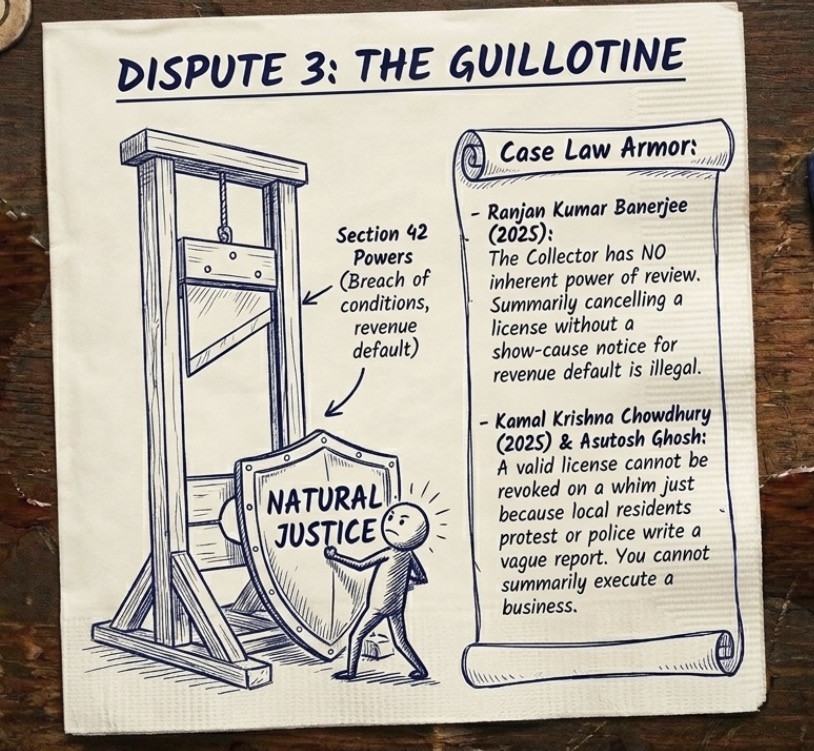
The allocation of new retail liquor licenses in West Bengal historically relied on public lotteries and drawing of lots37. Today, the system has transitioned heavily toward competitive e-tenders and online biddings13. Regardless of the mechanism, disputes are common regarding technical eligibility, bid rejections, and the forfeiture of earnest money deposits (EMD)13.
A classic precedent regarding the misuse of administrative power in lottery settlements is All Bengal Excise Licensees Association v. Raghabendra Singh, (2007) LawSuit(SC) 28742. In this case, despite clear interim orders from the Calcutta High Court directing that no final selection or lottery be held for certain new country spirit shops, the state authorities went ahead and conducted the lottery42. The Supreme Court held the state officials, including the Principal Secretary and the Excise Commissioner, guilty of contempt of court43. The Court ruled that any lottery held in violation of a judicial stay is unlawful, invalid, and must be set aside, establishing that the executive cannot present the judiciary with a fait accompli43.
Furthermore, in Tapas Kumar Das v. State of West Bengal, (WPA 20269 of 2011), the High Court clarified the rights of unsuccessful lottery participants39. The Court held that simply participating in a lottery and paying an application fee does not create a vested right to demand that the state cancel a selected candidate’s non-functional license and hold a fresh lottery39. Once the selection process is finalized and concluded, an unsuccessful bidder has no locus standi to interfere with the administrative discretion of the excise authorities39.
Suspension Pending Enquiry and Cancellation of Licence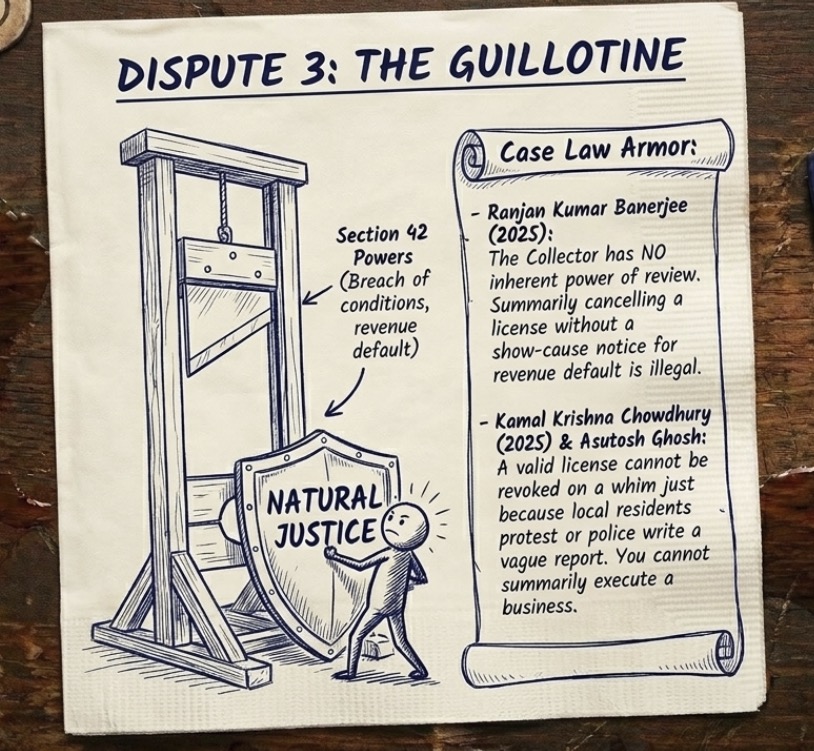
The suspension or cancellation of an existing excise license represents the most severe administrative penalty, often resulting in immediate closure of a business1. Under Section 42 of the Bengal Excise Act, 1909, the Collector is empowered to cancel or suspend a license for a breach of licensing conditions, default in excise revenue payments, or conviction for non-bailable offences2.
A common ground of challenge in these cases is the violation of the principles of natural justice2. In Ranjan Kumar Banerjee v. State of West Bengal & Ors. (decided March 19, 2025), the Collector of Excise, Kolkata (North) cancelled three licenses—a Foreign Liquor Bonded Warehouse, a Foreign Liquor Wholesale Trade, and a Foreign Liquor Off-Shop—for alleged default in paying outstanding excise duty2. The High Court observed that prior to the cancellation of the wholesale and off-shop licenses, no show-cause notice was issued to the licensee2. The Court held that the Collector has no inherent power to review or summarily cancel a license without providing a proper opportunity to be heard, and quashed the orders2.
Similarly, in Kamal Krishna Chowdhury v. State of West Bengal & Ors. (WPA 4868 of 2025, decided July 22, 2025), the High Court protected a country spirit licensee from a revocation proceeding initiated by the police following local protests20. Citing Asutosh Ghosh v. State of West Bengal (2014 SCC OnLine Cal 3246), the Court held that a validly granted license cannot be cancelled at the whims of a protesting group or cluster of local residents, and confirmed that the Collector does not possess an inherent power to review or revoke a license on arbitrary, non-statutory grounds20.
Non-Renewal and Renewal-Fee Disputes
The renewal of an excise license on an annual basis is a standard administrative requirement1. However, disputes frequently arise when the excise department refuses renewal based on non-statutory grounds, such as police objections or allegations of law-and-order issues1.
In State of West Bengal v. M/S Downtown Temptations Pvt Ltd (MAT 1434/2023), the Division Bench evaluated a case where the renewal of an excise license for three prominent restaurant-cum-bars (including Spice Garden and Hotel Down Town) was refused from 2017-2018 onwards1. The refusal was based on police reports alleging that offences under the Immoral Traffic (Prevention) Act, 1956 had been committed within the premises9.
The High Court observed that while the State has a broad interest in checking immoral activities, Rule 14(2) of the West Bengal Excise Rules, 2003 contains specific and exhaustive conditions under which a license renewal can be refused9. In the absence of an actual conviction of the licensee by a criminal court, the Collector could not use unproven police reports as a blanket ground to refuse renewal, highlighting that the state’s licensing power cannot be exercised for extraneous considerations1.
Demand of Excise Dues / Penalty / Re-Fixation
The financial and regulatory demands made by the excise department are a constant source of friction32. Under the West Bengal Excise (Change in Management) Rules, 2009, the state frequently demanded astronomical additional license and management fees when a corporate licensee underwent structural changes32.
In the landmark case of State of West Bengal v. New Kenilworth Hotel Private Limited (decided in early 2026), the Division Bench examined a challenge to an order of the Excise Commissioner demanding an additional sum of Rs. 45,00,000 for a main bar and Rs. 25,00,000 for additional bars following a change in the company’s status from a private to a deemed public company32.
The High Court declared Clause (d) of the proviso to Rule 5(1) of the 2009 Rules to be ultra vires the Constitution of India, holding that the state cannot use regulatory management rules as a mechanism to extract disproportionate fees without clear statutory authorization, thus providing a major remedy for corporate hospitality groups facing arbitrary penalty demands32. For an contextual understanding of how the High Court treats other regulatory frameworks, practitioners may refer to its handling of [other licensing and regulatory disputes] in related domains.
When a Writ Petition Is Maintainable Against an Excise Order
Given the existence of statutory remedies under Section 8 of the Bengal Excise Act, 1909, a petitioner seeking to file a writ petition against excise commissioner West Bengal must establish that their case falls within the recognized exceptions of the “alternative remedy” rule4.
The Hurdle of Alternative Statutory Remedy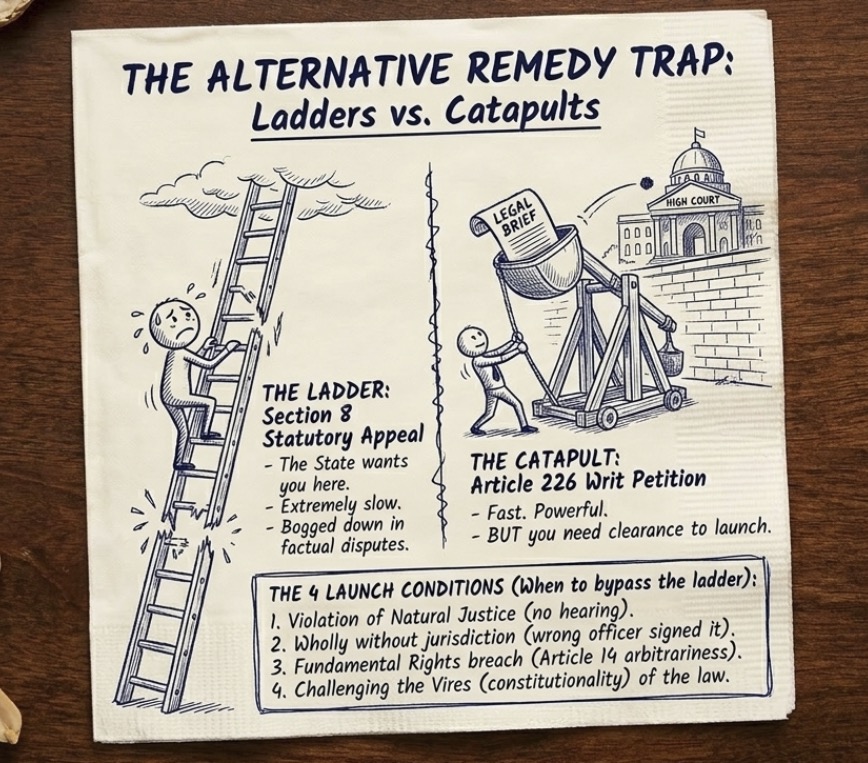
Section 8(2) of the Act, read with the Consolidated Rules framed under Section 85, provides that any order passed by a Collector or subordinate excise officer is appealable before the Excise Commissioner4. Furthermore, Section 8(3) empowers the State Government (usually the Finance Department) to revise any order passed by the Collector or the Excise Commissioner1.
Because the Bengal Excise Act, 1909 is a self-contained code, the Calcutta High Court frequently declines to entertain writ petitions under Article 226 if the licensee has bypassed these statutory forums4. The Court’s rationale is to allow specialized administrative tribunals to resolve complex factual disputes concerning revenue and regulatory compliance5.
The Exceptions to the Rule of Exhaustion
The rule requiring the exhaustion of alternative statutory remedies is not a jurisdictional bar but a rule of policy, discretion, and self-restraint adopted by the courts4. In Shyam Sundar Mal v. State of West Bengal & Ors. (WPA 907 of 2019), the Calcutta High Court clearly delineated the exceptions where a writ petition under Article 226 remains maintainable despite the availability of an appeal under Section 84:
- Violation of the Principles of Natural Justice: Where an order of suspension, cancellation, or refusal is passed without issuing a show-cause notice, denying a personal hearing, or failing to disclose the adverse materials relied upon2.
- Wholly Without Jurisdiction: Where the authority passing the order lacks the statutory power to do so (such as a Superintendent issuing an order reserved exclusively for the Collector, or the Collector attempting to exercise an inherent power of review)2.
- Enforcement of Fundamental Rights: Where the arbitrary action of the state directly violates constitutional guarantees under Article 14 (non-arbitrariness) or Article 21 (fair procedure)4.
- Vires of Legislation Challenged: Where the petitioner challenges the constitutional validity of a statutory provision or subordinate rules, such as the New Kenilworth Hotel challenge to the Change in Management Rules4.
Furthermore, the Court in Shyam Sundar Mal held that if a writ petition has been entertained, affidavits have been exchanged, and the matter is up for final hearing after several years, it is inequitable to relegate the petitioner to a statutory appeal at that late stage4.
Locus Standi and the Camouflage of Public Interest Litigation
While the doors of Article 226 are open to genuinely aggrieved licensees, the High Court maintains a strict threshold regarding locus standi28. In the landmark public interest litigation (PIL) case of Smt. Mala Banerjee v. State of West Bengal and Ors. (2008), a petitioner claiming to be a social worker challenged the validity of the West Bengal Excise (Selection of New Sites) Rules, 2003, arguing that the state was issuing liquor licenses indiscriminately to augment revenue in violation of Article 47 of the Constitution28.
The Division Bench dismissed the petition, holding that the PIL was a mere camouflage designed to protect the commercial interests of a particular coterie of existing license holders who sought to prevent new competition28. The Court ruled that a petitioner with “unclean hands” who lacks a genuine public interest cannot invoke the writ jurisdiction of the High Court to settle private commercial rivalries28.
Before Filing a Writ: The Practitioner’s Diagnostic Checklist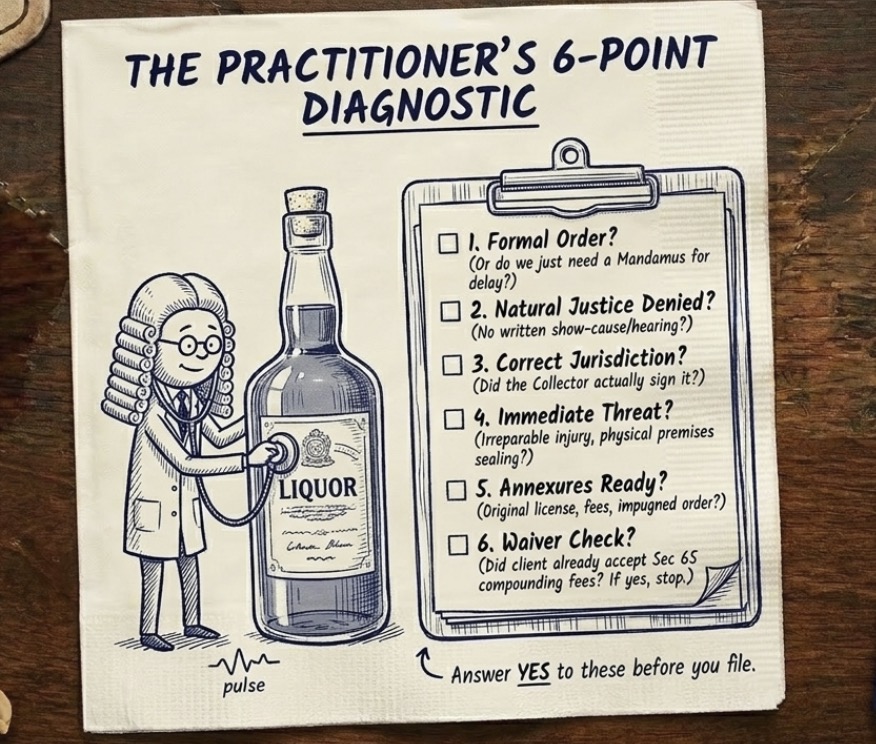
Before initiating a writ petition under Article 226 of the Constitution of India to challenge an excise or liquor license order, the legal practitioner must evaluate the following six diagnostic questions to ensure maintainability and success:
- Has a formal statutory order been issued? A writ petition requires a concrete, impugned administrative order. If the authority has simply delayed its decision, the proper prayer is a writ of mandamus directing them to decide the pending representation within a specified timeframe1.
- Does the impugned order violate the principles of natural justice? Verify if a written show-cause notice was served, whether the licensee was given an opportunity to submit a reply, and if a personal hearing was conducted before the adverse order was passed2.
- Did the issuing authority possess the proper statutory jurisdiction? Check if the officer who signed the order is empowered under the Bengal Excise Act, 1909 or the relevant West Bengal Excise Rules to issue that specific order2.
- Is there an immediate threat of business closure or physical sealing? To secure an ad-interim stay on the very first day of listing, the petitioner must demonstrate “irreparable injury”—such as the immediate sealing of licensed premises or the active cancellation of an operational license1.
- Have you compiled all necessary statutory documents as annexures? The writ petition must contain the original license, the impugned order, proof of payment of license fees, all representations submitted to the Collector, and any relevant inquiry or police reports1.
- Are there any delays, laches, or waiver issues? The petition must be filed promptly after the adverse order is communicated. If the licensee has already accepted compounding fees under Section 65 or participated in a subsequent process without protest, they may be contractually or legally estopped from challenging the original order3.
How to Research Past Calcutta High Court Excise Petitions: The Practitioner’s Method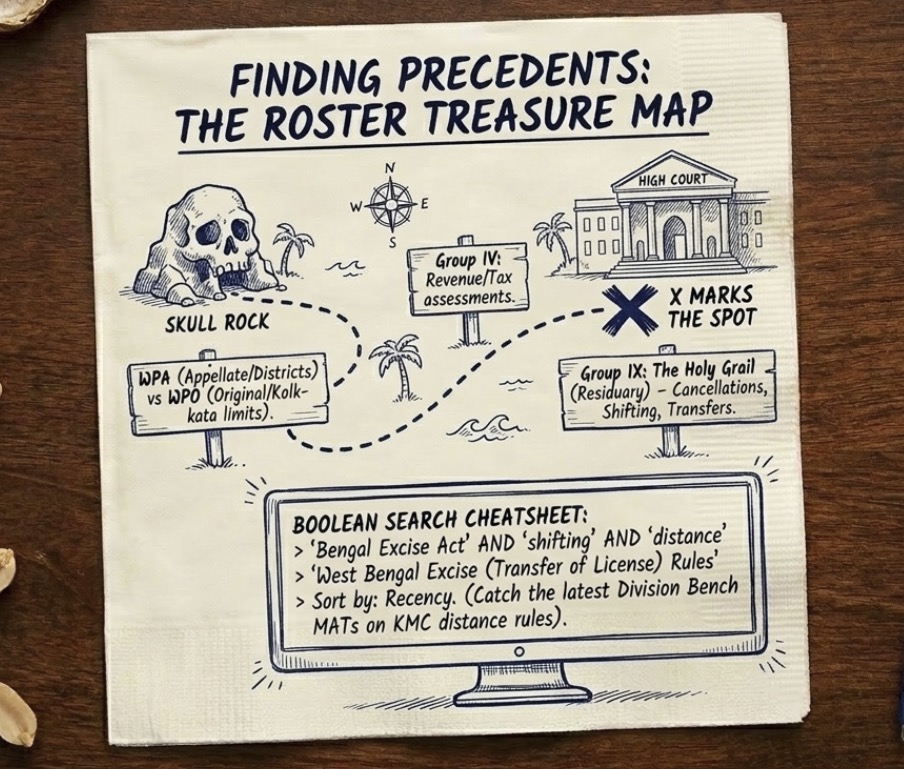
For legal practitioners, conducting precise case-law research is essential to build a persuasive writ petition37. Finding past precedents on Bengal Excise Act licence dispute matters requires a structured methodology49.
Understanding Case-Type Codes
At the Calcutta High Court, writ petitions are filed under two primary jurisdictions:
- WPA (Writ Petition Application): Filed on the Appellate Side of the High Court, which covers all districts of West Bengal outside the original municipal limits of Kolkata1.
- WPO (Writ Petition Original): Filed on the Original Side, covering disputes originating within the original territorial limits of the Kolkata Municipal Corporation1.
If a single judge’s order is challenged before a Division Bench, it is filed as a MAT (Mandamus Appeal Tender) on the Appellate Side1 or an APO (Appeal from Original Side) on the Original Side32.
Utilizing the High Court’s Roster and Cause Lists
The Calcutta High Court utilizes a strict “determination” or roster system, where specific judges are assigned designated categories of cases50. Writs under Article 226 are categorized into distinct “Groups”50:
- Group IV (Revenue): Covers disputes relating to direct and indirect taxes, custom duties, and revenue-raising disputes50. If the challenge is focused on an excise duty assessment or a tax liability under the Act, it falls under Group IV51.
- Group IX (Residuary): Covers all residuary administrative actions not specifically allocated to other groups51. Regulatory disputes, license cancellations, shifting refusals, and transfer challenges are classified under Group IX (Residuary)48.
Practitioners must monitor the daily and weekly cause lists on the Calcutta High Court portal under these specific Group determinations to identify active, live litigation trends and locate pending matters50.
Digital Search Strategies
When utilizing online legal databases such as Indian Kanoon, SCC Online, or Manupatra, searchers should use precise boolean operators to avoid irrelevant hits49:
- Query 1: “Bengal Excise Act” AND “writ petition” AND “Calcutta High Court”
[cite: 5, 49] - Query 2: “Bengal Excise Act” AND “shifting” AND “distance”
[cite: 4, 18] - Query 3: “West Bengal Excise (Transfer of License) Rules”
[cite: 21, 22]
Sorting search results by “recency” reveals how coordinate benches are interpreting new policy directives, such as the 1 km distance rule or the 2023 Transfer Rules15.
Step-by-Step Precedent Retrieval Protocol
- Identify the Roster Bench: Check the latest Calcutta High Court roster notification to identify the specific Single Judge handling Group IX (Residuary) matters and the Division Bench handling Group IX appeals50.
- Access the High Court Portal: Navigate to the “Judgments” and “Case Status” sections of the Calcutta High Court website1.
- Execute Act-Based Searches: In the “Search by Act” field, input “Bengal Excise Act, 1909” to retrieve all orders registered under the statute1.
- Deploy Keyword Filters: Refine the search results by combining the principal Act with specific functional keywords such as “shifting”, “transfer”, “cancellation”, or “lottery” to isolate precise factual matches4.
- Cross-Reference with Commercial Databases: Input the WPA case numbers retrieved from the High Court portal into SCC Online or Manupatra to analyze the ratio decidendi and determine whether the single bench order was appealed via MAT to a Division Bench1.
- Analyze Live Cause Lists: Scan the daily supplementary cause lists for Group IX to identify active, recurring excise matters, which serve as a live signal of what regulatory issues are currently being litigated50.
Key Court & Tribunal Judgments on Excise Licensing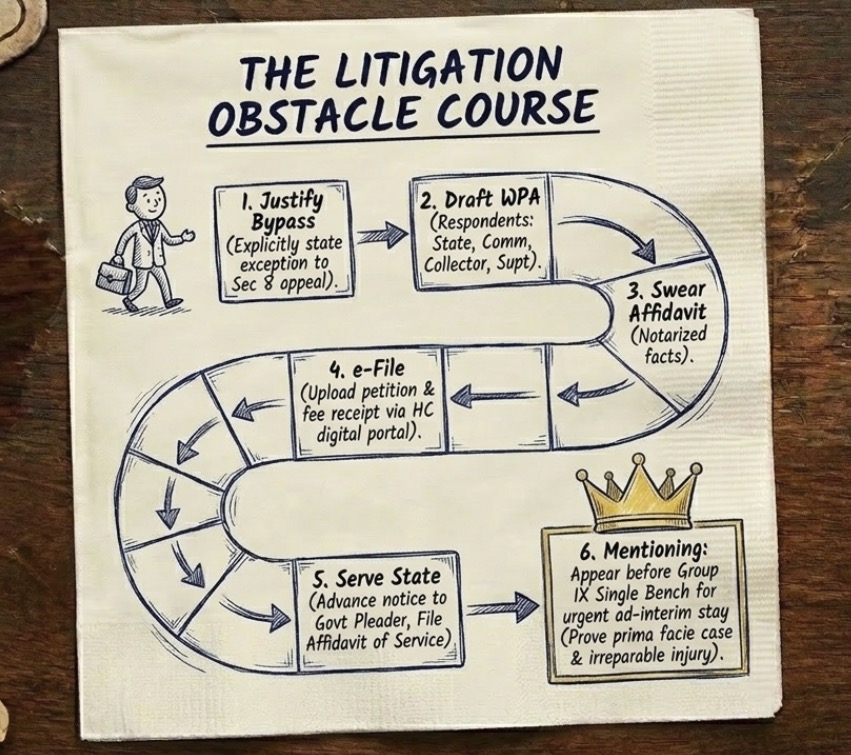
Building a robust case before the Calcutta High Court requires a strong grasp of both Supreme Court anchors and local High Court decisions1.
Supreme Court Anchor Precedents
These landmark rulings establish the boundaries of state control:
- Har Shankar v. Deputy Excise & Taxation Commissioner, (1975) 1 SCC 737: Establishes that the state possesses the exclusive privilege to trade in liquor and that licensees cannot escape contractually accepted licensing conditions6.
- Khoday Distilleries Ltd. v. State of Karnataka, (1995) 1 SCC 574: Confirms that potable liquor is res extra commercium, but establishes that once the state permits private trade under a licensing framework, its actions must remain fair, non-arbitrary, and compliant with Article 146.
- State of Punjab v. Devans Modern Breweries Ltd., (2004) 11 SCC 26: Clarifies that the state cannot impose discriminatory regulations or levies that disrupt inter-state trade once a licensing scheme is in operation8.
Calcutta High Court Line of Authority
These decisions address the practical realities of excise licensing in West Bengal:
- All Bengal Excise Licensees Association v. Raghabendra Singh, (2007) LawSuit(SC) 287: A key precedent where the Supreme Court, reversing the Calcutta High Court’s lenient stance, strictly penalised state officials for holding a license lottery in defiance of an active high court stay42. The ruling establishes that any administrative step taken in violation of a court order must be set aside43.
- Shyam Sundar Mal v. State of West Bengal & Ors., (WPA 907 of 2019): Justice Hiranmay Bhattacharyya held that the rule of alternative remedy is a discretionary rule of policy, and that a writ petition is maintainable if the excise authority allowed a shop relocation in violation of statutory distance rules without hearing local objections4.
- Ranjit Saha v. State of West Bengal, (WPA 29228 of 2023): Confirms that while the excise department possesses broad discretion to manage the spatial concentration of vends to avoid oversaturation, this discretion must be guided by objective data and an independent report from the Collector17.
- Ranjan Kumar Banerjee v. State of West Bengal & Ors., (March 19, 2025): Establishes that the Collector lacks an inherent power of review and cannot summarily cancel a license without providing a prior show-cause notice and a proper hearing, even in cases of alleged revenue defaults2.
- Kamal Krishna Chowdhury v. State of West Bengal & Ors., (WPA 4868 of 2025): Reaffirms that a valid license cannot be revoked or suspended solely due to public protests or arbitrary police representations, reinforcing the requirement for a strict statutory basis for any cancellation20.
- Piku Saha v. State of West Bengal & Ors., (WPA 1864 of 2023): Highlights the modern role of digital portals and administrative communication54. The Court emphasized that when notices are formally uploaded onto the state’s portal, they are deemed validly served, and a licensee’s failure to monitor the portal or respond to electronic show-cause notices precludes them from raising subsequent claims of natural justice violations54.
Step-by-Step Guide to Filing an Excise Writ Petition in the Calcutta High Court
Screenshot
Challenging an adverse excise order in court requires strict adherence to procedural protocols to ensure the petition is listed, heard, and protected by interim relief1.
1. Exhausting or Justifying the Bypass of Statutory Appeal
The practitioner must first evaluate whether a statutory appeal under Section 8(2) before the Excise Commissioner is feasible4. If the appeal is bypassed, the writ petition must explicitly state in the opening paragraphs the grounds for the bypass, such as a complete lack of statutory jurisdiction by the issuing officer or a blatant violation of the principles of natural justice2. Detailed preparation at this stage should refer to the standard protocols on [how to file a writ petition in the Calcutta High Court]30 to ensure the petition is not dismissed on initial presentation.
2. Drafting the Writ Petition (WPA)
The petition must be drafted as a Writ Petition Application (WPA) on the Appellate Side (or WPO on the Original Side) under Article 226 of the Constitution of India1.
The drafting must focus on the following core components3:
- The Cause Title: Name the aggrieved licensee as the Petitioner. The Respondents must include the State of West Bengal (through the Secretary, Department of Finance/Excise), the Excise Commissioner, the Collector of Excise of the concerned district, and the local Superintendent of Excise1.
- Statement of Facts: Clearly outline the history of the license, investments made, and the events leading to the dispute1.
- Grounds of Challenge: Articulate clear legal arguments showing a violation of natural justice, lack of jurisdiction, or a breach of statutory rules2. Avoid framing the dispute as a breach of a fundamental right to trade; instead, frame it as an arbitrary exercise of state power under Article 144.
- The Prayers: Seek specific writs—such as a writ of certiorari to quash the impugned order, a writ of mandamus to compel the renewal or transfer, and a writ of prohibition to prevent further adverse action28.
- Prayer for Interim Relief: This is the most critical element1. The petition must pray for an interim stay on the operation of the impugned suspension or cancellation order, or a status-quo order regarding the location, pending a final decision1.
3. Compiling the Affidavit and Annexures
The petition must be supported by a signed and notarized affidavit of facts3. All vital documents, including the original license, the impugned order, any pending representations, and relevant inquiry or police reports, must be compiled as clean, legible annexures1.
4. Electronic Filing (e-Filing)
The practitioner must upload the finalized petition and annexures through the Calcutta High Court’s electronic filing portal to officially [e-file your writ petition]55. The portal payment system must be used to deposit the nominal court fees30.
5. Serving Notice on the State
Prior to moving the matter before the court, the petitioner must serve physical and electronic copies of the entire writ application on the Excise Commissioner, the Collector, and the office of the Government Pleader at the High Court1. An affidavit of service must be prepared and filed to prove completion of this step3.
6. Mentioning and Listing for Urgent Interim Stay
Once the case is registered and appears on the daily list, the petitioner’s advocate can “mention” the matter before the determined Single Bench Judge (Group IX – Residuary)30. During the mentioning hour, the advocate highlights the extreme urgency—such as the threat of immediate closure or physical sealing of the premises—to secure an immediate hearing1.
Upon admission, the advocate presents arguments to satisfy the triple test for interim relief: a prima facie case, the balance of convenience, and irreparable injury30. Securing an ad-interim stay on the operation of the cancellation or suspension order is critical to keep the business operational while the writ is adjudicated1.
Common Mistakes and Procedural Pitfalls for Licensees
Filing a writ petition in the Calcutta High Court is a strategic legal step1. However, many licensees make critical procedural or substantive errors that can lead to the immediate dismissal of their petition30.
Bypassing Statutory Appeals Without Justification
The most common mistake is filing a writ petition while a clear, effective statutory appeal under Section 8(2) remains unexhausted4. If the impugned order involves complex factual disputes—such as whether a shop’s physical distance is 990 feet or 1,010 feet from a religious site—the High Court will decline to enter a fact-finding mission and will relegate the petitioner to the Excise Commissioner4. A writ must only be filed directly if the order is demonstrably without jurisdiction or violates the principles of natural justice2.
Relying on the Fundamental Right to Trade
Relying heavily on a fundamental right to carry on the business of selling liquor under Article 19(1)(g) is a strategic error5. The State will immediately invoke the res extra commercium doctrine, and the court may dismiss the petition6. The legal argument must be framed around Article 14, demonstrating that the State’s action is arbitrary, discriminatory, and violates its own statutory rules4.
Delay and Laches
Writ jurisdiction is an equitable remedy4. If a licensee waits several months to challenge an order of suspension or cancellation without a compelling reason, the High Court may dismiss the petition on the grounds of delay and laches4. This is particularly true where the State has already declared a vacancy and initiated a fresh e-tender or lottery process for the same site39.
Incomplete Annexures and Lack of Service
Filing a petition with missing or illegible documents, or failing to serve a timely notice on the Government Pleader, will result in immediate adjournments1. If the petitioner seeks an urgent interim stay of a cancellation order, a failure to serve the respondents beforehand will prevent the judge from granting ex-parte relief1.
Legal Representation by Patra’s Law Chambers
Navigating complex regulatory disputes under the Bengal Excise Act, 1909 requires specialized, strategic, and experienced legal advocacy10. The legal professionals at Patra’s Law Chambers, led by Advocate Sudip Patra, offer comprehensive legal counsel and litigation services for hospitality and retail clients across West Bengal.
The firm specializes in drafting and presenting writ petitions before the Calcutta High Court to challenge arbitrary excise department orders, license cancellations, and illegal suspensions1. With a deep understanding of administrative law and constitutional remedies, Patra’s Law Chambers actively represents clients in obtaining urgent interim stay orders to protect active business operations1.
Additionally, the firm provides guidance on regulatory compliance, handles statutory appeals and revisions before the Excise Commissioner and the State Government, and manages disputes arising under the 2023 Transfer Rules and the 2009 Shifting Rules12. Whether dealing with a commercial corporate restructuring or a localized retail licensing issue, the legal team ensures that the client’s rights are protected against state overreach21. Interested parties seeking professional assistance can easily [consult a Calcutta High Court advocate] to evaluate their legal options.
Professional Summary and Conclusion
The regulatory regime governing liquor licensing in West Bengal is exceptionally strict, backed by the constitutional doctrine of res extra commercium and extensive state control6. However, this executive privilege does not shield the excise department from the mandates of administrative fairness, non-discrimination, and procedural due process2.
When the state acts arbitrarily, violates its own statutory regulations, or fails to provide a fair hearing, a liquor licence writ petition Calcutta High Court remains a powerful and effective legal remedy to safeguard commercial interests, restore business operations, and successfully challenge excise department order Calcutta High Court1.
Frequently Asked Questions
Q1: Can a licensee file a writ petition directly in the Calcutta High Court against an excise order, or is a statutory appeal mandatory?
Yes, a licensee can file a writ petition under Article 226 of the Constitution of India directly in the Calcutta High Court1. While the court generally expects a party to exhaust the statutory appeal available under Section 8(2) of the Bengal Excise Act, 1909 before the Excise Commissioner, this rule is a matter of policy and discretion rather than a strict jurisdictional bar4. A direct writ petition is maintainable under several recognized exceptions, such as when the impugned order violates the principles of natural justice, is passed wholly without jurisdiction, or is based on an unconstitutional rule2.
Q2: Is there a fundamental right to run a liquor shop in West Bengal?
No. The Supreme Court of India has consistently held under the res extra commercium doctrine that there is no fundamental right under Article 19(1)(g) of the Constitution to trade in potable liquor6. The state maintains an exclusive privilege over the manufacture, possession, and sale of intoxicants, which it may choose to delegate to private individuals through licenses7. However, once the state decides to permit the liquor trade through a regulatory licensing framework, its administrative decisions are subject to the non-arbitrariness requirements of Article 1426.
Q3: Can the excise department suspend or cancel a liquor license without a prior hearing?
Generally, no2. A suspension or cancellation of an active license carries significant civil and financial consequences1. The Calcutta High Court has repeatedly held that any administrative order carrying such civil consequences must adhere to the principles of natural justice2. As established in Ranjan Kumar Banerjee v. State of West Bengal & Ors. (2025), a cancellation or suspension order passed by the Collector without serving a prior show-cause notice and providing a fair personal hearing is legally unsustainable and can be set aside by writ2.
Q4: What are the current distance restrictions for setting up or shifting a retail liquor shop in West Bengal?
According to the state budget and policy announcements, no new retail liquor licenses or shifting proposals will be approved if the proposed premises fall within a one-kilometre (1,000 meters) radius of an educational institution, hospital, or place of public worship across the state33. However, for areas falling under the jurisdiction of the Kolkata Municipal Corporation (KMC), this distance restriction is relaxed to a minimum of 500 meters to account for the denser urban environment36. These rules apply to all new licensing decisions and pending proposals, but they do not affect existing liquor shops already operating under earlier rules33.
Q5: How can a licensee challenge a refusal to transfer a liquor license in West Bengal?
The transfer of retail and wholesale licenses is governed by the West Bengal Excise (Transfer of License) Rules, 202315. If the Collector (for individual/proprietorship licenses) or the Excise Commissioner (for partnerships/LLPs) arbitrarily refuses an application that complies with the rules, or demands excessive fees outside the statutory schedule, the applicant can file an appeal under Section 8(2)12. If the refusal is based on an error of law, a violation of the 2023 rules, or incorporates irrelevant considerations, the applicant can file a writ petition under Article 226 in the High Court to quash the decision4.
Q6: Can a citizen challenge a public lottery or e-tender result for a new liquor shop?
An unsuccessful participant or a member of the public can challenge a settlement, lottery, or e-tender result only on the grounds of procedural unfairness, fraud, arbitrary deviation from eligibility rules, or systemic manipulation39. Pure disappointment at losing a fair lottery or competitive draw is not a ground for judicial review39. As clarified in Tapas Kumar Das v. State of West Bengal (2011), an unsuccessful bidder does not acquire a vested right to demand that the state cancel a selected candidate’s license and initiate a fresh process simply because the selected candidate has not yet commenced business39.
Q7: What is the compounding of an offence under the Bengal Excise Act, and can it prevent licence cancellation?
Under Section 65 of the Bengal Excise Act, 1909, the Collector or an empowered excise officer can allow a licensee to compound certain non-serious licensing violations by paying a compounding fee instead of undergoing license suspension or cancellation3. If an excise officer issues a notice directing the licensee to pay a compounding fee under Section 65 in lieu of cancellation, and the licensee is dissatisfied with the basis of the charge, they can contest the notice before the Collector3. If the demand is arbitrary, they can file a statutory appeal or challenge it in the High Court by writ3.
Q8: Does the Collector of Excise have the power to review and revoke a license once it has been granted?
No, the Collector of Excise does not possess an inherent power to review or revoke a validly granted license on a whim2. The Calcutta High Court in Asutosh Ghosh v. State of West Bengal and Kamal Krishna Chowdhury v. State of West Bengal & Ors. (2025) confirmed that the Collector’s power is strictly limited to statutory cancellation under Section 42 for specific, proven violations2. The Collector cannot initiate a review or revocation proceeding simply because of local protests, police complaints citing social concerns, or arbitrary public representations, provided the licensee is running the business in accordance with licensing conditions20.
Q9: What legal remedy is available if a vehicle carrying duty-paid liquor is seized and detained by the excise department?
Under the West Bengal Finance Act, 2024, which amended Section 78(2) of the Bengal Excise Act, 1909, the Collector must issue a notice and grant a reasonable opportunity to make a representation before confiscating a vehicle19. If the owner can prove that the vehicle was used without their knowledge or connivance, the Collector may allow interim custody19. If the administrative authorities delay or reject this release, the owner can file a revision petition or a criminal application before the High Court, as in Totan Doloi v. State of West Bengal (2026), to secure the return of the vehicle upon furnishing a bond to prevent its deterioration23.
Q10: How are writ petitions concerning excise matters classified under the Calcutta High Court’s roster?
Writ petitions under Article 226 are classified based on the nature of the dispute and are assigned to specific Single Judges or Division Benches according to the High Court’s determination roster30. If the dispute involves the assessment, demand, or recovery of excise revenue, duties, or associated taxes, it is classified under Group IV (Revenue) and assigned to the tax and revenue benches50. If the dispute involves licensing, suspensions, cancellations, shifting, or transfer of licenses, it is classified under Group IX (Residuary)48.
Q11: What is the impact of the West Bengal Finance Act, 2024 on liquor retailers and transport operators?
The West Bengal Finance Act, 2024 introduced stricter regulatory measures and modified enforcement scales19. It defined “intermediate quantity” to enable more precise classification of possession offences under Section 2(12iaa)19. For license holders and transport operators, the major impact lies in Section 46A, which established a graduated penal scale, and Section 78(2), which detailed rigorous mandatory procedures for notice, representation, and hearing before a seized vehicle can be confiscated, enhancing procedural protections against arbitrary state seizures19.
Q12: How does the “legitimate expectation” doctrine apply to annual renewals of liquor licenses in West Bengal?
Under West Bengal excise law, while a license is granted for a specific period of settlement (typically one financial year), an existing license holder who has made substantial capital investments and operated without violations has a legitimate expectation of renewal1. As ruled in the Downtown Temptations case (MAT 1434/2023), the state cannot refuse renewal based on arbitrary, non-statutory grounds such as police objections regarding unproven criminal allegations1. The Collector must record reasons and restrict any refusal strictly to the criteria enumerated in the provisos of the licensing rules9.
Q13: Can a corporate license holder challenge the demand of high “change in management” fees in West Bengal?
Yes32. In State of West Bengal v. New Kenilworth Hotel Private Limited (2026), the Calcutta High Court declared Clause (d) of the proviso to Rule 5(1) of the West Bengal Excise (Change in Management) Rules, 2009 to be unconstitutional and ultra vires32. Corporate license holders can challenge any arbitrary demand of additional license or management fees imposed due to corporate conversions, mergers, or changes in shareholding structures by filing a writ petition to quash the demand22.
Q14: What is the significance of the All Bengal Excise Licensees Association case regarding contempt of court?
The case of All Bengal Excise Licensees Association v. Raghabendra Singh (2007) is a crucial precedent establishing the sanctity of interim protection orders42. It holds that if state executive officers proceed to hold a lottery or make a license selection in active defiance of a High Court stay order, they are guilty of contempt of court43. The Supreme Court ruled that any steps taken or selections finalized in violation of a court injunction are void and must be set aside to uphold the majesty of law43.
Works cited
- soumajit chatterjee – SARTHAC, https://sarthac.gov.in/download-case-file?page=view-case-file&id=15671&year=2023
- RANJAN KUMAR BANERJEE v. STATE OF WEST BENGAL & ORS | Calcutta High Court, https://www.casemine.com/judgement/in/67e1c0ef7b93335d50102b80
- RAJA CHAMBER : – Room No. 18, Mazannine Floor. 4, Kiran Sankar Roy Road – SARTHAC, https://sarthac.gov.in/view-case-file?id=783&year=2016
- Shyam Sundar Mal vs State Of West Bengal & Ors on 17 March, 2023 – Indian Kanoon, https://indiankanoon.org/doc/125474927/
- Mr. Arindam Jha vs The State Of West Bengal & Ors on 5 October, 2010 – Indian Kanoon, https://indiankanoon.org/doc/182183862/
- Privilege, Police Power and res Extra Commercium – Glaring Conceptual Errors – Scholarship Repository, https://repository.nls.ac.in/cgi/viewcontent.cgi?article=1049&context=nlsir
- State Of Punjab And Anr vs M/S. Devans Modern Brewaries And Anr on 20 November, 2003 – Indian Kanoon, https://indiankanoon.org/doc/1453639/
- mis. dev ans modern breweries and anr. etc. november 20, 2003 [vn khare, cj., rc lahoti, bn agrawal, sb sinha and dr. ar. lakshmanan, jj.] – High Court of Gujarat, https://gujarathighcourt.nic.in/hccms/sites/default/files/scgujaratijudgments/eng/SC_CA_3017_of_1997.pdf
- IN THE HIGH COURT AT CALCUTTA – LiveLaw, https://www.livelaw.in/pdf_upload/display-71-454815.pdf
- The Bengal Excise Act, 1909 Keyword(s) – PRS India, https://prsindia.org/files/bills_acts/acts_states/west-bengal/1909/1909WB5.pdf
- Bengal Excise Act,1909. – High Court of Tripura, https://thc.nic.in/Central%20Governmental%20Acts/Bengal%20Excise%20Act,1909.pdf
- Section 8 in Bengal Excise Act, 1909 | Draft Bot Pro, https://app.draftbotpro.com/doc/180780672
- Acts – Rules – Excise Directorate of West Bengal Government, https://excise.wb.gov.in/CommonUser/how_do_i.aspx
- Narendra Narayan Bhattacharjee v. Secy. To The Govt. Of West Bengal Excise Depot, And Others | Calcutta High Court | Judgment – CaseMine, https://www.casemine.com/judgement/in/56095f02e4b01497112c92f4
- West Bengal Excise (Transfer Of License) Rules, 2023 – LegitQuest, https://www.legitquest.com/act/west-bengal-excise-transfer-of-license-rules-2023/DBC2
- Issuance of West Bengal Excise (Transfer of License) Rules, 2023 – Complinity, https://complinity.com/legal-update/issuance-of-west-bengal-excise-transfer-of-license-rules-2023-9726/
- Ranjit Saha vs State Of West Bengal And Others on 16 January, 2024 – Indian Kanoon, https://indiankanoon.org/doc/114581862/
- State Of West Bengal & Ors. v. Avijit Karan & Ors. | Calcutta High Court | Judgment | Law, https://www.casemine.com/judgement/in/5728eb56e561092892872395
- Bill No. 5 of 2024 – PRS India, https://prsindia.org/files/bills_acts/bills_states/west-bengal/2024/Bill5of2024WB.pdf
- Kamal Krishna Chowdhury vs The State Of West Bengal & Ors on 22 July, 2025, https://indiankanoon.org/doc/12877423/
- West Bengal Excise Act and Rules | PDF | License | Board Of Directors – Scribd, https://www.scribd.com/document/1018783601/West-Bengal-Excise-Act-and-Rules
- “transfer of license” – Indian Kanoon, https://indiankanoon.org/search/?formInput=%22transfer%20of%20license%22&pagenum=30
- Totan Doloi vs The State Of West Bengal on 30 April, 2026 – Indian Kanoon, https://indiankanoon.org/doc/156105570/
- Sri Kalidas Chakravarti vs State Of West Bengal Through The … on 17 April, 1957, https://indiankanoon.org/doc/109526/
- State Of Punjab & Anr v. Ms Devans Modern Brewaries Ltd. & … – CaseMine, https://www.casemine.com/judgement/in/5609adebe4b01497114128a5
- State of Punjab and Anr. Vs. M/S. Devans Modern Breweries and Anr. Etc – Caseon, https://www.caseon.in/case/state-of-punjab-and-anr-vs-ms-devans-modern-breweries-and-anr-etc
- State Of Punjab And Anr vs M/S. Devans Modern Brewaries And Anr on 20 November, 2003 – Indian Kanoon, https://indiankanoon.org/docfragment/1453639/?formInput=khoday%20distilleries%20ltd%20%20%20
- Smt. Mala Banerjee vs The State of West Bengal and Ors Calcutta High Court 8 January 2008 Citations – Global Health & Human Rights Database |, https://www.globalhealthrights.org/wp-content/uploads/2012/12/HC-2008-Smt.-Mala-Banerjee-v.-State-of-West-Bengal-and-Ors..pdf
- Your Rights During Liquor Seizure Under Excise Act – Supreme Today AI, https://supremetoday.ai/search/liquor-seizure-rights-excise-act
- Writ Petition Calcutta High Court 2026 | Complete Guide | Adv. Siddharth Gupta, https://siddharthgupta.in/blog/writ-petition-calcutta-high-court-guide
- Amendments to West Bengal Excise Rules | PDF | License | Holding Company – Scribd, https://www.scribd.com/document/977085045/SAR-210-Finance-Department-Revenue-No-713-FT-2
- VERDICTUM.IN, https://www.verdictum.in/pdf_upload/state-of-west-bengal-v-new-kenilworth-hotel-private-limited-1772690.pdf
- CM: No licence for liquor shop in 1 km of school, college, temple | Kolkata News, https://timesofindia.indiatimes.com/city/kolkata/cm-no-licence-for-liquor-shop-in-1-km-of-school-college-temple/articleshow/131335478.cms
- Bengal to deny liquor shop licences within 1 km of schools, colleges and temples – EdexLive, https://www.edexlive.com/news/bengal-to-deny-liquor-shop-licences-within-1-km-of-schools-colleges-and-temples
- Somdev Kapoor vs State Of W.B. & Ors on 7 October, 2013 – Indian Kanoon, https://indiankanoon.org/doc/113211551/
- West Bengal Tightens Liquor Rules: No New Shops Within 1 Km Of Schools, Hospitals, Religious Places – NDTV Profit, https://www.ndtvprofit.com/india/west-bengal-tightens-liquor-rules-no-new-shops-within-1-km-of-schools-hospitals-religious-places-11670023
- Asutosh Ghosh vs State Of West Bengal & Others on 10 February, 2014 – Indian Kanoon, https://indiankanoon.org/doc/83111688/
- Subhasish Mukhopadhyay vs The Commissioner Of Excise on 13 November, 2019 – Indian Kanoon, https://indiankanoon.org/doc/6142184/
- Sri Tapas Kumar Das vs The State Of West Bengal & Ors on 14 December, 2011, https://indiankanoon.org/doc/68907476/
- ह या गोदी प रसर haldia dock complex – i&cf division – SMPK, https://smportkolkata.shipping.gov.in/smpk/hld/wp-content/uploads/sites/3/2026/06/NIT-ICF-160-11062026.pdf
- Banglar Dairy Limited, https://banglardairy.com/WriteReadData/RTF1984/1767690874.pdf
- All Bengal Excise Licensees … vs Raghabendra Singh & Ors on 9 March, 2007 – Indian Kanoon, https://indiankanoon.org/doc/182170/
- ALL BENGAL EXCISE LICENSEES ASSOCIATION Versus RAGHABENDRA SINGH , 09 March 2007 – lawsuitcasefinder, https://lawsuitcasefinder.com/casedetail?id=U2FsdGVkX18f92NTplo24M9moJkPV2xjEebh782bBaT8ZO6dn4Mgs5
- All Bengal Excise Licensees … vs Raghabendra Singh & Ors on 9 March, 2007, https://indiankanoon.org/docfragment/182170/?formInput=all%20bengal%20excise
- SpotLaw 2014, http://spotlawapp.com/judgementText/pdf/910012007/9100120070309001.pdf
- “West+Bengal+Excise+++Change-in-Management | Indian Case Law | Law – CaseMine, https://www.casemine.com/search/in/%22West%2BBengal%2BExcise%2B%2B%2BChange-in-Management
- Ritesh Narula v. The State Of West Bengal & Ors. | Calcutta High Court | Judgment | Law, https://www.casemine.com/judgement/in/56ea865a607dba36fd0b830c
- advocate – SARTHAC, https://sarthac.gov.in/download-case-file?page=view-case-file&id=6569&year=2020
- bengal excise act doctypes: judgments – Indian Kanoon, https://indiankanoon.org/search/?formInput=bengal%20excise%20act+doctypes:judgments
- IN THE HIGH COURT AT CALCUTTA, https://www.calcuttahighcourt.gov.in/Notice-Files/roster/16468
- IN THE HIGH COURT AT CALCUTTA, https://calcuttahighcourt.gov.in/Notice-Files/roster/5870
- IN THE HIGH COURT AT CALCUTTA Notification no.7270-RG Dated: 31.10.2025 Roster / Determination of the Appellate Side & O, https://www.calcuttahighcourt.gov.in/Notice-Files/roster/15465
- DETERMINATION OF THE HON’BLE JUDGES – Calcutta High Court, https://calcuttahighcourt.gov.in/Notice-Files/CL/1292
- Calcutta High Court Dismisses Writ Petition Against Tax Liability under West Bengal GST Act, https://www.thakurani.in/shocksnmocks/Income-Tax-1-group/calcutta-high-court-dismisses-writ-petition-agains-29794/
- INVITATION OF e-TENDER FOR “Construction of Behala Divisional Model Store with in the premises of Amtala 33/11 KV Sub-Station – WBSEDCL, https://www.wbsedcl.in/irj/go/km/docs/internet/new_website/pdf/Tenders/TenderDocument_Behala.pdf
- GOVERNMENT OF WEST BENGAL DIRECTORATE OF FORESTS Conservator of Forests Parks & Garden Circle, WB E-Tender for Selection of, https://forest.wb.gov.in/download/30-06-2025-07.pdf
- 21.pdf – Government of West Bengal, https://bsk.wb.gov.in/download/21.pdf