A detailed guide to the Service Matter Writ petition in the Calcutta High Court
Screenshot
Creditor and contributor of this article:
Patra’s Law Chambers:
About Us:
Patra’s Law Chambers is a law firm with offices in Kolkata & Delhi, offering comprehensive legal services across various domains. Established in 2020 by Advocate Sudip Patra (Advocate, Supreme Court of India & Calcutta High Court) an alumnus of the Prestigious Rajiv Gandhi School of Intellectual Property Law, IIT Kharagpur ,with Post Graduate diploma in Business Law from IIM Calcutta, the firm specializes in Civil, Criminal, Writs, High Court Matters, Trademark, Copyright, Company, Tax, IT, GST & Customs, Banking & DRT, Property disputes, Service law & CAT & High Court related service matters, Military Law, Family law, and Supreme Court matters. You can know more about us in here
Kolkata Office:
NICCO HOUSE, 6th Floor, 2, Hare Street, Kolkata-700001 (Near Calcutta High Court)
Delhi Office:
House no: 4455/5, First Floor, Ward No. XV, Gali Shahid
Bhagat Singh, Main Bazar Road, Paharganj, New Delhi-110055
Website: www.patraslawchambers.com
Email: [email protected]
Phone: +91 890 222 4444/ +91 7003 715 325
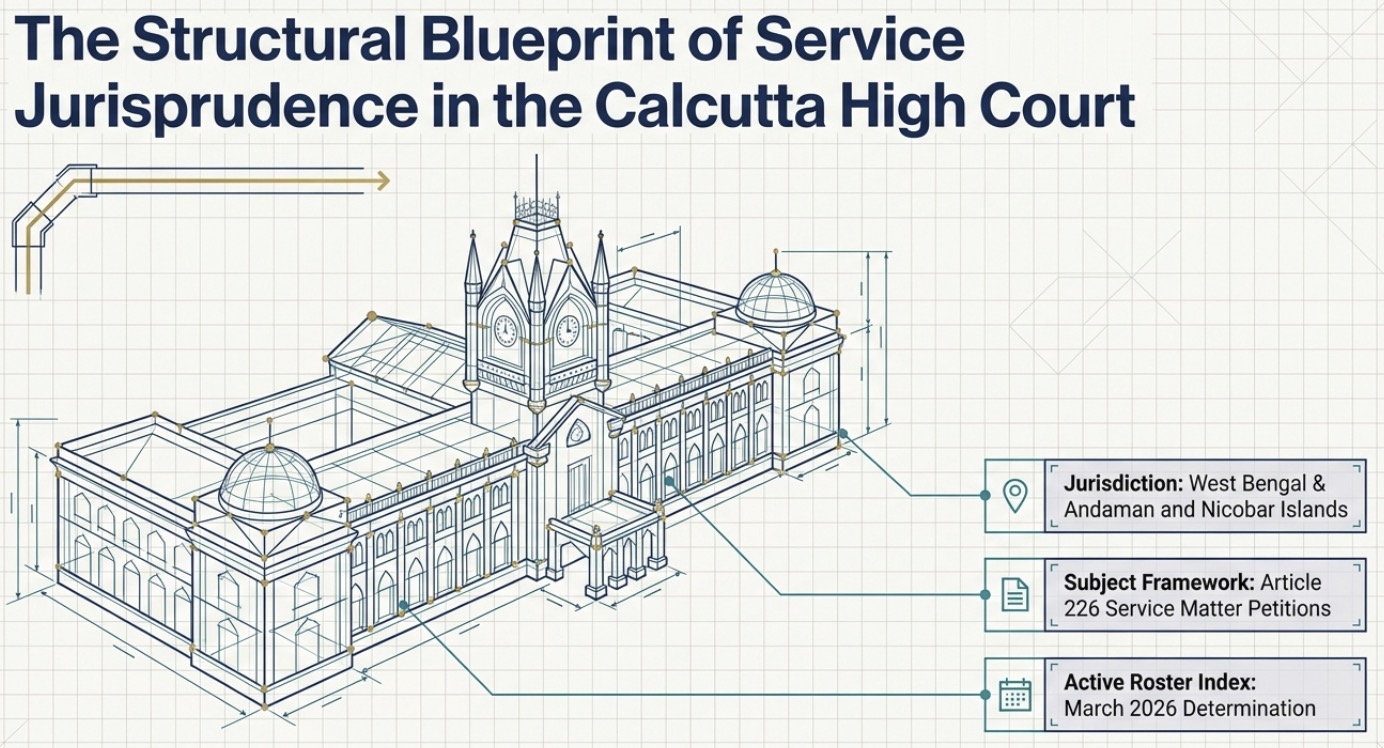
The constitutional framework of India provides for an intricate system of judicial review that acts as a primary safeguard for the rights of public servants. In the State of West Bengal and the Union Territory of Andaman and Nicobar Islands, the High Court at Calcutta serves as the ultimate arbiter of service-related disputes, exercising its extraordinary jurisdiction under Article 226 of the Constitution of India.1 Service matters, which encompass the entire lifecycle of public employment from recruitment to post-retirement benefits, constitute one of the most litigated areas of law within this historic institution.4 This report provides an exhaustive analysis of the procedural and substantive aspects of service matter writ applications, detailing the classification systems, the hierarchy of judicial benches, and the evolving relationship between the High Court and administrative tribunals such as the Central Administrative Tribunal (CAT) and the West Bengal Administrative Tribunal (WBAT).
Historical Context and Constitutional Mandate
The Calcutta High Court, established on July 1, 1862, under the High Courts Act of 1861, is the oldest High Court in India and possesses a unique jurisdictional heritage.3 While its Ordinary Original Civil Jurisdiction was traditionally limited to the local limits of the presidency town of Calcutta, its Appellate Side jurisdiction extends across the entire State of West Bengal and the Andaman and Nicobar Islands.3 The authority to issue writs is a cornerstone of this jurisdiction, derived from Article 226, which empowers the Court to issue directions, orders, or writs to any person, authority, or government for the enforcement of fundamental rights and “for any other purpose”.1
In the context of service law, Article 226 operates alongside Article 311, which provides constitutional protection against arbitrary dismissal or reduction in rank for civil servants.4 However, the High Court’s writ power is significantly broader, reaching into areas of administrative unfairness, procedural impropriety, and the violation of statutory service rules that do not necessarily involve dismissal.8 The relationship between a government employee and the State is not merely contractual but is governed by status and statutory regulations, making every administrative action subject to the touchstone of Article 14 (equality) and Article 16 (equality of opportunity in public employment).4
The Jurisdictional Divide: Original Side vs. Appellate Side
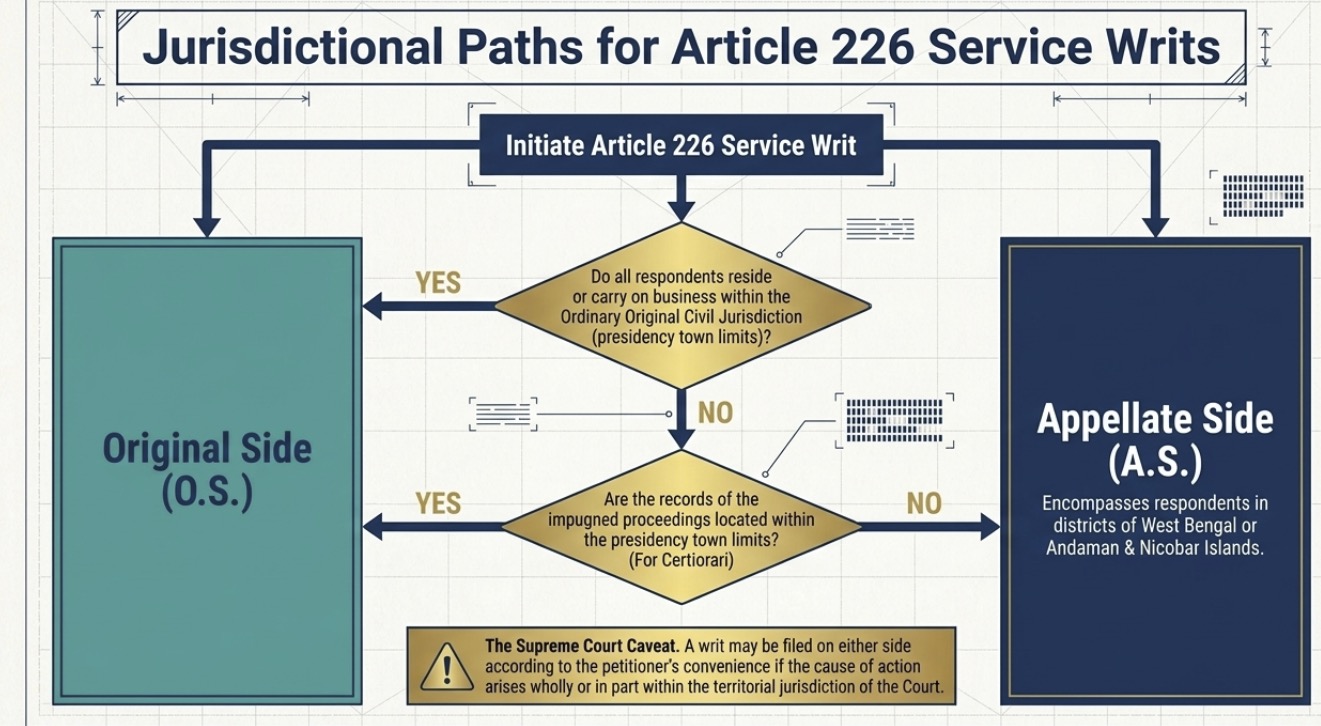
A critical procedural distinction in the Calcutta High Court is the divide between the Original Side (O.S.) and the Appellate Side (A.S.).1 This distinction is governed by specific rules that determine where a writ petition must be filed based on the location of the respondents and the cause of action.10
Criteria for Original Side Jurisdiction
A writ petition is marked as “Original Side” under the following conditions:
- All respondents reside or carry on business within the Ordinary Original Civil Jurisdiction of the High Court.10
- In the case of a Writ of Certiorari, the records of the impugned proceedings are located or available within the same local limits.10
- The offices of the primary respondent authorities are situated within the prescribed limits of the presidency town.10
Criteria for Appellate Side Jurisdiction
Conversely, “Appellate Side” applications encompass all other matters where respondents are located outside the presidency town limits or where the cause of action arises in the districts of West Bengal or the Andaman and Nicobar Islands.10 In service matters, the choice of jurisdiction often depends on whether the department’s headquarters (e.g., in Salt Lake or central Kolkata) or the local office that issued the order is the primary target of the litigation.11 However, the Supreme Court has clarified that a writ petition may be filed in either side according to the choice and convenience of the petitioner if the cause of action arises wholly or in part within the territorial jurisdiction of the High Court at Calcutta.11
Classification of Service Matters: The Group System
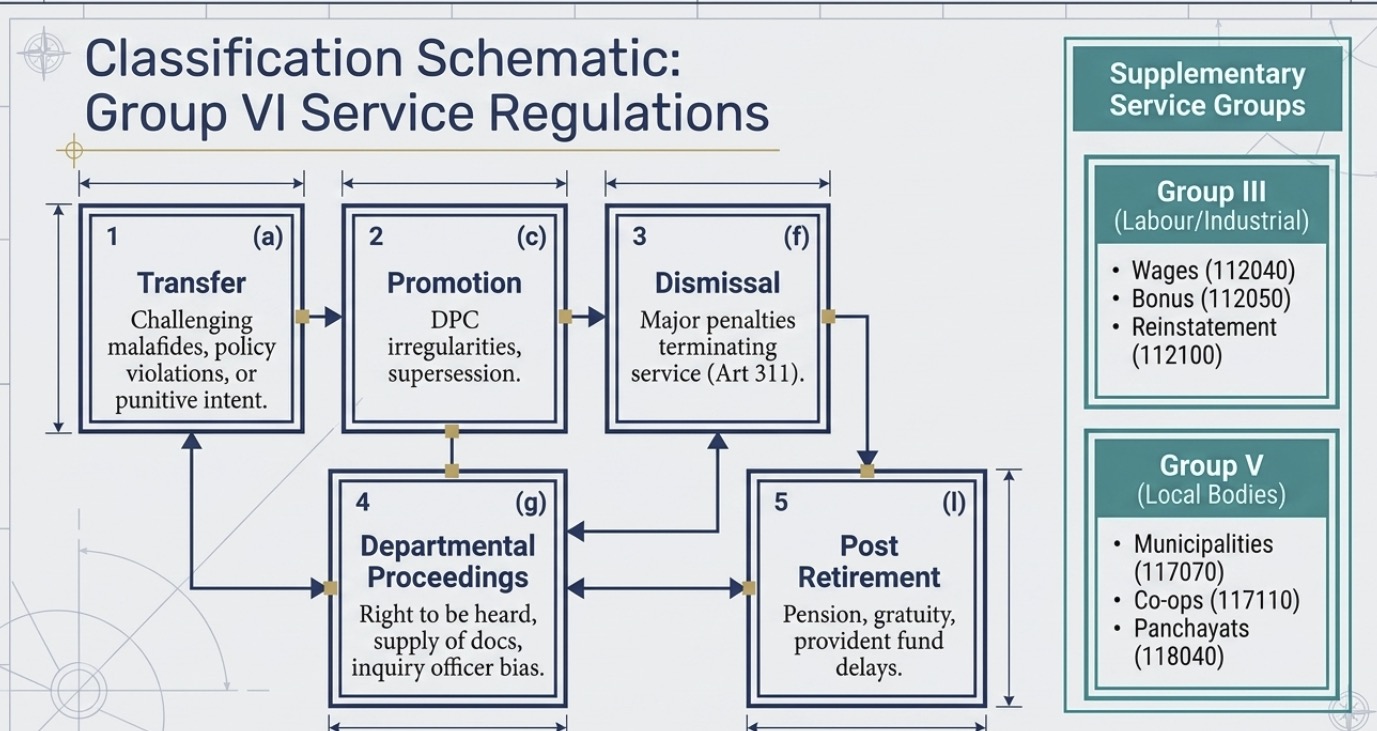
The Calcutta High Court utilizes a structured classification system to organize its vast caseload, ensuring that matters are heard by benches with the appropriate determination.10 For service litigation, the “Group” system is the primary method of categorization. Every petition must be accompanied by a “Proforma” (Schedule A) that specifies the Group and Head under which the matter falls.13
Group VI: Service Regulations
Group VI is the standard classification for matters relating to general service regulations for government employees.13 It is the most common category for individual grievances against the State. The classification is divided into thirteen specific sub-heads:
| Sub-head | Detailed Description of Service Matter |
| (a) | Transfer: Challenges to transfer orders based on malafides, violation of policy, or punitive intent.13 |
| (b) | Seniority: Disputes regarding placement in the gradation list or inter-se seniority with colleagues.13 |
| (c) | Promotion: Denial of promotion, irregularities in Departmental Promotion Committee (DPC) proceedings, or supersession.13 |
| (d) | Suspension: Challenges to orders placing an employee under suspension pending inquiry or as a penalty.13 |
| (e) | Reversion: Contesting an order reducing an employee from a higher post to a lower post.13 |
| (f) | Dismissal/Removal: Major penalties resulting in the termination of service, often involving Article 311.13 |
| (g) | Departmental Proceedings: Challenges to the issuance of a charge sheet, second show-cause notice, or the conduct of an inquiry.13 |
| (h) | Confirmation: Matters related to the successful completion of probation and formal entry into the permanent cadre.13 |
| (i) | Age Dispute: Litigation concerning the date of birth in service records and the resulting date of superannuation.13 |
| (j) | Compulsory Retirement: Challenges to orders retiring an employee early, either as a penalty or in public interest.13 |
| (k) | Leave and Condition of Service: General disputes regarding leave entitlements, working hours, and benefits.13 |
| (l) | Post Retirement Benefit: All matters relating to pension, gratuity, provident fund, and retiral arrears.13 |
| (m) | Miscellaneous: Service matters that do not fit into the above specific categories.13 |
Group II: Educational Service Matters
Service matters involving educational institutions are unique and fall under Group II.13 Due to the high volume of teacher and staff litigation, the Court has developed a granular system of computer codes (Head ‘h’ Miscellaneous) to track these cases.13 Each educational sector follows a tripartite sub-classification: (a) Selection Process, (b) In-Service matters, and (c) Post Retirement.13
| Educational Sector | Selection Process | In-Service Matters | Post Retirement |
| Primary Education | 106070 | 106080 (Promotion), 106081 (Reversion), 106082 (Pay), 106083 (Transfer), 106084 (Suspension), 106085 (Discipline), 106086 (Termination) | 106090 13 |
| Secondary Education | 106100 | 106110 to 106116 | 106120 13 |
| Higher Secondary | 106130 | 106140 to 106146 | 106150 13 |
| College Service | 106160 | 106170 to 106176 | 106180 13 |
| University Service | 106190 | 106200 to 106206 | 106210 13 |
| Library Service | 106220 | 106230 to 106236 | 106240 13 |
| Para Teachers | 106250 | 106260 to 106266 | 106270 13 |
| Madrasa Service | 106310 | 106320 to 106326 | 106330 13 |
These codes ensure that service matters involving institutions like the West Bengal Board of Primary Education or the West Bengal Central School Service Commission are distinct from general government service matters.15
Supplementary Service-Related Groups
- Group III (Labour and Industrial): Focuses on “In-Service” matters for the industrial workforce, including wage disputes (112040), bonus/gratuity (112050), and reinstatement (112100).13
- Group V (Local Bodies): Covers service matters in Municipalities (117070), Co-operative Societies (117110), and Panchayats (118040).13 These matters are often heard by specialized benches due to the specific statutes governing local self-government.13
The Roster System and Bench Determinations: March 2026
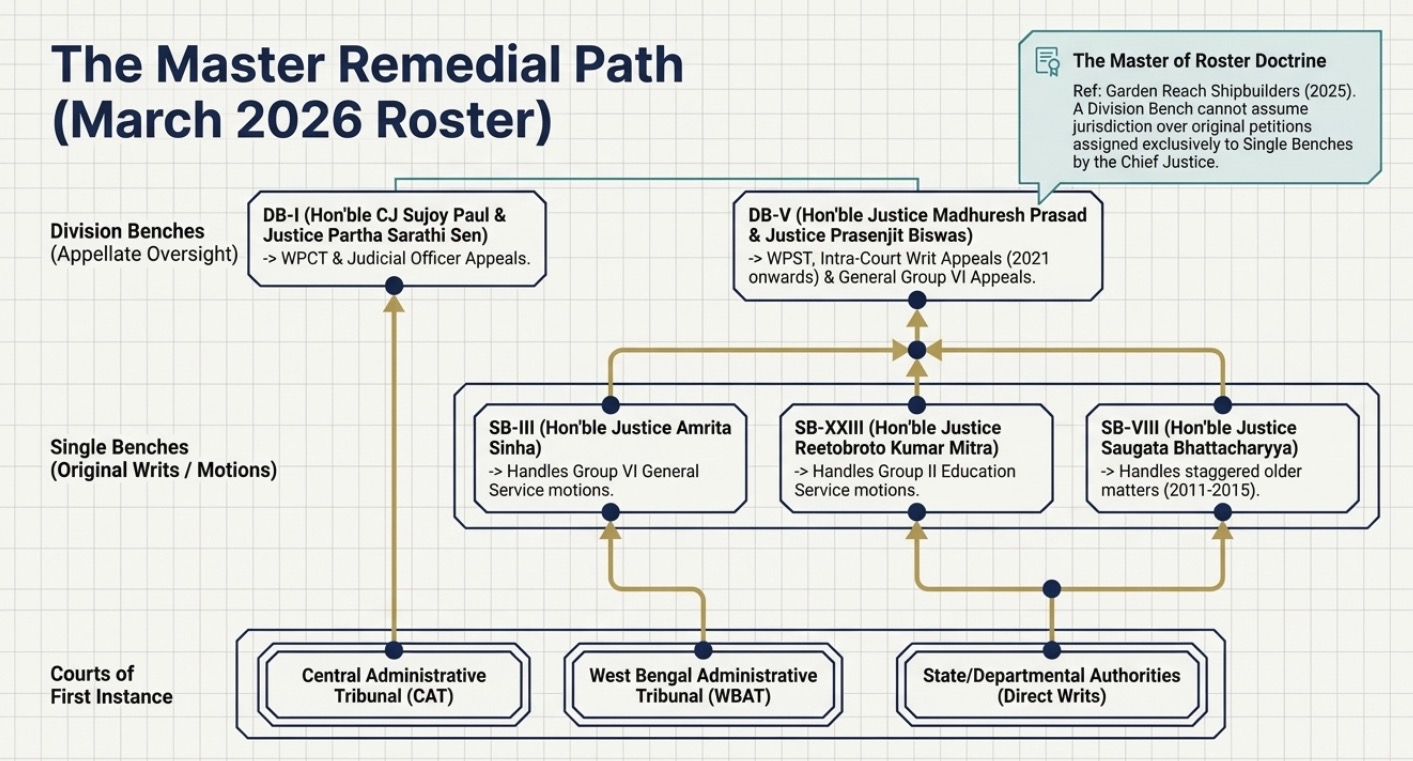
The distribution of cases is governed by the “Roster” or “Determination” issued periodically by the Hon’ble Chief Justice.13 For the period starting March 2, 2026, the specific judicial assignments for service matters and tribunal appeals are as follows 13:
Division Bench I (DB-I)
Hon’ble Chief Justice Sujoy Paul and Hon’ble Justice Partha Sarathi Sen This bench, traditionally known as the First Division Bench, handles matters of high institutional importance.13 Its determination for service matters includes:
- WPCT (Central Tribunal): Matters relating to the Central Tribunal under Articles 323A and 323B.13
- Specific Group VI Appeals: This bench hears appeals from orders concerning the service of Judicial Officers, Officers and Staff of the High Court Service, and the District Judiciary (both serving and retired).13 This exclusion from general Group VI benches ensures that matters internal to the judiciary are handled by the Chief Justice’s bench.
Division Bench V (DB-V)
Hon’ble Justice Madhuresh Prasad and Hon’ble Justice Prasenjit Biswas This is the primary bench for broader service litigation and state-level administrative oversight.13 Its determination includes:
- WPST (State Tribunal): Matters relating to the West Bengal State Administrative Tribunal under Articles 323A and 323B.13
- General Group VI Appeals: Hearing appeals from orders relating to service under Group VI, specifically excluding the judicial/HC staff matters assigned to DB-I.13
- Intra-Court Writ Appeals: Hearing appeals against orders passed by Single Benches in writ petitions filed from 2021 onwards.13
Single Bench Determinations for Service Matters
While Division Benches hear appeals and tribunal matters, original writ petitions (Motions) are typically heard by Single Benches.21
- SB-III (Hon’ble Justice Amrita Sinha): Handles motions and hearings under Article 226 relating to Service under Group VI and applications connected thereto.13 This bench is the primary gateway for state government employees seeking urgent intervention.
- SB-XXIII (Hon’ble Justice Reetobroto Kumar Mitra): Specifically handles service matters related to Education under Group II, including Secondary, Higher Secondary, College, and University services.13
- SB-VIII (Hon’ble Justice Saugata Bhattacharyya): Often assigned to Group VI or Group II matters in staggered years, such as those from 2011 to 2015, depending on the cumulative workload of the court.14
The “Master of Roster” doctrine, reaffirmed by the Supreme Court in Garden Reach Shipbuilders and Engineers Limited v. GRSE Limited Workmen’s Union (2025), dictates that no bench can assume jurisdiction over a matter not assigned to it by the Chief Justice.18 In that case, a Division Bench’s order in a Group VI original writ petition was declared null and void because the Chief Justice had assigned such original petitions exclusively to Single Benches.18
The Tribunal Framework: CAT, WBAT, and AFT
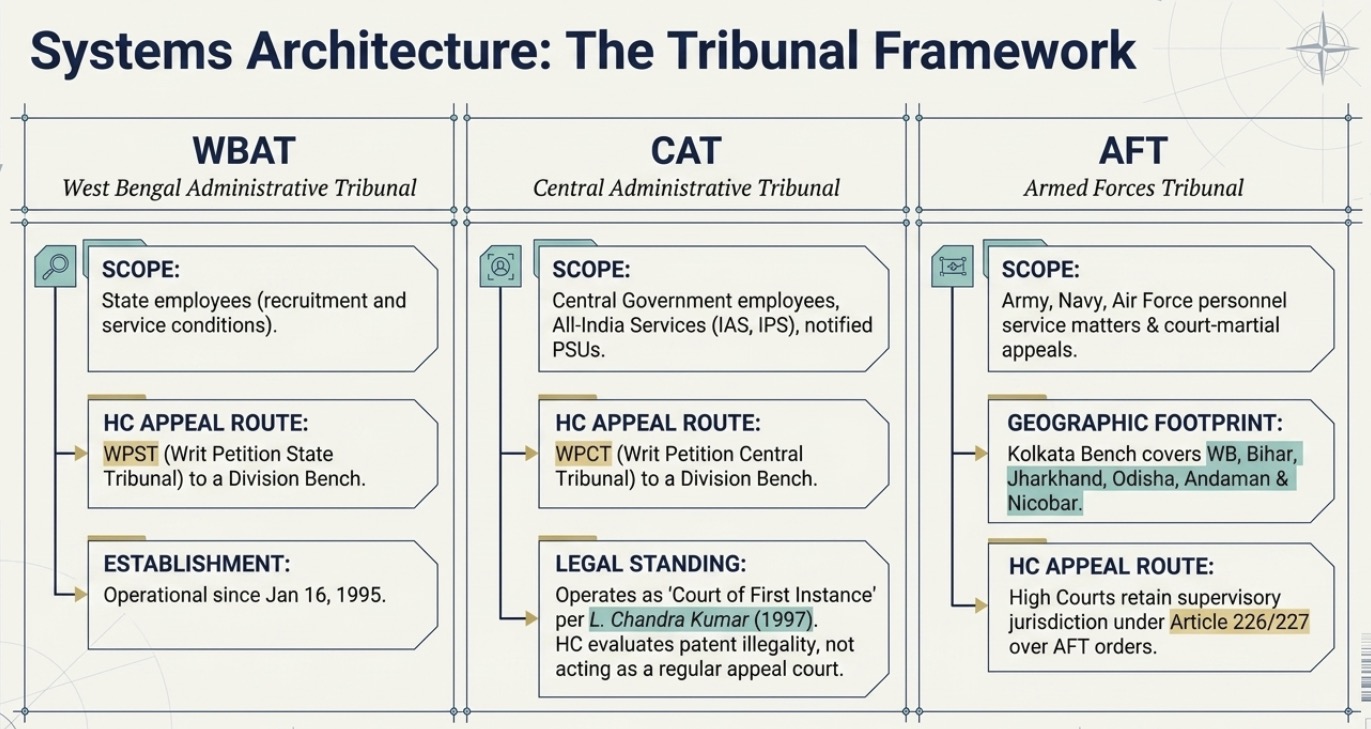
The Administrative Tribunals Act, 1985, creates a specialized tier of adjudication for service matters to alleviate the burden on constitutional courts.5
Central Administrative Tribunal (CAT) – WPCT
The CAT possesses original jurisdiction over service matters for Central Government employees, All-India Services (IAS, IPS, etc.), and notified public sector undertakings.5
- Legal Standing: Under the rule laid down in L. Chandra Kumar v. Union of India (1997), the CAT acts as the “Court of First Instance.” High Courts cannot entertain these matters directly.24
- High Court Role: Decisions of the CAT are challenged via a writ petition marked as WPCT (Writ Petition Central Tribunal) before a Division Bench of the High Court.25 The High Court exercises judicial review, examining patent illegality, perversity in findings, or violation of natural justice, rather than acting as a regular court of appeal.25
West Bengal Administrative Tribunal (WBAT) – WPST
Established on January 16, 1995, the WBAT handles service disputes of employees of the State of West Bengal.31
- Scope: This includes recruitment complaints and service condition disputes for all state departments.7
- High Court Role: Orders of the WBAT are assailed through WPST (Writ Petition State Tribunal) applications, which are heard by the designated Division Bench (currently DB-V).13
Armed Forces Tribunal (AFT)
The AFT has jurisdiction over service matters and court-martial appeals for personnel in the Army, Navy, and Air Force.34
- Kolkata Bench: The AFT Kolkata Bench covers West Bengal, Bihar, Jharkhand, Odisha, and the Andaman and Nicobar Islands.34
- Judicial Oversight: While the AFT Act initially sought to bypass High Courts, the Supreme Court has affirmed that High Courts retain supervisory jurisdiction under Article 226/227 over AFT orders.37
Navigating Non-Functional Tribunals
A significant challenge for petitioners arises when tribunals become non-functional due to vacancies in judicial or administrative membership.31 The WBAT has historically faced such crises, sometimes operating with only the Chairman and no other members.31
Legal Principles during Tribunal Inaction
- Restoration of High Court Jurisdiction: When a tribunal is unable to function or lacks a quorum (e.g., the required Division Bench quorum for complex matters), the aggrieved litigant may approach the High Court directly under Article 226.38
- Urgent Interim Relief: In “extraordinary situations” where a tribunal’s non-functionality endangers the due process of law, the High Court may step in as a court of first instance to grant interim stays on transfers, suspensions, or dismissals.39
- Supervisory Intervention: Under Article 227, the High Court has the power of superintendence. It can direct a non-functional tribunal to dispose of a matter expeditiously once the quorum is restored or, in extreme cases, withdraw a case to itself if justice so requires, though this is rarely done as it bypasses the L. Chandra Kumar mandate.3
- Limitations: Long pendency alone is typically not a valid reason to bypass a tribunal. The petitioner must demonstrate that the tribunal is actually non-functional or that an immediate irreparable injury is imminent which the tribunal cannot address in its current state.28
Kinds of Writs in Service Matters
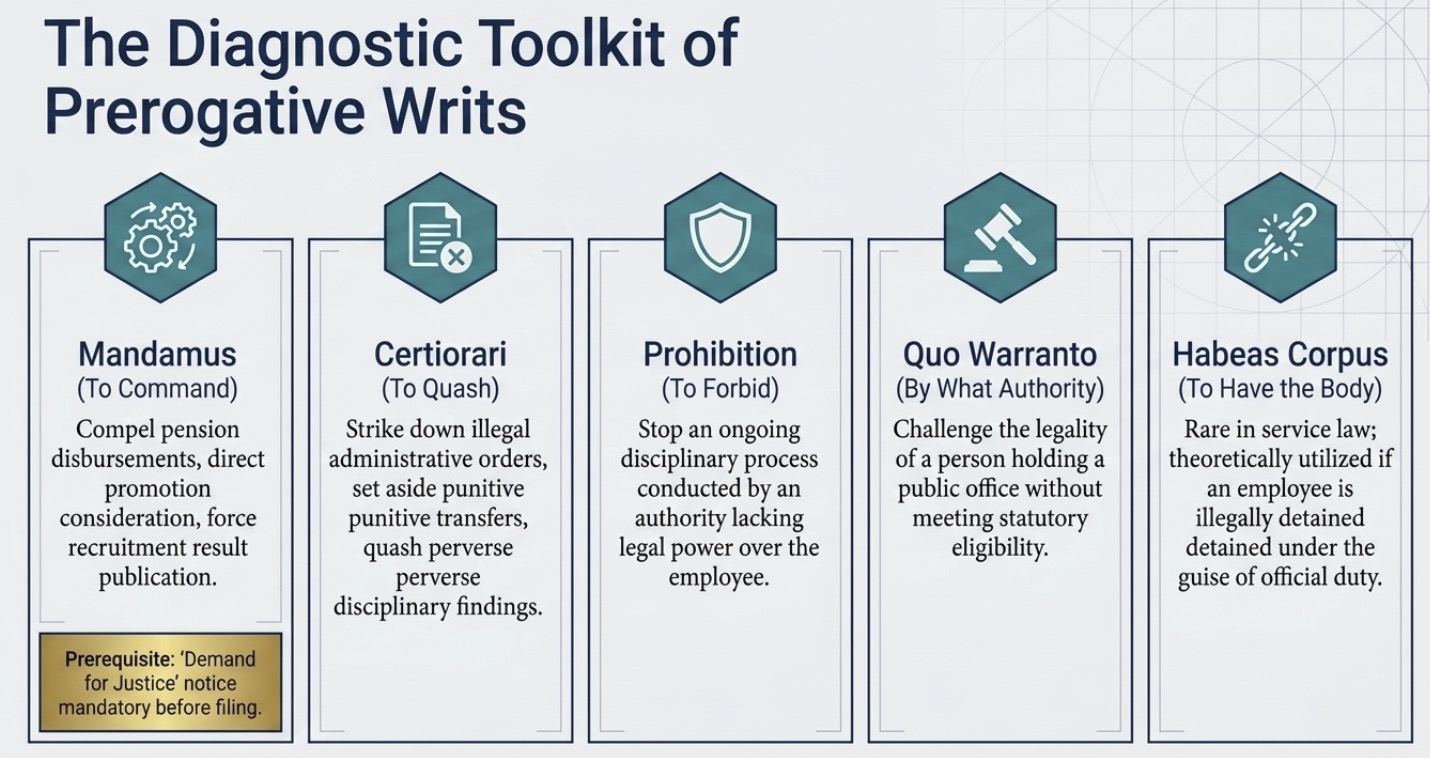
The Five Prerogative Writs are tailored to different service scenarios:
1. Writ of Mandamus (To Command)
This is the most frequent writ in service law.1 It is used to:
- Compel the disbursement of pensionary benefits or gratuity.16
- Direct an authority to consider a representation for promotion or regularization.1
- Force the publication of a long-delayed recruitment result.40
- Prerequisite: A “Demand for Justice” (a formal letter seeking the relief) must usually be sent and ignored before Mandamus can be issued.1
2. Writ of Certiorari (To Quash)
Certiorari is used to strike down illegal administrative orders.1 Scenarios include:
- Quashing a final order of dismissal passed without an inquiry.4
- Setting aside a punitive transfer order.7
- Quashing a perverse finding in a disciplinary proceeding.9
3. Writ of Prohibition (To Forbid)
Less common but vital, this stops an ongoing process that is without jurisdiction.1
- Preventing a disciplinary authority from continuing an inquiry if they lack the legal power over the employee.2
4. Writ of Quo Warranto (By What Authority)
Used to challenge the legality of a person holding a public office.1
- Challenging the appointment of a Vice-Chancellor or a senior government head if they do not meet the statutory eligibility criteria.9
5. Writ of Habeas Corpus (To Have the Body)
Rare in service matters, but theoretically possible if an employee is illegally detained by the State under the guise of official duty.1
Step-by-Step Guide for Petitioners
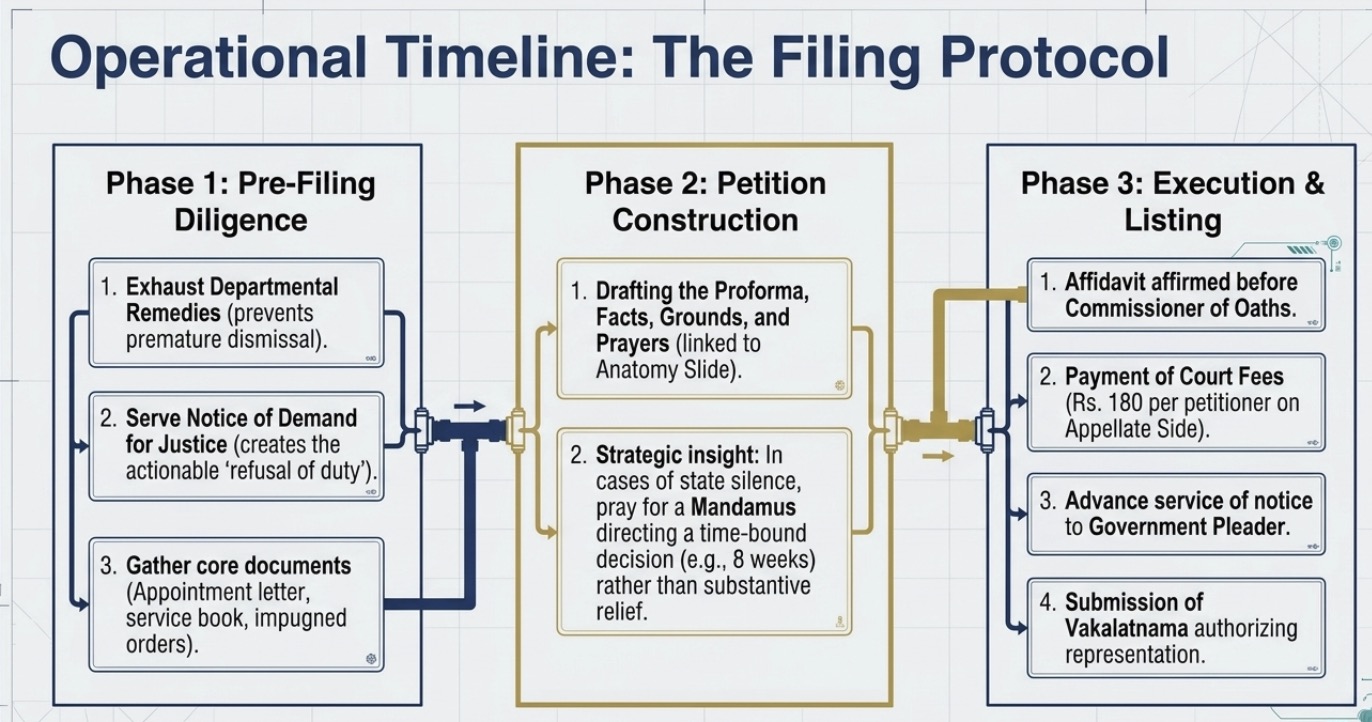
Navigating the Calcutta High Court requires precision in both drafting and procedure.1
Phase 1: Pre-Filing Diligence
- Exhaust Departmental Remedies: Most service rules require an employee to file a departmental appeal first. The Court may dismiss a petition as premature if these are bypassed.8
- Notice of Demand for Justice: Serve a legal notice to the respondent authorities. This creates a “refusal of duty” if they do not respond, which is necessary for Mandamus.1
- Gathering Documents: Collect the appointment letter, service book entries, the impugned order, and any relevant departmental communications.26
Phase 2: Structuring the Petition
- The Title: “In the Matter of: An application under Article 226 of the Constitution of India”.1
- The Proforma (Schedule A): Specify Group VI, Head (a-m), and provide the Advocate’s contact details.13
- Statement of Facts: Present a chronological, objective narrative. Link every fact to an “Annexure” (e.g., Annexure P/1).1
- Grounds of Law: Frame the legal arguments—violation of rules, perversity, malafides, or violation of Articles 14/16.2
- Prayers: Clearly state the relief sought (e.g., “Issue a Writ of Mandamus quashing the order dated 01.01.2025”).1
- Declaration under Rule 11: Declare that no other application on the same cause of action is pending.1
Phase 3: Filing and Listing
- Affidavit: Affirm the truth of the petition before a Commissioner of Oaths.42
- Court Fees: Pay the prescribed fees (typically Rs. 180 per petitioner on the A.S.).46
- Service of Notice: Provide advance copies to the Government Pleader and all other respondents.2
- Vakalatnama: Authorize the advocate to represent the case.45
Detailed Analysis of Sub-Head Scenarios
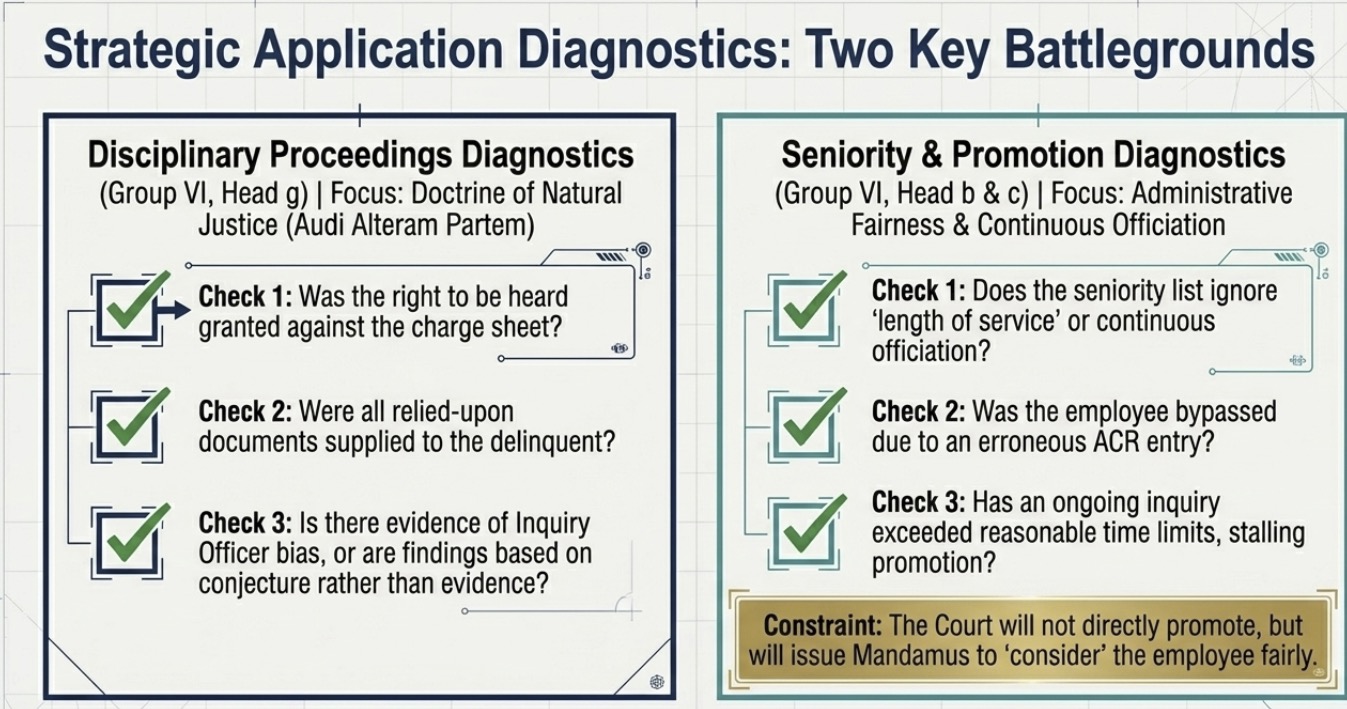
Seniority and Promotion (Group VI Head b & c)
The High Court frequently intervenes in seniority lists that ignore “continuous officiation” or “length of service”.4 In promotion cases, while the Court cannot direct a promotion, it can direct the State to “consider” the employee fairly if they were bypassed due to an erroneous ACR (Annual Confidential Report) entry or an ongoing inquiry that has exceeded the time limit.4
Disciplinary Proceedings (Group VI Head g)
The “Doctrine of Natural Justice” (Audi Alteram Partem) is the central theme here.9 The High Court checks:
- The Right to Be Heard: Was the employee given a fair chance to reply to the charge sheet?.4
- Supply of Documents: Were all documents relied upon by the department shared with the delinquent?.27
- The Inquiry Officer’s Conduct: Is there any bias? Was the IO’s report based on evidence or mere conjecture?.9
Educational Service: The Madrasah Act Case Study
The Calcutta High Court has handled sensitive issues regarding the West Bengal Madrasah Service Commission Act.15 Petitioners (Minority Institutions) argued that the State’s central selection of teachers violated their right to administer institutions under Article 30.15 The Court discussed whether the right to choose teaching staff is a “major constituent component” of the right to administer, balancing minority rights with the need for quality education.15
Frequently Asked Questions (FAQs) for Litigants
| Question | Expert Answer |
| Can I file a case for a pension delay directly in the HC? | If you are a state employee, you must file an OA in the WBAT first. Only if the WBAT is non-functional or after its order can you come to the HC (WPST).26 |
| Who is the “Master of Roster”? | The Hon’ble Chief Justice. No other judge or bench can hear a case unless it is assigned to them in the official notification.18 |
| What is the deadline to file a service writ? | While the High Court doesn’t have a strict limitation period under the Limitation Act, a delay of more than 6-12 months without explanation may lead to dismissal for “laches”.26 |
| Under which Group does a teacher’s transfer fall? | It falls under Group II (Education), Head (h) Miscellaneous, with specific computer codes depending on whether it is Primary, Secondary, etc..13 |
| What is the difference between WPCT and WPST? | WPCT is for Central employees (from CAT). WPST is for State employees (from WBAT).29 |
| Who is the current judge for Group VI service motions? | As per the March 2026 roster, Hon’ble Justice Amrita Sinha (SB-III).13 |
| Can a union file a case for a member? | Yes, registered organizations or unions can file a writ on behalf of their members if there is a common grievance.44 |
| Is a “Demand for Justice” mandatory? | Yes, for a Writ of Mandamus, the court usually insists on seeing that the authority was given a chance to act before being sued.1 |
Strategic Insights for Effective Service Litigation
Navigating Computer Codes and Classification
Precision in the “Presentation Form” is vital.13 Misclassifying a matter under Group IX (Residuary) instead of Group VI can result in the matter being “delisted” or sent to a different bench, losing weeks of time.21 Practitioners must use the comprehensive computer codes provided in the 2010 High Court notification for educational services to ensure correct routing.13
Addressing Administrative Inaction
In many instances, the State does not pass an order but simply stays silent. In such cases, the petitioner should pray for a Mandamus directing the authority to decide the pending representation within a time-bound period (e.g., 8 weeks).1 This “limited prayer” often leads to a quick disposal of the motion with a positive direction.
Dealing with the 2026 Roster Realities
For the March 2026 roster, practitioners should note that DB-I handles only “Judicial Officers” and “Central Tribunal” matters.13 General service appeals for state employees must be mentioned before DB-V.13 Furthermore, the order of March 4, 2024, mandates that the date of institution shall be reckoned from the date of filing, which is crucial for determining which bench’s determination (year-wise) will apply.13
Conclusion: The Path to Judicial Redress
Service jurisprudence in the Calcutta High Court is a refined system that balances the State’s administrative autonomy with the individual employee’s constitutional rights. The transition from the tribunal-as-substitute model to the tribunal-as-first-instance model has established a two-tier remedial path that ensures both specialized factual analysis at the tribunal level and robust constitutional oversight at the High Court level.24
The March 2026 roster demonstrates a strategic delegation of service matters across the judicial spectrum, placing specialized categories like internal judiciary disputes under the First Division Bench while providing dedicated single benches for teachers and general state staff.13 For the petitioner, the key to success lies in meticulous procedural compliance—from the initial “Demand for Justice” to the correct selection of the “Group VI” or “Group II” classification codes.1 As the High Court continues to modernise its systems through comprehensive computerised listing, the clarity provided in this guide serves as a vital resource for navigating one of India’s most significant legal arenas.13
Works cited
- Guide to Filing a Writ Petition in the Calcutta High Court – Patras Law Chamber, accessed on March 23, 2026, https://patraslawchambers.com/guide-to-filing-a-writ-petition-in-the-calcutta-high-court/
- Writs Under The Calcutta High Court: A Comprehensive Legal Analysis, accessed on March 23, 2026, https://patraslawchambers.com/writs-under-the-calcutta-high-court-a-comprehensive-legal-analysis/
- Matters at Hon’ble High Court: – A.L.L.O.W.B, accessed on March 23, 2026, https://allowb.org/assets/pdfs/courtmatters/fc2.pptx
- SERVICE MATTERS – The LawTech, accessed on March 23, 2026, https://lawtechcorp.com/services/indian-subsidiary-company/
- WRITS RELATING TO SERVICE MATTERS – Govind Ramnath Kare College of Law Library, accessed on March 23, 2026, http://www.grkarelawlibrary.yolasite.com/resources/SM-Jul14-Lab-4-Samatina.pdf
- Writ Petitions at the Supreme Court of India & High Courts, accessed on March 23, 2026, https://www.indialawoffices.com/legal-articles/writ-petitions-at-the-supreme-court-of-india-high-court
- Service Matters India | Government Employee Disputes & Legal Support | lexpartem.com, accessed on March 23, 2026, https://lexpartem.com/services/service-matters
- How to Argue Maintainability Under Article 226 in High Court – Supreme Today AI, accessed on March 23, 2026, https://supremetoday.ai/issue/how-to-argue-maintainability-under-article-226-in-high-court
- FREQUENTLY ASKED QUESTIONS FAQs ON WRITS IN INDIA – Acuity Law, accessed on March 23, 2026, https://acuitylaw.co.in/wp-content/uploads/2024/02/FAQ-40-Writs-in-India.pdf
- Rules of High Court at Calcutta relating to Applications under Article 226 of The Constitution of India – Indian Kanoon, accessed on March 23, 2026, https://indiankanoon.org/doc/23892089/
- IN THE HIGH COURT AT CALCUTTA – Constitutional Writ Jurisdiction ORIGINAL SIDE, accessed on March 23, 2026, https://images.assettype.com/barandbench/2021-02/78011bab-5c27-4b17-8904-207957d63fb7/Susmita_Gayen_v__The_State_of_West_Bengal___Others.pdf
- Article 226 – Where Must the “Action” be Instituted? – SCC Online, accessed on March 23, 2026, https://www.scconline.com/blog/post/2025/02/22/article-226-where-must-the-action-be-instituted/
- APPELLATE SIDE CLASSIFICATION.pdf
- Daily Supplementary List Of Cases For Hearing On Monday, 9th of March, 2026 – Appellate Jurisdiction, accessed on March 23, 2026, https://www.calcuttahighcourt.gov.in/Notice-Files/CL/16537
- IN THE HIGH COURT AT CALCUTTA CONSTITUTIONAL WRIT JURISDICTION APPELLATE SIDE Present: The Hon’ble Justice Sambuddha Chakrabar, accessed on March 23, 2026, https://www.calcuttahighcourt.gov.in/Order-Judgment-PDF/A/WP_20650W_2013_12032014_J_216.pdf
- SUNITA NASKAR ADVOCATE HIGH COURT CALCUTTA M no. 9830529398 CHAMBER – SARTHAC, accessed on March 23, 2026, https://sarthac.gov.in/download-case-file?page=view-case-file&id=3482&year=2021
- Santosh Kumar Das vs The State Of West Bengal & Ors on 18 June, 2024 – Indian Kanoon, accessed on March 23, 2026, https://indiankanoon.org/doc/122960304/
- Supreme Court sets aside Calcutta HC order for lack of jurisdiction – SCC Online, accessed on March 23, 2026, https://www.scconline.com/blog/post/2025/03/20/supreme-court-sets-aside-calcutta-hc-order-lack-of-jurisdiction/
- IN THE HIGH COURT AT CALCUTTA, accessed on March 23, 2026, https://www.calcuttahighcourt.gov.in/Notice-Files/roster/16468
- Calcutta High Court Division Bench Roster (Effective 3 Nov 2025), accessed on March 23, 2026, https://advocatetanmoy.com/calcutta-high-court-division-bench-roster-w-e-f-3-nov-2025/
- Division Bench of High Court Cannot Hear Appeal Unless Referred by Single Judge or Chief Justice, accessed on March 23, 2026, https://www.scobserver.in/supreme-court-observer-law-reports-scolr/division-bench-of-high-court-cannot-hear-appeal-unless-referred-by-single-judge-or-directed-by-chief-justice-garden-reach-shipbuilders-and-engineers-limited-v-grse-limited-workmens-union-25-februa/
- GARDEN REACH SHIPBUILDERS AND ENGINEERS LIMITED v. GRSE LIMITED WORKMENS UNION | Supreme Court Of India | Judgment | Law | CaseMine, accessed on March 23, 2026, https://www.casemine.com/judgement/in/67e237ec7b93335d5010415b
- IN THE HIGH COURT AT CALCUTTA Notification no.7270-RG Dated: 31.10.2025 Roster / Determination of the Appellate Side & O, accessed on March 23, 2026, https://www.calcuttahighcourt.gov.in/Notice-Files/roster/15465
- Tribunals in India: Structure, Jurisdiction & Key Reforms – aptiplus, accessed on March 23, 2026, https://aptiplus.in/blogs/tribunals-in-india/
- All to know about service matter cases in CAT – Patras Law Chamber, accessed on March 23, 2026, https://patraslawchambers.com/all-to-know-about-service-matter-cases-in-cat/
- Service Matter Case Filing Process in India | Complete Legal Guide – High Court lawyer’s, accessed on March 23, 2026, https://srinivasalaw.co.in/how-to-file-service-matter-case-in-india/
- Can CAT orders be appealed in High Court Archives | Rajendra Civil Law Firm, accessed on March 23, 2026, https://www.civiladvocate.in/legal-services-chennai/can-cat-orders-be-appealed-in-high-court/
- Minati Chakraborty vs State Of West Bengal And Others on 10 June, 2025 – Indian Kanoon, accessed on March 23, 2026, https://indiankanoon.org/doc/39194304/
- Calcutta High Court – Appellate side – Case Status : Search by Case Number, accessed on March 23, 2026, https://hcservices.ecourts.gov.in/ecourtindiaHC/cases/case_no.php?state_cd=16&dist_cd=1&court_code=3&stateNm=Calcutta
- CASE TYPE Original Side (Jurisdiction) (Pertinent to regular work) CS – Civil Suits TS – Testamentary Suits TCS – W.B.L.L.R.O.A – West Bengal Land & Land Reforms Officers’ Association, accessed on March 23, 2026, https://wbllroa.in/wp-content/uploads/2021/01/LLRO_CASE-TYPE.pdf
- tribunal – WBAT, accessed on March 23, 2026, https://wbat.wb.gov.in/office.html
- Home – State Administrative Tribunal, Maharashtra State, India, accessed on March 23, 2026, https://testsatw.mahaitgov.in/
- west bengal administrative tribunal – Indian Kanoon, accessed on March 23, 2026, https://indiankanoon.org/search/?formInput=%20west%20bengal%20administrative%20tribunal%20%20%20%20%20&pagenum=10
- Jurisdiction – ARMED FORCES TRIBUNAL (PRINCIPAL BENCH), accessed on March 23, 2026, https://aftdelhi.nic.in/index.php/home/jurisdiction
- Jurisdiction – Armed Forces TribunalJaipur |, accessed on March 23, 2026, https://aftjaipur.gov.in/pages/jurisdiction
- Armed Forces Tribunal appeals in Supreme Court – Advocate Jayprakash Somani, accessed on March 23, 2026, https://www.jayprakashsomani.com/service-detail/AFT-matter
- Filling cases in the Armed Forces Tribunal( AFT):A complete guide – Patras Law Chamber, accessed on March 23, 2026, https://patraslawchambers.com/guide-to-filling-cases-in-the-armed-forces-tribunal-aft-of-india/
- WBAT Division Bench Quorum: Legal Insights – Supreme Today AI, accessed on March 23, 2026, https://supremetoday.ai/issue/wbat-division-bench-quorum%3A-legal-insights
- 2009~scr_2009_10_896_907_e.pdf – Calcutta High Court, accessed on March 23, 2026, https://calcuttahighcourt.gov.in/Show-Judgment-File/2009~scr_2009_10_896_907_e.pdf
- SRI GOBINDALAL BISWAS & ORS Vs. THE STATE OF WEST BENGAL & ORS On 06 January, 2025 – Legitquest, accessed on March 23, 2026, https://www.legitquest.com/case/sri-gobindalal-biswas-ors-v-the-state-of-west-bengal-ors/7B5301
- Service Matters | Important Judgements | Details Page – Referencer, accessed on March 23, 2026, https://www.referencer.in/Details_Judgements.aspx
- Writ petitions in India and how to file them – iPleaders, accessed on March 23, 2026, https://blog.ipleaders.in/writ-petitions-india-file/
- What is a Writ Petition. And how do you file one in Court? – MyAdvo.in, accessed on March 23, 2026, https://www.myadvo.in/blog/how-to-file-writ-petition-in-court/
- Writ Petition In India – Types, Process & Legal Guide – Diligence Certifications, accessed on March 23, 2026, https://www.diligencecertification.com/writ-petition/
- HOW TO FILE WRIT PETITION IN INDIA – e-jagriti.com | Legal-Awareness |, accessed on March 23, 2026, https://e-jagriti.com/how-to-file-writ-petition-in-india/
- FORMAT OF WRIT PETITION A SYNOPSIS AND LIST OF DATES (Specimen enclosed) B FROM NEXT PAGE IN THE SUPREME COURT OF INDIA ORIGINAL – S3waas, accessed on March 23, 2026, https://cdnbbsr.s3waas.gov.in/s3ec0490f1f4972d133619a60c30f3559e/uploads/2024/01/2024011726.pdf
- West Bengal Administrative Tribunal (procedural) Rules, 1994, India-legitquest, accessed on March 23, 2026, https://www.legitquest.com/act/west-bengal-administrative-tribunal-procedural-rules-1994/9f79
- Notification on Public Interest Litigation Uploaded:24-Aug-2010 11:03:51 – Calcutta High Court, accessed on March 23, 2026, https://www.calcuttahighcourt.gov.in/Notice-Files/gazette-notification/250