Challenge of Promotion Denial in Government Service: Constitutional Remedies, Tribunal Procedures, and Seniority Jurisprudence
The Constitutional Matrix: Promotion as a Fundamental Right of Consideration
Creditor and contributor of this article:
Patra’s Law Chambers:
About Us:
Patra’s Law Chambers is a law firm with offices in Kolkata & Delhi, offering comprehensive legal services across various domains. Established in 2020 by Advocate Sudip Patra (Advocate, Supreme Court of India & Calcutta High Court) an alumnus of the Prestigious Rajiv Gandhi School of Intellectual Property Law, IIT Kharagpur ,with Post Graduate diploma in Business Law from IIM Calcutta, the firm specializes in Civil, Criminal, Writs, High Court Matters, Trademark, Copyright, Company, Tax, IT, GST & Customs, Banking & DRT, Property disputes, Service law & CAT & High Court related service matters, Military Law, Family law, and Supreme Court matters. You can know more about us in here
Kolkata Office:
NICCO HOUSE, 6th Floor, 2, Hare Street, Kolkata-700001 (Near Calcutta High Court)
Delhi Office:
House no: 4455/5, First Floor, Ward No. XV, Gali Shahid
Bhagat Singh, Main Bazar Road, Paharganj, New Delhi-110055
Website: www.patraslawchambers.com
Email: [email protected]
Phone: +91 890 222 4444/ +91 7003 715 325
Within the framework of public employment in India, the trajectory of an employee’s career is not merely an administrative detail but a constitutional interest protected by the rule of law. While it is a settled principle of service jurisprudence that a public servant has no vested fundamental right to actual promotion, the right to be considered for promotion is recognized as a fundamental right under Articles 14 and 16(1) of the Constitution of India1.
The distinction between a right to promotion and a right to be considered for promotion is a foundational pillar of administrative law1. The state possesses the discretion to decide whether to fill a vacancy, but once it initiates a promotional exercise, it cannot act arbitrarily, selectively, or in violation of its own established rules1. When an eligible employee falls within the designated zone of consideration and is bypassed or excluded, a direct infraction of Article 16(1) occurs, establishing a clear path to seek judicial remedies1.
This constitutional status was established by a five-judge Constitution Bench of the Supreme Court in Ajit Singh v. State of Punjab and subsequently affirmed in Union of India v. Krishna Kumar1. In these decisions, the judiciary clarified that the guarantee of “equality of opportunity” in matters of public employment under Article 16(1) extends beyond the initial appointment to cover the entire span of an employee’s service, including promotions, pay-scale upgrades, and career advancement1.
This constitutional protection is further reinforced by the Supreme Court’s ruling in Bihar State Electricity Board v. Dharamdeo Das (2024), which balanced the state’s administrative needs with the employee’s rights, confirming that while there is no automatic right to be promoted from the exact date a vacancy arises, the right to a fair evaluation remains absolute1.
When a public servant finds their promotion denied in government service what to do becomes a matter of assessing the administrative actions against constitutional standards. For an employee facing this issue, seeking guidance from a specialized service law advocate promotion dispute expert is often necessary to navigate the complex rules.
A common question is: can government employee file writ for promotion? The answer is that while a court will not ordinarily substitute its own opinion for that of a selection committee, it will issue a writ of mandamus to compel the state to consider the employee fairly if the denial is found to be arbitrary or in violation of the rules1.
| Constitutional Provision | Legal Implications for Promotion Denial | Key Remedies |
| Article 14 | Prohibits manifest arbitrariness, discrimination, and non-application of mind in selection processes1. | Certiorari to quash discriminatory selection lists; Mandamus to re-evaluate suitability1. |
| Article 16(1) | Guarantees equality of opportunity in promotions for all eligible employees within the zone1. | Writs against supersession; Mandamus to hold Departmental Promotion Committees (DPCs)1. |
| Article 16(4A) | Enables reservation in promotions with consequential seniority for SCs/STs under specific conditions9. | Legal challenges to non-compliant reservation policies or improper seniority fixation9. |
| Article 335 | Mandates that the claims of SCs/STs must be balanced with the maintenance of administrative efficiency9. | Judicial review of the balance between representative bureaucracy and administrative standards12. |
Performance Appraisals: ACR/APAR Jurisprudence and the Caesar to Caesar Rule
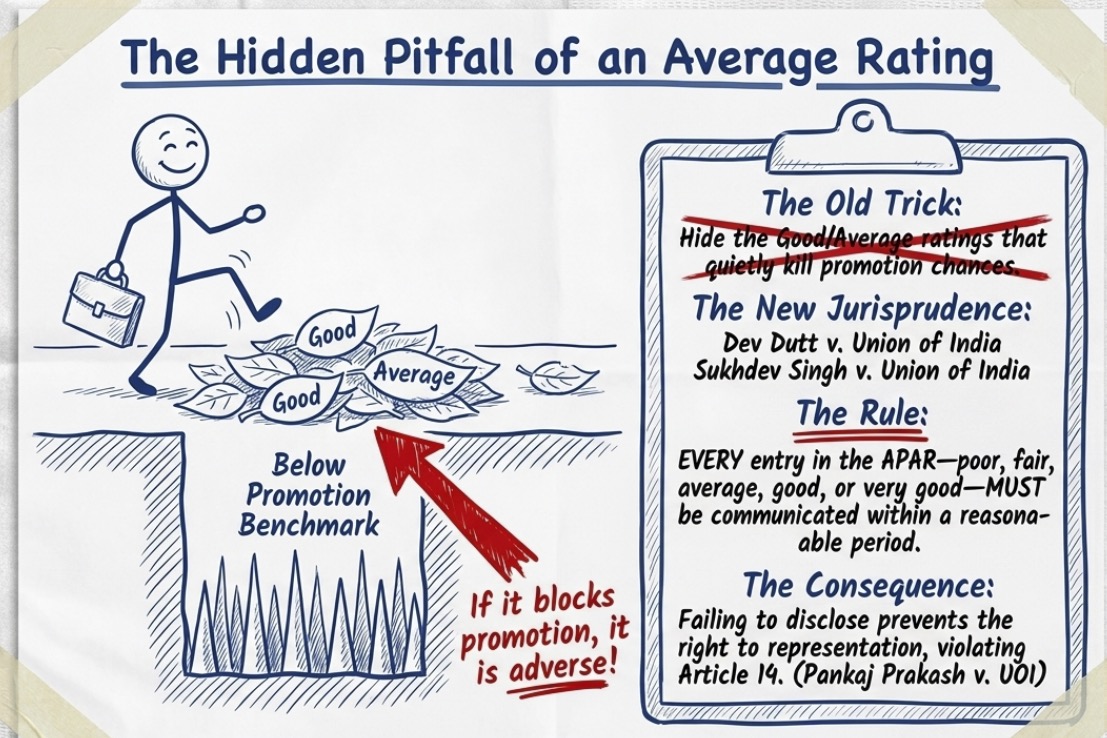
The evaluation of merit for promotion in government service relies heavily on the Annual Confidential Report (ACR), now widely referred to as the Annual Performance Appraisal Report (APAR)14. Because the selection process often uses a “benchmark” system—where an employee must achieve a specific grading (e.g., “Very Good” or “Outstanding”) to be considered fit for promotion—the recording and communication of these reports are critical to career progression16.
The Requirement of Communication: Dev Dutt and Sukhdev Singh
The legal standards governing performance evaluations were reshaped by the Supreme Court’s decisions in Dev Dutt v. Union of India (2008) 8 SCC 725 and Sukhdev Singh v. Union of India (2013) 9 SCC 56616. Prior to these rulings, administrative guidelines only required the communication of explicitly “adverse” remarks (such as “Poor” or “Unsatisfactory”)5.
Under Dev Dutt and Sukhdev Singh, the Supreme Court established that every entry in the ACR/APAR—whether poor, fair, average, good, or very good—must be communicated to the employee within a reasonable period15.
The reasoning behind this rule is that a “Good” or “Average” grading can act as an adverse entry if it falls below the benchmark required for promotion, effectively blocking the employee’s advancement without their knowledge16. Failing to disclose such gradings prevents the employee from submitting a representation for upgradation, violating the principles of natural justice and Article 14 of the Constitution15.
This principle was reinforced in Pankaj Prakash v. United India Insurance Co., where the Supreme Court held that the obligation to communicate APAR entries is a binding constitutional duty that cannot be bypassed by subsequent changes in administrative policy15.
Challenging Adverse Gradings and the “Caesar to Caesar” Prohibition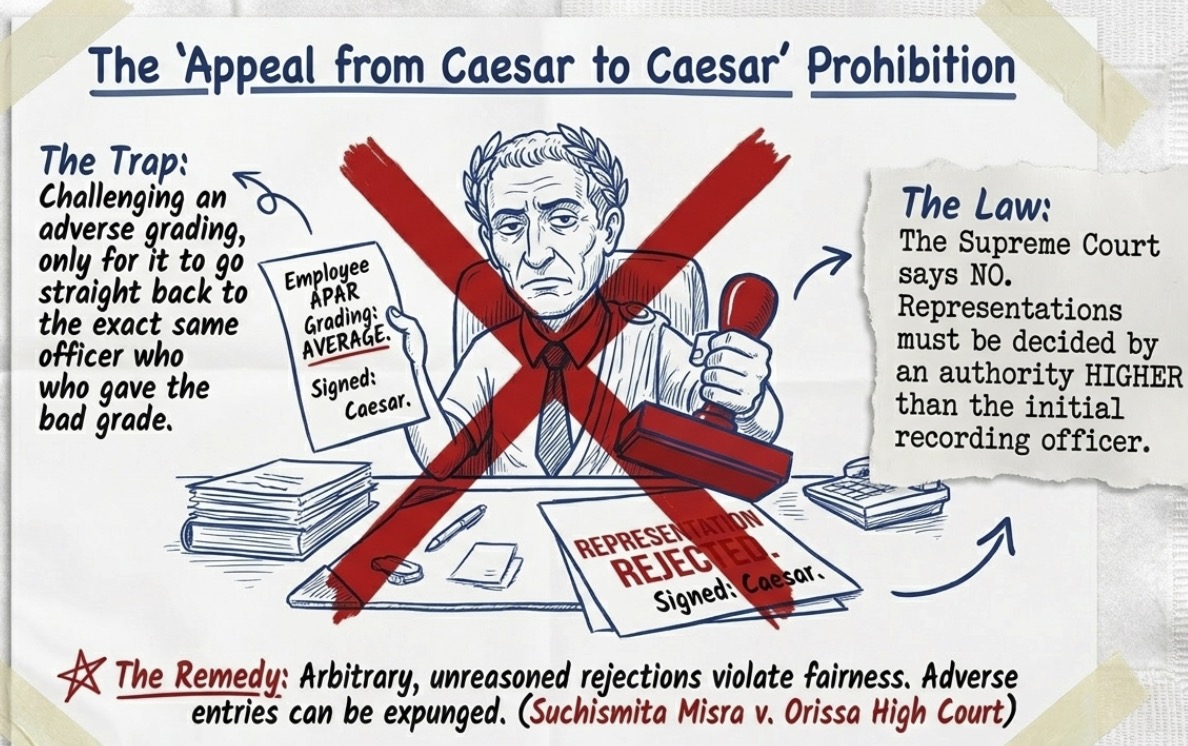
When an employee receives a below-benchmark or adverse grading, they have the right to submit a representation to the competent authority17. However, the process of resolving these representations is subject to strict judicial standards.
A common issue in service law is when a representation is decided by the same official who recorded or accepted the original grading5. The Supreme Court in Dev Dutt strongly rejected this practice, describing it as an improper “appeal from Caesar to Caesar”17.
To ensure a fair and unbiased review, the representation must be considered and decided by an authority higher than the one who recorded or endorsed the grading5.
In Suchismita Misra v. Registrar, Administration, Orissa High Court, the court expunged adverse entries because the employee’s representation had been rejected without recorded reasons, confirming that the arbitrary rejection of an APAR representation violates the basic requirements of administrative fairness19.
Digital Workflows and SPARROW Timelines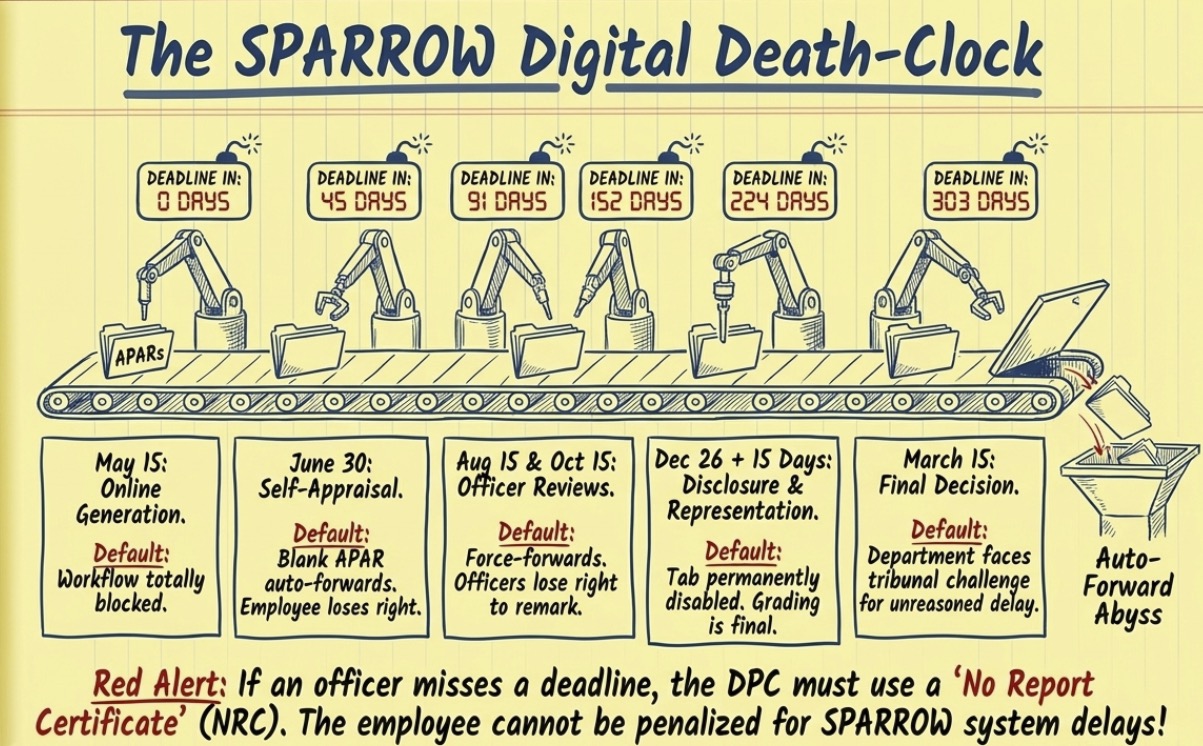
The introduction of the Smart Performance Appraisal Report Recording Online Window (SPARROW) has digitized the performance appraisal process, establishing strict, system-enforced timelines for each stage of the cycle20. These timelines are designed to prevent administrative delays and ensure transparency:
| Milestone / Activity | Standard SPARROW Deadline | System-Enforced Consequences of Default |
| Online Generation of APAR | 15th May27 | Failure to generate blocks the digitized workflow of the cycle26. |
| Submission of Self-Appraisal | 30th June28 | The system auto-forwards a blank APAR; the employee forfeits the right to self-appraisal26. |
| Recording by Reporting Officer | 15th August28 | The reporting officer loses the right to enter remarks; the APAR is force-forwarded to the reviewer20. |
| Review by Reviewing Officer | 15th October28 | The reviewing officer loses the right to review; the APAR is force-forwarded to the Custodian20. |
| Disclosure of Completed APAR | 26th December27 | The Custodian discloses the APAR to the employee to allow for acceptance or representation20. |
| Submission of Representation | Within 15 days of disclosure20 | The representation tab is disabled, and the disclosed grading becomes final20. |
| Decision on Representation | 15th March of the succeeding year27 | The competent authority must issue a reasoned order, or face legal challenge before a tribunal21. |
Under these rules, if an assessing authority fails to record their evaluation within the scheduled period, they lose the right to do so20. The DPC must then assess the candidate based on the remaining records or a “No Report Certificate” (NRC) to ensure the employee is not disadvantaged by administrative delays20.
DPC Failures: Delayed Meetings, Retrospective Promotions, and Arrears of Pay
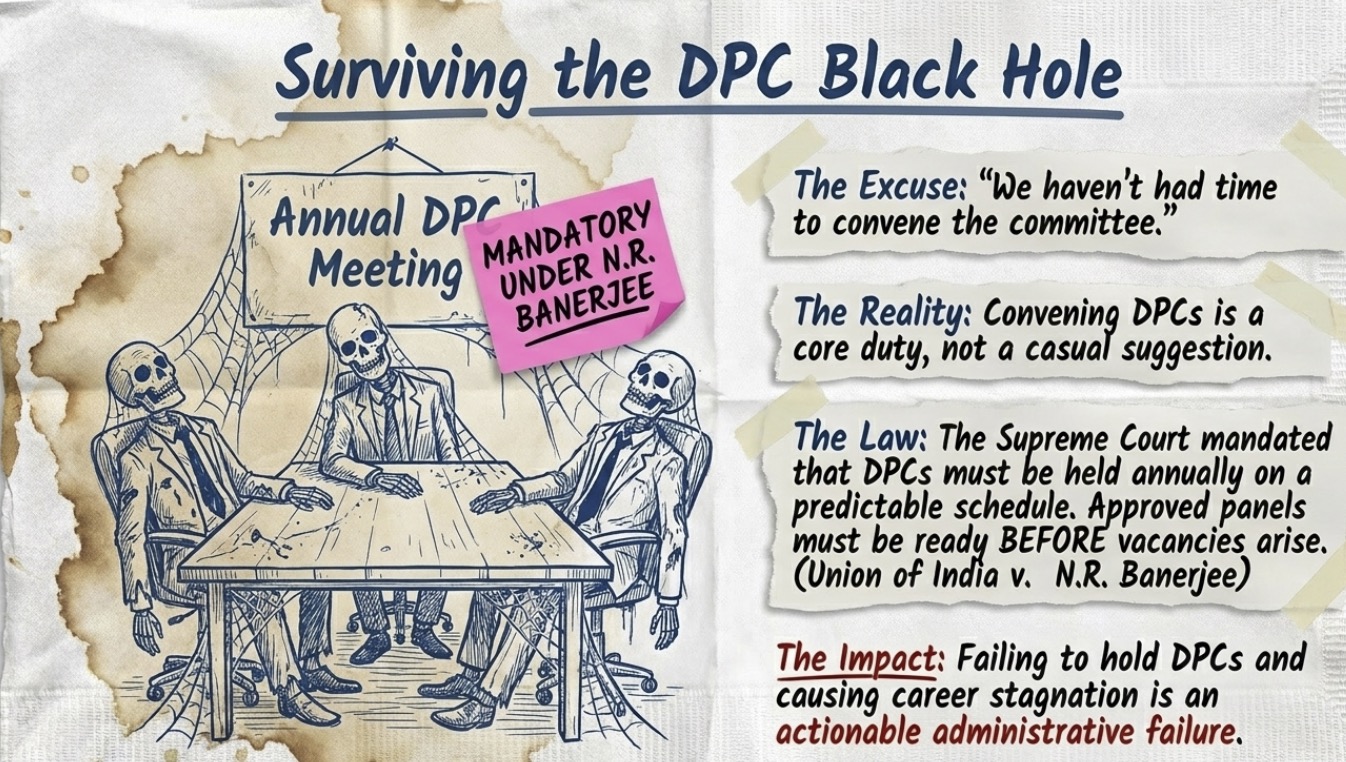
The regular convening of Departmental Promotion Committees (DPCs) is a core duty of government departments8. The Supreme Court in Union of India v. N.R. Banerjee (1997) 9 SCC 287 emphasized that DPCs should be held annually on a predictable schedule, ensuring that approved select panels are available before vacancies arise8.
When a department fails to hold DPCs on time, it can lead to career stagnation and give rise to significant legal disputes8.
Notional and Retrospective Promotions for Bypassed Employees
When a DPC is delayed through no fault of the employee, the courts have established clear remedies to restore their career progression7:
- Retrospective Promotion: In P.N. Premachandran v. State of Kerala (2004) 1 SCC 245, the Supreme Court held that administrative delays in convening a DPC are lapses by the state32. Consequently, when the DPC eventually meets, eligible employees must be granted retrospective promotion from the date the vacancies originally occurred, protecting them from the consequences of administrative inaction32.
- Notional Promotion Post-Retirement: A common issue occurs when an employee is within the zone of consideration but retires before the delayed DPC is held31. In Sadhu Singh v. D/O Post (2026) and Hari Dev v. Union of India, the Central Administrative Tribunal applied established precedents to rule that a retired employee cannot be denied promotion simply because of the department’s delay31. The DPC must evaluate the retired employee’s suitability for the relevant vacancy year31. If found fit, they are entitled to notional promotion from the date their junior was promoted, with a corresponding recalculation of their pensionary benefits7.
The “No Work No Pay” Rule and the Right to Arrears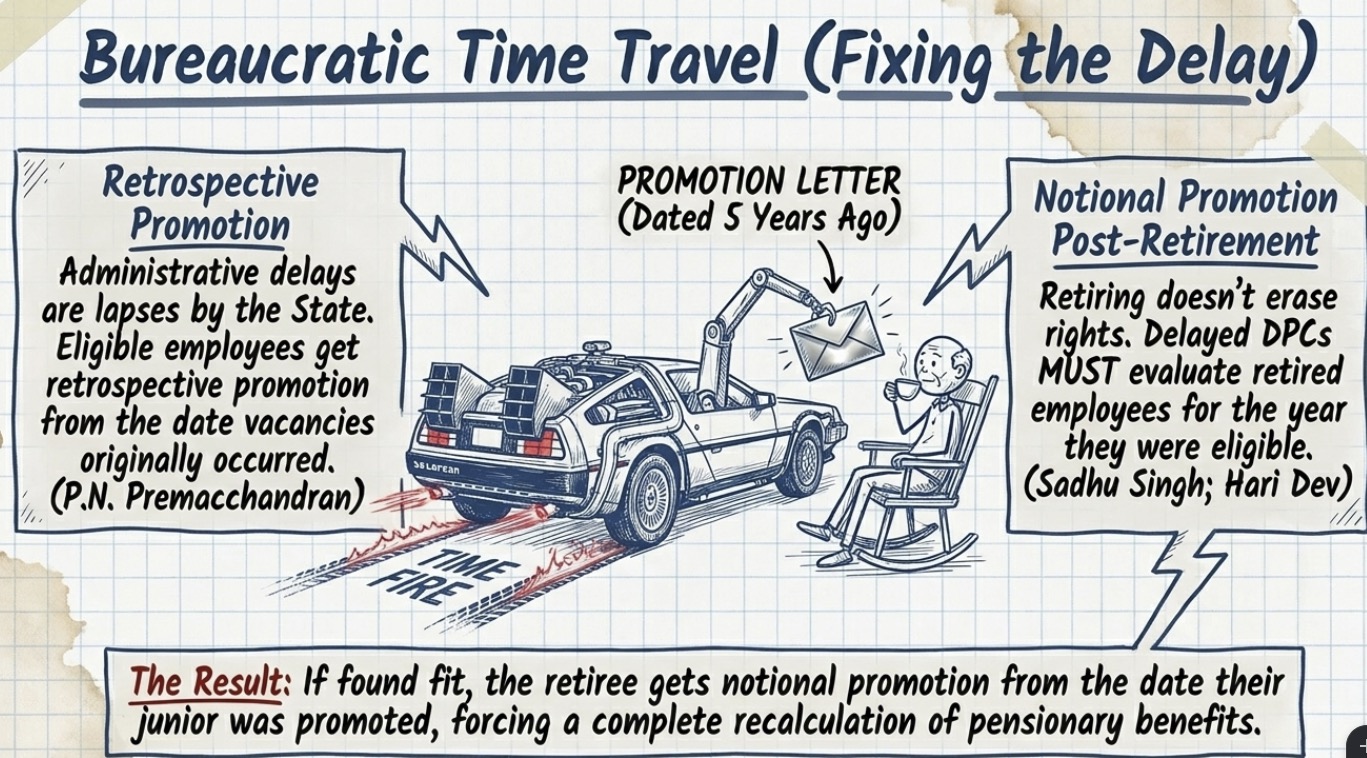
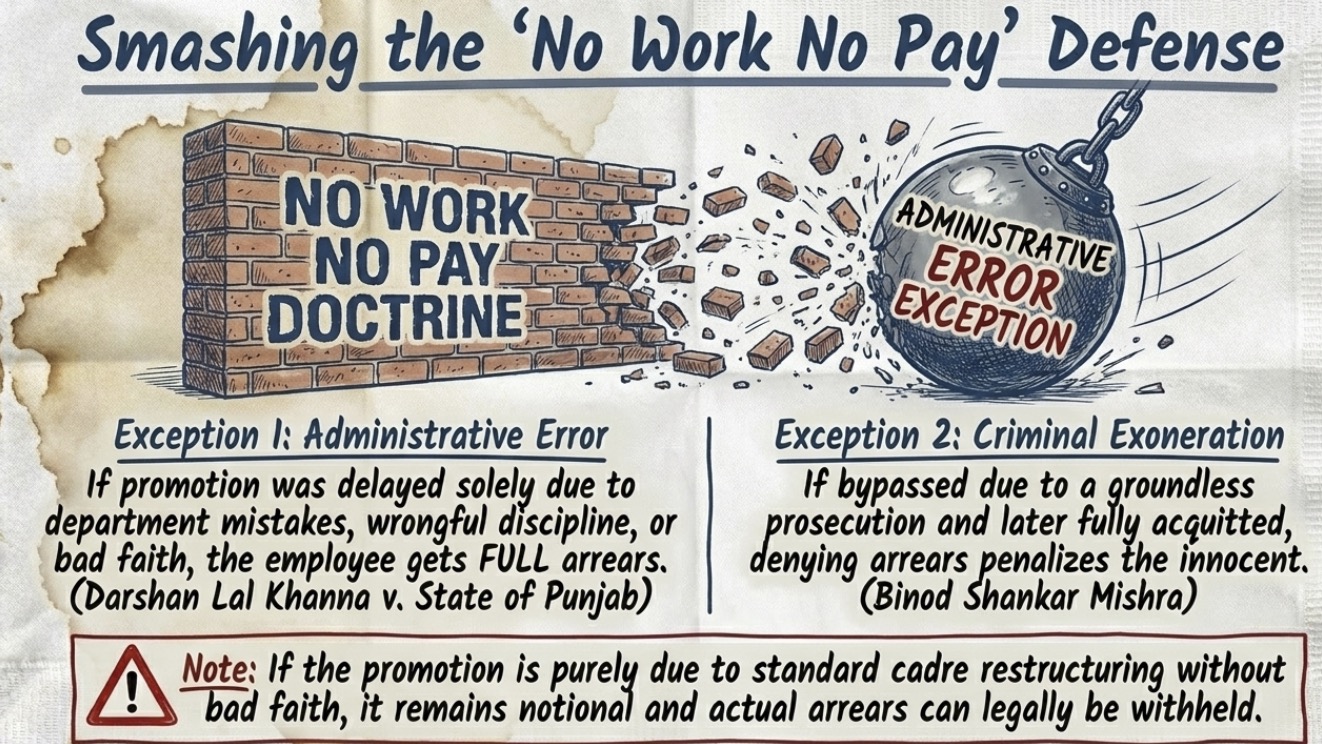
When retrospective promotion is granted, departments often refuse to pay arrears of salary by citing the “No Work No Pay” rule, arguing that the employee did not perform the duties of the higher post during that period35. However, service jurisprudence recognizes several key exceptions to this principle35:
- The Administrative Error Exception: If the promotion was delayed or withheld solely due to administrative error, wrongful disciplinary action, or a unilateral mistake by the department, the “No Work No Pay” rule does not apply35. The employee is entitled to full arrears of salary because the failure to work in the higher post was caused entirely by the employer’s actions35. This exception was affirmed in Darshan Lal Khanna v. State of Punjab and Mahavir Pandey v. State of Bihar35.
- Exoneration and Criminal Acquittal: When an employee is bypassed due to a pending criminal prosecution or disciplinary inquiry but is subsequently acquitted or exonerated, they are entitled to retrospective promotion with full arrears of salary from the date their junior was promoted34. This was confirmed by the Jharkhand High Court in Binod Shankar Mishra v. State of Jharkhand (2018), which held that denying arrears after a complete acquittal would penalize the employee for a groundless prosecution35.
- Purely Notional Promotions: In contrast, if a retrospective promotion is granted due to a standard restructuring or where no administrative error or bad faith is present, the promotion is treated as notional for seniority and pension purposes, and actual pay arrears may be withheld for the period before the employee assumed active charge33.
The Sealed Cover Procedure: Suspension and Pending Inquiries
The “sealed cover procedure” is an administrative mechanism designed to handle promotions when an eligible employee is facing disciplinary or criminal proceedings36. The procedural rules governing this mechanism were established by the Supreme Court in the landmark case of Union of India v. K.V. Jankiraman (1991) AIR 2010, SCC 10936.
The Triggers for the Sealed Cover Procedure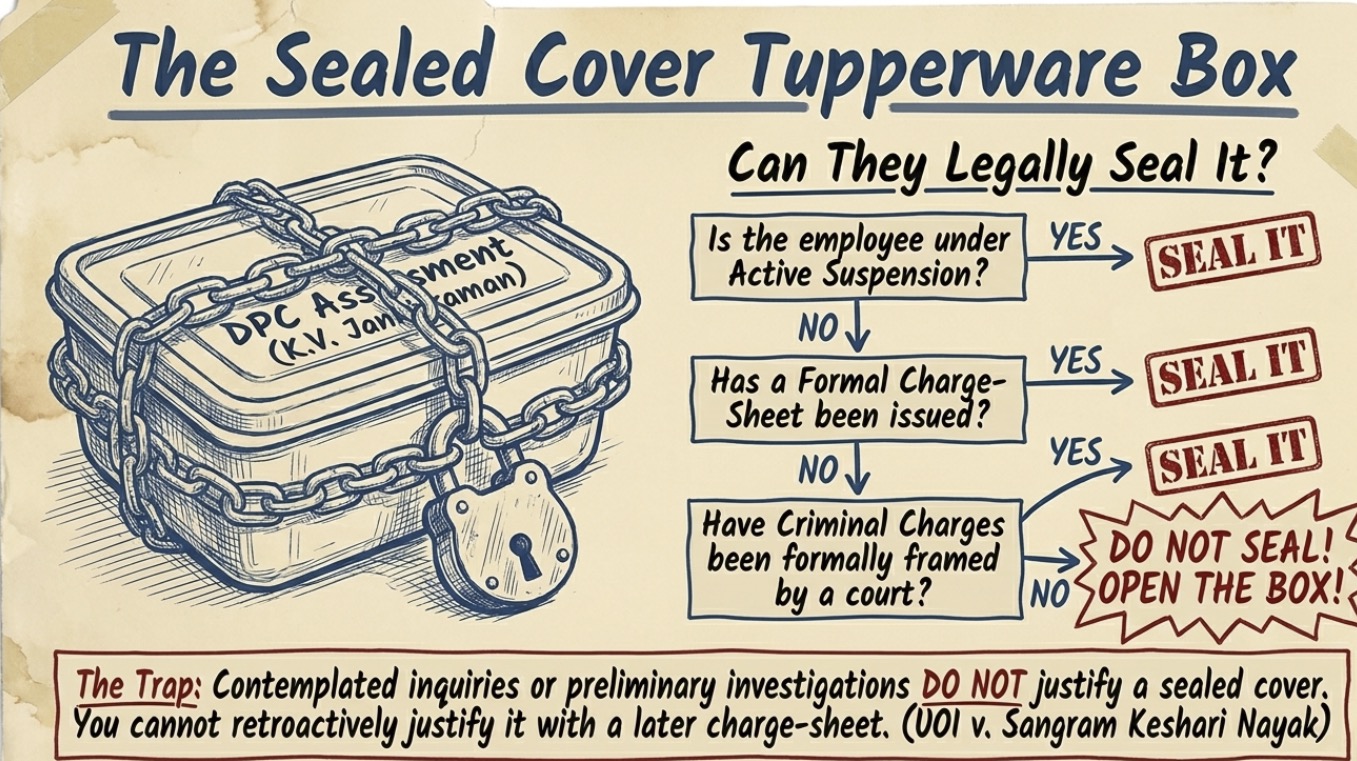
The Supreme Court has clarified that the sealed cover procedure cannot be invoked arbitrarily or simply because an inquiry is contemplated or a preliminary investigation is underway37. The procedure is strictly limited to cases where one of the following three conditions is present at the time the DPC meets34:
- Active Suspension: The government servant is placed under suspension37.
- Formal Charge-Sheet Issued: A charge-sheet has been formally issued, and departmental disciplinary proceedings are pending37.
- Criminal Charges Framed: A prosecution for a criminal charge is pending, and charges have been formally framed by the trial court37.
If none of these three conditions are met on the date of the DPC meeting, the committee must disclose its assessment and cannot place its findings in a sealed cover37.
This rule was reinforced in Union of India v. Sangram Keshari Nayak, where the Supreme Court held that the department cannot use a subsequent charge-sheet to retroactively justify placing an employee’s promotion in a sealed cover if no formal proceedings were active when the DPC originally met38.
Resolution and the Impact of Penalties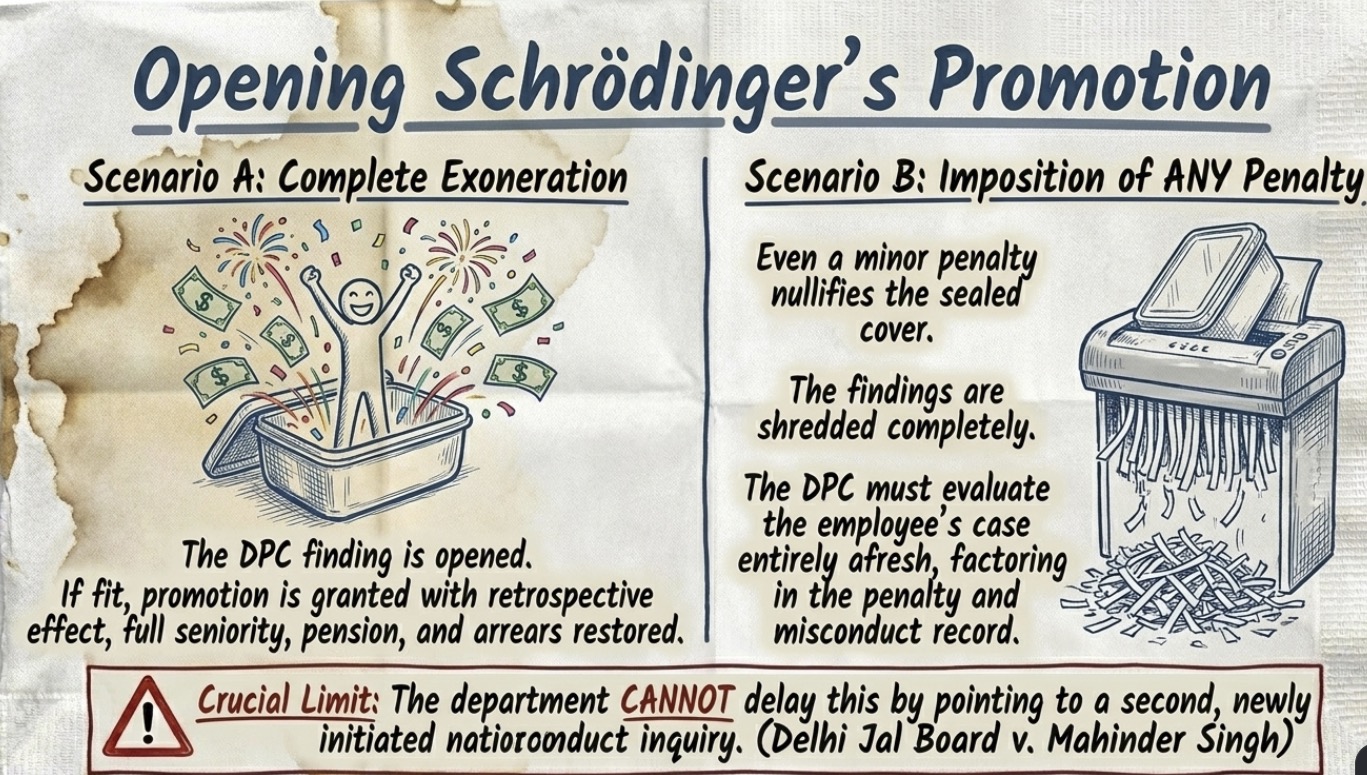
Once the pending proceedings are resolved, the sealed cover must be handled according to the outcome of the case34:
- Complete Exoneration: If the employee is completely exonerated or acquitted of all criminal charges, the sealed cover is opened34. If the DPC had found them fit, they must be promoted with retrospective effect from the date their junior was promoted, with their seniority, pensionary benefits, and arrears of pay fully restored34.
- Imposition of a Penalty: If the proceedings result in the imposition of a penalty (including minor penalties) or a criminal conviction, the findings in the sealed cover are nullified and cannot be acted upon34. The DPC must then evaluate the employee’s case for promotion afresh, taking into account the penalty and the underlying record of misconduct34.
- Subsequent Inquiries: In Delhi Jal Board v. Mahinder Singh (2000), the Supreme Court clarified that if the first disciplinary inquiry concludes in favor of the employee, the benefits of the sealed cover must be granted immediately, and the department cannot delay the promotion by pointing to a second, subsequently initiated inquiry37.
Seniority Fixation: Accelerated Promotion and the Consequential Seniority Dispute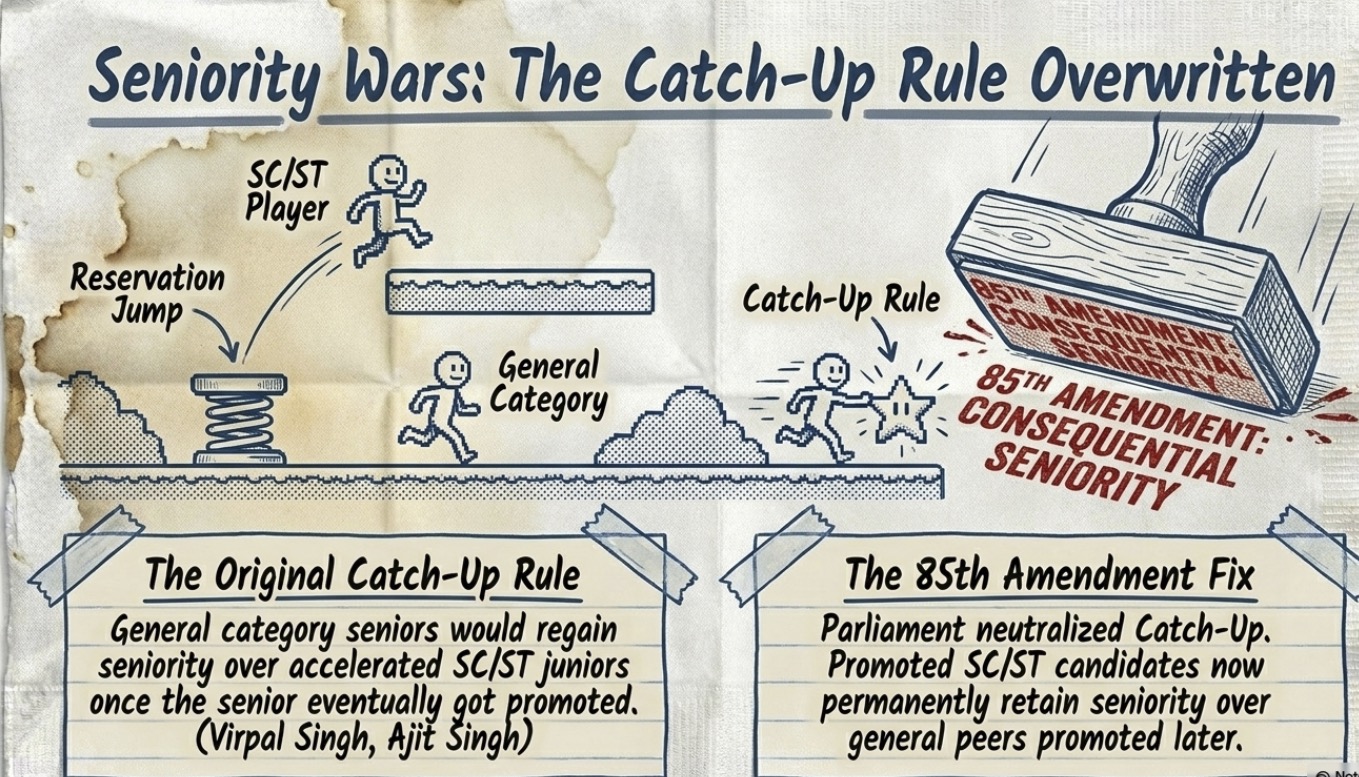
The relationship between seniority and promotion is a complex area of service law, particularly regarding reservations in promotions for Scheduled Castes (SCs) and Scheduled Tribes (STs)9. This landscape has been shaped by the competing legal principles of the “Catch-Up Rule” and “Consequential Seniority”9.
The Evolution of the Catch-Up Rule and Consequential Seniority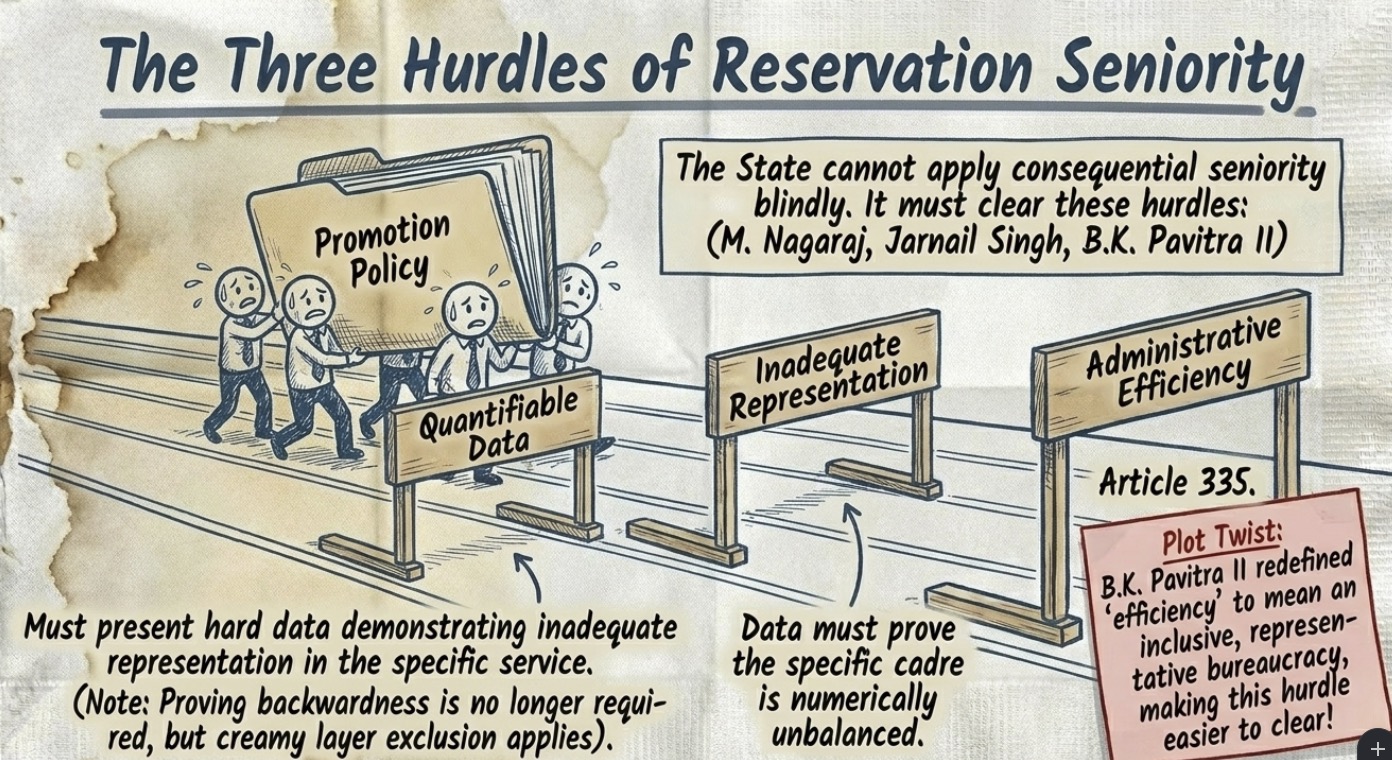
The Catch-Up Rule was developed by the Supreme Court in Union of India v. Virpal Singh Chauhan (1995) and Ajit Singh v. State of Punjab (1996) to address an anomaly in roster-point promotions9.
Under these rulings, if a reserved category candidate received an accelerated promotion ahead of a senior general category peer, the senior general category employee would “catch up” and regain their seniority over the reserved candidate upon their own subsequent promotion to the higher grade9.
To protect the interests of reserved category employees, Parliament enacted the 85th Constitutional Amendment Act, which amended Article 16(4A) to introduce the principle of “Consequential Seniority”9. This amendment allowed promoted SC/ST candidates to permanently retain their seniority over general category peers who were promoted later, effectively neutralizing the Catch-Up Rule9.
The Judicial Standards: Nagaraj, Jarnail Singh, and B.K. Pavitra II
The constitutional validity of the 85th Amendment was challenged in M. Nagaraj v. Union of India (2006) 8 SCC 2129. The Constitution Bench upheld the amendment but established three strict conditions that the state must satisfy before implementing reservations in promotions with consequential seniority9:
- Quantifiable Data on Backwardness: Demonstrate the backwardness of the class9.
- Inadequacy of Representation: Show that the class is inadequately represented in the specific service9.
- Maintenance of Administrative Efficiency: Ensure that the reservations do not compromise overall administrative efficiency under Article 3359.
In Jarnail Singh v. Lachhmi Narain Gupta (2018), the Supreme Court modified these requirements by removing the need to prove backwardness for SC/STs, but introduced the “creamy layer exclusion” principle to reservations in promotions9.
The practical application of these rules was further refined in B.K. Pavitra v. Union of India (II) (2019)11. The Supreme Court upheld Karnataka’s consequential seniority law after the state presented detailed quantifiable data showing inadequate representation12.
Significantly, the Court introduced a representative definition of “administrative efficiency” under Article 335, holding that a meritorious and efficient bureaucracy is one that represents diverse communities and fulfills the constitutional goal of social inclusion12.
Procedural Roadmap: Filing Petitions before CAT, High Courts, and AFT
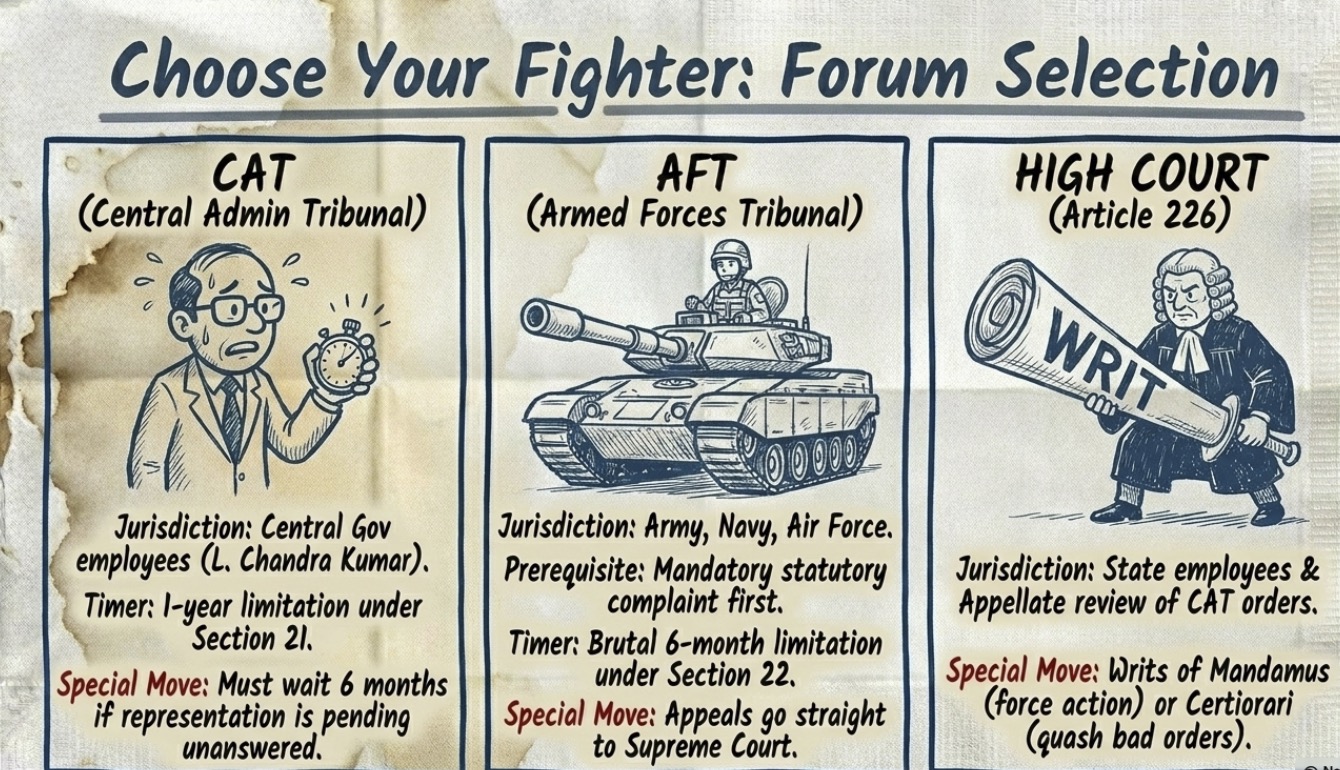
When a government employee decides to challenge an arbitrary promotion denial or a disputed seniority list, choosing the correct legal forum and adhering to procedural timelines is critical to the success of the case.
Filing an Original Application (OA) before the Central Administrative Tribunal (CAT)
For central government employees, the Central Administrative Tribunal (CAT) serves as the court of first instance for all service-related disputes, as established by the Supreme Court in L. Chandra Kumar v. Union of India (1997) 3 SCC 26142.
- Filing Requirements: An Original Application (OA) is filed under Section 19 of the Administrative Tribunals Act, 198540. The application must include a detailed chronological account of the dispute, copies of the relevant recruitment rules, the impugned promotion or seniority order, and any representations submitted to the department48.
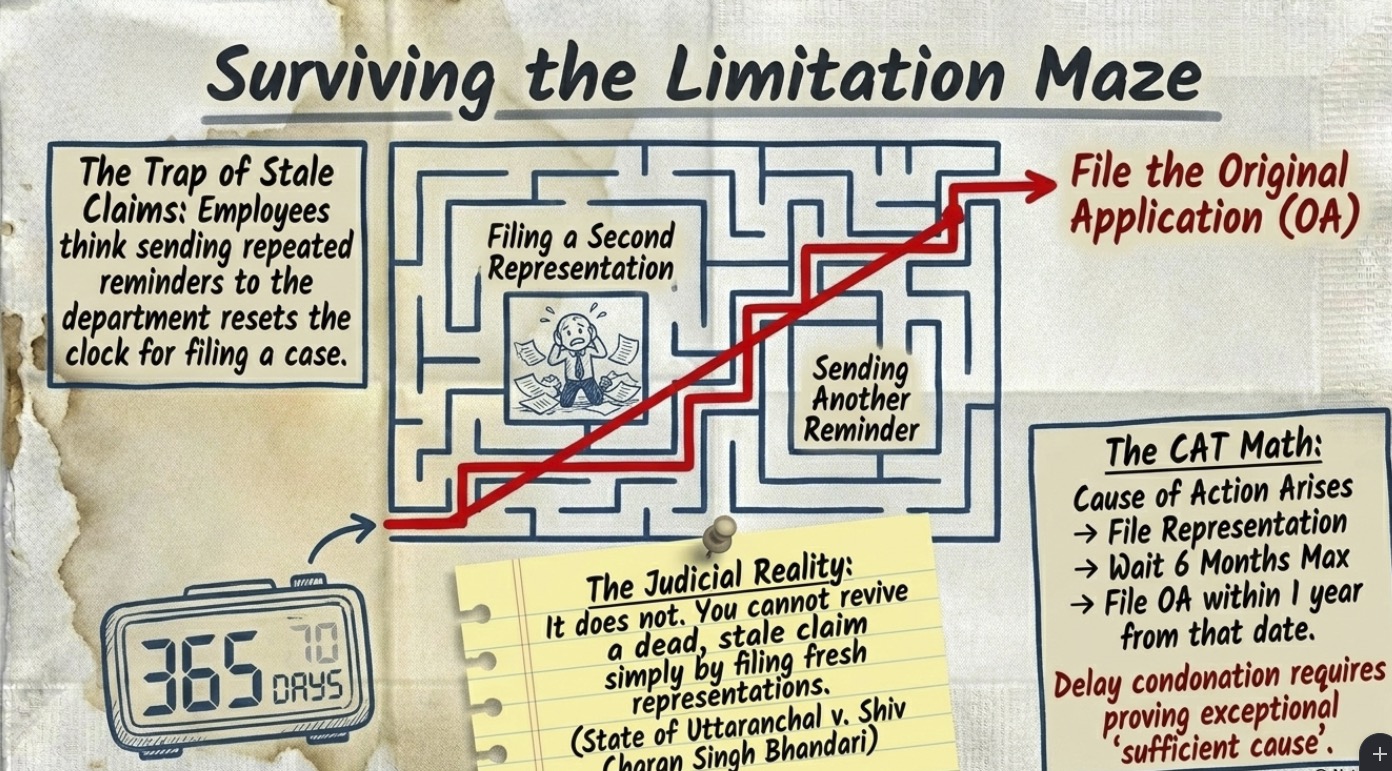
- Limitation Period: Under Section 21 of the Act, an application must be filed within one year from the date the cause of action arose (typically when the final rejection of a representation is communicated)48. If no decision is made on a pending representation, the employee must wait six months and then file the application within one year after that six-month period expires51.
- Condonation of Delay: While Section 21(3) allows tribunals to condone delays, the applicant must demonstrate “sufficient cause”48. The Supreme Court in State of Uttaranchal v. Shiv Charan Singh Bhandari clarified that stale claims cannot be revived simply by filing new representations, meaning prompt action is essential to protect one’s rights16.
Writ Petitions before the High Courts under Article 226
While administrative tribunals are the primary forum for service disputes, High Courts retain broad powers of judicial review6.
- Writ of Mandamus: An employee can file a writ petition under Article 226 of the Constitution seeking a writ of mandamus to compel the state to perform its public duty, such as convening a DPC or evaluating an eligible candidate fairly1.
- Writ of Certiorari: This writ is used to challenge and quash an illegal administrative order, such as a discriminatory promotion list, an arbitrary seniority fixation, or the wrongful rejection of an APAR representation6.
- Appellate Jurisdiction: Under L. Chandra Kumar, any order passed by an administrative tribunal must first be challenged before a Division Bench of the respective High Court via a writ petition under Article 226 or 227 before the matter can be appealed to the Supreme Court42.
Promotion Disputes in the Armed Forces: Approving the AFT
For personnel in the Army, Navy, and Air Force, promotion and seniority disputes are governed by a distinct statutory framework54.
- The Statutory Complaint Pre-condition: An officer or soldier cannot directly approach the Armed Forces Tribunal (AFT)57. They must first file a formal statutory complaint under Section 27 of the Air Force Act, Section 27 of the Navy Act, or Section 165 of the Army Act57. Only after the statutory complaint is rejected, or if the authority fails to decide within a reasonable period, can an OA be filed before the AFT57.
- Limitation under Section 22: Under Section 22 of the AFT Act, an application challenging a final order must be filed within six months of its issuance61. While the tribunal can condone delays under Section 22(2), a strict approach is often maintained to avoid disrupting military hierarchy and settled seniority63.
- Appeals from AFT Decisions: A unique feature of this framework is that AFT decisions cannot be challenged before a High Court under Article 22655. The sole appellate remedy lies directly before the Supreme Court of India under Section 31 of the AFT Act, 2007, provided the case involves a point of law of general public importance55.
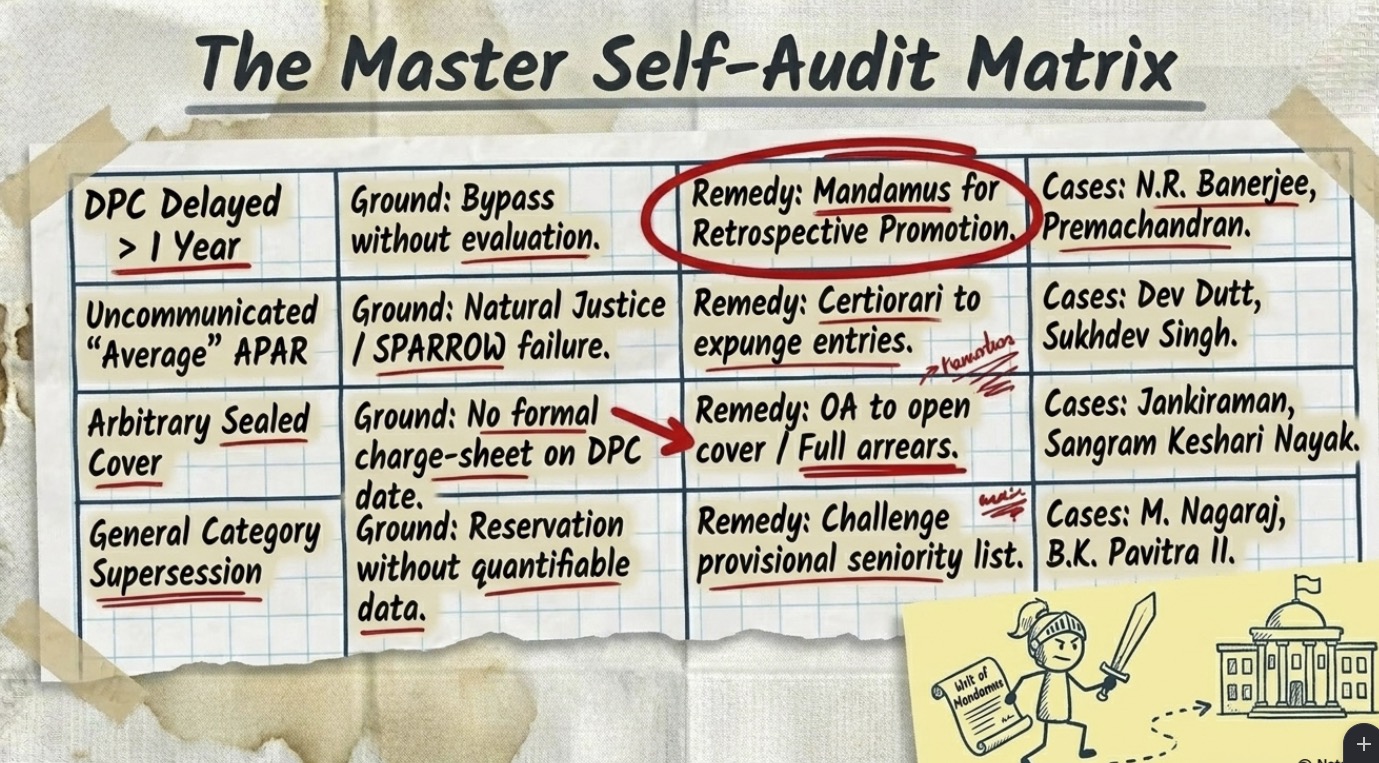
Promotion and Seniority Rules: Comprehensive Self-Audit Matrix
To assist government employees in evaluating their legal options, the following matrix summarizes the key components of promotion and seniority rules, outlining the common grounds for challenge and the corresponding remedies:
| Dispute Category | Common Grounds for Challenge | Recommended Legal Remedy | Key Precedents to Cite |
| DPC Failures | – DPC not held annually8
– Eligible candidates bypassed without evaluation1 – Rules changed mid-process to favor juniors1. |
– OA before CAT/SAT44
– Writ of Mandamus under Article 2261 – Claim for retrospective/notional promotion31. |
– UOI v. N.R. Banerjee
[cite: 8] – P.N. Premachandran v. State of Kerala [cite: 32] – Sadhu Singh v. D/O Post31. |
| APAR / ACR Disputes | – Uncommunicated below-benchmark gradings16
– Representation decided by the same officer5 – Violation of SPARROW timelines20. |
– Representation for upgradation17
– Writ of Certiorari to expunge adverse entries6 – Petition to compel reasoned decision-making19. |
– Dev Dutt v. UOI
[cite: 17, 18] – Sukhdev Singh v. UOI [cite: 17, 18] – Pankaj Prakash v. UOI15. |
| Sealed Cover Issues | – Sealed cover applied without formal charge-sheet38
– Sealed cover kept active despite exoneration37 – Promotion withheld during preliminary inquiry38. |
– OA before CAT/SAT to open sealed cover39
– Petition for retrospective promotion with full arrears34. |
– UOI v. K.V. Jankiraman
[cite: 36, 39] – Delhi Jal Board v. Mahinder Singh [cite: 37, 39] – UOI v. Sangram Keshari Nayak38. |
| Seniority Fixation | – Juniors promoted over seniors arbitrarily7
– Improper application of the Catch-Up Rule9 – Non-compliance with reservation data mandates9. |
– Challenge to provisional/final seniority lists11
– Claim for consequential seniority restoration12 – Writ petition against out-of-turn promotions11. |
– M. Nagaraj v. UOI
[cite: 9, 11] – Jarnail Singh v. Lachhmi Narain Gupta [cite: 9, 11] – B.K. Pavitra II11. |
| Military Personnel | – SSB/Selection Board manipulation of marks60
– Denial of legal branch promotions59 – Improper weightage given to administrative censures64. |
– Statutory Complaint under military acts57
– Original Application before the AFT49 – Statutory Appeal to the Supreme Court55. |
– UOI v. Ram Avtar
[cite: 65, 66] – UOI v. Sgt. Girish Kumar [cite: 65, 66] – UOI v. Col. Ran Singh Dudee58. |
Conclusions
Challenging a promotion denial in government service requires an understanding of both the constitutional protections and the specific administrative rules that govern public employment. The right to be considered for promotion remains a fundamental interest under Articles 14 and 16(1) of the Constitution, ensuring that the state must act with transparency and fairness1. When administrative actions fall short—whether through uncommunicated APARs, delayed selection committees, or arbitrary seniority lists—the legal framework provides clear paths for review8. By enforcing strict digital timelines under the SPARROW system, protecting the integrity of the sealed cover procedure, and providing remedies for administrative delays, Indian service jurisprudence maintains a balance between administrative efficiency and the constitutional rights of employees20.
Works cited
- Right to be Considered for Promotion as a Fundamental Right | Current Affairs – Shankar IAS Parliament, https://www.shankariasparliament.com/current-affairs/right-to-be-considered-for-promotion-as-a-fundamental-right
- right+to+promotion | Indian Case Law – CaseMine, https://www.casemine.com/search/in/right%2Bto%2Bpromotion
- Vijay Kumar Lanjewar vs State Of Chhattisgarh on 23 June, 2025 – Indian Kanoon, https://indiankanoon.org/docfragment/181210937/?big=3&formInput=right%20to%20be%20considered%20for%20promotion
- J U D G M E N T – Supreme Court of India, https://api.sci.gov.in/supremecourt/2016/33063/33063_2016_9_1501_17253_Judgement_03-Oct-2019.pdf
- 9th January, 2026. Pronounced on – High Court of Delhi, https://delhihighcourt.nic.in/app/showFileJudgment/SVN10032026CW79132018_194036.pdf
- Writ Petition Calcutta High Court 2026 | Complete Guide | Adv. Siddharth Gupta, https://siddharthgupta.in/blog/writ-petition-calcutta-high-court-guide
- Inder Raj Bhatia vs State Of Punjab And Ors. on 1 April, 2026 – Indian Kanoon, https://indiankanoon.org/doc/77874412/
- Right To Be Considered For Promotion Is A Fundamental Right: P&H HC – LAWyersclubindia, https://www.lawyersclubindia.com/articles/right-to-be-considered-for-promotion-is-a-fundamental-right-p-h-hc-18285.asp
- Reservation in Promotion: Court in Review, https://www.scobserver.in/journal/reservation-in-promotion-court-in-review/
- M. Nagaraj and Ors. Vs. Union of India (UOI) and Ors. – Manupatra Academy, https://www.manupatracademy.com/LegalPost/MANU_SC_4560_2006
- M.Ram Singh vs State Of Telangana on 7 October, 2025 – Indian Kanoon, https://indiankanoon.org/doc/173996463/
- Plain English Summary of the Judgment in B.K. Pavitra v Union of India-II, https://www.scobserver.in/reports/consequential-seniority-plain-english-summary-of-the-judgment-in-b-k-pavitra-v-union-of-india-ii/
- AFR Reserved Case :- SERVICE SINGLE No. – 5472 of 2015 Petitioner :- Manoj Kumar Respondent :- State Of U.P. Through Commissione – eLegalix, https://elegalix.allahabadhighcourt.in/elegalix/WebDownloadOriginalHCJudgmentDocument.do?translatedJudgmentID=11416
- STATE PUBLIC SERVICES TRIBUNAL, INDIRA BHAWAN, LUCKNOW. PRESENT, https://spst.hqup.in/Upload_File/Judgment/CP02902016-02042019.pdf
- Mandatory Communication of All Entries in Annual Performance Appraisal Reports: Supreme Court Sets New Precedent – CaseMine, https://www.casemine.com/commentary/in/mandatory-communication-of-all-entries-in-annual-performance-appraisal-reports%3A-supreme-court-sets-new-precedent/view
- Union Of India And Others v. Chaman Rana . | Supreme Court Of India | Judgment | Law, https://www.casemine.com/judgement/in/5b0535729eff433df93b2d14
- Sukhdev Singh vs Union Of India & Ors on 23 April, 2013 – Indian Kanoon, https://indiankanoon.org/doc/9665019/
- Leading judgment of supreme court on annual confidential report of government servant, https://www.lawweb.in/2018/04/supreme-court-every-entry-in-acr-poor.html
- SUCHISMITA MISRA v. REGISTRAR .ADMINISTRATION. ORISSA HIGH COURT CUTTA, https://www.casemine.com/judgement/in/5b1a379e4a932631a5a0c575
- Directorate General of Human Resource Development, HRM-I Central Board of Indirect Taxes & Customs, Bhai Vir Singh Sahitya S, https://dghrdcbic.gov.in/Admin/Pdf//69f0616ece46e6.73766756.pdf
- Rai Sahib Bishnoi vs State Of Raj. And Anr. … on 7 May, 2025, https://indiankanoon.org/doc/71853661/
- Rai Sahib Bishnoi vs State And Ors (2025:Rj-Jd:22020) on 7 May, 2025 – Indian Kanoon, https://indiankanoon.org/doc/153666070/
- Shri Gunjan Prasad vs Govt. Of India on 28 April, 2015 – Indian Kanoon, https://indiankanoon.org/doc/182670853/
- VERDICTUM.IN, https://www.verdictum.in/pdf_upload/malaya-ranjan-dash-v-registrar-generalwatermark-1711542.pdf
- Government of India Ministry of Finance, Department of Revenue Central Board of Indirect Taxes & Customs Directorate General, https://dghrdcbic.gov.in/Admin/Pdf//69f061f330f4c3.35701144.pdf
- Timely submission and completion of APARS and NRCS – ITGOA-WB Unit, https://itgoawbunit.org/pdf/2372-apar-m_11zon.pdf
- Timeline for recording of APAR for the reporting year 2025-26 through SPARROW: Railway Board Order | StaffNews, https://www.staffnews.in/2026/04/timeline-for-recording-of-apar-year-2025-26-through-sparrow.html
- Timeline for recording of APAR for the reporting year 2025-26 -Self-appraisal upto 30th June: Railway Board Order | StaffNews, https://www.staffnews.in/2026/06/timeline-for-recording-of-apar-year-2025-26-upto-30th-june.html
- Timeline for recording of APAR for the reporting year 2025-26 for Railway employees: Railway Board order dated 02.04.2026 – Govt Staff, https://www.govtstaff.com/2026/04/timeline-for-recording-of-apar-for-the-reporting-year-2025-26-for-railway-employees-railway-board-order-dated-02-04-2026.html
- Prithi Chand vs M/O Finance on 6 May, 2026 – Indian Kanoon, https://indiankanoon.org/doc/27911014/
- Sadhu Singh vs D/O Post on 19 February, 2026 – Indian Kanoon, https://indiankanoon.org/doc/29415513/
- citedby: 622779 – Indian Kanoon, https://indiankanoon.org/search/?formInput=citedby%3A%20622779&pagenum=1
- Promotion of Government Officers with Retrospective Effect – Law Senate, https://www.lawsenate.com/news/promotion-of-government-officers-with-retrospective-effect.html
- ministry of personnel, public grievances and pensions (department of personnel and training), https://sansad.in/getFile/loksabhaquestions/annex/16/AU3529.pdf?source=pqals
- Arrears of Pay on Retrospective Promotion: Employee Rights? – Supreme Today AI, https://supremetoday.ai/search/retrospective-promotion-arrears
- UOI v K.V. Jankiraman: Sealed Cover Promotion Rules – Supreme Today AI, https://supremetoday.ai/issue/uoi-vs-kv-jankiraman-case-summary
- Sealed cover procedure in promotions – iPleaders, https://blog.ipleaders.in/sealed-cover-procedure-promotions/
- Sealed Cover Promotion: Key Rules in India – Supreme Today AI, https://supremetoday.ai/issue/sealed-cover-promotion-india
- Promotion+in+sealed+DPC | Indian Case Law – CaseMine, https://www.casemine.com/search/in/Promotion%2Bin%2Bsealed%2BDPC
- 44575.pdf – Supreme Court of India, https://api.sci.gov.in/jonew/judis/44575.pdf
- consequential+seniority+promotion | Indian Case Law – CaseMine, https://www.casemine.com/search/in/consequential%2Bseniority%2Bpromotion
- Case: L. Chandra Kumar v. Union of India, (1997) 3 SCC 261 – Dhyeya Law, https://www.dhyeyalaw.in/l-chandra-kumar-v-union-of-india-1997-3-scc-261
- L. Chandra Kumar vs. Union of India (UOI) and Ors., https://www.manupatracademy.com/LegalPost/MANU_SC_0261_1997
- AN ANNOTATION ON L. CHANDRA KUMAR CASE ADJUDICATING CONSTITUTIONALITY OF ARTICLE 323A&B – IJNRD, https://www.ijnrd.org/papers/IJNRD2401187.pdf
- REPORTABLE IN THE SUPREME COURT OF INDIA CIVIL APPELLATE JURISDICTION CIVIL APPEAL NO(S). OF 2025 (ARISING OUT OF SLP (CIVIL, https://api.sci.gov.in/supremecourt/2023/50191/50191_2023_4_1501_65055_Judgement_16-Oct-2025.pdf
- L. Chandra Kumar vs Union Of India And Others on 18 March, 1997 – Indian Kanoon, https://indiankanoon.org/doc/1152518/
- AMIT BANSAL v. REGIONAL PROVIDENT FUND OFFICE | Central Administrative Tribunal | Judgment | Law | CaseMine, https://www.casemine.com/judgement/in/5de36a274a932645e0725231
- What is the limitation period for CAT applications – Rajendra Civil Law Firm, https://www.civiladvocate.in/legal-services-chennai/what-is-the-limitation-period-for-cat-applications/
- Armed Forces Tribunal (AFT) Delhi: Complete Legal Guide for Defence Personnel, https://advocatemalinijain.com/armed-forces-tribunal-aft-delhi-complete-legal-guide-for-defence-personnel/
- Section 21 of Central Administrative Limitation Impugned – Supreme Today AI, https://supremetoday.ai/search/section-21-of-central-administrative-limitation-impugned
- Vinod Kumar Singh vs Deptt Of Posts on 17 October, 2025 – Indian Kanoon, https://indiankanoon.org/doc/29055628/
- SECTION+21(1)+of+Administrative+Tribunal | Indian Case Law – CaseMine, https://www.casemine.com/search/in/SECTION%2B21%281%29%2Bof%2BAdministrative%2BTribunal
- Pg (Deb Kumar Mondal vs The State Of West Bengal & on 22 July, 2019 – Indian Kanoon, https://indiankanoon.org/doc/194625434/
- Armed Forces Tribunal (AFT) – Composition & Jurisdiction | UPSC – Testbook, https://testbook.com/ias-preparation/armed-forces-tribunal
- Military Law FAQs | Armed Forces Legal Questions Answered – Ajit Kakkar, https://ajitkakkar.com/faqs/
- Armed Forces Tribunal (AFT) | Current Affairs – Shankar IAS Parliament, https://www.shankariasparliament.com/current-affairs/armed-forces-tribunal-aft
- Armed Forces Tribunal — Rights of Defence Personnel in Service Disputes – Adv. Rahul Gupta, https://advrahulgupta.com/blog-post.php?slug=armed-forces-tribunal-service-disputes-guide
- Union of India & Others Vs. Col Ran Singh Dudee Case Summary You Can Listen To | Caseon, https://www.caseon.in/case/union-of-india-others-vs-col-ran-singh-dudee
- Union Of India vs Air Commodore Nk Sharma on 14 December, 2023 – Indian Kanoon, https://indiankanoon.org/doc/147304448/
- J U D G M E N T – Supreme Court of India, https://api.sci.gov.in/supremecourt/2018/19101/19101_2018_Judgement_01-Aug-2018.pdf
- Section 22 in The Armed Forces Tribunal Act, 2007 – Indian Kanoon, https://indiankanoon.org/doc/136958772/
- No. 2894436P Ex Rfn Pappu Singh vs U.O.I. Thru. Secy. Ministry Of Defence … on 17 February, 2025, https://indiankanoon.org/doc/60017393/
- IN THE ARMED FORCES TRIBUNAL, https://aftrbghy.nic.in/judgement/MA%2013%20of%202018.pdf
- 01.07.2025 + W.P.(C) 7381/2024 MAJ GE – High Court of Delhi, https://delhihighcourt.nic.in/app/showFileJudgment/61601072025CW73812024_124508.pdf
- 2026 LiveLaw (SC) 148 Armed Forces Tribunal Act, 2007 – Section 22 – Limitation Act, 1963 – Disability Pension, https://www.livelaw.in/pdf_upload/2026/03/24/2026-livelaw-sc-148-union-of-india-v-sgt-girish-kumar-12-feb-2026-663391.pdf
- Limitation for Entitlement to Disability Pension – Supreme Court Observer, https://www.scobserver.in/supreme-court-observer-law-reports-scolr/union-of-india-v-sgt-girish-kumar-limitation-for-entitlement-to-disability-pension/