Legal Treatise on Seniority Disputes, Gradation Lists, and Judicial Remedies in Indian Public Employment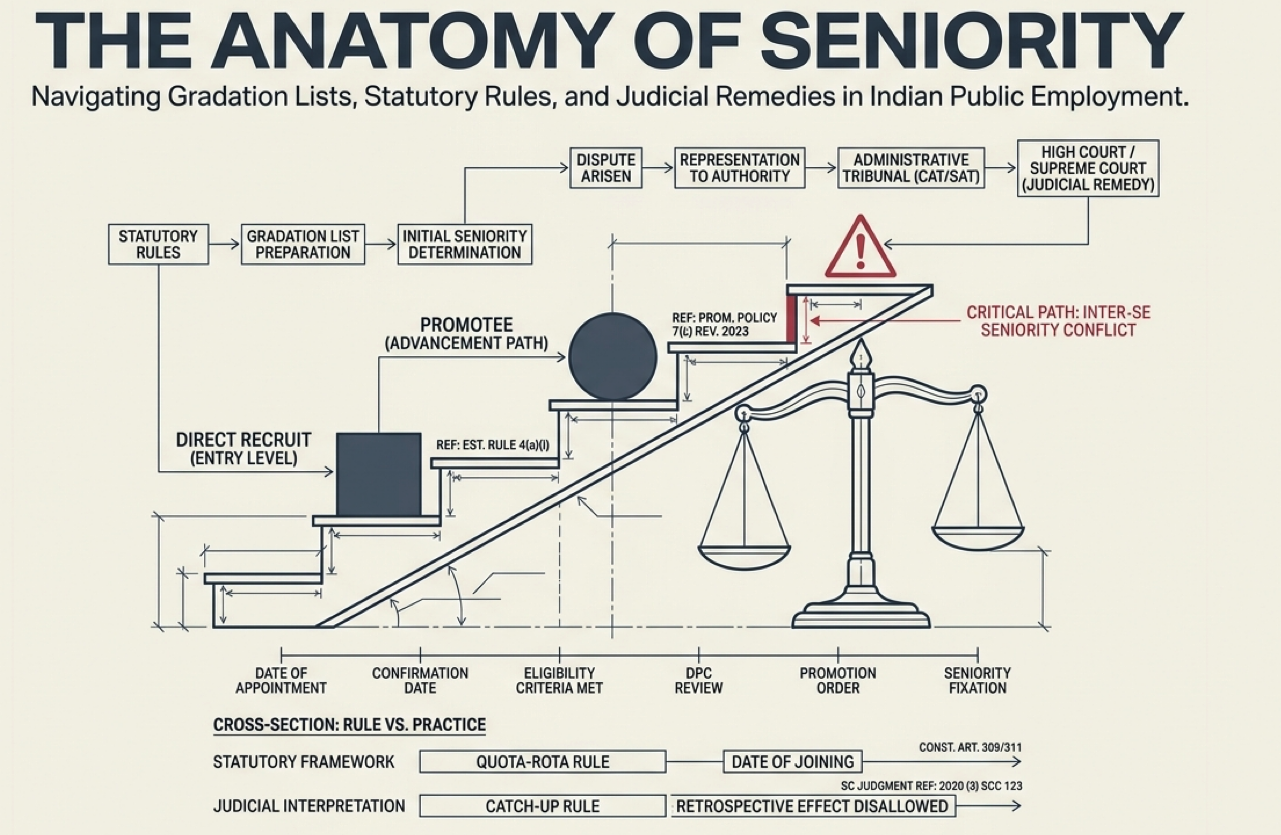
Creditor and contributor of this article:
Patra’s Law Chambers:
About Us:
Patra’s Law Chambers is a law firm with offices in Kolkata & Delhi, offering comprehensive legal services across various domains. Established in 2020 by Advocate Sudip Patra (Advocate, Supreme Court of India & Calcutta High Court) an alumnus of the Prestigious Rajiv Gandhi School of Intellectual Property Law, IIT Kharagpur ,with Post Graduate diploma in Business Law from IIM Calcutta, the firm specializes in Civil, Criminal, Writs, High Court Matters, Trademark, Copyright, Company, Tax, IT, GST & Customs, Banking & DRT, Property disputes, Service law & CAT & High Court related service matters, Military Law, Family law, and Supreme Court matters. You can know more about us in here
Kolkata Office:
NICCO HOUSE, 6th Floor, 2, Hare Street, Kolkata-700001 (Near Calcutta High Court)
Delhi Office:
House no: 4455/5, First Floor, Ward No. XV, Gali Shahid
Bhagat Singh, Main Bazar Road, Paharganj, New Delhi-110055
Website: www.patraslawchambers.com
Email: [email protected]
Phone: +91 890 222 4444/ +91 7003 715 325
The determination of seniority in public service is a vital element of the fundamental rights of equality and equal opportunity in public employment guaranteed under Articles 14 and 16 of the Constitution of India1. Seniority is not a mere administrative ornament; it is the primary engine that drives a public servant’s career progression, dictating eligibility for promotions, selection for officiating or higher-charge postings, and the receipt of financial upgradations3. Because public service in India is characterized as a “status” rather than a simple contractual relationship, the terms and conditions of service—including seniority rules—can be unilaterally modified by the state through statutory rules framed under the proviso to Article 309 of the Constitution7. However, any such administrative action must strictly align with statutory frameworks and established judicial precedents to prevent arbitrariness and ensure equal opportunity2.
When the state publishes a gradation or seniority list that is fraught with clerical errors, misapplications of quota-rota rules, or erroneous adjustments following inter-departmental transfers, the affected public servant must act with absolute promptitude. “Wrong position in gradation list?” is a query that demands immediate administrative and legal mobilization. Administrative delay, combined with the judicial doctrine of laches, can permanently extinguish a public servant’s right to challenge an incorrect seniority list, as courts are highly reluctant to disturb long-settled positions that have allowed third-party rights to crystallize8. “Don’t let a clerical error cost you your promotion”—public servants must realize that a failure to challenge an incorrect list in a timely manner can result in permanent supersession by juniors11.
I. The Anatomy of Seniority and Gradation Lists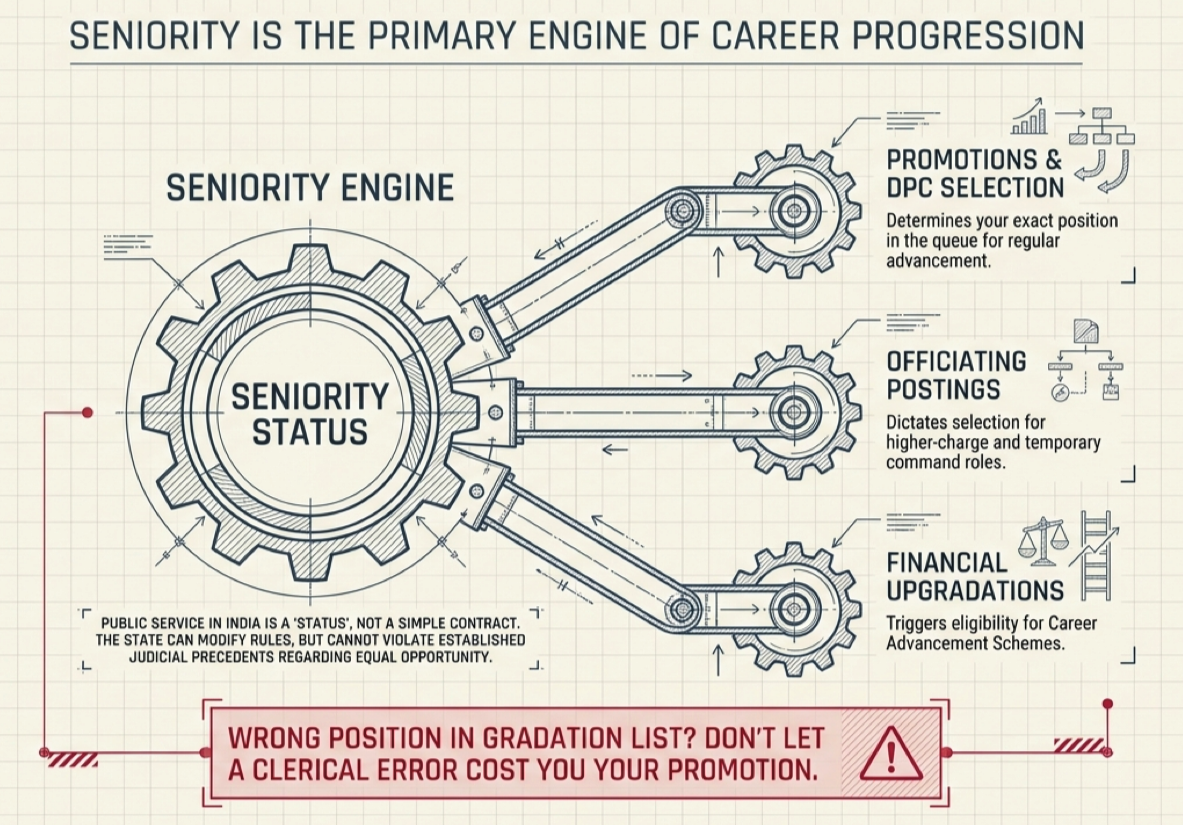
A gradation list is the formal administrative instrument that records the relative ranking of employees within a specific post, cadre, or grade4. It is the foundational document from which Departmental Promotion Committees (DPCs) draw candidates for advancement6. Consequently, any error in this list can have a catastrophic compounding effect on a public servant’s career, leading to supersession by juniors and loss of notional pay and pensionary benefits11.
The Distinction Between Draft and Final Gradation Lists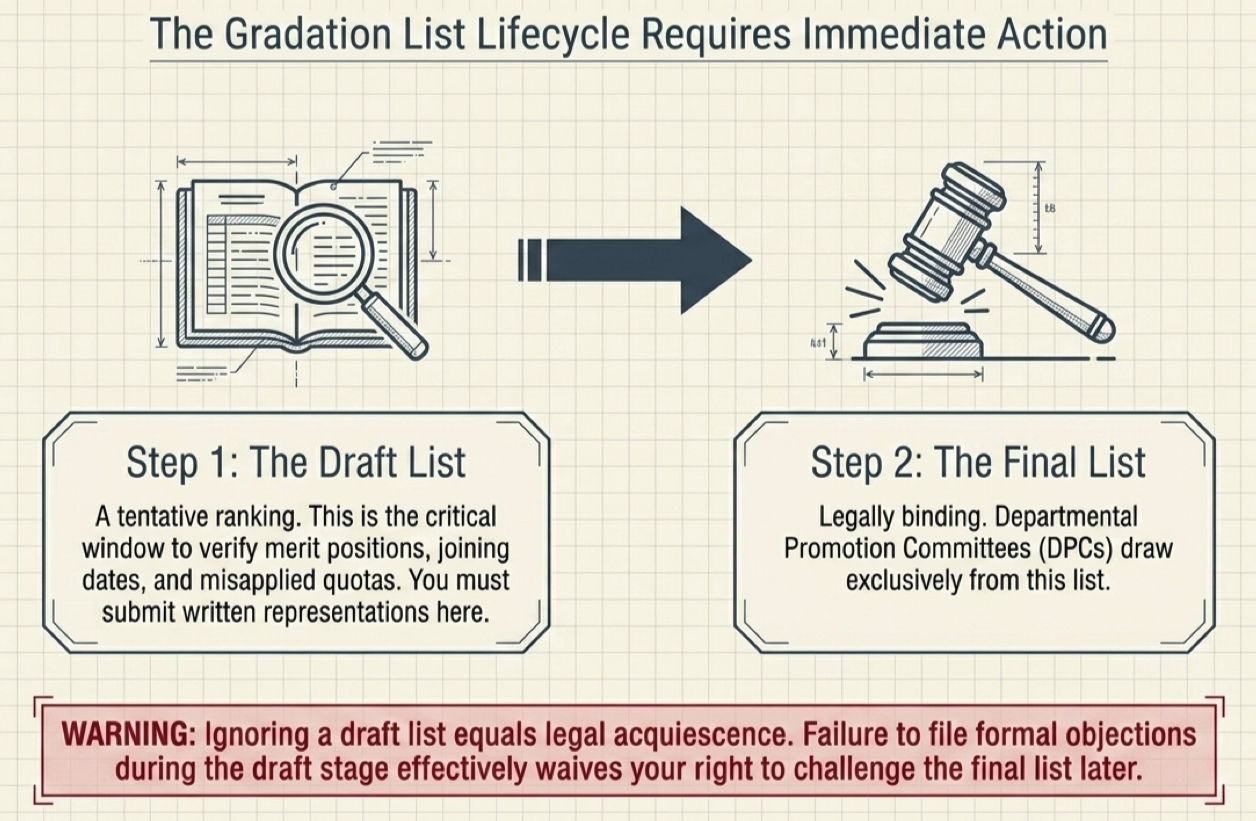
The process of finalising a gradation list typically involves two stages: the publication of a tentative or draft list and the subsequent issuance of the final list. The draft list serves as an invitation for affected employees to submit written representations pointing out errors, such as incorrect dates of joining, flawed calculations of merit, or misapplied quotas13.
An employee cannot afford to ignore a draft list; failure to object to a tentative list may be construed as acquiescence or waiver of rights if the final list is later challenged19. Once the administrative authorities consider the representations, they are legally bound to publish a finalized gradation list in accordance with the governing service rules18.
Clerical Errors and the Immediacy of Filing an Original Application
Clerical and administrative errors—such as typographical mistakes in dates of birth or joining, or the omission of names—frequently occur during the compilation of draft lists. While minor clerical errors can often be rectified through administrative representations, structural errors involving the incorrect placement of batches or direct recruits vis-à-vis promotees usually meet with administrative resistance6.
In such scenarios, relying solely on endless administrative representations is a dangerous strategy. Under the statutory framework of the Administrative Tribunals Act, 1985, an aggrieved employee must approach the Central Administrative Tribunal (CAT) or the relevant State Administrative Tribunal (SAT) immediately upon the rejection of their representation, or upon the expiry of six months from the date of filing an undecided representation6. Waiting indefinitely for an administrative response does not toll the statutory limitation period, and a belated challenge to a finalized list will be summarily rejected on the grounds of limitation11. “File OA before CAT immediately” is the gold standard of legal advice in service disputes6.
II. The West Bengal Services (Determination of Seniority) Rules, 1981
In the state of West Bengal, service conditions and seniority disputes for the vast majority of government employees are governed by the West Bengal Services (Determination of Seniority) Rules, 198114. These rules came into force on March 11, 1981, and apply to all government servants under the rule-making power of the state, excluding members of the All India Services, the West Bengal Higher Judicial Service, the West Bengal Civil Service (Judicial), the West Bengal Civil Service, and the West Bengal Police Service14. “Seniority Rules 1981 — your protection” represents the core statutory shield for West Bengal state employees14.
Rule 4: Determination of Seniority of Direct Recruits
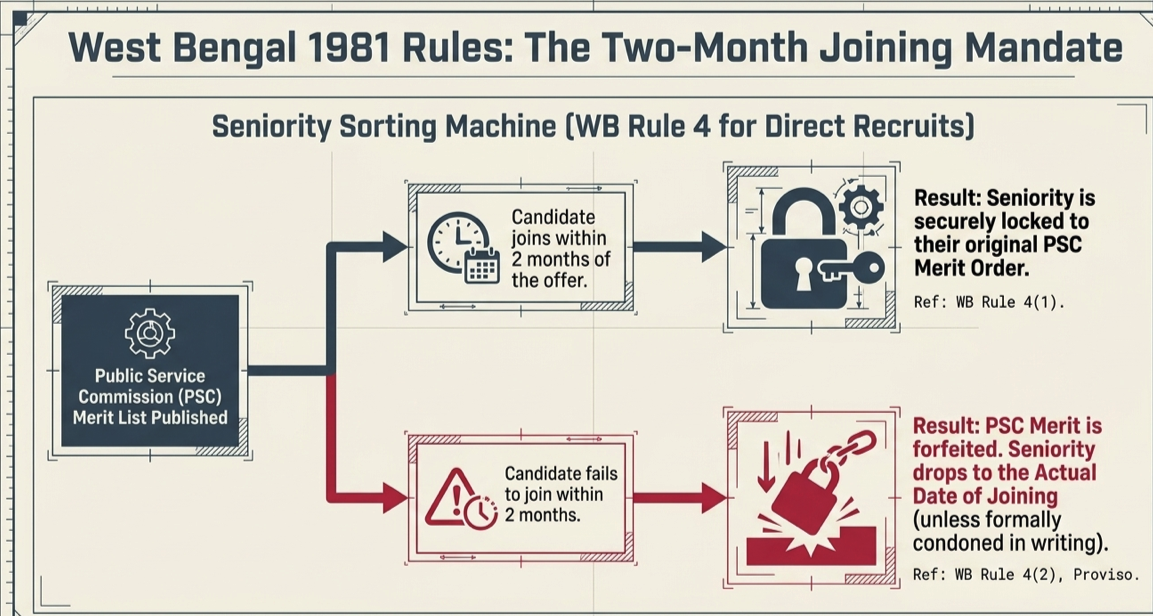
Under Rule 4 of the 1981 Rules, the relative seniority of direct recruits appointed through competitive examination, interview, or training is determined strictly by the order of merit in which they are recommended by the Public Service Commission (PSC) or other designated selecting authority14. This rule establishes that merit, rather than the fortuity of the actual date of joining, is the primary determinant of seniority among direct recruits of the same batch14.
However, Rule 4 contains crucial provisos and conditions:
- The Two-Month Joining Rule: If a selected candidate fails to join the post within two months from the date of the offer of appointment, their seniority will not be determined by their merit position14. Instead, their seniority will count strictly from the actual date on which they join the post, unless the appointing authority formally condones the delay in writing based on recorded reasons14.
- Subsequent Regularization: Where an initial appointment was made otherwise than in accordance with the recruitment rules and is subsequently regularized in consultation with the PSC, the seniority of such an employee is reckoned from the formal date of regularization, not from the date of their initial temporary or ad-hoc appointment14.
- The Date of Joining Fallback: Under Note 2 of Rule 4, if the inter se seniority of several employees was not determined prior to the commencement of the 1981 Rules, it must be determined based on the actual date of joining14. If the dates of joining are identical, the older employee is adjudged senior14. If the dates of birth are also identical, seniority is determined by the total marks obtained in the qualifying examination prescribed for recruitment14.
Rule 5: Seniority of Promotees and Confirmation Intersections
While the seniority of direct recruits is governed by merit rankings, the seniority of persons appointed on promotion to any post, cadre, or grade under the West Bengal government is determined from the date of joining such post3. The “date of joining” is defined as the date of continuous officiation in the post, cadre, or grade14. “Date of joining = seniority date” serves as the foundational rule for promotees under this framework3.
This creates a distinct statutory regime for promotees, where actual continuous service in the promotional post forms the basis of seniority, provided the promotion is regular and made in accordance with the recruitment rules24. If a promotion is granted retrospectively or notionally—such as in cases of wrongful supersession or when a sealed cover is opened upon exoneration in disciplinary proceedings—the employee is deemed to have held the promotional post from that retrospective date and is entitled to count seniority from that date17.
Additionally, the West Bengal Services (Appointment, Probation and Confirmation) Rules, 1979, prescribe that all initial appointments are temporary25. An employee is deemed to be on probation for one year upon completing two years of continuous temporary service25. Satisfactory completion of probation leads to confirmation and substantive status, which secures the employee’s title to the post and stabilizes their place in the seniority list5.
Rule 6: Relative Seniority Between Promotees and Direct Recruits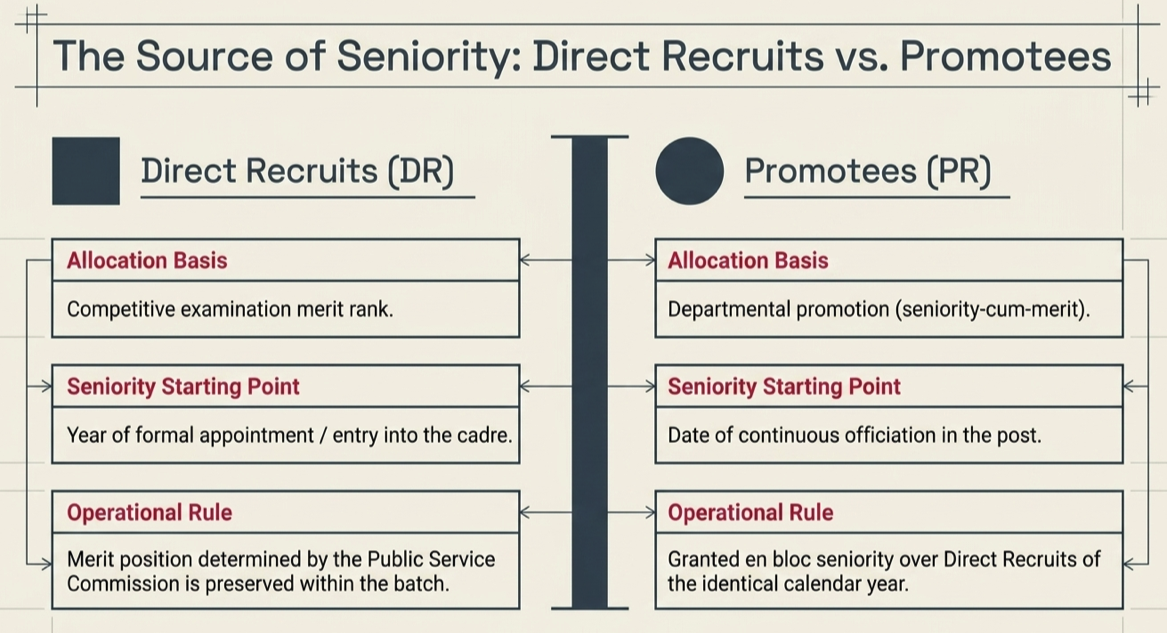
The inter se seniority between direct recruits and promotees in West Bengal is governed by Rule 6 of the 1981 Rules, which completely delinks relative seniority from the date of joining24.
The operation of Rule 6 is characterized by two fundamental statutory principles:
- Reckoning by the Year of Appointment/Promotion: The relative seniority between a promotee and a direct recruit is determined by the “year of appointment or promotion” of each in the cadre or grade, irrespective of their actual date of joining3. The “year of promotion or appointment” is interpreted as the calendar year in which the first person of a particular batch of promotees or direct recruits joins the post in compliance with the appointment/promotion order27.
- The En Bloc Seniority Rule: Rule 6(ii) explicitly mandates that promotees of a particular year shall be en bloc senior to the direct recruits of that same year27. This provides a powerful statutory protection for departmental promotees, ensuring that even if a direct recruit of the same calendar year joins earlier due to faster administrative processing, the promotees of that year will rank above them in the final gradation list27.
However, this protection only applies to regular promotions24. As established by the Supreme Court in Md. Israils v. State of West Bengal, ad-hoc promotions made in exigencies of service without the approval of the Public Service Commission or contrary to statutory recruitment rules are fortuitous in nature and cannot be counted for the purpose of reckoning seniority under Rule 624.
III. The Quota-Rota Rule: Rotation Cycles, Merit, and Cadre Strength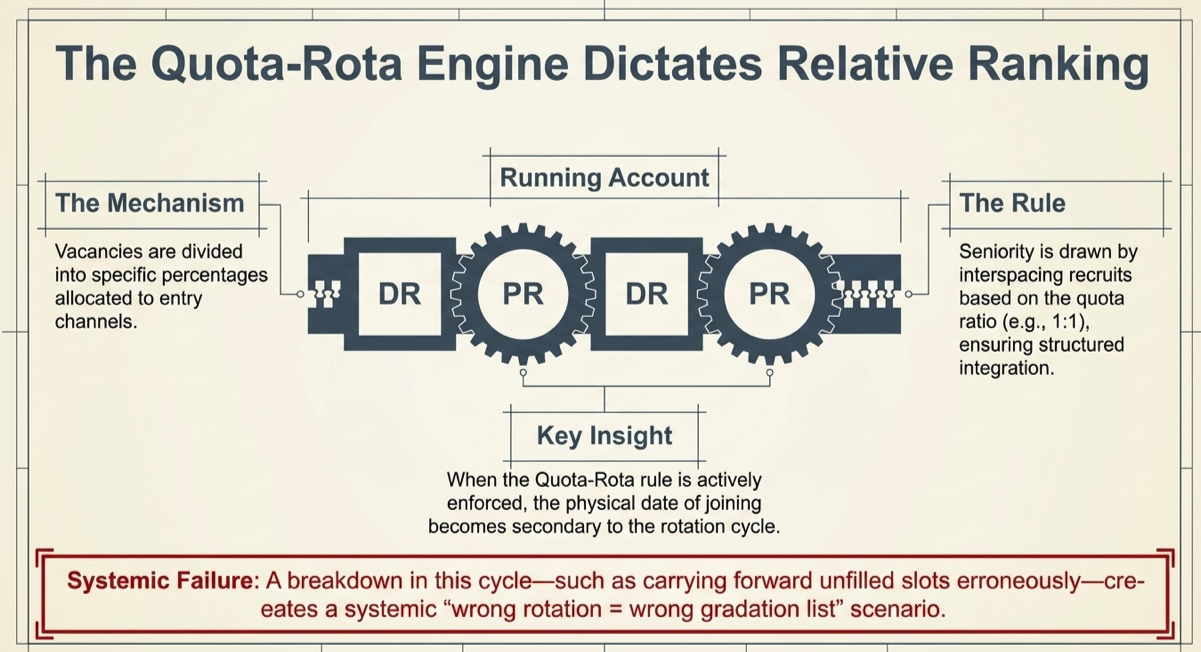
The “Rota Quota Rule — what is it?” is a fundamental question in public service law. Under this system, vacancies within a cadre are divided into specific percentages allocated to different channels of entry—typically direct recruitment and departmental promotion15. The relative seniority of direct recruits and promotees is determined by rotating vacancies between these two groups based on their respective quotas15.
Direct Recruit vs Promotee Seniority
The application of the quota-rota rule governs the balance between direct recruits and promotees15. Direct recruits enter the service based on competitive examinations, while promotees rise from lower feeder cadres24. When the quota-rota rule is in force, the physical date of joining becomes secondary to the rotation cycle3. The rotation cycle decides your rank16.
For example, if the rules prescribe a 1:1 ratio between direct recruits and promotees, the seniority list must be drawn by interspacing one direct recruit with one promotee (e.g., DR, PR, DR, PR)16. Even if all promotees join in January and the direct recruits join in December, the rotation cycle must be maintained, provided both are appointed against the vacancies of the same recruitment year30.
| Recruitment Source | Allocation Basis | Seniority Starting Point | Operational Rule |
|---|---|---|---|
| Direct Recruit (DR) | Competitive exam merit rank5. | Year of formal appointment/cadre entry34. | Merit position is preserved within the batch14. |
| Promotee (PR) | Departmental promotion/seniority-cum-merit3. | Date of continuous officiation in post3. | En bloc seniority over DRs of the same year (under Rule 6)27. |
Rotation Cycle Decides Your Rank
Under the consolidated instructions issued by the Department of Personnel and Training (DoPT), the relative seniority of direct recruits and promotees is determined according to the rotation of vacancies, which is based on the quotas reserved for direct recruitment and promotion in the relevant recruitment rules15. The rotation cycle functions as a running account37. If recruitment in a particular year stops at a specific point of the cycle, recruitment in the subsequent year begins at the next point37.
A “wrong rotation = wrong gradation list” scenario arises when the administrative department fails to properly align the roster points, erroneously carries forward unfilled slots, or allows one stream of entry to monopolize the higher ranks of the gradation list in violation of the prescribed ratio28. When the quota-rota rule breaks down due to promotions being made in excess of the quota, or due to a complete failure to initiate direct recruitment for consecutive years, the rotation cycle can no longer be applied mechanically, and seniority must be determined based on actual length of continuous service in the cadre5.
IV. The Born-in-the-Cadre Principle: From N.R. Parmar to K. Meghachandra Singh and Beyond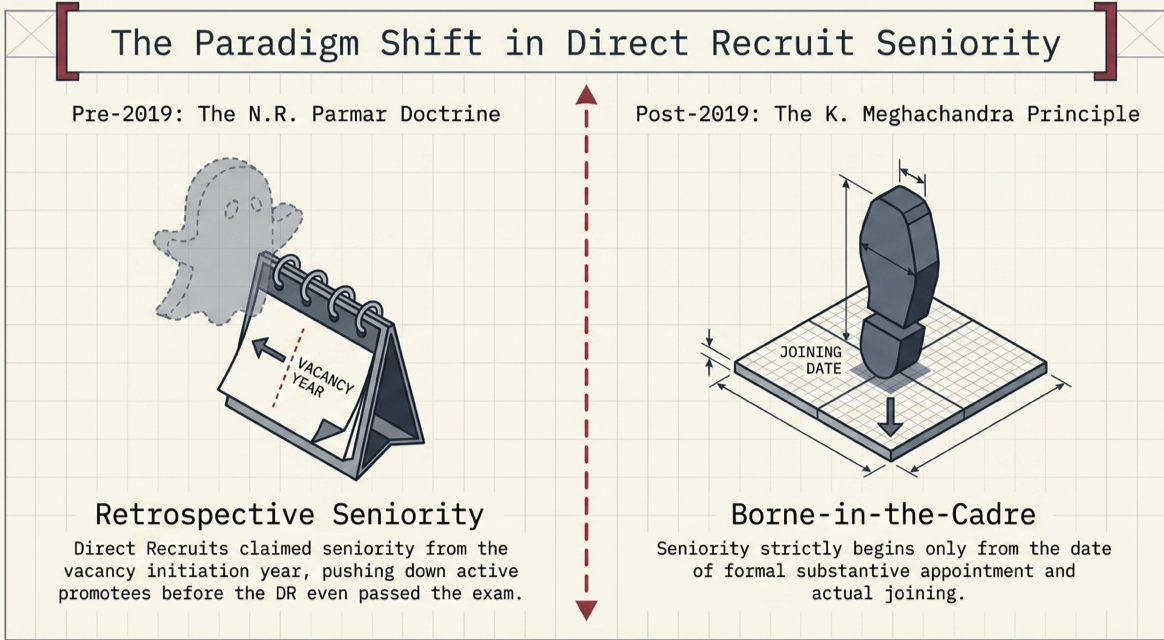
The practical execution of the quota-rota rule has been the subject of intense litigation, leading to a major paradigm shift in Indian service jurisprudence.
The Rise and Fall of the N.R. Parmar Doctrine
The core dispute in rota-quota litigation centers on when a direct recruit’s seniority begins. Under the historical DoPT Office Memorandum dated December 22, 1959, relative seniority was fixed according to the rotation of vacancies based on the quotas allocated to direct recruitment and promotion16. Over time, delays in direct recruitment led to situations where direct recruits joined service years after the vacancies arose, and years after promotees had already filled their promotion quotas30.
This culminated in the Supreme Court’s decision in Union of India v. N.R. Parmar (2012)15. The Court interpreted the DoPT guidelines to mean that if a recruitment process was initiated in a particular vacancy year (the recruitment year), the direct recruits selected through that process were entitled to carry their seniority back to that vacancy year15.
Under the N.R. Parmar doctrine, the recruitment year was defined as the year in which the requisition for recruitment was sent to the recruiting agency (such as the UPSC or SSC)16. This allowed direct recruits to claim seniority from a date when they had not even cleared the selection examination, pushing down promotees who had been working in the grade for several years21.
The K. Meghachandra Singh Overruling and the “Borne-in-the-Cadre” Principle
The inequities of the N.R. Parmar decision led to its review and ultimate overruling by a three-judge bench of the Supreme Court in K. Meghachandra Singh v. Ningam Siro (2019)34.
The Court in K. Meghachandra Singh established the “borne-in-the-cadre” principle, holding that a person cannot claim seniority in a service from a date when they were not even appointed or “borne” in the cadre21. The Court observed that a direct recruit’s seniority must depend on their actual length of service and can only begin from the date of their formal substantive appointment or actual joining, not from a fictional backdated date or the date of initiation of the recruitment process38.
The Court held that allowing direct recruits to claim retrospective seniority before they are even appointed violates Articles 14 and 16, as it defeats the legitimate expectations of promotees who have rendered actual service in the cadre during the intervening years1. The overruling of N.R. Parmar was made prospective, meaning that seniority lists finalized prior to November 19, 2019, based on the N.R. Parmar principles, were protected and could not be reopened, but any list finalized thereafter must strictly comply with the new law34.
The DoPT Office Memorandum of 13.08.2021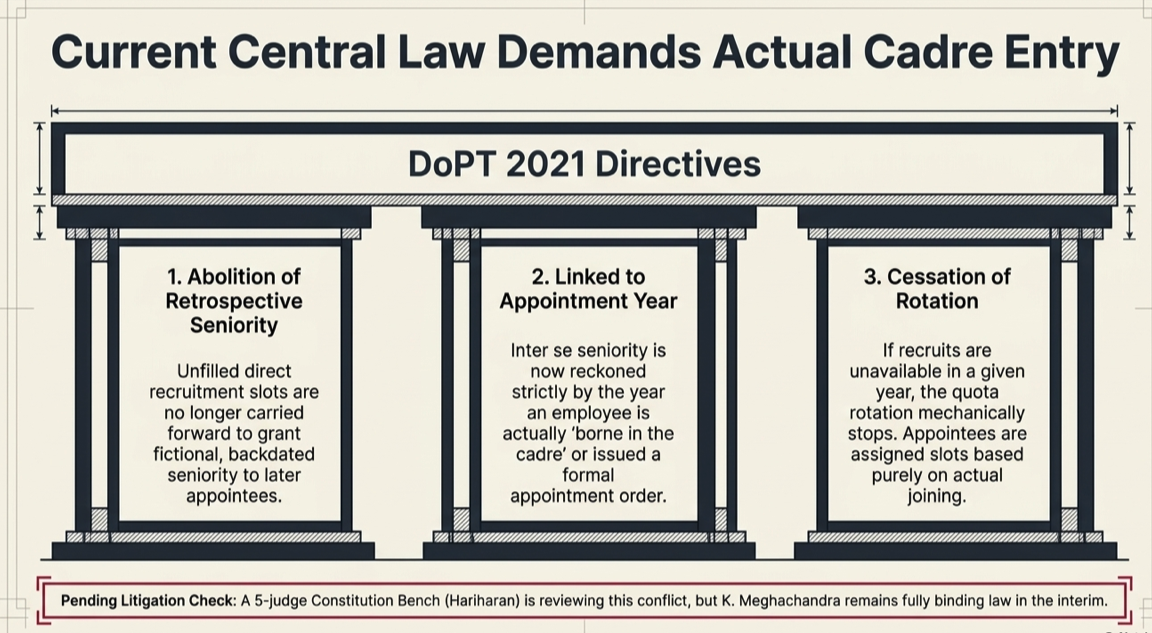
Following the K. Meghachandra Singh judgment, the DoPT issued revised consolidated instructions on August 13, 2021, to govern the inter se seniority of direct recruits and promotees in Central Civil Services34. The key modifications introduced by this O.M. include:
- Abolition of Retrospective Seniority: The practice of carrying forward unfilled direct recruitment slots to subsequent years and granting retrospective seniority to later-appointed direct recruits was discontinued34.
- Seniority Linked to Appointment Year: The inter se seniority of direct recruits and promotees is now reckoned strictly with reference to the “year of appointment”—defined as the year in which they are borne in the cadre or in which a formal appointment order is issued34.
- Cessation of Rotation: If an adequate number of direct recruits or promotees do not become available in a particular year, the rotation of quotas for determining seniority stops34. The remaining unfilled slots are not carried forward to grant retrospective seniority; instead, the appointees of that year are simply assigned their slots based on actual joining, preventing the creation of fictional backdated seniority34.
The Pending Five-Judge Bench Reference: Hariharan v. Harsh Vardhan Singh Rao
The jurisprudential landscape remains dynamic. In Hariharan v. Harsh Vardhan Singh Rao (2022), a two-judge bench of the Supreme Court noted that the three-judge bench in K. Meghachandra Singh had overruled N.R. Parmar without considering earlier binding Constitution Bench decisions—specifically Mervyn Coutindo v. Collector of Customs (1966) and coordinate bench decisions like M. Subba Reddy v. APSRTC (2004)43.
The Court in Hariharan observed that treating the recruitment year as a financial or calendar year, and the impact of delayed recruitment processes on candidates who were otherwise eligible but could not join due to no fault of their own, required deeper constitutional scrutiny43.
Consequently, the Supreme Court has referred the matter to a larger five-judge Constitution Bench to resolve the conflict between the N.R. Parmar and K. Meghachandra Singh doctrines43.
Importantly, various High Courts and Tribunals have clarified that the mere reference of a matter to a larger bench does not suspend or unsettle the declared law38. Until the five-judge Constitution Bench delivers its verdict, the law laid down in K. Meghachandra Singh remains fully binding, and administrative authorities must prepare fresh seniority lists accordingly38. However, courts routinely direct that any revised seniority lists prepared under the current regime will remain subject to the final outcome of the larger bench reference38.
V. Inter-Departmental and Cadre Transfers: Seniority Preservation vs. Forfeiture
“Transferred and lost seniority?” is a common grievance among public servants who undergo administrative or request-based transfers1. The impact of a transfer on an employee’s accumulated seniority is determined by the legal character of the transfer itself1.
The Core Distinction: Public Interest vs. Own Request Transfers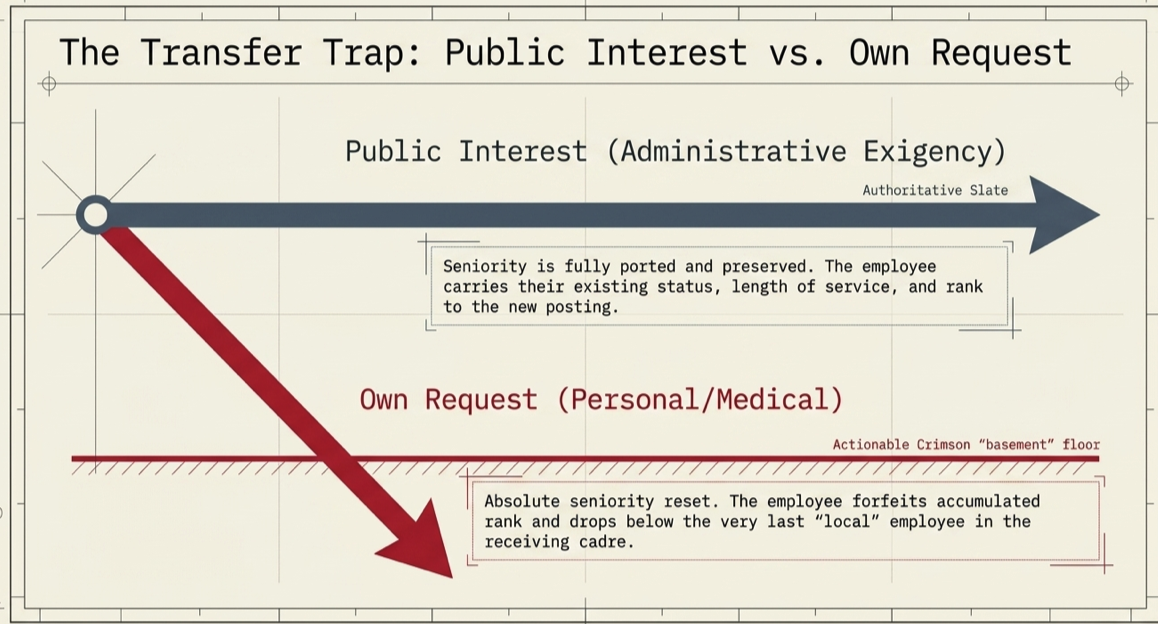
The law draws a sharp, uncompromising distinction between transfers executed in the “public interest” (or on administrative grounds) and transfers granted at the “own request” of the employee1:
- Public Interest Transfer: When the administration initiates a transfer for the public good or due to administrative exigencies (such as reorganization, reduction of posts, or disciplinary grounds), the employee’s seniority is fully protected1. The employee carries their existing status and length of service to the new post, and their seniority cannot be reset1. “Public interest transfer ≠ seniority reset” is an absolute rule in service law1.
- Own Request Transfer: When an employee voluntarily seeks a transfer or cadre change for personal, medical, or family reasons, they must take a junior position in the new cadre1. In this scenario, the transferee’s seniority in the new cadre is reckoned from the date of joining the new post, placing them below all existing employees (the “locals”) in that grade, ensuring that voluntary entrants do not bypass those already serving in the cadre1.
The Crucial Requirement: Transfer Order Must Specify Seniority Terms
When an administrative transfer is ordered, the transfer order must specify seniority terms4. If the transfer is made in the public interest, the order should explicitly state that the transfer will not affect the employee’s existing seniority and length of service1. Conversely, if the transfer is request-based, the administration must ensure that the employee provides written consent to take a position below the last candidate in the new cadre before the final transfer order is executed7.
Under standard departmental policies, such as those of the Press Information Bureau (PIB), transfers are classified as “within-zone” or “outside-zone”48. An employee does not lose their seniority upon within-zone or regular outside-zone transfers executed for administrative reasons, as their rank is protected by their Staff Selection Commission merit and original year of recruitment48.
The Landmark Ruling: K.C. Devaki (2025)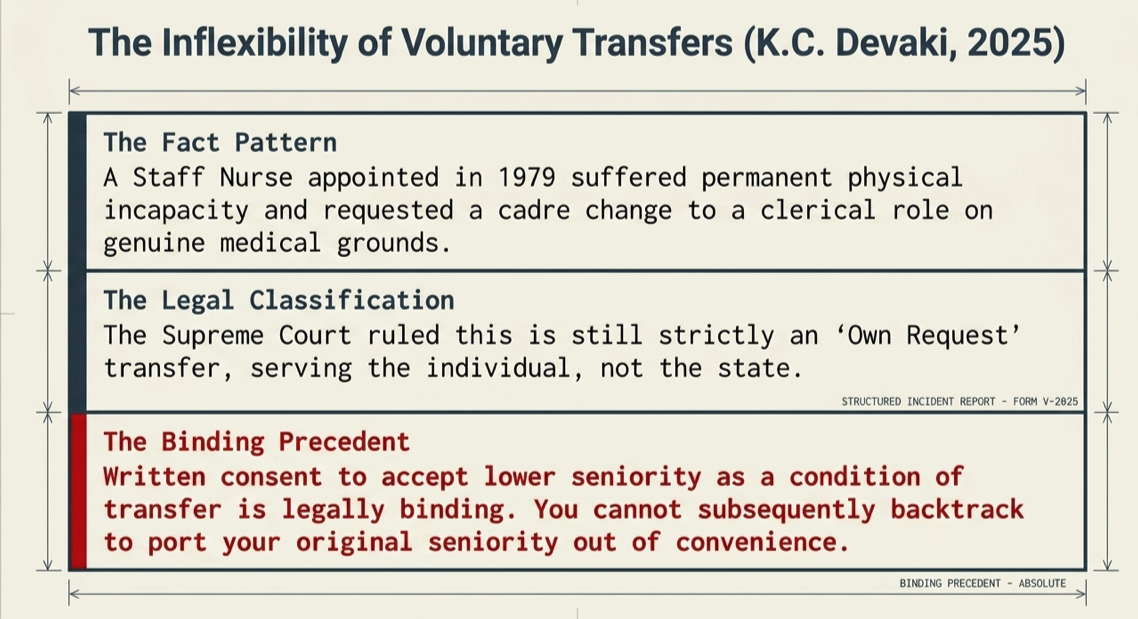
The Supreme Court’s decision in The Secretary to Government, Department of Health & Family Welfare v. K.C. Devaki (2025) has established a definitive rule regarding request-based cadre changes4.
In this case, a Staff Nurse appointed in 1979 requested a cadre change to First Division Assistant on medical grounds, which was supported by a medical board’s finding of permanent physical incapacity for nursing duties46. The state government acceded to her request in 1989, subject to her written consent to take seniority below the last person in the clerical cadre46. Years later, she challenged the gradation list, asking that her seniority in the new cadre be calculated from her original 1979 appointment date46.
The Supreme Court reversed the High Court’s judgment, holding that a voluntary cadre change prompted by legitimate personal factors (including medical illness) does not allow an employee to port over their seniority from their previous cadre1. The Court emphasized that:
- Written Consent is Binding: Having accepted the cadre change subject to the condition of lower seniority, the employee cannot later backtrack and claim retrospective seniority4.
- Strict Boundary of Public Interest: A transfer on medical grounds serves the individual’s needs and cannot be equated with a transfer in the public interest, which exists solely to serve broader governance needs4.
- Protection of Existing Employees: Allowing a voluntary transferee to carry over their original seniority would violate Article 16 by pushing down existing “local” employees who have rendered continuous service in that cadre1.
VI. Procedural Roadmap: How to Challenge a Wrong Seniority List
When a public servant is placed in an incorrect position in a draft or final gradation list, they must navigate a precise, statutory multi-stage legal process to secure relief. Any procedural error, particularly regarding limitation or the failure to exhaust alternative remedies, can prove fatal to the case11.
Step 1: File Detailed Written Representations Promptly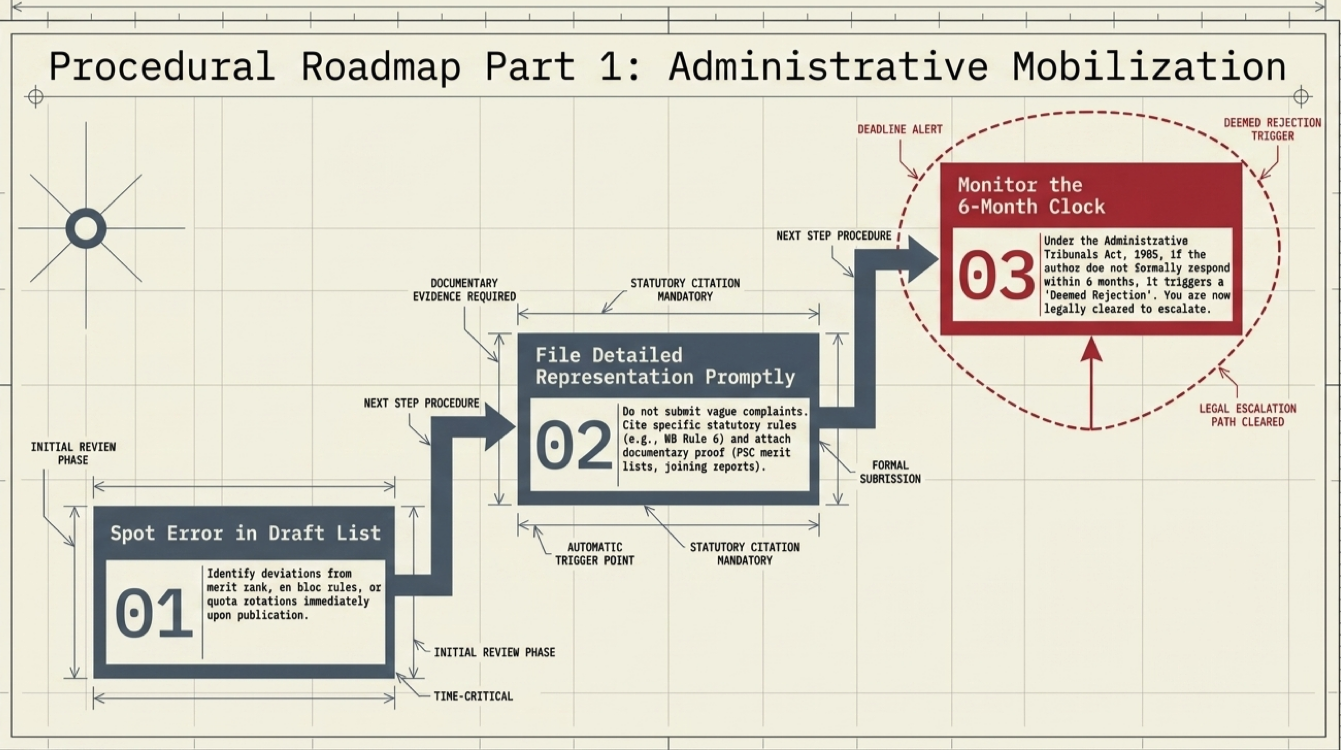
Immediately upon the publication of a draft gradation list, the aggrieved employee must file a detailed, written representation before the competent appointing authority13. The representation must clearly outline:
- The specific rules (e.g., Rule 4 or 6 of the West Bengal Rules, or DoPT O.M. of 13.08.2021) that have been violated14.
- The factual errors in the list, supported by documentary evidence such as initial appointment orders, joining reports, and PSC merit recommendations14.
- The specific relief sought, such as placement at a particular serial number or relative position vis-à-vis named juniors13.
Step 2: “File OA before CAT immediately — don’t wait”
If the administrative representation is rejected, or if the authority fails to pass an order within six months from the date the representation was filed, the employee must immediately approach the Administrative Tribunal6.
- Filing an Original Application (OA): Under Section 19 of the Administrative Tribunals Act, 1985, the employee must file an OA challenging the final gradation list, or the rejection of their representation, and seek a direction for the reconstitution of the list6.
- The Limitation Barrier (Section 21): Section 21 of the Act mandates a strict statutory limitation period of one year from the date on which the cause of action arises (the date of rejection of the representation, or the expiry of the six-month period for an undecided representation)6.
- Condonation of Delay: Under Section 21(3), the Tribunal may admit an application after the limitation period only if the applicant satisfies the Tribunal that they had “sufficient cause” for the delay6. However, in seniority matters, the hurdle for condonation is exceptionally high6.
Step 3: CAT + High Court = Your Remedies
The statutory remedies for challenging an incorrect seniority list are structured hierarchically under the Constitution of India and the Administrative Tribunals Act, 198549:
- Central/State Administrative Tribunal (CAT/SAT): The forum of first instance for all service disputes concerning central or state government employees (excluding defense personnel)6. The Tribunal has the powers of a civil court to summon records and direct the reconstitution of gradation lists6.
- High Court (Writ Jurisdiction under Article 226/227): Following the landmark Constitution Bench decision in L. Chandra Kumar v. Union of India, the jurisdiction of the High Courts under Article 226/227 is not excluded52. Any party aggrieved by an order of the Tribunal can challenge it by filing a writ petition before the division bench of the relevant High Court6.
- Supreme Court of India (Article 136): A final appeal against the decision of the High Court can be preferred before the Supreme Court through a Special Leave Petition (SLP) under Article 136 of the Constitution52.
VII. Landmark Judgments Reference Matrix
The following reference matrix summarizes the core legal principles and applications established by the landmark judgments discussed in this treatise:
| Judgment Name & Citation | Core Subject Matter | Legal Principle Established | Practical Application / Holding |
|---|---|---|---|
| K. Meghachandra Singh v. Ningam Siro
(2020) 5 SCC 689 [cite: 35, 38] |
Inter se seniority of direct recruits and promotees38. | Borne-in-the-Cadre Principle: Seniority cannot be granted retrospectively from a date when the employee was not borne in the service21. | Overruled N.R. Parmar prospectively34. Seniority of direct recruits must run from their actual date of formal appointment or joining, not the vacancy occurrence date38. |
| Union of India v. N.R. Parmar
(2012) 13 SCC 340 [cite: 15, 38] |
Retroactive seniority of direct recruits under quota-rota15. | Recruitment Year Linkage: Direct recruits can claim seniority from the vacancy year if the recruitment process was initiated in that year15. | Now overruled by K. Meghachandra Singh, but seniority lists finalized under its regime prior to 19.11.2019 remain protected34. |
| Secretary to Govt, Dept. of Health & Family Welfare v. K.C. Devaki
2025 INSC 389 [cite: 46] |
Seniority after inter-departmental transfer on medical grounds4. | Voluntary Transfer Forfeiture: An employee transferred at their own request or for personal reasons (including medical grounds) forfeits original seniority1. | Replaced the transferee at the bottom of the receiving cadre’s seniority list, placing them below the existing “local” employees on the date of joining1. |
| Shiba Shankar Mohapatra v. State of Orissa
(2010) 12 SCC 471 [cite: 8, 10] |
Delay and laches in challenging seniority list8. | Limitation of Challenge: A seniority list must be challenged within a reasonable period of 3 to 4 years8. | Courts will not encourage stale claims where third-party rights have crystallized10. “Fence-sitters” who delay filing are barred from relief10. |
| Hariharan v. Harsh Vardhan Singh Rao
2022 SCC OnLine SC 1717 [cite: 38, 45] |
Conflict between N.R. Parmar and K. Meghachandra Singh43. | Constitution Bench Reference: The conflict regarding retrospective seniority has been referred to a 5-judge bench43. | High Courts and Tribunals must follow K. Meghachandra Singh in the interim, but revised lists remain subject to the outcome of the 5-judge bench reference38. |
| Md. Israils v. State of West Bengal
(2002) 1 Supreme 20 [cite: 28] |
Countability of ad-hoc service for seniority under West Bengal Rules24. | Regular Promotion Requirement: Only promotions made in accordance with statutory rules count toward relative seniority under Rule 624. | Excluded ad-hoc or fortuitous services rendered prior to formal Public Service Commission approval from reckoning seniority24. |
VIII. Consolidated FAQ Directory
Q1. What is a gradation list, and why is its accuracy critical for a government employee?
A gradation list is an official administrative document published by a government department that ranks employees within a specific post, cadre, or grade based on their relative seniority4. Its accuracy is critical because it directly determines a public servant’s eligibility and position in the queue for promotions, selection for officiating or higher-charge postings, and benefits like financial upgradations under Career Advancement Schemes3. A lower placement in the list due to an administrative or clerical error can lead to permanent supersession by juniors11.
Q2. What is the distinction between a draft gradation list and a final gradation list?
A draft gradation list is a tentative, provisional ranking published by the department to allow employees to verify their details and point out errors13. It is accompanied by a notice inviting written objections within a specified timeframe, usually fifteen to thirty days13. A final gradation list is published only after the administrative authorities consider and dispose of the representations received against the draft list18. The final list has legal force and is used by Departmental Promotion Committees for regular promotions16.
Q3. How does a clerical error in a gradation list differ from a structural seniority error?
A clerical error is a non-discretionary mistake, such as a typo in an employee’s date of birth, date of joining, spelling of their name, or the omission of their name from a specific batch14. These can generally be rectified through a simple administrative representation6. A structural seniority error is a fundamental misapplication of statutory rules, such as placing an entire batch of direct recruits above promotees in violation of the en bloc promotion rule, or miscalculating the rotation of vacancies under the quota-rota rule22. Structural errors usually require formal adjudication before an Administrative Tribunal6.
Q4. What immediate steps should an employee take upon finding their name in the wrong position on a draft list?
The employee must immediately draft a detailed written representation and submit it to the competent appointing authority through the proper channel within the period prescribed in the draft notification13. The representation must specify their correct details, cite the relevant statutory rules being violated, and provide documentary evidence such as their initial offer of appointment, joining report, PSC merit list recommendation, or promotion order13. The employee should obtain a formal acknowledgment of receipt for their records6.
Q5. Can an employee file an Original Application (OA) before the Central Administrative Tribunal (CAT) against a draft list?
Generally, Administrative Tribunals do not entertain challenges against tentative or draft gradation lists because they are provisional and do not constitute a final administrative decision18. Challenging a draft list is considered premature unless the employee can demonstrate that the draft list is issued by an authority completely lacking jurisdiction, or that it inflicts immediate, irreparable harm21. The proper recourse is to file a representation and await the final list, or the formal rejection of the representation11.
Q6. What is the statutory limitation period for filing an OA before CAT under the Administrative Tribunals Act, 1985?
Under Section 21 of the Administrative Tribunals Act, 1985, an application must be filed within one year from the date on which the cause of action arises11. If an adverse order (such as a final gradation list) is issued, the limitation is one year from that date11. If the employee has submitted a statutory representation or appeal and it is formally rejected, the one-year period runs from the date of communication of the rejection11.
Q7. How does the “deemed rejection” rule affect the limitation period for filing an OA?
Under Section 20 of the Administrative Tribunals Act, 1985, if an employee files a statutory representation or appeal and the competent authority fails to pass a final order within six months, the employee is deemed to have exhausted their administrative remedies11. The cause of action then arises on the day of the expiry of those six months, and the employee must file their OA within one year from that deemed rejection date11. Waiting indefinitely for a reply beyond this period will make the OA time-barred11.
Q8. Will filing successive administrative representations extend the statutory limitation period?
No, it is a well-settled principle of service law that filing repeated, non-statutory representations does not extend the statutory limitation period for approaching a court or tribunal11. Once a final decision is communicated, or once the six-month period for a deemed rejection expires, the limitation clock begins to run11. Subsequent reminder letters or additional representations do not create a fresh cause of action, and any delay resulting from such actions will not be condoned11.
Q9. What grounds must an employee establish to secure a condonation of delay under Section 21(3)?
The applicant must file a formal application for condonation of delay under Section 21(3) of the Act and demonstrate “sufficient cause” for failing to approach the Tribunal within the prescribed one-year period6. “Sufficient cause” requires a credible, day-by-day explanation of the delay11. Valid grounds may include severe, documented medical illness of the applicant or their immediate family, lack of knowledge due to posting in extreme remote areas with no access to communication, or proof of being misled by formal written assurances from the department6.
Q10. What is the “Doctrine of Laches,” and how does it apply to seniority disputes?
The Doctrine of Laches is an equitable principle which dictates that courts will not assist a litigant who has slept over their rights and failed to seek a remedy within a reasonable period8. In the context of seniority disputes, even if an OA is technically within statutory limitation, or if a delay is explained, the courts may refuse to interfere if the challenge is brought after a long lapse of time8. This is because disrupting a settled seniority list after years of operation causes administrative chaos and prejudices third parties who have already been promoted based on that list9.
Q11. What is the “reasonable period” for challenging a finalized seniority list as defined by the Supreme Court?
In Shiba Shankar Mohapatra v. State of Orissa, the Supreme Court held that a challenge to a seniority list must be brought within a reasonable period, which it defined as three to four years from the date of publication of the finalized list8. If an employee agitates the issue of seniority beyond this three-to-four-year window, they face a heavy burden to explain the delay and laches by presenting a highly satisfactory explanation54. If they fail to do so, the adjudicatory forum must reject the challenge at the threshold54.
Q12. Who is classified as a “fence-sitter” in service jurisprudence, and why are they denied relief?
A “fence-sitter” is an employee who is fully aware of an illegality or error in a seniority list but chooses not to challenge it in court, instead waiting to see the outcome of litigation initiated by their more diligent colleagues10. Once the active litigants secure a favorable order, the fence-sitter approaches the court seeking the same benefit10. Courts treat fence-sitters as being barred by delay and laches, denying them relief because they failed to pursue timely remedies and sought to leverage the litigation only at its final stage10.
Q13. What is the “Rota-Quota” rule in the context of inter se seniority?
The rota-quota rule is a recruitment and seniority principle where vacancies in a specific cadre are allocated to direct recruits and promotees in a fixed ratio (the quota) specified in the recruitment rules15. For the purpose of seniority, the vacancies filled from both sources are rotated (the rota) in a structured cycle to ensure that direct recruits and promotees are interspaced in the gradation list in accordance with their respective quotas15.
Q14. What was the core principle established by the Supreme Court in the N.R. Parmar (2012) case?
In Union of India v. N.R. Parmar, the Supreme Court ruled that the seniority of direct recruits should be linked to the “recruitment year” in which the recruitment process was initiated against the corresponding vacancy year, even if their actual selection and appointment occurred years later15. Under this doctrine, direct recruits were granted retrospective seniority from the date when the requisition for recruitment was formally sent to the recruiting agency (UPSC/SSC), provided the process was initiated during the vacancy year itself16.
Q15. Why did the Supreme Court overrule N.R. Parmar in the K. Meghachandra Singh (2019) case?
The Supreme Court overruled N.R. Parmar because its application led to highly inequitable results, where direct recruits who were not even appointed or “borne in the service” were granted retrospective seniority over promotees who had already rendered years of regular service in the cadre21. The Court in K. Meghachandra Singh held that seniority can only be counted from the date of formal substantive appointment or actual joining, and a person is legally disentitled to claim seniority from a date when they were not borne in the cadre21.
Q16. Does the overruling of N.R. Parmar apply retrospectively to all past seniority lists?
No, the Supreme Court explicitly held that the overruling of N.R. Parmar in K. Meghachandra Singh applies prospectively34. This means that seniority lists that were already finalized and settled prior to the date of the judgment (November 19, 2019) based on the N.R. Parmar rules are fully protected and cannot be reopened34. However, any seniority list prepared or finalized after November 19, 2019, must comply with the new “borne-in-the-cadre” principle20.
Q17. What is the significance of the pending five-judge Constitution Bench reference in Hariharan?
In Hariharan v. Harsh Vardhan Singh Rao, a two-judge bench noted that K. Meghachandra Singh overruled N.R. Parmar without considering earlier binding Constitution Bench decisions like Mervyn Coutindo43. The Court referred the matter to a 5-judge Constitution Bench to conclusively decide the correctness of both decisions43. While this reference is pending, K. Meghachandra Singh remains the binding law of the land, though any revised seniority lists prepared in the interim are subject to the final outcome of the reference38.
Q18. How does the DoPT O.M. dated 13.08.2021 implement the K. Meghachandra Singh judgment?
The DoPT O.M. dated August 13, 2021, modified the instructions for determining the inter se seniority of direct recruits and promotees by aligning them with the K. Meghachandra Singh verdict34. It established that relative seniority must be determined based on the actual “year of appointment” (when the formal appointment order is issued or when they join)34. It discontinued the carrying forward of unfilled slots for the purpose of granting retrospective seniority, stipulating that rotation of quotas stops once the available recruits of a given year are assigned their slots34.
Q19. What is the scope of application of the West Bengal Services (Determination of Seniority) Rules, 1981?
The 1981 Rules apply to all government servants under the rule-making power of the Government of West Bengal14. However, Rule 2 explicitly excludes members of the All India Services (such as the IAS, IPS, and IFS), the West Bengal Higher Judicial Service, the West Bengal Civil Service (Judicial), the West Bengal Civil Service (Executive), and the West Bengal Police Service, which are governed by their own specific cadre rules14.
Q20. How is the relative seniority of direct recruits determined under Rule 4 of the West Bengal 1981 Rules?
Under Rule 4, the seniority of direct recruits is determined by the order of merit in which they are recommended for appointment by the Public Service Commission or other selecting authority14. Their merit position in the select list is preserved, provided they join the post within two months from the date of the offer of appointment14.
Q21. What happens to a direct recruit’s seniority under the West Bengal Rules if they join after two months?
If a selected direct recruit fails to join within two months from the date of the offer of appointment, their seniority will not be determined by their merit position in the select list14. Instead, their seniority will count strictly from the actual date on which they join the post, unless the appointing authority condones the delay in writing based on recorded reasons14.
Q22. How is the seniority of promotees calculated under the West Bengal 1981 Rules?
The seniority of promotees under the West Bengal rules is determined from the actual date of joining the promotional post, cadre, or grade3. The “date of joining” is defined as the date of continuous officiation in that post14. Therefore, unlike direct recruits, promotees cannot rely on their select-list merit to claim seniority from a date prior to their actual continuous officiation3.
Q23. What is the “en bloc” seniority rule under Rule 6 of the West Bengal 1981 Rules?
Rule 6 of the 1981 Rules governs the inter se seniority of promotees and direct recruits in West Bengal24. Rule 6(ii) explicitly mandates that promotees of a particular calendar year shall be en bloc senior to the direct recruits appointed in that same calendar year, irrespective of their actual dates of joining27. This ensures that departmental promotees of a given batch are placed above direct recruits of that same year in the gradation list27.
Q24. What is the “year of appointment or promotion” for applying Rule 6 of the West Bengal Rules?
The “year of promotion or appointment” is interpreted as the calendar year in which the first person of a particular batch of promotees or direct recruits joins the post in compliance with their respective appointment or promotion order27. The year of the batch is not decided by the date of the order, but by the year in which the first appointee of that batch actually reports for duty27.
Q25. Do ad-hoc promotions count toward seniority under the West Bengal 1981 Rules?
No, the Supreme Court in Md. Israils v. State of West Bengal held that service rendered on a purely ad-hoc basis—specifically where the promotion order states that it is ad-hoc and subject to Public Service Commission approval—cannot count for the purpose of reckoning seniority24. Only regular promotions made in accordance with the statutory recruitment rules can be counted under Rule 624.
Q26. Can a public servant claim seniority from a date prior to their formal regularization?
No, where an initial appointment or promotion is made otherwise than in accordance with the recruitment rules (such as ad-hoc, temporary, or stop-gap appointments) and is subsequently regularized in consultation with the PSC, the employee’s seniority is counted only from the date of regularization, not from the initial date of appointment5.
Q27. What is the difference between an administrative transfer in “public interest” and an “own request” transfer?
An administrative transfer in the “public interest” is initiated by the government to serve organizational needs and ensure efficient administration1. An “own request” transfer is voluntary, initiated by the employee for personal reasons such as medical conditions, family issues, or a preference for a specific location1.
Q28. How does a transfer in the “public interest” affect an employee’s accumulated seniority?
When a transfer is executed in the public interest, the employee’s seniority is fully protected1. The employee carries their existing status, length of continuous service, and relative seniority with them to the new post or cadre, ensuring they are not penalized for an involuntary, state-mandated transfer1.
Q29. What are the seniority consequences of an “own request” or voluntary transfer?
In an “own request” transfer, the employee forfeits their accumulated seniority1. Upon joining the new department, cadre, or region, they are placed at the bottom of the seniority list of that cadre, ranking below the last existing employee (“local”) in that grade on the date of their joining1.
Q30. What was the key ruling of the Supreme Court in the K.C. Devaki (2025) case regarding transfers?
In Secretary to Government, Department of Health and Family Welfare v. K.C. Devaki, the Supreme Court ruled that a voluntary cadre change sought by an employee on medical grounds (confirmed by a medical board) is an “own request” transfer and not a “public interest” transfer4. Consequently, the employee must take a bottom-seniority position in the new cadre and cannot carry forward their previous seniority1.
Q31. Can an employee challenge their placement at the bottom of a seniority list after consenting to it during a request-based transfer?
No, the Supreme Court in K.C. Devaki held that once an employee provides written consent to take seniority below the last candidate as a condition for accepting a voluntary transfer or cadre change, they are legally bound by that consent and cannot later challenge the resulting gradation list4.
Q32. Do DoPT guidelines protect seniority during “within-zone” transfers?
Yes, under DoPT guidelines and standard transfer policies, an employee does not lose their seniority upon “within-zone” or regular administrative transfers48. In such cases, seniority continues to be determined by their original rank, year of selection, and length of regular service in the cadre1.
Q33. How does a retrospective or notional promotion affect an employee’s seniority?
When an employee is granted a retrospective or notional promotion (such as after exoneration in a temporary or pending disciplinary inquiry where their junior was promoted earlier), it is legally presumed that they have been occupying the promotional post from that retrospective date17. Consequently, they are entitled to count their seniority from that retrospective date of promotion, rather than the date of actual physical joining on the post17.
Q34. What is the effect of an extension of the probation period on an employee’s seniority?
If an employee’s probation period is extended due to unsatisfactory performance, they may be placed below those who completed their probation on time and were confirmed earlier13. However, if the probation is successfully completed, the employee is generally confirmed in service and assigned their original rank in the seniority list based on their initial selection merit, unless the service rules specifically provide otherwise5.
Q35. What is “consequential seniority” in the context of reservation in promotions?
Consequential seniority is a constitutional provision (under Article 16(4A)) where SC/ST government employees who are promoted earlier than their general category peers as per reservation roster points are entitled to retain their seniority in the promotional cadre3. Consequently, general category employees promoted later to the same grade will rank junior to the SC/ST employees who were promoted earlier3.
Q36. How is the seniority of candidates appointed from a waitlist or shadow panel determined?
Under standard DoPT and administrative guidelines, candidates appointed from a shadow or waitlist panel are fixed in seniority according to their position in the overall merit list prepared by the selecting authority35. However, their seniority remains subject to the condition that they are appointed against the vacancies of the same recruitment year35.
Q37. Does a candidate gain any vested right to a particular seniority rank upon mere selection?
No, selection or empanelment does not confer any vested right to appointment or a particular seniority rank38. As ruled in Shankarsan Dash v. Union of India, selected candidates acquire rights only upon the completion of the formal appointment process and their formal induction into the service38.
Q38. What is the difference between seniority and eligibility for promotion?
Seniority refers to the relative position of an employee within a cadre or grade1. Eligibility for promotion refers to the minimum qualifications, continuous service, or completion of specific tests required to be considered for advancement to a higher post5. An employee may be senior in a cadre but remains ineligible for promotion if they have not met the statutory training or examination requirements9.
Q39. What is the “swimming test” relegation precedent under the PTC Manual 1936?
In Vinod Kumar v. State of West Bengal, an applicant’s relative seniority as a Sub-Inspector of Police was relegated from serial number 3 to 177 because he failed to clear his swimming test on the first attempt57. The Tribunal held that under the Police Training College Manual, 1936, passing all basic training tests on the first attempt is mandatory to retain original merit seniority, and a second attempt results in loss of original batch rank57.
Q40. Can a High Court direct the preparation of a fresh seniority list while a reference is pending before the Supreme Court’s 5-judge bench?
Yes, as established in Omber Singh Parmar v. Union of India and Vikas Kumar v. Union of India, High Courts and Tribunals can direct departments to prepare fresh seniority lists based on the currently binding precedent of K. Meghachandra Singh, but such lists will remain subject to revision depending on the final outcome of the reference pending before the five-judge Constitution Bench38.
IX. Strategic Legal Recommendations
To safeguard career progression and mitigate the risks associated with flawed gradation lists, public servants and administrative authorities must adhere to the following strategic guidelines:
- Vigilant Monitoring of Draft Lists: Government employees must treat draft gradation lists with the utmost seriousness19. Any deviation from merit rankings, incorrect recording of dates, or misapplication of en bloc rules must be objected to in writing within the provisional period13.
- Prompt Recourse to Judicial Fora: Relying on repeated administrative representations is a failed legal strategy11. Aggrieved employees must strictly monitor the statutory limitation period under Section 21 of the Administrative Tribunals Act, 1985, and file an Original Application before the Tribunal immediately upon the rejection of their representation, or upon the expiry of the six-month deemed-rejection window6.
- Strict Compliance with the Borne-in-the-Cadre Principle: For all seniority lists finalized after November 19, 2019, administrative authorities must ensure that no retrospective seniority is granted to direct recruits from a date prior to their formal substantive appointment or actual joining, in strict compliance with K. Meghachandra Singh34.
- Acceptance of Seniority Forfeiture in Voluntary Transfers: Public servants seeking voluntary transfers, even on medical, compassionate, or personal grounds, must accept that they will lose their accumulated seniority and be placed at the bottom of the receiving cadre’s list1. Consent given to such terms is legally binding and cannot be challenged subsequently4.
- Adherence to the Current Law Pending Larger Bench Decision: While the Hariharan reference to a five-judge Constitution Bench is pending, the “borne-in-the-cadre” principle established in K. Meghachandra Singh remains the binding law of the land38. Tribunals and departments must apply this principle, ensuring that any revised seniority lists are prepared under the current regime, subject to the final outcome of the larger bench38.
Works cited
- Seniority Unchanged in Administrative Cadre Transfers – Supreme Today AI, https://supremetoday.ai/search/seniority-unchanged-administrative-cadre-transfer
- Income Tax Seniority: Direct Recruits vs Promotees Rules – Supreme Today AI, https://supremetoday.ai/issue/income-tax-seniority-rules-direct-recruits-promotees
- Determination of Seniority – WBXPress, https://wbxpress.com/determination-of-seniority/
- Clarifying Seniority Rights in Request-Based Transfers: A New Principle on Public-Interest vs. Voluntary Transfers – CaseMine, https://www.casemine.com/commentary/in/clarifying-seniority-rights-in-request-based-transfers%3A-a-new-principle-on-public-interest-vs.-voluntary-transfers/view
- SENIORITY*, http://14.139.60.116:8080/jspui/bitstream/123456789/679/39/Seniority.pdf
- Central Administrative Tribunal (CAT) Matters: Expert Guidance | Rajendra Civil Law Firm, https://www.civiladvocate.in/central-administrative-tribunal-cat-matters-expert-guidance/
- REPORTABLE IN THE SUPREME COURT OF INDIA CIVIL APPELLATE JURISDICTION CIVIL APPEAL NO. 4356 OF 2025 ARISING OUT OF SLP (C) No. 2, https://api.sci.gov.in/supremecourt/2023/758/758_2023_11_1501_60362_Judgement_25-Mar-2025.pdf
- shiba+shankar+mohapatra | Indian Case Law – CaseMine, https://www.casemine.com/search/in/shiba%2Bshankar%2Bmohapatra
- Doctrine of Laches in Seniority Challenges: Comprehensive Analysis of Shiba Shankar Mohapatra v. State of Orissa – CaseMine, https://www.casemine.com/commentary/in/doctrine-of-laches-in-seniority-challenges:-comprehensive-analysis-of-shiba-shankar-mohapatra-v.-state-of-orissa/view
- Service-law finality: Courts should not unsettle long-settled promotions/relaxations; “fence-sitters” barred by laches – CaseMine, https://www.casemine.com/commentary/in/service-law-finality%3A-courts-should-not-unsettle-long-settled-promotions-relaxations-fence-sitters-barred-by-laches/view
- What is the limitation period for CAT applications – Rajendra Civil Law Firm, https://www.civiladvocate.in/legal-services-chennai/what-is-the-limitation-period-for-cat-applications/
- Hon’ble Justice Ranjit Kumar Bag – WBAT – Government of West Bengal, https://wbat.wb.gov.in/judgement/MA%20137%20of%202018%20and%20%20OA-1052%20of%202016_150219_judgement.pdf
- REPORTABLE IN THE SUPREME COURT OF INDIA CIVIL APPELLATE JURISDICTION CIVIL APPEAL NO(S). 8617 OF 2013 V. VINCENT VELANKANNI, https://api.sci.gov.in/supremecourt/2012/10562/10562_2012_14_1501_56170_Judgement_30-Sep-2024.pdf
- West Bengal Services (Determination of Seniority) Rules, 1981 – WBXPress, https://wbxpress.com/west-bengal-services-determination-seniority-rules-1981/
- Rota Quota Seniority | PDF | Government Of India | Supreme Court Of India – Scribd, https://www.scribd.com/document/1008349552/Rota-Quota-Seniority
- Bharat Sanchar Nigam Limited – SNEA India, http://sneaindia.com/current_events/Inter%20se%20seniority%20of%20Direct%20Recruits%20and%20Promotees%20-%20Guidelines%20as%20per%20DoPT%2016-04-14.pdf
- The District Judge vs Salil Ray & Ors on 18 March, 2026 – Indian Kanoon, https://indiankanoon.org/doc/40775652/
- Haragopal Ghosh v. State Of West Bengal & Ors. | Calcutta High Court – CaseMine, https://www.casemine.com/judgement/in/5ac5e54f4a93261ae6b662e1
- seniority once settled cannot be unsettled – Indian Kanoon, https://indiankanoon.org/search/?formInput=seniority%20once%20settled%20cannot%20be%20unsettled%20
- CIVIL APPELLATE JURISDICTION WRIT PETITION NO. 6152 OF 2024 Deepak Kumar & Ors. – Bombay High Court, https://bombayhighcourt.nic.in/generatenewauth.php?bhcpar=cGF0aD0uL3dyaXRlcmVhZGRhdGEvZGF0YS9qdWRnZW1lbnRzLzIwMjUvJmZuYW1lPTIwNjkwMDExMjk1MjAyNV85LnBkZiZzbWZsYWc9TiZyanVkZGF0ZT0mdXBsb2FkZHQ9MjgvMTEvMjAyNSZzcGFzc3BocmFzZT0wMTEyMjUxNzI0NDcmbmNpdGF0aW9uPTIwMjU6QkhDLUFTOjUxNzQxLURCJnNtY2l0YXRpb249JmRpZ2NlcnRmbGc9WSZpbnRlcmZhY2U9Tw==
- 19th September, 2025 Pronounced on – High Court of Delhi, https://delhihighcourt.nic.in/app/showFileJudgment/59815102025CCP10982024_193829.pdf
- Sumesh Kumar Dua vs. Govt. of NCT of Delhi | Delhi High Court 2026 | W.P.(C) 5620/2019 Judgment. – Caseon, https://www.caseon.in/case/sumesh-kumar-dua-vs-govt-of-nct-of-delhi-and-ors
- Subrata Majumdar And Another v. State Of West Bengal And Others | Calcutta High Court | Judgment | Law | CaseMine, https://www.casemine.com/judgement/in/5ac5e2b64a932619d901f064
- MD. ISRAILS AND ORS. STATE OF WEST BENGAL AND ORS. JANUARY 7, 2002 [G.B. PATTANAIK AND Y.K. SABHARWAL, JJ.] Service Law – Calcutta High Court, https://calcuttahighcourt.gov.in/Show-Judgment-File/2002~scr_2002_J_13_26_e.pdf
- West Bengal Services (Appointment, Probation and Confirmation) Rules, 1979 – WBXPress, https://wbxpress.com/west-bengal-services-appointment-probation-and-confirmation-rules/
- West Bengal Service Rules Overview | PDF | Pension | Employment – Scribd, https://www.scribd.com/document/60975206/wbsrv
- State Of West Bengal v. Bhaskar Chandra Mondal | Calcutta High Court | Judgment | Law, https://www.casemine.com/judgement/in/56b48f2c607dba348fff7106
- WB Judicial Seniority: Direct Recruits vs Promotees – Supreme Today AI, https://supremetoday.ai/search/wb-judicial-seniority-direct-promotee
- Kolkata, Friday, ata, Friday, 30th DECEMBER, 202 2022. – West Bengal Police, https://wbpolice.gov.in/writereaddata/wbp/Poli2023040001.pdf
- Inter seniority between direct and promotees – Kaanoon, https://www.kaanoon.com/82934/inter-seniority-between-direct-and-promotees
- DOPT Guidelines on Inter Se Seniority | PDF – Scribd, https://www.scribd.com/doc/210745318/DOPT-Clarification-Seniority-DirectRecruit-Parmar-04-03-2014
- Inter-se seniority of direct recruit and promotee – Kaanoon, https://www.kaanoon.com/26420/inter-se-seniority-of-direct-recruit-and-promotee
- quota rota rule – Indian Kanoon, https://indiankanoon.org/search/?formInput=quota%20rota%20rule&pagenum=26
- Seniority of direct recruits and promotees and inter-se seniority thereof – Revised Instructions by DoP&T in view of SC Judgement – Govt Staff, https://www.govtstaff.com/2021/08/seniority-of-direct-recruits-and-promotees-and-inter-se-seniority-thereof-revised-instructions-by-dopt-in-view-of-sc-judgement.html
- 23.12.2021 — Guidelines of fixation of inter se seniority.pdf, https://dda.gov.in/sites/default/files/Personnel/23.12.2021%20–%20Guidelines%20of%20fixation%20of%20inter%20se%20seniority.pdf
- CHAPTER 6 DETERMINATION OF SENIORITY FOR PROMOTION IN SERVICES UNDER THE STATE WITH SPECIAL REFERENCE TO THE STATE OF WEST BENGA – NBU-IR, https://ir.nbu.ac.in/bitstreams/dc0fa94d-003f-4abc-a97c-41fba172b93b/download
- III. RESERVATION OF VACANCIES – W.B.L.L.R.O.A – West Bengal Land & Land Reforms Officers’ Association, https://wbllroa.in/wp-content/uploads/2021/01/Chapter_III_18.3.15.pdf
- OMBEER SINGH PARMAR & ORS. v. UNION OF INDIA & ORS. | Delhi High Court | Judgment | Law | CaseMine, https://www.casemine.com/judgement/in/680b8040dd00805621625813
- K. Meghachandra Singh And Others v. Ningam Siro And Others | Gauhati High Court | Judgment | Law | CaseMine, https://www.casemine.com/judgement/in/5d9199b7714d587fe94e93c3
- Ombeer Singh Parmar & Ors vs Union Of India & Ors on 20 February, 2026 – Indian Kanoon, https://indiankanoon.org/doc/69989170/
- Can You Claim Seniority Before Joining on Vacancy Date? – Supreme Today AI, https://supremetoday.ai/issue/claim-seniority-before-joining-vacancy-invalid
- Seniority – Rules/Orders – Disciplinary and Transparency Forum – India – Dtf.in, https://dtf.in/seniority-government-orders/
- Inter-se-seniority -Promotees versus Direct Appointees: ‘K. Meghachandra requires reconsideration’; Supreme Court’s 5-judge bench to hear the matter – SCC Online, https://www.scconline.com/blog/post/2022/12/24/k-meghachandra-requires-reconsideration-by-larger-bench-as-binding-decision-in-mervyn-coutindo-and-m-subba-reddy-were-not-placed-for-consideration-before-the-bench-which-decide/
- Hariharan Case on Seniority Dispute | PDF | Appeal | Supreme Court Of The United States, https://www.scribd.com/document/824378506/Hariharan-vrs-Harsh-Verdhan-Singh
- citedby: 46628364 – Indian Kanoon, https://indiankanoon.org/search/?formInput=citedby%3A%2046628364&pagenum=7
- The Secretary to Government Department of Health & Family Welfare & Anr. v. K.C. Devaki, [2025] 3 S.C.R. 1133 – LawFoyer, https://lawfoyer.in/the-secretary-to-government-department-of-health-family-welfare-anr-v-k-c-devaki-2025-3-s-c-r-1133-2025-insc-389/
- TRANSFER POLICY 2015 FOR GROUP ‘B’ & GROUP ‘C’ (Including Erstwhile Group ‘D’) Officers/Staff 1. Introduction – Survey of India, https://surveyofindia.gov.in/files/Transfer_policy_Group_B_and_C.pdf
- Transfer Policy for CG-II & MTS of PIB’s Regional/Branch offices, https://static.pib.gov.in/WriteReadData/specificdocs/documents/2024/apr/doc2024415330301.pdf
- AFR Neutral Citation No. – 2024:AHC:52137-DB Reserved Case :- WRIT – A No. – 602 of 2024 Petitioner :- Dr Brajendra Singh Chauha – eLegalix, https://elegalix.allahabadhighcourt.in/elegalix/WebDownloadOriginalHCJudgmentDocument.do?translatedJudgmentID=82362
- Application filed under section 19 rejected by CAT, https://jkhighcourt.nic.in/upload/judgments/2023/sci/S_1997_3_56_62.pdf
- REPORTABLE IN THE SUPREME COURT OF INDIA CIVIL APPELLATE JURISDICTION CIVIL APPEAL NO. 6640 OF 2019 (@ SLP(C) No., https://api.sci.gov.in/supremecourt/2017/34072/34072_2017_12_1501_16336_Judgement_27-Aug-2019.pdf
- cat cases – ISTM, https://www.istm.gov.in/uploads/tenders/1442216864CAT%20Cases.pdf
- ITEM NO.44 COURT NO.11 SECTION IV-A S U P R E M E C O U R T O F I N D I A RECORD OF PROCEEDINGS Petition(s) for Speci, https://www.sci.gov.in/sci-get-pdf/?diary_no=7582023&type=o&order_date=2025-01-31&from=latest_judgements_order
- SHIBA SHANKAR MOHAPATRA & ORS. v. STATE OF ORISSA & ORS. NOVEMBER 12, 2009 *’.. ~-, https://www.orissahighcourt.nic.in/uploads/vernacular_judgements/sc_judgements/Civil%20Appeal_7537-7541_2009_e.pdf
- Right to equality in Government Service – Kaanoon, https://www.kaanoon.com/263525/right-to-equality-in-government-service
- 1 IN THE SUPREME COURT OF INDIA CIVIL APPELLATE JURISDICTION CIVIL APPEAL NO.6213 OF 2008 (@SPECIAL LEAVE PETITION (CIVIL)NO.768, https://api.sci.gov.in/jonew/judis/33294.pdf
- WEST BENGAL ADMINISTRATIVE TRIBUNAL – WBAT, https://wbat.wb.gov.in/judgement/2021/OA%20%20602%20of%202021_040925.pdf