Legal Defences Against Section 13(4) Notice of Bank for Symbolic Possession
Creditor and contributor of this article:
Patra’s Law Chambers:
About Us:
Patra’s Law Chambers is a law firm with offices in Kolkata & Delhi, offering comprehensive legal services across various domains. Established in 2020 by Advocate Sudip Patra (Advocate, Supreme Court of India & Calcutta High Court) an alumnus of the Prestigious Rajiv Gandhi School of Intellectual Property Law, IIT Kharagpur ,with Post Graduate diploma in Business Law from IIM Calcutta, the firm specializes in Civil, Criminal, Writs,High Court Matters, Trademark, Copyright, Company, Tax, Banking, Property disputes, Service law, Family law, and Supreme Court matters.You can know more about us in here
Kolkata Office:
NICCO HOUSE, 6th Floor, 2, Hare Street, Kolkata-700001 (Near Calcutta High Court)
Delhi Office:
House no: 4455/5, First Floor, Ward No. XV, Gali Shahid
Bhagat Singh, Main Bazar Road, Paharganj, New Delhi-110055
Website: www.patraslawchambers.com
Email: [email protected]
Phone: +91 890 222 4444/ +91 7003 715 32
RESOURCES: IMFOGRAPHICS.PDF
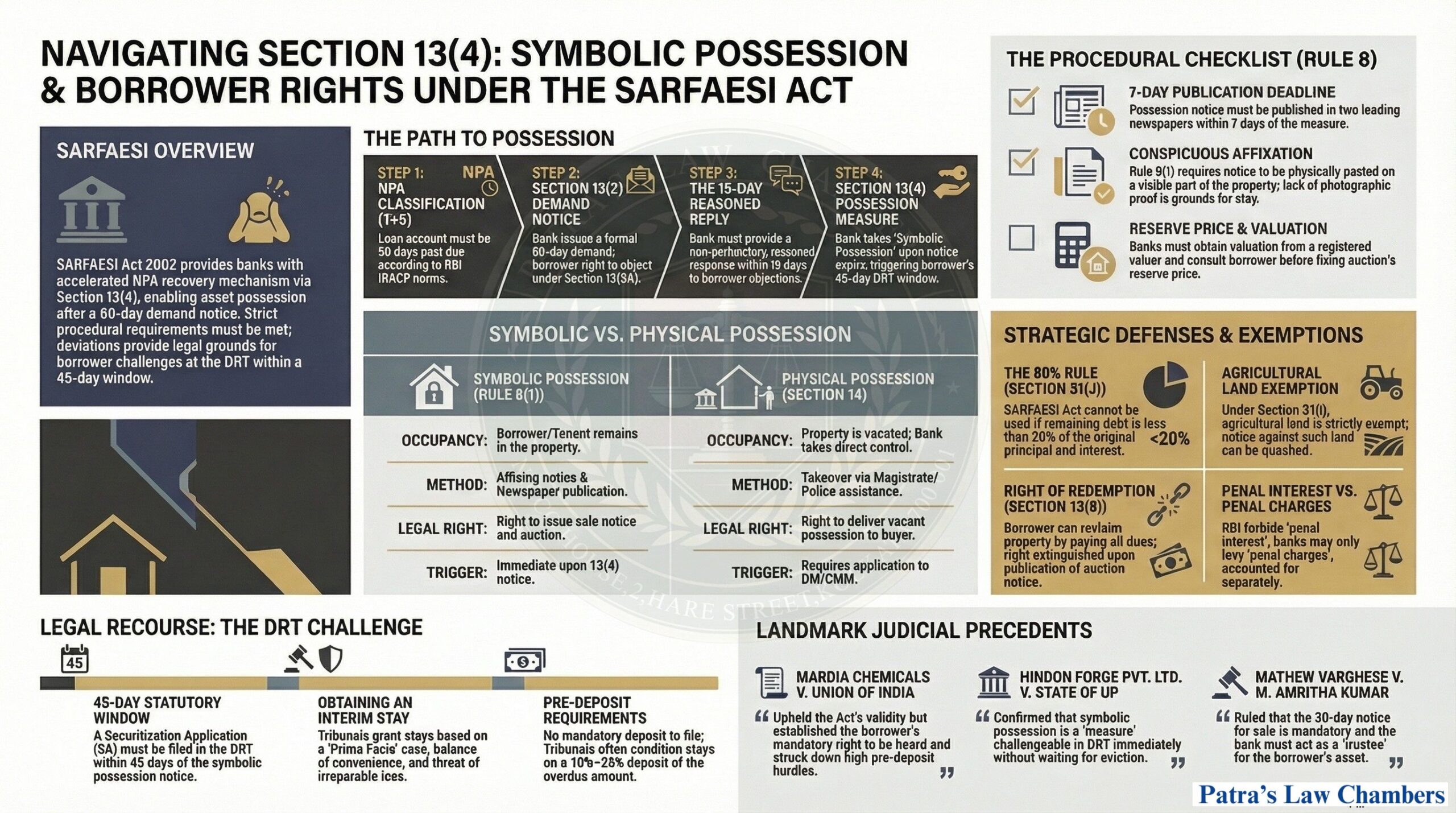
The Securitisation and Reconstruction of Financial Assets and Enforcement of Security Interest (SARFAESI) Act, 2002, was birthed from a systemic necessity to address the escalating crisis of Non-Performing Assets (NPAs) that threatened the liquidity and stability of the Indian banking sector.1 Prior to its enactment, financial institutions were tethered to the slow-moving machinery of civil courts and the Recovery of Debts Due to Banks and Financial Institutions (RDB) Act, 1993, which often resulted in decades of litigation before a single rupee could be recovered.1 The SARFAESI Act fundamentally altered this landscape by granting secured creditors the extraordinary power to enforce security interests without the intervention of the court or tribunal, provided the debt is secured and classified as an NPA.4 Central to this enforcement power is Section 13(4), which permits a bank to take “symbolic” or “physical” possession of a secured asset once a borrower fails to comply with a demand notice.1 This report provides an exhaustive examination of the legal defenses available to borrowers, the procedural mandates the banks must satisfy, the mechanisms for obtaining stay orders from the Debt Recovery Tribunal (DRT), and the landmark judicial precedents that define the boundaries of this power.
The Genesis and Statutory Architecture of Possession Measures
The enforcement of security interest under the SARFAESI Act is a structured process that moves from a demand for payment to the eventual takeover and sale of assets.2 The process begins with the classification of a loan account as an NPA, a status determined by the Reserve Bank of India’s (RBI) Prudential Norms on Income Recognition, Asset Classification, and Provisioning pertaining to Advances (IRACP).7 Once an account is identified as an NPA, typically after ninety days of continuous default in interest or principal payments, the bank issues a notice under Section 13(2).7 This notice serves as a formal demand, requiring the borrower to discharge the full liability within sixty days from the date of the notice.1
The Significance of Section 13(4) Measures
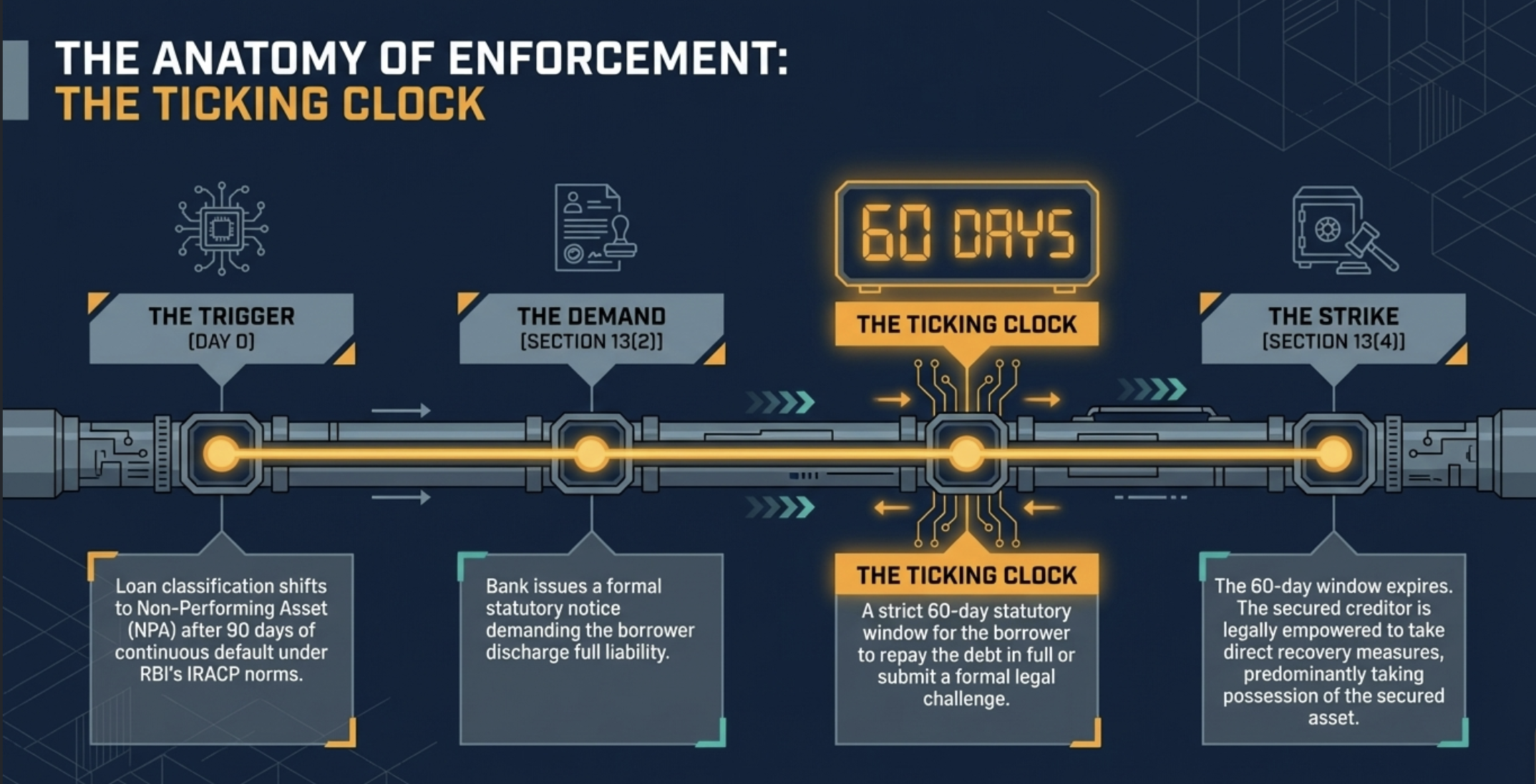
When the sixty-day window expires without full repayment or a successful challenge to the demand, the secured creditor invokes Section 13(4).1 This section empowers the bank to take one or more recovery measures, the most frequent being the taking of possession of the secured asset.1 The statute distinguishes between symbolic and physical possession, a distinction that has profound implications for the borrower’s occupancy and the bank’s ability to facilitate a sale.4
| Feature | Symbolic Possession | Physical Possession |
| Legal Basis | Rule 8(1) and 8(2) of the Security Interest Rules, 2002 | Rule 8(3) and Section 14 of the SARFAESI Act |
| Occupancy Status | The borrower or a third-party tenant continues to physically occupy the property.6 | The property is vacated, and the bank takes direct, actual control.4 |
| Method of Exercise | Delivery of notice, affixation on the property, and publication in two newspapers.6 | Actual takeover, often with the assistance of an Executive Magistrate or police.4 |
| Transfer of Rights | Allows the bank to issue a sale notice and conduct an auction.11 | Finalizes the bank’s ability to deliver vacant possession to a purchaser.12 |
| DRT Challenge | Can be challenged as a “measure” immediately upon notice.15 | Can be challenged if procedural lapses occur during the takeover.14 |
The legal theory behind symbolic possession is that the “right to possession” is transferred to the bank, even if the “actual physical custody” remains with the occupant.4 The Supreme Court in Hindon Forge Pvt. Ltd. v. State of Uttar Pradesh clarified that taking symbolic possession is an action of the bank that constitutes a “measure” under Section 13(4), thereby ripening the cause of action for a borrower to approach the DRT under Section 17.15
Defensive Strategies Against the Section 13(4) Notice
A borrower facing a Section 13(4) notice is not without recourse. The law demands strict adherence to procedural fairness, and any deviation by the bank can be exploited to set aside the possession notice.14 These defenses can be categorized into substantive challenges to the underlying debt and procedural challenges to the manner of enforcement.
Substantive Challenges to NPA Classification
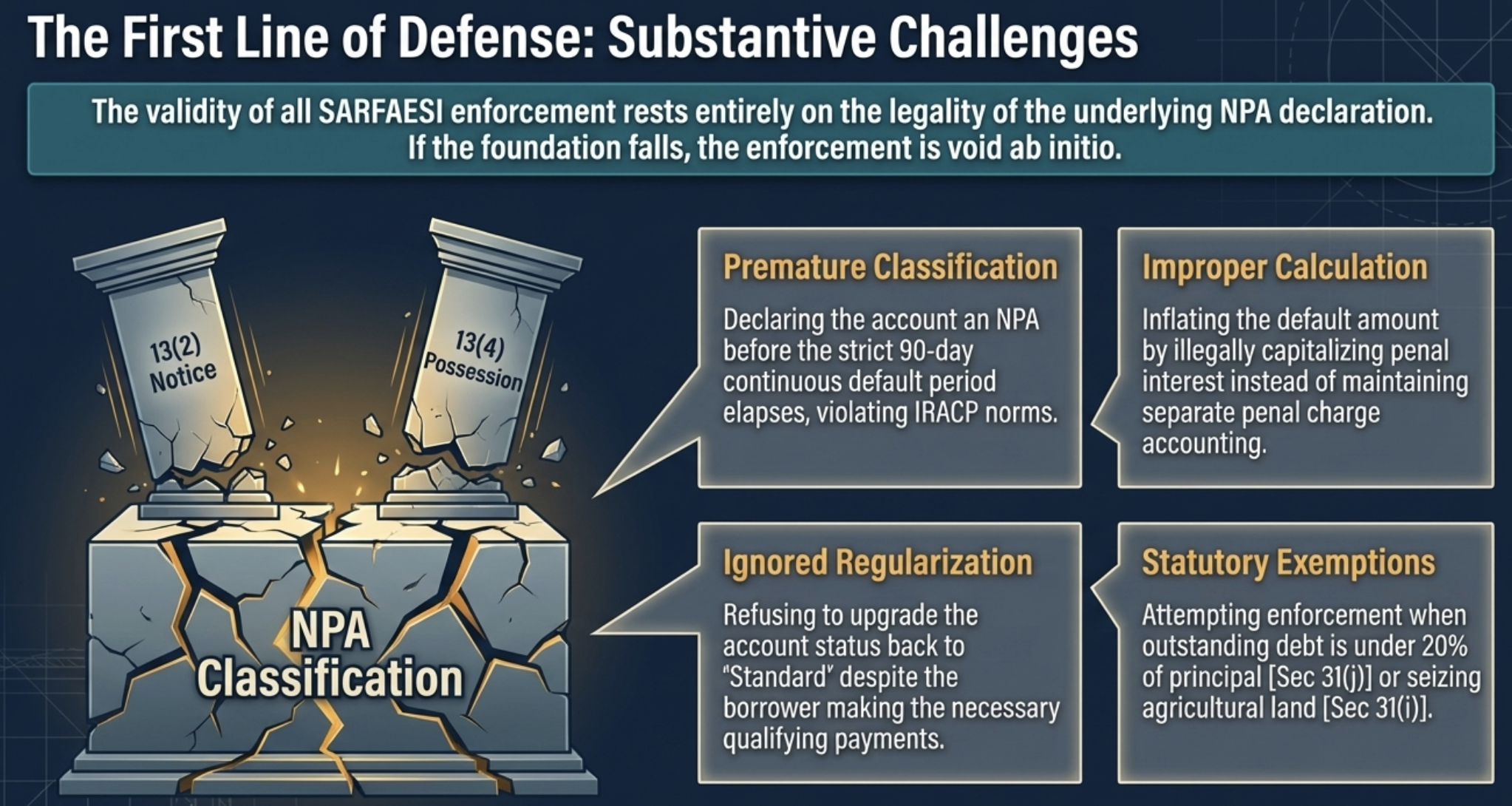
The validity of all subsequent SARFAESI actions rests on the legality of the NPA classification.14 If the bank fails to follow RBI guidelines in declaring the account an NPA, the demand notice under Section 13(2) and the possession notice under Section 13(4) are both void ab initio.14 Common substantive defenses include:
- Premature Classification: The bank declared the account an NPA before the ninety-day default period had elapsed, violating the IRACP norms.8
- Improper Calculation of Dues: The bank included penal interest, excessive charges, or failed to credit payments made by the borrower, thereby inflating the default amount.19
- Regularization of Account: The borrower made payments that should have brought the account back into the “Standard” category, but the bank refused to upgrade the account status.19
- Force Majeure and Economic Hardship: While generally harder to sustain, some defenses rely on the bank’s failure to consider government-mandated moratoriums or relief packages during crises.5
The Right to be Heard under Section 13(3A)
Following the landmark ruling in Mardia Chemicals Ltd. v. Union of India, Section 13(3A) was inserted to provide a “pre-litigation” window for the borrower.5 Upon receiving a 13(2) notice, the borrower has a right to submit a representation or an objection.5 The secured creditor is then legally mandated to consider these objections and, if they are rejected, to communicate a reasoned reply within fifteen days.5
The failure of the bank to issue a “reasoned reply” is a fatal procedural defect.22 In ITC Ltd. v. Blue Coast Hotels Ltd., the Supreme Court emphasized that the bank’s response must not be perfunctory; it must address the specific points of dispute raised by the borrower.5 If the bank proceeds to Section 13(4) without correctly disposing of the 13(3A) representation, the possession notice can be quashed by the DRT.20
Procedural Non-Compliance under Rule 8
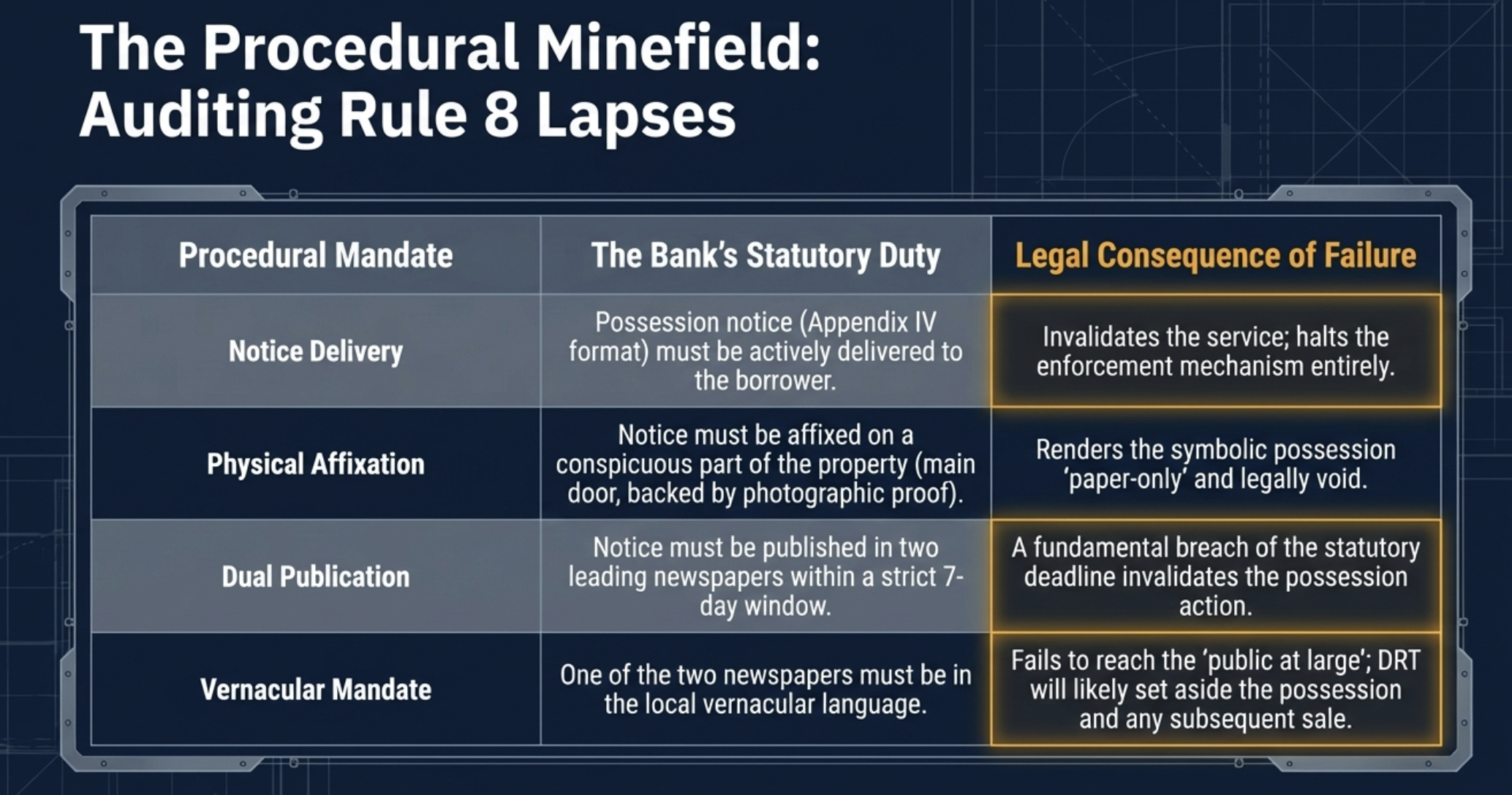
The Security Interest (Enforcement) Rules, 2002, provide a granular procedure for taking possession of immovable property.6 Rule 8 is the cornerstone of this process, and its requirements are mandatory rather than directory.23
| Procedural Requirement | Legal Mandate under Rule 8 | Consequence of Failure |
| Delivery of Notice | A possession notice in the format of Appendix IV must be delivered to the borrower.6 | Invalidates the service; prevents the bank from proceeding.24 |
| Affixation | The notice must be affixed on a conspicuous part of the property (usually the main door).6 | Renders the symbolic possession “paper-only” and invalid.10 |
| Publication | Notice must be published in two leading newspapers within seven days.6 | Fundamental breach of the seven-day statutory deadline.25 |
| Vernacular Media | One of the newspapers must be in a vernacular language of the locality.13 | Failure to reach local bidders and the borrower; invalidates notice.22 |
A common defense arises when the bank publishes the notice in newspapers that are not “widely circulated” in the locality or if the publication happens on the eighth day instead of within the seven-day window.24 Furthermore, the lack of photographic evidence showing the affixation of the notice on the property is a frequent ground for a stay order in the DRT.16
Procedural Mechanics for Moving the Debt Recovery Tribunal
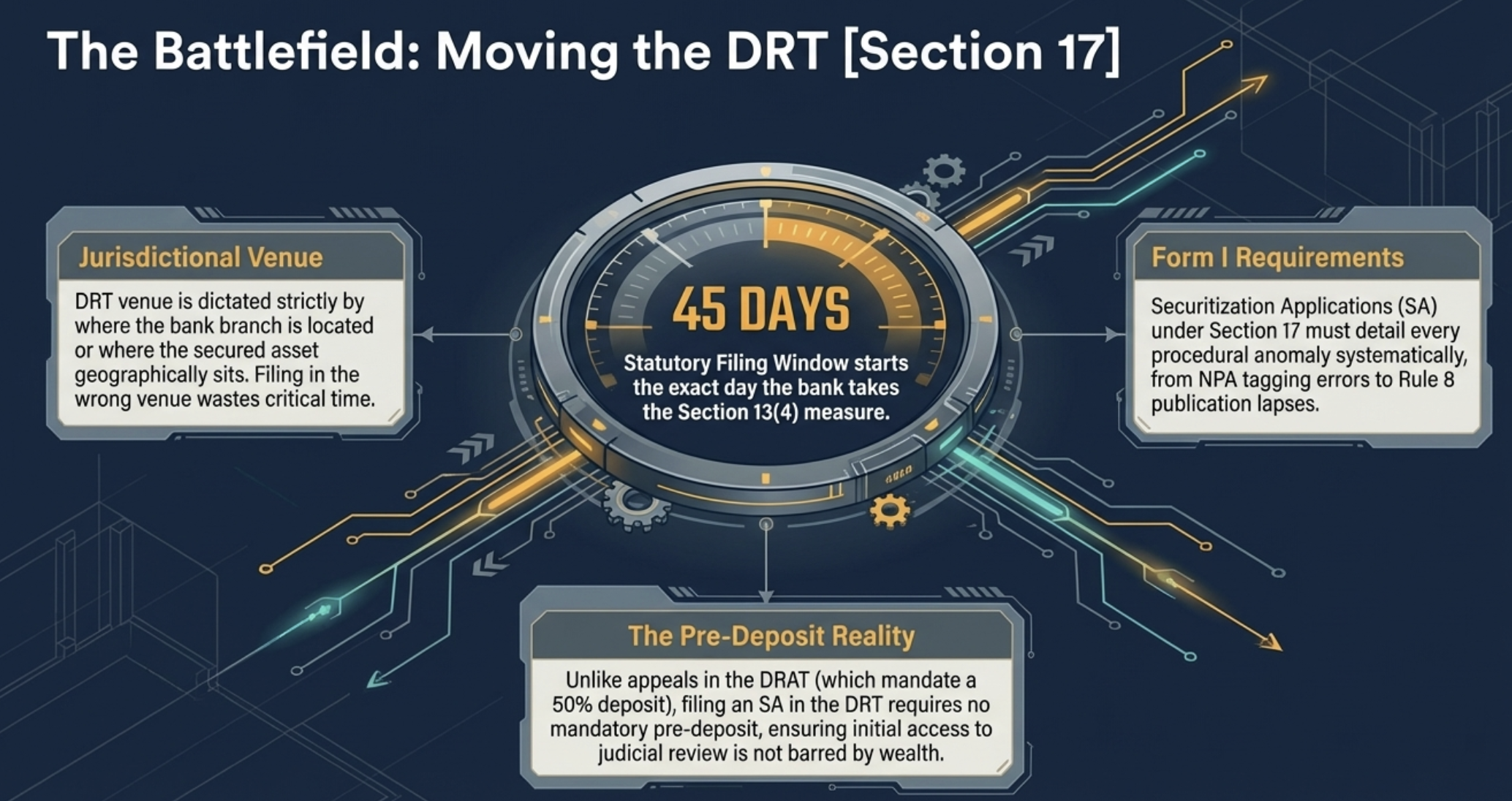
Once a Section 13(4) notice is issued, the borrower has a statutory window of forty-five days to challenge the measure by filing a Securitization Application (SA) under Section 17 before the DRT.14 This is the most effective remedy available to a borrower seeking to halt the recovery process.27
Jurisdiction and Filing Requirements
The jurisdiction of the DRT is determined by where the branch of the bank is located or where the secured asset is situated.3 For a borrower to move the DRT effectively, they must prepare the SA in “Form I” as prescribed by the DRT Rules.27 This application must detail every procedural irregularity committed by the bank, from the NPA classification to the publication of the 13(4) notice.14
One of the primary challenges for borrowers is the “pre-deposit” requirement.27 While there is no mandatory pre-deposit to file an SA in the DRT (unlike the 50% required for appeals in the DRAT), many Tribunals grant interim stays only on the condition that the borrower deposits a certain portion of the overdue amount.27 The 2004 amendment following Mardia Chemicals ensured that access to the first level of judicial review is not barred by an unreasonable deposit requirement.21
Obtaining a Stay Order
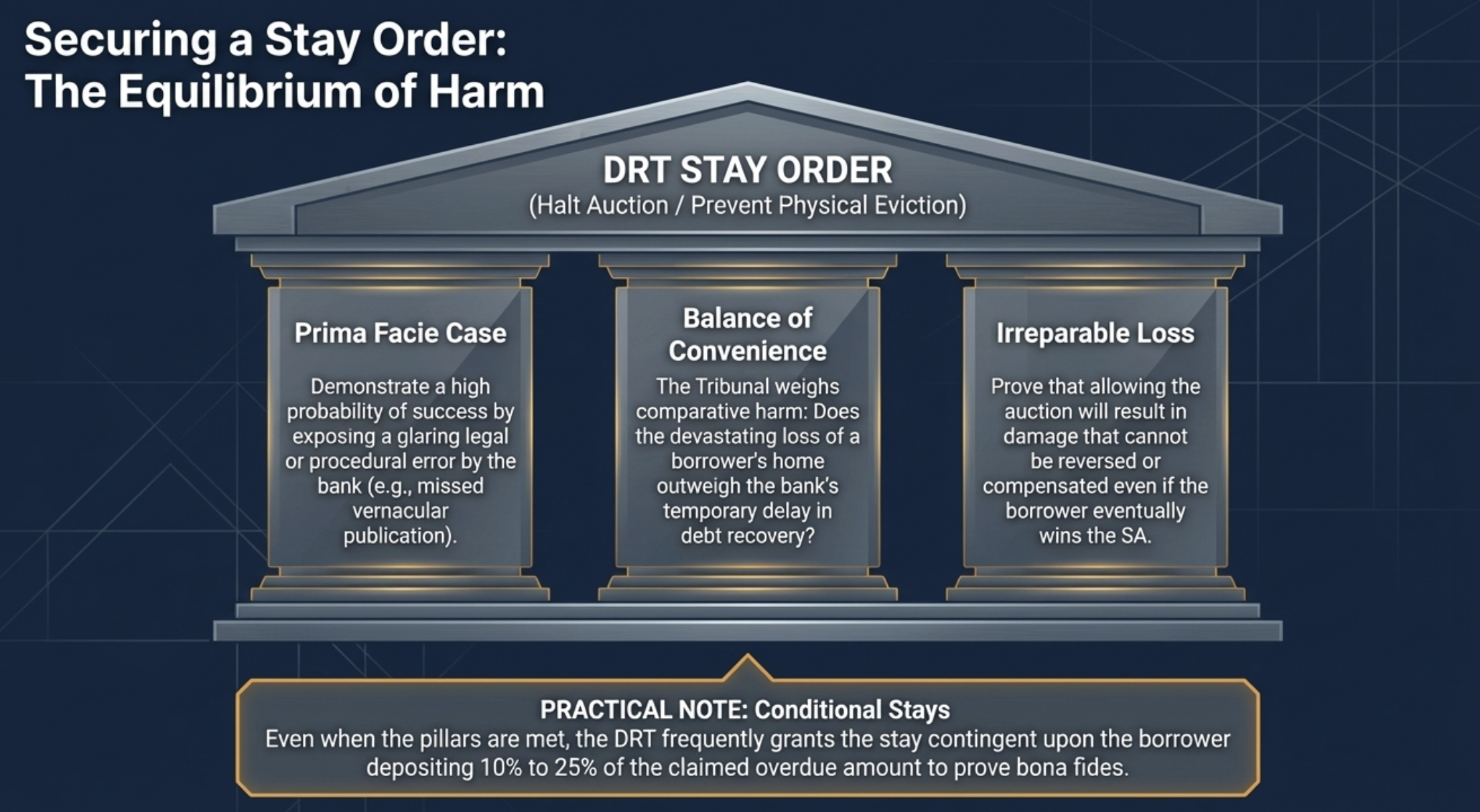
To stop an impending auction or to prevent the bank from moving from symbolic to physical possession, the borrower must move an “Interim Application” (IA) for a stay.14 The DRT exercises its power to grant a stay based on the traditional principles of equity and civil procedure:
- Prima Facie Case: The borrower must show that there is a high probability of success based on a clear legal or procedural error by the bank.28
- Balance of Convenience: The Tribunal weighs whether the harm to the borrower (losing a home or business) outweighs the harm to the bank (delay in recovery).28
- Irreparable Loss: The borrower must demonstrate that if the property is sold, it cannot be recovered later even if they win the final case.28
In practice, the DRT often grants a “conditional stay,” allowing the bank’s action to be halted provided the borrower deposits 10% to 25% of the claimed amount.28 If the borrower can prove that the bank failed to serve the 13(2) notice or failed to respond to the 13(3A) representation, the DRT may grant an “absolute stay” or even quash the 13(4) notice entirely.20
The Role of the Section 14 Application
While Section 13(4) allows for symbolic possession, many banks find that they cannot sell the property effectively while the borrower is still living there.11 Consequently, they approach the District Magistrate (DM) or Chief Metropolitan Magistrate (CMM) under Section 14 to obtain physical possession.14
The DM/CMM is not an adjudicatory authority; their role is purely administrative.8 They must verify nine specific points in an affidavit filed by the bank’s authorized officer—including whether the 13(2) notice was served and whether the account is an NPA—and once satisfied, they must provide administrative assistance to take possession.16 Borrowers often challenge these Section 14 orders by filing an amended SA in the DRT, arguing that the bank provided false information in the Section 14 affidavit.34
Landmark Judgments Governing Symbolic Possession
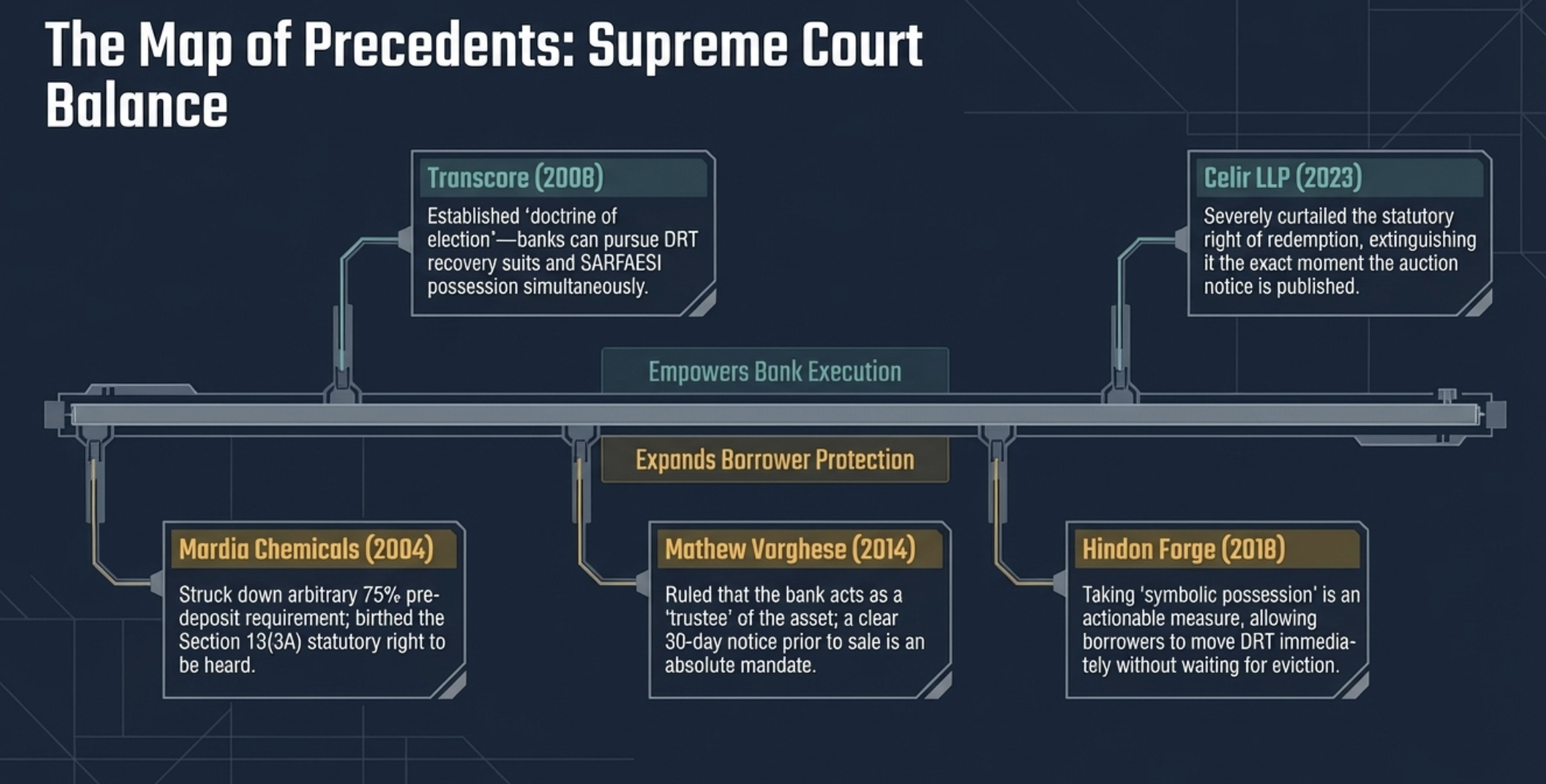
The landscape of the SARFAESI Act is continuously reshaped by the judiciary, which seeks to balance the legislative intent of “speedy recovery” with the constitutional protection of property rights under Article 300A.20
Mardia Chemicals Ltd. v. Union of India (2004)
This remains the most significant case in SARFAESI history.5 The Supreme Court upheld the constitutional validity of the Act but struck down the 75% pre-deposit requirement for filing a challenge as arbitrary.21 Crucially, the Court established that a borrower must be given a chance to raise objections, leading to the enactment of Section 13(3A).21 It also clarified that a civil suit is maintainable only in cases of “fraud” by the bank, effectively ousting civil courts from most recovery matters under Section 34.21
Transcore v. Union of India (2008)
In this case, the Supreme Court addressed the “doctrine of election”.5 It held that a bank could pursue remedies under the SARFAESI Act and the RDB Act simultaneously.5 This meant that a bank could file a recovery suit in the DRT while also taking possession of the property under Section 13(4) without having to withdraw the first action.5
Hindon Forge Pvt. Ltd. v. State of Uttar Pradesh (2018)
This judgment resolved a deep conflict among High Courts regarding when a borrower can approach the DRT.15 Some courts had argued that a borrower could only file an application once they were physically dispossessed.38 The Supreme Court overruled this, holding that taking symbolic possession under Rule 8(1) is a “measure” under Section 13(4), and the borrower is entitled to approach the DRT immediately to challenge the legality of that measure.15
Mathew Varghese v. M. Amritha Kumar (2014)
The Court ruled that the thirty-day notice for sale is mandatory.39 It held that the bank is a “trustee” of the secured asset and must ensure that the borrower has a fair opportunity to redeem the property before it is auctioned.20 Any auction held without a clear thirty-day notice period between the publication of the sale notice and the auction date is void.39
Celir LLP v. Bafna Motors (Mumbai) Pvt. Ltd. (2023)
In a decision that significantly curtailed borrower rights, the Supreme Court addressed the “Right of Redemption” under Section 13(8).5 It held that the 2016 amendment changed the cut-off point for redemption.42 Previously, a borrower could redeem the property until the sale was finalized.44 Under the new regime, the right to redeem is extinguished the moment the auction notice is published in the newspapers.42 This makes it imperative for borrowers to tender their dues or obtain a stay order before the sale notice is disseminated.
Additional Remedies and Alternative Avenues
While the DRT is the primary battleground, a borrower should consider other legal and financial strategies to protect their interests.
High Court Writ Jurisdiction (Article 226)
Borrowers frequently file writ petitions in the High Court to challenge Section 13(4) notices.14 However, judicial discipline dictates that the High Court will not entertain a writ petition if the borrower has not exhausted the remedy in the DRT.45 A writ may be entertained only if:
- The bank’s action is so patently illegal that it violates fundamental rights.45
- The DRT is not functional or is not presiding on a particular day.48
- There is a clear jurisdictional error (e.g., the bank is trying to seize agricultural land).45
One-Time Settlement (OTS) Negotiations
Parallel to litigation, borrowers should explore the possibility of a “Compromise Settlement” or OTS.14 Under the RBI’s 2023 circular, banks are encouraged to have Board-approved policies for settlements, which can provide a significant discount on interest and penal charges.20 In the DRT, a borrower can argue that they are ready and willing to settle the debt, which may influence the Tribunal to grant more time for payment rather than allowing an auction.19
Redemption Rights and Private Sales
Under Section 13(8), the borrower retains a “statutory right of redemption”.5 If the borrower can arrange the entire principal, interest, and costs before the auction notice is published, the bank is legally obligated to return the property and the title deeds.42 Additionally, a borrower can find a private buyer who is willing to pay more than the reserve price and request the bank to conduct a “sale by private treaty” under Rule 8(8), which ensures that the borrower receives the maximum possible surplus from the sale.8
Rules and Guidelines on Interest and Penal Charges
The RBI has recently tightened the rules on how banks can charge penalties on defaulting borrowers, providing new grounds for challenging the “amount claimed” in the notices.8
| RBI Guideline | Mandatory Practice | Defense Against 13(4) |
| No Penal Interest | Banks can only charge a “Penal Charge,” not “Penal Interest”.20 | If the bank capitalized penalties and charged interest on them, the notice amount is illegal.19 |
| Separate Accounting | Penal charges must be kept in a separate account from the principal.20 | Failure to separate these amounts leads to “ballooning debt” and is challengeable.19 |
| 90-Day NPA Rule | An account cannot be an NPA unless it is overdue for 90 days.7 | Premature classification renders the 13(2) and 13(4) notices invalid.9 |
| Valuation Update | Assets must be valued by a registered valuer before auction.13 | Using an outdated valuation or an internal bank estimate is a procedural lapse.19 |
Frequently Asked Questions (FAQs) Regarding Section 13(4) Notices
What is the difference between a Section 13(2) notice and a Section 13(4) notice? The 13(2) notice is a sixty-day demand for payment, informing the borrower that they have defaulted and must clear the debt.1 The 13(4) notice is the “action” notice, informing the borrower and the public that the bank has taken possession of the asset and will now proceed to sell it to recover the dues.2
How much time do I have to file a case in the DRT after receiving a possession notice? You have exactly forty-five days from the date the bank took the measure.14 If the bank pasted the notice on your door on January 1st, you must file the SA by mid-February.27 Missing this deadline is highly risky, as Tribunals are often reluctant to condone delays in SARFAESI matters.36
Can the bank take my home if I have paid more than 80% of the loan? No. Under Section 31(j) of the SARFAESI Act, the enforcement provisions do not apply if the remaining debt is less than 20% of the original principal and interest.7 If you are in this category, the bank must go through a regular civil court or the DRT recovery suit process instead of the summary SARFAESI route.8
Can the bank seize my agricultural land? No. Agricultural land is expressly exempt from the SARFAESI Act under Section 31(i).7 If a bank issues a 13(4) notice for agricultural property, it can be quashed immediately in the DRT or through a Writ Petition in the High Court for lack of jurisdiction.5
What happens if the bank does not respond to my objections? If you sent a representation under Section 13(3A) and the bank did not send a reasoned reply within fifteen days, any 13(4) notice they issue afterward is legally invalid.20 This is one of the strongest grounds for getting an immediate stay order from the DRT.20
Do I have to vacate the house immediately after a symbolic possession notice? No. Symbolic possession means the bank has taken “legal control,” but you still have “physical custody”.4 You do not have to vacate until the bank gets an order from the Magistrate under Section 14 and arrives with the police for physical possession.4 However, the bank can still auction the property while you are living there.11
Can I challenge the “Reserve Price” of my property? Yes. Under Rule 8(5), the bank must consult with the borrower and obtain a valuation from an approved valuer before fixing the reserve price.13 If you believe your property is undervalued, you can challenge the sale notice in the DRT and provide your own valuation report from a registered valuer to show that the bank is conducting a distress sale at an unfair price.19
What is the consequence of not publishing the notice in a vernacular newspaper? It is a mandatory requirement under Rule 8(2).6 If the property is in West Bengal and the bank only publishes the notice in English newspapers, skipping a Bengali publication, the possession is illegal.25 The DRT will likely set aside the possession and the subsequent sale because the “public at large” in the local area was not properly notified.13
Can I stop the auction if I find a buyer myself? Yes, but you must act quickly. You can exercise your right of redemption by paying the bank in full before the auction notice is published.42 Alternatively, you can move the DRT to allow a “private sale” under Rule 8(8) if your buyer is offering more than the bank’s auction price.8
Conclusion and Recommendations for Borrowers
The Section 13(4) symbolic possession notice represents the most critical juncture in a borrower’s struggle to retain their property. The SARFAESI Act is a powerful weapon in the hands of banks, designed for efficiency and finality.3 However, the strength of the Act is its Achilles’ heel—because the procedure is so summary and bypasses the courts, the law requires “absolute perfection” in the bank’s procedural conduct.19
Borrowers must prioritize the following actions:
- Immediate Objection: Always respond to the 13(2) notice under Section 13(3A) to force the bank to give a reasoned reply.5
- Audit the Procedure: Check every date and every newspaper. Did the bank publish within seven days? Was there a vernacular publication? Was the notice affixed?.13
- Timely Filing: Do not wait for physical eviction. Approach the DRT within forty-five days of the symbolic possession notice to challenge the “measure”.15
- Monitor the Valuation: Ensure the property is not being sold at an “undervalued” price, as this is a breach of the bank’s duty as a trustee.13
While the 2016 amendments and rulings like Celir LLP have narrowed the window for redemption, the DRT remains a robust forum for correcting the wrongful use of power by financial institutions.27 By leveraging procedural lapses and the mandatory requirements of Rule 8, borrowers can secure stay orders, regain possession, and ensure that the recovery process is conducted with the fairness and transparency demanded by the Constitution.14
Works cited
- Understanding Section 13(4) of SARFAESI Act | Bajaj Finance, accessed on March 27, 2026, https://www.bajajfinserv.in/understanding-sec-13-4-of-sarfaesi-act
- What to Do if Your Property is Taken Under SARFAESI: A Step-by-Step Guide | CG Legal, accessed on March 27, 2026, https://www.cglegal.in/blog-13-2-demand-notice-13-4-possession-notice-sarfaesi-drt
- Debt Recovery in India: Legal Process Explained – Legistify, accessed on March 27, 2026, https://legistify.com/blogs/debt-recovery-in-india/
- Understanding Symbolic vs Physical Possession under SARFAESI …, accessed on March 27, 2026, https://www.cglegal.in/blog-symbolic-possession-physical-property
- Section 13 of the SARFAESI Act: Enforcement of Security Interest – The Legal School, accessed on March 27, 2026, https://thelegalschool.in/blog/section-13-sarfaesi-act
- What is Symbolic Possession under Sarfaesi Act? – ipr junction, accessed on March 27, 2026, https://iprjunction.in/f/what-is-symbolic-possession-under-sarfaesi-act?blogcategory=Sarfaesi+Act
- SARFAESI ACT, 2002- Applicability, Objectives, Process, Documentation – ClearTax, accessed on March 27, 2026, https://cleartax.in/s/sarfaesi-act-2002
- SARFAESI Act Explained: Borrower Rights and Protection Guide – Airtel, accessed on March 27, 2026, https://www.airtel.in/blog/personal-loan/sarfaesi-act-explained-borrowers-know/
- Borrower’s Consent as Waiver of SARFAESI Auction Formalities and Validity of NPA Classification on the 90th Day: Commentary on CANARA BANK (Erstwhile Syndicate Bank) v. Karishma Enterprises & Ors., 2025 DHC 10911-DB – CaseMine, accessed on March 27, 2026, https://www.casemine.com/commentary/in/borrower%E2%80%99s-consent-as-waiver-of-sarfaesi-auction-formalities-and-validity-of-npa-classification-on-the-90th-day:-commentary-on-canara-bank-(erstwhile-syndicate-bank)-v.-karishma-enterprises-&-ors.,-2025-dhc-10911-db/view
- Quashing of possession notice under SARFAESI Act due to non-compliance of mandatory notice requirements: DRAT KOLKATA – Dreamlaw, accessed on March 27, 2026, https://dreamlaw.in/quashing-of-possession-notice-under-sarfaesi-act-due-to-non-compliance-of-mandatory-notice-requirements-drat-kolkata/?print=print
- Physical vs Symbolic Possession in Property: Key Differences Explained – IIFL One Home, accessed on March 27, 2026, https://www.iiflonehome.com/blog/physical-vs-symbolic-possession-in-property-key-differences-explained
- “PHYSICAL” OR “SYMBOLIC” Possession – Which is better? – FindAuction, accessed on March 27, 2026, https://findauction.in/blog/physical-or-symbolic-possession
- Section 8 in The Security Interest (Enforcement) Rules, 2002 – Indian Kanoon, accessed on March 27, 2026, https://indiankanoon.org/doc/165827732/
- What to Do After Court Possession Notice? – The Law Brigade …, accessed on March 27, 2026, https://thelawbrigade.com/general-research/what-to-do-after-court-possession-notice/
- Hindon Forge Private Limited v. The State of Uttar Pradesh – Argus Partners, accessed on March 27, 2026, https://www.argus-p.com/updates/updates/hindon-forge-private-limited-v-the-state-of-uttar-pradesh/
- DEBTS RECOVERY TRIBUNAL 1, KOLKATA – DRT, accessed on March 27, 2026, https://cis.drt.gov.in/drtlive/order/pdf/pdf1.php?file=L3VwbG9hZHMvZHJ0L2RydGNvdXJ0L2RhaWx5X29yZGVyLzIwMjUvSnVseS8xOTAxMTAwMDUzNTIwMjJfMzcxNDkyZmQ4M2U0ZmZhMWVlMTE2NTNiNzQ5NWUwYzEucGRmKioqODk2MTQjMSNrb2xrYXRhMQ==
- Hindon Forge (P) Ltd. & Anr. v. State of Uttar Pradesh – Taxpublishers.in, accessed on March 27, 2026, https://taxpublishers.in/ShowCL?98135000?a0
- DRAT February 2026 Important Judgments on SARFAESI & Debt Recovery – IBC Laws, accessed on March 27, 2026, https://ibclaw.in/drat-february-2026-important-judgments-on-sarfaesi-debt-recovery/
- Received a DRT Notice? Key Steps to Take Within 30 Days – The Law Brigade Publishers, accessed on March 27, 2026, https://thelawbrigade.com/general-research/received-a-drt-notice-key-steps-to-take-within-30-days/
- Defend Section 13(2) and 13(4) SARFAESI notice – Patras Law Chamber, accessed on March 27, 2026, https://patraslawchambers.com/defend-section-132-and-134-sarfaesi-notice/
- Mardia Chemicals Ltd. vs. Union of India: Constitutional Validity and Enforcement Framework of the SARFAESI Act, 2002 – Bhatt & Joshi Associates, accessed on March 27, 2026, https://bhattandjoshiassociates.com/mardia-chemicals-ltd-v-union-of-india-constitutional-validity-and-enforcement-framework-of-the-sarfaesi-act-2002/
- DRT: Guide to Challenging S.13(2), S.13(4) Notices under SARFAESI, accessed on March 27, 2026, https://patraslawchambers.com/drt-guide-to-challenging-s-132-s-134-notices-under-sarfaesi/
- Security Interest (Enforcement) Rules, 2002., accessed on March 27, 2026, https://www.arcindia.co.in/assets/img/Security-Interest-Enforcement-Rules-2002.pdf
- SARFAESI: Mandatory Affixture & Publication Without Postal Service? – Supreme Today AI, accessed on March 27, 2026, https://supremetoday.ai/issue/sarfaesi:-mandatory-affixture-&-publication-without-postal-service
- Hind Agro Industries Vs. Authorized Officer, Syndicate Bank And Ors On 19 August, 2023 – Legitquest, accessed on March 27, 2026, https://www.legitquest.com/case/hind-agro-industries-v-authorized-officer-syndicate-bank-and-ors/7893AA
- DEBT RECOVERY TRIBUNAL AND DEBT RECOVERY APPELLATE TRIBUNAL – RKS Associate, accessed on March 27, 2026, https://www.rksassociate.com/debt-recovery-tribunal-and-debt-recovery-appellate-tribunal/
- Section 17 of SARFAESI Act, 2002: Right to Appeal, Provisions & Case Laws, accessed on March 27, 2026, https://thelegalschool.in/blog/section-17-sarfaesi-act
- Stay on Bank Auction in Delhi – SARFAESI Act – Raizada Law Associates, accessed on March 27, 2026, https://www.raizadaassociates.com/blog/stay-on-bank-auction-in-delhi-sarfaesi-act/
- When and How to Approach the DRT for Loan Recovery Cases – The Law Brigade Publishers (India), accessed on March 27, 2026, https://thelawbrigade.com/general-research/when-and-how-to-approach-the-drt-for-loan-recovery-cases/
- ISSUE XI : Section 17 of SARFAESI: Is it effective for the borrowers?, accessed on March 27, 2026, https://psalegal.com/issue-xi-section-17-of-sarfesi-is-it-effective-for-the-borrowers/
- Balancing Financial Efficiency and Borrower Protections: A Comprehensive Analysis of Mardia Chemicals Ltd. v. Union Of India (2004 INSC 244) – CaseMine, accessed on March 27, 2026, https://www.casemine.com/commentary/in/balancing-financial-efficiency-and-borrower-protections:-a-comprehensive-analysis-of-mardia-chemicals-ltd.-v.-union-of-india-(2004-insc-244)/view
- Debts Recovery Tribunal-III, Delhi – DRT, accessed on March 27, 2026, https://cis.drt.gov.in/drtlive/order/pdf/pdf1.php?file=L3VwbG9hZHMvZHJ0L2RydGNvdXJ0L2RhaWx5X29yZGVyLzIwMjIvTWFyY2gvMDcwMTMwMDAzMDYyMDIyXzRmYjkwY2ZlZjIxMjc0NzUyYThjNzg4NDMwMjc0Y2ZmLnBkZioqKjE2NzQyNCMxI2RlbGhp
- Landmark Judgments on Banking Laws [2022] Part I – SCC Online, accessed on March 27, 2026, https://www.scconline.com/blog/post/2023/03/22/landmark-judgments-on-banking-laws-2022-part-i/
- the demand notice and possession notice and non-approving the – DRT, accessed on March 27, 2026, https://cis.drt.gov.in/drtlive/order/pdf/pdf1.php?file=L3VwbG9hZHMvZHJ0L2RydGNvdXJ0L2RhaWx5X29yZGVyLzIwMjIvTWF5LzE5MDEzMDAxMTk2MjAyMV8xYjIwZGVjNjgzZjA5NGExMTY5OTBjZjYyYmVjNzhlNi5wZGYqKiozOTkwNCMxI2tvbGthdGEz
- BORROWER’S RIGHT TO REDEEM MORTGAGED PROPERTY CEASES UPON PUBLICATION OF AUCTION NOTICE – Legal 500, accessed on March 27, 2026, https://www.legal500.com/developments/thought-leadership/borrowers-right-to-redeem-mortgaged-property-ceases-upon-publication-of-auction-notice/
- Akshat Commercial Pvt. Ltd. & Anr vs Kalpana Chakraborty & Ors on 30 April, 2010, accessed on March 27, 2026, https://indiankanoon.org/doc/37966736/
- HINDON FORGE PVT. LTD. vs STATE OF UTTAR PRADESH THROUGH DISTRICT MAGISTRATE GHAZIABAD – 2018 Supreme(SC) 1107, accessed on March 27, 2026, https://supremetoday.ai/doc/judgement/00100062390
- M/S Hindon Forge Pvt. Ltd. vs The State Of Uttar Pradesh Thr. District … on 1 November, 2018, accessed on March 27, 2026, https://indiankanoon.org/docfragment/80182706/?big=2&formInput=symbolic%20possession
- Any sale or transfer of a Secured Asset cannot take place without duly informing the borrower of the time and date of such sale or transfer in order to enable the borrower to tender the dues of the SECURED CREDITOR with all costs, charges and expenses – Mathew Varghese Vs. M. Amritha Kumar and Ors. – Supreme Court – IBC Laws, accessed on March 27, 2026, https://ibclaw.in/mathew-varghese-vs-m-amritha-kumar-ors-supreme-court/
- Mathew Varghese vs. M. Amritha Kumar & Ors. (2014) 5 SCC 610. – KMNP Law, accessed on March 27, 2026, https://kmnplaw.com/mathew-varghese-vs-m-amritha-kumar-ors-2014-5-scc-610/
- Mathew Varghese v. M. Amritha Kumar And Others | Supreme Court Of India | Judgment | Law | CaseMine, accessed on March 27, 2026, https://www.casemine.com/judgement/in/56b48d62607dba348fff2a29
- Supreme Court Clarifies Amended Section 13(8) SARFAESI Act; Right of Redemption Extinguished Upon Notice Publication. – – CaseGuru, accessed on March 27, 2026, https://caseguru.in/judgements/supremecourt/supreme-court-clarifies-amended-section-138-sarfaesi-act-right-of-redemption-extinguished-upon-notice-publication
- SUPREME COURT DECIDES UPON THE REDEMPTION RIGHT OF THE BORROWER AND PROSPECTIVE APPLICATION OF THE AMENDMENT UNDER SECTION 13(8) OF THE SARFAESI ACT. – GNS Legal, accessed on March 27, 2026, https://www.gnslegal.in/supreme-court-decides-upon-the-redemption-right-of-the-borrower-and-retrospective-application-of-the-amendment-under-section-138-of-the-sarfaesi-act/
- Right of Redemption and Foreclosure- Under SARFAESI Act – Economic Laws Practice, accessed on March 27, 2026, https://elplaw.in/leadership/right-of-redemption-and-foreclosure-under-sarfaesi-act/
- Gujarat High Court: “Once the statutory bar applies, no writ jurisdiction can override it” – Court dismisses petition challenging SARFAESI proceedings – Raw Law, accessed on March 27, 2026, https://rawlaw.in/gujarat-high-court-once-the-statutory-bar-applies-no-writ-jurisdiction-can-override-it-court-dismisses-petition-challenging-sarfaesi-proceedings/
- Reportable IN THE SUPREME COURT OF INDIA CIVIL APPELLATE JURISDICTION CIVIL APPEAL NO., accessed on March 27, 2026, https://api.sci.gov.in/supremecourt/2024/11545/11545_2024_2_1501_62321_Judgement_15-Jul-2025.pdf
- * IN THE HIGH COURT OF DELHI AT NEW DELHI % Date of Decision: 30.05.2025 + W.P.(C) 7939/2025, CM APPLs 34917-18/2025 B, accessed on March 27, 2026, https://delhihighcourt.nic.in/app/showFileJudgment/MKO30052025CW79392025_182824.pdf
- Calcutta High Court, accessed on March 27, 2026, https://calcuttahighcourt.gov.in/Show-Judgment-File/2022~wpa_18157_e.pdf
- IN THE HIGH COURT OF MADHYA PRADESH AT INDORE – Mphc.gov.in, accessed on March 27, 2026, https://mphc.gov.in/upload/indore/MPHCIND/2024/RP/453/RP_453_2024_FinalOrder_03-11-2025.pdf