Cross-border Foreigners’ Marriages in India: the complete legal guide for 2026
Creditor and contributor of this article:
Patra’s Law Chambers:
About Us:
Patra’s Law Chambers is a law firm with offices in Kolkata & Delhi, offering comprehensive legal services across various domains. Established in 2020 by Advocate Sudip Patra (Advocate, Supreme Court of India & Calcutta High Court) an alumnus of the Prestigious Rajiv Gandhi School of Intellectual Property Law, IIT Kharagpur ,with Post Graduate diploma in Business Law from IIM Calcutta, the firm specializes in Civil, Criminal, Writs,High Court Matters, Trademark, Copyright, Company, Tax, Banking, Property disputes, Service law, Family law, and Supreme Court matters.You can know more about us in here
Kolkata Office:
NICCO HOUSE, 6th Floor, 2, Hare Street, Kolkata-700001 (Near Calcutta High Court)
Delhi Office:
House no: 4455/5, First Floor, Ward No. XV, Gali Shahid
Bhagat Singh, Main Bazar Road, Paharganj, New Delhi-110055
Website: www.patraslawchambers.com
Email: [email protected]
Phone: +91 890 222 4444/ +91 7003 715 325
Any Indian citizen, NRI, OCI holder, or foreign national can legally marry in India under the right legal framework — but the process demands careful navigation of notice periods, documentation, and jurisdiction-specific rules. The Special Marriage Act, 1954 remains the primary pathway for cross-border and inter-faith marriages, LawCrust while the Foreign Marriage Act, 1969 governs marriages solemnized at Indian embassies abroad. lawchakra Whether you are an Indian citizen marrying a foreigner in India, two Indians marrying overseas, or an NRI registering a marriage in West Bengal, this guide covers every legal provision, document requirement, and procedural step you need.
India’s cross-border marriage framework sits across four major statutes — the Special Marriage Act, the Foreign Marriage Act, the Hindu Marriage Act, and the Indian Christian Marriage Act — each with distinct eligibility criteria, notice periods, and documentation demands. Recent High Court and Supreme Court judgments have reshaped key aspects of this landscape, from the Delhi High Court confirming that foreigners can marry under the Special Marriage Act without any citizenship requirement, Live Law to the Allahabad High Court declaring the 30-day notice period directory rather than mandatory. Understanding which law applies, what documents to gather, and how state-specific rules (particularly West Bengal’s MARREG portal system) interact with central legislation can mean the difference between a smooth registration and months of bureaucratic delay.
The four legal frameworks that govern cross-border marriages
Special Marriage Act, 1954 — the secular, universal pathway
The Special Marriage Act (SMA) is India’s religion-neutral civil marriage law Wikipedia and the most commonly used framework for cross-border marriages. Legal AirBestdivorcelawyer Its defining feature lies in Section 4, which permits marriage between “any two persons” — not “any two citizens.” This critical distinction, confirmed by the Delhi High Court in 2023, means that even two foreign nationals can marry under the SMA in India. AdvocateinchandigarhLive Law
Section 4 conditions require that neither party has a living spouse, both are of sound mind, the groom has completed 21 years and the bride 18 years of age, and the parties are not within prohibited degrees of relationship. Wikipedia Citizenship appears only in Section 4(e), which applies exclusively to marriages solemnized in Jammu & Kashmir. Advocateinchandigarhindiacode
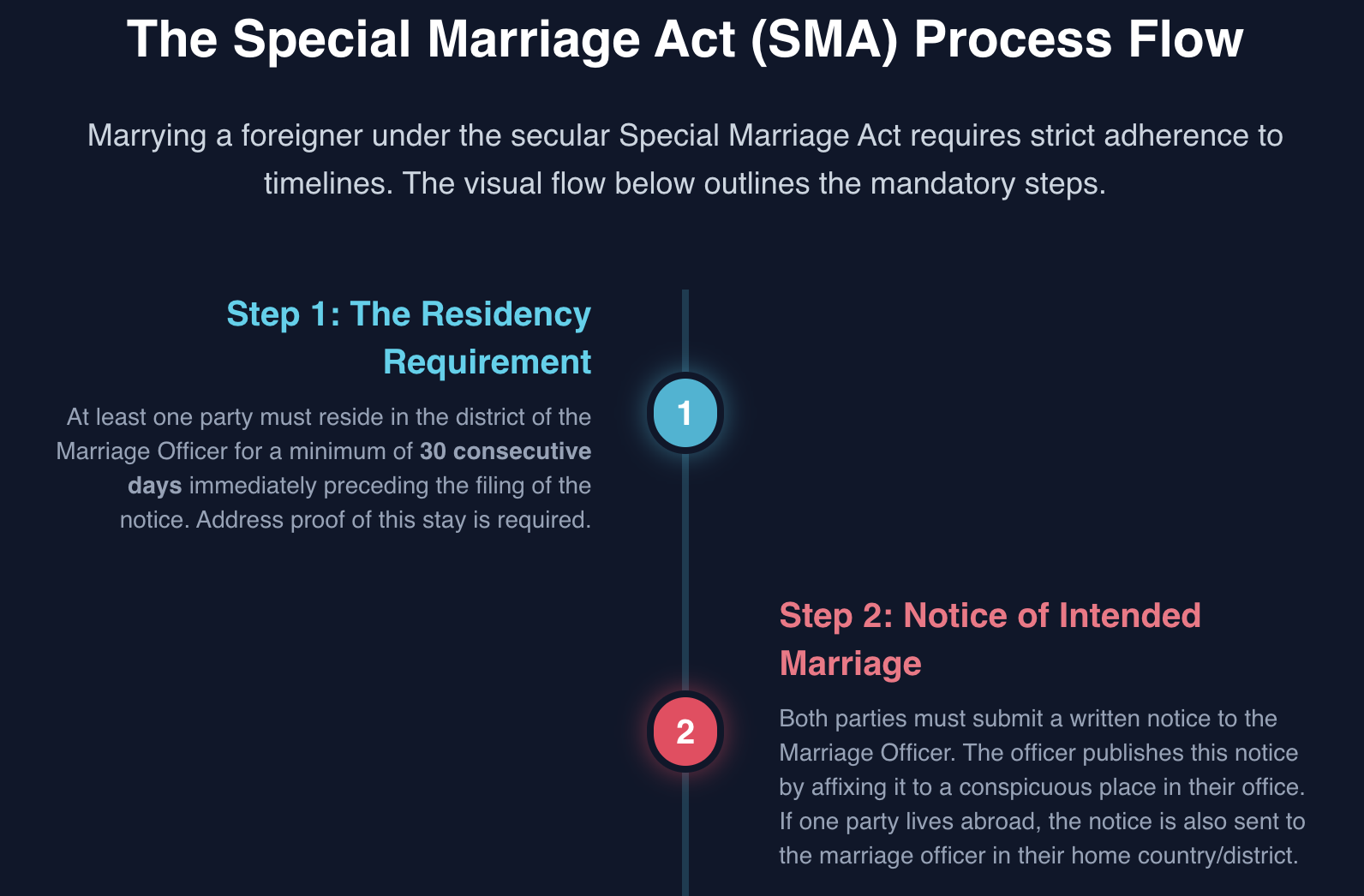
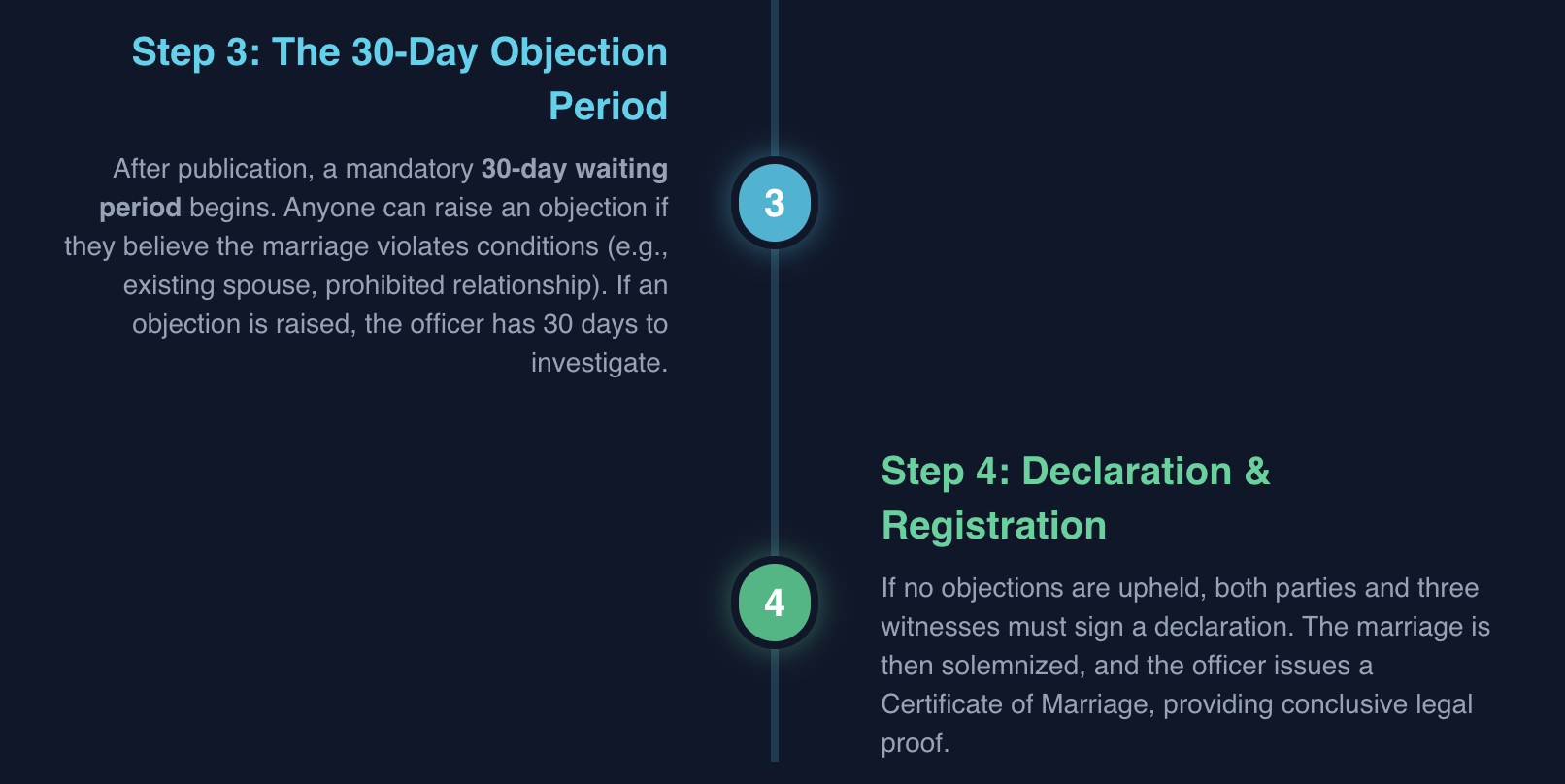
The SMA imposes a 30-day notice period under Section 5. At least one party must have resided in the Marriage Officer’s district for not less than 30 days immediately before filing the notice. Wikipedia The Marriage Officer publishes the notice under Section 6, and any person may object within 30 days Business Standard under Section 7 on grounds that the marriage would violate Section 4 conditions. indiacode If an objection is received, the Marriage Officer investigates under Section 8, with a maximum inquiry period of 30 days. Either party may appeal a refusal to the District Court. Delhi Revenue Departmentindiacode
The marriage is solemnized under Section 12 at the Marriage Officer’s office, with open doors, in the presence of three witnesses. Both parties declare: “I, (A), take thee (B), to be my lawful wife (or husband).” WikipediaIndian Kanoon The Marriage Officer then issues a certificate under Section 13, which serves as conclusive evidence of the marriage. Sharks of LawIndian Kanoon If the marriage is not solemnized within three calendar months of the notice, fresh notice must be filed under Section 14. National Commission for WomenIndian Kanoon
For inter-faith couples, the SMA offers a significant advantage: neither party needs to convert or renounce their faith. LawCrustLawBhoomi However, Section 19 provides that a Hindu, Buddhist, Sikh, or Jain marrying under the SMA is deemed to have severed from their joint family, LawBhoomi and property succession is governed by the Indian Succession Act, 1925 rather than personal law — except where both parties are Hindu, Buddhist, Sikh, or Jain, in which case Section 21A applies the Hindu Succession Act. Wikipedia
Foreign Marriage Act, 1969 — marriages at Indian embassies abroad
The Foreign Marriage Act (FMA) governs marriages solemnized outside India. India Law Offices Unlike the SMA, Section 4 of the FMA requires at least one party to be an Indian citizen Indian KanoonIndia Law Offices — two foreign nationals cannot marry under this Act. India Law OfficesIndian Kanoon Every Indian diplomatic or consular officer Indian Kanoon of the rank of Second Secretary and above is designated a Marriage Officer, ElawimmigrationNational Commission for Women meaning all Indian embassies and consulates worldwide can solemnize marriages. National Commission for Women +2
The FMA mirrors the SMA’s procedural framework: a 30-day notice period under Section 5, public display and objection provisions under Sections 6–8, Indian KanoonNational Commission for Women and solemnization at the Marriage Officer’s official house (the embassy or consulate) National Commission for Women between 6 AM and 7 PM with three witnesses. Indian Kanoon +3 The certificate issued under Section 14 is conclusive evidence of the marriage. SlideShare
Section 17 is particularly important for couples who marry under foreign local law. It allows registration of already-solemnized marriages at the Indian embassy, provided at least one party is an Indian citizen. LegalhelpnriIndian Kanoon Section 18 extends the SMA’s divorce, judicial separation, and nullity provisions to all FMA marriages. Indian Kanoon +2 Section 19 explicitly preserves the validity of marriages solemnized abroad under foreign law — registration under the FMA is not mandatory for a foreign marriage to be valid in India, as the Karnataka High Court confirmed in 2025. Verdictum
Hindu Marriage Act, 1955 — no citizenship barrier for Hindu marriages
The Hindu Marriage Act (HMA) applies to any person who is Hindu, Buddhist, Jain, or Sikh by religion under Section 2. NotarykartWikipedia Section 5 permits marriage between “any two Hindus” highcourtchd — with no citizenship requirement. The Rajasthan High Court has explicitly held that refusal to register a Hindu marriage based on foreign nationality violates Article 14 of the Constitution, directing state governments to remove “Indian Citizen Mandatory” requirements from all portals. Arya Samaj Mandir
The HMA’s greatest advantage for cross-border couples is the absence of any mandatory notice period. Under Section 7, a Hindu marriage is solemnized according to customary rites Arya Samaj Mandir — when the ceremony includes Saptapadi (seven steps before the sacred fire), the marriage is complete upon the seventh step. highcourtchd Section 8(5) makes registration optional for validity, highcourtchd though it is practically essential for documentation and legal recognition abroad. Arya Samaj Mandir
A foreign national who is Hindu (or Buddhist, Jain, or Sikh) can marry under the HMA in India without the 30-day waiting period required under the SMA. Arya Samaj Mandir This makes the HMA significantly faster for eligible couples.
Indian Christian Marriage Act, 1872 — a shorter waiting period
The Indian Christian Marriage Act applies when at least one party is Christian (Section 4). JohnsonasirservicesLegal Service India It requires no citizenship. The notice period is only 4 days (14 days if a minor is involved) under Sections 41–42, far shorter than the SMA’s 30 days. Bishops and Archbishops can issue special licences bypassing the notice period entirely. Lawsection Marriages must be solemnized by a person with episcopal ordination, licensed clergy, or a Marriage Registrar appointed under the Act. The Legal Quotient
How an Indian citizen can marry a foreigner in India
#image_title
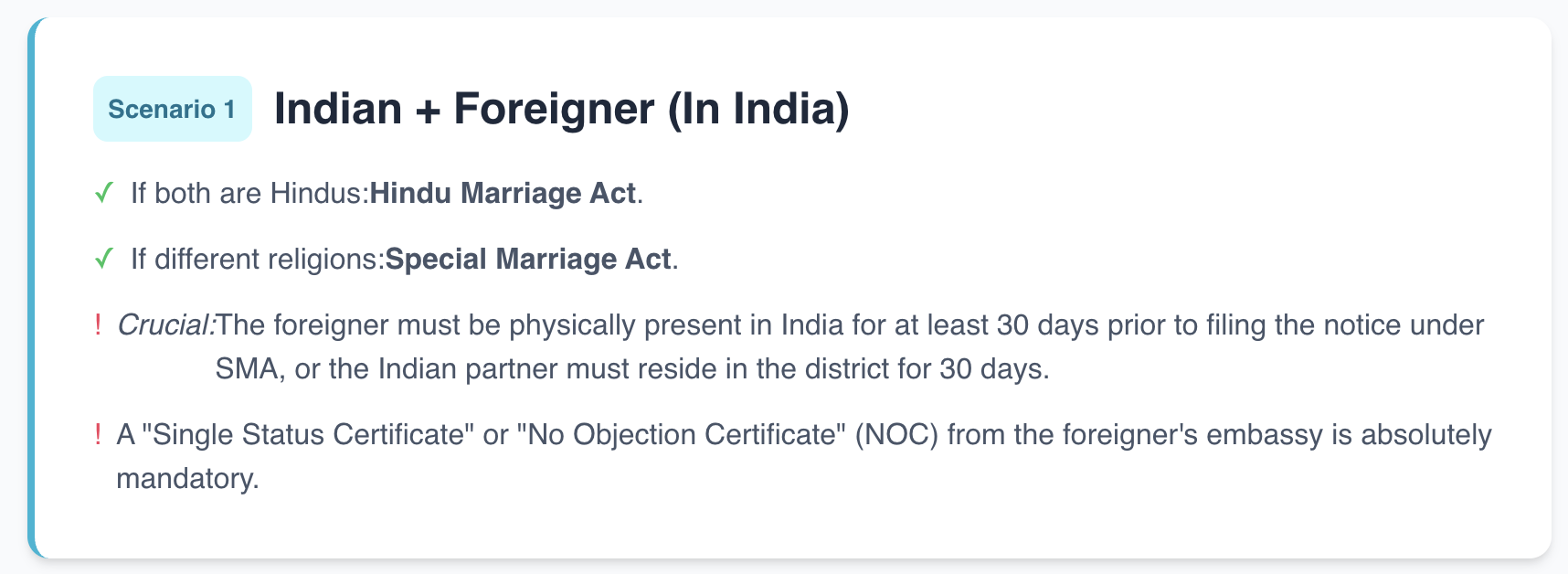
This is the most common cross-border marriage scenario, and the Special Marriage Act is the standard pathway when the couple belongs to different religions or the foreign spouse has no Indian personal law affiliation. LawCrust +2 If both parties are Hindu, the Hindu Marriage Act offers a faster route.
Step-by-step procedure under the Special Marriage Act
#image_title
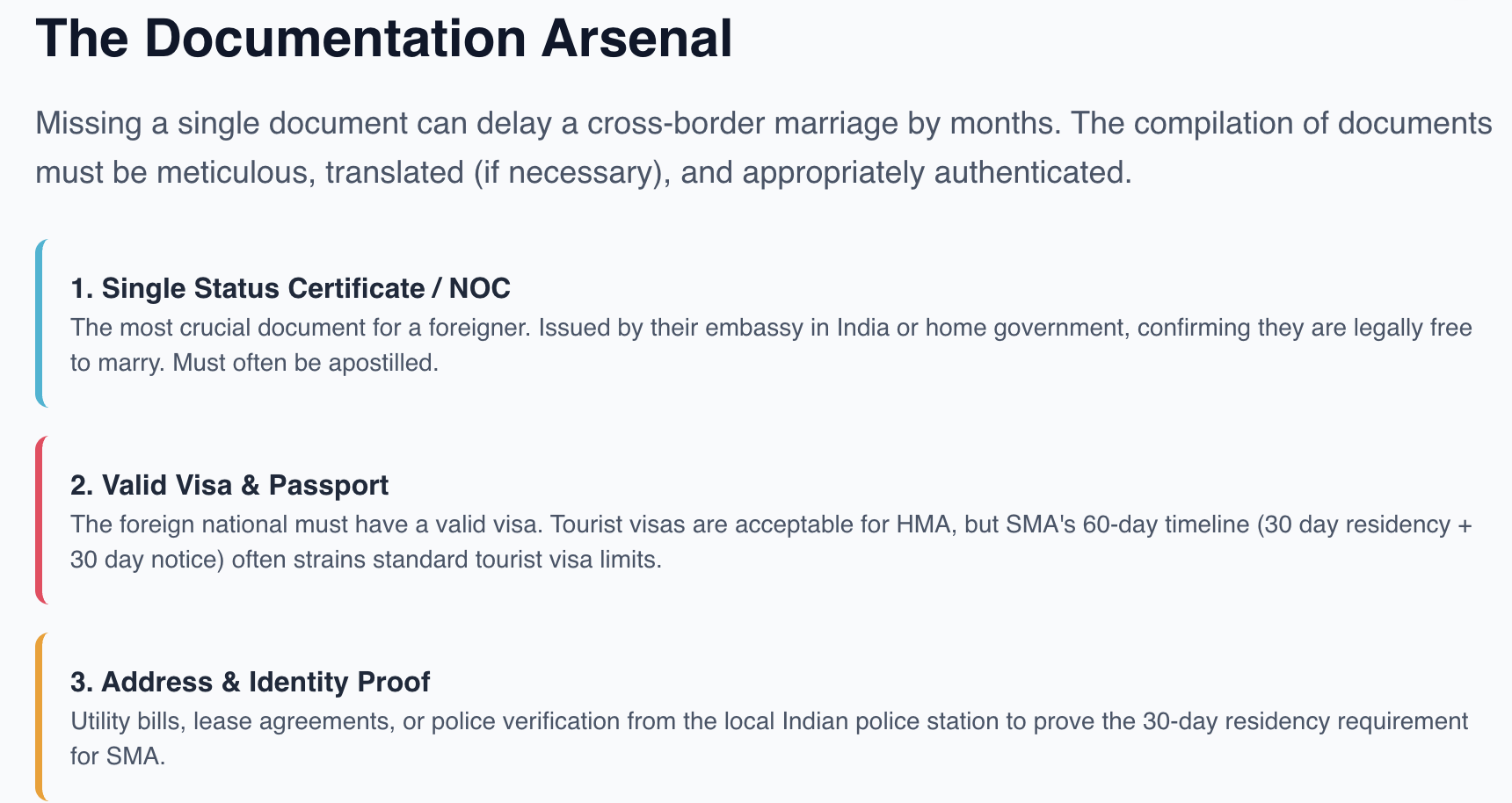
Phase 1 — Document preparation (before arriving in India). The foreign partner must obtain a valid passport with at least six months’ remaining validity, an appropriate visa Law4uBestdivorcelawyer (tourist visa valid for 60–90 days minimum), a birth certificate (apostilled for Hague Convention countries or embassy-attested for others), a Certificate of No Impediment (CNI) or No Objection Certificate (NOC) from their embassy, High Commission of India and — if previously married — a divorce decree or death certificate, properly apostilled and translated into English.
Phase 2 — Establishing residency (30 days). At least one party must reside in the Marriage Officer’s district for 30 days before filing notice. Kaanoon For the foreign partner, residency is evidenced by Kaanoon Form C (filed by the hotel or landlord with local police within 24 hours of the foreigner’s arrival), a certificate from the local police station, or FRRO registration. Kaanoon
Phase 3 — Filing notice of intended marriage. Both parties file a Notice of Intended Marriage in prescribed form with the Marriage Officer. LawCrust The Indian partner submits Aadhaar, passport, birth certificate, address proof, passport-size photographs, and an affidavit of marital status. Kaanoon The foreign partner submits their passport with visa, apostilled birth certificate, CNI/NOC, and affidavit of single status. Legalhelpnri Both file a joint affidavit declaring no prohibited relationship, age eligibility, mental soundness, and no subsisting marriage.
Phase 4 — Publication and 30-day objection period. The Marriage Officer displays the notice publicly. iPleaders Local police may conduct verification during this period. Kaanoon If one party is a foreign citizen, the notice may be sent to their embassy.
Phase 5 — Solemnization. After 30 days without valid objection, the Marriage Officer schedules the ceremony. LegalhelpnriiPleaders Both parties and three witnesses (carrying valid ID, address proof, and photographs) appear. Sharks of Law Each party makes the marriage declaration. Witnesses sign the register.
Phase 6 — Certificate issuance. The Marriage Officer enters a certificate in the Marriage Certificate Book. This certificate is legally valid globally, Sharks of Law though apostille may be needed for use in foreign countries. Advocatejaved
The total minimum timeline is approximately 60–65 days (30 days’ residency plus 30 days’ notice period plus a few days for scheduling), though if the Indian partner already resides in the district, the process takes 35–45 days from filing. BestdivorcelawyerSection 172 BNSS
The faster Hindu Marriage Act route
When both parties are Hindu (including Buddhist, Jain, or Sikh), the HMA eliminates the 30-day notice requirement entirely. Arya Samaj Mandir The marriage is solemnized per customary rites — typically in a single ceremony — and can then be registered at the local Marriage Registrar’s office. Legallands This can reduce the total timeline to just a few days, making it the preferred option for eligible cross-border couples where the foreign spouse follows a Hindu faith tradition.
How two Indian citizens can marry outside India
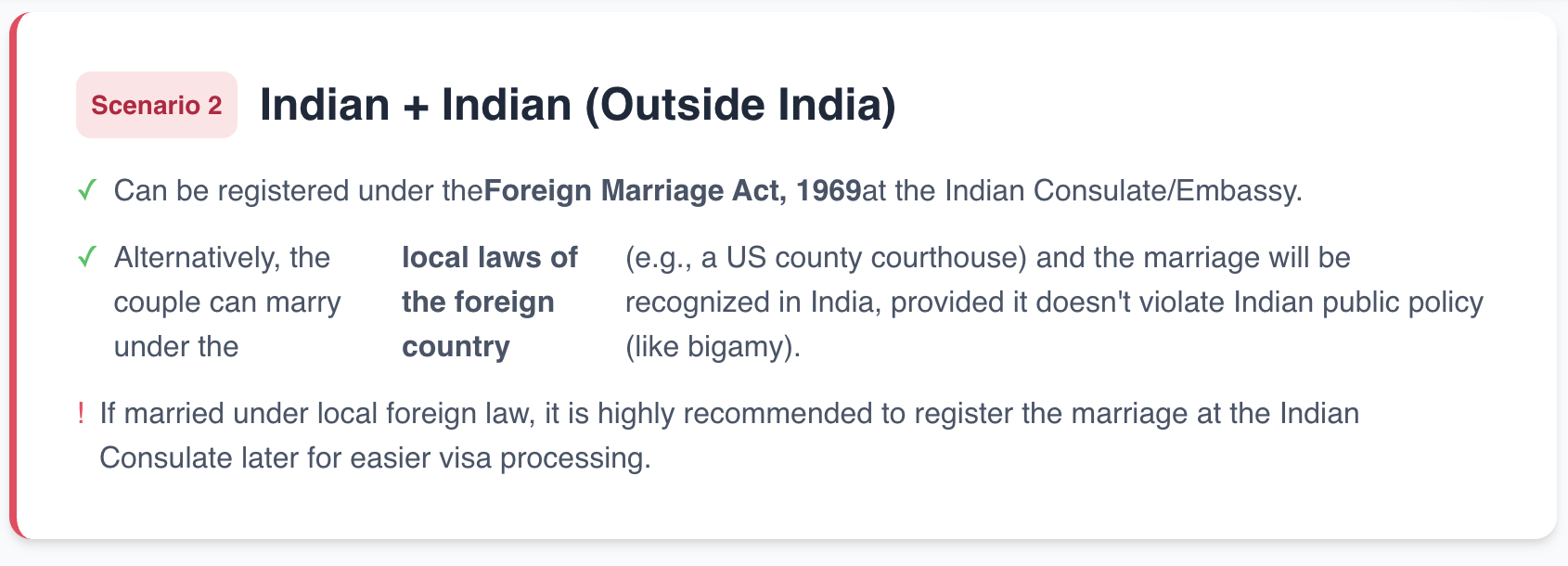
Indian citizens marrying abroad have two primary options, and both result in legally valid marriages recognized in India.
Marriage at an Indian embassy or consulate
Under Section 14 of the Foreign Marriage Act, any Indian embassy or consulate can solemnize a marriage. Indian KanoonSlideShare At least one party must have resided within the consular jurisdiction for 30 days before filing notice. Indian Kanoon The procedure mirrors the SMA: both parties and three witnesses appear before the Marriage Officer, file prescribed forms and declarations, publish notice in a widely circulated newspaper (both in the foreign country and in the Indian state of permanent residence), wait 30 days, and then complete the solemnization ceremony. CgimarseilleHigh Commission of India
Fees vary by mission — approximately USD $52 at the Washington DC embassy, Embassy of IndiaEmbassy of India EUR €48 at European missions. Embassy of India The notice remains valid for six months; if the marriage is not completed within this period, the process restarts. National Commission for Women
Marriage under local foreign law with subsequent registration
Indian citizens can marry under the law of the country where they reside. Such marriages are generally recognized in India, LegalhelpnriWise provided they comply with local law, Bda-skl do not violate Indian public policy, and do not contravene Indian personal law (particularly regarding bigamy). India Law Offices For practical purposes — passport changes, property matters, inheritance — couples should register the marriage at the Indian embassy under Section 17 of the FMA, which provides for registration of already-solemnized marriages. Indian Kanoon This requires presenting the original apostilled foreign marriage certificate, passports, address proof, and three witnesses, Indian Kanoon with processing often completed the same day.
Couples who return to India without registering at the embassy can approach the local Marriage Registrar in India, presenting the apostilled or embassy-attested foreign marriage certificate along with standard identity documents.
How an Indian citizen can marry a foreigner outside India
When an Indian citizen marries a foreign national abroad, the marriage is typically solemnized under the host country’s local law. Each country has its own requirements — civil ceremony, courthouse wedding, or church ceremony — and the Indian citizen usually needs a Certificate of No Impediment from the Indian embassy or from Indian authorities (apostilled by MEA). The marriage certificate issued under foreign local law is valid in India without mandatory FMA registration, Wise as confirmed by the Karnataka High Court in its 2025 ruling that the FMA “does not mandate that every marriage of an Indian citizen solemnized abroad must be registered under it.” Verdictum
However, registration under Section 17 at the Indian embassy is strongly recommended for practical recognition. The process requires presenting the original apostilled marriage certificate, completing prescribed forms, appearing in person with three witnesses, and paying the applicable fee. Indian Kanoon
For the marriage certificate to be used in India, documents from Hague Convention countries (125+ member nations including the US, UK, Canada, Australia, and most European countries) need only an apostille from the issuing country’s competent authority. eSanadApostilleservice Documents from non-Hague countries (UAE, Qatar, Kuwait, Bangladesh, and others) require full consular legalization — authentication by both the foreign government and the Indian embassy in that country.
NRI, OCI, and PIO marriages: status, procedures, and special issues
Understanding the legal distinctions
Non-Resident Indians (NRIs) hold Indian passports and retain full citizenship. Legal Service India They can marry under any Indian law — the SMA, HMA, or any applicable personal law — with no additional restrictions beyond those applying to resident Indians.
Overseas Citizens of India (OCI) hold foreign passports with OCI cards granting lifelong multiple-entry visa privileges. Savory Partners For marriage purposes, OCI holders are treated as foreign nationals. Government of India They must comply with foreigner-specific requirements, though they are exempt from FRRO registration and police reporting obligations. Wikipedia
Persons of Indian Origin (PIO) had their separate scheme merged into OCI in 2015. Hcipos As of January 1, 2026, PIO cards are no longer accepted for entry into India — holders must convert to OCI or obtain a standard visa. Wikipedia
NRI marriages in India
NRIs follow the same process as resident Indians but must satisfy the 30-day residency requirement if marrying under the SMA. Sharks of Law Key documents include a valid Indian passport, proof of foreign residence (visa, work permit, green card), address proof in both India and abroad, and — if previously divorced abroad — a decree attested by the competent foreign authority and counter-attested by the Indian mission.
OCI holder marriages in India
OCI cardholders marrying Indian citizens under the SMA must provide their OCI card, valid foreign passport, CNI or NOC from their country of citizenship’s embassy, and standard affidavits. The OCI card itself serves as visa documentation. After marriage, the foreign spouse of an Indian citizen or OCI holder becomes eligible for OCI registration after two continuous years of marriage. The Womb +2
A critical caution: if OCI was obtained on a spousal basis, it can be cancelled if the marriage is dissolved or found fraudulent. Government of India OCI holders must declare on each passport renewal that the marriage remains subsisting. India Law Offices
The NRI marriage fraud crisis
The scale of abandoned-spouse cases remains significant. Legal Service India The MEA received over 1,617 complaints from women deserted by NRI husbands in recent years, Deccan Herald with earlier data showing 5,298 complaints between 2016 and 2019. iPleaders The NRI Marriage Registration Bill, 2019 — which would mandate compulsory marriage registration within 30 days and allow passport impounding for non-compliance — was introduced in the Rajya Sabha but has not been enacted as of March 2026 despite Law Commission recommendations in 2024 to expand its scope. Puchd
Current protective measures include the MEA’s MADAD portal for consular grievances, Shaadi Diaries the Indian Community Welfare Fund (providing up to USD $3,000 in legal assistance), Look Out Circulars against deserting spouses, Puchd passport impounding under Section 10 of the Passport Act, legal wellbeing and prosecution for cruelty under Section 498A IPC or bigamy under Section 494 IPC. ApniLaw
Complete documentation checklist for every party
Documents for Indian nationals
- Identity proof: Aadhaar card (widely expected though not legally mandatory), passport, or voter ID ZOOP
- Age proof: Birth certificate, 10th/12th marksheet, or passport Itzeazy
- Address proof: Aadhaar, voter ID, ration card, utility bills, registered rent agreement, or bank passbook KaanoonDelhi Government
- Photographs: 2–4 passport-size photographs per person (white background, full face, attested by a Gazetted Officer); Delhi Revenue Department joint photographs for post-ceremony documentation
- Affidavits: On non-judicial stamp paper (₹10–₹500 depending on state), notarized, eVaakil declaring full name, age, date of birth, marital status, nationality, willingness to marry, and absence of prohibited relationship. NoBroker Typical notarization cost: ₹1,000–₹3,000 per document NoBroker
- If previously married: Certified copy of final divorce decree from a competent court, or official death certificate of deceased spouse KaanoonDelhi Revenue Department
Documents for foreign nationals
- Passport: Valid for at least 6 months from marriage date, fargoworldwide with clear bio-data page and multiple self-attested photocopies
- Visa: Tourist visa (regular paper visa recommended over e-Tourist for easier conversion) valid for minimum 60–90 days
- No Objection Certificate or Certificate of No Impediment: Country-specific requirements vary significantly. US citizens execute a notarized affidavit of eligibility at the US Embassy (the US does not issue formal NOCs). UK nationals must obtain a CNI from their local registry office. Australians apply through the Australian High Commission in New Delhi (in-person appointment required). Canadians apply for a Statement in Lieu through Global Affairs Canada
- Single status certificate: Declaration confirming the person is currently unmarried, from the home-country embassy or vital records office
- If previously married: Divorce decree or death certificate, apostilled fargoworldwide (Hague countries) or embassy-attested (non-Hague countries), with certified English translation if in another language Legalhelpnri
- Residence proof in India: Hotel booking confirmation, Form C (hotel registration of foreign nationals), registered rental agreement, or utility bills in the host’s name Law4uThewanderingwebdeveloper
- Affidavits: Same declarations as Indian nationals, on Indian non-judicial stamp paper, notarized in India NoBroker
Documents for NRI and OCI holders
NRIs submit their valid Indian passport, proof of foreign residence (visa/work permit/green card), and Indian address proof. Sharks of Law OCI cardholders submit their OCI card, valid foreign passport, and may still need a CNI from the country of current citizenship. The OCI card itself serves as proof of Indian origin, eliminating the need for separate ancestry documentation.
West Bengal marriage registration: state-specific rules and procedures
Governing framework in West Bengal
West Bengal administers marriage registration through the Office of the Registrar General of Marriages (RGM) under the Law Department. IGRS AP The state operates under the West Bengal Hindu Marriage Registration Rules, 2010 and the West Bengal Special Marriage Rules, 2010, with all registering officers serving as ex-officio Marriage Officers within their jurisdiction. WB Registration Muslim marriages fall under the unique Bengal Muhammadan Marriages and Divorces Registration Act, 1876, Wbmmr one of India’s oldest marriage registration statutes.
The MARREG portal — mandatory online registration since 2018
All marriage registrations in West Bengal must be filed electronically through the MARREG portal at rgmwb.gov.in, which has been mandatory since December 1, 2018. RGMWB Physical appearance remains required for solemnization, but the application, document upload, and fee payment all occur online. Legalkart
The step-by-step process begins with visiting the portal and selecting the applicable Act (Hindu Marriage Act, Special Marriage Act Section 13 for fresh marriages, Section 16 for already-solemnized marriages, Indian Christian Marriage Act, or Parsi Marriage Act). Applicants enter groom and bride details, upload documents in prescribed formats PM Ujjwala Yojana (.png for photographs and signatures, .pdf for certificates), select a Marriage Officer by searching district and police station, and submit the application. rgmwb The portal generates an application serial number and sends confirmation via SMS and email. RGMWB
After submission, the couple contacts the Marriage Officer, meets in person with original documents, pays fees through GRIPS (Government Receipt Portal System), and signs Schedule-A declarations using biometric (Left Thumb Impression) scanners. rgmwb The notice is published for the applicable objection period — 7 days under the Hindu Marriage Act, 30 days under the Special Marriage Act. RGMWB After the objection period, solemnization occurs with three witnesses present, Schedule-B is signed, rgmwb and a joint photograph with the Marriage Officer is taken. RGMWB
Marriage certificates are delivered as digitally signed documents via email, plus two physical copies within 3 days of registration. rgmwb
Fees and timelines in West Bengal
| Filing window | Registration fee |
|---|---|
| Within 2 months of marriage | ₹200 |
| After 2 months of marriage | ₹400 |
| Correction (single field) | ₹100 |
| Correction (multiple fields) | ₹200 |
Under the Special Marriage Act Section 13, the total timeline in West Bengal runs 30–45 days (notice period plus scheduling). Under the Hindu Marriage Act, the shorter 7-day objection period means registration can be completed in approximately 15–30 days.
Foreigners marrying in West Bengal — practical realities
Foreign nationals marrying in West Bengal must use the Special Marriage Act LeadIndia and provide all standard foreigner documentation: valid passport with visa, CNI from their embassy, 30-day residence proof Legallands (Form C, police certificate, or FRRO registration), and notarized affidavits. Kaanoon FRRO Kolkata, one of India’s seven major FRROs, Dr. Abhishek GandhiWikipedia handles post-marriage visa conversion through the e-FRRO portal. e-FRRO
Several practical challenges are specific to West Bengal. Some local lawyers incorrectly advise that foreigners cannot register marriages in the state — this is legally inaccurate, as the SMA applies uniformly across India. LeadIndia The MARREG portal occasionally experiences technical glitches during document upload. Legalkart The biometric LTI (Left Thumb Impression) requirement using scanner devices may confuse foreigners unfamiliar with the system. Most foreign embassies are located in Delhi rather than Kolkata, which can delay CNI procurement. The portal maintains a searchable database of all Marriage Officers with photographs to prevent fraud, RGMWB accessible under the “Public Info” section.
The Registrar General of Marriages office is located at the 4th Floor, KIT Building, P-16, India Exchange Place, Kolkata – 700 073, reachable at 033-2225-9398 or [email protected]. Sarkari Yojana
Apostille, attestation, and document authentication
How apostille works under the Hague Convention
India has been a member of the Hague Apostille Convention since 2005. Apostilleservice An apostille is a standardized certificate authenticating the origin of a public document — it confirms the signature, the signer’s capacity, and the seal, Schmidt & Schmidt but does not certify the document’s content. eSanadWikipedia Among the 125+ Hague member countries (including the US, UK, Canada, Australia, Germany, France, Japan, and most European nations), an apostille alone is sufficient — no embassy legalization is needed. Schmidt & Schmidt +2
For non-Hague countries (UAE, Qatar, Kuwait, Saudi Arabia, Bangladesh, Pakistan, and others), full consular legalization is required: Schmidt & Schmidt +2 notarization, home-country government authentication, and Indian Embassy attestation, followed by attestation by the destination country’s foreign ministry.
Apostille process for Indian documents going abroad
The Ministry of External Affairs is India’s sole competent authority for issuing apostilles. Eoibogota +2 Since 2012, MEA no longer accepts documents directly from individuals — applications must go through authorized service providers Apostilleservice at 15 Regional Passport Offices across India. The process involves pre-authentication (by the State Home Department for personal documents, HRD for educational documents, or Chamber of Commerce for commercial documents), followed by MEA apostille. Mea-india +2 The e-Sanad portal (esanad.nic.in) now provides contactless, paperless apostille services. eSanad Typical cost: ₹2,000–₹4,000 through service providers, with processing in 3–7 working days. Apostille Services
Visa requirements and FRRO procedures for foreign spouses
Which visa works for marriage in India?
A foreign national can legally marry in India on a tourist visa. KaanoonThewanderingwebdeveloper India does not have a specific “marriage visa” category. However, the mandatory 30-day notice period under the SMA means the visa must remain valid for at least 30 days after filing notice. A regular paper tourist visa (not e-Tourist) is recommended for its easier conversion to a spouse visa after marriage. The Visa Project
Post-marriage visa conversion
After obtaining the court-issued marriage certificate, the foreign spouse applies through the e-FRRO portal (indianfrro.gov.in) to convert their tourist visa to an Entry (X) visa — the spouse visa category. S2immigration +2 Required documents include the marriage certificate, passport and visa copies, spouse’s Indian ID, proof of residence, financial proof (spouse’s bank statements), fargoworldwide an indemnity bond on ₹100 stamp paper (where the Indian spouse assumes financial and medical responsibility), Kaanoon and an undertaking by the foreign spouse not to engage in employment or business. The Visa Project Processing takes approximately 2 weeks, though police verification may extend this timeline.
The Entry (X) visa has no stay limits within its validity period and can be extended through FRRO. fargoworldwide After 2 years of continuous marriage, the foreign spouse becomes eligible for an OCI card, granting lifelong visa-free entry to India. The Visa Projectlawchakra
Landmark court judgments shaping cross-border marriage law
Can the 30-day notice period be waived?
Indian courts are deeply divided. In Safiya Sultana v. State of U.P. (2021), the Allahabad High Court held that the SMA’s notice and objection provisions are directory, not mandatory, reasoning that mandatory publication violates the fundamental right to privacy established in K.S. Puttaswamy v. Union of India. Bar and BenchLive Law If parties choose not to publish, “the Marriage Officer has to solemnize their marriage forthwith.” The Bridge Chronicle
The Kerala High Court reached the opposite conclusion in Digin Varghese (2020), holding the 30-day period is mandatory and “no power is vested in the Marriage Registrar or any Officer to waive the statutory period.” The petitioner’s intended bride — a US citizen — had to leave India before the 30 days expired. Kerala The Court found no exception possible. kerala
A petition challenging Sections 5–8 of the SMA remains pending before the Supreme Court Live Law (Nandini Praveen v. Union of India, notice issued September 2020). Bar and Bench Until the SC rules, the law remains unsettled, with the Allahabad HC ruling applicable in Uttar Pradesh and the Kerala HC ruling prevailing in Kerala.
Foreigners’ right to marry under the SMA
The Delhi High Court (2023) confirmed definitively that there is no citizenship requirement under the Special Marriage Act, Advocateinchandigarh directing the Delhi government to amend its guidelines. Advocateinchandigarh The Rajasthan High Court similarly ruled that denying registration based on foreign nationality violates Article 14. Arya Samaj Mandir These rulings collectively establish that any person, regardless of nationality, can marry under the SMA in India.
Foreign divorce decrees and Indian law
The Supreme Court’s framework from Y. Narasimha Rao v. Y. Venkata Lakshmi (1991) continues to govern: a foreign divorce decree is recognized in India only if the foreign court had jurisdiction under Indian law, the decree was passed on merits after contest, the divorce ground is recognized under Indian personal law, natural justice was followed, and the decree was not obtained by fraud. Khemka & Associateslawchakra
In 2024, the Supreme Court applied this framework to set aside a US divorce decree Siasat Daily obtained on “irretrievable breakdown” grounds — a ground not recognized under the Hindu Marriage Act. The Gujarat High Court in Smiti v. Aakash (2025) similarly held an Australian divorce decree invalid for a Hindu couple married in India. Khemka & Associates These decisions make clear that Hindu marriages solemnized in India remain governed exclusively by Indian law, regardless of where the parties subsequently reside.
The reciprocating-territory framework under Section 44-A CPC covers only 13 jurisdictions: Aden, Bangladesh, Cook Islands, Fiji, Hong Kong, Malaysia, New Zealand, Papua New Guinea, Singapore, Trinidad and Tobago, UAE, UK, and Western Samoa. For divorces from non-reciprocating territories (including the US, Canada, and Australia), a fresh suit must be filed in India. Chavdalaws
Common legal challenges and how to overcome them
Marriage Officers refusing to register foreigner marriages. Despite clear judicial precedent, some officers apply informal guidelines requiring Indian citizenship. The remedy is to cite the Delhi HC’s 2023 ruling, Advocateinchandigarh file an appeal with the District Court, or approach the High Court via writ petition. Under Section 17(3) of the FMA, refusal is appealable to the Central Government within 30 days. India Law Offices +2
Embassy NOC complications. Many embassies do not issue traditional NOCs. The US provides a notarized affidavit instead; Elawimmigration Germany and France have lengthy processing times; some countries issue CNIs rather than NOCs. When an embassy does not issue NOCs, a sworn affidavit attested by the embassy is an acceptable substitute for most Marriage Officers. ElawimmigrationHigh Commission of India
Visa expiring during the notice period. The 30-day residency requirement plus the 30-day objection period means foreigners need at minimum 60 days in India. Arriving with a tourist visa valid for 90+ days is advisable. Alternatively, marrying under the Hindu Marriage Act (if both parties qualify) eliminates the notice period entirely. Arya Samaj Mandir
Police verification delays. FRRO police verification for visa conversion can take weeks. Filing applications early, ensuring all documents are complete in duplicate, and following up regularly with local FRRO and police offices helps. Delhi, Mumbai, and Bangalore generally have more efficient FRRO processing than smaller cities.
Recognition of NRI foreign divorce decrees. The Supreme Court’s 2024 ruling and the Gujarat HC’s 2025 decision reinforce that foreign divorces on grounds not recognized under Indian personal law are invalid in India. NRIs who obtain foreign divorces and remarry without Indian judicial recognition risk prosecution for bigamy National Commission for Women under Section 494 IPC, ApniLaw as established in Sarla Mudgal v. Union of India (1995). NRIHelpline
Conclusion
Cross-border marriage law in India operates at the intersection of four major statutes, state-specific rules, constitutional rights, and evolving judicial interpretation. The Special Marriage Act remains the default pathway for most LawCrust cross-border couples, offering universal applicability regardless of religion or nationality — but at the cost of a 30-day notice period that remains judicially contested. The Hindu Marriage Act provides a faster, notice-free alternative for eligible couples, while the Foreign Marriage Act enables Indian embassies worldwide to solemnize and register marriages abroad.
Three developments deserve particular attention going forward. First, the Supreme Court’s pending decision on the SMA’s notice provisions could fundamentally reshape how quickly cross-border couples can marry in India. Second, the Uttarakhand Uniform Civil Code — India’s first state-level UCC, implemented in January 2025 — introduces mandatory Janata Weekly 60-day marriage registration requirements that apply even to cross-border couples with an Uttarakhand-resident partner. Third, the stalled NRI Marriage Registration Bill represents an unfulfilled legislative response to thousands of abandoned-spouse cases.
For couples planning a cross-border marriage, the practical takeaway is clear: begin document preparation well in advance, secure a visa with sufficient validity, understand which legal framework best fits your situation, and — particularly in West Bengal — navigate the state’s mandatory online MARREG portal system early. Registration of any marriage, whether performed in India or abroad, remains the single most important step for ensuring legal recognition across borders.