Legal Rights of Private Vehicle Owners During Election Requisition
Creditor and contributor of this article:
Patra’s Law Chambers:
About Us:
Patra’s Law Chambers is a law firm with offices in Kolkata & Delhi, offering comprehensive legal services across various domains. Established in 2020 by Advocate Sudip Patra (Advocate, Supreme Court of India & Calcutta High Court) an alumnus of the Prestigious Rajiv Gandhi School of Intellectual Property Law, IIT Kharagpur ,with Post Graduate diploma in Business Law from IIM Calcutta, the firm specializes in Civil, Criminal, Writs,High Court Matters, Trademark, Copyright, Company, Tax, Banking, Property disputes, Service law, Family law, and Supreme Court matters.You can know more about us in here
Kolkata Office:
NICCO HOUSE, 6th Floor, 2, Hare Street, Kolkata-700001 (Near Calcutta High Court)
Delhi Office:
House no: 4455/5, First Floor, Ward No. XV, Gali Shahid
Bhagat Singh, Main Bazar Road, Paharganj, New Delhi-110055
Website: www.patraslawchambers.com
Email: [email protected]
Phone: +91 890 222 4444/ +91 7003 715 32
Resources: the copy of the judgment. To download here
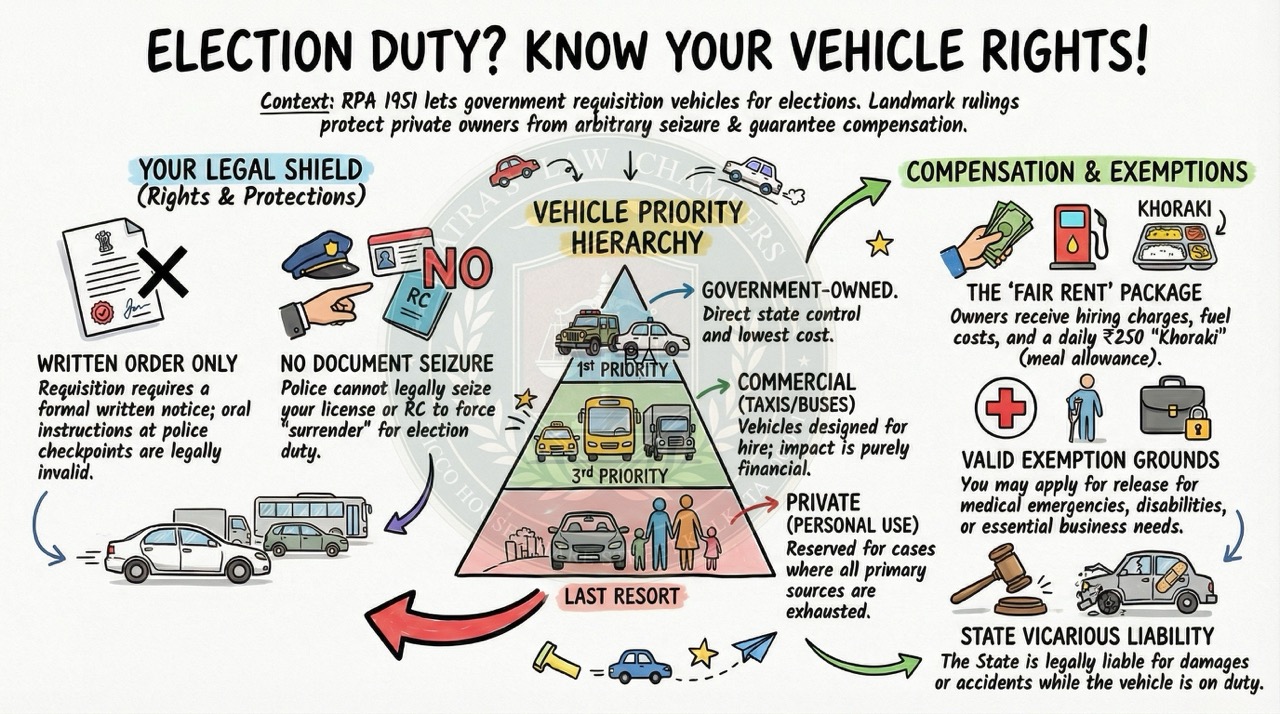
The logistical scale of an Indian election is frequently described as the largest peacetime mobilization in human history. Central to this mobilization is the requirement for thousands of vehicles to transport polling personnel, security forces, Electronic Voting Machines (EVMs), and election observers across diverse and often challenging terrains. To meet this demand, the State utilizes its power of requisitioning under the Representation of the People Act, 1951. However, the exercise of this power frequently leads to friction between administrative necessity and the constitutional rights of private property owners. This report provides a detailed legal examination of the norms governing vehicle requisitioning, the specific protections established by the landmark 2006 Calcutta High Court judgment, the procedural requirements for notice and compensation, and the mechanisms for the release of vehicles.
The Statutory Architecture of Requisitioning: Sections 160-167 of the RPA 1951
The authority of the State Government to take temporary possession of private property for electoral purposes is rooted in Part X of the Representation of the People Act (RPA), 1951.1 This portion of the Act serves as a comprehensive code that balances the “eminent domain” of the State with the rights of the individual.
Section 160: The Power to Requisition Premises and Vehicles
Under Section 160, if it appears to the State Government that any vehicle is needed or is likely to be needed for the purpose of transport of ballot boxes (or EVMs), transport of members of the police force for maintaining order, or transport of any officer or other person for the performance of election-related duties, the Government may, by order in writing, requisition such property.3
The term “vehicle” is interpreted broadly under Section 160(4)(b) to encompass any vehicle used or capable of being used for road transport, regardless of whether it is propelled by mechanical power.4 This definition includes everything from heavy-duty trucks and buses to small passenger cars and even non-motorized transport where applicable. The 2021 amendment further modernized this section to explicitly include the storage of voting machines and voter verifiable paper audit trails (VVPATs), as well as the provision of accommodation for security forces.5
Section 161: The Mandate for Compensation
A fundamental pillar of the requisition process is the right to compensation. Section 161 stipulates that whenever a vehicle is requisitioned, the owner must be paid an amount determined by the State Government on the basis of the fares or rates prevailing in the locality for the hire of such a vehicle.6 This section ensures that the requisitioning is not a confiscatory act but a temporary lease mandated by law.
Section 166: Delegation of Authority
The power of requisitioning is typically delegated from the State Government to district-level officials. In most cases, the District Magistrate (DM), acting as the District Election Officer (DEO), or the Returning Officer (RO) is empowered to issue requisition orders.2
The 2006 Calcutta High Court Judgment: Curbing Arbitrary Impoundment
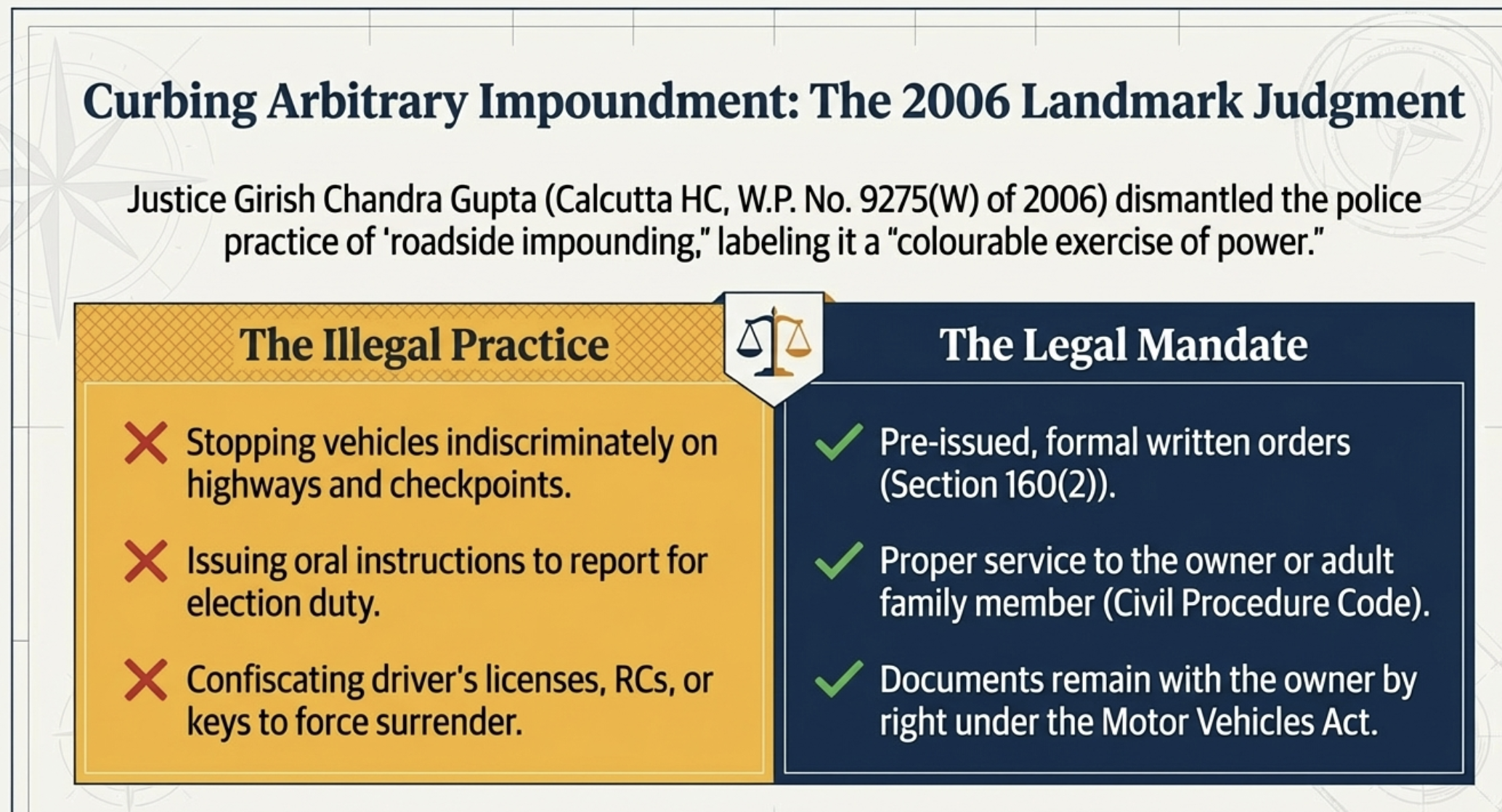
The user correctly identifies a pivotal judicial intervention by the Calcutta High Court in 2006. In the case of W.P. No. 9275(W) of 2006, Justice Girish Chandra Gupta addressed the recurring grievance of “roadside impounding,” where police officers would stop private vehicles on the highway and seize their documents to force them into election duty.9
The Distinction Between Requisitioning and Seizing
The Court observed that the practice adopted by the police was often a “colourable exercise of power”.9 The judgment established several critical legal precedents that define the rights of vehicle owners today:
- Necessity of a Written Order: The Court held that Section 160(2) explicitly requires a “written order” addressed to the owner or the person in possession.4 An oral instruction by a police officer at a checkpoint does not constitute a valid requisition.
- Service of Notice: The law requires the order to be “served in the prescribed manner”.3 For individuals, this means personal service or service to an adult family member. For corporations or firms, service must follow the protocols of Rule 2 Order 29 or Rule 3 Order 30 of the Code of Civil Procedure.9
- Illegal Seizure of Documents: The High Court found that seizing a driver’s license, registration certificate (RC), or tax token without a prior written requisition order was illegal.9 These documents are held by the owner as a matter of right under the Motor Vehicles Act, and the police cannot use their seizure as a tool to compel the “surrender” of the vehicle for election work.
- The Principle of Non-Indiscrimination: The Court ruled that the RPA does used not authorize the “indiscriminate” requisitioning of vehicles.9 The authorities must demonstrate that the specific vehicle is required and that they have followed the established hierarchy of requisitioning.
The Hierarchy of Requisitioning: Why Private Vehicles are the Last Resort
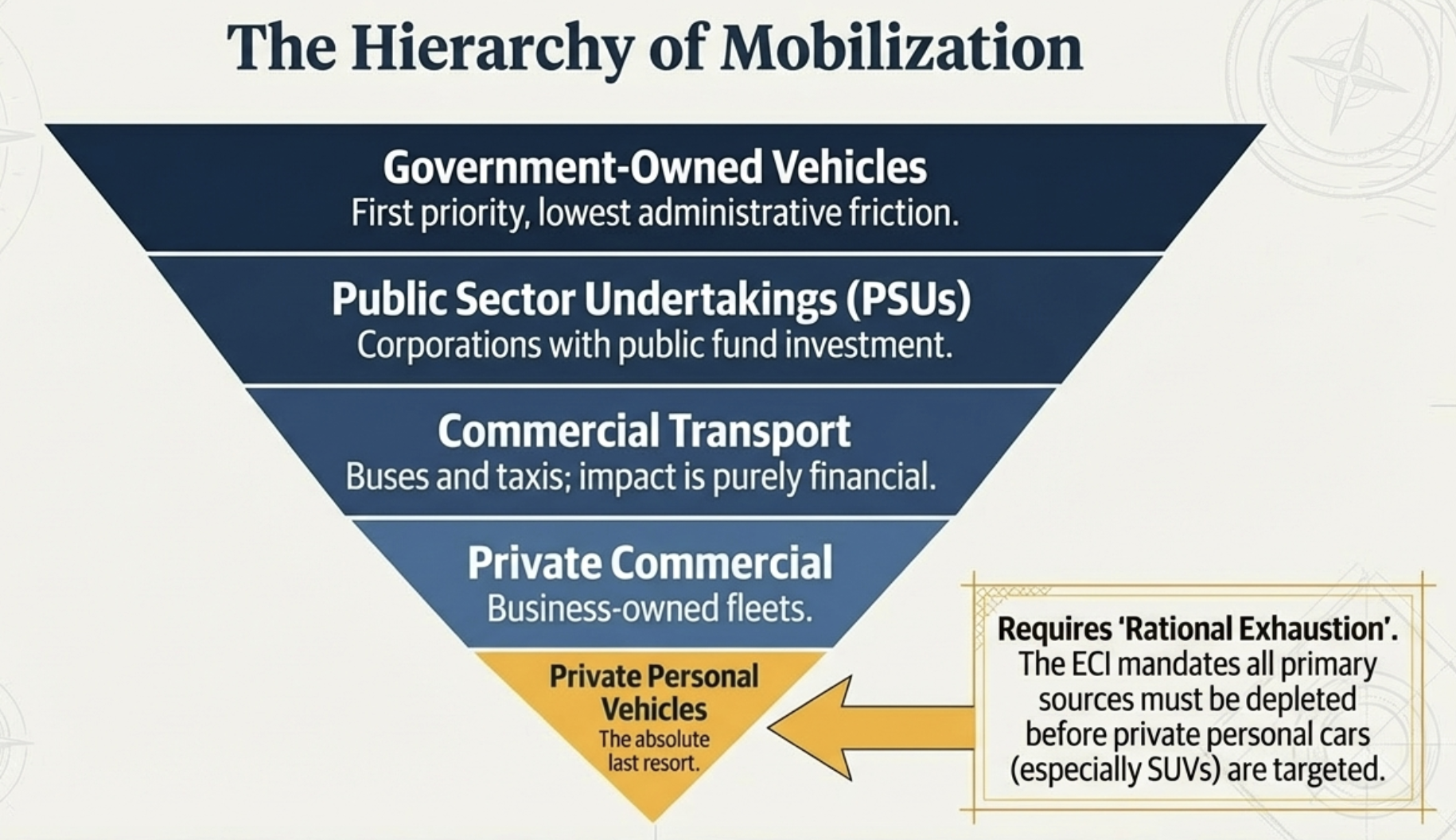
Administrative guidelines issued by the Election Commission of India (ECI) and state transport departments create a clear order of priority for vehicle mobilization. The objective is to minimize disruption to the public transport system and the lives of individual citizens.10
| Priority | Vehicle Category | Legal and Administrative Rationale |
| First Priority | Government-Owned Vehicles | Direct state control minimizes costs and administrative friction. |
| Second Priority | Public Sector Undertakings (PSUs) | Vehicles belonging to corporations where public funds are invested. 12 |
| Third Priority | Commercial Transport Vehicles | Buses and taxis are designed for hire; the impact is purely financial. 10 |
| Fourth Priority | Private Vehicles (Commercial Use) | Vehicles owned by individuals but used for business purposes. 11 |
| Last Resort | Private Vehicles (Personal Use) | Reserved for cases where all other options are exhausted; requires “rational exhaustion” of primary sources. 10 |
In practical terms, the ECI manual emphasizes that government and commercial vehicles should be fully exhausted before private personal cars are touched.10 SUVs are often a specific target for requisitioning due to their suitability for carrying election observers into rural areas, which frequently leads to private SUV owners being caught in the net.10
Procedural Safeguards: Notice, Consent, and Representation
While the power of requisitioning under Section 160 is technically a compulsory one, the judiciary has read into it the requirement of “fair play” and “natural justice.”
The Requirement of Proper Notice
As established in the 2006 judgment, a valid requisition must begin with a formal notice.9 This notice should ideally be served well in advance of the polling date. It must identify the vehicle by its registration number and specify the date, time, and location where the vehicle is to report for duty.9
The Role of “Consent” and Representations
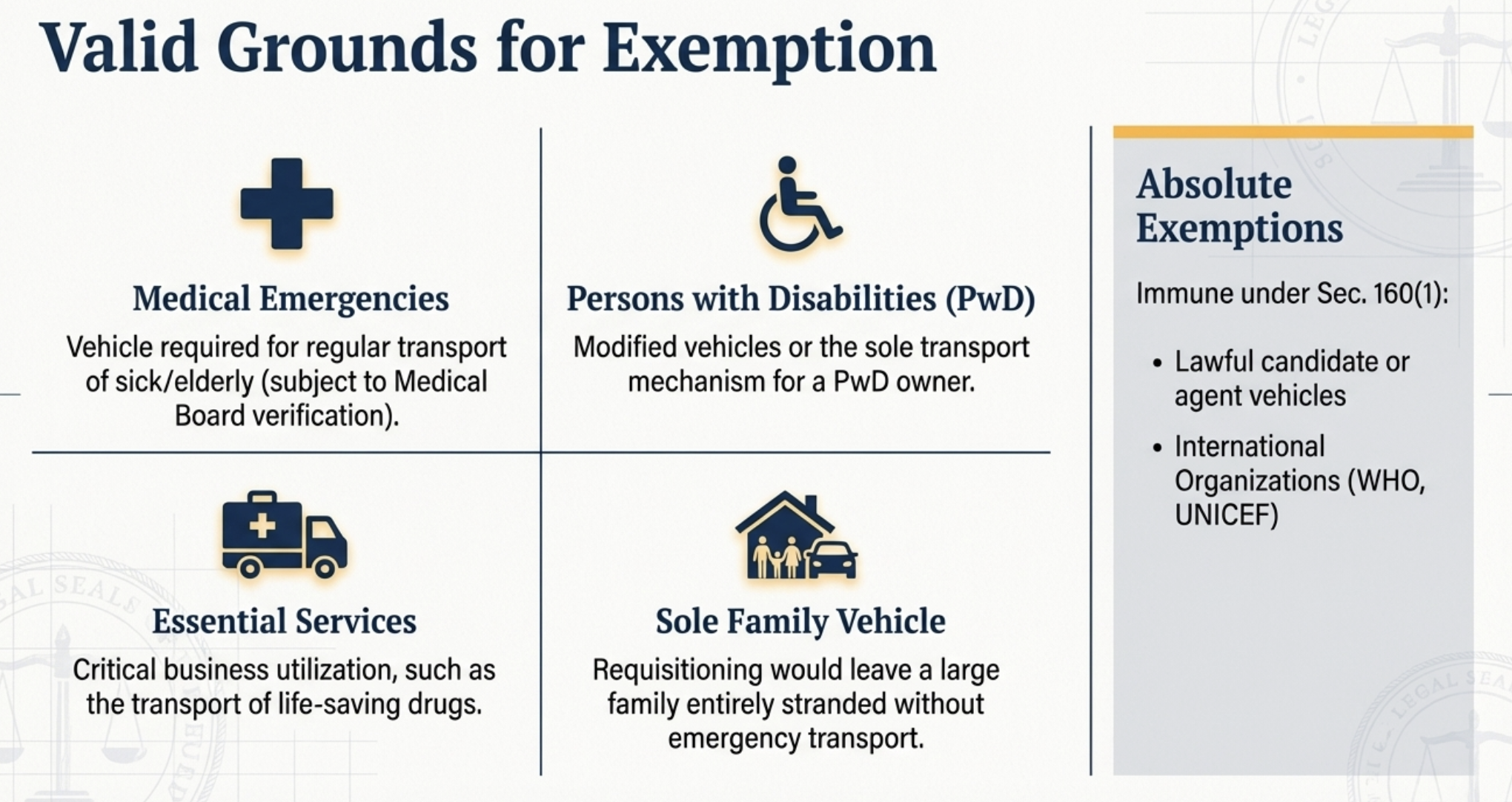
The user mentions that a vehicle can only be taken “upon consent.” Legally, “consent” in the traditional sense is not required because the statute provides a mandate. However, the ECI and the courts have established a “right to a fair hearing”.10 If an owner receives a requisition notice, they have the right to file a representation (an application) before the DEO or the Additional District Magistrate (ADM) stating why their vehicle should be exempted.10
Common grounds for successful representation include:
- Medical Emergencies: The vehicle is needed for the regular transport of a sick or elderly family member.
- Persons with Disabilities: The vehicle is specially modified or is the only means of transport for a PwD owner.
- Essential Business Use: The vehicle is critical for maintaining an essential service (e.g., transport of life-saving drugs).
- Sole Vehicle for Large Families: Requisitioning would leave a family without any means of emergency transport.
The district administration often constitutes a “Medical Board” to verify health-related claims to prevent the misuse of exemptions.13
Compensation: Understanding “Fair Rent” and Collection Procedures
The owner of a requisitioned vehicle is entitled to “just compensation” under Section 161.6 The determination of “fair rent” is a standardized process managed by the State Transport Department.
How Fair Rent is Calculated
The compensation is generally divided into several heads to ensure the owner does not suffer a financial loss. Using the West Bengal 2024 guidelines as a template, the components are as follows 8:
- Hiring Charge: A fixed daily rate for the “possession” of the vehicle.
- Fuel Consumption: Calculated based on the distance traveled (in kilometers) or hours of engine operation (for vessels).
- Khoraki (Driver’s Meal Allowance): A mandatory daily payment for the crew.8
| Vehicle Type | Daily Hire Rate (Excl. Fuel) | Fuel Consumption Standard (Example) | Khoraki (Per Head) |
| Heavy Bus | ₹ 2,530 | Standard Mileage for 6-cylinder engine | ₹ 250 |
| SUV / Small Car | ₹ 890 – ₹ 1,230 | km per liter based on engine capacity | ₹ 250 |
| Goods Vehicle | ₹ 890 – ₹ 2,860 | Based on Gross Vehicle Weight (GVW) | ₹ 250 |
| Auto Rickshaw | ₹ 500 | Fixed mileage rate | ₹ 250 |
Procedure for Collecting Rent
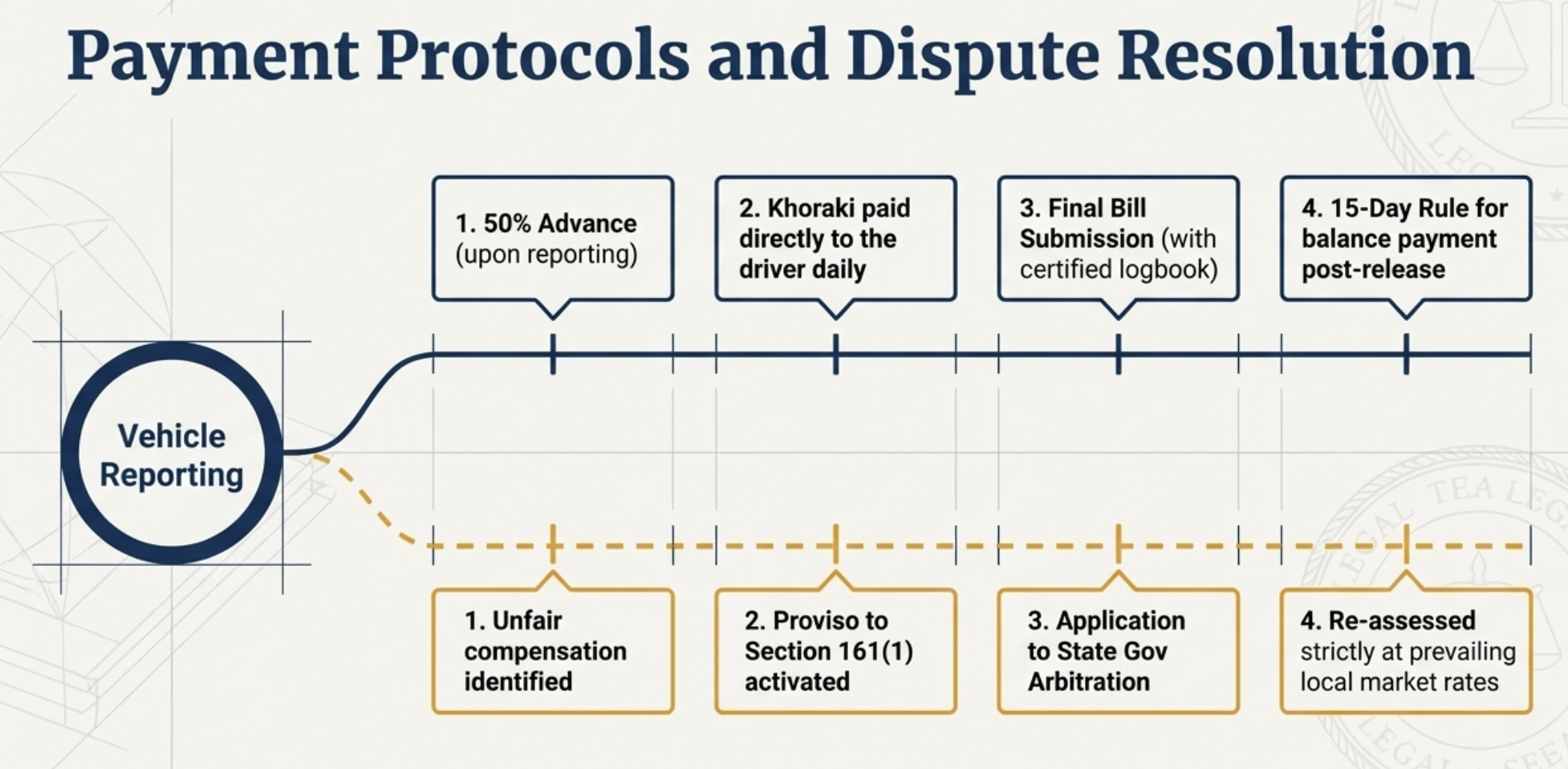
- Reporting and Advance: Upon reporting for duty, the driver should receive the “Khoraki” payment immediately. Owners are often entitled to a 50% advance on the estimated hiring charges for a three-day period.8
- Logbook Documentation: The most critical document for an owner is the vehicle’s logbook. Every trip must be recorded and signed by the using officer. This logbook is the primary evidence for fuel and detention claims.8
- Final Bill Submission: After the vehicle is de-requisitioned, the owner must submit a formal bill along with the certified logbook to the DEO’s office.8
- 15-Day Rule: Balance payments should ideally be made within 15 days of the submission of the bill or the release of the vehicle.8
Dispute Resolution in Compensation
If an owner believes the determined compensation is unfair, the proviso to Section 161(1) allows them to apply to the State Government to refer the matter to an arbitrator.6 The arbitrator, appointed by the government, will determine the final amount based on prevailing market rates in the locality.
Procedure for Releasing a Requisitioned Vehicle
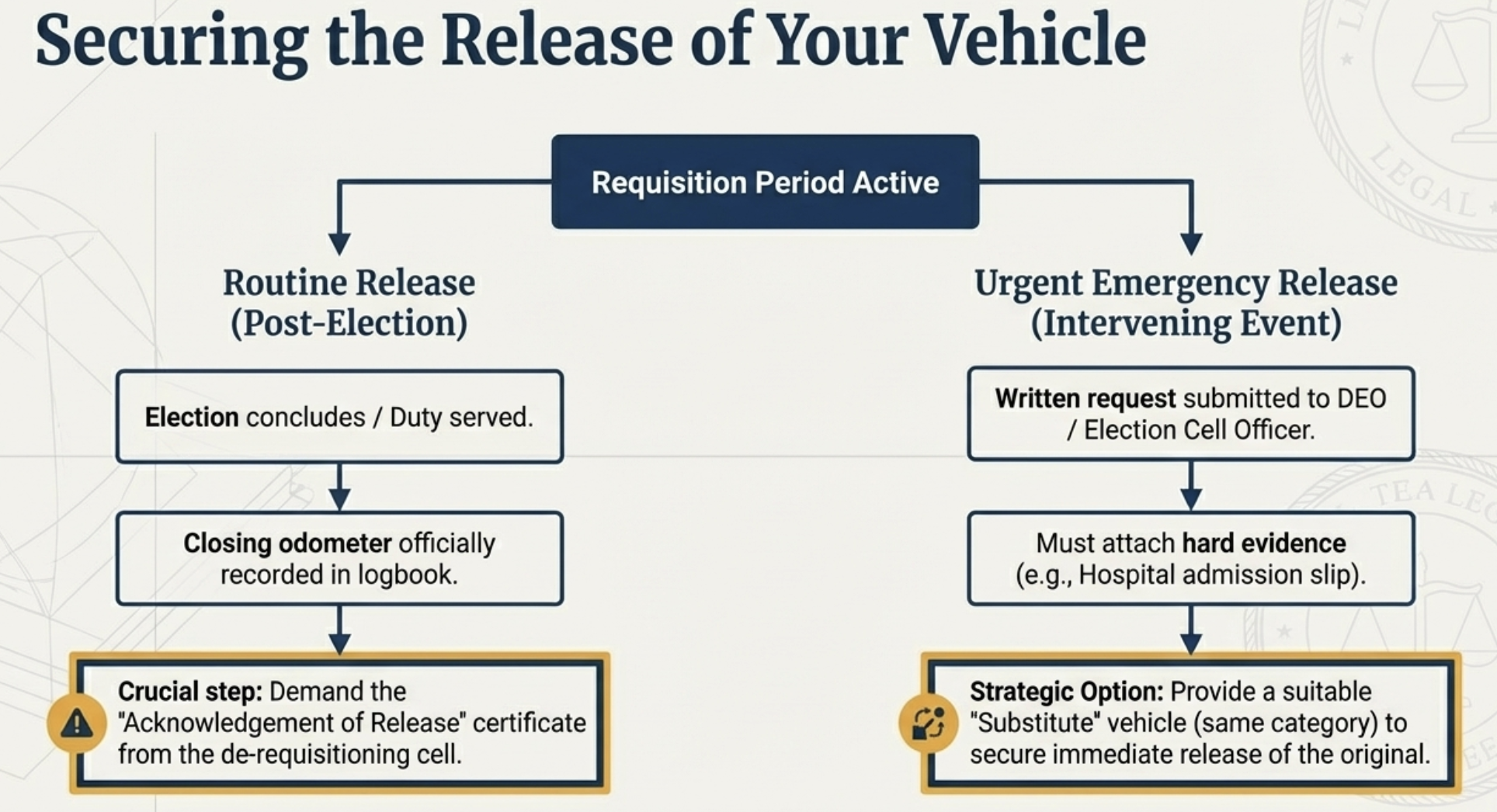
The release of a vehicle can be either routine (after the election is over) or urgent (due to an intervening emergency).
Routine De-requisitioning
Once the purpose for which the vehicle was taken is served (e.g., the security forces have been transported back to their barracks), the authority must issue a release order.4 The owner should ensure the closing odometer reading is noted in the logbook and an “Acknowledgement of Release” is obtained from the reporting center.
Urgent Release for Emergency Situations
If an owner faces an urgent need for the vehicle during its duty period, they must follow a specific administrative path:
- Immediate Application: A written request must be submitted to the DEO or the Officer-in-Charge of the Election Cell.
- Evidence of Urgency: If the request is for a medical emergency, a hospital admission slip or a doctor’s certificate must be attached.13
- Suvidha Portal: In many jurisdictions, the “Suvidha” digital platform allows for the tracking and submission of such requests.10
- Substitution: In some cases, the authorities may allow the release of a vehicle if the owner provides a suitable substitute (e.g., another car of the same category) at their own cost.
Liability for Damage and Accidents During Duty
One of the greatest risks for a private owner is the possibility of an accident while the vehicle is under the control of government-assigned drivers or personnel.
Divestment of Insurance Liability
Standard motor insurance policies frequently contain an exclusion clause for periods of government requisition.17 This means that if an accident occurs during election duty, the private insurer may repudiate the claim.
The Doctrine of Vicarious Liability
The judiciary has filled this gap by establishing that the State is vicariously liable for any damage caused to a requisitioned vehicle.17 In New India Assurance Co. Ltd. v. R. Ramulamma, it was held that since the requisitioning authority takes away the owner’s “possession and control,” the State steps into the shoes of the owner/employer. Any claim for damages or loss sustained during this period must be filed against the State Government.17
Digital Governance: The Suvidha Ecosystem
To bring transparency to the requisitioning process, the Election Commission has launched the “Suvidha” portal and mobile applications.16 While primarily used by candidates for seeking permissions, the backend of the system (Encore) is used by nodal officers to manage vehicle logistics.18
Owners can use these digital tools to:
- Track the status of their vehicle.
- Apply for exemptions or relief from duty.10
- Check the status of pending compensation payments.
Detailed FAQs for Private Vehicle Owners
Is it legal for the police to take my car keys at a checkpoint?
No. The 2006 Calcutta High Court judgment made it clear that the police cannot stop a vehicle on the road and seize documents or keys without a pre-existing, written requisition order served on the owner.9
What happens if I ignore a written requisition order?
Failure to comply with a valid order issued under Section 160 is a criminal offense under Section 167 of the RPA 1951. It is punishable with imprisonment for up to one year, or a fine, or both.2 If you have a problem, you must file a representation for exemption rather than simply ignoring the order.
How is fuel cost handled?
The Government usually provides fuel through authorized pumps using coupons, or they reimburse the owner based on the distance recorded in the logbook.8 The cost of fuel for the journey from your garage to the reporting spot and back is also compensable.8
My car is on a bank loan (EMI). Who gets the compensation?
The “person interested,” which is the person in actual possession (the owner/lessee), is entitled to receive the compensation.6 If there is a dispute regarding the title (e.g., between a buyer and seller), Section 161(2) requires the matter to be referred to an arbitrator.6
Can I provide my own driver?
Yes, and in most cases, the authorities prefer it. If you provide a driver, you are responsible for their salary, but the Government pays a daily “Khoraki” (meal allowance) of approximately ₹ 250 directly to the driver.8
Are there any vehicles that can never be taken?
Yes. Section 160(1) provides an absolute exemption for any vehicle being lawfully used by a candidate or their agent for election purposes.4 Additionally, vehicles of international organizations like the WHO or UNICEF are exempt.19
Who pays for minor repairs during the duty?
For private transport vehicles, the cost of minor repairs and maintenance is typically the responsibility of the owner, but this is factored into the “hiring charge.” However, for central government vehicles being used by a state, the state bears the repair costs.19
What should I do if my vehicle is not released after the poll is over?
You should immediately contact the de-requisitioning cell at the DEO’s office. If the vehicle is held beyond the required period, you are entitled to additional compensation for the “overstay”.4
Nuanced Legal Insights: Beyond the Basics
The law of requisitioning represents a unique intersection of administrative law and property rights. A deeper analysis reveals that the “Subjective Satisfaction” of the State Government mentioned in Section 160 is not beyond judicial review. The courts have consistently held that the “appearance of need” must be based on objective data. If an authority requisitions 500 private cars when 1,000 government vehicles are lying idle, the order can be challenged as mala fide or arbitrary.
Furthermore, the 2021 amendments have significant “ripple effects.” By allowing the requisitioning of premises for “accommodation for security forces,” the legislature has essentially created a mechanism that could preemptively take over private community halls or empty buildings.4 This expansion of “election duty” beyond the 24 hours of polling to weeks of “security deployment” increases the financial and logistical burden on the private sector, making the “15-day payment rule” and the “arbitration clause” even more critical for the survival of small transport businesses.
Conclusion and Strategic Recommendations
The protection of one’s legal rights during an election cycle requires a proactive rather than a reactive approach. The 2006 Calcutta High Court judgment remains the primary shield against police overreach, but it must be wielded correctly.
- Demand Documentation: Never allow a vehicle to be taken without a written order addressed to the owner. Roadside “seizures” are a violation of the mandates set by Justice Girish Chandra Gupta.9
- File Representations Promptly: If a vehicle is needed for medical or essential personal use, file an application for exemption immediately upon receipt of notice. Do not wait for the “reporting date” to raise objections.10
- Strict Logbook Control: The logbook is the owner’s financial lifeline. Ensure every kilometer is accounted for and signed by a Gazetted Officer. This is the only way to ensure “fair rent” is accurately calculated.8
- Recourse to Article 226: If the district administration acts arbitrarily or refuses to release a vehicle despite a genuine emergency, the High Court’s writ jurisdiction under Article 226 remains open. The precedent in W.P. 9275(W) of 2006 provides a strong foundation for such challenges.
- Claim State Indemnity: In the event of an accident, do not rely solely on your private insurance. File a claim against the DEO/State Government for vicarious liability, citing established precedents that divest the owner of control during requisition.17
By adhering to these protocols, vehicle owners can navigate the complexities of election duty while ensuring their property is used according to the “due process of law” and that they are fairly compensated for their contribution to the democratic exercise.
Works cited
- Representation of the People Act, 1951 – Wikipedia, accessed on March 31, 2026, https://en.wikipedia.org/wiki/Representation_of_the_People_Act,_1951
- the representation of the people act, 1951 ______ – arrangement of sections, accessed on March 31, 2026, https://www.parlament.cat/document/intrade/181101
- Section 160 in The Representation of the People Act, 1951 – Indian Kanoon, accessed on March 31, 2026, https://indiankanoon.org/doc/76051674/
- State Acts – India Code: Section Details, accessed on March 31, 2026, https://www.indiacode.nic.in/show-data?actid=AC_CEN_3_81_00001_195143_1517807327542&orderno=194
- Requisition of premises/vehicles for election purpose – regarding. – Chief Electoral Officer, Delhi, accessed on March 31, 2026, https://ceodelhi.gov.in/PDFFolder/ECI/eci-ins-Requisition-of-premises-vehilces.pdf
- Section 161 in The Representation of the People Act, 1951 – Indian Kanoon, accessed on March 31, 2026, https://indiankanoon.org/doc/79961425/
- Section 161 of Representation Of The People Act, 1951 – Payment of compensation – LawRato, accessed on March 31, 2026, https://lawrato.com/indian-kanoon/bare-act/representation-of-the-people-act/section-161
- No. WB(Part-IA)/2024/SAR-10 – CEO West Bengal, accessed on March 31, 2026, https://ceowestbengal.wb.gov.in/Downloads/Election/GE2024/SAR10.pdf
- Anirban Ghosh vs Dist. Election Officer And Anr. on 18 April, 2006 – Indian Kanoon, accessed on March 31, 2026, https://indiankanoon.org/doc/1281824/
- Vehicle requisition for poll duty starts but your car may be spared, accessed on March 31, 2026, https://www.wbtrafficpolice.com/userfiles/file/vehicle-requisition-for-poll-duty-starts-but-your-car-may-be-spared.pdf
- JUDGMENT/ORDER IN – WRIT – C No. 5295 of 2017 at Allahabad Dated-8.2.2017 CASE TITLE – Arvind Kumar Vs. State Of U.P. & Another – eLegalix, accessed on March 31, 2026, https://elegalix.allahabadhighcourt.in/elegalix/WebShowJudgment.do?judgmentID=5280612
- Use of vehicles for distribution of publicity material-Regarding – Chief Electoral Officer, Delhi, accessed on March 31, 2026, https://ceodelhi.gov.in/PDFFolder/2018/Use-of-vehicles-for-distribution-of-publicity-material-Regarding.pdf
- Procedure to decide applicationsfor exemption from poll duty – The Hindu, accessed on March 31, 2026, https://www.thehindu.com/news/national/karnataka/procedure-to-decide-applicationsfor-exemption-from-poll-duty/article26562378.ece
- Surendra Pandey v. Chief Electoral Officer, Bihar And Others | Patna High Court – CaseMine, accessed on March 31, 2026, https://www.casemine.com/judgement/in/56b49322607dba348f004f46
- Mah. XL] 1 THE MAHARASHTRA MUNICIPAL COUNCILS, NAGAR PANCHAYATS AND INDUSTRIAL TOWNSHIPS ACT, 1965 [Text as on 4th April – India Code, accessed on March 31, 2026, https://www.indiacode.nic.in/bitstream/123456789/16073/3/maharashtra_municipa.pdf
- PN-153- SUVIDHA 2.0.docx – Election Commission of India, accessed on March 31, 2026, https://www.eci.gov.in/eci-backend/public/api/download?url=LMAhAK6sOPBp%2FNFF0iRfXbEB1EVSLT41NNLRjYNJJP1KivrUxbfqkDatmHy12e%2FzX%2FLARKC1lI3JwqUiIIk3e6%2Baa%2FbpWDFPEAlAkMKDW6z5E2QYzRYKScn8mn1spBtiyKzGsKzKlbBW8rJeM%2FfYFA%3D%3D
- Ram Narayan Singh v. The Election Commission And Ors. | Patna High Court – CaseMine, accessed on March 31, 2026, https://www.casemine.com/judgement/in/56098a98e4b0149711383ace
- Election Permissions – Election Commission of India, accessed on March 31, 2026, http://www.eci.gov.in/election-permissions
- Frequently Asked Questions (FAQs) relating to Conduct of Elections – Election Commission, accessed on March 31, 2026, https://www.eci.gov.in/Documents/FAQs_on_Conduct_of_Elections_Edition-1.pdfa