Transfer Petitions in the Supreme Court of India: A Comprehensive Analysis of Civil and Matrimonial Litigation
Creditor and contributor of this article:
Patra’s Law Chambers:
About Us:
Patra’s Law Chambers is a law firm with offices in Delhi & Kolkata, offering comprehensive legal services across various domains. Established in 2020 by Advocate Sudip Patra (Advocate, Supreme Court of India & Calcutta High Court) an alumnus of the Prestigious Rajiv Gandhi School of Intellectual Property Law, IIT Kharagpur, with Post Graduate diploma in Business Law from IIM Calcutta, the firm specializes in Civil, Criminal, Writs, High Court Matters, Trademark, Copyright, Company, Tax, Banking, Property disputes, Service law, Family law, and Supreme Court matters. You can know more about us here
Delhi Office:
House no: 4455/5, First Floor, Ward No. XV, Gali Shahid Bhagat Singh, Main Bazar Road, Paharganj, New Delhi-110055
Kolkata Office:
NICCO HOUSE, 6th Floor, 2, Hare Street, Kolkata-700001 (Near Calcutta High Court)
Website: www.patraslawchambers.com
Email: [email protected]
Phone: +91 890 222 4444/ +91 7003 715 325
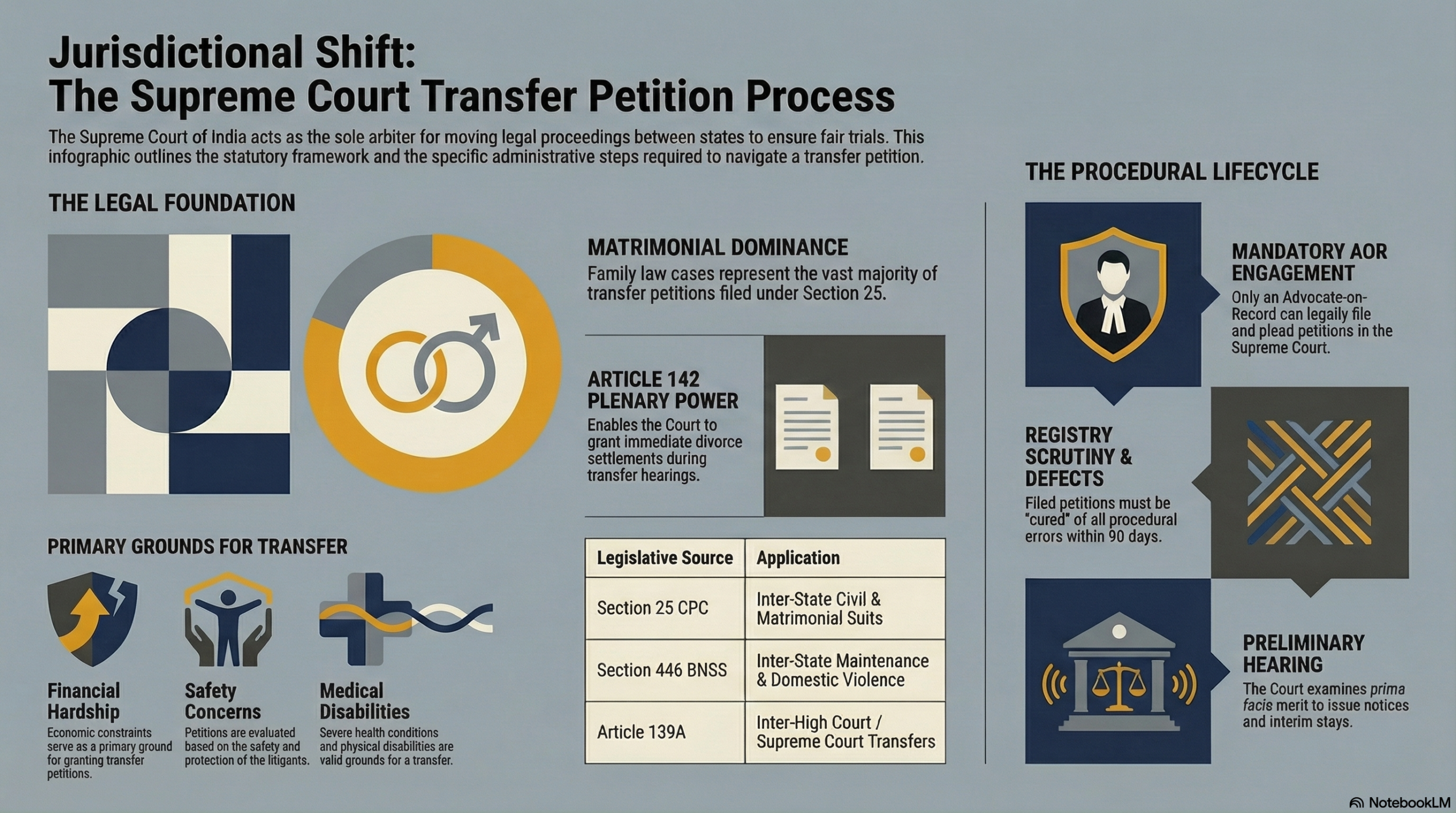
The transfer of civil and matrimonial proceedings across state boundaries in India represents a sophisticated nexus of constitutional prerogative and statutory mandate. Within the federalized structure of the Indian judiciary, the Supreme Court of India serves as the exclusive arbiter for inter-state jurisdictional shifts, ensuring that the geographic location of a trial does not become an instrument of oppression or a barrier to the “ends of justice”.1 This legal mechanism, primarily codified under Section 25 of the Code of Civil Procedure (CPC), 1908, has evolved from a narrow procedural tool into a powerful equitable instrument, particularly in family law, where the Court increasingly leverages its plenary powers under Article 142 of the Constitution to achieve holistic resolution.2
The Statutory and Constitutional Framework of Transfer Jurisdiction
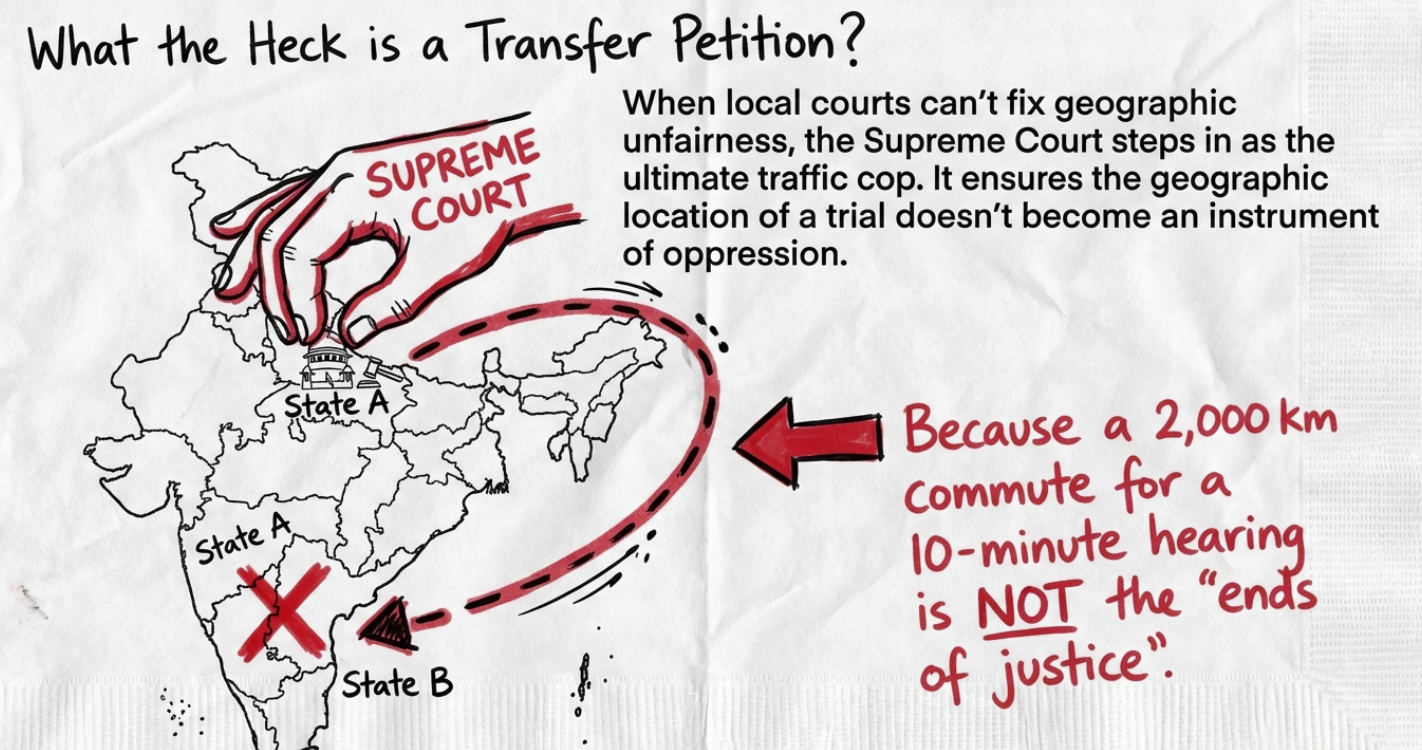
The authority of the Supreme Court to transfer cases is not a singular power but a composite of various legislative and constitutional provisions that cater to different legal scenarios. While the High Courts possess the power to transfer cases within their respective states under Section 24 of the CPC, only the Supreme Court can facilitate the movement of a suit, appeal, or proceeding from a court in one state to a court in another.1
Section 25 of the Code of Civil Procedure, 1908
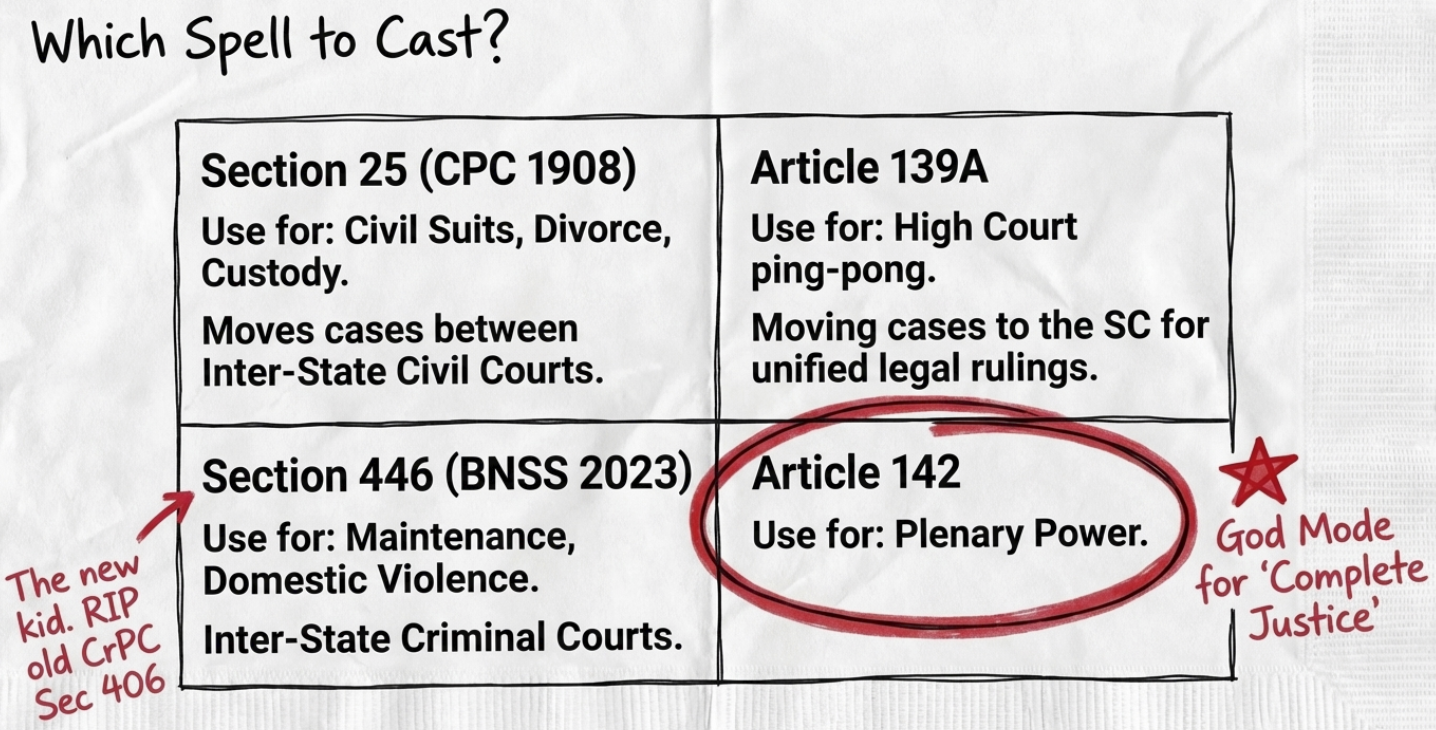
Section 25 of the CPC is the cornerstone for civil transfer petitions. It empowers the Supreme Court to transfer any case if it is satisfied that such an order is “expedient for the ends of justice”.1 The legislative intent behind this provision is to ensure that a party is not denied a fair trial due to the tactical advantage gained by the opposing party in choosing a forum that is inaccessible or hostile to the petitioner.5 The Supreme Court’s discretion under Section 25 is broad, allowing it to consider factors ranging from physical safety and financial hardship to the consolidation of multiple parallel proceedings.1
Article 139A: Constitutional Oversight
Article 139A(2) of the Constitution of India provides a constitutional layer to this power, allowing the Supreme Court to transfer cases, appeals, or other proceedings pending before any High Court to itself or to another High Court.2 This is frequently invoked in matters involving substantial questions of law or where identical legal issues are being litigated in multiple High Courts across the country, necessitating a unified judicial determination.2
The Transition to the Bharatiya Nagarik Suraksha Sanhita (BNSS)
In matrimonial disputes involving criminal or quasi-criminal elements—such as maintenance under Section 125 of the CrPC or proceedings under the Protection of Women from Domestic Violence Act—the transfer power was historically governed by Section 406 of the Code of Criminal Procedure (CrPC), 1973.8 However, with the 2023 legal reforms, these powers have transitioned to Section 446 of the Bharatiya Nagarik Suraksha Sanhita (BNSS).2 Section 446(1) mirrors the older provision, maintaining that the Supreme Court can transfer criminal cases or appeals across state lines if justice so requires.11
| Legal Provision | Legislative Source | Primary Application | Jurisdictional Reach |
| Section 25 | Code of Civil Procedure, 1908 | Civil Suits, Divorce, Custody | Inter-State Civil Courts |
| Section 446 | Bharatiya Nagarik Suraksha Sanhita, 2023 | Maintenance, Domestic Violence | Inter-State Criminal Courts |
| Article 139A | Constitution of India, 1950 | High Court Transfers | Inter-High Court / Supreme Court |
| Article 142 | Constitution of India, 1950 | Equitable Remedies, Divorce | Plenary Power for “Complete Justice” |
Procedural Mechanics: A Petitioner’s Comprehensive Guide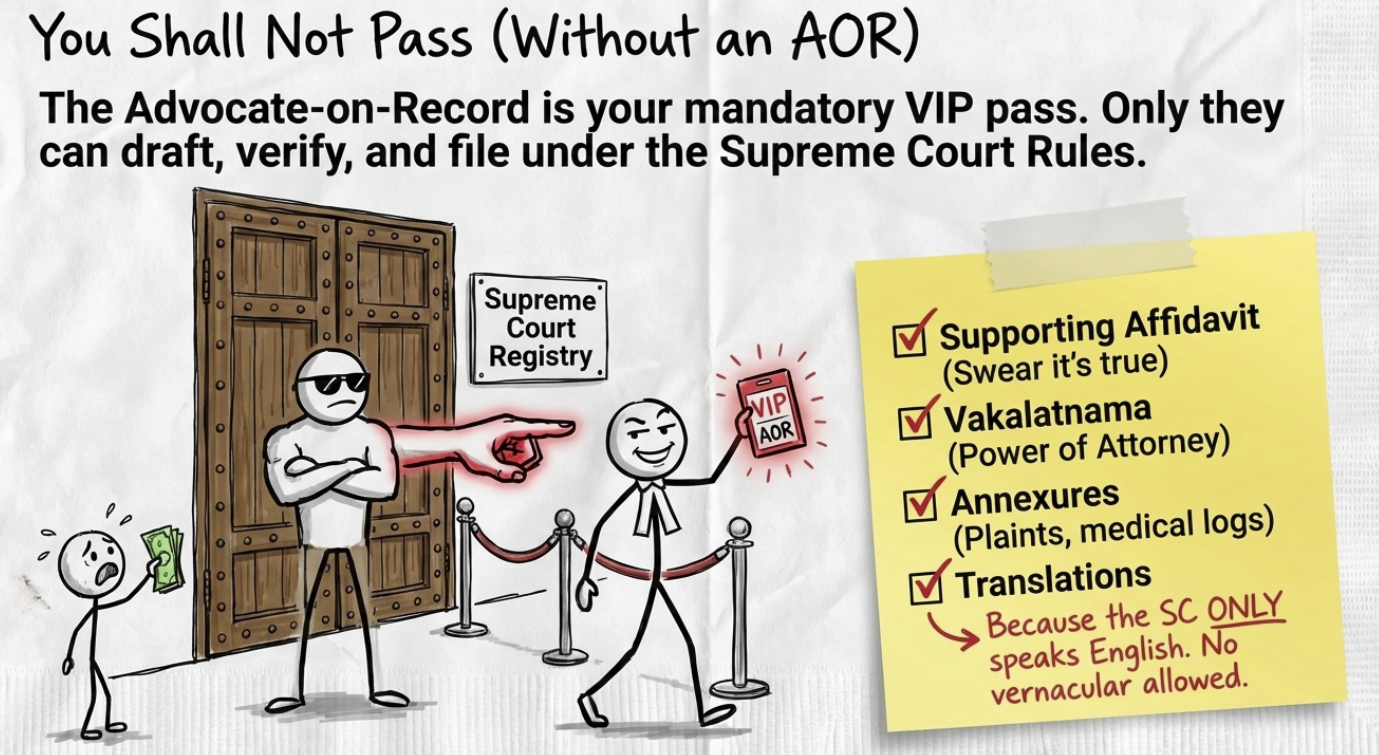
Filing a transfer petition in the Supreme Court is an intricate process governed by the Supreme Court Rules, 2013. For a petitioner, understanding the administrative lifecycle of the application is as critical as the legal grounds themselves.2
The Role of the Advocate-on-Record (AOR)
A distinguishing feature of Supreme Court practice is the mandatory involvement of an Advocate-on-Record. Under the Supreme Court Rules, only an AOR can appear, plead, and file cases on behalf of a litigant.2 The AOR system acts as a specialized filter, ensuring that all petitions meet the rigorous formatting and procedural standards of the apex court.2 The AOR is responsible for drafting the petition, verifying the facts through a supporting affidavit, and managing the registry’s requirements.2
Drafting and Filing Requirements
The petition must be a concise document detailing the parties involved, the nature of the case currently pending in the lower court, and the specific grounds justifying the transfer.2 Key administrative requirements include:
- Supporting Affidavit: A sworn statement by the petitioner verifying the truth of the claims.14
- Vakalatnama: The formal document authorizing the AOR to represent the petitioner.2
- Annexures: Copies of the original case papers (plaint or complaint), current court orders, and evidence supporting the grounds for transfer (e.g., medical certificates, travel logs).14
- Translation of Documents: Since the Supreme Court functions exclusively in English, any document in a vernacular language must be translated by an authorized translator and certified by the AOR.2
The Registry and the “Defect” Stage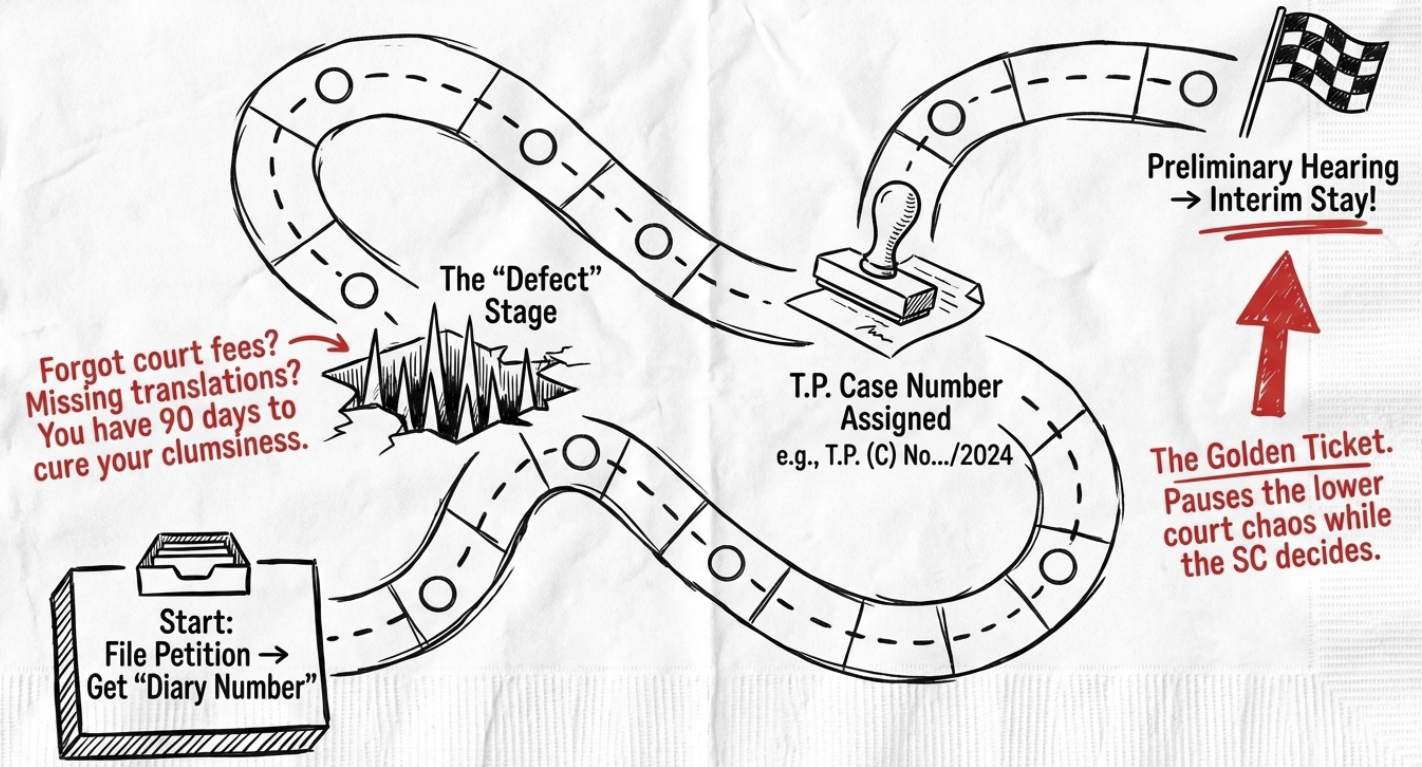
Once the petition is filed, it is assigned a Diary Number.2 The registry then scrutinizes the file for procedural errors, known as “Defects.” These can range from minor formatting issues to significant omissions like missing court fees or untranslated documents.2 A petitioner generally has 90 days to “cure” these defects.2 Once the registry is satisfied, the case is assigned a formal case number (e.g., T.P. (C) No…./2024) and listed for a preliminary hearing.2
Preliminary Hearing and Issuance of Notice
At the first hearing, the Court examines whether there is a prima facie case for transfer. If the Court finds merit, it may issue a Notice to the respondent and, critically, grant an Interim Stay on the proceedings in the original court.2 This stay ensures that the case does not reach a final judgment in the original forum while the transfer petition is being considered.7
The Pre-eminence of Matrimonial Disputes in Transfer Jurisdiction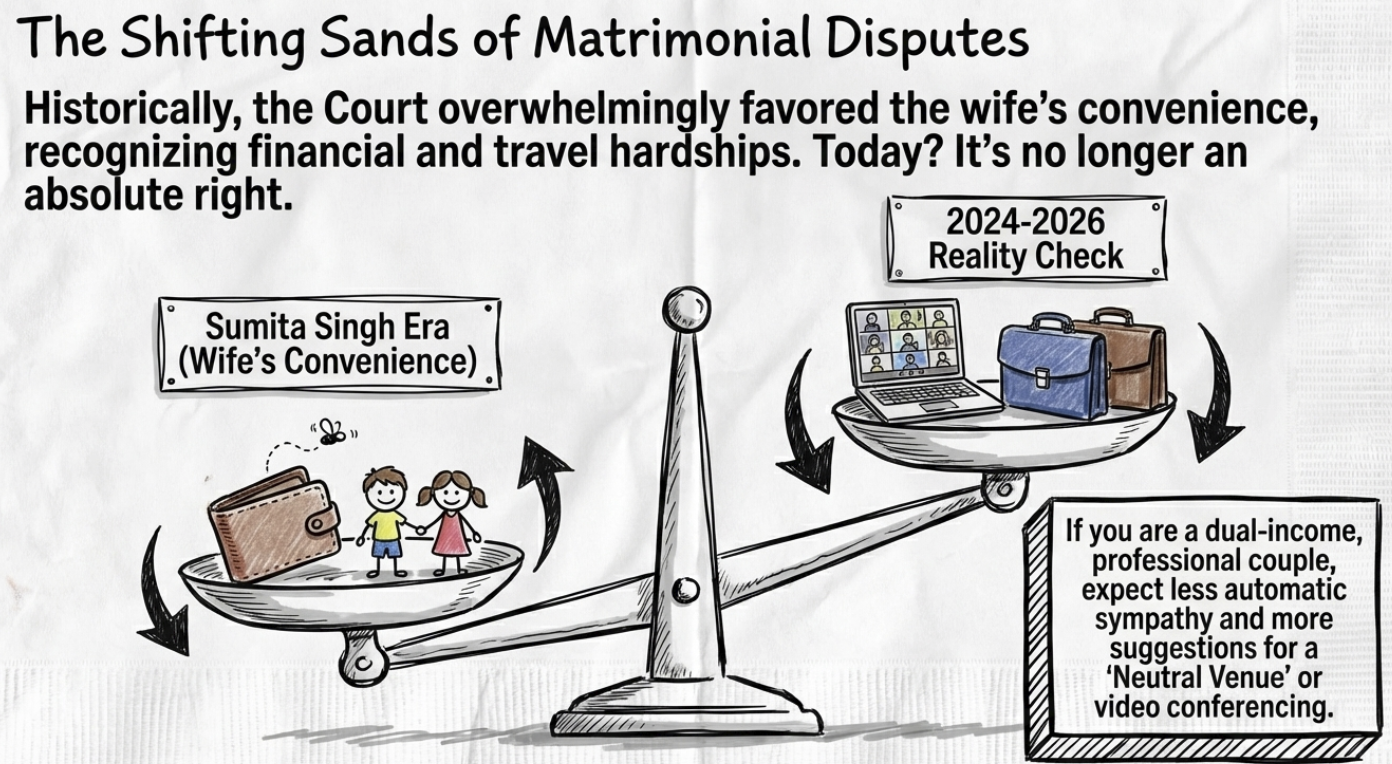
Matrimonial and family matters form the overwhelming majority of transfer petitions filed under Section 25 of the CPC.2 The breakdown of a marriage often results in the parties relocating to different states, leading to logistical and financial challenges in attending court hearings.18
The “Wife’s Convenience” Doctrine
The Supreme Court has historically prioritized the convenience of the wife in matrimonial disputes. This doctrine, crystallized in cases like Sumita Singh v. Kumar Sanjay, recognizes that a woman may face greater hardship in traveling to a distant state, especially if she has no independent source of income or is the primary caregiver for minor children.1
However, the 2024-2026 judicial trend indicates a shift toward a more nuanced, evidence-based approach. While the wife’s convenience remains a primary consideration, it is no longer an absolute right.6 The Court now balances this against the husband’s hardships, the availability of modern technology, and the potential for a “Neutral Venue”.2
| Ground for Transfer | Petitioner’s Context | Necessary Evidence |
| Financial Hardship | Unemployed or low-income spouse | Bank statements, Alimony pendente lite records |
| Care for Dependents | Presence of minor children or elderly parents | Birth certificates, School records, Doctor’s affidavits |
| Safety Concerns | Apprehension of physical harm or intimidation | FIRs, Police complaints, Call recordings |
| Distance & Logistics | Travel exceeding 500-1000 km | Travel itineraries, Distance maps |
| Medical Grounds | Chronic illness or physical disability | Hospital records, Disability certificates, Doctor’s certificates |
Health and Medical Hardship as a Basis for Transfer
Medical emergencies or chronic illnesses are increasingly accepted as valid grounds for transfer. While Section 25 does not explicitly list “medical grounds,” the Supreme Court has interpreted “ends of justice” to include situations where attending court would exacerbate a life-threatening condition or cause severe physical pain.1 For instance, if a respondent has a terminal illness or is recovering from a major surgery, the Court may transfer the case to a court nearest to their place of treatment.1
Multiplicity of Proceedings and Consolidation
In many matrimonial disputes, multiple cases are filed across different states: a divorce petition in one, a maintenance case in another, and a domestic violence complaint in a third.18 The Supreme Court utilizes transfer petitions to consolidate these cases into a single court, preventing the risk of conflicting judgments and reducing the harassment caused by attending multiple forums.4
Landmark Judgments and the 2024-2026 Judicial Evolution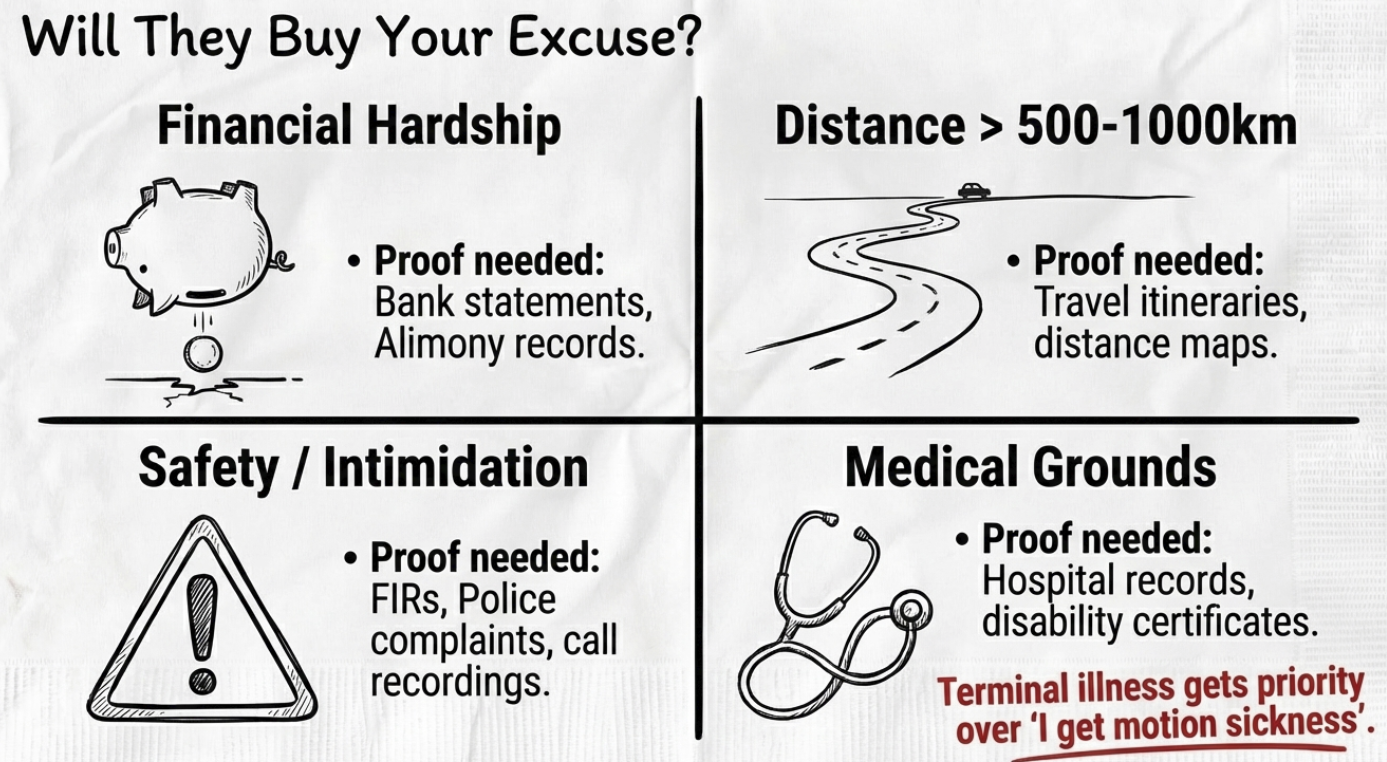
The landscape of transfer petitions has been significantly reshaped by a series of landmark judgments that have expanded the Court’s role from a simple venue-changer to a proactive settler of domestic disputes.3
Shilpa Sailesh v. Varun Sreenivasan (2023): The Paradigm Shift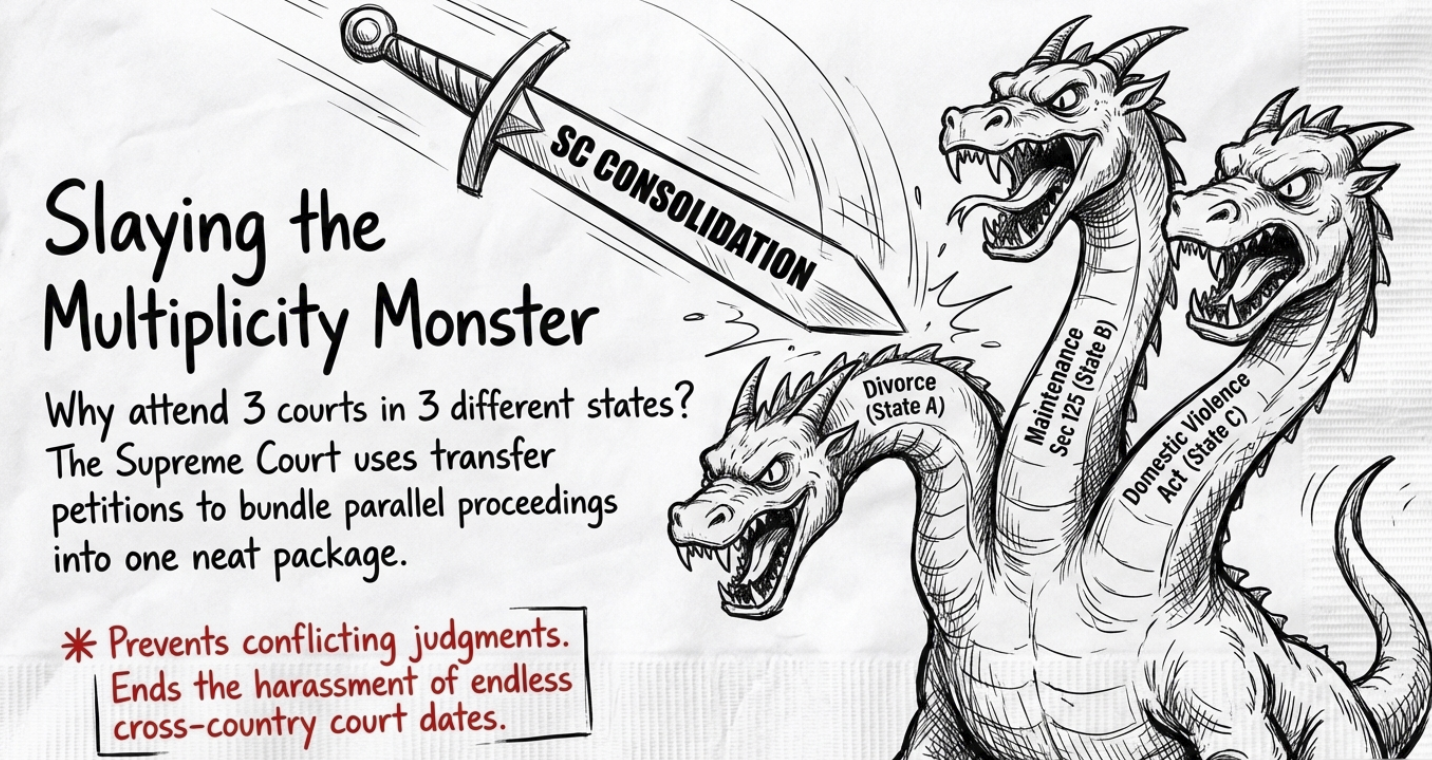
The Shilpa Sailesh judgment is perhaps the most significant development in family law in recent decades. The Constitution Bench held that the Supreme Court can use its powers under Article 142 to grant a divorce directly on the grounds of “irretrievable breakdown of marriage,” bypassing the mandatory waiting periods of the Hindu Marriage Act.3 In the context of transfer petitions, this means that if the Court realizes a marriage is “emotionally dead” during a transfer hearing, it can dissolve the marriage then and there, provided both parties agree to a settlement.24
Recent Case Studies (2024-2026)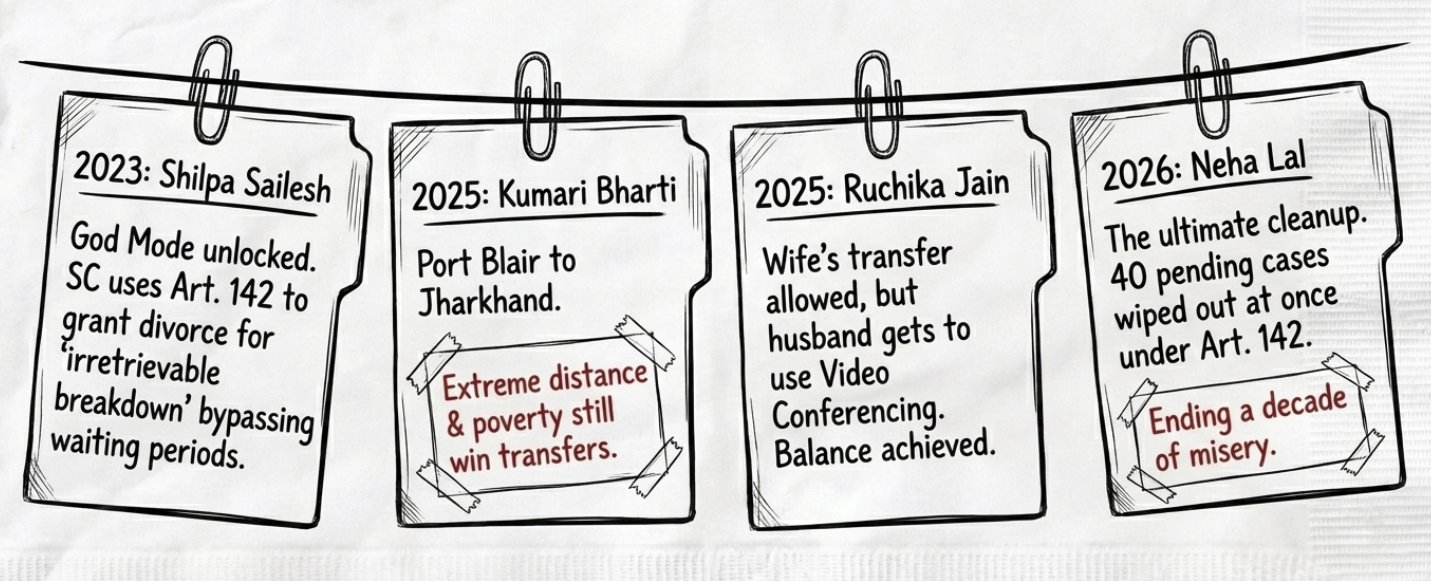
- Kumari Bharti v. Saurabh Kumar Jha (January 2025): The Court transferred divorce proceedings from Port Blair to Jharkhand, citing the extreme geographical hardship for the wife and the lack of financial means to travel between these remote locations.20
- Ruchika Jain v. Manish Jain (July 2025): While allowing the wife’s transfer petition, the Court granted the husband the liberty to appear before the transferee court via Video Conferencing, illustrating the Court’s attempt to balance convenience with technological solutions.20
- Neha Lal v. Abhishek Kumar (January 2026): In a case where the parties had been litigating for over a decade with pending cases, the Court used the transfer petition to consolidate all matters and dissolved the marriage under Article 142, terminating the “cycle of litigation”.20
- Nisha v. Jia Lal (January 2025): The Court allowed the transfer of a divorce case from Uttar Pradesh to Haryana on the grounds of the wife’s unemployment and safety concerns, but specifically directed the transferee court to explore mediation before proceeding on merits.26
| Judgment Year | Case Name | Principle Established |
| 2023 | Shilpa Sailesh v. Varun Sreenivasan | Dissolution of marriage on “irretrievable breakdown” under Article 142. |
| 2025 | Kumari Bharti v. Saurabh Kumar Jha | Distance and financial hardship remain strong grounds for inter-state transfer. |
| 2025 | Ruchika Jain v. Manish Jain | Integration of video conferencing as an alternative to physical travel. |
| 2026 | Neha Lal v. Abhishek Kumar | Quashing of multiple criminal and civil cases during transfer to stop judicial abuse. |
The Role of the Supreme Court Mediation Centre
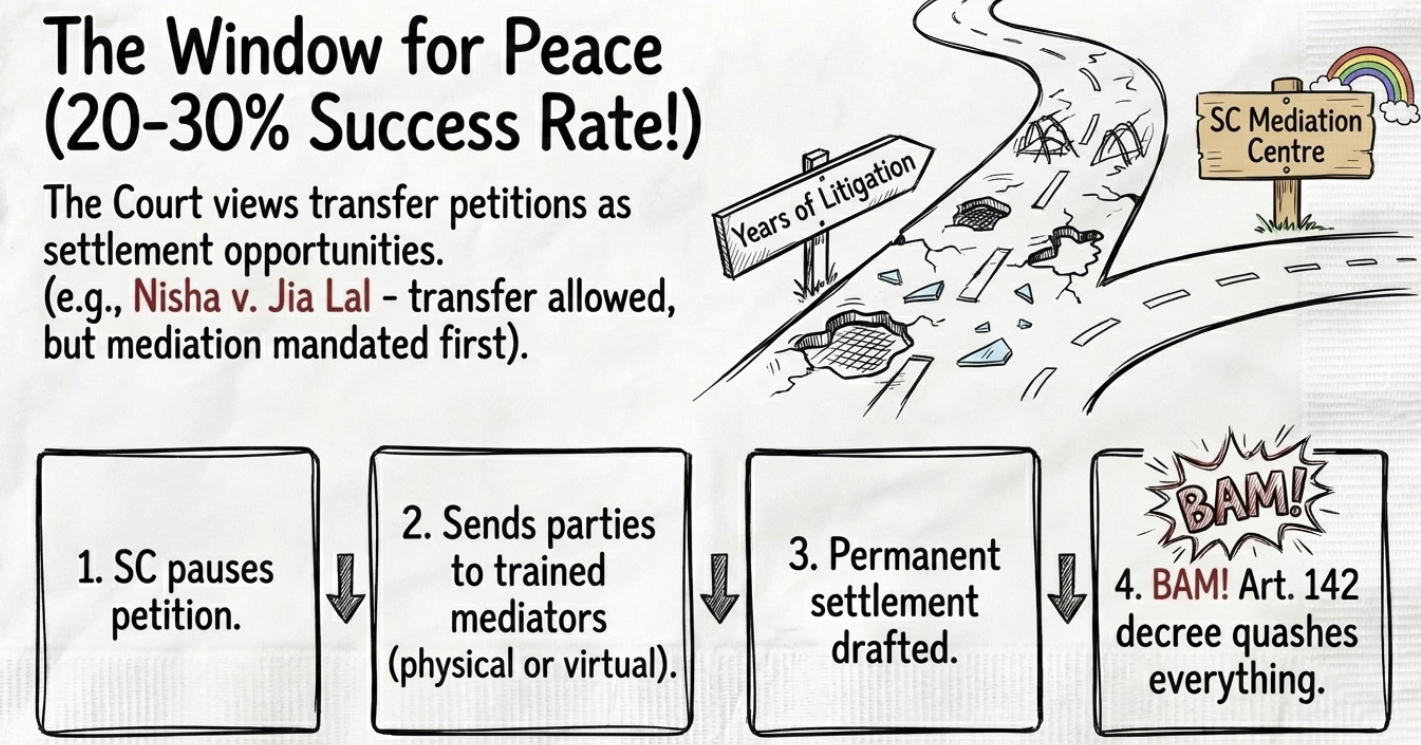
A unique aspect of the transfer petition process in matrimonial matters is the frequent referral to mediation. The Supreme Court views transfer petitions not just as procedural hurdles but as windows of opportunity for settlement.2
The Mediation Referral Protocol
If the respondent appears and expresses a willingness to settle, or if the Court feels that the dispute is “pre-eminently fit for mediation,” it refers the parties to the Supreme Court Mediation Centre.2 The process usually follows these steps:
- Reference: The Court passes an order referring the parties to mediation, often staying the main transfer petition.27
- Sessions: Parties meet with trained mediators (often Senior Advocates or former Judges) either physically or virtually.27
- Settlement Agreement: If successful, a formal settlement agreement is drafted, covering permanent alimony, child custody, and the withdrawal of all pending cases.24
- Decree under Article 142: The Supreme Court records the settlement and passes a final order dissolving the marriage and quashing all related criminal cases in one go.20
Statistics and Success Rates
Every year, approximately 20-30% of matrimonial transfer petitions are settled through mediation.2 This is considered highly effective because it resolves multiple parallel litigations—civil and criminal—simultaneously, saving years of court battles.2
Financial and Administrative Considerations
For a petitioner, the cost of filing a transfer petition is a combination of fixed court fees and variable professional charges.
Estimated Cost Structure (2024-2026)
The Supreme Court Registry provides a fee calculator to determine the exact amount based on the case type.29
| Cost Component | Estimated Amount (INR) | Mandatory / Optional |
| Court Fee (Filing) | Mandatory | |
| Process Fee (Notice) | Mandatory | |
| AOR Professional Fee | Mandatory | |
| Translation Charges | per page | If applicable |
| Clerkage / Stationery | 10% of legal fees | Standard Practice |
| Senior Advocate Fee | Optional (for arguments) |
Legal Aid for Indigent Petitioners
Recognizing that many matrimonial transfer petitions are filed by women without independent income, the Supreme Court has a robust legal aid system. The Supreme Court Legal Services Committee (SCLSC) provides free legal representation to women, children, and those with an annual income below .16 This ensures that the cost of an AOR does not prevent a deserving party from seeking a transfer.31
Technical Nuances: Challenges and Pitfalls in Transfer Petitions
Filing a transfer petition is not without its risks. The Court takes a dim view of frivolous applications or those intended solely to stall proceedings.
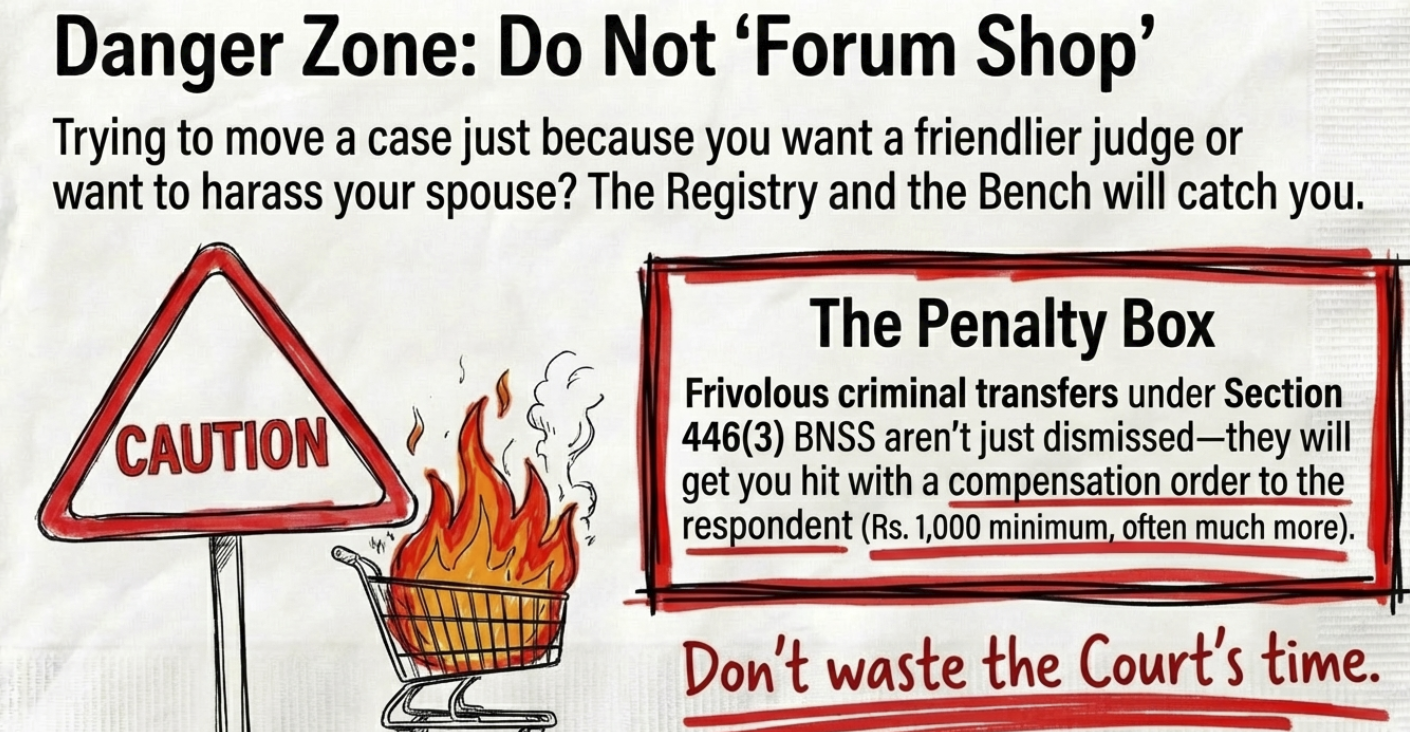
Forum Shopping and Vexatious Petitions
#image_title
If the Supreme Court finds that a transfer petition is filed to “forum shop”—i.e., to find a court that might be more favorable without any genuine hardship—it may dismiss the petition with heavy costs.21 Under Section 446(3) of the BNSS, if a criminal transfer petition is found to be frivolous, the Court can order the applicant to pay up to (or more depending on circumstances) as compensation to the respondent.11
The Professional Barrier: Dual-Income Couples
A rising challenge in the 2024-2026 period is the treatment of dual-income, professional couples (e.g., both spouses being doctors or lawyers). In such cases, the Court is less inclined to grant a transfer based solely on “travel inconvenience,” as both parties are perceived to have the financial means to travel.19 However, even in these cases, if the wife can prove safety risks or that the husband is using his local influence to bias the trial, a transfer can still be granted.19
The Jammu and Kashmir Context
Historically, transfers to and from the State of Jammu and Kashmir faced unique legal hurdles due to different procedural codes.5 However, post-2019, the integration of central laws has streamlined these petitions, bringing them under the standard Section 25 CPC and Section 446 BNSS framework.4
Conclusion: The Holistic Future of Transfer Jurisprudence
The transfer petition mechanism in the Supreme Court of India has transformed from a mere venue-transfer tool into a sophisticated gateway for complete domestic resolution. The integration of Section 25 CPC with the plenary powers of Article 142 ensures that the Court does not just decide where a case should be heard, but often decides how a dispute should be ended.3
For a petitioner, the journey from filing to disposal requires meticulous documentation, the strategic engagement of an AOR, and an openness to mediation.2 As the judiciary continues to embrace technological solutions like video conferencing and virtual mediation, the traditional definitions of “hardship” and “convenience” are evolving.6 However, the foundational principle remains unchanged: the Supreme Court of India stands as a safeguard against jurisdictional unfairness, ensuring that every citizen—regardless of their geography or financial status—can access justice in a forum that is safe, accessible, and fair.1
Works cited
- Section 25 CPC: Case Transfer Guidelines | PDF | Supreme Court Of The United States, accessed on April 8, 2026, https://www.scribd.com/document/920713279/Section-25-CPC-Research-Summary
- Transfer Petitions u/s 25 CPC in Matrimonial Disputes | Legal Insights – Qualegal, accessed on April 8, 2026, https://www.qualegalindia.com/transfer-petitions-us-25-cpc-in-matrimonial-disputes.html
- Shilpa Sailesh v. Varun Sreenivasan- 2023 – Vintage Legal, accessed on April 8, 2026, https://www.vintagelegalvl.com/post/shilpa-sailesh-v-varun-sreenivasan-2023
- How To Transfer Your Case From Another State To Your State: Know The Supreme Court Procedure And Rules – leadindia.law, accessed on April 8, 2026, https://www.leadindia.law/blog/en/how-to-transfer-your-case-from-another-state-to-your-state-know-the-supreme-court-procedure-and-rules/
- Transfer Petition in the Supreme Court of India – RB Law, accessed on April 8, 2026, https://rblaw.in/transfer-petition-in-the-supreme-court-of-india/
- Transfer in Case of Matrimonial Disputes – Legal Tick, accessed on April 8, 2026, https://legaltick.com/uncategorized/transfer-in-case-of-matrimonial-disputes/
- How to File a Transfer Petition – Step-by-Step Procedure – Legal Light Consulting, accessed on April 8, 2026, https://legallightconsulting.com/how-to-file-a-transfer-petition-step-by-step-procedure/
- How to File a Transfer Petition in the Supreme Court of India – Lawyer No, accessed on April 8, 2026, https://aorsupremecourt.com/how-to-file-a-transfer-petition-in-the-supreme-court-of-india
- Transfer Petition in Supreme Court of India – Legal Light Consulting, accessed on April 8, 2026, https://legallightconsulting.com/transfer-petition-in-supreme-court-of-india/
- What is Transfer Petition – – Lawsathi Consulting, accessed on April 8, 2026, https://lawsathi.com/transfer-petition-lawyer/
- Transfer of Criminal Cases Explained | PDF | Bail | Nuisance – Scribd, accessed on April 8, 2026, https://www.scribd.com/document/897508584/Bnss-End-Sem
- Section 446 in Bharatiya Nagarik Suraksha Sanhita, 2023 – Indian Kanoon, accessed on April 8, 2026, https://indiankanoon.org/doc/109930280/
- Supreme Court Rules, 2013., accessed on April 8, 2026, https://images.assettype.com/barandbench/import/2014/07/Supreme-Court-Rules-2013.pdf
- Documents Required for a the Supreme Court Transfer Petition – Legal Light Consulting, accessed on April 8, 2026, https://legallightconsulting.com/documents-required-for-a-the-supreme-court-transfer-petition/
- SUPREME COURT TRANSFER PETITION (CIVIL) – Lawvs, accessed on April 8, 2026, https://lawvs.com/drafts/supreme-court-transfer-petition-civil-156
- Checklist – Supreme Court Legal Services Committee, accessed on April 8, 2026, https://sclsc.gov.in/Application/Checklist
- Law of transfer petitions in the Supreme Court of India, accessed on April 8, 2026, https://patraslawchambers.com/law-of-transfer-petitions-in-the-supreme-court-of-india/
- The Transfer Of Matrimonial Proceedings: When You Should Approach The Supreme Court, accessed on April 8, 2026, https://nilotpaldatta.com/blog/post/the-transfer-of-matrimonial-proceedings-when-you-should-approach-the-supreme-court/
- Can Criminal Cases Be Transferred Through a Supreme Court Petition? – Legal Light Consulting – Leading Law Firm in India, accessed on April 8, 2026, https://legallightconsulting.com/can-criminal-cases-be-transferred-through-a-supreme-court-petition/
- Recent Supreme Court Judgments on Transfer Petitions in …, accessed on April 8, 2026, https://legallightconsulting.com/recent-supreme-court-judgments-on-transfer-petitions-in-matrimonial-cases-in-india/
- File Transfer petition in the supreme court of India | Taps9 Law, accessed on April 8, 2026, https://taps9.com/transfer-petition-in-the-supreme-court-of-india/
- Shilpa Sailesh v Varun Sreenivasan: Case Summary & Download PDF – Testbook, accessed on April 8, 2026, https://testbook.com/landmark-judgements/shilpa-sailesh-vs-varun-sreenivasan
- SC’s Power To Directly Grant Divorce: Judgement in Plain English, accessed on April 8, 2026, https://www.scobserver.in/reports/divorce-under-article-142-judgement-in-plain-english/
- Which cases can be transferred by the Supreme Court under Section 25 CPC? – Legal Light Consulting – Leading Law Firm in India, accessed on April 8, 2026, https://legallightconsulting.com/which-cases-can-be-transferred-by-the-supreme-court-under-section-25-cpc/
- CASE ANALYSIS – Shilpa Sailesh Vs. Varun Sreenivasan – Jus Scriptum Law, accessed on April 8, 2026, https://www.jusscriptumlaw.com/post/case-analysis-shilpa-sailesh-vs-varun-sreenivasan
- IN THE SUPREME COURT OF INDIA CIVIL ORIGINAL JURISDICTION TRANSFER PETITION (CIVIL) NO.1942/2024 NISHA PETITIONER VERSUS JIA, accessed on April 8, 2026, https://www.sci.gov.in/sci-get-pdf/?diary_no=319032024&type=o&order_date=2025-01-09&from=latest_judgements_order
- IN THE SUPREME COURT OF INDIA CIVIL ORIGINAL JURISDICTION TRANSFER PETITION (C) NO. 2922 OF 2024 XXX … PETITIONER Versus YYY, accessed on April 8, 2026, https://www.sci.gov.in/sci-get-pdf/?diary_no=479302024&type=o&order_date=2025-03-20&from=latest_judgements_order
- The present case has a chequered history. Initially by order dated 20.02.2025, the matter had been disposed of by allowing the t – Supreme Court of India, accessed on April 8, 2026, https://api.sci.gov.in/supremecourt/2024/19741/19741_2024_14_9_62859_Order_31-Jul-2025.pdf
- Supreme Court Rules | Supreme Court of India | India, accessed on April 8, 2026, https://www.sci.gov.in/supreme-court-rules/
- Court Fees Calculator – Supreme Court of India, accessed on April 8, 2026, https://www.sci.gov.in/court-fees-calculator/
- Jurisdiction – Supreme Court of India, accessed on April 8, 2026, https://www.sci.gov.in/jurisdiction/
- Top Trending Legal Industry Keywords and What They Mean for Law Firms’ SEO, accessed on April 8, 2026, https://attorneys.media/trending-legal-keywords-law-firms/
- SEO for Family Law: A 2026 Strategy Guide – SeoProfy, accessed on April 8, 2026, https://seoprofy.com/blog/seo-for-family-lawyers/
- The Best SEO Keywords for Lawyers – SEOpital, accessed on April 8, 2026, https://www.seopital.co/blog/seo-keywords-for-lawyers
- SEO for Divorce Lawyers | Clectiq, accessed on April 8, 2026, https://www.clectiq.com/best-seo-service-for-lawyers/seo-for-divorce-lawyers
- Transfer Petitions in the Supreme Court of India – Your Top Questions Answered, accessed on April 8, 2026, https://legallightconsulting.com/transfer-petitions-in-the-supreme-court-of-india-your-top-questions-answered/