SLP Against a Calcutta High Court Order: Help for West Bengal
If the Calcutta High Court has ruled against you, a special leave petition under Article 136 asks the Supreme Court for permission to appeal. The time limit is short, so the first week matters. Clients in Kolkata, the districts and abroad are kept informed without travelling to Delhi.
When can you take a Calcutta High Court order to the Supreme Court?
You can ask the Supreme Court to hear an appeal against a Calcutta High Court judgment or order by filing a special leave petition (SLP) under Article 136 of the Constitution. Leave is not a right. The Court grants it in exceptional cases only, as stated in Pritam Singh v. The State, AIR 1950 SC 169. In some matters, an appeal on a High Court certificate under Article 134A may be possible instead. Our general page on Supreme Court matters covers the wider picture, and what an SLP is is explained in a separate guide. The official site of the Supreme Court of India carries the rules and case status.
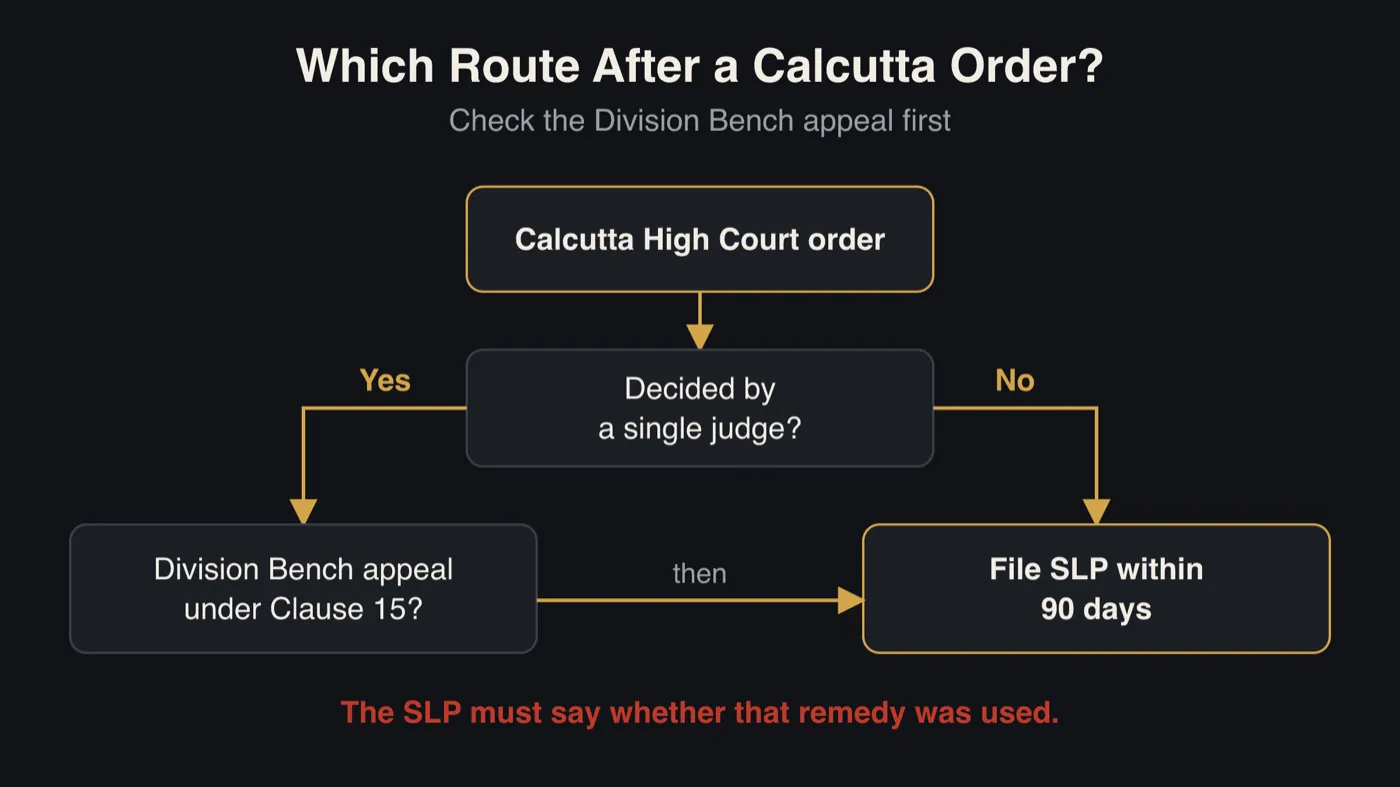
This page is for the Calcutta High Court route and the practical side for West Bengal clients. Under Order XXI Rule 1 of the Supreme Court Rules, 2013, a civil SLP is filed within 90 days of the High Court judgment or order, or within 60 days of the refusal of a certificate. Sections 4, 5, 12 and 14 of the Limitation Act, 1963 apply. If a single judge decided your matter, first check whether an appeal to a Division Bench lies under Clause 15 of the Letters Patent, because the SLP must say whether that remedy was used. See also our notes on Calcutta High Court civil appeals and the Calcutta High Court advocate consultation page. Every case turns on its own facts and papers, so please verify your dates with a lawyer.
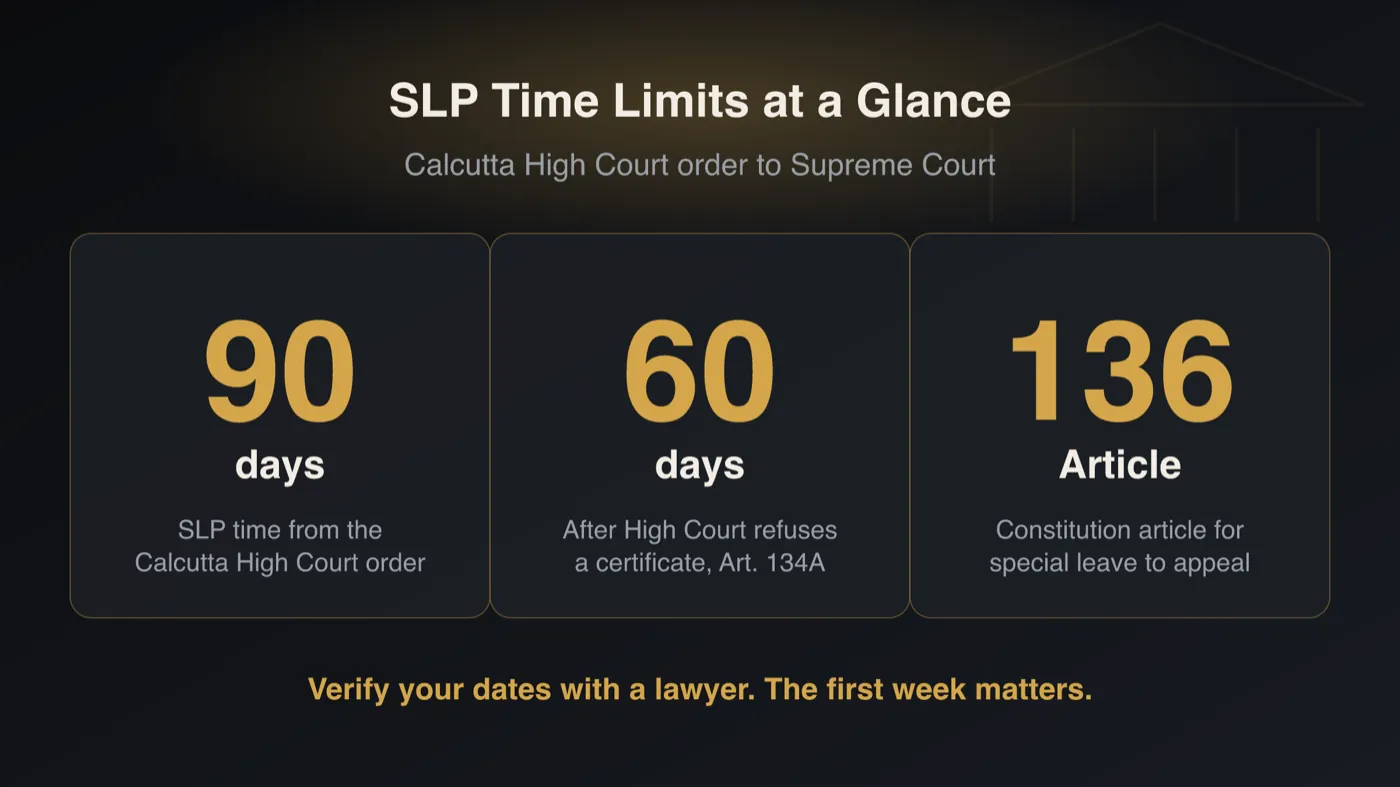
How long you have to approach the Supreme Court
The main periods under the Supreme Court Rules, 2013, subject to sections 4, 5, 12 and 14 of the Limitation Act.
Short explainers from Adv. Sudip Patra
More short explainers on our YouTube channel: Patra’s Law Chambers on YouTube ↗
What has the Calcutta High Court just done in your case?
Pick the situation closest to yours to see the usual route to the Supreme Court. This is general information, not advice on your papers.
Choose one of the options above.
From the Calcutta High Court order to the first Supreme Court hearing
The usual order of events for a civil or criminal SLP. Each case differs, and the dates below depend on your papers.
Apply for the certified copy at once and keep the receipt. Ask whether a short stay of the High Court order is sought from the same Bench so there is time to approach Delhi.
Decide whether a Division Bench appeal lies, or whether the order goes straight to the Supreme Court. Our notes on Calcutta High Court civil appeals and writ petitions explain the High Court routes.
Certified copies, High Court pleadings, translations and a signed vakalatnama are collected. The petition in Form No. 28 is drafted with a list of dates, questions of law, grounds and the interim prayer inside it.
The petition is e-filed by an Advocate-on-Record in the Supreme Court; Sudip Patra prepares the matter and argues it himself. The Registry may mark defects, and they must be cured in the time given.
The matter is listed under the Court’s current listing practice. The Court may dismiss, issue notice, pass an interim order, or grant leave. Read more on what an SLP is.
If leave is granted, the SLP becomes a Civil or Criminal Appeal. If it is dismissed without reasons, the High Court order does not merge into it, and other remedies may still be examined.
Three things people often assume about an SLP: tap a card
It does not. Until the Supreme Court passes an interim order, the High Court order can be acted on. The interim prayer is made inside the petition itself.
An SLP under Article 136 asks for permission to appeal. The Court grants leave only where it finds the case fit for it.
Usually not. Papers can be signed and sworn in Kolkata, the districts or abroad, and counsel argues the matter. Hearings may be hybrid.
What we handle in an SLP from Calcutta
Civil and writ matters
SLPs against Calcutta High Court judgments in civil appeals, writ petitions and revision matters. We first check forum and limitation, and whether a Division Bench appeal under Clause 15 should come first, as discussed in Shyam Sel and Power Ltd. v. Shyam Steel Industries Ltd., 2022 INSC 303.
Criminal SLPs and bail orders
SLPs against Calcutta High Court orders in criminal revisions, quashing and bail matters. Limits follow Order XXII of the Supreme Court Rules. See our guides on quashing of criminal cases and the SLP for anticipatory bail.
Condonation of delay
If the 90 days have passed, an application under section 5 must explain every day of delay and the Court issues notice to the other side first. Recent rulings such as Pathapati Subba Reddy v. Special Deputy Collector, 2024 INSC 286, show how strictly delay is examined. No result can be promised.
If you won in the High Court
A party who succeeded in Calcutta can lodge a caveat under Order XV Rule 2 so that no interim order is passed without being heard. We also prepare the response to the SLP and the opposition to any stay.
How your SLP matter is handled
- Review of the Calcutta High Court order, dates and limitation on the first day
- Check of the Division Bench appeal route before an SLP is filed
- Drafting in Form 28 with synopsis, list of dates, questions of law and grounds
- Interim prayer included in the petition itself, as the Rules require
- E-filing by an Advocate-on-Record in the Supreme Court, with Sudip Patra preparing and arguing the matter himself
- Case number, cause-list and order copies passed to you the same day
Supreme Court rulings that shape an SLP against a Calcutta High Court order
These decisions settle what happens before, during and after an SLP from a Calcutta High Court order: which forum comes first, how delay is judged, which papers the Registry insists on, and what a dismissal at the first hearing leaves open.
2000
Refusal of leave causes no merger
A three-judge Bench held that an order refusing special leave, whether it gives reasons or not, does not merge the High Court order into the Supreme Court’s order. Merger happens only once leave is granted and the appeal is decided. Until then the Calcutta High Court order remains the operative order, and a review in the High Court is not shut out.
2019
Review survives an in limine SLP dismissal
On a reference, a three-judge Bench affirmed Kunhayammed. If an SLP is dismissed at the threshold by a non-speaking order, the High Court can still hear a review petition against its own judgment. A client whose SLP fails at the first hearing therefore still has this route, although the grounds for review remain narrow.
2022
Clause 15 appeal needs trappings of finality
This appeal came from the Calcutta High Court. The Supreme Court held that a single judge’s order is a judgment open to a Division Bench appeal under Clause 15 of the Letters Patent only if it decides a valuable right with some finality. An order that only granted time to file an affidavit did not qualify. Check this before choosing between an intra-court appeal and an SLP.
2013
Condonation is never a matter of course
The Supreme Court gathered the principles on condonation of delay. Courts take a justice-oriented approach, but a liberal approach must stay reasonable. Lack of bona fides, negligence and inaction count against the applicant, and applications must not be decided routinely or on a judge’s personal outlook. Parties that are expected to obey court orders cannot stay indifferent to them.
2024
Long unexplained delay will not be condoned
The Supreme Court upheld a High Court’s refusal to condone a 5,659-day delay in filing an appeal. It restated that limitation must be applied as the statute says, that sufficient cause has to be shown, and that a liberal approach cannot override the Limitation Act. A late SLP now needs a documented, period-by-period explanation.
2024
Copy exemption needs the High Court receipt
This order arose from a Calcutta High Court criminal revision. It directs that any application for exemption from filing a certified copy of the impugned order must carry the receipt issued by the High Court section for the copy application, and must give the reason for the exemption. The direction took effect on 20 August 2024.
How an SLP against a Calcutta High Court order moves to the Supreme Court
On the day of the High Court order
Apply for the certified copy at once and keep the receipt. The Supreme Court Registry asks for it if you seek exemption. Where it fits, ask the Bench orally for a certificate under Article 134A, or for a short stay of its order. Whether to grant either is up to the High Court.
Check that the SLP is the right remedy
If a single judge decided the matter, see first whether a Division Bench appeal lies under Clause 15 of the Letters Patent. The SLP must say whether that remedy existed and whether it was used (Order XXI Rule 3(5), Supreme Court Rules 2013). Our Calcutta High Court matters page explains the intra-court routes.
Count the limitation period
A civil SLP must be filed within 90 days of the judgment or order. If the High Court refused a certificate, the limit is 60 days from the refusal (Order XXI Rule 1). Criminal SLPs follow Order XXII. Sections 4, 5, 12 and 14 of the Limitation Act apply, so the time taken to get the certified copy is excluded. If you are late, file a condonation application that explains every period of delay.
Send the papers from Kolkata, the districts or abroad
Send the certified copy of the impugned order, the orders of the courts below, the High Court pleadings and annexures, English translations of Bengali documents, identity proof, a signed vakalatnama and a notarised affidavit. Clients abroad can swear the affidavit before an Indian consulate or have it apostilled; check the Registry’s current requirements. See our NRI and OCI clients page.
Drafting, e-filing and curing defects
The petition is drafted in Form No. 28 with a synopsis, list of dates, questions of law, grounds, and the interim prayer inside the petition, with annexures in date order. The petition is e-filed by an Advocate-on-Record in the Supreme Court; Sudip Patra prepares the matter and argues it himself. Defects the Registry points out must be cured within the time it allows.
Listing, first hearing and keeping you informed
The matter is listed under the Supreme Court’s current listing procedure. At the first hearing the Court may dismiss it, issue notice, grant an interim stay or status quo, or grant leave, after which it becomes a civil or criminal appeal. You get the diary number, the hearing dates and a copy of each order, so you can follow the case without travelling to Delhi. More on Supreme Court matters.
How a Calcutta High Court order reaches the Supreme Court
The usual path from the High Court order to a decision on leave.
Calcutta High Court order
Apply for the certified copy and keep the receipt.
Division Bench appeal check
If a Clause 15 appeal lies, it is considered first.
SLP filed in Form 28
Filed through an Advocate-on-Record with the interim prayer inside.
Registry defects cured
Defects marked by the Registry must be removed in time.
First hearing
The Court may dismiss, issue notice, pass an interim order, or grant leave.
Civil or Criminal Appeal
After leave, the SLP is registered as an appeal and heard.
Common mistakes in an SLP against a Calcutta High Court order
Assuming that filing the SLP stops the High Court order Filing does not stay anything by itself. The Calcutta High Court order can be enforced until the Supreme Court passes an interim order, so the stay must be asked for in the petition and pressed at the first hearing.
Going straight to Delhi when a Division Bench appeal lies An SLP against a single judge’s order is often sent back so the party can use the Letters Patent appeal first. Check under Shyam Sel whether the order is a judgment under Clause 15 before choosing the forum.
Giving a vague reason for delay Lines like “the papers were with the old lawyer” or “the family was unsure” are not enough. After Pathapati Subba Reddy and later rulings, each period of delay needs a reason and supporting papers, and notice goes to the other side before condonation.
Seeking exemption without the copy receipt, or not mentioning an earlier SLP Since Harsh Bhuwalka, an exemption application without the High Court receipt for the certified copy may be refused. Rule 3(2) requires a statement on any earlier SLP, and leaving it out risks dismissal. Read what an SLP is before you file.
Send the High Court order before the days run out
The 90 days start from the Calcutta High Court order, and the certified copy should be applied for at once. Send us the order, the High Court papers and your dates, and we will tell you what route is open, what the Registry will need and what a stay application would involve. You sign papers in Kolkata, in your district or abroad, and we keep you informed of each listing and order. Nothing here is a promise of any result.
Book a ConsultationEstablished by a distinguished alumnus of IIT Kharagpur, Patra’s Law Chambers stands as a beacon of legal expertise in Kolkata & Delhi. Know more →
Kolkata Office
NICCO House, 6th Floor, 2 Hare Street
Kolkata-700001 (Near Calcutta High Court)
Delhi Office
4455/5, First Floor, Gali Shahid Bhagat Singh
Main Bazar Road, Paharganj, New Delhi-110055
Contact
[email protected]
+91 890 222 4444 / +91 7003 715 325
Filing an SLP versus getting a Supreme Court stay
Filing the petition and obtaining interim protection are two separate steps.
Frequently asked questions: SLP against a Calcutta High Court order
Under Order XXI Rule 1 of the Supreme Court Rules, 2013, it is 90 days from the High Court’s judgment or order, and 60 days from the refusal of a certificate under Article 134A. The time taken to obtain the certified copy is excluded under section 12 of the Limitation Act.
The petition can be filed with an application for condonation of delay under section 5 of the Limitation Act. The Court looks for a sufficient cause covering the whole period, and decides after notice to the other side. Recent rulings expect a day-by-day explanation.
Usually not. Affidavits and the vakalatnama can be signed in Kolkata or your district, or abroad. Counsel argues the matter, and the case can be followed online through the diary number and cause list.
First check whether a Letters Patent appeal to a Division Bench lies under Clause 15. The test is whether the order has the trappings of finality (Shyam Sel and Power Ltd., 2022 INSC 303). The SLP must say whether that remedy was used.
No. Only an interim order of the Supreme Court does that. The request for stay or status quo is made inside the petition (Form No. 28), and the Court decides it at the hearing, so no result can be assured.
The certified copy of the High Court order, orders of the courts below, the High Court pleadings and annexures, English translations of Bengali documents, identity proof, a signed vakalatnama, and details of any earlier SLP. Criminal matters also need surrender-related papers.
It depends on the order. A dismissal without reasons does not merge the High Court order into it (Kunhayammed, (2000) 6 SCC 359), so a High Court review may still lie (Khoday Distilleries, (2019) 4 SCC 376). A fresh SLP needs liberty. Verify your own order.
Yes, through an affidavit sworn before an Indian consulate or notarised and apostilled, or through a power of attorney holder. The Registry’s current requirements should be verified before signing. See our page for NRI and OCI legal matters.