Comprehensive Legal Analysis and Procedural Roadmap for Filing Special Leave Petitions in Anticipatory Bail Matters Before the Supreme Court of India
Creditor and contributor of this article:
Patra’s Law Chambers:
About Us:
Patra’s Law Chambers is a law firm with offices in Kolkata & Delhi, offering comprehensive legal services across various domains. Established in 2020 by Advocate Sudip Patra (Advocate, Supreme Court of India & Calcutta High Court) an alumnus of the Prestigious Rajiv Gandhi School of Intellectual Property Law, IIT Kharagpur ,with Post Graduate diploma in Business Law from IIM Calcutta, the firm specializes in Civil, Criminal, Writs,High Court Matters, Trademark, Copyright, Company, Tax, Banking, Property disputes, Service law, Family law, and Supreme Court matters.You can know more about us in here
Kolkata Office:
NICCO HOUSE, 6th Floor, 2, Hare Street, Kolkata-700001 (Near Calcutta High Court)
Delhi Office:
House no: 4455/5, First Floor, Ward No. XV, Gali Shahid
Bhagat Singh, Main Bazar Road, Paharganj, New Delhi-110055
Website: www.patraslawchambers.com
Email: [email protected]
Phone: +91 890 222 4444/ +91 7003 715 325
The Constitutional Genesis and Jurisprudential Scope of Article 136
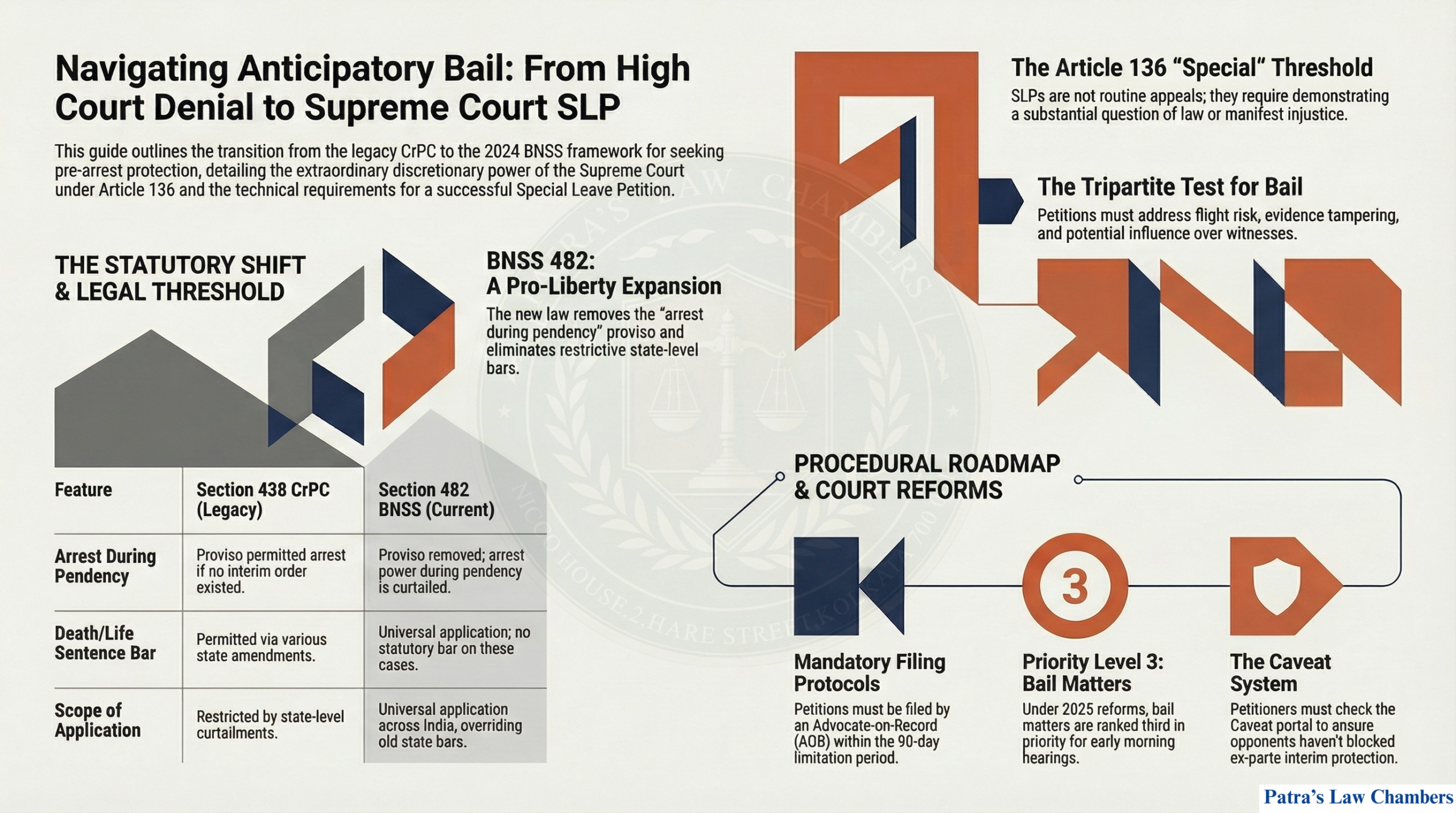
The Special Leave Petition (SLP) constitutes one of the most significant and expansive powers conferred upon the Supreme Court of India by the Constitution. Under Article 136, the Court is vested with the discretionary authority to grant “special leave” to appeal from any judgment, decree, determination, sentence, or order passed by any court or tribunal within the territory of India.1 This power is uniquely plenary and overriding, as indicated by the non-obstante clause “Notwithstanding anything in this Chapter,” which allows the Court to transcend the standard limitations of appellate jurisdiction found in Articles 132 to 135.2
The historical evolution of Article 136 reveals its intent as a “residual” and “extraordinary” remedy. During the Constituent Assembly debates in 1949, the framers intentionally designed this provision to ensure that technicalities would not prevent the highest court from intervening when a grave miscarriage of justice occurred.2 One significant debate centered on whether the Supreme Court should have jurisdiction over military tribunals; ultimately, Clause (2) was added to exclude courts-martial from the purview of Article 136, except in cases where jurisdictional excess or arbitrary procedure could be demonstrated.2 For the modern petitioner in an anticipatory bail matter, this constitutional history underscores that the SLP is not a routine second appeal but a request for the Court to exercise its “conscience” to rectify a manifest legal error by a High Court.5
In criminal matters, particularly those involving the apprehension of arrest, the Supreme Court has repeatedly clarified that Article 136 should be invoked sparingly. The judgment in Pritam Singh v. State established early on that the Court would only interfere where the circumstances are “exceptional” or “outrageous enough to shock the basis of justice”.6 Consequently, an SLP challenging the denial of anticipatory bail must demonstrate more than just an alternative view of the facts; it must establish a “substantial question of law” or a violation of fundamental rights, particularly the right to personal liberty under Article 21.7
The Statutory Paradigm Shift: Transitioning from CrPC to BNSS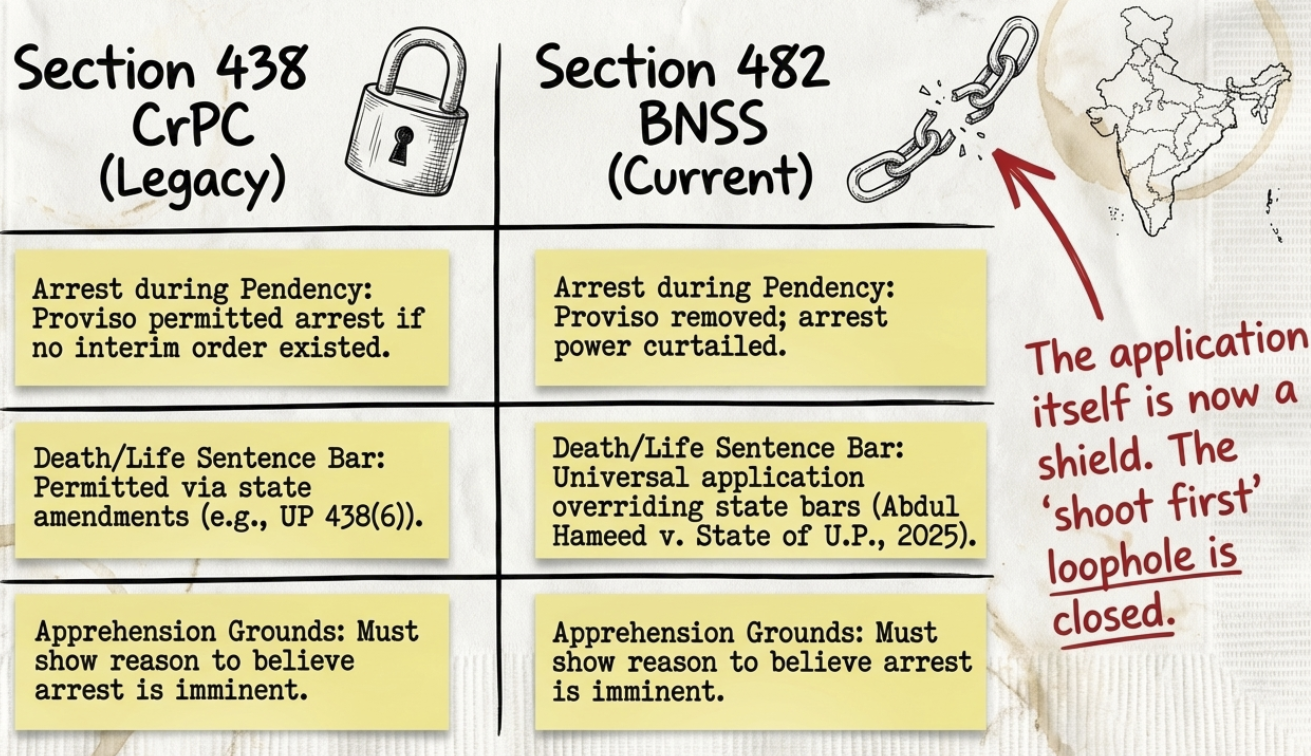
A pivotal development for any petitioner seeking pre-arrest protection is the repeal of the Code of Criminal Procedure (CrPC), 1973, and the implementation of the Bharatiya Nagarik Suraksha Sanhita (BNSS), 2023, which took effect on July 1, 2024.9 This shift has profound implications for the legal grounds on which an SLP is drafted, as the governing provision for anticipatory bail has moved from Section 438 of the CrPC to Section 482 of the BNSS.8
The transition reflects a significant philosophical expansion of pre-arrest rights. Under the old Section 438(1) of the CrPC, a proviso allowed police to arrest an applicant while a bail plea was pending if the court had not granted an explicit interim protection. The BNSS deliberately omits this proviso, effectively removing the statutory justification for arrest solely because a court has not yet reached the hearing stage.9 This change suggests a legislative intent to treat the filing of an anticipatory bail application as a “shield” from the moment of registration. Furthermore, the BNSS has eliminated state-level restrictions, such as those in Uttar Pradesh, which previously barred anticipatory bail for offenses carrying death or life imprisonment sentences.9 The Allahabad High Court, in the 2025 ruling of Abdul Hameed v. State of U.P., affirmed that Section 482 of the BNSS applies retrospectively to obstacles removed by the new law, even if the offense occurred prior to its enactment.9
Comparative Statutory Framework for Anticipatory Bail
| Feature | Section 438 CrPC (Legacy) | Section 482 BNSS (Current) |
| Arrest during Pendency | Proviso permitted arrest if no interim order existed.9 | Proviso removed; arrest power during pendency is curtailed.9 |
| Death/Life Sentence Bar | Permitted via state amendments (e.g., UP 438(6)).9 | No statutory bar on death or life imprisonment cases.10 |
| Scope of Application | Restricted by state-level curtailments.9 | Universal application across India, overriding old state bars.10 |
| Apprehension Grounds | Must show “reason to believe” arrest is imminent.11 | Jurisprudence on “reason to believe” remains pari materia.9 |
| Jurisdictional Forum | Concurrent (Sessions Court and High Court).11 | Concurrent (Sessions Court and High Court).8 |
For a petitioner approaching the Supreme Court, these changes mean that arguments must now be framed within the context of the BNSS. Even if the investigation began under the CrPC, the procedural remedy of bail is governed by the law in force at the time of the application.9 The Supreme Court has already signaled that the principles of personal liberty established under the old code continue to inform the interpretation of the new framework.8
Comprehensive Procedural Roadmap: The Petitioner’s Path to the Apex Court
The process of filing an SLP is highly regulated by the Supreme Court Rules, 2013, and requires strict adherence to technical and financial protocols.1 Unlike lower courts, the Supreme Court operates under a unique system where only a designated “Advocate-on-Record” (AOR) is permitted to file cases.1
The Mandatory Role of the Advocate-on-Record (AOR)
The AOR is a specialized class of advocate who has cleared a rigorous examination and is authorized by the Court to act as the legal agent for the petitioner. Under the Supreme Court Rules, while a Senior Advocate or any other lawyer may argue the matter, the AOR is the only person legally entitled to sign the petition, file a Vakalatnama, and handle communication with the Registry.1 The relationship between the petitioner and the AOR is critical; the AOR certifies that the facts presented are accurate and that the SLP does not contain any new facts or documents that were not part of the lower court records.3
Timelines and the Limitation Period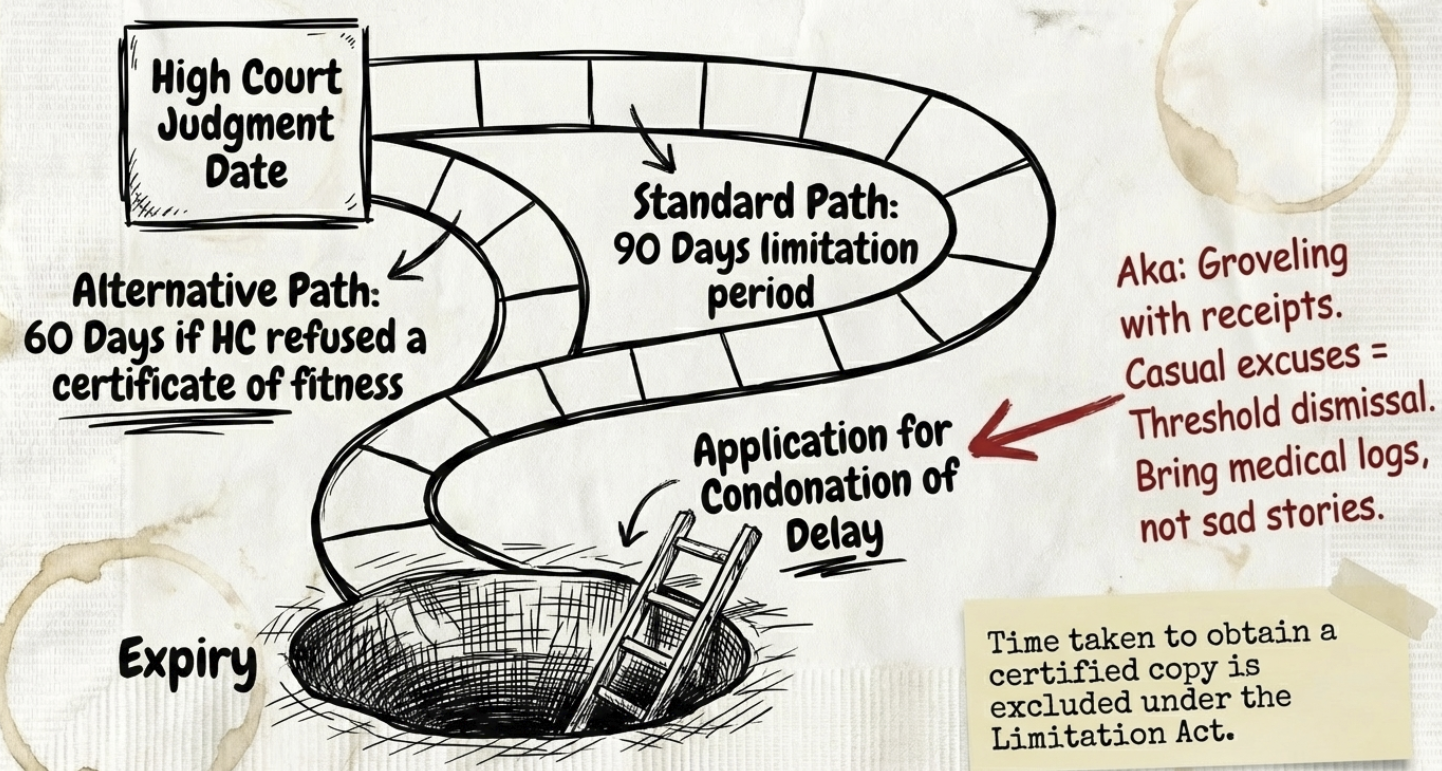
The limitation period for filing an SLP in criminal matters is generally 90 days from the date of the impugned High Court judgment.1 However, if the petitioner had applied for a certificate of fitness to appeal from the High Court and it was refused, the SLP must be filed within 60 days of that refusal.1 In computing these periods, the time taken to obtain a certified copy of the judgment is typically excluded under the Limitation Act.13
If an SLP is filed after the expiry of the limitation period, it must be accompanied by an “Application for Condonation of Delay.” This application must explain every single day of delay with documentary proof, such as medical certificates or administrative logs.1 The Court scrutinizes these applications strictly, and a “casual” explanation often leads to threshold dismissal.17
Mandatory Document Checklist and Arrangement
The Supreme Court Registry maintains a “Scrutiny Assistant Check List” that every petition must pass before it is listed.18 Missing documents or improper formatting can lead to the matter being classified as an “unregistered case”.7
| Document Category | Specific Requirements |
| Core Petition | Special Leave Petition in Form No. 28, incorporating Questions of Law and Grounds.3 |
| Impugned Order | Certified copy of the High Court’s judgment denying anticipatory bail.1 |
| Timeline of Events | Synopsis and List of Dates in chronological order.1 |
| Legal Authorization | Vakalatnama signed by the petitioner and accepted by the AOR.1 |
| Verifications | Affidavit of the petitioner or an authorized Pairokar in criminal matters.1 |
| Original Records | Copy of the First Information Report (FIR) and Trial Court/Sessions Court orders.14 |
| Translations | Official English translations of any vernacular documents (e.g., FIR in local language).18 |
Strategic Drafting: Substantiating the “Special” Nature of the Leave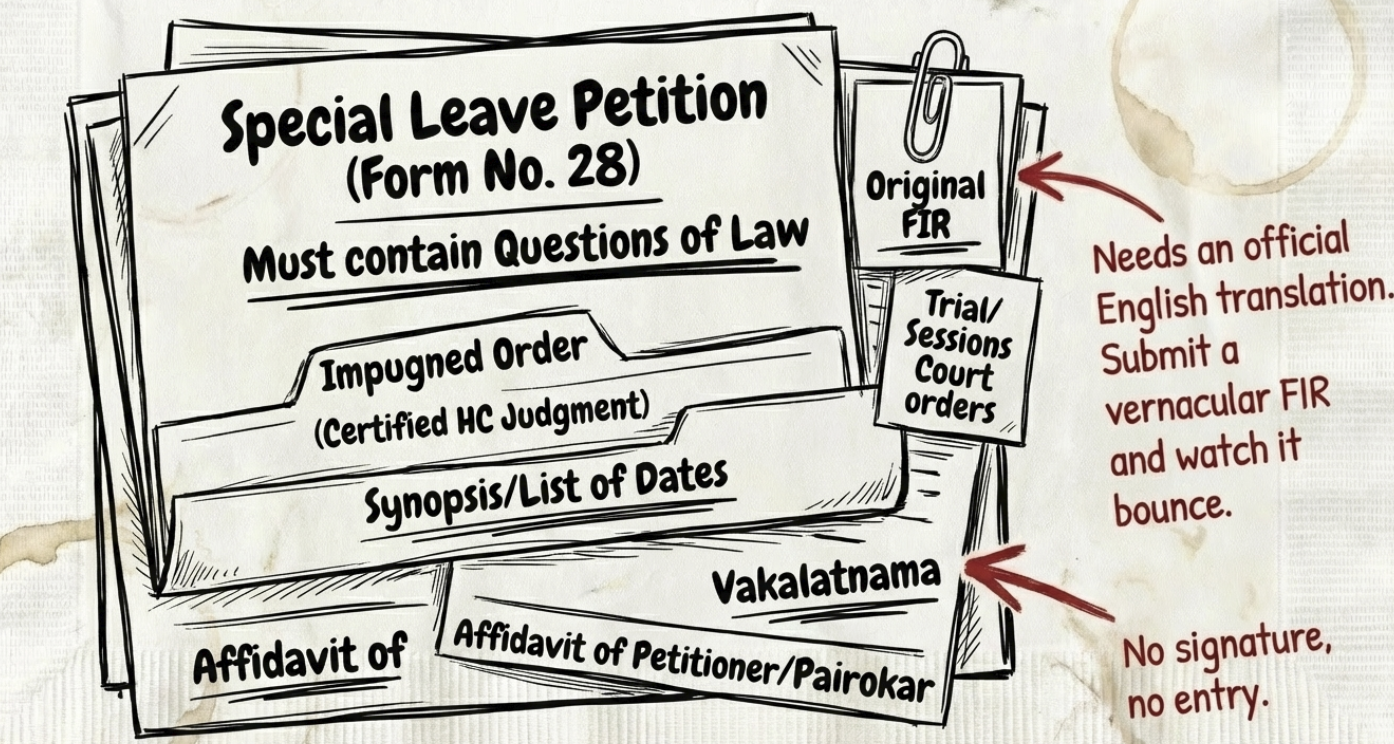
The drafting of an SLP is more than a mere recitation of facts; it is a persuasive legal exercise designed to convince the Bench that the case warrants extraordinary intervention.7 Many petitioners make the mistake of treating the SLP as an “appeal by right,” but the Supreme Court has clarified that it is a “request for leave” that the Court may deny without hearing the merits if no substantial question of law is raised.17
Framing the Questions of Law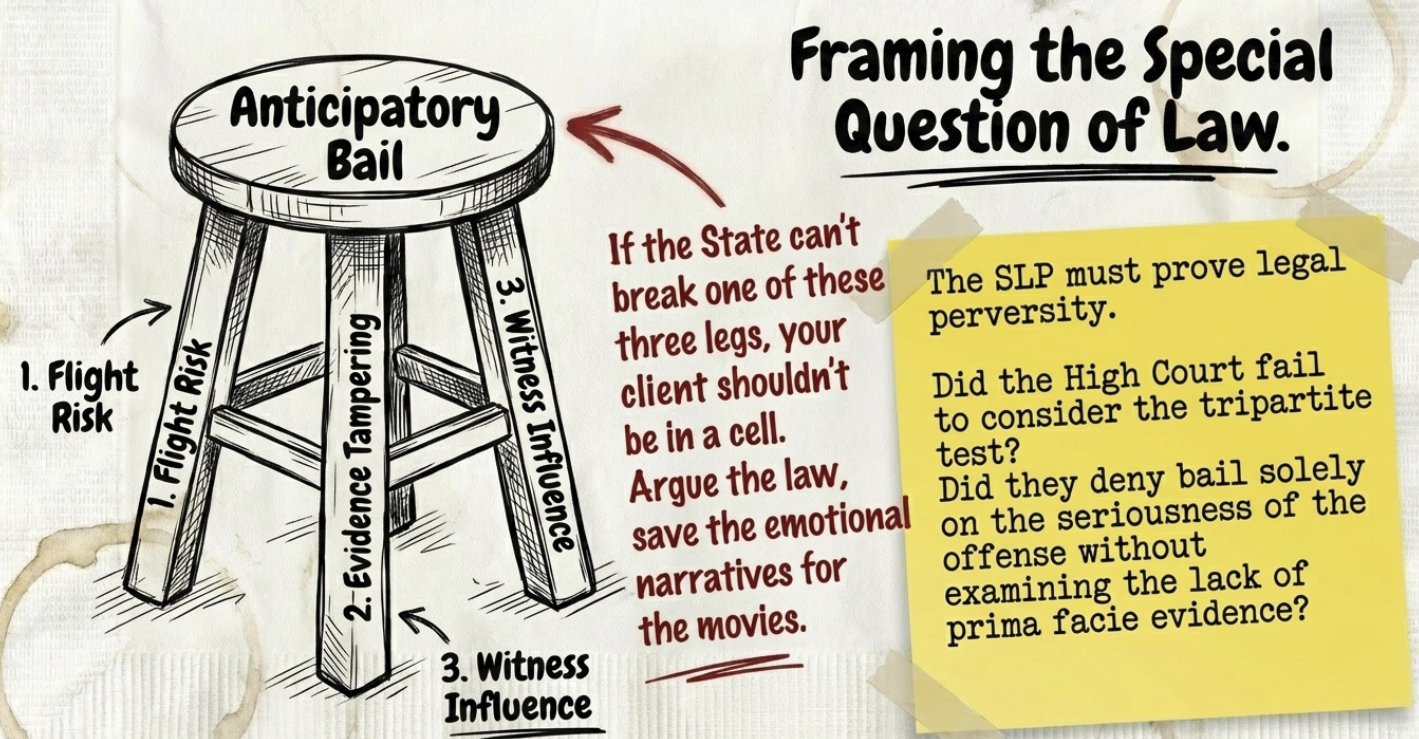
The “Questions of Law” section must be formulated with precision. Effective questions typically address:
- Whether the High Court ignored binding Supreme Court precedents (e.g., Sibbia or Sushila Aggarwal) when denying bail.7
- Whether the High Court failed to consider the “tripartite test” of bail: flight risk, evidence tampering, and influence over witnesses.11
- Whether the denial of anticipatory bail in a case of commercial or civil nature constitutes a manifest error of law.7
Grounds for Special Leave
The grounds section should focus on “legal perversity” or a “misreading of evidence” that has led to a grave miscarriage of justice.5 Emotional narratives are generally avoided in favor of “speaking documents” that highlight constitutional infirmities or jurisdictional errors.17 For example, if a petitioner was denied bail solely based on the “seriousness of the offense” without the High Court examining the prima facie lack of evidence, this constitutes a strong ground for interference under Article 136.8
The Doctrine of Parity and Disclosure
Petitioners must maintain “candor” before the Court. This includes a mandatory declaration that no other petition has been filed against the same order and a full disclosure of any prior bail rejections.1 Furthermore, the principle of “parity” is a vital tool; if co-accused individuals with identical or more severe allegations have been granted protection, the petitioner should highlight this to demonstrate a violation of Article 14.5
Registry Scrutiny and the Defect-Curing Process
After filing—whether through the physical counter or the e-filing portal—the Supreme Court Registry examines the petition for “filing defects”.1 Common procedural lapses that lead to objections include:
- Improper pagination or non-consecutive numbering of paragraphs.7
- Incomplete Vakalatnama (e.g., missing mobile numbers or emails of the parties).18
- Non-certified annexures or failure to file an application for exemption from filing a certified copy.7
- Inconsistency in the description of the impugned judgment across different documents.18
The AOR is notified of these defects and must “cure” them within the prescribed time limit. Failure to remove defects can result in the petition being dismissed for “non-prosecution”.7 Once the Registry is satisfied that the petition complies with the Supreme Court Rules, 2013, the case is assigned a regular registration number and moves to the “Admission Stage”.7
The Mechanism for Interim Protection and Notice
The primary objective for most petitioners filing an SLP is to secure immediate protection from arrest. The Supreme Court has wide powers to grant ad-interim relief during the pendency of the petition.14
Issuance of Notice to the State
If the Court finds a prima facie case after a preliminary hearing, it “issues notice” to the respondent (usually the State Government or the prosecuting agency).15 In urgent matters, the Court often grants interim protection simultaneously with the issuance of notice.21 This protection typically directs that the petitioner shall not be arrested until the next date of hearing or until the final disposal of the SLP, contingent upon the petitioner’s cooperation with the investigation.23
The Role of the Bench Sitting Singly
While most Supreme Court matters are heard by a Bench of at least two Judges, the Supreme Court (Amendment) Rules, 2025, have reinforced the power of a Single Judge nominated by the Chief Justice to hear and finally dispose of SLPs arising out of the grant or rejection of bail and anticipatory bail.24 This administrative efficiency ensures that matters involving personal liberty can be heard more quickly, often within 1-3 weeks of filing.21
Addressing High Court Adjournments without Protection
The Supreme Court has taken a stern view of High Courts that adjourn anticipatory bail pleas for long periods without granting or refusing interim relief. In Sumin v. State of Haryana (2025) and Prabhu Narayan Ram v. State of U.P., the Court held that such a course of action violates established legal principles.23 When a person is before the Court in a matter of personal liberty, they are entitled to a decision on interim protection “one way or the other” rather than an indefinite adjournment.22
Analyzing Judicial Benchmarks: Landmark Precedents on Anticipatory Bail
The Supreme Court’s intervention in bail matters is guided by several cornerstone judgments that have interpreted the scope of pre-arrest protection under Section 438 CrPC and now Section 482 BNSS.
Gurbaksh Singh Sibbia v. State of Punjab (1980)
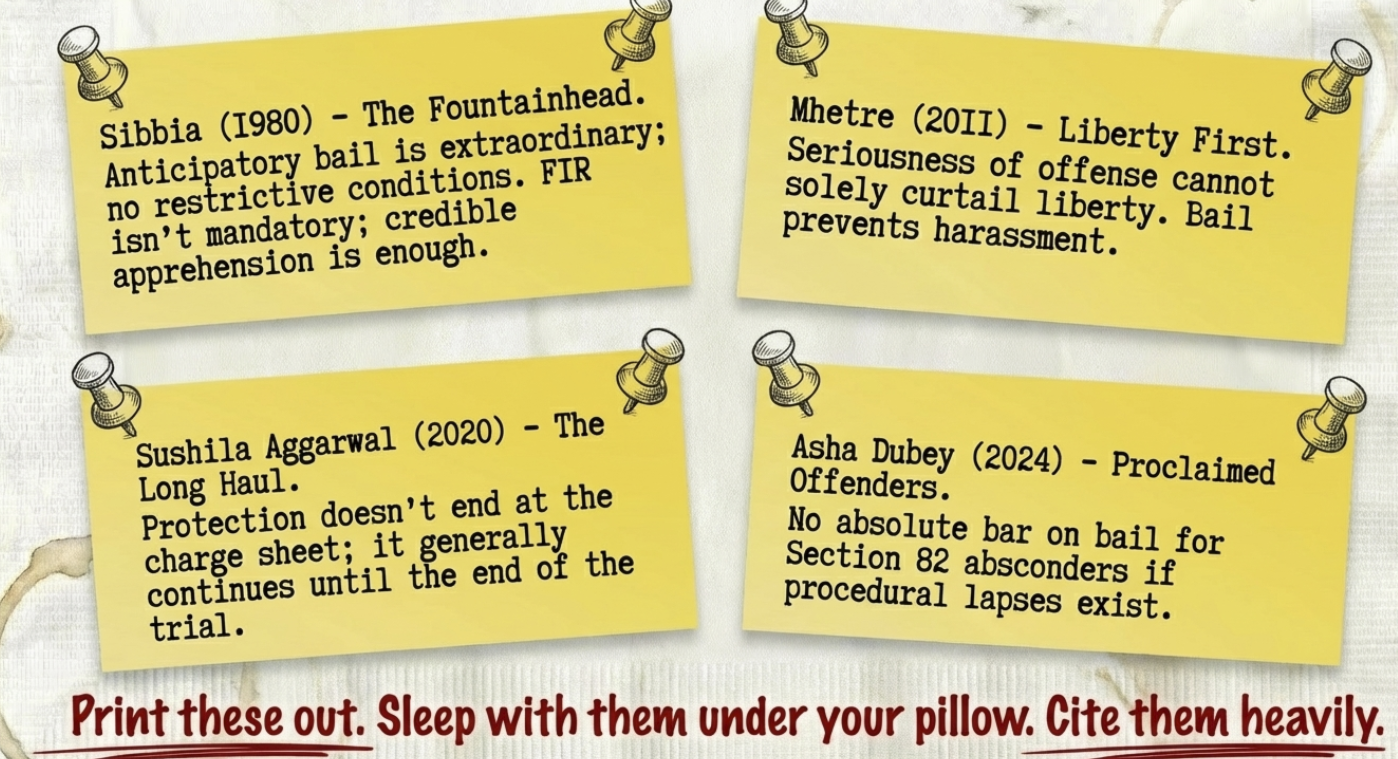
This Constitution Bench judgment remains the “fountainhead” of anticipatory bail law. It established that the power to grant such bail is “extraordinary” and should not be hedged by restrictive conditions not found in the statute.11 Importantly, it held that an FIR is not a mandatory prerequisite for filing; a “credible apprehension” based on a complaint or inquiry is sufficient to move the court.8
Siddharam Satlingappa Mhetre v. State of Maharashtra (2011)
In Mhetre, the Court emphasized that personal liberty is a precious constitutional right that cannot be curtailed merely because an offense is serious.8 It provided a comprehensive list of factors for courts to consider, such as the petitioner’s antecedents and the likelihood of flight. It also clarified that anticipatory bail is intended to prevent the “harassment and humiliation” that an accused may suffer if arrested and subsequently released.8
Sushila Aggarwal v. State (NCT of Delhi) (2020)
This judgment settled the debate regarding the duration of pre-arrest protection. It held that anticipatory bail does not end upon the filing of a charge sheet but generally continues until the end of the trial.8 This ruling provides long-term security for petitioners, ensuring they are not forced to seek fresh bail at every stage of the criminal proceeding.
Asha Dubey v. State of Madhya Pradesh (2024)
This recent decision addressed the bar on granting bail to “proclaimed offenders” (those declared as absconding under Section 82 CrPC/BNSS). While historically such persons were denied relief, the Court in Asha Dubey clarified that there is no “absolute and inflexible bar”.25 The Court must examine the facts sensitivity, as a proclamation may sometimes result from procedural lapses or a lack of knowledge of the proceedings.25
Financial Logistics and the Caveat System
#image_title
Petitioners must manage the financial and strategic risks associated with Supreme Court litigation, including the “Caveat” mechanism used by opponents.
Fee Schedule and Legal Aid
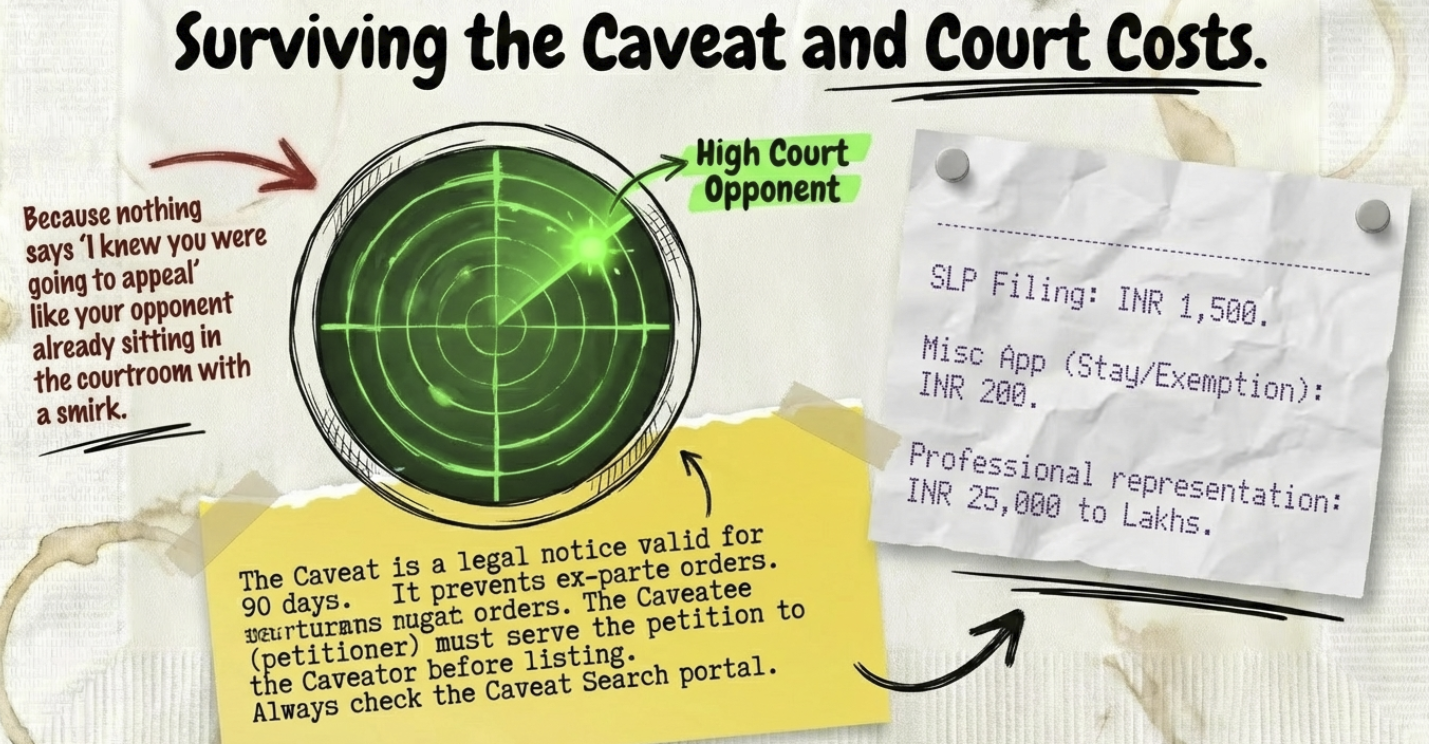
The court fees for filing an SLP are relatively modest, typically INR 1,500, with an additional INR 200 for miscellaneous applications like those for interim stay or exemption.3 However, the cost of professional representation can be substantial, often ranging from INR 25,000 to several lakhs depending on the counsel’s seniority and the case’s complexity.7
| Fee Type | Amount / Authority |
| SLP (Criminal) Filing | INR 1,500 3 |
| Miscellaneous Application | INR 200 per application 3 |
| Caveat Filing Fee | Specified by Registry; typically nominal 26 |
| Legal Aid | Available via Supreme Court Legal Services Committee for those with financial inability.20 |
The Role of the Caveat
A “Caveat” is a legal notice filed by a party who has succeeded in the High Court and expects the opponent to challenge the order in the Supreme Court.26 If a Caveat is active, the Supreme Court cannot grant an ex-parte order (an order without hearing both sides) in favor of the petitioner.26 A Caveat is valid for 90 days, and the “Caveatee” (the petitioner) must serve a copy of the petition to the “Caveator” (the opponent) before the matter is listed.27 For a petitioner seeking anticipatory bail, checking the “Caveat Search” portal is essential to avoid being blindsided by an opponent’s presence at the first hearing.29
Modern Administrative Reforms (2025-2026): Streamlining Justice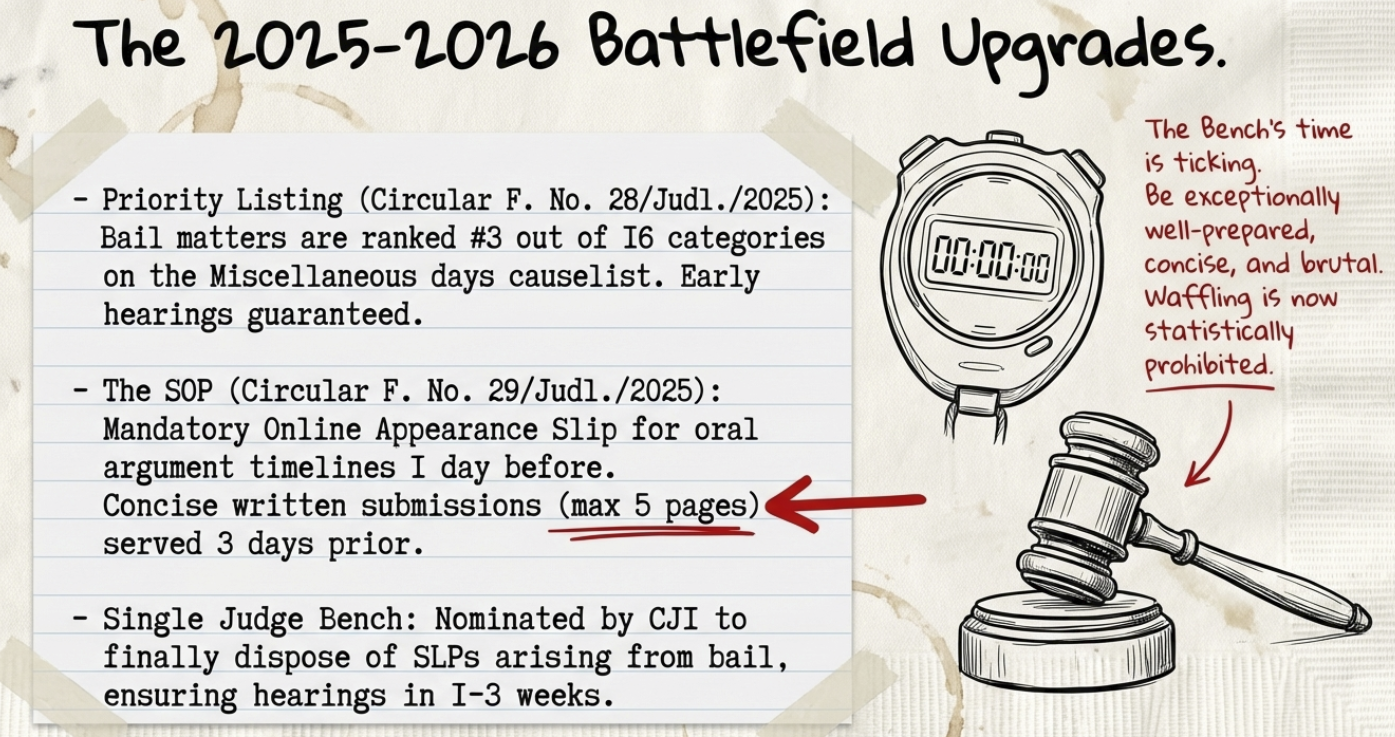
As of late 2025 and 2026, the Supreme Court has introduced several circulars to standardize court management and ensure “timely access to justice”.30
Standardized Order of Priority for Listing
Under Circular F. No. 28/Judl./2025, the Chief Justice of India directed a 16-category order of priority for the Miscellaneous days causelist.30 Bail matters are now ranked third in priority, ensuring they are heard early in the day’s proceedings.
| Priority | Case Category | Requirements |
| 1 | Early hearing applications in admitted matters | Pending admitted cases.30 |
| 2 | Fresh matters | Newly filed petitions.30 |
| 3 | Bail matters | All SLPs/appeals relating to bail.30 |
| 7 | Specially Abled persons / Acid attack Victims | Documentary government proof.30 |
| 8 | Senior Citizens (80+ years) | Proof of age required.30 |
| 9 | Below Poverty Line (BPL) persons | Valid BPL certificate.30 |
The Online Appearance Slip Portal and Argument Timelines
To optimize court hours, the Court has introduced a “Standard Operating Procedure” (SOP) under Circular F. No. 29/Judl./2025.30 Advocates must now submit their expected oral argument timelines through the “Online Appearance Slip” portal at least one day before the hearing. Counsel are also required to file a concise written submission (not exceeding five pages) and serve it on the opposite side at least three days prior to the hearing.30 These reforms suggest that the petitioner’s legal team must be exceptionally well-prepared and concise to maximize their time before the Bench.
Conclusion: Strategic Synthesis for the Petitioner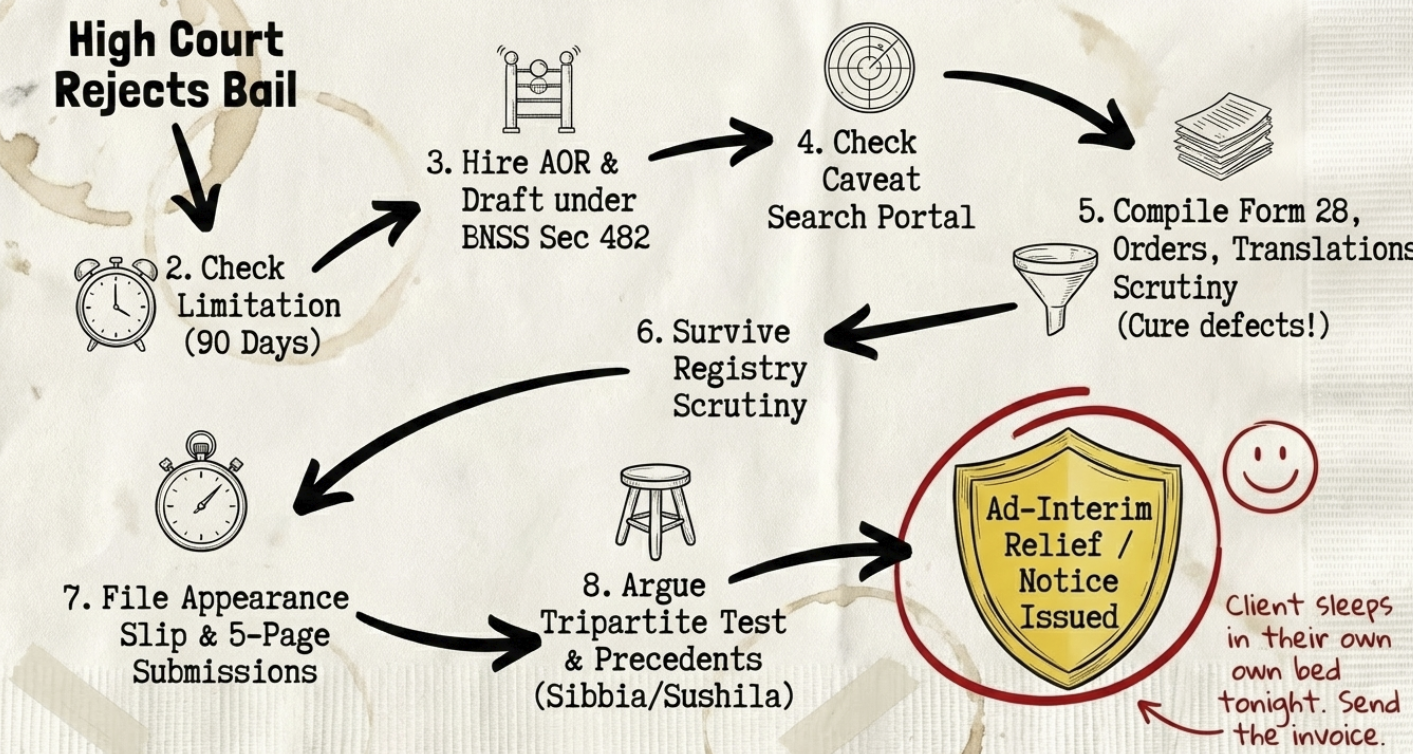
Filing an SLP for anticipatory bail is a multifaceted challenge that requires navigating the high threshold of Article 136 while mastering the procedural nuances of the Supreme Court Rules. The transition to Section 482 of the BNSS has created a more “pro-liberty” environment by removing previous statutory hurdles, such as the arrest proviso during the pendency of a plea and restrictive state amendments.9 However, the success of a petition remains contingent on the AOR’s ability to frame a “substantial question of law” and demonstrate that the High Court’s refusal of bail amounts to a manifest illegality.5
The petitioner must approach the Court with complete transparency, ensuring that every claim is supported by the lower court records and that all procedural defects are cured swiftly to avoid delays.13 By leveraging parity arguments, highlighting humanitarian grounds, and utilizing the new priority listing rules for 2026, a petitioner can effectively seek the Supreme Court’s protection to uphold the sanctity of personal liberty.21 The Supreme Court remains the “court of conscience,” and through a well-drafted SLP, it continues to serve as a vital safeguard against arbitrary arrest and the miscarriage of justice in the criminal justice system.5
Works cited
- How to File an SLP in the Supreme Court of India – Sheokand Legal, accessed on April 8, 2026, https://sheokandlegal.com/articles/how-to-file-an-slp-in-the-supreme-court-of-india/
- Article 136: Special leave to appeal by the Supreme Court – Constitution of India, accessed on April 8, 2026, https://www.constitutionofindia.net/articles/article-136-special-leave-to-appeal-by-the-supreme-court/
- SLP Filing Supreme Court – SSRANA, accessed on April 8, 2026, https://ssrana.in/litigation/special-leave-petition-india/slp-special-leave-petition-filing-supreme-court/
- How to File Special Leave Petition In Supreme Court – Advocate Kapil Chandna, accessed on April 8, 2026, https://kapilchandna.legal/special-leave-petitions-in-supreme-court-of-india-2/
- in the supreme court of india, accessed on April 8, 2026, https://api.sci.gov.in/supremecourt/2010/9622/9622_2010_3_1501_58346_Judgement_09-Jan-2025.pdf
- SPECIAL LEAVE PETITIONS, AN IMPEDIMENT TO JUSTICE: NEED FOR STRUCTURAL CHANGES TO ENSURE EFFICIENT TIME ALLOCATION OF THE COURT – Manupatra, accessed on April 8, 2026, http://docs.manupatra.in/newsline/articles/Upload/23DCCFF6-CEA5-4494-9877-40F3C2ABD219.pdf
- How to File an SLP in Supreme Court of India – Expert Guide, accessed on April 8, 2026, https://patronslegal.com/blogs/how-to-file-an-slp-in-the-supreme-court-of-india/
- Anticipatory Bail Application Under BNSS 2026: Format, Grounds & Filing – LawSikho, accessed on April 8, 2026, https://lawsikho.com/blog/anticipatory-bail-application/
- Anticipatory Bail Under BNSS: Section 482 Explained [2026 Updated] – iPleaders Blog, accessed on April 8, 2026, https://blog.ipleaders.in/anticipatory-bail-under-bnss-section-482/
- Anticipatory Bail Under BNSS: What Changed in 2025 – Legal Articles – Free Law, accessed on April 8, 2026, https://www.freelaw.in/legalarticles/Anticipatory-Bail-Under-BNSS-What-Changed-in-2025
- Anticipatory Bail 2026: Section 482 BNSS, Grounds & Process – LawSikho.com, accessed on April 8, 2026, https://lawsikho.com/blog/anticipatory-bail/
- Supreme Court Rules, 2013., accessed on April 8, 2026, https://images.assettype.com/barandbench/import/2014/07/Supreme-Court-Rules-2013.pdf
- SLP in India | Special Leave Petition Process – S.S. Rana & Co., accessed on April 8, 2026, https://ssrana.in/ufaqs/special-leave-petition-slp-india/
- What documents are required to file an anticipatory bail petition before the Supreme Court? – LawyerChennai.com, accessed on April 8, 2026, https://www.lawyerchennai.com/legal-advice/what-documents-are-required-to-file-an-anticipatory-bail-petition-before-the-supreme-court/
- SLP Filing in Supreme Court | Article 136 Guide and Procedure, accessed on April 8, 2026, https://duasnduas.com/resources/slp-filing-process-supreme-court-india/
- How to File a Special Leave Petition in the Supreme Court of India – Lawyer No, accessed on April 8, 2026, https://aorsupremecourt.com/how-to-file-a-special-leave-petition-in-the-supreme-court-of-india
- Common Mistakes That Lead to Dismissal of Special Leave Petitions in the Supreme Court of India – Advocate on Record (AOR), accessed on April 8, 2026, https://aorbrijeshgupta.com/common-mistakes-that-lead-to-dismissal-of-special-leave-petitions-in-the-supreme-court-of-india/
- Default List | Supreme Court of India, accessed on April 8, 2026, https://www.sci.gov.in/default-list/
- Procedure – Supreme Court Observer, accessed on April 8, 2026, https://www.scobserver.in/about/supreme-court-of-india/procedure/
- Special Leave Petition (Criminal) in Supreme Court of India – Legal …, accessed on April 8, 2026, https://legallightconsulting.com/special-leave-petition-criminal-in-supreme-court-of-india/
- How To Obtain Bail From The Supreme Court Of India: Complete Process Explained, accessed on April 8, 2026, https://www.leadindia.law/blog/en/how-to-obtain-bail-from-the-supreme-court-of-india-complete-process-explained/
- 1 ITEM NO.17 Court 1 (Video Conferencing) SECTION II-C S U P R E M E C O U R T O F I N D I A RECORD OF PROCEEDINGS Pe – LiveLaw, accessed on April 8, 2026, https://www.livelaw.in/pdf_upload/27982022311733300order21-feb-2022-410463.pdf
- SC Protects Man Despite Pending Anticipatory Bail, Says HC Should Have Considered Interim Relief at Admission Stage – LawBeat, accessed on April 8, 2026, https://lawbeat.in/top-stories/sc-protects-man-despite-pending-anticipatory-bail-says-hc-should-have-considered-interim-relief-at-admission-stage-1532123
- Supreme Court Rules, 2013 – Indian Kanoon, accessed on April 8, 2026, https://indiankanoon.org/doc/45279932/
- Anticipatory Bail for Proclaimed Offenders: The Evolution of Law, accessed on April 8, 2026, https://www.livelaw.in/articles/anticipatory-bail-law-evolution-521303
- File Caveat Petition in the supreme court of India | Taps9, accessed on April 8, 2026, https://taps9.com/file-caveat-petition-in-the-supreme-court-of-india/
- Caveat Petition – Prevent Legal Action with Quick Filing – Corpbiz, accessed on April 8, 2026, https://corpbiz.io/caveat-petition
- Caveat Petition in India – Benefits, Documents and Procedure – Legal Light Consulting, accessed on April 8, 2026, https://legallightconsulting.com/caveat-petition-in-india-benefits-documents-and-procedure/
- Caveat Search – eCourt India Services, accessed on April 8, 2026, https://services.ecourts.gov.in/ecourtindia_v6/?p=caveat_search/index
- Supreme Court: Circular on Cause List Order and Oral Argument …, accessed on April 8, 2026, https://www.scconline.com/blog/post/2025/12/31/supreme-court-circular-cause-list-oral-arguments-timeline-scc-times/