Special Leave Petition (SLP) in the Supreme Court: Meaning, Article 136, Who Can File and What to Expect
SLP full form: Special Leave Petition. It is a request under Article 136 of the Constitution for the Supreme Court’s permission to appeal, and it is not an appeal itself. This guide explains the law, the 90-day limit, the stages from diary number to leave granted, and what follows a dismissal.
SLP full form: Special Leave Petition, a request for permission to appeal
SLP stands for Special Leave Petition. It is filed under Article 136 of the Constitution of India and asks the Supreme Court for permission, called leave, to appeal against a judgment, decree, sentence or order of any court or tribunal in India. In a case number, SLP(C) means a civil petition and SLP(Crl) a criminal one. Article 136 does not give anyone a right of appeal. It gives the Court a discretion, which it uses only in exceptional cases, as Pritam Singh v. The State (1950) and N. Suriyakala v. A. Mohandoss (2007) explain.
An SLP is the request for permission. The appeal is the hearing that follows once leave is granted, and the petition then gets a Civil Appeal or Criminal Appeal number. Before filing, check whether an intra-court or statutory appeal must come first, for example Calcutta High Court civil appeals. For bail matters, see the guide to an SLP for anticipatory bail. Petitions are filed through an Advocate-on-Record. Our Supreme Court advocate consultation page explains how matters from Kolkata are handled.
Three periods that decide whether you can move the Supreme Court
Each period runs from a different event, so note which order you hold and when you received it.
Short explainers from Adv. Sudip Patra
More short explainers on our YouTube channel: Patra’s Law Chambers on YouTube ↗
What kind of order are you holding?
Pick the situation closest to yours. This is general information on the usual route, not advice on your case, and the right route depends on the exact order and the statute behind it.
Choose one of the options above.
The life of an SLP, from certified copy to Civil Appeal
The stages below follow the Supreme Court Rules, 2013. Timings and Registry practice change, so verify the current position before relying on any date.
Apply for the certified copy of the order immediately and note the dates of application and delivery. Check whether an intra-court appeal or a statutory appeal is open first. In Kolkata, see Calcutta High Court civil appeals.
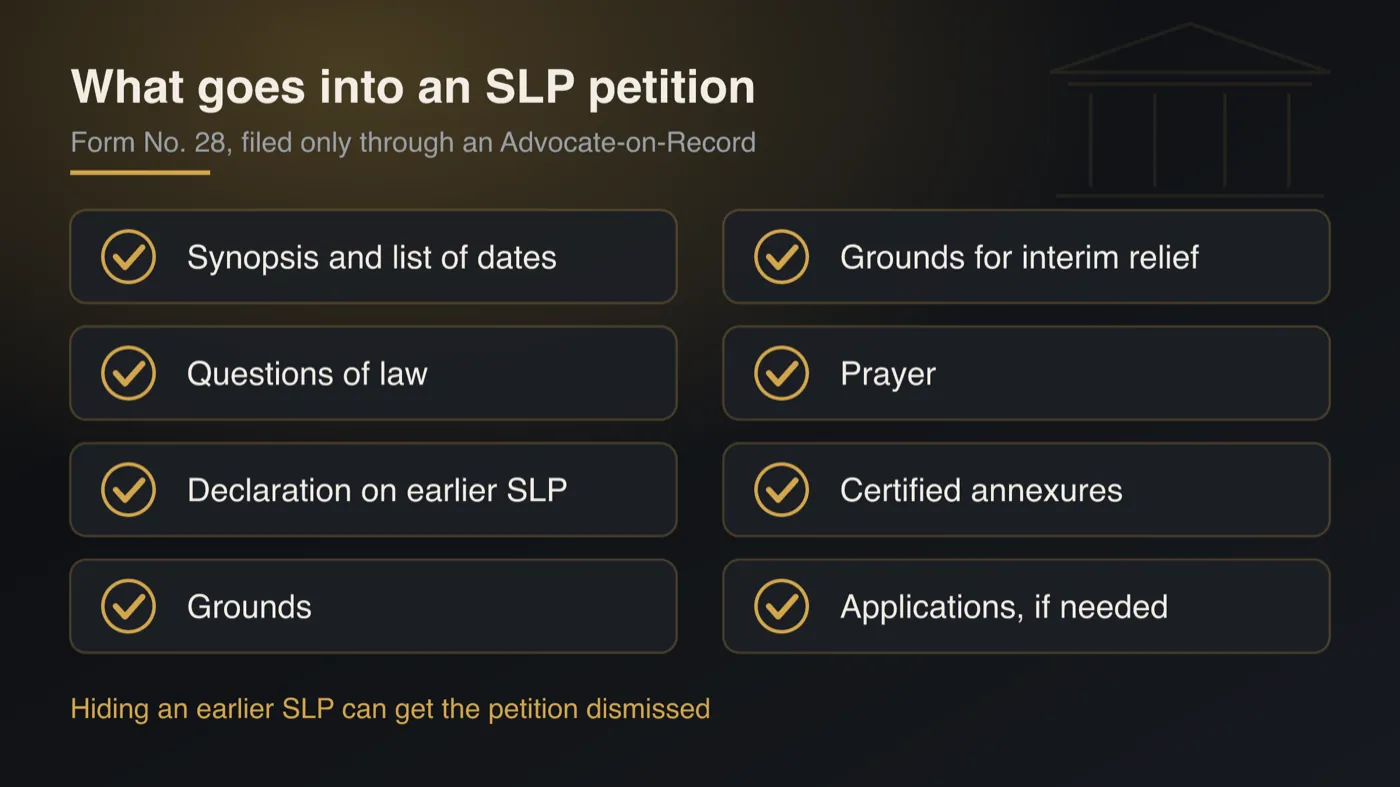
The petition carries a synopsis, list of dates, questions of law, grounds, prayer, true-copy annexures and a declaration about any earlier SLP against the same order. Only an Advocate-on-Record can file it, so a Kolkata litigant usually works with a Supreme Court advocate.
E-filing generates a diary number. The Registry then raises defects such as pagination, uncertified annexures, missing translations of Bengali documents or court fee. Defects must be cured within the time allowed, so verify the current period.
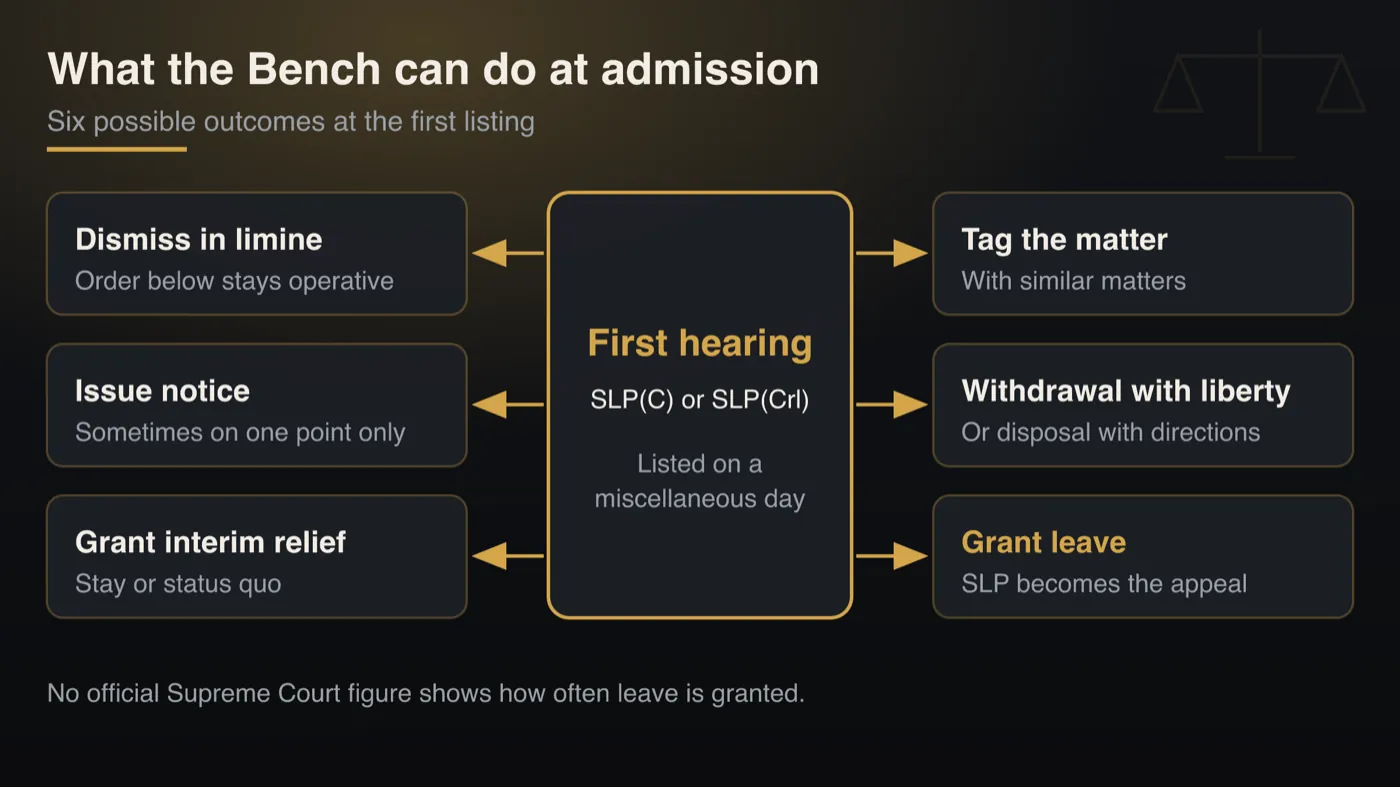
The SLP is numbered and listed on a miscellaneous day. The Court may dismiss it in limine, issue notice, grant interim relief, tag it with similar matters, dispose of it with directions, or grant leave.
The respondent files a counter affidavit and the petitioner a rejoinder. Interim orders may be continued while this happens.
Under Order XXI Rule 11 the SLP is treated as the petition of appeal and is registered as a Civil Appeal arising out of that SLP. The final judgment merges the lower court’s order (Kunhayammed, 2000). The wait for a regular hearing can be long, so interim protection often matters most.
Three outcomes, three different effects. Tap a card
The High Court order does not merge into the Supreme Court’s order. A review petition in the High Court can still be maintainable (Kunhayammed, 2000; Khoday Distilleries, 2019).
A speaking order is binding under Article 141 to the extent it declares law. It still does not merge the High Court order, but the reasons given carry weight in later cases.
The SLP becomes a Civil or Criminal Appeal, and once it is decided the High Court order merges into the Supreme Court’s judgment. The appeal is then heard on the existing paper book unless the Court orders otherwise.
SLP, certificate appeal and statutory appeal compared
Special Leave Petition
The Supreme Court decides at its discretion whether to grant leave. There is no right to be heard on merits at this stage. Limitation is 90 days, or 60 days from refusal of a certificate. Time spent getting a certified copy is excluded.
Appeal on a High Court certificate
Certain constitutional, civil and criminal appeals go to the Supreme Court on a certificate from the High Court under Article 134A. Article 134(1)(a) and (b) appeals in death-sentence cases are as of right. The route depends on the kind of case and the order challenged.
Direct appeals under special Acts
Several statutes give a direct appeal to the Supreme Court, such as the Consumer Protection Act, 2019, the Insolvency and Bankruptcy Code, 2016 and the Contempt of Courts Act, 1971. Each has its own limitation period, so verify it for the Act concerned. The Court generally expects the statutory route to be used.
Merger, review and curative petition
Dismissal without reasons does not merge the High Court order into the Supreme Court’s order (Kunhayammed, 2000; Khoday Distilleries, 2019), so a High Court review may still be maintainable. A dismissal with reasons binds under Article 141 to the extent it declares law.
From certified copy to Civil Appeal
- Obtain the certified copy of the order and note the dates (time taken is excluded from limitation)
- Check any intra-court or statutory appeal and any certificate under Article 134A
- Draft the petition in Form 28 with the list of dates, grounds, prayer and interlocutory applications
- File through the Advocate-on-Record on the e-filing portal and receive the diary number
- Cure Registry defects, then listing for admission: dismissal, notice or leave granted
- On leave, the SLP is treated as the petition of appeal and a Civil or Criminal Appeal number follows (Order XXI Rule 11)
How the Supreme Court reads Article 136: six decisions that shape every SLP
Article 136 gives the Supreme Court a discretion. It does not give a party a right of appeal. These decisions set out when leave is granted, what a dismissal means, and what a criminal petitioner must do before filing.
1950
Leave only in exceptional and special circumstances
In one of its first decisions, the Supreme Court held that it will not grant special leave unless exceptional and special circumstances exist and substantial and grave injustice has been done. It also held that once leave is granted, the whole case is not reopened. At the final hearing, only the points that were fit to be argued at the leave stage can be argued.
2000
Refusing leave does not merge the order below
A three-judge Bench held that dismissing an SLP, with or without reasons, does not attract the doctrine of merger. The High Court or tribunal order stays the operative order, and that forum can still review it if grounds exist. Where the dismissal gives reasons, any law it declares binds under Article 141. Merger happens only after leave is granted and the appeal is decided.
2007
Article 136 is not a regular appeal
The Court said Article 136 is not a regular forum of appeal. It is a residual provision that lets the Supreme Court interfere, in its discretion and in exceptional cases, with an order of any court or tribunal in India. The words “in its discretion” mean no party has a right of appeal. Where no statute gives an appeal, Article 136 cannot be used to create one.
2016
Article 136 will not be limited by fixed categories
In 2010 a two-judge Bench asked whether, because of rising pendency, Article 136 should be limited to set categories of cases. A five-judge Bench declined to restrict the power. It said each case must be judged on its own facts and that the power should be used with circumspection. The petition itself was dismissed as infructuous because the suit had been decided while it was pending.
2019
High Court review possible after dismissal in limine
Two-judge Benches had given conflicting views, so a three-judge Bench was asked whether a High Court can review its judgment after the Supreme Court has dismissed an SLP against it. The Bench followed Kunhayammed. A dismissal in limine, without a speaking order on the law, does not stop the High Court from hearing a review, whether the review is filed before or after the SLP is dismissed.
2025
Exemption from surrender only after a prison sentence
The Court said an application for exemption from surrender under Order XXII Rule 5 of the Supreme Court Rules, 2013 can be listed only where the petitioner was sentenced to a term of imprisonment. It does not apply to orders refusing anticipatory bail, cancelling bail or refusing to extend interim bail. It also asked the Chief Justice of India to issue instructions to the Registry.
Stages of an SLP, from certified copy to Civil Appeal
Get the certified copy and work out the limitation
Apply for the certified copy of the High Court or tribunal order straight away. The limitation is 90 days from the order, or 60 days from the refusal of a certificate of fitness (Order XXI Rule 1, Supreme Court Rules, 2013). Under section 12 of the Limitation Act, the time taken to get the copy is excluded. Keep a record of the application date and the date the copy was ready.
Use any appeal still available first
If an intra-court appeal to a Division Bench or a statutory appeal is still open, the Supreme Court usually expects it to be used first. A single-judge order is often taken to a Division Bench first; see Calcutta High Court civil appeals: FA, FMA and Article 227. Where a certificate under Article 134A is wanted, ask for it immediately after the judgment.
Draft the petition in Form No. 28 through an Advocate-on-Record
The petition has a synopsis and list of dates, questions of law, a declaration about any earlier SLP against the same order, grounds, grounds for interim relief, the prayer and certified annexures. It is filed only through an Advocate-on-Record, with any needed applications such as condonation of delay, interim stay or, in criminal matters, exemption from surrender. Supreme Court advocate consultation
E-filing, diary number and curing defects
The Advocate-on-Record files on the Supreme Court e-filing portal, and a diary number is generated. The Registry may raise defects, such as pagination, uncertified annexures, missing English translations of Bengali documents or court fee. These must be cured within the time allowed. Verify the current period with the Registry, because a matter left with defects may not be registered.
Admission hearing before the Bench
Once registered as SLP(C) or SLP(Crl), the matter is listed on a miscellaneous day. The Bench may dismiss it in limine, issue notice (sometimes on one point only), grant interim stay or status quo, tag it with similar matters, dispose of it with directions, allow withdrawal with liberty, or grant leave.
Leave granted: the SLP becomes an appeal
Under Order XXI Rule 11, once leave is granted the petition is treated as the petition of appeal. It is numbered as a Civil Appeal or Criminal Appeal arising out of the SLP and goes to the regular hearing list. The final judgment merges the order below (Kunhayammed). Interim protection is often the practical relief while the appeal waits.
SLP compared with a statutory appeal
Both can end in the Supreme Court, but they start from different places.
Mistakes that end an SLP before it is heard
Filing late with a weak delay explanation Condoning delay is discretionary, and a vague explanation about getting copies or arranging funds is judged strictly. Under Order XXI Rule 9, delay is not condoned without notice to the respondent, so explain each period of delay with dates.
Not disclosing an earlier SLP against the same order Order XXI Rule 3 requires a declaration about any earlier petition. If it is hidden, the petition can be dismissed or leave revoked, even after it has been granted.
Going straight to Delhi when an appeal is still open If a Division Bench appeal or a statutory appeal is available, the SLP is usually dismissed with liberty to use that remedy, and time is lost. Check the forum before drafting.
Filing a criminal SLP without surrender or a proper exemption application Where imprisonment was imposed, Order XXII Rule 5 requires proof of surrender or an application for exemption. After Jasminbhai Bharatbhai Kothari (2025), that exemption is not available against orders refusing or cancelling bail.
Considering a Special Leave Petition?
Limitation, the choice of remedy and the condition of the certified copy often decide whether an SLP can be heard at all. Bring the judgment or order, the date you received the certified copy and any earlier proceedings. We will read them and explain the options, including whether another appeal must be used first. Every case turns on its own facts, and no result can be promised.
Book a ConsultationEstablished by a distinguished alumnus of IIT Kharagpur, Patra’s Law Chambers stands as a beacon of legal expertise in Kolkata & Delhi. Know more →

Kolkata Office
NICCO House, 6th Floor, 2 Hare Street
Kolkata-700001 (Near Calcutta High Court)
Delhi Office
4455/5, First Floor, Gali Shahid Bhagat Singh
Main Bazar Road, Paharganj, New Delhi-110055
Contact
[email protected]
+91 890 222 4444 / +91 7003 715 325
Time to reach the Supreme Court: SLP and three direct statutory appeals
The statute decides the period, so check which route your order falls under before counting days.
Frequently asked questions about the Special Leave Petition (SLP)
SLP stands for Special Leave Petition. It is a petition under Article 136 of the Constitution asking the Supreme Court for permission, called leave, to appeal against an order of a court or tribunal. SLP(C) is a civil petition and SLP(Crl) is a criminal petition.
No. Article 136 gives the Supreme Court a discretionary power, not a right to any party. The Court has said it is not a regular forum of appeal (N. Suriyakala, 2007) and grants leave only in exceptional circumstances (Pritam Singh, 1950).
Ninety days from the judgment or order, or 60 days from the High Court’s refusal of a certificate of fitness (Order XXI Rule 1, Supreme Court Rules, 2013). Time taken to get the certified copy is excluded. A delay can be condoned for sufficient cause, but not without notice to the respondent.
Against any order of a court or tribunal in India, except those under a law relating to the Armed Forces (Article 136(2)). In practice, an available intra-court appeal or statutory appeal should be used first, or the SLP may be dismissed with liberty.
Any aggrieved party can file, including a private party or victim against an acquittal even where the State has not appealed (P.S.R. Sadhanantham v. Arunachalam, 1980). Filing is through an Advocate-on-Record under Order IV of the Supreme Court Rules, 2013.
The Court may dismiss the SLP in limine, issue notice, sometimes limited to one point, grant interim relief, tag it with similar matters, dispose of it with directions, or grant leave. There is no official Supreme Court figure for how often leave is granted.
Possibly. If the SLP was dismissed in limine, a review petition in the High Court may still be maintainable (Khoday Distilleries, 2019). A review in the Supreme Court or a curative petition is much narrower. Verify the facts of your case with an advocate.
If you were sentenced to a term of imprisonment, the petition must come with proof of surrender or an application for exemption from surrender (Order XXII Rule 5). After Jasminbhai Kothari (2025), exemption is not available where no term of imprisonment was imposed.