Writ Petition in the Calcutta High Court: When It Can Be Filed and What Happens After
A writ petition under Article 226 is not available for every grievance. This guide explains who can be challenged, when the High Court declines to hear a writ, and what follows the order: compliance, the Division Bench appeal and the Supreme Court.
A writ petition is a public-law remedy, not a general complaint box
Article 226 of the Constitution allows the Calcutta High Court to issue directions, orders or writs to “any person or authority”, including the Government, to enforce fundamental rights “and for any other purpose”. The words are wide, but the High Court uses the power with care. It asks first whether the respondent is the State, a statutory body, or a private body performing a public duty, and whether the act you challenge has a public-law element. You can read the text of the Constitution on the Legislative Department’s website.
Most writs are lost or won at the maintainability stage, before the merits are reached. The court looks at four things: whether another efficacious remedy such as an appeal, a tribunal or the DRT exists, whether the facts are seriously disputed, whether you came to court without unexplained delay, and whether you disclosed every earlier proceeding. This page walks through those tests, the steps from filing to final order, and the appeals that follow. For the five writs and the drafting format, see our guide to filing a writ petition in the Calcutta High Court. This page is general information, not advice on your facts.
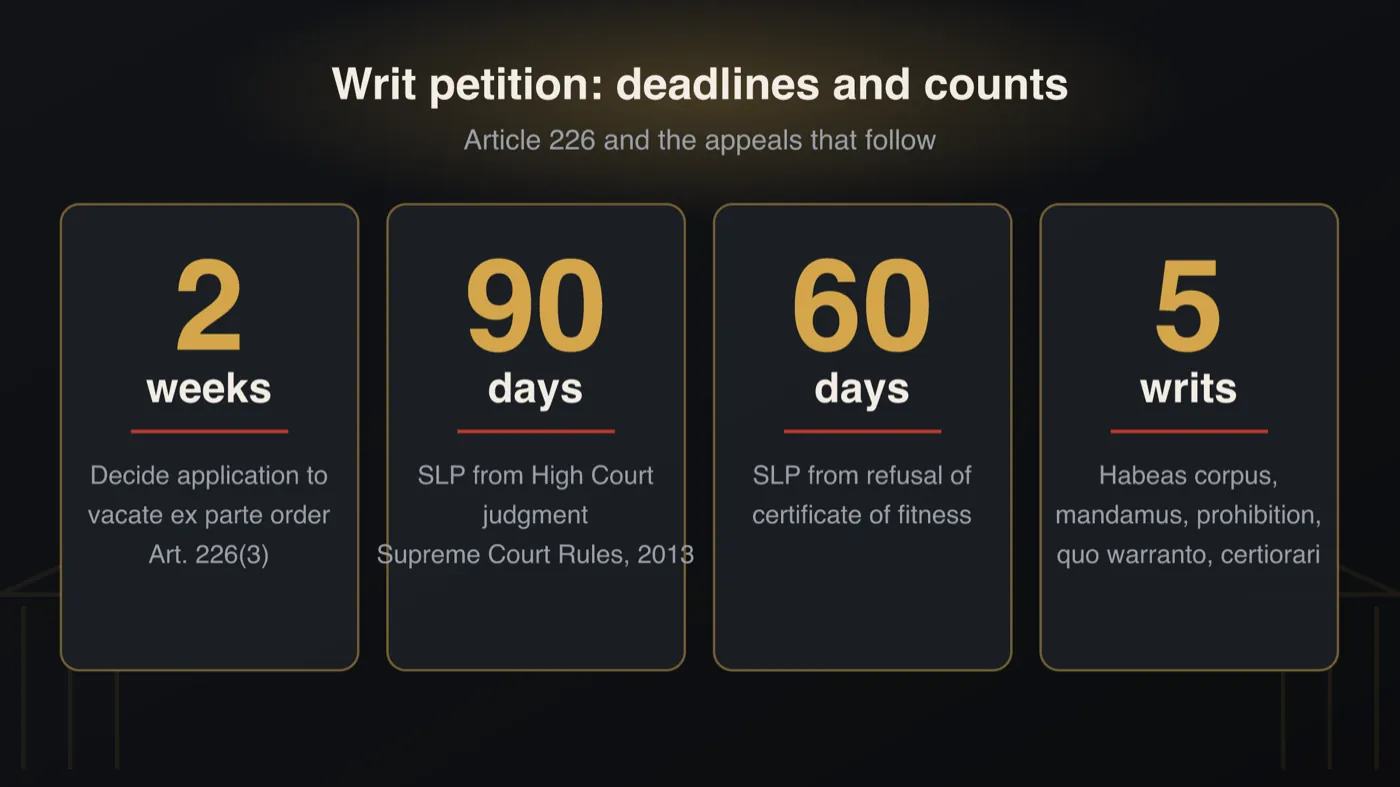
Three periods worth knowing
These limits apply after a High Court order, or to an interim order passed without hearing the other side.
Short explainers from Adv. Sudip Patra
More short explainers on our YouTube channel: Patra’s Law Chambers on YouTube ↗
What kind of problem are you facing?
Pick the option closest to your situation. This is general information on how the Calcutta High Court usually sees such disputes. It is not advice on your case.
Choose one of the options above.
From representation to the Supreme Court
A typical writ moves through these stages. Timing varies a great deal with the Bench and the subject.
For a mandamus the court usually expects you to have asked the authority first. Keep proof of delivery, such as speed-post tracking.
The petition sets out facts, grounds and prayers, with a verified affidavit, vakalatnama and serially marked annexures. Most matters go to the Appellate Side (WPA). The Original Side (WPO) is for cases where all respondents or the records are in Kolkata’s Original Civil Jurisdiction. See the step-by-step filing guide and the note on e-filing at the Calcutta High Court.
The roster Bench may issue notice, call for affidavits, pass an interim order or dispose of the matter at the admission stage. If an interim order was passed without hearing the other side, that side can apply to vacate it under Article 226(3), and the court must decide within two weeks.
The respondents file an affidavit-in-opposition and the petitioner replies. The court decides on the papers, usually with no oral evidence.
If an order is not obeyed, a contempt application can be filed under the Contempt of Courts Act, 1971. A fresh reasoned order is often what the court directs.
A single judge’s writ order can be appealed to a Division Bench under Clause 15 of the Letters Patent. The Supreme Court can then be approached under Article 136, as explained on our Supreme Court advocate consultation page. Check the time limit for each step without delay.
Four things people assume about writs: tap a card
No statute fixes a period for a writ, but unexplained delay and laches can defeat it. Courts look at whether you explained the delay.
Not so. A private body is reachable only where it performs a public duty and the act has a public-law element. Ordinary private service or contract disputes usually are not.
An efficacious alternative remedy usually stops a writ, though it is a rule of discretion and not of jurisdiction. Exceptions exist, such as a breach of natural justice.
A writ court decides on affidavits and documents. Where facts are seriously disputed and need oral evidence, the usual advice is a civil suit.

Four common reasons a writ petition does not succeed
A statutory appeal or tribunal exists
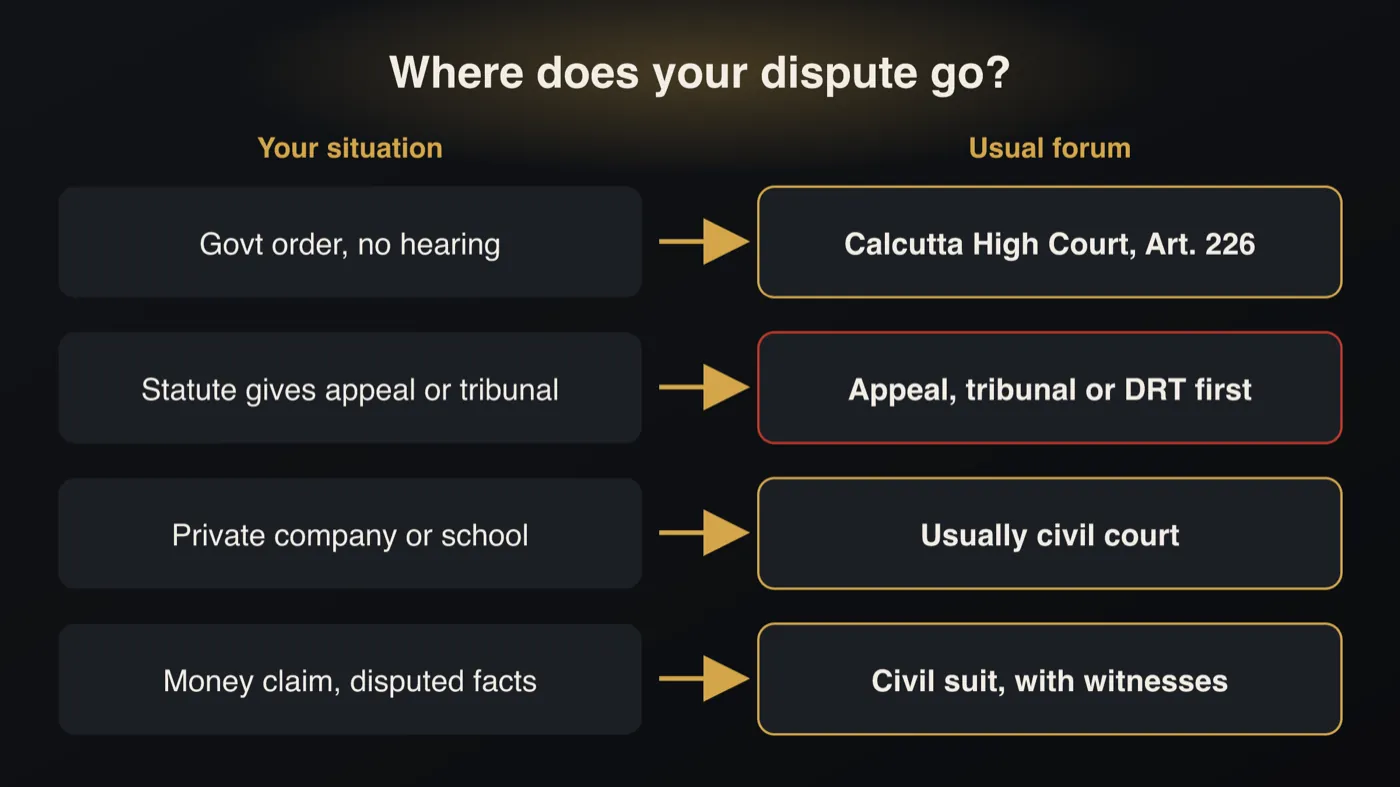
Where an appeal, tribunal or DRT is available, the High Court usually sends you there. Exceptions include a fundamental-rights breach, a breach of natural justice, action wholly without jurisdiction and a challenge to the validity of a law (Whirlpool; Radha Krishan Industries). The rule is one of discretion, not jurisdiction.
The case needs oral evidence
A writ court decides on affidavits and documents. Where liability or title turns on seriously disputed facts, the party is usually sent to a civil suit (Grid Corporation of Orissa v. Sukamani Das; State of Bihar v. Jain Plastics). Facts that documents can settle do not bar a writ (ABL International).
Unexplained delay or suppressed facts
There is no fixed limitation for a writ, but unexplained delay and laches can justify refusal (Tilokchand Motichand; T.T. Murali Babu). Suppressing earlier proceedings can lead to dismissal without going into the merits (K.D. Sharma v. SAIL). Disclose every earlier case.
No public duty or public-law element
A writ lies against a private body only when it performs a public function and the challenged act has a public-law element (Andi Mukta; St. Mary’s Education Society, 2022). Purely private service or contract disputes are not writ matters unless a statute governs them.
Why natural justice decides so many writs
- Procedure affecting rights must be fair, just and reasonable (Maneka Gandhi v. Union of India).
- An order is judged by the reasons stated in it; fresh reasons cannot be added later by affidavit (Mohinder Singh Gill).
- Authorities must record reasons, which are described as an indispensable component of decision-making (Kranti Associates).
- An order passed without hearing or reasons is usually quashed and sent back for a fresh decision, not decided on merits by the court.
- Courts may also ask whether the lack of a hearing caused real prejudice, so the petition should show the harm.
Supreme Court rulings that decide whether a writ petition will be heard
Most writ petitions in the Calcutta High Court are won or lost on maintainability before the merits come up. These six Supreme Court decisions settle who can be challenged, when another remedy comes first, and what the High Court expects from an authority’s order.
2022
Private bodies: only public-law acts are reviewable
A writ under Article 226 can go to a private body that performs a public duty, but only where the act challenged has a public-law element. Service disputes of employees of an unaided private school that rest on a contract of personal service, and are not governed by statute, stay in private law. Those employees cannot use a writ to enforce that contract.
1998
An alternative remedy is not an absolute bar
An appeal or other statutory remedy does not take away the High Court’s power under Article 226. The Court recognised that a writ can still be entertained where a fundamental right is breached, where natural justice is violated, where the authority acted wholly without jurisdiction, or where the validity of an Act is challenged. Outside those situations the petitioner is usually sent to the statutory forum.
2021
The alternative-remedy rule is about discretion
In a GST matter, the Supreme Court restated the Whirlpool exceptions and held that the power under Article 226 is plenary. The rule that a petitioner should first use an efficacious statutory remedy limits the High Court’s discretion, not its jurisdiction. In practice, a tax or other statutory dispute usually belongs before the appellate authority unless one of the recognised exceptions applies.
2003
Disputed facts are not an automatic bar
A writ can lie even in a contractual dispute with a State instrumentality. Some dispute over facts does not by itself shut out a writ if the court can decide it on affidavits and documents, for example on a plain reading of the contract, without detailed oral evidence. Where the facts can only be settled at a trial, the civil court is still the right forum.
1977
An order stands or falls on its own reasons
When a statutory authority passes an order on stated grounds, the court tests the order on those grounds alone. The authority cannot defend it in the High Court by adding new reasons in an affidavit. This is why the reasons written in the impugned order, or their absence, are often the centre of a writ petition against a government decision.
2010
Reasons are an indispensable part of a decision
Quasi-judicial authorities must record reasons, and so must administrative authorities whose decisions affect a person adversely. The Court called reasons as indispensable to decision-making as the principles of natural justice. Reasons restrain arbitrary use of power and show the affected person that their case was considered. A non-speaking order is liable to be set aside and the matter sent back.
Step by step: a writ petition in the Calcutta High Court, from first check to Supreme Court
Check maintainability and make a representation
Confirm that the respondent is a government, statutory body or a body doing a public duty, and that the act challenged is a public-law act. Check whether a statutory appeal, tribunal or DRT remedy applies. Write to the authority first and keep proof that the letter was delivered. Courts usually expect a demand and a refusal, or silence, before issuing a mandamus.
Choose the side and file the petition
Matters go to the Original Side (WPO) only where the respondents or records fall within Kolkata’s Ordinary Original Civil Jurisdiction. Most matters go to the Appellate Side (WPA). The petition sets out facts, grounds and prayers, with an affidavit, vakalatnama and serially marked annexures. See e-filing cases at the Calcutta High Court for the online route.
Serve an advance copy on the State and respondents
Before the petition is moved, a copy is served on the State’s counsel and on the other respondents, and an affidavit of service is filed. The Writ Rules govern this step, so verify the current rule and the court fee with the stamp reporter before filing. Skipping service usually means the matter cannot be taken up on the first day.
First hearing and interim orders
The roster Bench may issue notice and fix a schedule for affidavits, grant an interim order, dispose of the petition by directing the authority to decide a representation by a reasoned order, or dismiss it. Under Article 226(3), a party affected by an ex parte interim order can apply to vacate it. If that application is not decided within two weeks, the interim order stands vacated.
Affidavits, final hearing and compliance
The respondents file an affidavit-in-opposition and the petitioner replies. The writ court normally decides on these papers without oral evidence. Once the order is passed, the authority must comply. If it does not, a contempt application can be filed under the Contempt of Courts Act, 1971. The Guide to Filing a Writ Petition in the Calcutta High Court covers drafting and format.
Intra-court appeal, then special leave
A single judge’s writ order can be appealed to a Division Bench under Clause 15 of the Letters Patent (MAT/FMAT on the Appellate Side, APO on the Original Side). Verify the current time limit before filing. After that, a special leave petition under Article 136 usually has to be filed in the Supreme Court within 90 days of the judgment. See Supreme Court advocate consultation.
Writ court or another forum?
A rough guide to what a writ court usually takes up and what it usually sends elsewhere.
Four mistakes that get writ petitions dismissed at the first hearing
Skipping the statutory appeal or tribunal If the law provides an appeal, a GST appellate authority, the DRT or a service tribunal, the High Court will usually dismiss the writ with liberty to go there unless a Whirlpool exception applies. For SARFAESI action, see the SARFAESI borrowers’ guide.
Using a writ for a purely private or fact-heavy dispute Contract claims, money claims on bills, and boundary or ownership fights between private parties need evidence at a trial and are usually sent to a civil court. A private employer is not open to a writ unless a statute governs the employment.
Filing late without explaining the delay No fixed limitation period applies to a writ, but unexplained delay and laches can defeat even a good case. Give a date-wise account of the delay in the petition itself.
Not disclosing earlier proceedings A petitioner who hides an earlier writ, suit or tribunal case can be refused relief and ordered to pay costs, without the court going into the merits. Disclose every related case in the petition. To have your papers checked before filing, see Calcutta High Court advocate consultation.
Discuss whether a writ is the right remedy for your matter
Whether to file a writ, appeal to a tribunal or wait is often the hardest decision, and it depends on your documents, the authority involved and the dates. Patra’s Law Chambers appears in the Calcutta High Court and the Supreme Court. A consultation can help you understand the options and the likely route; no outcome can be promised. Bring the order or notice, your representations and a one-page chronology.
Book a ConsultationEstablished by a distinguished alumnus of IIT Kharagpur, Patra’s Law Chambers stands as a beacon of legal expertise in Kolkata & Delhi. Know more →

Kolkata Office
NICCO House, 6th Floor, 2 Hare Street
Kolkata-700001 (Near Calcutta High Court)
Delhi Office
4455/5, First Floor, Gali Shahid Bhagat Singh
Main Bazar Road, Paharganj, New Delhi-110055
Contact
[email protected]
+91 890 222 4444 / +91 7003 715 325
Papers and checks to have ready for a writ petition
A short list drawn from the filing steps above; confirm the current Writ Rules and court fee before filing.
A copy of your letter to the authority and proof of delivery, such as speed-post tracking.
The impugned order or the notice, with its reasons, or a note that none were given.
A note of whether an appeal, tribunal or DRT remedy exists, and why a writ is still proper.
A short chronology that explains each gap between the order and the petition.
Every earlier writ, suit or tribunal case on the same matter, to be disclosed in the petition.
A verified affidavit, a vakalatnama and serially marked annexures.
Service on the State’s counsel and the other respondents, with an affidavit of service.
Frequently asked questions about writ petitions in the Calcutta High Court
It is a petition under Article 226 of the Constitution asking the High Court to direct, stop or quash action by the government or a public authority. The writs are habeas corpus, mandamus, prohibition, quo warranto and certiorari.
Generally not. A private body can be reached only where it performs a public duty and the challenged act has a public-law element. Ordinary private contract or service disputes are usually sent to a civil court.
No statute sets one, but delay and laches can defeat the petition. Courts ask whether the delay is explained. Acting promptly and stating the reasons for any gap in the petition is sensible.
Common reasons are an effective alternative remedy, seriously disputed facts needing evidence, unexplained delay, suppression of material facts, or a purely private dispute. Any one of these can lead to dismissal, often with liberty to approach the right forum.
Usually not. Your advocate appears, and affidavits are sworn before an oath commissioner or notary. Practice on e-affidavits and e-filing changes, so verify the current direction of the High Court before filing.
A contempt application can be filed under the Contempt of Courts Act, 1971. Where the order only asked the authority to consider a representation, a fresh reasoned order, once passed, can itself be challenged.
Yes. An intra-court appeal lies to a Division Bench under Clause 15 of the Letters Patent (MAT or FMAT on the Appellate Side, APO on the Original Side). The time limit and fee should be verified before filing.
By special leave petition under Article 136, usually within 90 days of the judgment, or 60 days from refusal of a certificate. Leave is discretionary and is not granted automatically.
A writ protects your own legal right. A public interest litigation raises a cause that concerns a section of the public and is registered as WPA(P) in the Calcutta High Court.