Writ Against SARFAESI Action in the Calcutta High Court: When It Is Allowed Despite the DRT Remedy
A borrower hurt by a SARFAESI measure has a statutory remedy before the Debts Recovery Tribunal, and the High Court will ordinarily send the matter there. This page explains the few situations in which a writ under Article 226 is still heard, and how the Calcutta High Court has handled these cases in 2026.
DRT first, writ only in recognised exceptions
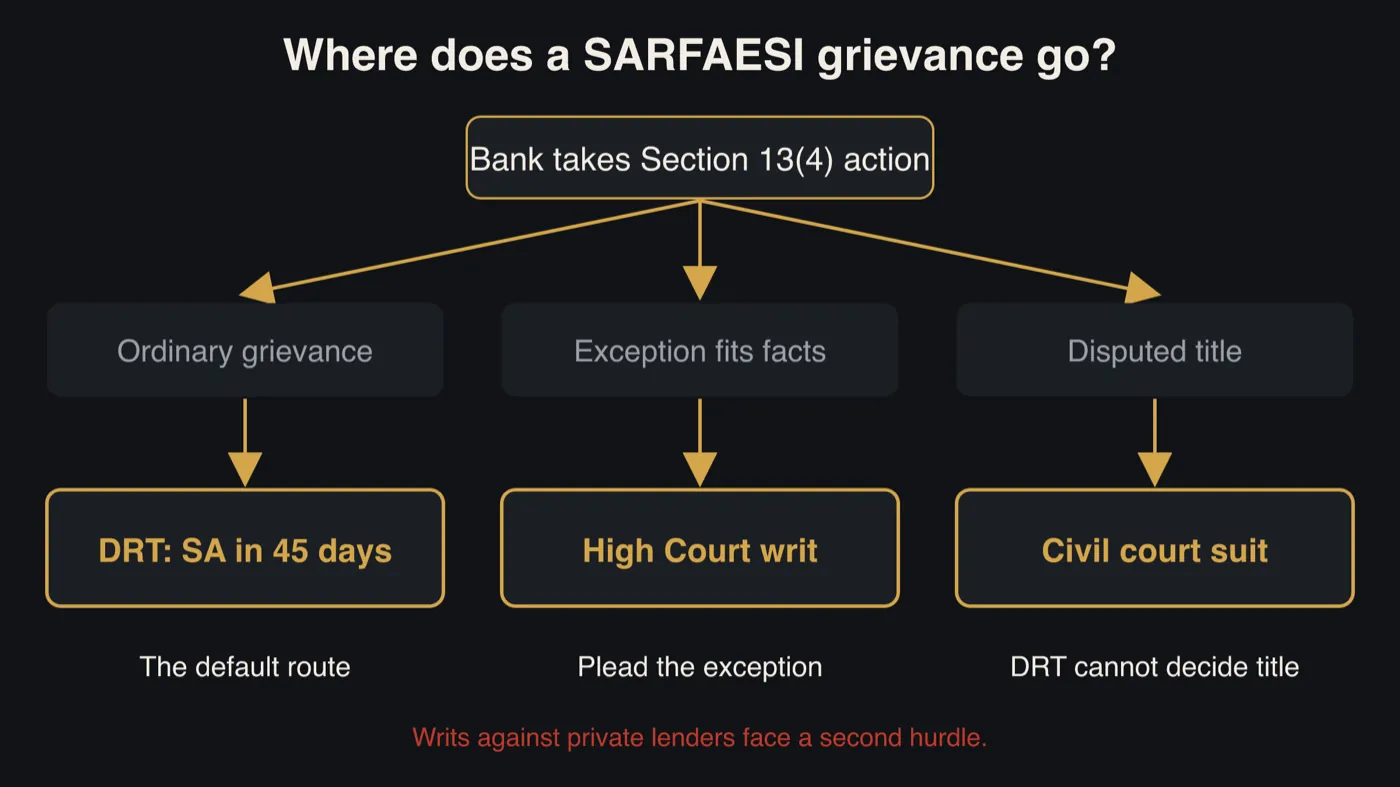
If a bank takes a measure under Section 13(4) of the SARFAESI Act, 2002, the person aggrieved can file a securitisation application (SA) before the DRT under Section 17 within 45 days. The Supreme Court has repeatedly said that High Courts should not bypass this remedy. In South Indian Bank v. Naveen Mathew Philip (2023), the Court noted that High Courts kept entertaining SARFAESI writs, especially against private banks, and said attempts to avoid the statutory remedy should not be encouraged.
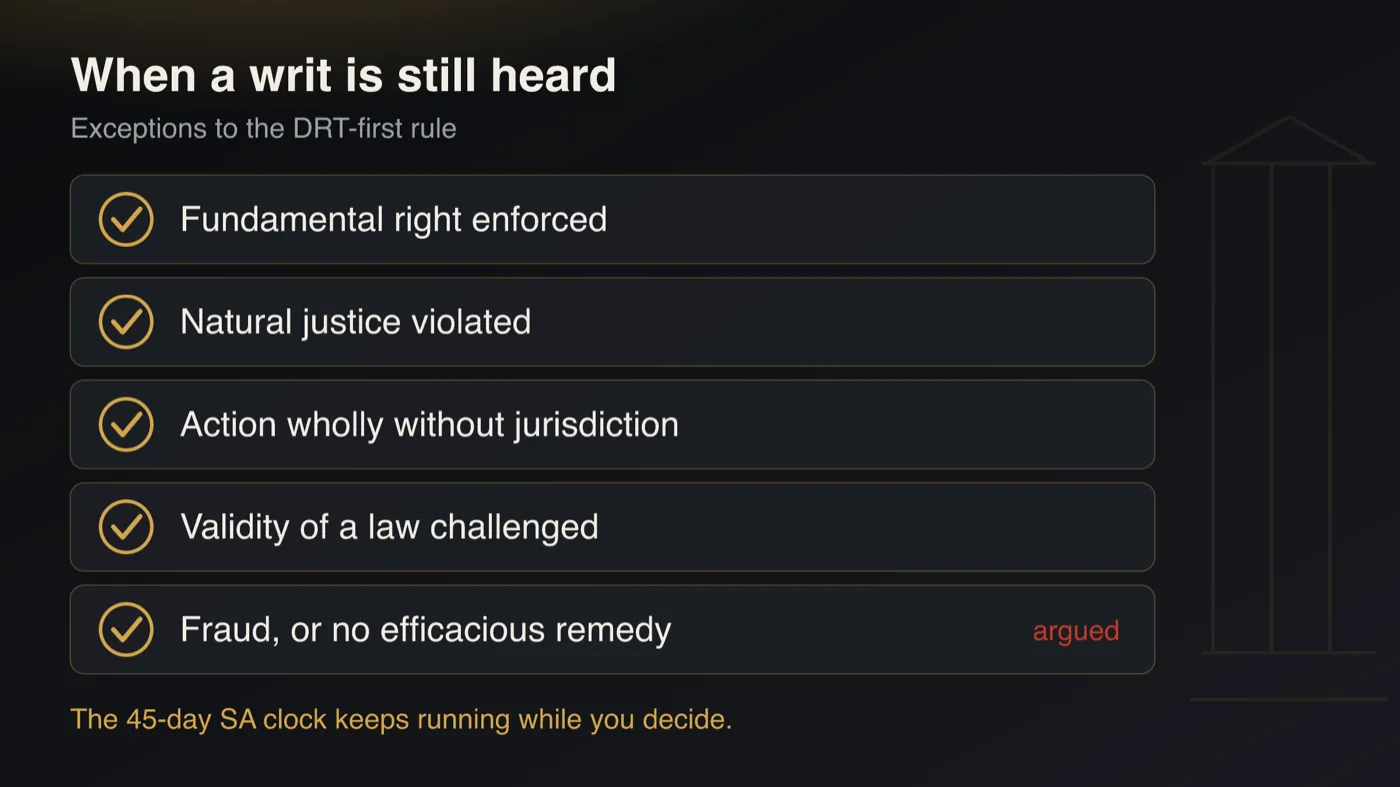
The rule is one of discretion, not a bar on jurisdiction. A writ may still be heard where a fundamental right is enforced, natural justice is violated, the action is wholly without jurisdiction, or the validity of a law is challenged. Fraud and a remedy that is not efficacious are also argued. Whether your facts fit is a case-by-case question, and the 45-day clock keeps running while you decide. For notices and tribunal work, see our DRT and banking advocate page, and for the borrower’s overall position read the SARFAESI Act borrower’s guide.
The four periods that matter in a SARFAESI action
Each period starts from a different event, so note the date of every paper.
Short explainers from Adv. Sudip Patra
More short explainers on our YouTube channel: Patra’s Law Chambers on YouTube ↗
Which SARFAESI paper have you received?
Pick the latest step the bank has taken. This is general information about the usual route, not advice on your file.
Choose one of the options above.
How a SARFAESI action moves, and where each remedy fits
The dates below follow the Act and the Security Interest (Enforcement) Rules. Check the exact date on each of your papers.
The bank calls on the borrower to discharge the liability within 60 days. The notice marks the start of the process. It is not yet a measure that can be challenged before the DRT.
You may send a representation or objection. The bank must reply with reasons within 15 days (the period was one week before the 2016 amendment). Under the 2016 Explanation, the reply itself is not a ground for an SA. A first-hand read of the SARFAESI borrower’s guide shows how to frame it.
The bank may take possession, take over management or appoint a manager. The 45-day period for the DRT starts from the measure. You can see the usual defences in our note on challenging the Section 13(4) notice.
The securitisation application goes to the DRT with territorial jurisdiction under Section 17(1A). See DRT Kolkata benches, jurisdiction and e-filing and our DRT and banking matters page. The DRT is to decide in 60 days, extendable to 4 months in aggregate.
After a Section 14 order and valuation, the bank gives the borrower 30 days’ notice of sale. Redemption under Section 13(8) ends on publication of the auction notice.
An appeal against the DRT’s order lies to the DRAT under Section 18 within 30 days, with a pre-deposit of 50% (the DRAT may reduce it to 25%). A writ is only for the narrow exceptions: when a writ petition is filed in the Calcutta High Court. Against a Division Bench decision, see the note on special leave petitions.
Writ against SARFAESI: three points people get wrong, tap a card
The alternative-remedy rule is about the court’s discretion, not its power. The Supreme Court in Mathew K.C. (2018) said a writ with bald pleadings should be dismissed at the threshold.
Section 34 bars civil courts from deciding matters the DRT can decide and from injuncting action taken or to be taken. The Calcutta High Court set aside a City Civil Court injunction on this ground (Axis Bank v. Tarun Kanti Ghosh, 2026).
It can, where the facts fall in an exception. In Amit Kumar Saha v. Canara Bank (8 October 2026) a single bench set aside a possession notice and restored possession, while sending the title dispute to a civil court.

Where a SARFAESI dispute can be taken
Securitisation application before the DRT
The statutory route for any person aggrieved by a Section 13(4) measure, including a borrower, guarantor or tenant. The DRT can take evidence, decide facts and restore possession. See the DRT Kolkata benches and e-filing guide for where to file.
Writ petition in the Calcutta High Court
Discretionary judicial review, decided mostly on affidavits and focused on legality. It is considered only when the pleadings bring the case inside a recognised exception. Our general note on when to file a writ in the Calcutta High Court covers the basics.
Suit on disputed title
Section 34 bars civil courts from deciding matters the DRT can decide and from injuncting SARFAESI action. A genuine dispute on title, which the DRT cannot decide, may still go to a civil court, as in Central Bank of India v. Prabha Jain (2025).
DRAT, Division Bench and Supreme Court
From the DRT, an appeal lies to the DRAT under Section 18 within 30 days, with a pre-deposit. From a Single Judge, appeal goes to a Division Bench. Beyond that, an SLP under Article 136 may be considered.
How recent orders have gone
- Inventory and panchnama disputes: sent to the DRT as they need fact-finding (Buddhadeb Samanta, verify details)
- Auction purchaser seeking a sale certificate while a DRT restraint stood: writ declined (R.S.H.S Impex v. Union of India)
- Civil court injunction against SARFAESI action set aside; Section 34 covers action to be taken (Axis Bank v. Tarun Kanti Ghosh)
- Possession notice set aside and possession restored, with two months to file a civil suit on title (Amit Kumar Saha v. Canara Bank, 8 October 2026)
- MSME writs sent back to be heard on affidavits (Merchant Monger Agrotech v. Indian Bank, Division Bench)
- Supreme Court set aside a Calcutta High Court order restoring possession to a claimed tenant (PNB Housing Finance v. Manoj Saha, 2025 INSC 847)
The Supreme Court rulings that decide whether a SARFAESI writ will be heard
Six Supreme Court decisions set out how the High Court treats a writ against SARFAESI action when the DRT remedy under Section 17 is still open. The Calcutta High Court applies them in its 2026 orders.
2010
Writ will ordinarily not be entertained
The Supreme Court held that a High Court will ordinarily not entertain an Article 226 petition where an effective remedy exists. It said the rule applies with greater rigour to the recovery of bank dues. Section 17 of the SARFAESI Act is that effective remedy, and the Court set aside the stay of recovery that the High Court had granted.
2018
Bald pleadings mean dismissal at the threshold
The Kerala High Court had stayed proceedings at the Section 13(4) stage by an interim order in a writ. The Supreme Court set that order aside. It held that the writ should have been dismissed at the threshold because the pleadings did not show that the grievance fell within any recognised exception. The borrower’s remedy was an application to the DRT under Section 17.
2022
No writ against a private ARC
The Supreme Court held that a writ under Article 226 does not lie against a private asset reconstruction company to challenge Section 13(4) action. Such a company does not perform a public function, and Section 17 provides the remedy. The Court also criticised interim orders that let borrowers hold on to secured assets for years without paying.
2023
High Courts must not bypass the statutory remedy
The Supreme Court disapproved of High Courts entertaining writs in SARFAESI matters, especially against private banks, when Parliament has provided a specific remedy. Article 226 powers are to be used only in extraordinary circumstances. Attempts to get around the DRT and DRAT route should not be encouraged.
2024
Writ cannot upset a SARFAESI auction
An auction purchaser appealed after the Telangana High Court entertained the borrower’s writ against a SARFAESI auction. The Supreme Court held that the High Court should not have done so while remedies under Sections 17 and 18 were available. It reaffirmed Satyawati Tondon, restated the narrow exceptions and set aside the High Court’s interference.
2025
Calcutta High Court order restoring possession reversed
The Supreme Court reversed a Calcutta High Court order that had restored possession of a mortgaged property to a claimed tenant. Since the 2016 amendment, tenancy claims go to the DRT under Section 17(4A). A tenant must prove that the tenancy was created before the mortgage. The West Bengal Premises Tenancy Act alone does not defeat SARFAESI action.
How to respond to SARFAESI action in Kolkata, step by step
Mark the dates first
List the dates of the Section 13(2) demand notice, the 13(3A) representation and the bank’s reply, the 13(4) possession notice and its newspaper publication, any Section 14 order and any sale notice. The 45 days for a securitisation application under Section 17 run from the date the measure was taken.
Choose the right forum
A securitisation application goes to DRT-1, DRT-2 or DRT-3 Kolkata, or to DRT Siliguri, as Section 17(1A) decides (see DRT Kolkata benches and jurisdiction). A writ lies only if a recognised exception applies. A title dispute that the DRT cannot decide goes to a civil court.
Plead an exception with facts, not labels
If a writ is filed, the petition needs a specific paragraph on maintainability. It must state which exception applies: breach of natural justice, action wholly without jurisdiction, fraud, or a fundamental right. It must also explain why Section 17 is not an efficacious remedy, and if the lender is a private bank, ARC or NBFC, why that lender is amenable to writ jurisdiction.
Disclose every parallel proceeding
State any securitisation application, Section 14 proceeding or civil suit already filed. The Calcutta High Court refuses relief that could conflict with a DRT order. Concealing a pending proceeding can lead to the writ being dismissed, sometimes with costs. Read more on when to file a writ in the Calcutta High Court.
Assemble the documents
Collect the sanction letter, the mortgage or memorandum of deposit of title deeds, the 13(2) notice with proof of service, the 13(3A) representation and the bank’s reply, the possession notice and newspaper publications, the Section 14 order and panchnama, any sale notice, the statement of account and the title papers. MSMEs also need the Udyam certificate and their request under the RBI framework.
Follow the appeal route
An order of the Single Judge is appealed to a Division Bench of the Calcutta High Court. A DRT order on a securitisation application is appealed to DRAT Kolkata under Section 18 within 30 days, with the pre-deposit. A Division Bench judgment can be challenged by a special leave petition under Article 136.
Securitisation application or writ petition?
The two remedies differ in nature, evidence and the way courts treat them.
Pre-deposit for an appeal to DRAT under Section 18 of the SARFAESI Act (on the debt claimed by the secured creditor or determined by the DRT, whichever is less)
Mistakes that get a SARFAESI writ dismissed
Letting the 45 days run out while the writ is pending A pending writ does not stop the Section 17 limitation from running. If the High Court sends you to the DRT, ask it to record that the time spent in the writ should be considered, and verify the current authority on whether that time can be excluded.
Writing a writ that only says the bank acted illegally In Mathew K.C. the Supreme Court held that a petition which does not plead a recognised exception with facts should be dismissed at the threshold. A general complaint about the bank’s conduct belongs before the DRT.
Filing a writ against a private bank, ARC or NBFC as if it were SBI Phoenix ARC and Naveen Mathew Philip make such writs ordinarily not maintainable, so the lender’s status is a second hurdle on top of the alternative-remedy rule. A public sector bank is State under Article 12, but the alternative-remedy rule still applies to it.
Asking the writ court to decide facts or title Disputes about the inventory, valuation, the amount due or a claimed tenancy are fact questions for the DRT. Disputed title goes to a civil court. A writ court decides on affidavits and will usually decline to examine these questions.
Discuss your SARFAESI notice or possession action
Whether the right step is an SA before the DRT, a writ petition, or a civil suit on title depends on the dates, the lender and the documents. The 45-day period does not wait. Patra’s Law Chambers appears before the DRT, the DRAT and the Calcutta High Court, and can review your papers and explain the options. See also our Calcutta High Court advocate consultation page. No result can be promised in any matter.
Book a ConsultationEstablished by a distinguished alumnus of IIT Kharagpur, Patra’s Law Chambers stands as a beacon of legal expertise in Kolkata & Delhi. Know more →

Kolkata Office
NICCO House, 6th Floor, 2 Hare Street
Kolkata-700001 (Near Calcutta High Court)
Delhi Office
4455/5, First Floor, Gali Shahid Bhagat Singh
Main Bazar Road, Paharganj, New Delhi-110055
Contact
[email protected]
+91 890 222 4444 / +91 7003 715 325
From SARFAESI measure to the right forum
A simple route-finder based on the law as the courts apply it.
Note the measure and its date
Fix the date of the 13(4) measure, the Section 14 order or the sale notice.
Identify the lender
A public sector bank is ‘State’; a private bank, ARC or NBFC faces the extra maintainability hurdle.
Look for a true exception
Natural justice, no jurisdiction, fundamental right, vires, fraud or an inefficacious remedy, pleaded with facts.
Pick the forum
SA under Section 17 in most cases; a writ only if an exception fits; a civil suit only for title disputes.
Protect your time
File the SA within 45 days; do not assume a pending writ stops the clock.
Frequently asked questions: writ against SARFAESI action in the Calcutta High Court
Usually not as the first step. The High Court expects a securitisation application before the DRT under Section 17 unless the case falls in a recognised exception. The petition must plead that exception with facts, not labels. Verify the position for your papers.
The classic ones, from Whirlpool, are enforcement of a fundamental right, violation of natural justice, an action wholly without jurisdiction, and a challenge to the vires of a law. Courts also consider fraud and a remedy that is not efficacious on the facts.
Generally not. The Supreme Court in Phoenix ARC (2022) and South Indian Bank v. Naveen Mathew Philip (2023) held that such writs are ordinarily not maintainable, both because the respondent is private and because Section 17 is available.
Such a bank is ‘State’ under Article 12, so a writ is maintainable in principle. The alternative-remedy rule still applies, and the High Court will usually send the borrower to the DRT unless an exception is made out.
A securitisation application under Section 17 of the SARFAESI Act must be filed within 45 days of the measure under Section 13(4). An appeal against the DRT’s order lies to the DRAT within 30 days under Section 18, with a pre-deposit.
Rarely. Where protection is given, it is usually short, conditional on a deposit, and tied to approaching the DRT. The Supreme Court has repeatedly set aside long-running interim orders in SARFAESI writs (Satyawati Tondon, Phoenix ARC, PHR Invent).
Section 34 bars civil courts from granting an injunction against action taken or to be taken under the Act. A suit can survive only on matters outside the DRT’s power, such as the genuineness of a title deed (Central Bank of India v. Prabha Jain, 2025).
The route is the DRT under Section 17(4A). In PNB Housing Finance v. Manoj Saha (2025 INSC 847), on appeal from the Calcutta High Court, the Supreme Court required the tenant to prove a tenancy created before the mortgage.