Which DRT Kolkata Bench Hears Your Case, and What to File Where
Four Debts Recovery Tribunals serve West Bengal, and territory decides the bench. This guide covers the ₹20 lakh floor, the difference between an OA and an SA, time limits and e-filing in plain English.
DRT Kolkata: Benches, Jurisdiction, E-Filing and What to File Where
Four Debts Recovery Tribunals serve West Bengal: DRT-1, DRT-2 and DRT-3 in Kolkata, and DRT Siliguri for the north. Appeals from all four go to the Debts Recovery Appellate Tribunal (DRAT) at Kolkata. Territory decides which bench hears a case, under a notification issued under Section 3 of the Recovery of Debts and Bankruptcy Act, 1993 (the RDB Act). It is not left to the allocation of work. The Centre reallocated territory among the four tribunals by S.O. 5807(E) dated 16 December 2025, as reported by LiveLaw. Please read the gazette text itself before relying on any bench table.
A bank can use the DRT only for a debt of ₹20 lakh or more (S.O. 4312(E) of 6 September 2018, under Section 1(4) of the RDB Act). A bank files an Original Application (OA) under Section 19 of the RDB Act. A borrower, guarantor or other aggrieved person challenges SARFAESI action by a Securitisation Application (SA) under Section 17 of the SARFAESI Act, within 45 days. All pleadings must now be e-filed. If you have a bank case in hand, our DRT advocate in Kolkata page explains how we assist, and the SARFAESI borrower’s guide covers the recovery process before the tribunal stage.
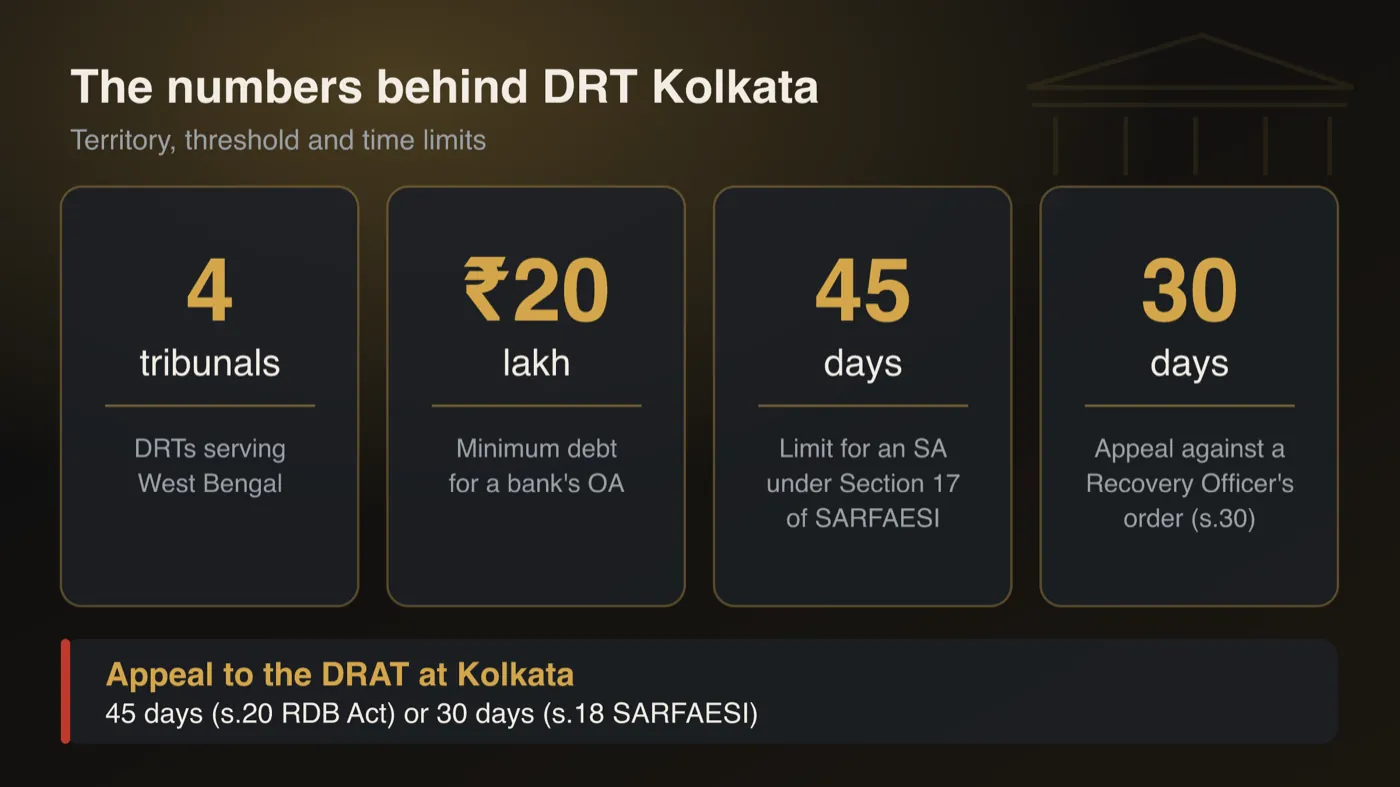
Four limits every DRT party should know
Each step in a DRT case has its own clock, so identify your order or measure first.
Short explainers from Adv. Sudip Patra
More short explainers on our YouTube channel: Patra’s Law Chambers on YouTube ↗
What has the bank or the tribunal sent you?
Pick the paper or step closest to your situation. This is general information, not advice, and the right forum depends on your documents.
Choose one of the options above.
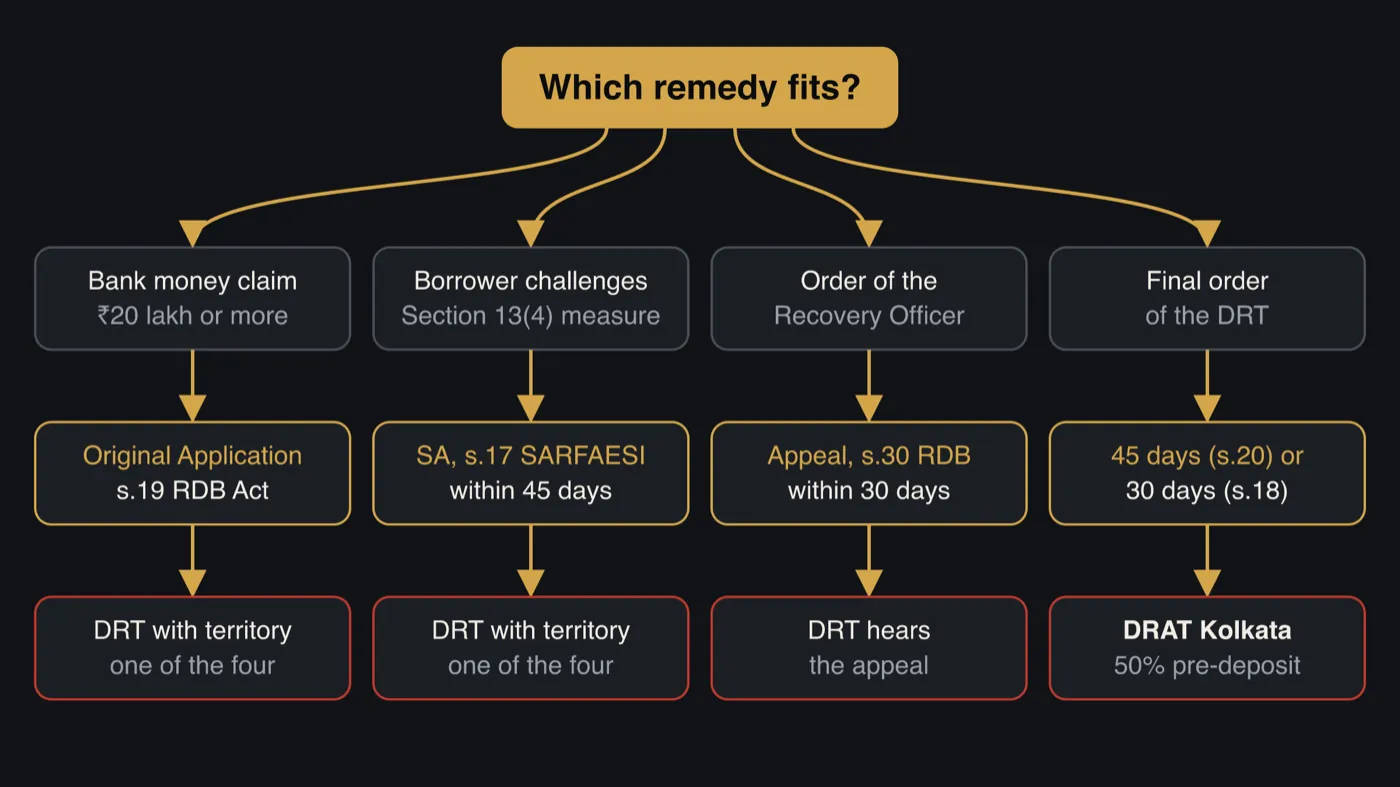
How a bank case moves through the DRT
A simple path from a bank’s filing to recovery. Actual dates depend on the bench and the cause list.
The bank files an Original Application, or the borrower files an SA, on the e-DRT portal. Paper filing is not accepted. The Section 19(1) or Section 17(1A) rules decide which DRT has territory.
The Registrar’s court handles service and completion of pleadings. The defendant files a written statement and any set-off or counter-claim. See our DRT advocate service in Kolkata for how we assist at this stage.
The Presiding Officer hears interim applications, takes evidence on affidavit and hears final arguments. A borrower facing an auction can read our guide on challenging bank auctions in the DRT.
If the OA succeeds, a recovery certificate is issued. Recovery proceedings then follow under Sections 25 to 30 of the RDB Act, before the Recovery Officer.
A final order can be appealed to the DRAT Kolkata with the required pre-deposit. For notices and measures under the SARFAESI Act, see our borrower’s guide to SARFAESI.
Four DRTs, one appeal forum: tap a card
Territory does, under a Section 3 notification of the Central Government. A notification dated 16 Dec 2025 (S.O. 5807(E)) reallocated areas, so verify the current text before you file.
Usually not. The Supreme Court in Satyawati Tondon (2010) and PHR Invent (2024) has said a writ should not be entertained where the DRT and DRAT remedy exists, except in rare cases such as fraud or lack of jurisdiction.
No. E-filing of pleadings is compulsory in DRTs and DRATs, and the Supreme Court upheld this in M.P. High Court Bar Association v. Union of India (29 Mar 2023). Help desks and e-seva kendras exist for those who need assistance.
Choosing the Right Remedy and the Right Bench
Original Application (OA)
The bank’s money claim for ₹20 lakh or more. The place of filing under Section 19(1) is where the account is kept, where the defendant lives or does business, or where the cause of action arose. The defendant has 30 days from summons to file a written statement, and may raise a set-off or counter-claim.
Securitisation Application (SA)
A challenge to a measure under Section 13(4), such as possession or an auction notice, filed within 45 days. Under Section 17(1A), the DRT with territory is where the cause of action arose, where the secured asset is, or where the branch keeping the account is. Our guide on challenging bank auctions in DRT has more.
Recovery stage and IAs
Interlocutory Applications (IAs) deal with interim relief and procedural issues during the case. Orders of the Recovery Officer can be appealed to the DRT within 30 days under Section 30 of the RDB Act. Fee amounts change, so verify them against the current rules and the e-DRT fee calculator.
Appeal to the DRAT
Appeal from a final DRT order lies to the DRAT at Kolkata: 45 days under Section 20 of the RDB Act, or 30 days under Section 18 of SARFAESI. A pre-deposit applies, 50% of the stated amount and reducible to 25% by the Appellate Tribunal for reasons recorded. The pre-deposit cannot be waived (Narayan Chandra Ghosh v. UCO Bank, (2011) 4 SCC 548).
E-filing at DRT Kolkata, step by step
- E-filing is compulsory for all pleadings, whatever the amount, since the amendment of 31 January 2023.
- The Supreme Court upheld mandatory e-filing in M.P. High Court Bar Association v. Union of India (29 March 2023) and asked for e-seva kendras with printers, scanners and internet.
- G.S.R. 403(E) of 23 June 2025 replaced Rule 4 of the 2020 E-Filing Rules and covers RDB and SARFAESI pleadings.
- Register on the e-DRT portal (drt.gov.in) as an advocate or party, upload scanned PDFs, pay the fee online and note the diary number.
- Keep screenshots of any portal or payment problem, and use the tribunal help desk. Verify that it exists at Kolkata.
- Check the daily cause list on drt.gov.in. Sitting days, holidays and court numbers change.
Supreme Court rulings that shape every DRT Kolkata case
Whichever of DRT-1, DRT-2, DRT-3 Kolkata or DRT Siliguri hears your matter, these decisions decide what you can file, when you can go to the High Court instead, and what you must deposit to appeal.
2004
SARFAESI valid; 75% pre-deposit struck down
The Supreme Court upheld the SARFAESI Act and the bank’s power to enforce its security without going to court. It struck down the original Section 17(2), which made a borrower deposit 75% of the claim before the DRT would hear a Securitisation Application, as arbitrary and against Article 14. Because of this ruling, a borrower can file an SA at the DRT without a pre-deposit.
2007
Bank may run OA and SARFAESI together
The borrower argued that a bank which had filed an Original Application in the DRT could not also take SARFAESI measures. The Court rejected this, holding that the doctrine of election does not apply because the two Acts together provide one remedy. A pending OA under Section 19 of the RDB Act therefore does not stop possession or auction under Section 13(4) SARFAESI.
2010
Use the DRT before a writ
Where a bank has taken a Section 13(4) measure, the borrower or guarantor should challenge it before the DRT under Section 17, and the High Court should not normally entertain a writ under Article 226. The Court described the RDB and SARFAESI forums as a complete code and asked High Courts to respect it in recovery matters.
2011
DRAT cannot waive Section 18 pre-deposit
This appeal came from the Calcutta High Court. The Supreme Court held that the pre-deposit for an appeal to the DRAT under Section 18 SARFAESI is mandatory. The DRAT can reduce it to 25% for recorded reasons but cannot waive it altogether, even where the DRT has not decided the amount due.
2023
Mandatory e-filing in DRTs upheld
A Bench led by Chief Justice D.Y. Chandrachud upheld the January 2023 amendment that made e-filing compulsory before every DRT and DRAT, whatever the amount of the debt. To bridge the digital divide, the Court directed e-sewa kendras with scanners, printers and internet at the tribunals, help desks, and a grievance mechanism.
2024
High Court must not bypass the DRT
A High Court had used its writ power to restore a borrower’s Securitisation Application that the DRT had dismissed, while an auction purchaser’s rights were at stake. The Supreme Court set that order aside and repeated the Satyawati Tondon line: with remedies under Sections 17 and 18 SARFAESI available, writs should be entertained only in narrow exceptions such as breach of natural justice.
From bank notice to DRT Kolkata hearing: the sequence
Identify the remedy and check the amount
A bank’s money claim of Rs. 20 lakh or more goes to the DRT as an Original Application under Section 19 of the RDB Act (S.O. 4312(E), 6 September 2018). A borrower challenging possession or an auction notice under Section 13(4) SARFAESI files a Securitisation Application under Section 17. See our SARFAESI borrower’s guide.
Count the time limit from the right date
An SA must be filed within 45 days of the Section 13(4) measure. A written statement in a bank’s OA is due within 30 days of summons. An appeal against a Recovery Officer’s order lies to the DRT within 30 days (Section 30). Appeals to DRAT Kolkata: 45 days under Section 20 RDB, 30 days under Section 18 SARFAESI.
Choose the correct bench by territory
Territory, not allocation of work, decides whether DRT-1, DRT-2, DRT-3 Kolkata or DRT Siliguri hears you. Apply Section 19(1) RDB for an OA, or Section 17(1A) SARFAESI for an SA (cause of action, location of the secured asset, or branch keeping the account), read with the 16 December 2025 notification S.O. 5807(E). Verify the bench before filing.
Assemble the documents
For an SA: the Section 13(2) notice, your Section 13(3A) objection and the bank’s reply, the Section 13(4) possession notice and its newspaper publication, any sale notice, loan papers, account statement, property papers, affidavit and vakalatnama. For an OA defence: the summons, a written statement, and any set-off or counter-claim with the supporting accounts.
E-file on the e-DRT portal
Paper filing is not accepted. Register on the e-DRT portal at drt.gov.in, upload signed and scanned PDFs, pay the fee online and note the diary number. The registry checks the filing and then lists it. If uploads or payment fail, use the tribunal help desk or e-sewa kendra and keep screenshots.
Attend the Registrar and the Presiding Officer
The Registrar’s court deals with service of notice and completion of pleadings. The Presiding Officer hears interim relief (such as a stay of auction), evidence on affidavit and final arguments. Check the daily cause list on drt.gov.in the evening before. Sitting days and court numbers change, so verify rather than assume.
Original Application and Securitisation Application side by side
The two most common DRT filings differ in who files, why and under which Act.
Pre-deposit for an appeal to DRAT Kolkata under Section 18 SARFAESI (on the debt claimed by the bank or the amount fixed by the DRT, whichever is less)
Mistakes that cost borrowers their DRT remedy
Letting the 45 days run out. Section 17 SARFAESI gives 45 days from the Section 13(4) measure, and tribunals apply it strictly. File early and name the exact measure you are challenging; our guide on challenging bank auctions in the DRT explains the grounds.
Going straight to the High Court. Under Satyawati Tondon and PHR Invent, a writ petition is usually sent back to the DRT unless there is a clear lack of jurisdiction or a breach of natural justice. Start at the tribunal, and keep Calcutta High Court proceedings for the exceptional case.
Filing before the wrong Kolkata bench. Since the December 2025 reallocation, the police station or district decides the bench, and for an SA so does the location of the property or branch. Check the notification and the case-status page before you file, or ask a DRT advocate in Kolkata to confirm.
Ignoring the Section 13(2) notice stage. The Section 13(3A) objection to the demand notice is your first record against the bank’s figures and is later relied on before the DRT. Our guide to Section 13(2) and 13(4) notices covers how to respond.
Bank Recovery Matter Before a Kolkata DRT?
Whether you are a borrower facing a SARFAESI notice, a guarantor served with an OA, or a party considering an appeal to the DRAT, the first step is to identify the right forum, the right bench and the time limit running against you. We can look at your notices and papers, explain the options under the RDB Act and the SARFAESI Act, and appear before the DRT and DRAT at Kolkata. Outcomes depend on the facts and the documents, and nothing can be promised in advance. You can also read about our work in the Calcutta High Court.
Book a ConsultationEstablished by a distinguished alumnus of IIT Kharagpur, Patra’s Law Chambers stands as a beacon of legal expertise in Kolkata & Delhi. Know more →

Kolkata Office
NICCO House, 6th Floor, 2 Hare Street
Kolkata-700001 (Near Calcutta High Court)
Delhi Office
4455/5, First Floor, Gali Shahid Bhagat Singh
Main Bazar Road, Paharganj, New Delhi-110055
Contact
[email protected]
+91 890 222 4444 / +91 7003 715 325
From a bank's Original Application to an appeal at the DRAT
A bank recovery case moves through these stages. Check the date of each order, because every step has its own time limit.
Original Application filed
A bank files an OA under Section 19 of the RDB Act for a debt of ₹20 lakh or more, e-filed before the DRT with territory.
Written statement
The defendant has 30 days from summons to file a written statement, with any set-off or counter-claim.
Hearing and final order
The Presiding Officer hears interim applications and final arguments. If the OA succeeds, a recovery certificate is issued.
Recovery Officer stage
Recovery follows before the Recovery Officer. An appeal against the Recovery Officer’s order lies to the DRT within 30 days under Section 30.
Appeal to the DRAT Kolkata
A final DRT order is appealed within 45 days under Section 20 of the RDB Act, or 30 days under Section 18 of SARFAESI, with a pre-deposit of 50%, reducible to 25%.
Frequently asked questions about DRT Kolkata
Three: DRT-1, DRT-2 and DRT-3, plus DRT Siliguri for north Bengal. Appeals from all four go to the DRAT at Kolkata. Territory is fixed by a Section 3 notification, so check the current one for your area.
A bank or financial institution can file an Original Application only for debts of ₹20 lakh or more. The floor was raised from ₹10 lakh by S.O. 4312(E) of 6 September 2018, under Section 1(4) of the RDB Act.
For an OA, Section 19(1) looks to where the account is kept, where the defendant lives or works, or where the cause of action arose. For an SA, Section 17(1A) of SARFAESI looks to the cause of action, the asset or the branch.
No. All pleadings must be e-filed through the e-DRT portal, whatever the amount. The Supreme Court upheld mandatory e-filing in March 2023. If you face difficulty, ask the tribunal help desk and keep screenshots.
Section 17(1) of the SARFAESI Act allows 45 days from the date of the measure taken under Section 13(4). Courts treat this limit strictly, so file early and clearly identify the measure you challenge.
An OA is the bank’s money-recovery claim under Section 19 of the RDB Act. An SA is a challenge by the borrower or another aggrieved person to a SARFAESI measure under Section 17. They have different filers, time limits and purposes.
To the DRAT Kolkata. Under the RDB Act the period is 45 days (Section 20); under SARFAESI Section 18 it is 30 days. A pre-deposit of 50%, reducible to 25%, is required.
Not necessarily. Sitting days and holidays should be checked on the tribunal’s own notices and the daily cause list at drt.gov.in. For court holidays elsewhere, see the 2026 West Bengal court holiday calendar.