West Bengal Administrative Tribunal (WBAT): Who Can Approach It and How to File
WBAT is the first forum for most service grievances of West Bengal government employees. This page explains what it hears, who falls outside it, the six-month and one-year limitation rule, how an Original Application is filed, and how a WBAT order is challenged in the Calcutta High Court.
What the West Bengal Administrative Tribunal is and where it sits
The West Bengal Administrative Tribunal (WBAT) is a State tribunal. The Centre can set one up when a State Government asks for it, under Section 4(2) of the Administrative Tribunals Act, 1985, and the constitutional source is Article 323A. It sits at Bikash Bhavan, Salt Lake, Kolkata-700091, and has worked from there since 16 January 1995. Its own website, wbat.wb.gov.in, carries the Procedure Rules, filing format and cause lists. If your grievance is about a State post, this is normally where it begins.
Under Section 15(1) the tribunal hears recruitment and service matters of people holding a civil service or civil post under the State of West Bengal. “Service matters” in Section 3(q) covers pay, pension, seniority, promotion, leave and discipline, and ends with “any other matter whatsoever”. That is why compassionate appointment, pension, transfer and recruitment disputes all go there. In *L. Chandra Kumar v. Union of India* ((1997) 3 SCC 261) the Supreme Court made tribunals the courts of first instance, so a direct writ is usually returned. For the wider picture, see our guide to the service matter writ petition in the Calcutta High Court and our government service matters page.
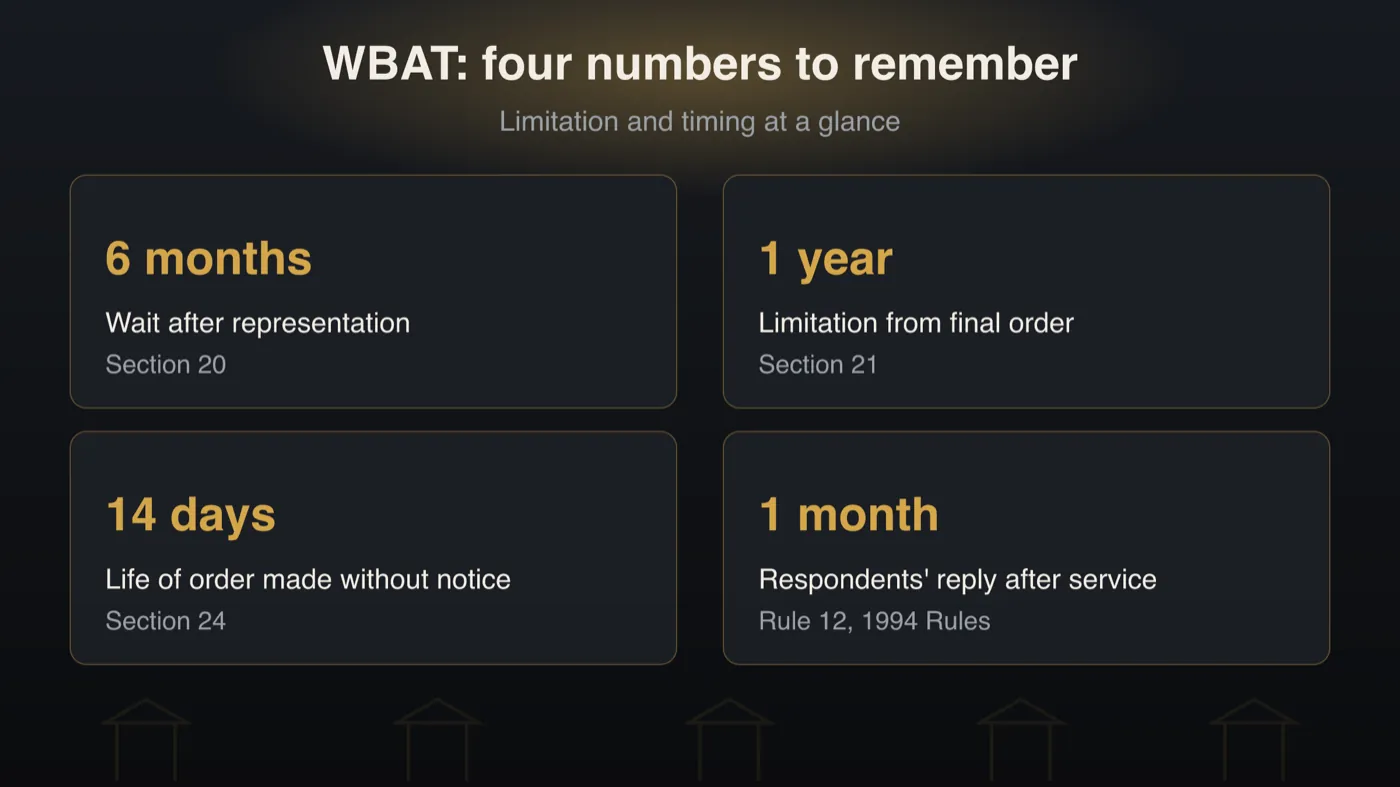
The time limits that matter in a WBAT case
Four periods decide whether a service dispute is ready, in time, or at risk.
Short explainers from Adv. Sudip Patra
More short explainers on our YouTube channel: Patra’s Law Chambers on YouTube ↗
Which kind of government job do you hold or want?
The forum depends on who your employer is. This is general information, not advice on your case, so please verify your own position before filing.
Choose one of the options above.
From representation to the Supreme Court
This is the usual path of a State service dispute. Each stage has its own clock, so keep every paper and date.
Under Section 20, the tribunal does not ordinarily admit an application until the remedies under the service rules are used. Send the appeal or representation to the competent authority and keep proof of receipt. See government service matters for the wider picture.
The remedy counts as used once a final order rejects your appeal, or six months pass with no decision. The limitation clock starts from one of these two points (Section 21).
File Form 1 in three paper-book sets with the court-fee stamp, at Bikash Bhavan, Salt Lake, or by registered post. If you are late, add an application to condone delay with an affidavit giving the reasons.
The respondents’ reply is due within one month of service under the 1994 Rules, followed by a rejoinder and the hearing. Interim relief under Section 24 needs advance service on the other side.
Apply for a certified copy, consider review under Section 22(3)(f), or seek contempt under Section 17 if the order is ignored. For the wider route, read service matters in CAT to compare the two tribunals.
A WBAT order goes before a Division Bench of the Calcutta High Court by a WPST writ. No fixed limitation applies, but delay and laches count against you. A further challenge lies by SLP against a Calcutta High Court order.
Three things people get wrong about WBAT, tap a card
Normally no. In L. Chandra Kumar v. Union of India, (1997) 3 SCC 261, the Supreme Court held that tribunals are the courts of first instance. The High Court then reviews the tribunal’s order through a Division Bench.
Generally not. Sending reminders does not restart the one-year period, so count from the final order or the end of the six-month wait. A continuing grievance such as pension may be treated differently, so verify your own case.
No. Central posts go to CAT, court staff to the High Court, and the armed forces to AFT. Checking the forum first saves months. A wrong filing can cost time and money.

Matters we handle before WBAT and the Calcutta High Court
State service matters
Pay fixation, pension and retirement benefits, seniority, promotion, leave, transfer and disciplinary action for State government employees. We check the forum first, because central posts go to CAT instead. See our note on service matters in CAT.
Compassionate appointment and recruitment
Claims for compassionate appointment and disputes over recruitment to State posts are service matters under Section 15(1)(a) and (b). Our explainer on the law of appointment in government service sets out the principles the tribunal applies.
Interim relief and stay
The tribunal can grant interim orders, but the other side must ordinarily be served and heard first. An order made without notice lapses after 14 days unless service is completed and the tribunal continues it. Advance service of copies on the respondents is therefore part of urgent filing.
Challenging a WBAT order
A WBAT order is challenged by a writ in the Calcutta High Court, case type WPST, before a Division Bench. A further appeal lies by special leave under Article 136. See SLP against a Calcutta High Court order and our Calcutta High Court advocate page.
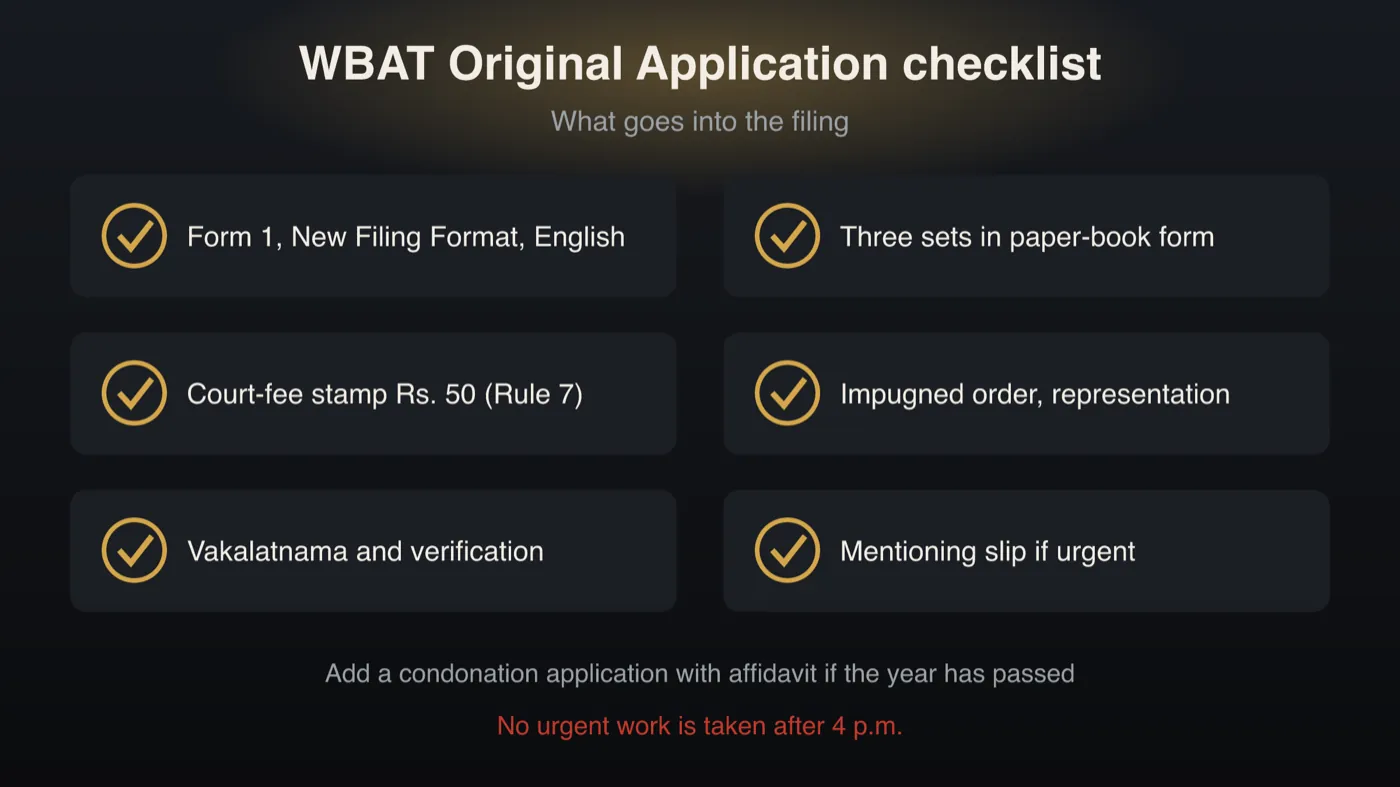
What goes into a WBAT Original Application
- Application in Form 1, in the New Filing Format, in English (Rules 3 and 4, 1994 Rules)
- Three complete sets in paper-book form, filed at the Registrar’s counter or sent by registered post with acknowledgement due
- Court-fee stamp of Rs. 50 under Rule 7 of the 1994 Rules (verify the current amount with the Registry)
- Impugned order, appointment letter, and the representation with proof of receipt and any reply
- Vakalatnama, verification, and an application for condonation of delay with affidavit if the year has passed
- Mentioning slip if urgent listing is needed; no urgent work is taken after 4 p.m.
Supreme Court rulings that shape every West Bengal Administrative Tribunal case
These decisions set out which forum hears a service matter first, how far the High Court can review a tribunal order, and how strictly time limits apply. Read each one in full before relying on it for your own case.
1997
Tribunal first, High Court review preserved
A seven-judge Constitution Bench held that the High Court’s writ power under Articles 226/227 and the Supreme Court’s power under Article 32 are part of the basic structure. Article 323A(2)(d) and Section 28 of the Administrative Tribunals Act, 1985 are invalid to the extent they exclude those powers. Tribunals remain the court of first instance, and their orders are tested before a Division Bench of the High Court.
2010
High Court cannot bypass the tribunal
The High Court had set aside a tribunal judgment and told the parties to bring their grievance to the High Court as the court of first instance. The Supreme Court held that this overlooked the tribunal’s jurisdiction and went against L. Chandra Kumar. A service dispute must begin before the tribunal, and the High Court’s role is to review the tribunal’s decision.
2023
Article 226 review of tribunal orders
The question was whether an Armed Forces Tribunal order can be challenged in a writ under Article 226. Relying on L. Chandra Kumar, the Supreme Court held that the High Court’s writ jurisdiction over tribunal orders cannot be taken away by statute. Superintendence under Article 227 is a separate power. The same reasoning supports a WPST writ against a WBAT order before the Calcutta High Court.
2010
Pay scales follow the statutory ROPA rules
This appeal arose from a West Bengal Administrative Tribunal order of 18.08.2005 that the Calcutta High Court had upheld. The order allowed a pay-revision claim based on a Chief Engineer’s order. The State argued that the ROPA rules, framed under Article 309, could not be changed that way, and the Supreme Court allowed the State’s appeal. The judgment also comments on a tribunal’s duty to decide the case itself; read that passage in full before relying on it.
1989
Repeated representations do not extend limitation
The cause of action arises on the final order rejecting the statutory appeal or representation. If the rules provide no such remedy, it arises on the original adverse order. Filing repeated or non-statutory representations does not restart the clock. This is why Sections 20 and 21 of the Administrative Tribunals Act, 1985 must be counted carefully.
2008
Continuing wrong, arrears ordinarily capped
A claim about a continuing wrong, such as wrong pay fixation or denial of pension, is not defeated by delay alone. However, arrears are ordinarily limited to about three years before the application or petition was filed. Later Supreme Court decisions have refused to apply this cap mechanically, so check the current position for a pension or pay case before filing.
How a service grievance moves from representation to an Original Application in WBAT
Confirm the forum
WBAT hears recruitment and service matters of people holding a civil post under the State of West Bengal (Section 15, Administrative Tribunals Act, 1985). Central government and central PSU staff go to the CAT Kolkata Bench (Section 15(4)). Court staff, the armed forces and legislature secretariat staff are excluded by Section 2. Verify whether any notification covers local-body or PSU staff.
Exhaust the departmental remedy
Under Section 20, first file the appeal or representation the service rules provide, such as under the WBS (CCA) Rules. The remedy counts as exhausted once a final order rejects it, or once six months pass without a decision. Keep proof that the authority received your representation.
Count the one-year limitation
Section 21 allows one year from the final order, or one year from the end of the six-month wait. If you are late, file an application for condonation of delay under Section 21(3) with an affidavit explaining the sufficient cause, day by day where possible.
Draft the Original Application
Prepare the application in Form 1 using WBAT’s New Filing Format. Include the parties, the order under challenge, jurisdiction, limitation, facts, grounds, reliefs, any interim prayer and a verification. Attach the appointment letter, the impugned order, the representation with proof of receipt, any reply, and the vakalatnama.
File at Bikash Bhavan
File three complete paper-book sets with the court-fee stamp at the Registrar’s counter in Bikash Bhavan, Salt Lake, or send them by registered post with acknowledgement due. Rule 7 of the 1994 Procedure Rules sets the fee at Rs. 50; verify the current fee with the Registry. Use the mentioning slip for urgent listing.
After the order
Apply for a certified copy. If the department does not comply, apply for contempt under Section 17. To challenge the order, file a writ under Articles 226/227, case type WPST, before a Division Bench of the Calcutta High Court; see our service matter writ guide. After that, an SLP under Article 136 lies to the Supreme Court.
State employee or central employee: where does the case go?
Two tribunals, two employers. Filing in the wrong one wastes time.
Forum chooser: WBAT, CAT, High Court or AFT
Pick the kind of post you hold or applied for and press the button. The tool names the usual forum under the Administrative Tribunals Act, 1985.
This is a general guide, not advice on your case. The tribunal or court decides its own jurisdiction. Verify before filing.
WBAT limitation date estimator
Enter the date of the final order on your appeal or representation, or the date you filed the representation if no order came. The tool estimates the one-year window under Sections 20 and 21.
- Choose whether you have a final order or only a pending representation.
- Enter the date.
- Press Calculate.
This is an estimate only. Repeated representations do not extend limitation, and delay may be condoned for sufficient cause under Section 21(3). The tribunal decides. Verify the dates with your advocate.
Mistakes that sink WBAT cases before they are heard
Filing a writ straight in the Calcutta High Court Under L. Chandra Kumar and Rajeev Kumar, a state employee’s service dispute must ordinarily start before WBAT. A direct writ is usually returned to the tribunal, and the time spent on it is lost.
Thinking each new representation restarts the clock S.S. Rathore holds that repeated representations do not extend limitation. Count the one year from the final order on the statutory appeal, or from the end of the six-month wait under Section 20.
Choosing the wrong tribunal Central government, central PSU and bank staff belong in the Central Administrative Tribunal, not WBAT (Section 15(4)); see our CAT service matters guide. Officers on deputation and state PSU staff should check the forum carefully before filing.
Letting an ex parte stay lapse Under Section 24, an interim order made without hearing the other side lasts only 14 days unless the respondents are served and the tribunal extends it. Serve advance copies and follow up on time. Our government service matters team can help track these dates.
Discuss your service grievance before the time runs out
Service matters turn on the right forum, a properly made representation and a limitation date counted correctly. If you are a West Bengal government employee or candidate with an order or a pending representation, bring the papers so the forum, the dates and the next step can be checked. Each matter is assessed on its own facts, and no result can be promised. The chamber appears before WBAT, the Calcutta High Court and the Supreme Court.
Book a ConsultationEstablished by a distinguished alumnus of IIT Kharagpur, Patra’s Law Chambers stands as a beacon of legal expertise in Kolkata & Delhi. Know more →

Kolkata Office
NICCO House, 6th Floor, 2 Hare Street
Kolkata-700001 (Near Calcutta High Court)
Delhi Office
4455/5, First Floor, Gali Shahid Bhagat Singh
Main Bazar Road, Paharganj, New Delhi-110055
Contact
[email protected]
+91 890 222 4444 / +91 7003 715 325
Fees in the 1994 WBAT Procedure Rules
These are the figures published on the WBAT site. Please verify the current amounts with the Registry before filing.
Frequently asked questions about the West Bengal Administrative Tribunal
A State government employee, a candidate for a State civil post, or a retired State employee with a service grievance can apply. The tribunal hears recruitment and service matters under Sections 3(q) and 15 of the Administrative Tribunals Act, 1985.
Normally no. Under L. Chandra Kumar and Rajeev Kumar v. Hemraj Singh Chauhan, the tribunal is the first forum for service matters. A direct writ is usually sent back to WBAT. Whether a non-functioning bench changes this is an argument still pending.
Usually one year from the final order on your appeal or representation. If no order comes, the year starts after six months from the representation (Sections 20 and 21). Delay can be condoned for sufficient cause, so file early.
The 1994 Procedure Rules provide Rs. 50 in court-fee stamps on the application, and Rs. 2 for an interim application. These figures are from the 1994 text on the WBAT site, so verify the current fee with the Registry.
No WBAT e-filing system has been found. Filing is at the Registrar’s counter at Bikash Bhavan, Salt Lake, or by registered post with acknowledgement due. Check with the Registry whether this has changed.
No. Where the Central Administrative Tribunal has jurisdiction, WBAT does not (Section 15(4)). Central employees, central PSU staff and banks should look at the CAT route, and verify any deputation or all-India service issue.
By a writ petition under Articles 226/227 before a Division Bench of the Calcutta High Court, case type WPST. A further challenge lies by SLP under Article 136. No fixed limitation applies, but delay counts against you.
Yes, interim orders are possible under Section 24. An order made without notice to the other side lapses after 14 days unless the steps are completed and the tribunal continues it. Contempt can be sought under Section 17.