SLP Limitation Period, Grounds and Process: Special Leave Petition
A special leave petition asks the Supreme Court for permission to appeal. It is not a right, and the clock starts on the day the High Court judgment is pronounced. This page explains the 90-day and 60-day limits, the grounds the Court looks for, and the steps from a Calcutta High Court order.
What a special leave petition is, and why the time limit matters
A special leave petition (SLP) is a request under Article 136 of the Constitution for the Supreme Court’s permission, called leave, to appeal against a judgment or order of any court or tribunal in India. The words “in its discretion” in Article 136 matter. The Court does not sit as an ordinary appeal court, and it interferes mainly where there is a substantial question of law, a grave injustice, a perverse finding or a breach of natural justice. The procedure is set out in the Supreme Court Rules, 2013, and the text should be checked there before filing.
Limitation is where many petitions are lost. Under the Limitation Act, 1963 and Orders XXI and XXII of the Rules, the usual period is 90 days from the judgment. It is 60 days where the High Court refused a certificate or leave, and 60 days in a death-sentence case. Time spent obtaining the certified copy is excluded, and a late petition needs an application for condonation of delay. For a first discussion of an order from Kolkata, see our Supreme Court advocate consultation page. For the filing steps, read how to file an SLP in the Supreme Court.
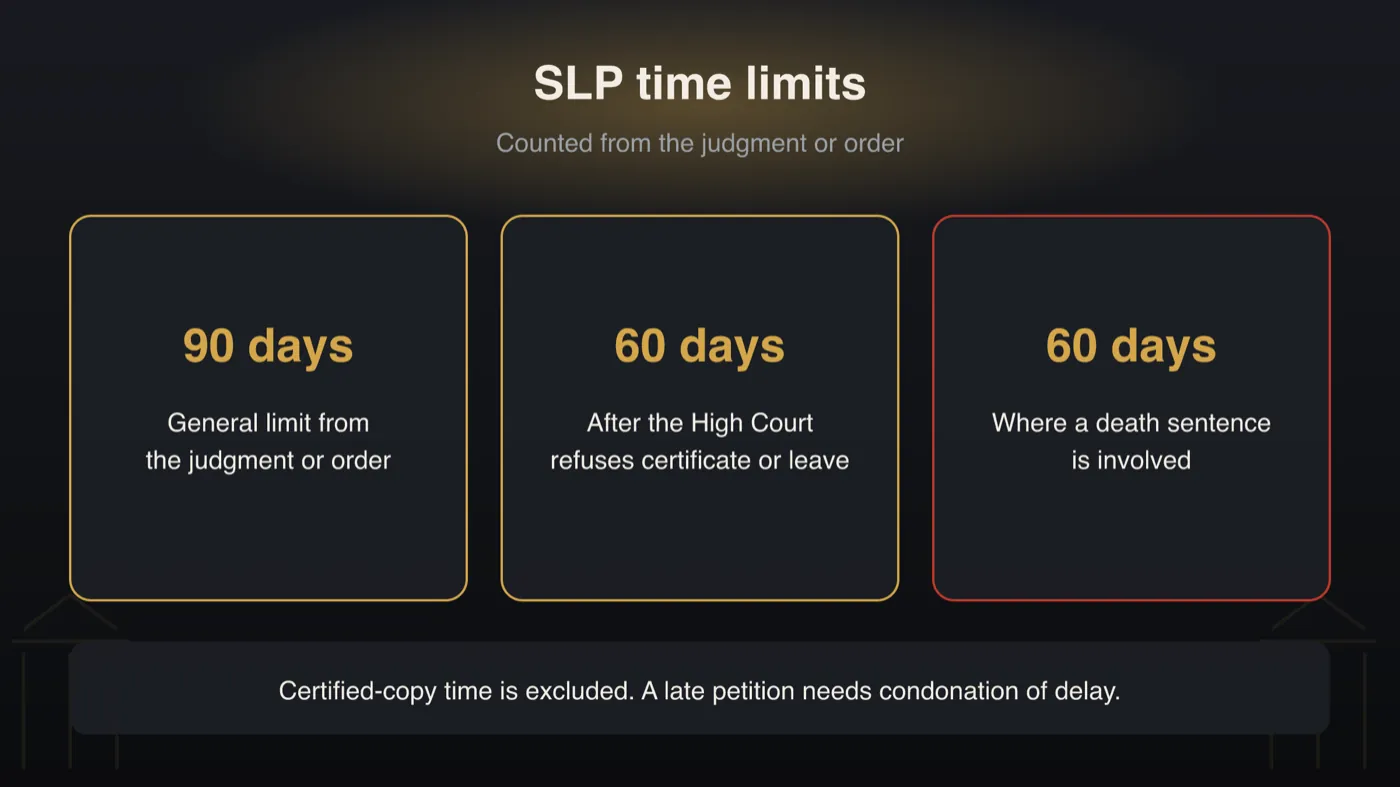
How many days you usually have to go to the Supreme Court
The period depends on the kind of order, and it can be extended by the time spent obtaining the certified copy.
Short explainers from Adv. Sudip Patra
More short explainers on our YouTube channel: Patra’s Law Chambers on YouTube ↗
What has the High Court just done in your case?
Pick the situation closest to yours. This is general information on how the route usually runs. It is not advice on your own case.
Choose one of the options above.
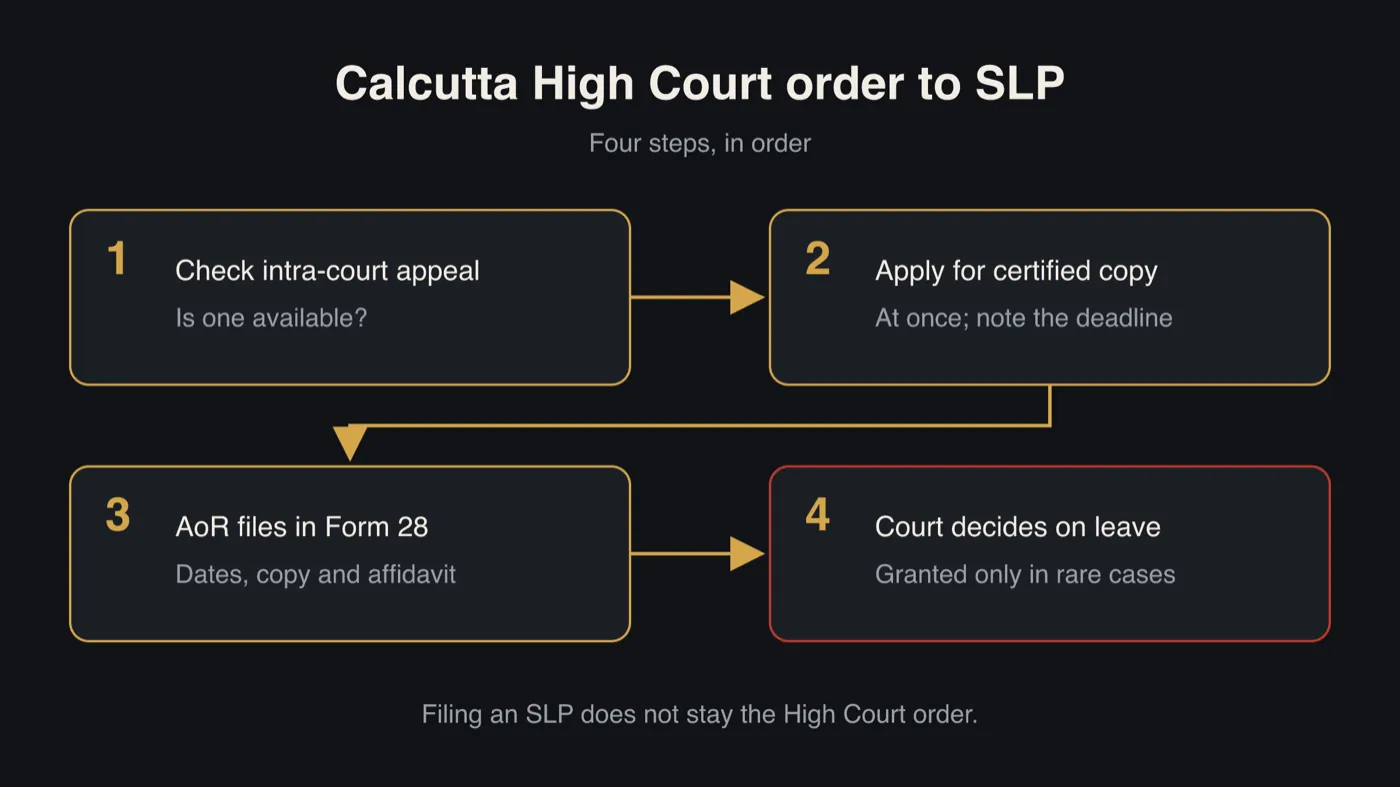
From the High Court judgment to the first hearing in the Supreme Court
The clock usually starts on the day the High Court pronounces its judgment, not the day you receive it. Here is the usual order of events.
If a certificate for appeal under Article 134A is wanted, the oral request must be made immediately after the judgment. Otherwise the route is Article 136. Check first whether an intra-court appeal is available.
Apply to the High Court’s Copying Department and keep the receipt. Time spent getting the copy is excluded under section 12 of the Limitation Act, 1963. The receipt is also needed for any exemption application (Harsh Bhuwalka v. Sanjay Kumar Bajoria, order of 5 August 2024).
Only an Advocate-on-Record can file an SLP. Send the certified copy, the pleadings and orders of the courts below, translations of Bengali papers and details of any earlier SLP. See the Supreme Court advocate consultation page, and filing an SLP in the Supreme Court for the filing mechanics.
The petition has a list of dates, grounds confined to the record below, the earlier-SLP declaration and the Form 28 certificate. It is e-filed, the fee is paid and a diary number is generated. Defects raised by the Registry should be cured promptly.
Without a caveat, the first listing is ex parte. The Court may dismiss the SLP, issue notice, give or refuse interim relief, or tag it with similar cases. For Calcutta matters, see SLP against a Calcutta High Court order.
If leave is granted, the SLP becomes a Civil or Criminal Appeal. If it is dismissed in limine, the High Court order does not merge in it, so a High Court review may still lie (Kunhayammed v. State of Kerala, (2000) 6 SCC 359; Khoday Distilleries Ltd. v. Sri Mahadeshwara Sahakara Sakkare Karkhane Ltd., (2019) 4 SCC 376).
Common misunderstandings about the SLP, tap a card
Article 136 gives the Supreme Court a discretion. It is not an ordinary appeal. The Court has said it is not a regular appellate forum and interferes only in exceptional cases (Pritam Singh v. The State, AIR 1950 SC 169).
Filing an SLP does not stay the order of the High Court. Only an interim order of the Supreme Court does. Any interim prayer goes inside Form 28, because no separate application is needed.
The SLP is confined to the pleadings and documents before the court below. New facts, documents or grounds need the Court’s permission (Order XXI Rule 3(1)(c); Order XXII Rule 2(4)). The Form 28 certificate confirms this.
Grounds, limitation and procedure for an SLP
Grounds the Court looks for
Leave is granted only in exceptional cases: a substantial question of law, grave injustice, a perverse finding or a breach of natural justice. A different view of the evidence is usually not enough. The petition is confined to the record before the court below, and new grounds need the Court’s leave.
Limitation and condonation of delay
The period is 90 days or 60 days depending on the order. Certified-copy time is excluded under s.12, and s.5 allows condonation for sufficient cause. The Court expects a day-by-day explanation with documents and will not condone delay without notice to the respondent.
Certification and filing
An SLP is filed only through an Advocate-on-Record in Form 28, with a list of dates, the certified copy of the order and an affidavit. It must state whether an earlier SLP was filed against the same order. Interim prayers go inside the petition itself.
From a Calcutta High Court order
First check whether an intra-court appeal is available, then apply for the certified copy at once and note the deadline. Read about an SLP against a Calcutta High Court order, or an SLP for anticipatory bail.
Points that often go wrong
- Counting 90 days from the date of receiving the copy instead of the date of the judgment
- Skipping an available intra-court appeal, such as a Letters Patent appeal
- Adding new facts or documents without the Court’s leave
- Not disclosing an earlier SLP against the same order
- Filing a criminal SLP without proof of surrender or an exemption application
- Assuming that filing an SLP stays the High Court order
Supreme Court rulings that decide how a special leave petition is heard
These decisions explain when the Supreme Court will grant special leave under Article 136, how it treats delay, and what happens to the High Court order after an SLP is dismissed. Check the official text of each judgment before quoting a paragraph.
1950
Leave only in exceptional, grave cases
In its first year, the Supreme Court held that special leave under Article 136 is not granted just to re-argue facts or the credibility of witnesses. The Court interferes only where exceptional and special circumstances exist and substantial and grave injustice has been done. This test still guides every first listing of a special leave petition.
2007
Article 136 is not a regular appeal
The Court read the words “in its discretion” in Article 136 to mean that no party has a right of appeal. Article 136 is a residual power, not an ordinary appellate forum. It is meant for constitutional questions, questions of law of general importance and grave injustice. A different view of the evidence is usually not enough to get leave.
2000
Refusing leave does not merge the order
A three-judge Bench held that an order refusing special leave, whether it gives reasons or not, does not attract the doctrine of merger. The High Court’s order stands on its own. Merger happens only once leave is granted and the appeal is decided. Any law the Supreme Court declares in its reasons still binds courts under Article 141.
2019
High Court review survives in limine dismissal
A three-judge Bench resolved conflicting decisions and affirmed Kunhayammed. Where the Supreme Court dismisses a special leave petition in limine by refusing leave, the High Court can still hear a review petition against its own judgment. For a litigant this matters: an early dismissal in Delhi does not always end the road in the Calcutta High Court.
2013
Condonation is liberal, but not automatic
This West Bengal case reached the Supreme Court after the Calcutta High Court condoned a delay of 2,449 days, and the Supreme Court set that order aside. The Court set out guidelines on condonation. The approach should be justice-oriented, but lack of bona fides and gross negligence weigh heavily, and the party seeking condonation must prove sufficient cause.
2024
Negligence defeats a 5,659-day delay
The Supreme Court upheld the High Court’s refusal to condone a delay of 5,659 days and dismissed the special leave petition. Section 3 of the Limitation Act is mandatory. Section 5 is discretionary and needs real sufficient cause. The merits of the case are not weighed when the Court decides whether to condone delay.
From a Calcutta High Court order to the Supreme Court: the special leave petition process
Day 0: decide on the route the day judgment is pronounced
If you want an appeal on a certificate, make an oral request under Article 134A immediately after the High Court pronounces judgment. Otherwise the route is a special leave petition under Article 136. First check whether an intra-court appeal, such as a Letters Patent appeal from a single judge, is still available. If it is, the SLP may be returned with liberty to file that appeal.
Apply for the certified copy and keep the receipt
Apply to the High Court copying department at once. Under section 12 of the Limitation Act, 1963, the time taken to get the copy is excluded from limitation. Since 20 August 2024, an application for exemption from filing the certified copy must include the High Court’s receipt for the copy application (Harsh Bhuwalka v. Sanjay Kumar Bajoria, order of 5 August 2024).
Work out the limitation period
The SLP must be filed within 90 days of the judgment or order. The limit is 60 days from the High Court’s refusal of a certificate or of leave, and 60 days in a death-sentence case (Article 133, Limitation Act; Orders XXI and XXII, Supreme Court Rules, 2013). Add the copy time. If you are late, file an application for condonation of delay, which the Court decides only after notice to the respondent.
Brief the Advocate-on-Record
Only an Advocate-on-Record can file in the Supreme Court. Send the certified copy, the pleadings and orders of every court below, English translations of Bengali documents, the vakalatnama and details of any earlier SLP against the same order. In a criminal SLP where a term of imprisonment was imposed, also send proof of surrender or the grounds for an exemption application (Order XXII Rule 5).
Draft in Form 28, confined to the record
The petition is drafted in Form No. 28, with a synopsis, a list of dates, questions of law, grounds and the interim prayer. The petition must stay within the pleadings and documents that were before the court below (Order XXI Rule 3(1)(c)). It must also say whether an earlier SLP was filed against the same order (Rule 3(2)). The Advocate-on-Record’s certificate rests on your affidavit.
E-filing, defects and the first listing
The Advocate-on-Record files on efiling.sci.gov.in, pays the court fee and gets a diary number. Cure any defects the Registry raises promptly. At the first listing, the Court may dismiss the petition, issue notice, grant or refuse interim relief, or grant leave, which turns the SLP into a civil or criminal appeal. How to file an SLP explains the paperwork in detail.
From a High Court order to the Supreme Court's decision
Each stage must be cleared before the next one, and the first listing decides whether the petition goes further.
High Court order
Check whether an intra-court appeal such as a Letters Patent appeal is available.
Article 134A request
If a certificate is wanted, ask orally immediately after the judgment.
Certified copy and AOR
Apply for the copy at once and brief an Advocate-on-Record.
SLP filed in Form 28
E-filed within limitation, with the list of dates and the certificate.
First listing
The Court may dismiss, issue notice, decide interim relief or tag the matter.
Leave granted
The SLP becomes a Civil or Criminal Appeal and is heard on the merits.
Mistakes that sink a special leave petition before it is heard
Treating the 90 days as thinking time Limitation runs from the date of the judgment, not from the day you receive the copy. Only the time actually taken to get the certified copy is excluded, so an unexplained gap needs a day-by-day explanation for condonation, and Esha Bhattacharjee and Pathapati Subba Reddy show that courts refuse vague or careless explanations.
Adding new facts, documents or grounds The SLP must stay within the record of the court below. Anything new needs the Court’s prior leave, through a separate application giving reasons (Order XXI Rule 3(1)(c); Order XXII Rule 2(4)).
Not disclosing an earlier SLP Rule 3(2) of Order XXI requires a statement on affidavit about any earlier SLP against the same order. Hiding it risks dismissal for suppression of material facts.
Assuming that filing stops the High Court order Filing an SLP does not stay the impugned order. Only an interim order of the Supreme Court does, so ask for interim relief in Form 28 if you need it. For a consultation on a Supreme Court matter, see Supreme Court Advocate consultation, and for the High Court side, SLP against a Calcutta High Court order.
Considering a Supreme Court appeal from Kolkata?
Every SLP depends on its own order, its own record and its own dates. If you are weighing a challenge to a Calcutta High Court judgment, bring the certified copy, or the receipt for it, and the dates of the order. We can look at limitation, the available remedies and the papers needed. No result can be promised, and the Supreme Court decides whether leave is granted. You can also read about our Calcutta High Court advocate consultation.
Book a ConsultationEstablished by a distinguished alumnus of IIT Kharagpur, Patra’s Law Chambers stands as a beacon of legal expertise in Kolkata & Delhi. Know more →
Kolkata Office
NICCO House, 6th Floor, 2 Hare Street
Kolkata-700001 (Near Calcutta High Court)
Delhi Office
4455/5, First Floor, Gali Shahid Bhagat Singh
Main Bazar Road, Paharganj, New Delhi-110055
Contact
[email protected]
+91 890 222 4444 / +91 7003 715 325
What an SLP can rely on and what needs the Court's leave
The petition must stay within what was before the court below, and anything beyond that needs permission.
Frequently asked questions about a special leave petition
Usually 90 days from the High Court judgment or order. It is 60 days if the High Court refused leave or a certificate, or in a death-sentence case (Limitation Act, 1963, Art. 133; Order XXI Rule 1 and Order XXII Rule 1). Time taken for the certified copy is excluded under section 12.
It can be filed with an application to condone delay under section 5 of the Limitation Act, 1963. The Court decides it only after notice to the respondent and expects a full, documented explanation. Condonation is never automatic, so verify the facts of your case with a lawyer.
No. Article 136 gives the Supreme Court a discretion to grant special leave to appeal. The petitioner asks for permission first. If leave is granted, the SLP is registered as an appeal and heard on the merits.
Typically a substantial question of law, a grave injustice, a perverse finding or a breach of natural justice. A different view of the evidence is usually not enough. The Court has said special leave is granted only in exceptional and special circumstances (Pritam Singh v. The State, AIR 1950 SC 169).
Only with the Court’s permission. The SLP is confined to the pleadings and documents before the court or tribunal below (Order XXI Rule 3(1)(c); Order XXII Rule 2(4), Supreme Court Rules, 2013). The fix is an application for leave to place additional documents, giving reasons.
It is a certificate in Form 28, given on the petitioner’s affidavit, that the petition is confined to the record below and no additional facts or grounds are taken. An SLP can be filed only through an Advocate-on-Record. Check the current form on sci.gov.in.
Yes. Order XXI Rule 3(2) requires a statement, supported by affidavit, on whether an earlier SLP was filed against the same order and with what result. Hiding it risks dismissal for suppression of material facts, so disclose every earlier filing.
It depends on the order. If it was dismissed in limine, a High Court review may still lie because the doctrine of merger does not apply (Kunhayammed; Khoday Distilleries). A Supreme Court review or curative petition has a narrow scope. Get advice on the exact order.