Reading a Supreme Court Judgment: Headnote, Ratio and Obiter in Plain Words
Not every line of a Supreme Court judgment binds a court. Only the principle the case was decided on does. This guide shows how to find that principle, tell it from passing remarks and the headnote, and check whether it fits your own facts.
What Article 141 actually makes binding
Article 141 of the Constitution says: “The law declared by the Supreme Court shall be binding on all courts within the territory of India.” The words that matter are “law declared”. That law is the ratio decidendi, the principle on which the case was decided. In *State of Orissa v. Sudhansu Sekhar Misra* (AIR 1968 SC 647), the Court said a decision is only an authority for what it actually decides, and that what is of the essence is its ratio, not every observation in it. Judgments can be read in full on the Supreme Court of India website, which is free.
Many disputes in Kolkata courts, tribunals and offices turn on one question: “Has the Supreme Court already decided this?” The answer depends on reading the judgment itself, not a news headline or a headnote. Where an authority refuses to follow settled law, the route is usually a representation and then a writ petition in the Calcutta High Court. For a Supreme Court matter, see our Supreme Court advocate consultation page. This page is general information, not advice on your case. Please verify current rules and citations before relying on them.
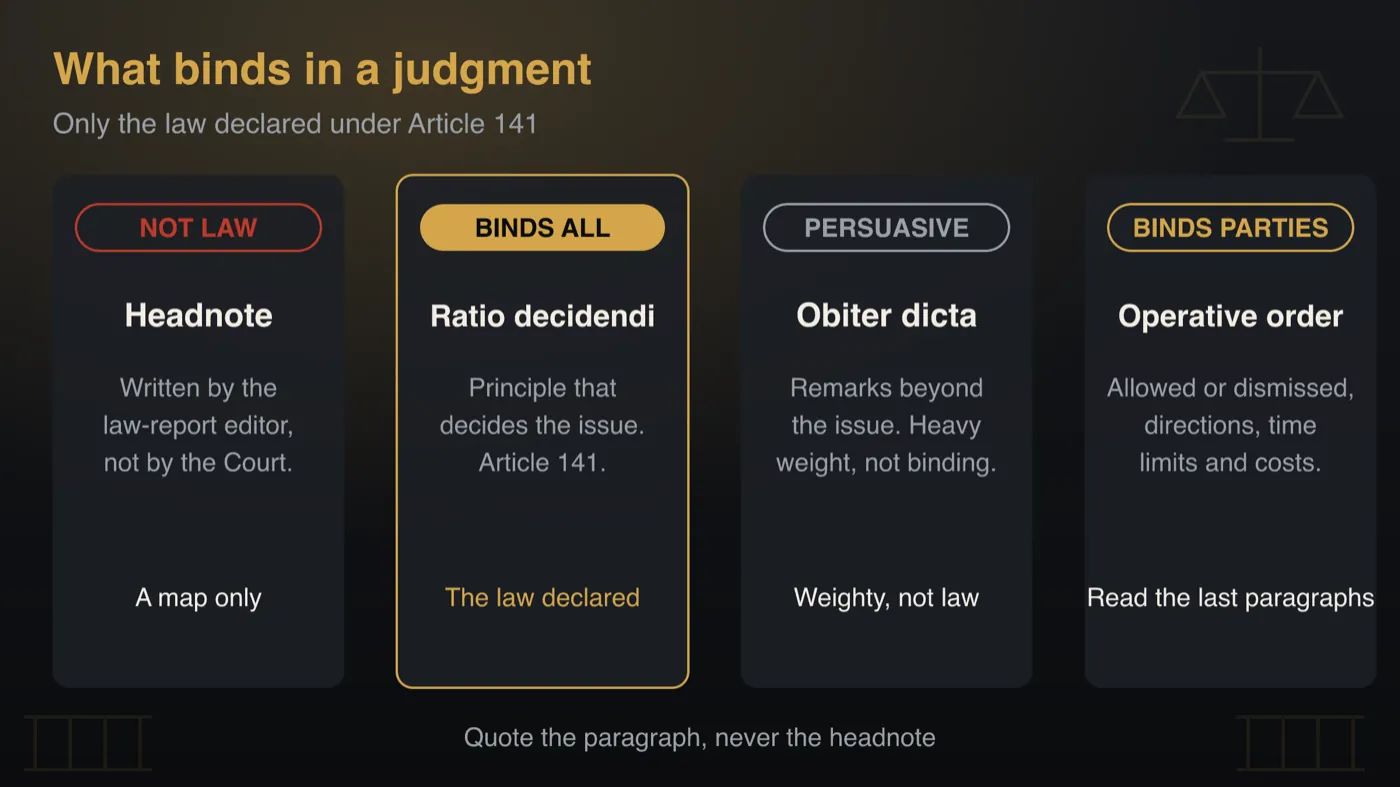
Ratio decidendi and obiter dicta side by side
Only one of these is the law declared under Article 141.
Videos from Adv. Sudip Patra
More short explainers on our YouTube channel: Patra’s Law Chambers on YouTube ↗
What kind of Supreme Court ruling are you holding?
Pick the description closest to the paper or argument in front of you. This is general information, not advice on your case.
Choose one of the options above.
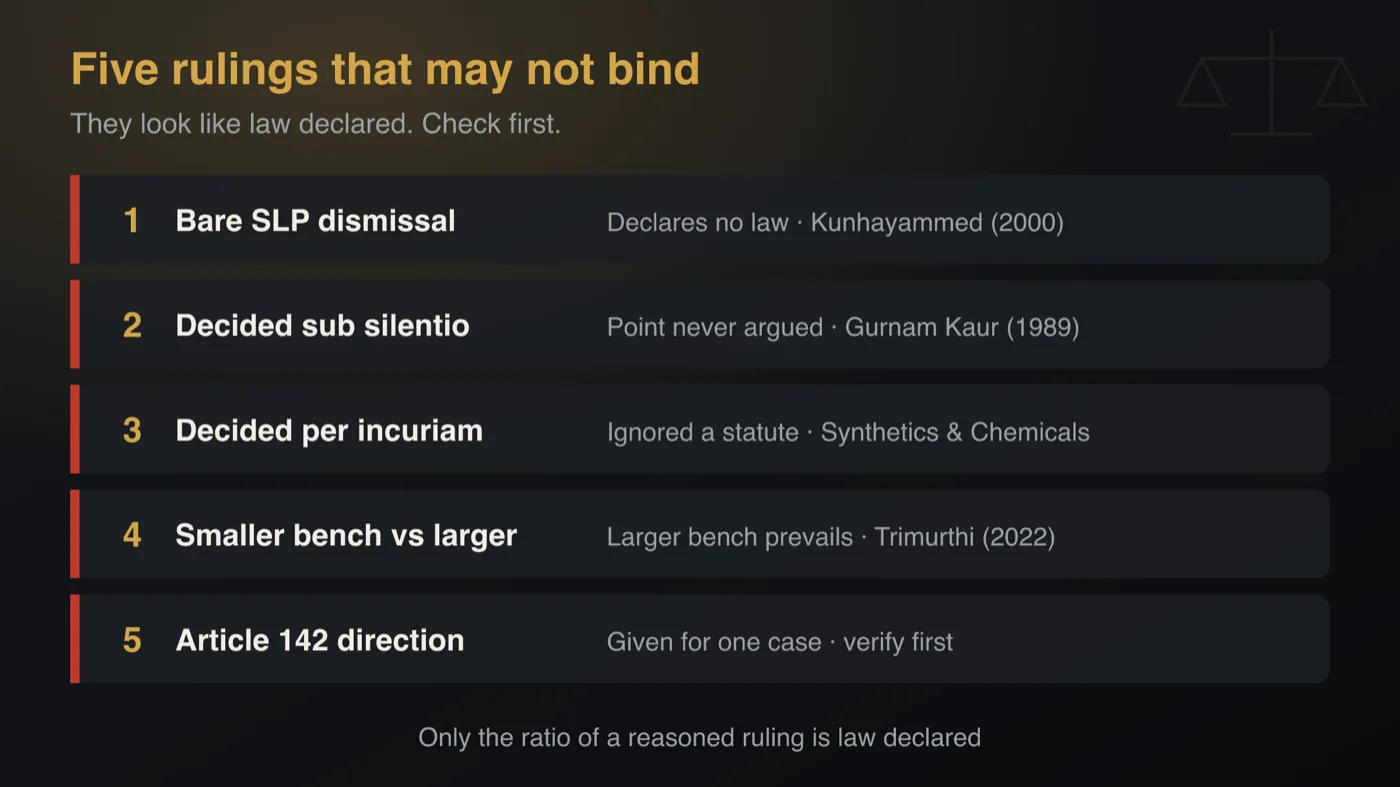
How to read a Supreme Court judgment, in order
A judgment is easier to read when you take it in a set order instead of top to bottom.
Download the judgment from the Supreme Court website or the eSCR portal and note its INSC neutral citation. Indian Kanoon is fine for reading, but take quotes from the Court’s own copy.
Note the number of judges and the date. Check whether a later or larger bench has overruled it or referred it onward. Also check whether it is reportable.
Read the cause title, the issues or questions for consideration, then jump to the final paragraphs. Those carry the operative order: allowed or dismissed, directions, time limits and costs.
Go to the analysis and mark the paragraph that answers the issue. That is your candidate ratio. Facts, arguments of counsel and passing remarks are not the ratio.
List the three to five facts the Court relied on and compare them with yours. One different fact can make a precedent inapplicable (Padma Sundara Rao).
Quote paragraph numbers in representations, replies or petitions, never the headnote. If a authority refuses to follow settled law, a writ petition in the Calcutta High Court may be the route. For Supreme Court matters, see our Supreme Court advocate consultation page.
Three things people think are law. Tap a card
A law-report editor writes it, not the judges. High Courts have warned against relying on it, so quote the paragraph of the judgment instead.
If the SLP was dismissed without reasons, no law is declared and nothing merges (Kunhayammed, Khoday Distilleries). It only means leave was refused.
Only the ratio decidendi binds under Article 141. As the Court said in State of Orissa v. Sudhansu Sekhar Misra, it is the ratio and not every observation that is of the essence.
The parts of a Supreme Court judgment
Headnote: a map, not the law
A headnote is written by the law-report editor, not by the Court. The Kerala High Court has cautioned against relying on headnotes, and a Madhya Pradesh High Court circular told judicial officers to quote the actual paragraph. Use the headnote to find your way, then read the judgment.
Ratio decidendi: the part that binds
The ratio is the reasoning needed to answer the issue before the Court. In *Director of Settlements v. M.R. Apparao* ((2002) 4 SCC 638) the Court held that what binds is the principle behind the decision, including observations on points raised and decided.
Obiter dicta: weighty, not binding
Obiter dicta are remarks beyond what was needed to decide the case. They do not bind strictly, but a considered observation of the Supreme Court carries heavy weight with High Courts (*Apparao*). A point disposed of on concession is not law declared.
The last paragraphs: what must be done
The operative part says whether the appeal is allowed or dismissed, and gives directions, time limits and costs. It binds the parties. The ratio, found in the reasoning, is what binds everyone else. Read both before you act.
Things that look like law declared but may not be
- A bare, non-speaking dismissal of an SLP declares no law (*Kunhayammed v. State of Kerala*, (2000) 6 SCC 359; *Khoday Distilleries*, (2019) 4 SCC 376)
- A decision *sub silentio*, where the point was never argued or considered (*Municipal Corporation of Delhi v. Gurnam Kaur*, (1989) 1 SCC 101)
- A decision *per incuriam*, given in ignorance of a statute or binding authority (*State of U.P. v. Synthetics & Chemicals*, (1991) 4 SCC 139)
- A smaller bench against a larger one: the majority of the larger bench prevails (*Trimurthi Fragrances*, Constitution Bench, 19 Sep 2022)
- Article 142 directions made for complete justice in one case; verify the Supreme Court authority before citing them as precedent
What the Supreme Court has said about its own judgments
Article 141 makes the law declared by the Supreme Court binding on every court in India. These decisions explain which part of a judgment is that law and which part is not.
1967
A decision binds only for what it decides
The Court said that a decision is an authority only for what it actually decides. What matters is the ratio, the principle on which the case was decided, and not every observation in the judgment. Read a judgment to find the principle that answers the issue before the Court. A sentence lifted from elsewhere in the text does not carry that force.
2002
Obiter carries weight but is not precedent
A three-judge bench held that what binds under Article 141 is the principle underlying a decision, including observations on points that were raised and decided. Remarks made in passing (obiter dicta) do not bind as precedent, but they carry considerable weight with High Courts. A point disposed of on a concession is not law declared.
2002
Read the ratio with the facts
The Constitution Bench warned that one additional or different fact may make a world of difference between two cases. A court should not rely on a decision without first discussing how its facts fit the case at hand. Before citing a judgment, list the facts it turned on and compare them honestly with yours.
2000
A bare SLP dismissal declares no law
A three-judge bench held that dismissing a special leave petition without reasons is not a declaration of law under Article 141, and the High Court order does not merge into it. If the order refusing leave gives reasons, the law stated in those reasons binds under Article 141, but there is still no merger. So ‘SLP dismissed’ does not mean ‘the Supreme Court upheld the point’.
1988
Unargued conclusions are not binding precedent
The Court held that a decision is sub silentio, and not binding as precedent, where the conclusion was reached without argument, without reference to the crucial words of the rule and without citing authority. Along with decisions given per incuriam or by consent, this is a recognised exception to the binding force of precedent.
2022
A larger bench prevails whatever its majority
A five-judge Constitution Bench held that the majority decision of a larger bench prevails over a smaller bench’s decision, whatever the number of judges in that majority. A smaller bench cannot overrule or disagree with a larger one. Where two Supreme Court rulings conflict, first check the bench strength of each.
How to find the binding part of a Supreme Court judgment
Get the authentic text
Download the judgment from the Supreme Court website or the Supreme Court Reports portal by case number, party name or neutral citation (for example 2024 INSC 286). Free reading sites are useful, but take every quotation from the Court’s own copy. A certified copy is applied for separately and costs a fee; check the current fee on sci.gov.in.
Note the bench, date and status
Record how many judges heard the case, the date, and whether the judgment is reportable. Then check whether a later or larger bench has overruled it, doubted it or referred it to a larger bench. A two-judge bench cannot overrule a three-judge bench (*Trimurthi Fragrances*, 2022).
Read the issues, then the last paragraphs
Start with the cause title and the questions framed for decision. Then go to the final paragraphs: appeal allowed or dismissed, directions, time limits and costs. This is the operative order, and it binds the parties. The headnote is written by the law-report editor and is not part of the judgment.
Find the paragraph that answers the issue
In the analysis or discussion, mark the paragraph where the Court answers each question. Keep it apart from the summary of facts, the arguments of counsel and remarks that go beyond the issue. The reasoning that answers the issue is your candidate ratio. The rest is background or obiter.
Match the facts with your own case
List the three to five facts the Court relied on and set them beside your own. If one material fact is different, the other side will distinguish the judgment (*Padma Sundara Rao*, 2002). Check too that the order was not a bare SLP dismissal, a concession or relief granted only for that case.
Quote paragraph numbers, not headnotes
In a petition, a representation or a reply to a government department, quote the exact paragraph with its number and the full citation. For a matter where the right reading of a Supreme Court ruling decides the outcome, take advice from a Supreme Court advocate before you file.
Does this Supreme Court ruling bind my case?
Run through these questions in order before relying on a ruling.
Is it a reasoned ruling?
A bare SLP dismissal declares no law.
Was the point decided?
A point conceded or not argued is not law declared.
Do the facts match?
One different fact can make it inapplicable.
Is the bench larger or later?
A larger bench’s majority prevails over a smaller bench.
Has it been overruled?
Check for a later ruling or a reference to a larger bench.
Mistakes people make when citing a Supreme Court judgment
Quoting the headnote or a news headline A headnote is an editor’s summary and is not the Court’s words. Courts expect the actual paragraph, and the Kerala and Madhya Pradesh High Courts have both warned judicial officers against relying on headnotes.
Calling an SLP dismissal a Supreme Court ruling A dismissal without reasons declares no law under Article 141 (*Kunhayammed*, 2000). The High Court’s judgment stands, but only as High Court law.
Relying on a judgment whose facts differ One material fact can make a precedent inapplicable. Compare the facts before you cite the case, or the other side will distinguish it in a single paragraph.
Ignoring bench strength and later decisions A smaller bench’s view gives way to a larger bench’s view (*Trimurthi Fragrances*, 2022). Check that the judgment has not been overruled or referred to a larger bench. For old IPC or CrPC rulings, check that the matching BNS or BNSS provision uses the same words before you rely on them.
Need a Supreme Court ruling read against your own facts?
Whether a ruling helps or hurts a matter depends on its ratio, its bench strength and how closely its facts match yours. Patra’s Law Chambers can read the judgment with you and explain, in plain words, what it does and does not decide for your matter. Outcomes depend on the facts and the law, and no result can be promised. Please bring the judgment or order and the papers you have.
Book a ConsultationEstablished by a distinguished alumnus of IIT Kharagpur, Patra’s Law Chambers stands as a beacon of legal expertise in Kolkata & Delhi. Know more →

Kolkata Office
NICCO House, 6th Floor, 2 Hare Street
Kolkata-700001 (Near Calcutta High Court)
Delhi Office
4455/5, First Floor, Gali Shahid Bhagat Singh
Main Bazar Road, Paharganj, New Delhi-110055
Contact
[email protected]
+91 890 222 4444 / +91 7003 715 325
What to check before relying on a judgment
A short list to run through before a ruling goes into your paper.
Take the quote from the Supreme Court’s own copy.
Note the INSC citation, in use from 6 July 2023.
A smaller bench cannot overrule a larger one.
Quote the paragraph, never the headnote.
List the facts the Court used and compare them with yours.
For IPC, CrPC or Evidence Act rulings, check the BNS, BNSS or BSA wording is the same.
Frequently asked questions about reading Supreme Court judgments
No. Under Article 141 only the law declared, the ratio decidendi or principle needed to decide the issue, binds all courts. Remarks made in passing are obiter. They carry weight with other courts but do not bind strictly.
A headnote is a summary written by the law-report editor, not by the judges. It helps you find your way but is never authority. Quote the actual paragraph of the judgment in any petition or reply.
Usually in the last few paragraphs: whether the appeal is allowed or dismissed, any directions, time limits and costs. That operative part binds the parties. The ratio, found in the reasoning, is what binds everyone else.
Observations beyond what was needed to decide the case. They are not strictly binding, but a considered view of the Supreme Court carries heavy weight with High Courts, as the Court explained in Director of Settlements v. M.R. Apparao (2002).
Not if the order gave no reasons. A non-speaking dismissal declares no law under Article 141 and causes no merger (Kunhayammed v. State of Kerala). If the order gives reasons, the law stated in it is declared.
The majority of a larger bench prevails over a smaller bench, whatever the number of judges in the majority (Trimurthi Fragrances, 2022). Between benches of equal strength the position is unsettled, so verify the current position or take advice.
The usual period is 30 days from the judgment under Order XLVII of the Supreme Court Rules, 2013. Review is limited to an error apparent on the record. Verify the rule text, and speak to an advocate early.
Yes, generally for courts and tribunals under its jurisdiction, unless the Supreme Court has said otherwise. Supreme Court law binds everywhere. For a related read, see our note on public interest litigation in the Calcutta High Court.