Jurisprudential Evolution and Procedural Architecture of Public Interest Litigation: A Comprehensive Study of Indian Constitutional Remediation and the Regulatory Framework of the Calcutta High Court
Creditor and contributor of this article:
Patra’s Law Chambers:
About Us:
Patra’s Law Chambers is a law firm with offices in Kolkata & Delhi, offering comprehensive legal services across various domains. Established in 2020 by Advocate Sudip Patra (Advocate, Supreme Court of India & Calcutta High Court) an alumnus of the Prestigious Rajiv Gandhi School of Intellectual Property Law, IIT Kharagpur ,with Post Graduate diploma in Business Law from IIM Calcutta, the firm specializes in Civil, Criminal, Writs,High Court Matters, Trademark, Copyright, Company, Tax, Banking, Property disputes, Service law, Family law, and Supreme Court matters.You can know more about us in here
Kolkata Office:
NICCO HOUSE, 6th Floor, 2, Hare Street, Kolkata-700001 (Near Calcutta High Court)
Delhi Office:
House no: 4455/5, First Floor, Ward No. XV, Gali Shahid
Bhagat Singh, Main Bazar Road, Paharganj, New Delhi-110055
Website: www.patraslawchambers.com
Email: [email protected]
Phone: +91 890 222 4444/ +91 7003 715 325
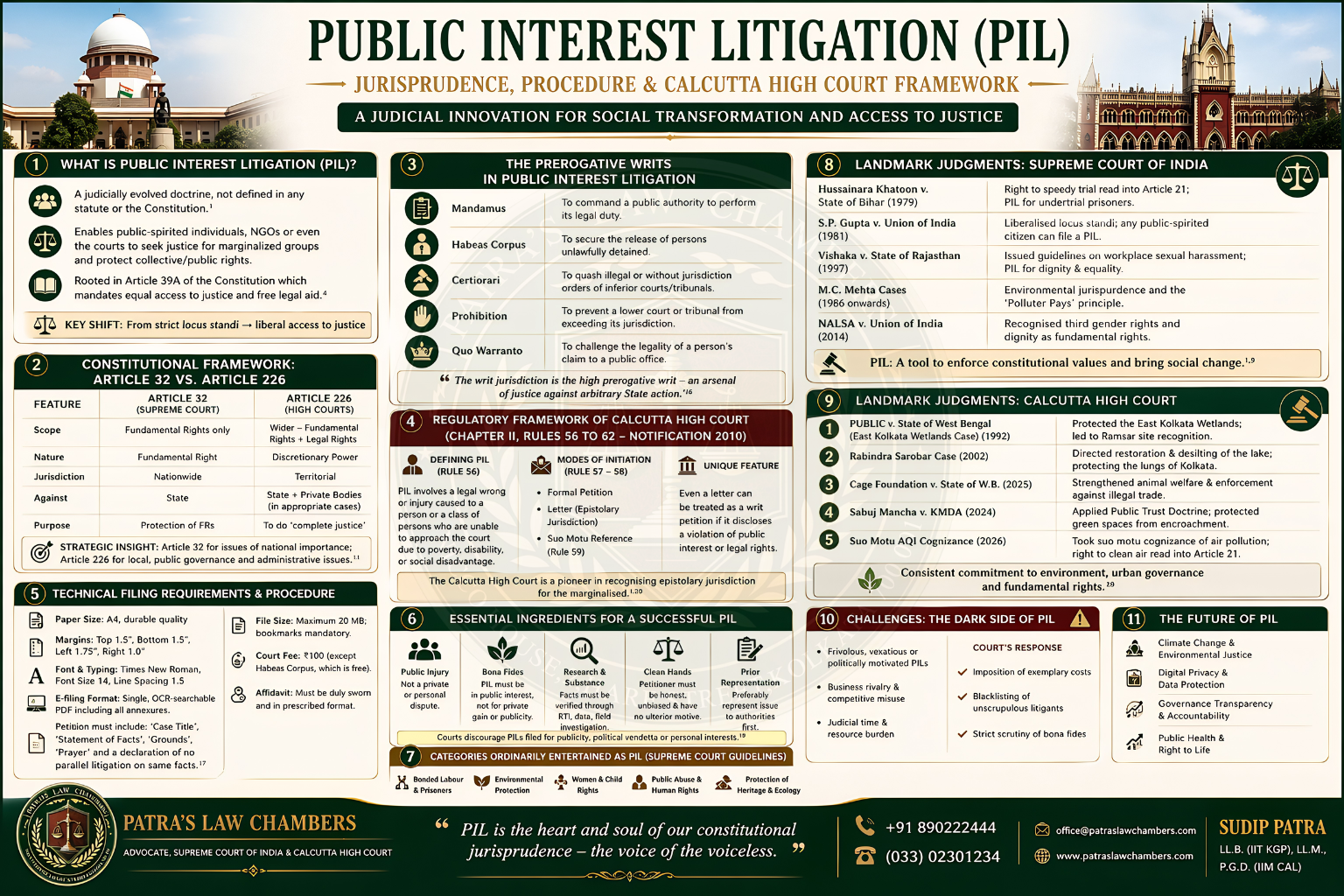
Click to download the infographic and PDF of this article.
The emergence of Public Interest Litigation (PIL) in the Indian legal system represents one of the most significant shifts in the history of global jurisprudence, marking the transition of the judiciary from a passive arbiter of private disputes to an active catalyst for social transformation. Historically rooted in the post-Emergency era of the late 1970s, PIL serves as a mechanism to democratize access to justice, particularly for those who are socially, economically, or physically disadvantaged and unable to approach the halls of justice themselves.1 This juristic innovation, pioneered by the Supreme Court of India, has fundamentally altered the traditional Anglo-Saxon rule of locus standi, allowing public-spirited individuals, non-governmental organizations (NGOs), and even the courts themselves to initiate litigation in the interest of the public at large.4
The Conceptual and Jurisprudential Foundations of Public Interest
The term “Public Interest Litigation” is not explicitly defined in the Constitution of India or any legislative statute; instead, it is a judicial doctrine evolved through constitutional interpretation.3 Lexically, it signifies a legal action initiated in a court of law for the enforcement of a public interest or general interest in which the community has a pecuniary or legal stake that affects their rights or liabilities.7 The core philosophy of PIL is anchored in Article 39A of the Constitution, which mandates the state to ensure that the legal system promotes justice on the basis of equal opportunity and provides free legal aid to ensure that justice is not denied by reason of economic or other disabilities.4
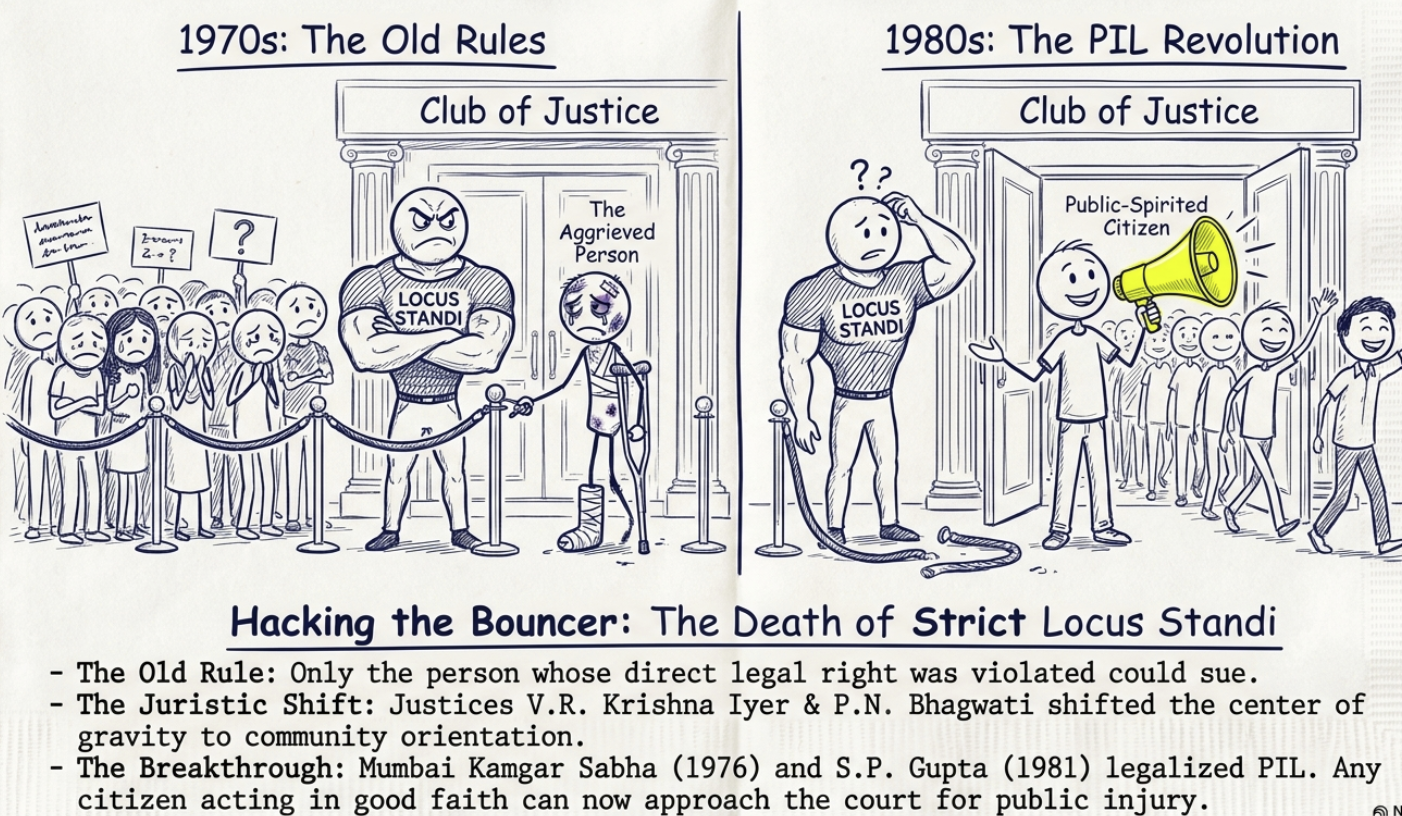
Prior to the 1980s, the Indian judiciary adhered strictly to the doctrine of locus standi, which dictated that only the “aggrieved person”—the individual whose legal right was directly violated—had the standing to move the court.4 This rigid approach often resulted in the systematic exclusion of marginalized groups, such as bonded laborers, undertrial prisoners, and victims of environmental degradation, who lacked the awareness or resources to litigate.1 The realization that a purely adversarial system was ill-suited for a developing nation with deep-seated socio-economic inequalities prompted a “juristic revolution” led by Justice V.R. Krishna Iyer and Justice P.N. Bhagwati.1
This transition moved the “center of gravity of justice” from traditional individualism to community orientation.11 In Mumbai Kamgar Sabha v. Abdulbhai Faizullabhai (1976), Justice Krishna Iyer first articulated that a spacious construction of locus standi was necessary to permit a liberal reception of public causes at the judicial doorstep.1 The Supreme Court eventually formalized this in the seminal case of S.P. Gupta v. Union of India (1981), where it was held that any member of the public acting in good faith can approach the court for a direction or writ under Articles 32 or 226 in cases of public injury caused by the violation of constitutional or legal rights.5
The Constitutional Architecture: Article 32 vs. Article 226
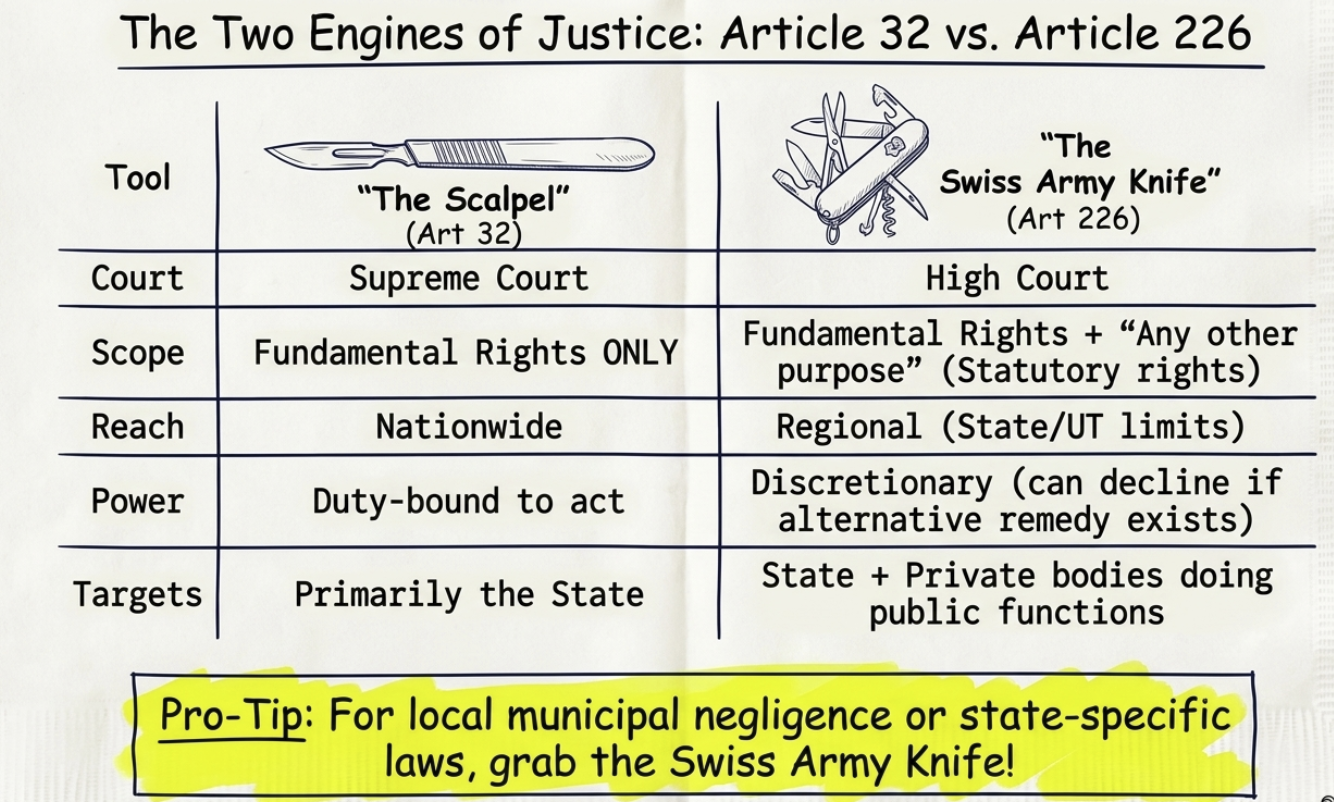
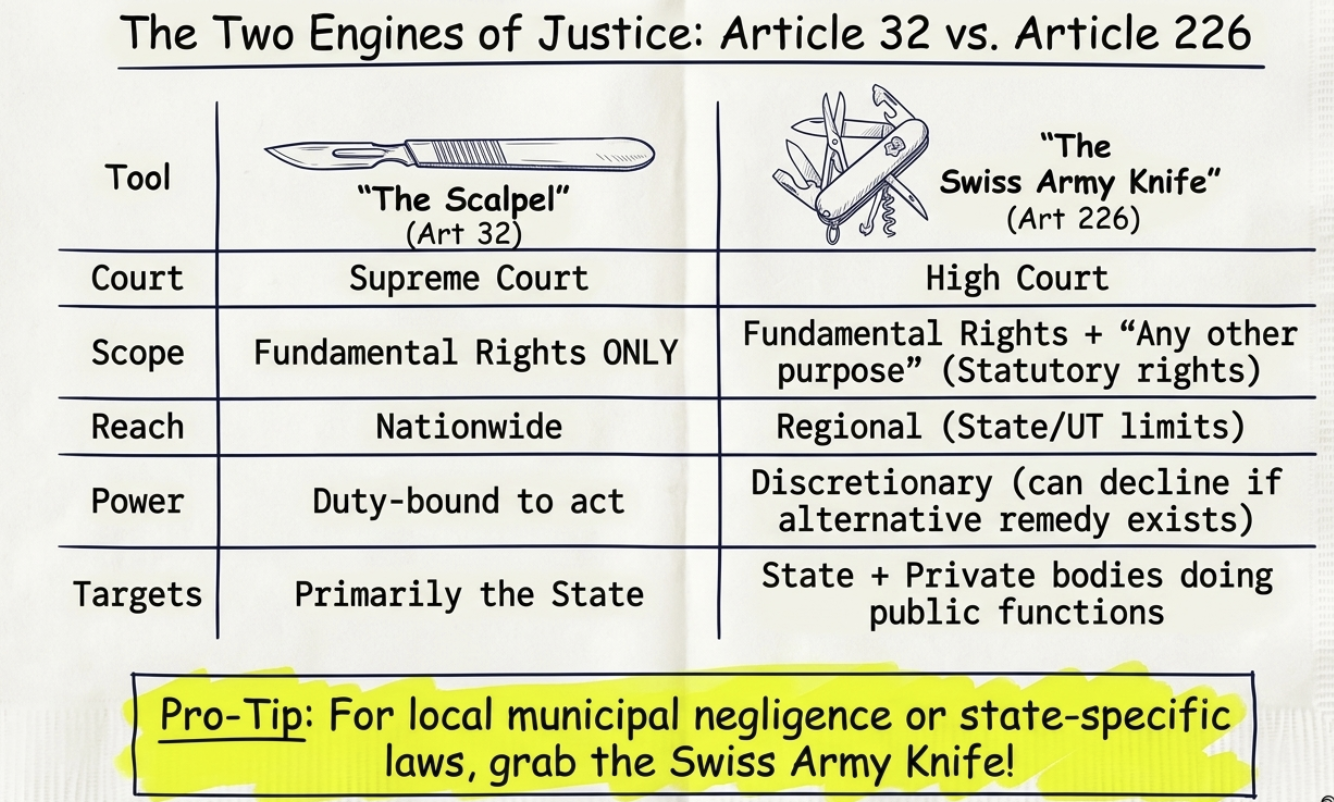
The power to entertain PIL is vested in the higher judiciary under two distinct but complementary constitutional provisions. Article 32 empowers citizens to move the Supreme Court directly for the enforcement of Fundamental Rights (Part III), while Article 226 grants the High Courts the authority to issue writs for both Fundamental Rights and “any other purpose”.13
Jurisdictional Comparison of Writ Powers
The distinction between the writ jurisdictions of the Supreme Court and the High Courts is essential for understanding the strategic choices made by litigants when filing a PIL.
| Comparative Feature | Article 32 (Supreme Court) | Article 226 (High Court) |
| Nature of Right | A Fundamental Right in itself; cannot be suspended except during an emergency.13 | A Constitutional power, not a Fundamental Right; its exercise is discretionary.13 |
| Scope of Application | Limited strictly to the enforcement of Fundamental Rights (Part III).13 | Broader scope; includes Fundamental Rights and “any other purpose” (statutory/legal rights).13 |
| Territorial Jurisdiction | Nationwide; decisions are binding on all courts in India.13 | Limited to the state or union territory over which the High Court has jurisdiction.13 |
| Issued Against | Primarily against the State and public authorities.14 | Against the State, public authorities, and private bodies performing public functions.14 |
| Discretionary Power | The Court is duty-bound to act for Every violation of Fundamental Rights.13 | The High Court may decline to entertain a petition if an alternative efficacious remedy exists.13 |
The broader ambit of Article 226 makes it a more versatile tool for regional issues, such as municipal negligence, administrative arbitrariness, or violations of state-specific statutory laws.14 In contrast, Article 32 remains the ultimate safeguard for the nation’s core constitutional values, often dealing with systemic issues like national environmental policies, human rights violations across multiple states, or challenges to central legislation.14
The Prerogative Writs in Public Interest Litigation
In the context of PIL, the courts utilize the five traditional prerogative writs to provide remedies. These writs serve as an “arsenal for justice” against arbitrary state action.17
- Writ of Mandamus: This is the most frequently used writ in PIL. It is issued to compel a public authority to perform a legal duty that it has failed to execute, such as providing sanitation services, cleaning a river, or implementing a welfare scheme.17
- Writ of Habeas Corpus: This writ is used to secure the release of persons unlawfully detained. In PIL, it has been used to release bonded laborers and undertrial prisoners who have completed their maximum possible sentences.6
- Writ of Certiorari: Issued to quash an illegal or ultra vires order of a lower court or quasi-judicial body. In public interest matters, it can be used to quash arbitrary administrative orders that affect the public welfare.16
- Writ of Prohibition: This prevents a lower court or tribunal from proceeding in a matter that is outside its jurisdiction, thereby stopping an ongoing legal injury.16
- Writ of Quo Warranto: This challenges a person’s claim to a public office. Unlike other writs where the rule of locus standi is merely relaxed, for Quo Warranto, any member of the public has the right to sue as a matter of course.16
Regulatory Framework of the Calcutta High Court
The Calcutta High Court, established in 1862, has a rich tradition of upholding social justice. To streamline the adjudication of public interest matters and prevent the abuse of the court process, the High Court formalized the “Rules of the High Court at Calcutta relating to applications under Article 226 of the Constitution of India”.19 Specifically, Chapter 2 (Rules 55 to 62) was incorporated via a notification in 2010 to define the parameters of PIL.19
Defining PIL under Calcutta High Court Rules (Rule 56)
Rule 56 defines Public Interest Litigation as litigation where the subject matter involves a legal wrong or injury caused to a person or a determinate class of persons who are unable to approach the court due to poverty, disability, or social/economic disadvantage.19 The injury must result from the violation of a constitutional or legal right. Importantly, the court retains the discretion to treat a petition filed for private interest as a PIL if the “interest of justice” and public interest are found to be paramount in the matter.19
Modes of Initiation and Epistolary Jurisdiction (Rule 57 & 58)
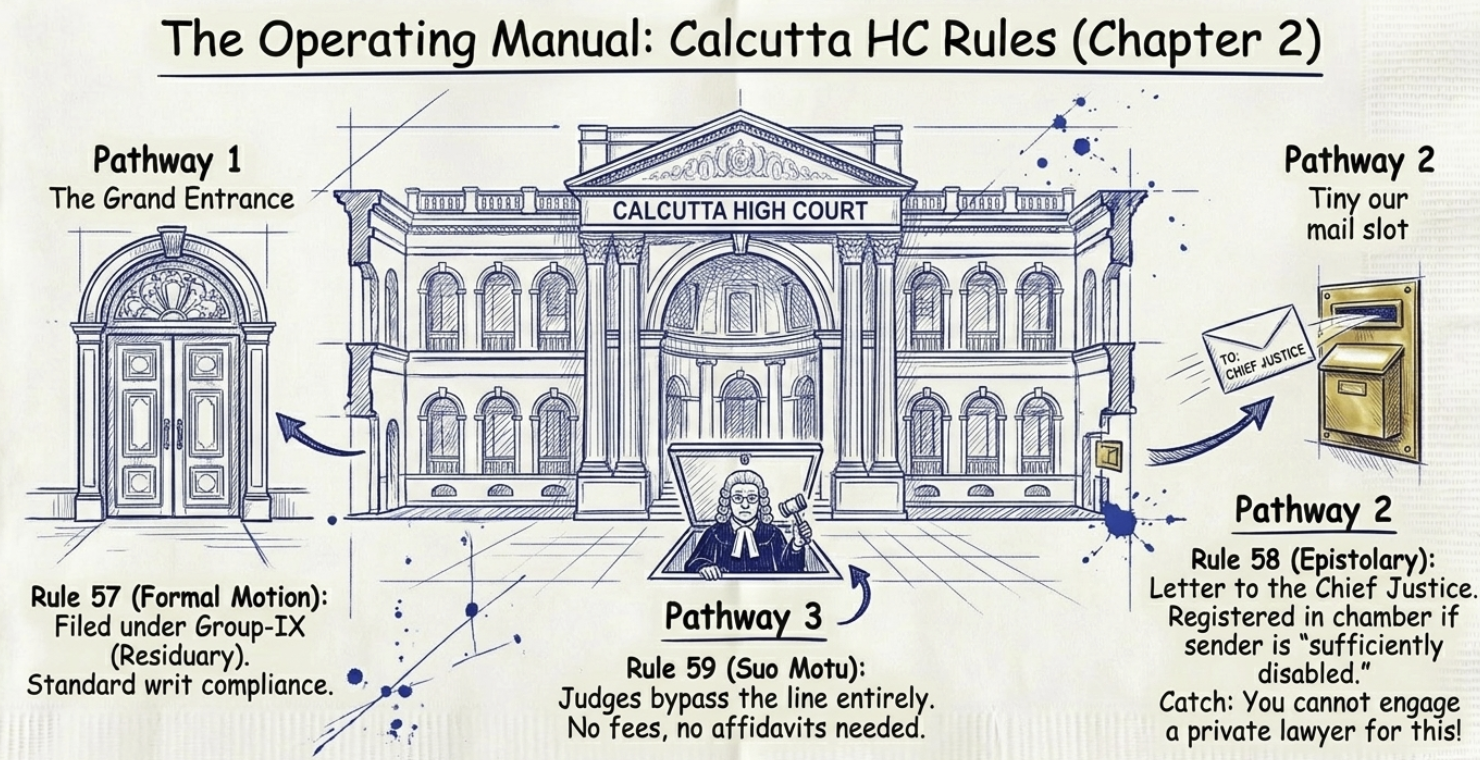
The Calcutta High Court recognizes that formal legal requirements should not be a barrier to justice for the marginalized. Under Rule 57, a PIL may be initiated through a formal petition, a letter addressed to the Chief Justice, or through suo motu action by the court.19
- Formal Petitions: These are filed as motions and must comply with the formalities required for ordinary writ applications under Group-IX (Residuary) of the Classification List.19
- Epistolary Jurisdiction: Rule 58 provides a specific procedure for letters addressed to the Chief Justice. These letters are considered in chamber. If the Chief Justice finds that the letter raises a valid public interest issue and that the sender is “sufficiently disabled” from filing a formal petition, the letter is registered as a writ petition.19 Upon registration, the petitioner cannot engage a private lawyer of their choice for the letter-based proceeding, but they may withdraw the letter to file a formal petition under Rule 57(a) if they wish to do so.19
- Suo Motu Reference: Rule 59 empowers judges to direct the Registrar General to register a PIL if they identify a violation of rights during other judicial proceedings. No court fees or supporting affidavits are required for such suo motu19
Technical Filing Requirements and Procedure
The Calcutta High Court requires precise technical adherence for all filings, especially under the current e-filing 3.0 protocol. The court is divided into the “Original Side” (for matters arising within the Ordinary Original Civil Jurisdiction of the court) and the “Appellate Side” (for matters from the districts/mofussil).17
| Technical Parameter | Specification for Filings |
| Paper Standard | A-4 size, durable quality. |
| Margins | Top: 1.5″, Bottom: 1.5″, Left: 1.75″, Right: 1.0″. |
| Font and Typography | Times New Roman, Font Size 14, Line Spacing 1.5. |
| E-filing Format | Single, OCR-searchable PDF file including all annexures. |
| File Management | Maximum file size 20 MB; bookmarks mandatory for navigation. |
| Court Fees | Rs. 100 (excluding Habeas Corpus, which is free).25 |
| Affidavits | Must be duly sworn and follow the prescribed format.26 |
Petitions must begin with the correct “Cause Title” and be classified under Group-IX (Residuary).17 The petition must include a “Statement of Facts,” “Grounds,” and clearly articulated “Prayers”.17 Under Rule 11, a mandatory declaration is required stating that no other application on the same facts has been moved before any other court.17
Essential Ingredients for a Successful PIL
The success of a PIL depends on the petitioner’s ability to satisfy the court that the intervention is both necessary and bona fide. The judiciary has established several filters to distinguish between genuine public interest and malicious or publicity-seeking litigation.6
The Substantive Checklist
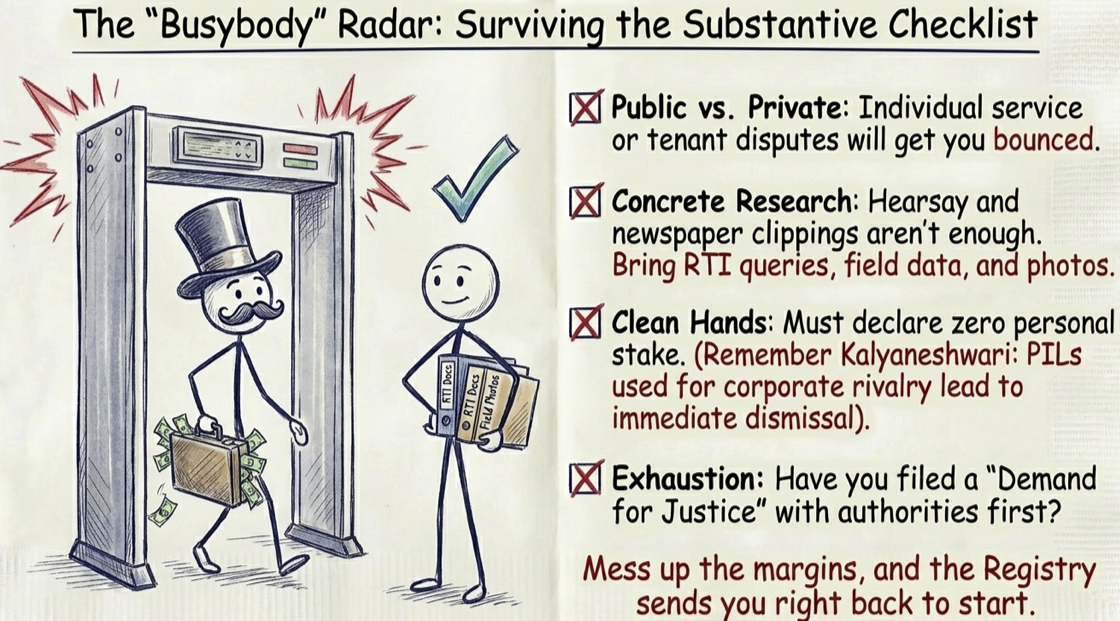
- Public Injury vs. Private Grievance: The matter must affect a large section of the community or a vulnerable group. Issues such as individual service disputes, landlord-tenant matters, or maintenance between spouses are generally not suitable for PIL.12
- Credentials of the Petitioner: The court often scrutinizes the background of the petitioner. While any citizen can file a PIL, the court must be convinced that the petitioner is not a “busybody” but is acting with social intent.6
- Thorough Research: A successful PIL cannot rely solely on hearsay or newspaper reports. The petitioner is expected to have conducted exhaustive research, including field visits, RTI queries, and gathering government data or photographs to provide a “concrete and credible basis” for the case.3
- Bona Fides and “Clean Hands”: The petitioner must declare they have no personal stake or vested interest in the outcome. Misusing PIL for political rivalry or business conflicts (as noted in Kalyaneshwari v. Union of India) leads to dismissal.3
- Exhaustion of Administrative Remedies: While not a strict rule, courts prefer that the petitioner first approaches the relevant government authorities with a “Demand for Justice” before seeking judicial intervention.17
Categories Ordinarily Entertained as PIL (Supreme Court Guidelines)
The Supreme Court has identified specific categories that will ordinarily be entertained as PIL 6:
- Bonded labor and neglected children.
- Non-payment of minimum wages and exploitation of workers.
- Petitions from jails regarding harassment or custodial death.
- Petitions against police for refusal to register cases or harassment.
- Atrocities on women (rape, bride burning, kidnapping).
- Environmental pollution and disturbance of ecological balance.
- Maintenance of heritage, culture, and wildlife.
- Family pension matters.
Landmark Judgments of the Supreme Court of India
The following table and subsequent narrative provide an overview of the most influential PIL cases that have shaped Indian law.
| Case Name | Year | Subject Area | Core Legal Impact |
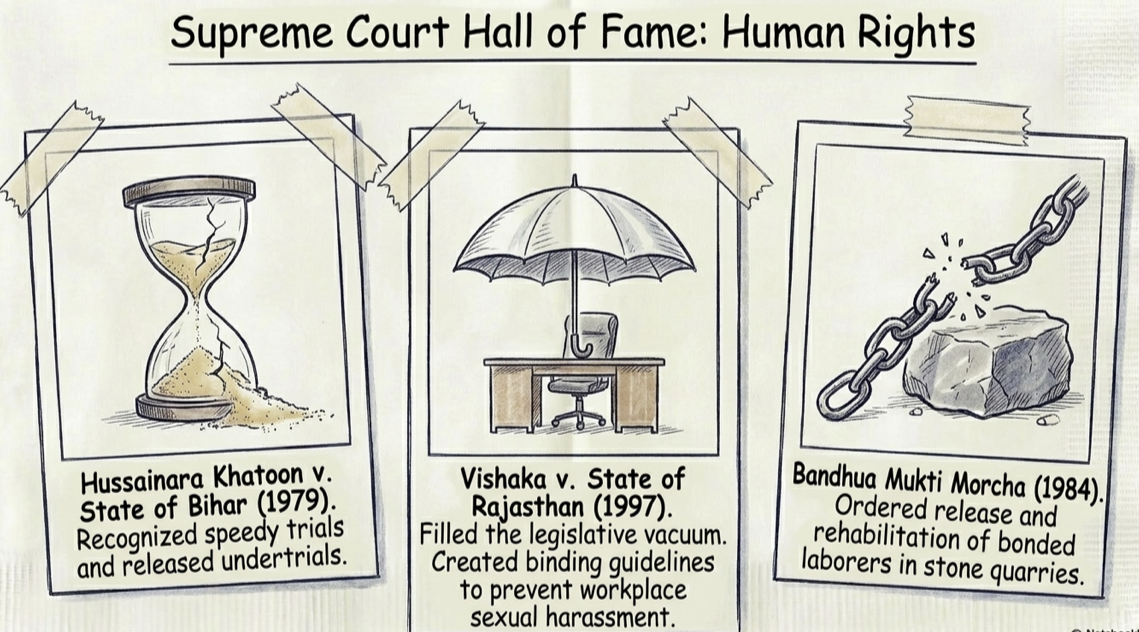
| Hussainara Khatoon v. State of Bihar | 1979 | Prisoners’ Rights | Recognized the right to a speedy trial as a fundamental right.4 |
| S.P. Gupta v. Union of India | 1981 | Locus Standi | Legalized PIL; defined standing for public-spirited citizens.5 |
| Vishaka v. State of Rajasthan | 1997 | Women’s Rights | Formulated guidelines to prevent sexual harassment at workplaces.33 |
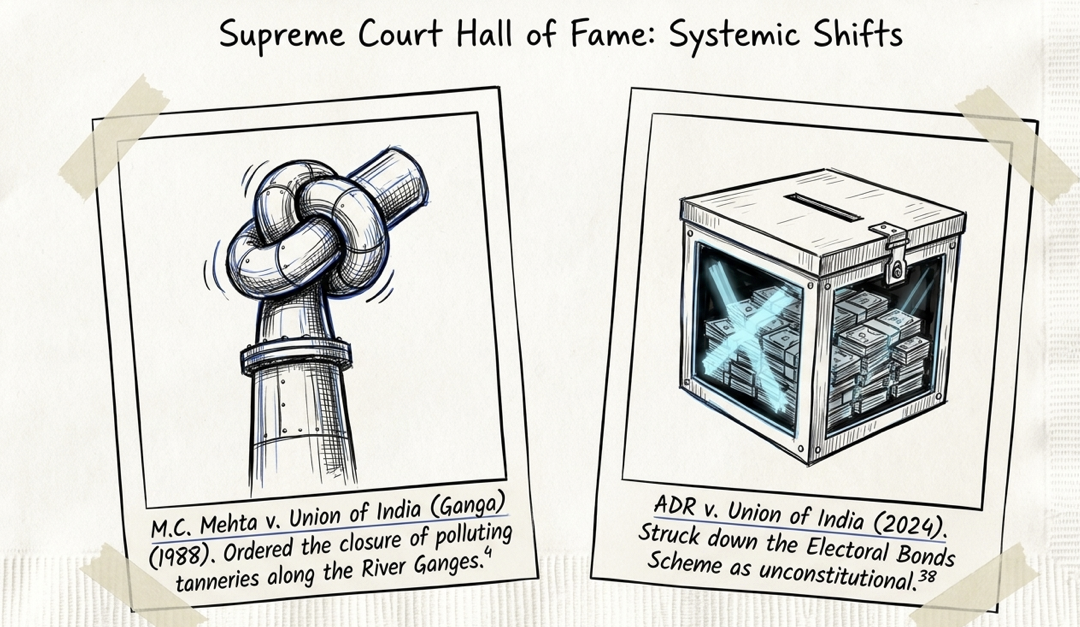
| M.C. Mehta v. Union of India (Ganga) | 1988 | Environment | Ordered the closure of polluting tanneries along the River Ganges.4 |
| Sunil Batra v. Delhi Administration | 1979 | Custodial Rights | Established “epistolary jurisdiction” and protected inmates from torture.11 |
| Bandhua Mukti Morcha v. Union of India | 1984 | Bonded Labor | Ordered the release and rehabilitation of bonded laborers in stone quarries.9 |
| Parmanand Katara v. Union of India | 1989 | Health Rights | Mandated that every doctor must provide immediate aid to accident victims.11 |
| NALSA v. Union of India | 2014 | Gender Identity | Recognized transgender persons as the “third gender” in law.37 |
| ADR v. Union of India | 2024 | Governance | Struck down the Electoral Bonds Scheme as unconstitutional.38 |
Analysis of Key Supreme Court Interventions
The case of Hussainara Khatoon is universally recognized as the foundational PIL. Triggered by a news report, it led to the release of 40,000 undertrial prisoners who had been detained longer than their potential prison terms.4 This case established that the right to life under Article 21 is meaningless without a “speedy trial”.33
In Vishaka v. State of Rajasthan, the court demonstrated its power to “fill the legislative vacuum.” Since there was no law governing sexual harassment at work, the court drew upon international conventions to create the “Vishaka Guidelines,” which remained the primary law for sixteen years until the POSH Act of 2013.33
Environmental jurisprudence was revolutionized by M.C. Mehta. In the Oleum Gas Leak case (1986), the court evolved the principle of “Absolute Liability” for industries engaged in hazardous activities, moving beyond the traditional English rule of strict liability.39 In the Ganga Pollution case, the court applied the “Polluter Pays” principle, forcing industries to internalize the costs of environmental degradation.4
Governance and transparency have also been central themes. The Association for Democratic Reforms (ADR) judgments (including the recent 2024 ruling) have consistently upheld the voters’ right to information regarding the criminal antecedents and financial funding of political candidates, viewing transparency as essential to a functional democracy.38
Landmark Judgments of the Calcutta High Court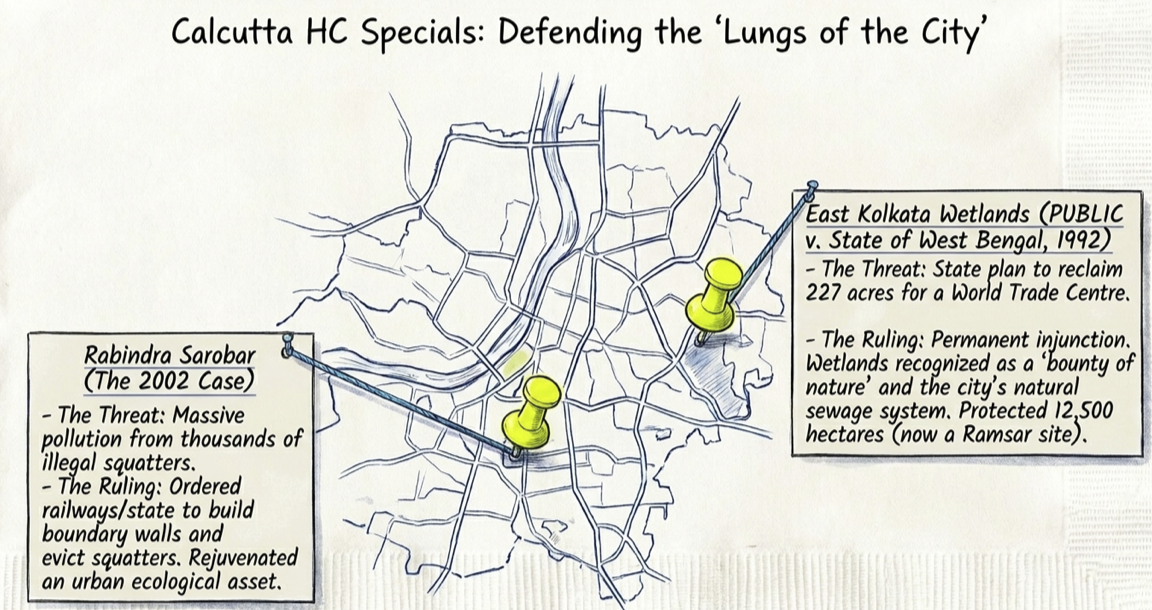
The Calcutta High Court has carved out a unique space in public interest law, particularly regarding environmental conservation and the rights of the voiceless in West Bengal.
1. The East Kolkata Wetlands Saga: PUBLIC v. State of West Bengal (1992)
This is perhaps the most significant environmental PIL in the history of the High Court. The NGO “People United for Better Living in Calcutta” (PUBLIC) challenged the state’s plan to reclaim 227 acres of wetlands for a World Trade Centre.41
- Judicial Reasoning: Justice Umesh Banerjee described the wetlands as a “bounty of nature” that served as the city’s natural sewage treatment plant. The court emphasized that while economic development is essential, it cannot come at the cost of “irreparable environmental harm”.42
- The Injunction: The court issued a permanent injunction restraining the state from changing the nature and character of the 12,500-hectare wetland area.43
- Long-term Impact: This ruling led to the area being recognized as a Ramsar Site of international importance in 2002.45 However, the battle continues; in 2026, the court warned that it would deploy paramilitary forces to demolish over 500 illegal structures in the wetlands if the state failed to act.46
2. The Lungs of the City: Rabindra Sarobar Case (2002)
The degradation of Rabindra Sarobar, an artificial lake in South Kolkata, led to a PIL filed by activist Subhash Dutta.48 The lake was suffering from massive pollution due to thousands of illegal squatters using its water for bathing and washing.
- Court Mandate: The court ordered the Eastern Railways and the state government to evict the squatters and build a boundary wall to protect the water body.48
- Result: Despite fierce resistance, the area was cleared by 2006, and the lake was listed under the National Lake Conservation Plan, leading to its rejuvenation as a vital urban ecological asset.48
3. Animal Rights: Cage Foundation v. State of West Bengal (2025)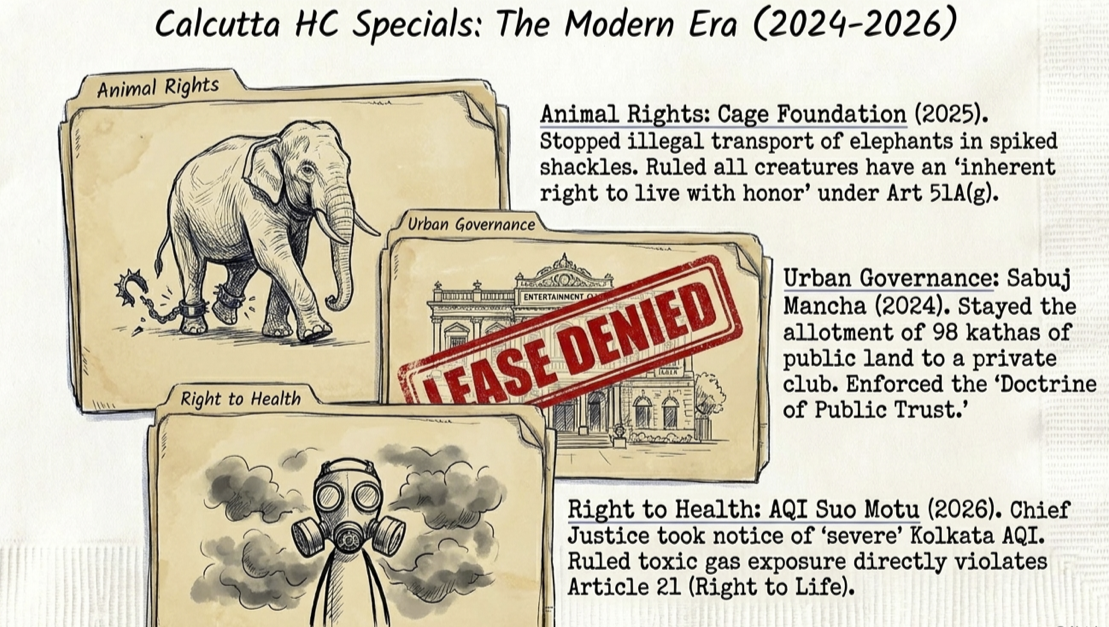
In a progressive move for animal welfare, the Cage Foundation filed a PIL regarding the illegal transportation of elephants from West Bengal to Bihar.50
- Legal Findings: The court observed that all creatures have an “inherent right to live with honor and dignity.” It relied on Article 51A(g), which mandates compassion for all living creatures.50
- Evidence of Torture: Inspection reports showed elephants chained with “spiked shackles” on cemented floors, resulting in chronic wounds and deformations.50
- Outcome: The court ordered the immediate repatriation of the elephants and directed the state to enforce strict border checks to stop illegal wildlife trafficking.50
4. Urban Governance: Sabuj Mancha v. KMDA (2024)
This case challenged the allotment of 98 kathas of public land around Rabindra Sarobar to a private entertainment club at a nominal rent.51
- Doctrine of Public Trust: The court ruled that public land is held by the state as a trustee for the people and cannot be alienated to a private entity without an open, transparent tender process.51
- Stay Order: The court stayed the allotment, reinforcing the principle that state assets must be managed for the common good rather than private interest.51
5. Right to Health: AQI Suo Motu Cognizance (2026)
Observing that Kolkata’s Air Quality Index (AQI) had occasionally surpassed that of Delhi, the Chief Justice of the Calcutta High Court took suo motu notice of the worsening air pollution.52
- Violation of Article 21: The court noted that exposure to “severe” and “hazardous” air quality constitutes a direct violation of the fundamental right to life and health.52
- Directives: The court sought coordinated action plans from the state and the Pollution Control Board, emphasizing that responses must address toxic gases (NO2 and Ozone) in addition to particulate matter.52
Comprehensive Examples of PIL Case Law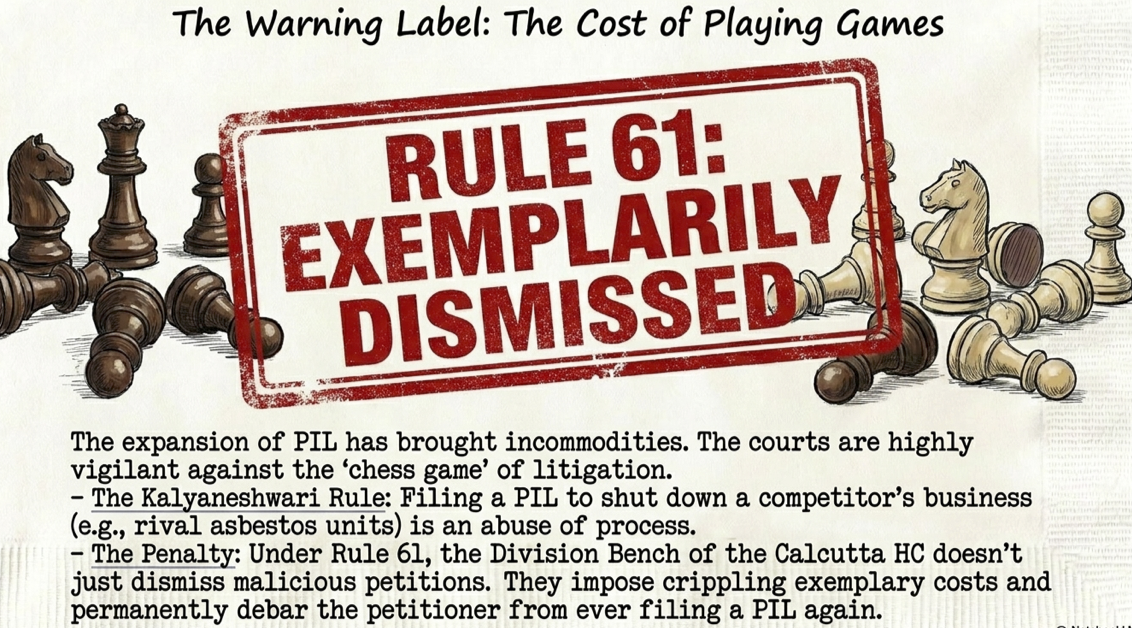
To fulfill the requirement for twenty to thirty examples of PIL applications, the following list highlights diverse areas of judicial intervention across India.
- Mumbai Kamgar Sabha v. Abdulbhai Faizullabhai (1976): Introduced the basic concept of public cause and standing.1
- Ratlam Municipal Council v. Vardichand (1980): Established that a municipality cannot use “lack of funds” as an excuse for failing to provide basic sanitation.7
- Olga Tellis v. Bombay Municipal Corporation (1985): Ruled that the right to life under Article 21 includes the right to “livelihood,” protecting pavement dwellers from arbitrary eviction.18
- Rural Litigation and Entitlement Kendra v. Union of India (1985): The first environmental PIL, which led to the closure of limestone mines in the Dehradun foothills.35
- Sheela Barse v. State of Maharashtra (1983): Established legal aid and separate custody for women prisoners.11
- C. Mehta v. Union of India (Oleum Gas Leak, 1986): Evolved the “Absolute Liability” doctrine for hazardous industries.39
- C. Mehta v. Union of India (Taj Trapezium, 1996): Ordered industries to shift to cleaner fuels to protect the Taj Mahal.40
- Vellore Citizens Welfare Forum v. Union of India (1996): Integrated the “Precautionary Principle” into Indian law.12
- Javed v. State of Haryana (2003): Upheld the two-child norm for panchayat elections as being in the public interest for population control.33
- Murli S. Deora v. Union of India (2001): Banned smoking in public places to protect non-smokers’ health.12
- Narmada Bachao Andolan v. Union of India (2000): Addressed the resettlement of tribal populations affected by dam projects.12
- Shreya Singhal v. Union of India (2015): Struck down Section 66A of the IT Act to protect online free speech.37
- Justice K.S. Puttaswamy v. Union of India (2017): Recognized the fundamental right to privacy.37
- Navtej Singh Johar v. Union of India (2018): Decriminalized consensual homosexual sex.37
- ABC v. State (NCT of Delhi) (2015): Allowed unwed Christian mothers to be legal guardians without the father’s consent.37
- Stanislaus v. State of Madhya Pradesh (1977): Ruled that the right to propagate religion does not include the right to forced conversion.37
- Delhi Domestic Working Women’s Forum v. Union of India (1995): Addressed the rights and safety of domestic workers.12
- Citizens for Democracy v. State of Assam (1995): Banned the indiscriminate handcuffing of prisoners.4
- Miss Veena Sethi v. State of Bihar (1982): Released “insane” prisoners detained without trial for decades.4
- Banerjee v. State of West Bengal (1986): Established that public servants cannot be dismissed without a fair hearing.54
- Ghosh v. University of Calcutta (1995): Protected students from arbitrary denial of admission.54
- Chatterjee v. State of West Bengal (2005): Upheld the right to protest against land acquisition.54
- Sita Soren v. Union of India (2024): Ruled that legislators do not enjoy immunity for accepting bribes for votes.38
- Sharif Ahmad v. State of Uttar Pradesh (2024): Clarified the definition of a “complete chargesheet” in criminal procedure.38
- Rahim Ali v. State of Assam (2024): Established standards for doubting an individual’s nationality under the Foreigners Act.38
- Mineral Area Development Authority v. SAIL (2024): Clarified the powers of states to tax mineral rights.38
- Noble M. Paikada v. Union of India (2024): Challenged environmental clearance exemptions for roads and pipelines.38
- Frank Vitus v. Narcotics Control Bureau (2024): Ruled that sharing Google Maps locations cannot be a standard bail condition.38
- Arvind Kejriwal v. ED (2024): Provided interim bail for a sitting Chief Minister to participate in elections.38
- Prabir Purkayastha v. State (NCT of Delhi) (2024): Emphasized the need to inform an accused of the grounds of arrest in writing.38
Critical Analysis: The Challenge of Frivolous Litigation
The expansion of PIL has not been without its disadvantages. The “incommodities” of the system include the rising number of frivolous, politically motivated, or business-oriented petitions.4 This “chess game” of litigation requires the court to be vigilant.4
In Kalyaneshwari v. Union of India, the court noted that a PIL seeking the closure of asbestos units was actually filed at the behest of a rival industrial group.4 Similarly, some activists use PIL as a substitute for ordinary remedies due to the lower court fees.3 To counter this, the Calcutta High Court Rules (Rule 61) empower the Division Bench to impose exemplary costs and even debar the petitioner from filing future PILs if the petition is found to be mala fide.19 The court must be “completely convinced” that a significant public interest exists before entertaining the matter.18
Conclusion: The Future of Public Interest Law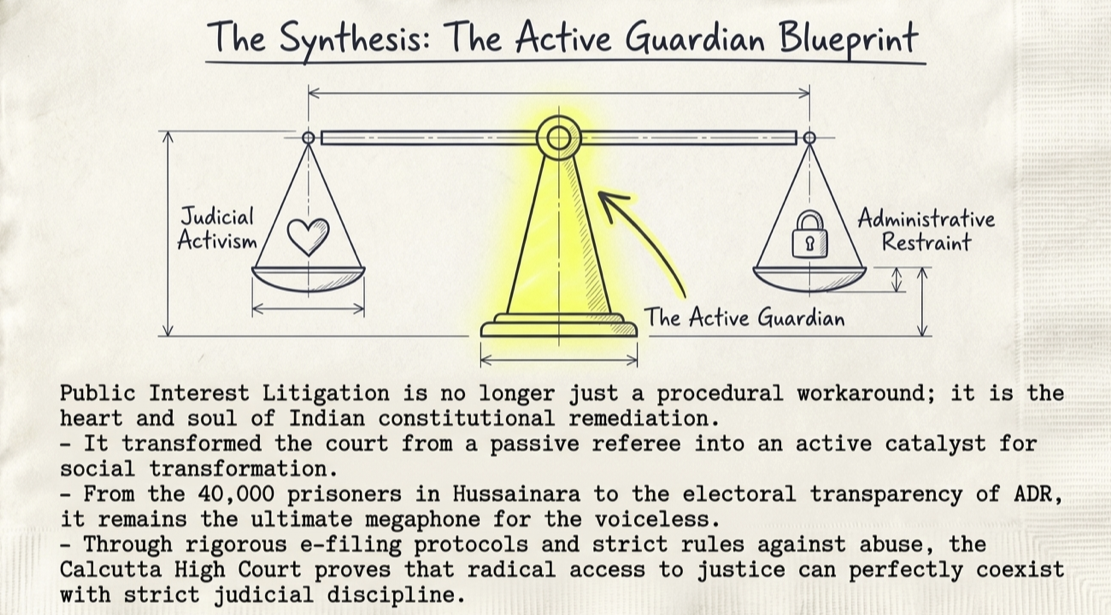
Public Interest Litigation has evolved from a procedural innovation into a foundational pillar of Indian democracy. It has shifted the role of the higher judiciary from being a mere arbiter of private disputes to becoming the “active guardian of public welfare”.28 In the Calcutta High Court, the institutionalization of PIL through specific rules and the adoption of modern e-filing protocols has ensured that the mechanism remains accessible while maintaining judicial discipline.
As India faces contemporary challenges such as climate change, digital privacy, and complex socio-economic inequities, the role of PIL will only become more critical. By maintaining the delicate balance between judicial activism and administrative restraint, the courts continue to fulfill the constitutional promise of a just and inclusive society. The journey from the early days of Hussainara Khatoon to the modern digital-era interventions in Association for Democratic Reforms demonstrates that the spirit of PIL remains the “heart and soul” of constitutional remediation in India.
Works cited
- Public Interest Litigation – The Indian Journal for Research in Law and Management, accessed on April 24, 2026, https://ijrlm.com/wp-content/uploads/jms/ms/69a4b365280ac.pdf
- Public-Interest-Litigation-in-India.pdf – INTERNATIONAL JOURNAL OF LAW MANAGEMENT & HUMANITIES, accessed on April 24, 2026, https://ijlmh.com/wp-content/uploads/Public-Interest-Litigation-in-India.pdf
- Public Interest Litigation (PIL): When and How to File in India – Vintage Legal, accessed on April 24, 2026, https://www.vintagelegalvl.com/post/public-interest-litigation-pil-when-and-how-to-file-in-india
- Public interest litigation in India – Wikipedia, accessed on April 24, 2026, https://en.wikipedia.org/wiki/Public_interest_litigation_in_India
- Public Interest Litigation (PIL) in India – Lawyered, accessed on April 24, 2026, https://www.lawyered.in/legal-disrupt/articles/public-interest-litigation-pil-india/
- PUBLIC INTEREST LITIGATION LOCUS STANDI – Plutus IAS, accessed on April 24, 2026, https://plutusias.com/elearning/wp-content/uploads/2024/07/PUBLIC-INTEREST-LITIGATION.pdf
- PUBLIC INTEREST LITIGATION (PIL) | The Lawyers & Jurists, accessed on April 24, 2026, https://www.lawyersnjurists.com/article/apublic-interest-litigation-pil/
- Law Access to justice Public Interest Litigation, accessed on April 24, 2026, https://www.bbau.ac.in/dept/HR/TM/LL.M.203%20Unit%205.Public%20Interest%20Litigation.ePathshala.pdf
- A Critical Study On Locus Standi With Case Analysis, accessed on April 24, 2026, https://www.ijllr.com/post/a-critical-study-on-locus-standi-with-case-analysis
- PUBLIC INTEREST LITIGATION AND THE DOCTRINE OF LOCUS STANDI by – MANISHA KUMARI GUPTA – INTERNATIONAL JOURNAL FOR LEGAL RESEARCH AND ANALYSIS, accessed on April 24, 2026, https://www.ijlra.com/details/public-interest-litigation-and-the-doctrine-of-locus-standi-by-manisha-kumari-gupta-
- Public Interest Litigation: Access To Justice – Manupatra, accessed on April 24, 2026, https://www.manupatra.com/roundup/379/articles/public%20interest%20litigation.pdf
- Public Interest Litigation – iPleaders, accessed on April 24, 2026, https://blog.ipleaders.in/public-interest-litigation-3/
- Difference Between Article 32 & Article 226: Meaning, Differences & Writs – The Legal School, accessed on April 24, 2026, https://thelegalschool.in/blog/difference-between-article-32-and-226
- Difference Between Article 32 and Article 226 – Pahuja Law Academy, accessed on April 24, 2026, https://www.pahujalawacademy.com/difference-between-article-32-and-article-226
- Comparison Between Article 32 and Article 226 of the Indian Constitution – LAW Notes, accessed on April 24, 2026, https://lawnotes.co/comparison-between-article-32-and-article-226-of-the-indian-constitution/
- Comparative Analysis of Article 32 and Article 226 – INTERNATIONAL JOURNAL OF LAW MANAGEMENT & HUMANITIES, accessed on April 24, 2026, https://ijlmh.com/wp-content/uploads/Comparative-Analysis-of-Article-32-and-Article-226.pdf
- Guide to Filing a Writ Petition in the Calcutta High Court – Patras Law Chamber, accessed on April 24, 2026, https://patraslawchambers.com/guide-to-filing-a-writ-petition-in-the-calcutta-high-court/
- Complete Guide to Filing a Public Interest Litigation (PIL): All about it – Lloyd Law College, accessed on April 24, 2026, https://www.lloydlawcollege.edu.in/blog/public-interest-litigation-guide.html
- Public Interest Litigation Rules – WBXPress, accessed on April 24, 2026, https://wbxpress.com/public-interest-litigation/
- Rules of High Court at Calcutta relating to Applications under Article 226 of The Constitution of India – Latestlaws.com, accessed on April 24, 2026, https://www.latestlaws.com/bare-acts/state-acts-rules/west-bengal-state-laws/rules-of-high-court-at-calcutta-relating-to-applications-under-article-226-of-the-constitution-of-india/
- Untitled – Calcutta High Court, accessed on April 24, 2026, https://www.calcuttahighcourt.gov.in/Notice-Files/gazette-notification/250
- Daily Supplementary List Of Cases For Hearing On Wednesday, 25th of March, 2026 – Appellate Jurisdiction, accessed on April 24, 2026, https://www.calcuttahighcourt.gov.in/Notice-Files/CL/16698
- Rules of High Court at Calcutta relating to Applications under Article 226 of The Constitution of India – Indian Kanoon, accessed on April 24, 2026, https://indiankanoon.org/doc/23892089/
- E-Filing Process at Calcutta High Court in 2025 – Patras Law Chamber, accessed on April 24, 2026, https://patraslawchambers.com/e-filing-cases-at-the-calcutta-high-court/
- Payment for filing writ petitions – Nyaaya, accessed on April 24, 2026, https://nyaaya.org/legal-explainer/payment-for-filing-writ-petitions/
- FORMAT OF WRIT PETITION A SYNOPSIS AND LIST OF DATES (Specimen enclosed) B FROM NEXT PAGE IN THE SUPREME COURT OF INDIA ORIGINAL – S3waas, accessed on April 24, 2026, https://cdnbbsr.s3waas.gov.in/s3ec0490f1f4972d133619a60c30f3559e/uploads/2024/01/2024011726.pdf
- PIL Draft Format for High Court | PDF | Justice | Crime & Violence – Scribd, accessed on April 24, 2026, https://www.scribd.com/document/732798688/PIL-Format
- Public Interest Litigation (PIL) In India Easy Filling In 2025 – Diligence Certifications, accessed on April 24, 2026, https://www.diligencecertification.com/public-interest-litigation/
- How to file a PIL? – Aashayein Judiciary, accessed on April 24, 2026, https://www.alec.co.in/show-blog-page/how-to-file-a-pil
- 30 PUBLIC INTEREST LITIGATION, accessed on April 24, 2026, http://14.139.60.116:8080/jspui/bitstream/123456789/43082/1/030_Public%20%28991-1024%29.pdf
- How to File PIL in High Court: Petition Format, Online Filing & Article 226 – Testbook, accessed on April 24, 2026, https://testbook.com/ugc-net-law/how-to-file-pil-in-high-court
- Supreme Court of India PIL guidelines – S3waas, accessed on April 24, 2026, https://cdnbbsr.s3waas.gov.in/s3ec0490f1f4972d133619a60c30f3559e/uploads/2024/01/2024011510.pdf
- List of PIL Cases in India | Public Interest Litigation Cases – Lawyered, accessed on April 24, 2026, https://www.lawyered.in/legal-disrupt/articles/5-pil-cases-every-indian-must-be-grateful/
- PIL Cases That Changed India | Landmark Public Interest Litigations – LawRato, accessed on April 24, 2026, https://lawrato.com/indian-kanoon/civil-law/pil-cases-every-indian-needs-to-be-thankful-for-2853
- 5 Landmark Cases of Public Interest Litigation – Knowledge Steez – WordPress.com, accessed on April 24, 2026, https://knowledgesteez.wordpress.com/2020/03/24/5-landmark-cases-of-public-interest-litigation/
- Writ Jurisdiction: Defender of Rights – RR Legal Partners, accessed on April 24, 2026, https://rrlegalpartners.com/blogs/writ-jurisdiction-defender-of-rights
- List of landmark court decisions in India – Wikipedia, accessed on April 24, 2026, https://en.wikipedia.org/wiki/List_of_landmark_court_decisions_in_India
- Supreme Court Landmark Cases 2024 – National Law University Delhi, accessed on April 24, 2026, https://nludelhi.ac.in/wp-content/uploads/2025/01/Supreme-Court-Landmark-Cases-2024.pdf
- The Indispensable Role of Public Interest Litigation in India’s Environmental Protection, accessed on April 24, 2026, https://www.legalmantra.net/blog-detail/the-indispensable-role-of-public-interest-litigation-in-india-s-environmental-protection
- Defending Nature Through Law: The Role of Public Interest Litigation in Environmental Protection – IJFMR, accessed on April 24, 2026, https://www.ijfmr.com/papers/2024/6/32939.pdf
- Never-ending story – Dandc.eu, accessed on April 24, 2026, https://www.dandc.eu/en/article/without-judicial-intervention-east-kolktata-wetlands-would-no-longer-exist
- A 30-Year Journey of the East Kolkata Wetlands – Degraded and Diminished – The Wire, accessed on April 24, 2026, https://m.thewire.in/article/environment/a-30-year-journey-of-the-east-kolkata-wetlands-degraded-and-diminished
- Calcutta High Court Reinforces Wetland Preservation: A Landmark Judgment – CaseMine, accessed on April 24, 2026, https://www.casemine.com/commentary/in/calcutta-high-court-reinforces-wetland-preservation:-a-landmark-judgment/view
- People United For Better Living In … vs East Kolkata Wetlands Management … on 24 December, 2008 – Indian Kanoon, accessed on April 24, 2026, https://indiankanoon.org/doc/153080470/
- The miracle of Kolkata’s wetlands – and one man’s struggle to save them – The Guardian, accessed on April 24, 2026, https://www.theguardian.com/cities/2016/mar/09/kolkata-wetlands-india-miracle-environmentalist-flood-defence
- HC displeased over inaction on East Kolkata Wetlands, warns of paramilitary deployment, accessed on April 24, 2026, https://www.thestatesman.com/bengal/hc-displeased-over-inaction-on-east-kolkata-wetlands-warns-of-paramilitary-deployment-1503561743.html
- Calcutta High Court expresses its anguish over lackluster role of govt of West Bengal & KMC over illegal constructions – Newsonair, accessed on April 24, 2026, https://www.newsonair.gov.in/calcutta-high-court-expresses-its-anguish-over-lackluster-role-of-govt-of-west-bengal-kmc-over-illegal-constructions/
- Ravindra Sarovar – Rainwater Harvesting, accessed on April 24, 2026, http://www.rainwaterharvesting.org/ravindra_sarovar/rabindra-sarovar.htm
- CASES ON PROTECTION OF LAKES – Centre for Science and Environment, accessed on April 24, 2026, https://www.cseindia.org/cases-on-protection-of-lakes-2556
- Inherent Right In All Creatures To Live With Honour And Dignity …, accessed on April 24, 2026, https://www.verdictum.in/court-updates/high-courts/calcutta-high-court/cage-foundation-v-state-of-west-bengal-1582469
- Sumita Banerjee vs The Chief Executive Officer Kmda And Ors on 1 October, 2024, accessed on April 24, 2026, https://indiankanoon.org/docfragment/66929059/?formInput=citedby%3A%20144974117
- Calcutta High Court takes suo motu cognisance of worsening AQI in Kolkata, issues notice to State – The Hindu, accessed on April 24, 2026, https://www.thehindu.com/news/cities/kolkata/calcuttahigh-court-takes-suo-motu-cognisance-of-worsening-aqi-in-kolkata-issues-notice-to-state/article70525711.ece
- Public Interest Litigation in India – Open Knowledge Repository – World Bank, accessed on April 24, 2026, https://openknowledge.worldbank.org/bitstreams/2d298c9b-dcdf-54fe-9003-2cad29f156a7/download
- Landmark Kolkata High Court Cases | PDF | Rule Of Law – Scribd, accessed on April 24, 2026, https://www.scribd.com/presentation/830042477/Landmark-Cases-of-Kolkata-High-Court-on-Equity-and-Justice