- Article 310 vs Article 311: Tension between the State's "Doctrine of Pleasure" and the reasonable opportunity protection under Article 311.
- Gopinath doctrine: Disciplinary Authority must specifically approve the charge sheet; failure renders proceedings void ab initio.
- Karunakar and Ram Prakash Singh: Right to receive the inquiry report; gross procedural violations no longer cured by "prejudice" test.
- Suspension rules: Suspension is administrative, review required every 90 days, with entitlement to subsistence allowance.
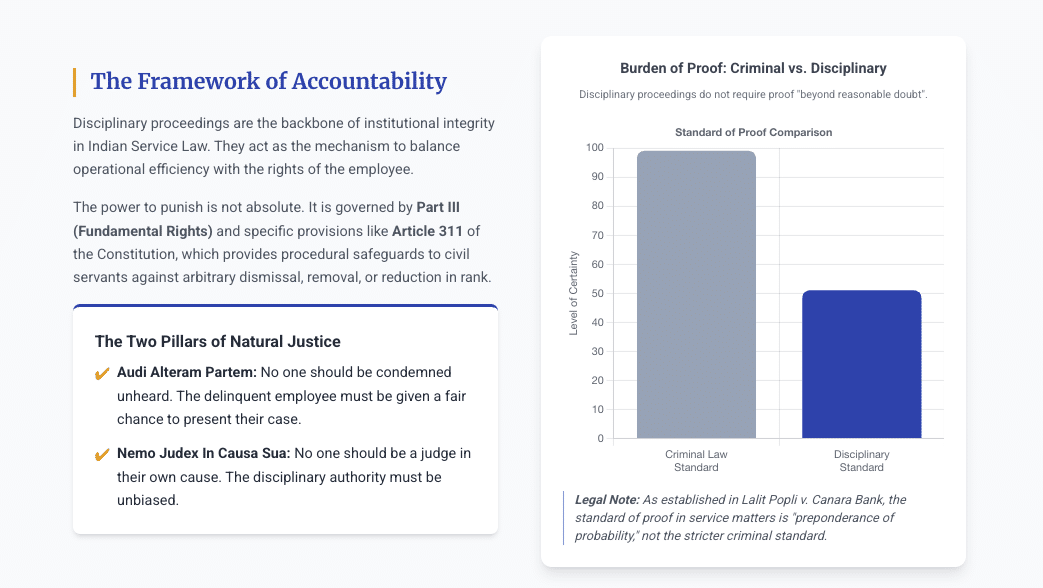
- Standard of proof: Departmental enquiries use preponderance of probability; "some evidence" required, hearsay needs corroboration.
- Electronic evidence: Section 65B certificate desirable; tribunals may admit undisputed electronic records but require authenticity if challenged.
- Proportionality: Courts intervene if punishment is disproportionate; doctrine applied across service law and legislative removal cases.
Legal Guide Disciplinary Proceedings in Government Service
-
Creditor and contributor of this article:
Patra’s Law Chambers:
About Us:
Patra’s Law Chambers is a law firm with offices in Kolkata & Delhi, offering comprehensive legal services across various domains. Established in 2020 by Advocate Sudip Patra (Advocate, Supreme Court of India & Calcutta High Court) an alumnus of the Prestigious Rajiv Gandhi School of Intellectual Property Law, IIT Kharagpur ,with Post Graduate diploma in Business Law from IIM Calcutta, the firm specializes in Civil, Criminal, Writs,High Court Matters, Trademark, Copyright, Company, Tax, Banking, Property disputes, Service law, Family law, and Supreme Court matters.You can know more about us in here
Kolkata Office:
NICCO HOUSE, 6th Floor, 2, Hare Street, Kolkata-700001 (Near Calcutta High Court)
Delhi Office:
House no: 4455/5, First Floor, Ward No. XV, Gali Shahid
Bhagat Singh, Main Bazar Road, Paharganj, New Delhi-110055
Website: www.patraslawchambers.com
Email: [email protected]
Phone: +91 890 222 4444/ +91 7003 715 325
Table of Contents
- Introduction: The Sovereign and the Servant
- The Constitutional Equilibrium: Article 310 vs. Article 311
- The Administrative Necessity of Discipline
- The Evolution of Service Jurisprudence (1950–2025)
- The Pre-Inquiry Stage: Suspension and Initiation
- The Nature of Suspension: Administrative or Punitive?
- Deemed Suspension and Subsistence Allowance
- The Competency Doctrine: Who Can Initiate?
- The Charge Sheet: The Magna Carta of Disciplinary Proceedings
- The Gopinath Doctrine: Distinction Between Initiation and Approval
- The Non-Est Principle: Recent 2025 Judicial Affirmations
- Vagueness and Precision in Drafting Charges
- The Enquiry Proper: Procedural Mechanics and Evidence
- The Role of the Inquiry Officer: Arbiter or Prosecutor?
- Standard of Proof: Preponderance of Probability vs. Beyond Reasonable Doubt
- Admissibility of Evidence: Hearsay and Electronic Records (Section 65B)
- Handling Hostile Witnesses: The Manjunath Precedent
- Natural Justice and the Report: The Karunakar Paradigm Shift
- The Second Stage of Inquiry: Constitutional History
- The Right to Representation and the Inquiry Report
- The Death of the “Prejudice Test”? Analysis of State of U.P. v. Ram Prakash Singh (2025)
- Anatomy of Misconduct: Specific Categories
- Unauthorized Absence: The “Gravest Act” Doctrine (Satpal Singh Case)
- Corruption and Bribery: Domestic vs. International Standards (Snyder Analysis)
- Sexual Harassment: The POSH Act, Compliance Surveys, and Limitation Periods
- The Interplay of Criminal and Departmental Proceedings
- Simultaneity of Proceedings: The Paul Anthony Guidelines
- The Effect of Acquittal: “Honourable” vs. “Benefit of Doubt”
- Double Jeopardy in Service Law
- The Quantum of Punishment and Judicial Review
- The Doctrine of Proportionality: Wednesbury to Om Kumar
- Judicial Interference: When Does Punishment “Shock the Conscience”?
- Legislative Privileges and Proportionality (Sunil Kumar Singh Case)
- The Central Administrative Tribunal (CAT): The First Line of Defense
- Jurisdiction and Powers under the Administrative Tribunals Act, 1985
- The Role of Legal Counsel in Tribunal Litigation
- Conclusion and Strategic Roadmap
- Legal Representation: Patra’s Law Chambers
1. Introduction: The Sovereign and the Servant

In the grand scheme of Indian constitutional governance, the relationship between the State and its employees is not merely contractual; it is a matter of status. This status is defined by a delicate tension between the “Doctrine of Pleasure” (derived from the Latin durante bene placito) enshrined in Article 310 of the Constitution of India, and the robust procedural safeguards guaranteed under Article 311. Disciplinary proceedings serve as the crucible where this tension is resolved. They are the mechanism by which the State purges inefficiency, corruption, and indiscipline to maintain the “steel frame” of administration, while simultaneously ensuring that the individual civil servant is protected against arbitrary, capricious, or vindictive exercises of power.1
As we navigate through the legal landscape of 2025, it becomes evident that the judiciary has adopted a dual approach. On one hand, there is an uncompromising stance against corruption and indiscipline in uniformed forces, as evidenced by the Supreme Court’s stringent rulings on unauthorized absence and bribery. On the other hand, there is a renewed emphasis on “due process,” where procedural lapses by the government—such as the failure to supply inquiry reports or obtain proper sanction for charge sheets—are no longer treated as minor technicalities but as fatal flaws that render the entire disciplinary edifice void ab initio.
This report, authored from the perspective of Patra’s Law Chambers, aims to provide an exhaustive legal commentary on this subject. Drawing from the seminal study note provided 1 and integrating the latest judicial pronouncements from 2024 and 2025 2, we dissect the disciplinary process from the nascent stage of suspicion to the finality of judicial review.
The Constitutional Equilibrium
The foundational principle of service law in India is that every person who is a member of a civil service of the Union or an all-India service holds office during the pleasure of the President (or Governor in the case of a State). However, Article 311 places two critical fetters on this pleasure:
- Protection against Dismissal by Subordinate Authority: No person shall be dismissed or removed by an authority subordinate to that by which they were appointed (Article 311(1)).
- Reasonable Opportunity: No such person shall be dismissed, removed, or reduced in rank except after an inquiry in which they have been informed of the charges and given a “reasonable opportunity” of being heard in respect of those charges (Article 311(2)).
The phrase “reasonable opportunity” has been the subject of decades of litigation. It is not a static concept but an evolving one. In the early years, it was interpreted narrowly. Post-1978, following Maneka Gandhi v. Union of India, it expanded to include the principles of natural justice—fair play, lack of bias, and the right to a reasoned order. In 2025, this evolution has reached a new zenith where the “process” is considered as vital as the “outcome.”
2. The Pre-Inquiry Stage: Suspension and Initiation
Before the formal machinery of a departmental inquiry is set in motion, the administration often resorts to suspension. While legally termed an “interim arrangement” and not a punishment, suspension has profound civil consequences, affecting the employee’s reputation, finances, and mental well-being.
The Nature of Suspension
Suspension is the temporary deprivation of office and privilege. Under Rule 10 of the Central Civil Services (Classification, Control and Appeal) Rules, 1965 (CCS (CCA) Rules), a competent authority may place a government servant under suspension where a disciplinary proceeding is contemplated or pending, or where a case against them in respect of any criminal offense is under investigation, inquiry, or trial.
Recent Judicial Insight: Anand Kumar v. Union of India (2025)
The Allahabad High Court’s ruling in Anand Kumar v. Union of India 4 serves as a critical reference point for the 2025 legal landscape. In this case, an employee of the India Government Mint was caught allegedly stealing coins. He was immediately suspended, and simultaneous criminal and departmental proceedings were initiated. The employee challenged the suspension and the parallel proceedings.
The Court reiterated several key principles:
- Suspension is Not Punishment: Therefore, the strict standards of proof required for imposing a penalty do not apply at the suspension stage. It is an administrative necessity to prevent the employee from tampering with evidence or continuing their alleged misconduct.
- Review is Mandatory: Suspension cannot be indefinite. The Supreme Court’s mandate in Ajay Kumar Choudhary v. Union of India requires that suspension orders be reviewed every 90 days. If the charge sheet is not served within 90 days, the suspension must ostensibly be revoked unless a reasoned order justifying its extension is passed.
- Subsistence Allowance: During suspension, the master-servant relationship continues. The employee is entitled to a subsistence allowance (usually 50% of salary initially, rising to 75% if the delay is not attributable to them). Denial of this allowance amounts to a denial of the opportunity to defend oneself, as a starving man cannot fight a legal battle (Ghanshyam Das Shrivastava v. State of M.P.).
The Competency Doctrine: Who Can Initiate?
One of the most frequent grounds for quashing disciplinary proceedings is the lack of competency of the authority initiating the action.
- Appointing Authority vs. Disciplinary Authority: While Article 311(1) protects against dismissal by a subordinate, the initiation of proceedings can be done by any authority empowered by the rules. However, the specific rules of the organization must be followed strictly.
- Delegation of Power: The power to initiate is often delegated. However, the power to decide the outcome is quasi-judicial and generally cannot be delegated unless the statute expressly permits.
3. The Charge Sheet: The Magna Carta of Disciplinary Proceedings
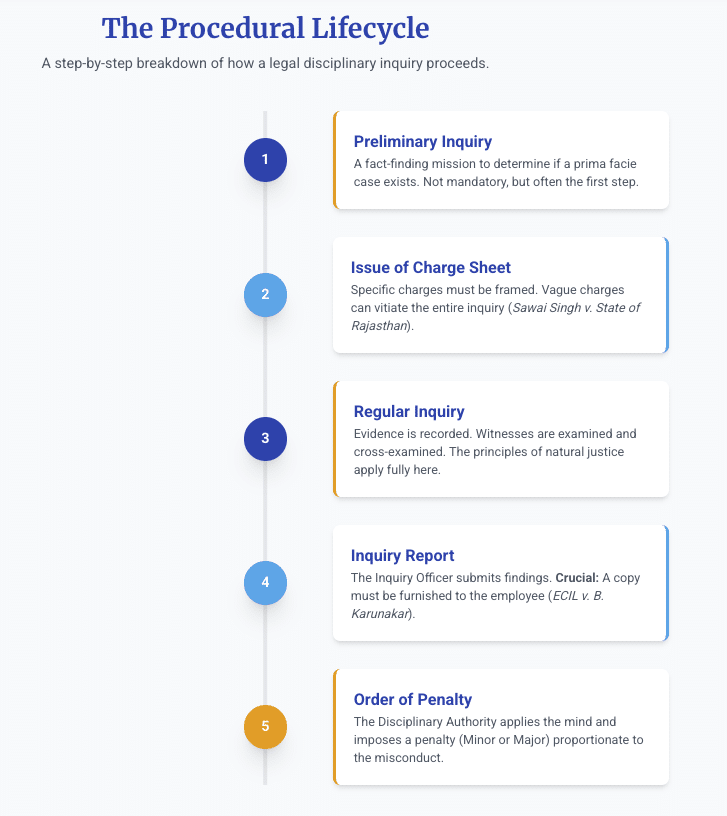
The charge sheet is the foundational document of any disciplinary inquiry. It must be specific, precise, and, most importantly, approved by the competent authority. A vague charge sheet denies the delinquent employee an effective opportunity to defend themselves, violating principles of natural justice.
The Gopinath Doctrine: Distinction Between Initiation and Approval
The most significant procedural hurdle for the government in recent years has been the Supreme Court’s ruling in Union of India v. B.V. Gopinath.5 This case established a nuanced but critical distinction between:
- Approval for initiating disciplinary proceedings: The general decision to start an inquiry.
- Approval of the Charge Sheet: The specific approval of the actual charges drafted.
The Court held that the Disciplinary Authority (DA) must apply its mind to both stages. It is not enough for the DA to say “Proceed with inquiry” and let a subordinate draft and issue the charge sheet. The DA must see, read, and approve the specific charges because the wording of the charge determines the nature of the misconduct and the potential penalty.
The 2025 Affirmation: Union of India v. S.K. Jasra
In 2025, the Delhi High Court in Union of India v. S.K. Jasra 7 faced a situation where the government argued that the Gopinath principle should be applied prospectively or that the defect was curable. The Court rejected these arguments, holding:
- Non-Est Proceedings: A charge sheet issued without the specific prior approval of the competent DA is non est—it does not exist in the eyes of the law.
- Incurable Defect: This is not a technical irregularity that can be fixed by post-facto approval. It is a jurisdictional error. If the foundation (the charge sheet) is void, the superstructure (the inquiry and punishment) must fall.
- No Estoppel Against Law: The fact that the employee participated in the inquiry for years does not prevent them from raising this legal objection later, as there can be no estoppel against a statutory violation.
Implication for Practitioners:
For lawyers representing clients (like those at Patra’s Law Chambers), the first step in any defense strategy is to use the Right to Information Act (RTI) to access the “Note Sheet” or file notings. If the file shows that the Minister or DA only signed off on the “initiation” proposal but the draft charge sheet was approved only by a Joint Secretary or lower officer, the entire proceeding is liable to be quashed in the Tribunal or High Court.
Vagueness of Charges
A charge that reads “You are guilty of conduct unbecoming of a government servant” without specifying the exact act, date, time, or manner of misconduct is void. In Sawai Singh v. State of Rajasthan, the Supreme Court held that charges involving complex financial irregularities must be accompanied by a clear statement of imputations explaining how the figures were arrived at. Failure to provide this clarity denies the employee a reasonable opportunity to defend.
4. The Enquiry Proper: Procedural Mechanics and Evidence
Once the charge sheet is validly served and the employee denies the charges, the Departmental Enquiry (DE) commences. This is a quasi-judicial process, and the Inquiry Officer (IO) acts as a judge.
The Role of the Inquiry Officer (IO)
The IO is usually a senior officer from a different department or a retired official.
- Neutrality: The IO must not be a witness in the case, nor should they have any personal interest in the outcome.
- The “Prosecutor” Trap: A common flaw occurs when the Department fails to appoint a Presenting Officer (PO), and the IO takes on the role of questioning witnesses to prove the charge. In Union of India v. Ram Lakhan Sharma 1, the Supreme Court held that if an IO assumes the role of a prosecutor—leading the examination-in-chief or cross-examining the defense witnesses aggressively—the inquiry is vitiated by bias. The IO must remain an impartial arbiter.
Standard of Proof
Unlike criminal trials where the standard is “proof beyond reasonable doubt,” disciplinary proceedings rest on the “preponderance of probability.”
- The Pravin Kumar Precedent: As cited in the synopsis 1, the Supreme Court in Pravin Kumar v. Union of India clarified that strict rules of the Evidence Act do not apply. The IO must look at the material and decide whether it is more likely than not that the misconduct occurred.
- Some Evidence Rule: However, suspicion cannot take the place of proof. There must be “some evidence” to support the findings. A finding based on no evidence is perverse and liable to be set aside by the courts.
Admissibility of Evidence
Electronic Evidence and Section 65B
With the increasing reliance on digital footprints (emails, WhatsApp, CCTV), the admissibility of electronic records in departmental inquiries is a hotbed of litigation in 2024-2025.
- Criminal vs. Departmental Standards: In criminal law, under Arjun Panditrao Khotkar, a certificate under Section 65B of the Evidence Act is mandatory to prove secondary electronic evidence.
- 2025 Outlook: Recent judgments 9 suggest a slight relaxation in departmental proceedings. While the certificate is desirable to ensure authenticity, tribunal courts may accept electronic evidence if its genuineness is not seriously disputed by the delinquent employee. However, if the employee challenges the integrity of the data, the Department must produce the certificate or a forensic report. Failure to do so can lead to the exclusion of critical evidence.
Hearsay Evidence
Hearsay is strictly inadmissible in criminal courts but is technically admissible in departmental inquiries if it has reasonable nexus and credibility. However, a finding of guilt cannot be based solely on hearsay evidence without some corroboration (State of Haryana v. Rattan Singh).
Handling Hostile Witnesses
A major challenge in corruption cases is witnesses turning hostile due to pressure or bribery.
- The Manjunath Ruling (2025): In Manjunath v. State of Karnataka 11, the Supreme Court dealt with a corruption case where the complainant and shadow witness turned hostile. The Court held that the testimony of the Investigating Officer and the recovery of tainted money could still support a conviction (and by extension, departmental punishment). The fact that witnesses turned hostile does not automatically result in exoneration if the surrounding circumstances and documentary evidence point to guilt. This judgment reinforces the state’s ability to punish corruption even when witnesses are compromised.
5. Natural Justice and the Report: The Karunakar Paradigm Shift
The concept of “Reasonable Opportunity” under Article 311(2) has three components:
- Opportunity to deny charges.
- Opportunity to defend during the inquiry (cross-examination, producing witnesses).
- Opportunity to represent against the findings of the inquiry.
The Inquiry Report: A Constitutional Right
Before the 42nd Amendment to the Constitution (1976), employees had a right to a second show-cause notice regarding the proposed punishment. The Amendment removed this, leaving only the right to represent against the findings.
In Managing Director, ECIL v. B. Karunakar (1993) 12, the Constitution Bench settled the law: The delinquent employee has a right to receive a copy of the Inquiry Report before the Disciplinary Authority accepts it. This allows the employee to persuade the DA that the IO’s findings are erroneous.
The Death of the “Prejudice Test”? Analysis of State of U.P. v. Ram Prakash Singh (2025)
For three decades post-Karunakar, courts applied the “Prejudice Doctrine.” If the Department failed to supply the report, the court would ask the employee: “What prejudice did you suffer? Would the outcome have been different?” If the employee couldn’t prove prejudice, the punishment often stood.
The Watershed Moment (April 2025):
In State of Uttar Pradesh v. Ram Prakash Singh 14, the Supreme Court delivered a stinging rebuke to this mechanical application.
- The Facts: An inquiry against a retired employee was conducted ex-parte. He was not given notice, nor was he supplied the inquiry report. The punishment was a reduction in pension.
- The Judgment: The Court held that in cases of such “obtrusive” and “patent” violations of natural justice, asking the employee to prove prejudice is a mockery of the law. The failure to supply the report, combined with the ex-parte nature of the inquiry, rendered the process a “charade.”
- The Outcome: Instead of remanding the case for a fresh inquiry (the usual remedy under Karunakar), the Court quashed the punishment entirely and ordered full restoration of benefits.
- Legal Insight: This signals a shift in 2025. The judiciary is no longer willing to tolerate procedural incompetence by the State under the guise of the “prejudice” test. Due process is now a substantive right in itself.
6. Anatomy of Misconduct: Specific Categories
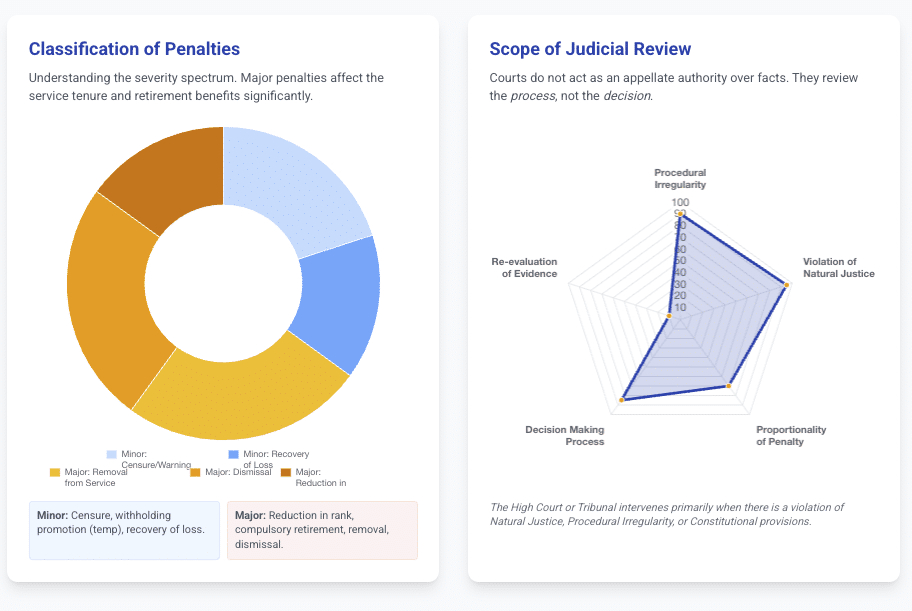
While procedure is paramount, the substantive nature of the misconduct defines the severity of the punishment.
Unauthorized Absence: The “Gravest Act” Doctrine
Unauthorized absence is often viewed leniently in civilian employment, but in uniformed services, it is fatal.
- Case Study: State of Punjab v. Ex. C. Satpal Singh (2025) 16
- Context: A commando in the Punjab Police was absent for 37 days. He was dismissed. The High Court reinstated him because the dismissal order relied on his past bad record without mentioning it in the charge sheet.
- Supreme Court Ruling: The Supreme Court overturned the High Court and upheld the dismissal. It ruled that for a member of a disciplined force, a 37-day unauthorized absence is, by itself, the “gravest act of misconduct.”
- The Principle: When the current act is sufficiently grave to warrant dismissal, the authority’s internal consideration of past conduct (to reinforce the decision) does not vitiate the order, even if not explicitly charged. This reinforces the “Zero Tolerance” approach to indiscipline in security forces.
Corruption and Bribery
Corruption erodes the moral fiber of the administration.
- Global Context: Snyder v. United States (2024) 19: The US Supreme Court recently narrowed the definition of bribery, distinguishing it from “gratuities” (payments made after an act without a prior agreement). It held that federal bribery statutes did not criminalize gratuities unless explicitly stated.
- Indian Context: India allows no such leniency. Under the Prevention of Corruption Act and Conduct Rules, accepting any valuable thing without authorization—whether before or after the act—is misconduct. The standard of proof is lower than in criminal courts. In Pravin Kumar 1, the Supreme Court upheld the dismissal of a CISF officer for merely “cooking a story” of a loan to cover up a bribe, emphasizing that integrity must be absolute.
Sexual Harassment: The POSH Act
The Sexual Harassment of Women at Workplace (Prevention, Prohibition and Redressal) Act, 2013 has created a parallel disciplinary ecosystem.
- The Internal Committee (IC): The IC’s report is treated as the Inquiry Report in disciplinary proceedings.
- Limitation Periods (2025 Ruling): A recent Supreme Court judgment 21 clarified that the 3-month limitation period for filing a complaint (extendable by another 3 months) is mandatory. Complaints filed years later cannot be entertained by the IC, protecting the accused from stale claims while urging victims to report promptly.
- Compliance Surveys: In Aureliano Fernandes 22, the Court expressed frustration at the lack of functional ICs. It mandated a nationwide “compliance survey” to be completed by late 2025. For private companies and government departments alike, failure to constitute an IC is now a direct invitation for judicial intervention and penalties.
7. The Interplay of Criminal and Departmental Proceedings
A recurring dilemma for civil servants is facing simultaneous criminal trials and departmental inquiries for the same set of facts (e.g., a trap case for bribery).
Simultaneity of Proceedings
The landmark case of Capt. M. Paul Anthony v. Bharat Gold Mines Ltd. established that:
- Proceedings can run simultaneously.
- If the case involves complicated questions of law and fact, and relies on the same evidence, the departmental inquiry may be stayed.
- However, a stay is not automatic.
2025 Trend: Courts are increasingly reluctant to grant stays. In Anand Kumar 4, the High Court refused to stay the departmental inquiry despite the ongoing criminal trial for theft. The rationale is that criminal trials in India take decades. Staying the departmental inquiry would force the government to pay subsistence allowance to a suspended employee for years, which is a drain on the exchequer.
The Effect of Acquittal
Does an acquittal in a criminal court force the department to reinstate the employee?
- Honourable Acquittal: If the criminal court says “There is absolutely no evidence, the accused is falsely implicated,” the department should generally respect this and drop the charges.
- Benefit of Doubt / Hostile Witnesses: As seen in State of Rajasthan v. Heem Singh 1, if the acquittal is technical (e.g., witnesses turned hostile, or proof beyond reasonable doubt was not met), the department can still punish. The standard in department inquiries is “preponderance of probability.” An employee may be acquitted of “criminal breach of trust” but still dismissed for “negligence” or “failure to maintain absolute integrity” based on the same facts.
8. The Quantum of Punishment and Judicial Review
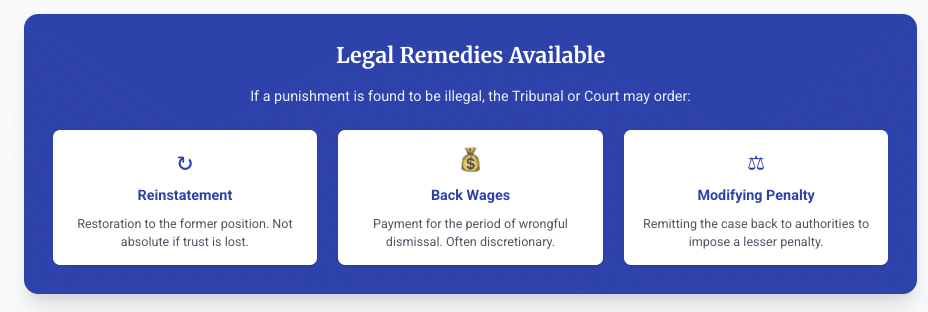
The Disciplinary Authority has wide discretion in imposing punishment. However, this discretion is not unfettered.
The Doctrine of Proportionality
Derived from the Wednesbury principles and refined in Om Kumar v. Union of India, the doctrine checks whether the punishment is “outrageously defiant of logic.”
- “Shocking the Conscience”: The court will not act as a Court of Appeal to re-appreciate evidence. It will only intervene if the punishment is so disproportionate to the offense that it “shocks the conscience” of the court.
- Examples:
- Dismissal Upheld: For assaulting a superior (Daya Shankar Rai) or negligent handling of weapons (Sitaram Mishra).
- Dismissal Quashed: In Union of India v. Ex LAC Nallam Shiva 1, dismissal for overstaying leave was found disproportionate because the employee had valid domestic reasons and it was a first offense.
Legislative Proportionality: Sunil Kumar Singh v. Bihar Legislative Council (2025)
In a rare intersection of service law principles and legislative privileges, the Supreme Court in 2025 24 held that the expulsion of a legislative member must also pass the test of proportionality. While not a service matter per se, this judgment reinforces the universal applicability of the proportionality doctrine in all state actions involving removal from office.
9. The Central Administrative Tribunal (CAT): The First Line of Defense
Established under Article 323-A of the Constitution, the CAT is the specialized forum for adjudicating service disputes of Central Government employees.
Jurisdiction and Structure
- Coverage: CAT covers members of the All India Services, Central Civil Services, and civil posts under the Union. It does not cover the armed forces (who go to AFT) or Supreme Court staff.
- Procedure: CAT is not bound by the rigorous Civil Procedure Code (CPC). It follows the principles of natural justice.
- The Application (OA): An aggrieved employee files an Original Application (OA). This must be filed within one year of the final order (limitation period).
The Role of Legal Counsel
Litigation in CAT is highly technical. It involves interpreting:
- Fundamental Rules and Supplementary Rules (FR/SR).
- CCS (CCA) Rules, 1965.
- Pension Rules.
- Complex Office Memorandums (OMs) issued by the DoPT.
A lawyer’s role is critical in:
- Drafting the OA: Ensuring all grounds (procedural flaws, Gopinath violation, proportionality) are pleaded.
- Interim Relief: Seeking stays on transfer or recovery orders.
- Rejoinders: effectively countering the government’s reply.
- Arguing: Presenting the latest case laws (like Ram Prakash Singh) to persuade the Tribunal.
10. Conclusion and Strategic Roadmap
The year 2025 marks a maturation of Indian service jurisprudence. The days of the State acting with impunity are over, as are the days of employees escaping accountability through minor technicalities.
Key Takeaways for Civil Servants:
- Vigilance: Ensure you receive the inquiry report. If denied, demand it in writing immediately.
- Competency Check: verifying via RTI if your charge sheet was approved by the Disciplinary Authority or merely by a subordinate.
- Timeliness: Do not delay legal challenges. Suspension reviews and limitation periods for CAT are strict.
Key Takeaways for Administrators:
- Process is Key: Adhere strictly to the Gopinath and Karunakar The process is the safeguard.
- Documentation: Ensure files reflect “application of mind” at every stage—initiation, charge sheet approval, inquiry report consideration, and final penalty.
- Proportionality: Record reasons why a lesser penalty was rejected before imposing dismissal.
The balance of the “Doctrine of Pleasure” and “Reasonable Opportunity” has tilted towards a “Culture of Justification.” Every administrative action must be justified, reasonable, and proportionate.
11. Legal Representation: Patra’s Law Chambers
In the complex arena of Administrative Law, expert representation is the difference between reinstatement and removal. Patra’s Law Chambers specializes in representing employees in Departmental Enquiries, Disciplinary Proceedings, and litigation before the Central Administrative Tribunal (CAT), High Courts, and the Supreme Court.
We provide comprehensive legal assistance for:
- Challenging Void Charge Sheets: Utilizing the Gopinath and K. Jasra precedents.
- Suspension Revocation: Fighting prolonged and illegal suspensions.
- Pensionary Benefits: Recovery of withheld gratuity and pension.
- Disciplinary Defense: Acting as Defense Assistants in inquiries and arguing counsel in Tribunals.
- Criminal-Service Nexus: Handling simultaneous criminal trials and departmental proceedings.
Contact Information
Patra’s Law Chambers
- Kolkata Office:
NICCO HOUSE, 6th Floor, 2, Hare Street, Kolkata-700001 (Near Calcutta High Court)
- Delhi Office:
House no: 4455/5, First Floor, Ward No. XV, Gali Shahid
Bhagat Singh, Main Bazar Road, Paharganj, New Delhi-110055
- Website: patraslawchambers.com
- Email: [email protected]
- Phone: +91 890 222 4444/ +91 9044 04 9044
- Expertise Areas: Service Law, Administrative Tribunal Matters, Criminal Defense, Civil Litigation.
For a consultation on your specific matter, please visit our website or our chambers at the City Civil Court, Kolkata.
Appendix: Tabular Chart of Key Case Laws (2024-2025 Focus)
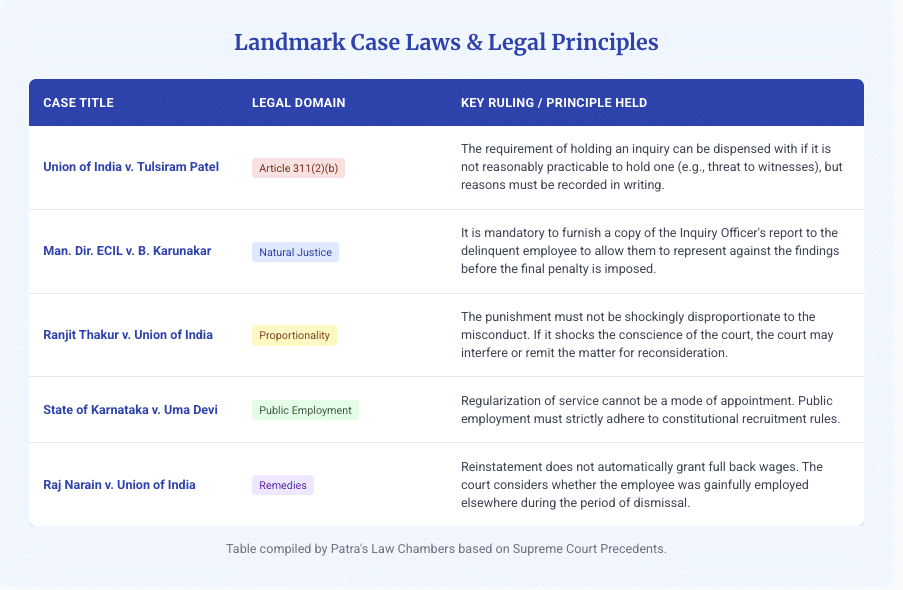
| Case Title | Court / Year | Legal Issue | Key Principle / Holding |
| Union of India v. B.V. Gopinath | SC (Reaffirmed 2025) | Charge Sheet Approval | Approval for initiation is not approval for charges. DA must approve the charge sheet specifically. |
| Union of India v. S.K. Jasra | Delhi HC (2025) | Non-Est Charge Sheets | Violation of Gopinath renders charge sheet void ab initio. Defect is incurable. |
| State of U.P. v. Ram Prakash Singh | SC (2025) | Inquiry Report | Non-supply of report in ex-parte inquiry is a fatal violation. “Prejudice test” need not be proved in gross cases. |
| State of Punjab v. Ex. C. Satpal Singh | SC (2025) | Unauthorized Absence | In disciplined forces, long absence is “gravest misconduct”. Past record can be considered even if not in charge sheet. |
| T. Manjunath v. State of Karnataka | SC (2025) | Hostile Witnesses | Hostile witnesses do not automatically lead to exoneration if other evidence (IO testimony, recovery) exists. |
| Anand Kumar v. Union of India | Allahabad HC (2025) | Suspension | Simultaneous criminal and departmental proceedings are valid. Suspension is not punishment. |
| Sunil Kumar Singh v. Bihar Leg. Council | SC (2025) | Proportionality | Expulsion from legislature must be proportionate to the misconduct. |
| State of Rajasthan v. Heem Singh | SC (Precedent) | Acquittal Effect | Acquittal on “benefit of doubt” does not bar departmental punishment. |
| Managing Director, ECIL v. B. Karunakar | SC (Constitution Bench) | Natural Justice | Right to Inquiry Report is a constitutional right under Art 311(2). |
Disclaimer: This blog post/report is intended for informational purposes only and does not constitute legal advice. The laws and judgments discussed are subject to change. Please consult a qualified legal professional for advice on your specific case.
Resources: 1.Paper for citattion:disciplinary proceeding
Works cited
- disciplinary proceeding..pdf
- Landmark Constitutional Law Judgments in 2024 by the Supreme Court of India (Part II of IV), accessed on December 9, 2025, https://www.scconline.com/blog/post/2025/05/19/landmark-constitutional-law-judgments-2024-supreme-court-india/
- STUDY MATERIAL ON HANDLING OF LITIGATION IN GOVERNMENT – A SYNOPSIS – ISTM, accessed on December 9, 2025, https://www.istm.gov.in/uploads/tenders/1442375355HLG.pdf
- Anand Kumar vs Union Of India And Another on 17 October, 2025 – Indian Kanoon, accessed on December 9, 2025, https://indiankanoon.org/doc/147204785/
- Union Of India & Ors vs B.V.Gopinath on 5 September, 2013 – Indian Kanoon, accessed on December 9, 2025, https://indiankanoon.org/doc/51249220/
- REPORTABLE IN THE SUPREME COURT OF INDIA CIVIL APPELLATE JURISDICTION CIVIL APPEAL NO. 7764 OF 2021 [Arising out of Special Lea, accessed on December 9, 2025, https://api.sci.gov.in/supremecourt/2017/34089/34089_2017_39_1501_32212_Judgement_17-Dec-2021.pdf
- Can a Chargesheet Issued Without the Prior Approval of the Disciplinary Authority Be Considered Valid? – Legal Bites, accessed on December 9, 2025, https://www.legalbites.in/administrative-law/can-a-chargesheet-issued-without-the-prior-approval-of-the-disciplinary-authority-be-considered-valid-1205204
- 10-10-2025 (txt) – Delhi High Court, accessed on December 9, 2025, https://delhihighcourt.nic.in/app/showFileJudgment/NAC10102025CW27422024_184106.txt
- Landmark Judgment on Admissibility of Electronic Evidence: A Legal Analysis – TaxTMI, accessed on December 9, 2025, https://www.taxtmi.com/tmi_notes?id=1092
- Admissibility of Electronic Evidence in the Light of Judicial Decisions – law Jurist, accessed on December 9, 2025, https://lawjurist.com/index.php/2025/10/10/admissibility-of-electronic-evidence-in-the-light-of-judicial-decisions/
- SUPREME COURT HOLDS WITNESSES TURNING HOSTILE IN DEPARTMENTAL PROCEEDINGS IS NOT A GROUND TO SEEK DISCHARGE IN CRIMINAL TRIAL – The Indian Lawyer, accessed on December 9, 2025, https://theindianlawyer.in/supreme-court-holds-witnesses-turning-hostile-in-departmental-proceedings-is-not-a-ground-to-seek-discharge-in-criminal-trial/
- Managing Director Ecil Hyderabad Etc. … vs B. Karunakar Etc. Etc on 1 October, 1993 – Indian Kanoon, accessed on December 9, 2025, https://indiankanoon.org/doc/1246653/
- Managing Director, ECIL, Hyderabad and Ors. vs. Karunakar and Ors. – Manupatra Academy, accessed on December 9, 2025, http://www.manupatracademy.com/home/subject_wise_case_guide_law_students_managing_director_ecil_karunakar
- 2025 INSC 555 REPORTABLE IN THE SUPREME COURT OF INDIA CIVIL APPELLATE JURISDICTION CIVIL APPEAL NO. 14724/2024 STATE OF UTTAR P, accessed on December 9, 2025, https://api.sci.gov.in/supremecourt/2020/5276/5276_2020_14_1503_61088_Judgement_23-Apr-2025.pdf
- Mandatory Furnishing of Enquiry Reports & Curbs on the “Prejudice” Test – A Commentary on State of Uttar Pradesh v. Ram Prakash Singh (2025 INSC 555) – CaseMine, accessed on December 9, 2025, https://www.casemine.com/commentary/in/mandatory-furnishing-of-enquiry-reports-&-curbs-on-the-%E2%80%9Cprejudice%E2%80%9D-test-%E2%80%93-a-commentary-on-state-of-uttar-pradesh-v.-ram-prakash-singh-(2025-insc-555)/view
- No Relief for Constable: Supreme Court Reinstates Dismissal Over Unauthorized Absences, accessed on December 9, 2025, https://thelegalchamber.in/no-relief-for-constable-supreme-court-reinstates-dismissal-over-unauthorized-absences/
- Supreme Court Upholds Dismissal of Punjab Constable for Long Unauthorized Absence, accessed on December 9, 2025, https://www.courtbook.in/posts/supreme-court-upholds-dismissal-of-punjab-constable-for-long-unauthorized-absence
- State of Punjab and Others vs Ex C Satpal Singh 2025 INSC 1056 – Lawcurb, accessed on December 9, 2025, https://www.lawcurb.in/judgements/state-of-punjab-and-others-vs-ex-c-satpal-singh-2025-insc-1056
- ‘Bribe’ vs. ‘Tip’ – The Implications of Snyder v. United States for Companies | BakerHostetler, accessed on December 9, 2025, https://www.bakerlaw.com/insights/bribe-vs-tip-the-implications-of-snyder-v-united-states-for-companies/
- US Supreme Court Holds That Federal Bribery Law Does Not Criminalize Gratuities | Skadden, Arps, Slate, Meagher & Flom LLP, accessed on December 9, 2025, https://www.skadden.com/insights/publications/2024/07/us-supreme-court-holds-that-federal-bribery-law-does-not-criminalize-gratuities
- Supreme Court dismisses complaint of sexual harassment barred by limitation on time, accessed on December 9, 2025, https://knowledge.dlapiper.com/dlapiperknowledge/globalemploymentlatestdevelopments/2025/supreme-court-dismisses-complaint-of-sexual-harassment-barred-by-limitation-on-time
- Supreme Court mandates six week compliance survey for PoSH Act – DLA Piper GENIE, accessed on December 9, 2025, https://knowledge.dlapiper.com/dlapiperknowledge/globalemploymentlatestdevelopments/2025/supreme-court-mandates-six-week-compliance-survey-for-PoSH-act
- 2025 INSC 554 REPORTABLE IN THE SUPREME COURT OF INDIA CIVIL APPELLATE JURISDICTION CIVIL APPEAL NO.5497 OF 2025 [ARISING OUT OF, accessed on December 9, 2025, https://api.sci.gov.in/supremecourt/2017/4985/4985_2017_14_1502_61088_Judgement_23-Apr-2025.pdf
- Supreme Court Establishes Guidelines for Assessing Proportionality of Punishment for Legislators – Lawvs, accessed on December 9, 2025, https://lawvs.com/news/supreme-court-establishes-guidelines-for-assessing-proportionality-of-punishment-for-legislators