GST Appeal Lawyer in Kolkata: APL-01, Pre-deposit and GSTAT
Got a GST demand order under Section 73, 74 or 74A? The appeal clock starts when the order is communicated, and it is short. We act in GST appeals before the Appellate Authority, the GST Appellate Tribunal (Kolkata Bench) and the Calcutta High Court.
How a GST demand order is appealed in West Bengal
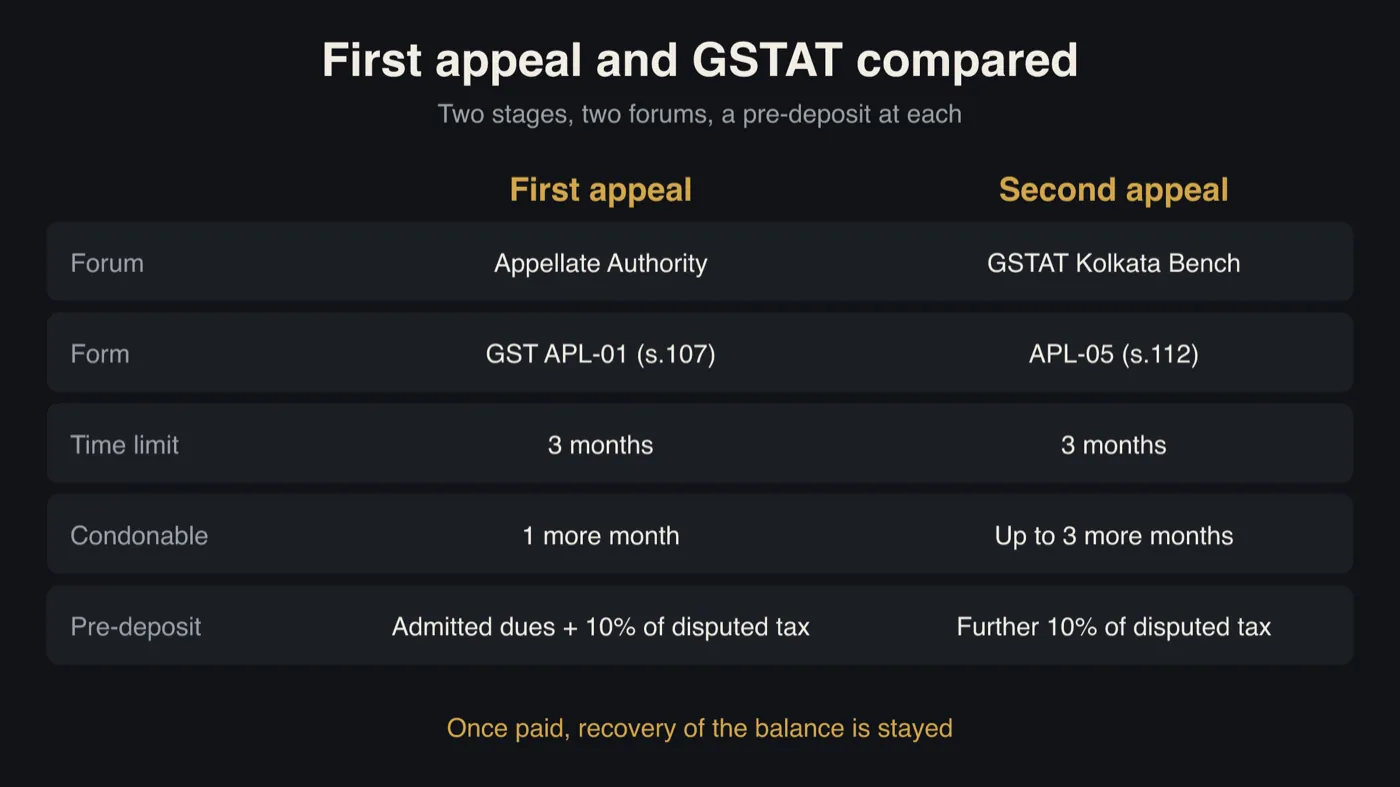
The first appeal against a GST demand order goes to the Appellate Authority in Form GST APL-01 under Section 107 of the CGST Act, 2017 and the WBGST Act, 2017. It must be filed within 3 months of the date the order is communicated to you. The authority can condone a further 1 month for sufficient cause, and no more. To file, you pay the admitted tax, interest and penalty in full plus 10% of the disputed tax, subject to a cap of Rs 20 crore. Once that is paid, recovery of the balance is stayed by Section 107(7). The forms and filing are on the GST portal. This page is about appeals after an order. For the notice and the reply to it, see our page on GST notice and SCN reply.
A second appeal lies to the GST Appellate Tribunal (GSTAT) under Section 112. Its Kolkata Bench, at Alipore, has been working since 23 March 2026 and covers West Bengal, Sikkim and the Andaman and Nicobar Islands. Beyond the Tribunal, there is a High Court appeal on a substantial question of law and then the Supreme Court. A writ petition is possible in limited cases, such as an order passed without a personal hearing. Patra’s Law Chambers appears in these matters, and brings the experience of an IIT Kharagpur and IIM Calcutta Alumnus with 10+ Years of Professional Legal Experience. Supreme Court filings are made through the firm’s Supreme Court connection. Please bring the order, the notice and the date you received it. No outcome can be promised.
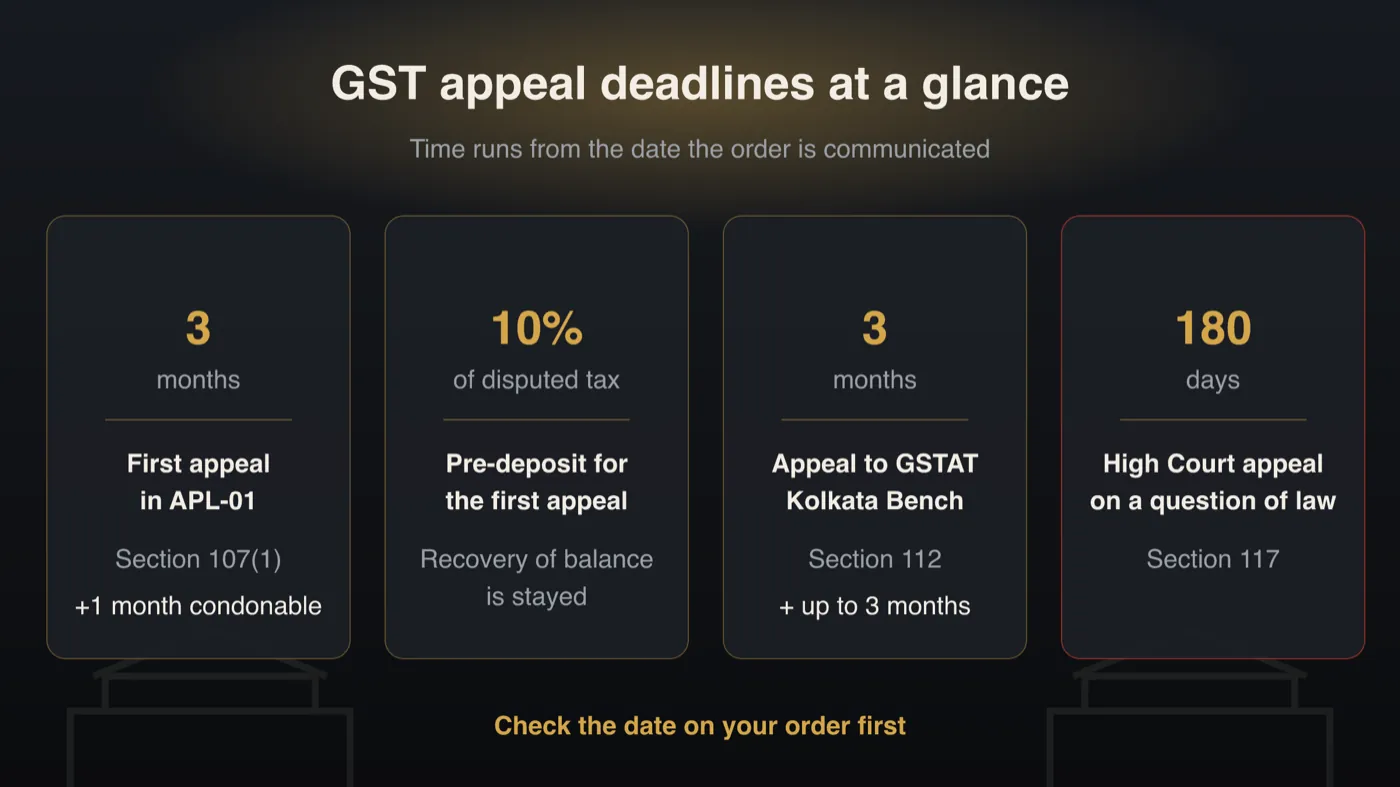
How long do you have at each stage?
Each stage has its own clock, and each runs from communication of the order.
Short explainers from Adv. Sudip Patra
More short explainers on our YouTube channel: Patra’s Law Chambers on YouTube ↗
Which GST paper or order do you have in hand?
Pick the one that matches your situation. This is general information on the usual route, not advice on your own file.
Choose one of the options above.
From demand order to the Supreme Court
This is the usual ladder after a GST demand order is passed. Not every matter climbs every step.
Note the section (73, 74 or 74A), the split of tax, interest and penalty, whether a hearing was given, and the date the order was communicated. Earlier steps such as the notice and reply are covered on the GST notice and SCN reply page.
Pay the admitted amount and 10% of the disputed tax, then file Form GST APL-01 online under Section 107. The appeal counts as filed when the final acknowledgement in APL-02 is issued. Recovery of the balance is stayed once the deposit is paid.
The Authority hears both sides and can confirm, modify or annul the order. It cannot send the matter back. Additional grounds need its leave.
If you lose, an appeal in Form APL-05 goes to the GST Appellate Tribunal, Kolkata Bench at Alipore, with a further 10% pre-deposit and a filing fee. Place-of-supply matters go to the Principal Bench in New Delhi.
A Section 117 appeal lies on a substantial question of law. A writ under Article 226 is separate and limited to exceptional cases, as explained in when to file a writ petition in the Calcutta High Court.
Some orders go to the Supreme Court under Section 118, or by special leave petition under Article 136. The filing is made through Sudip’s Supreme Court connection.
Common GST appeal mistakes: tap a card
The 3 months run from communication of the order, not from the recovery notice. Waiting can cost you the first appeal.
Courts treat the statutory appeal as the normal route and entertain writs only in exceptional cases such as a breach of natural justice or an order without jurisdiction. Verify before choosing.
For the first appeal it is the admitted amount plus 10% of the disputed tax, subject to the statutory cap. The balance stays stayed while the appeal is pending.

Where a GST demand order can be challenged
First appeal in APL-01
Filed online within 3 months of communication of the order, with the order, the notice, your reply and grounds. The appeal is treated as filed on the date of the final acknowledgement (APL-02), so the file is prepared before the last week. The authority may confirm, modify or annul the order but cannot send the case back.
Second appeal to the Tribunal
Filed in Form APL-05 on the GSTAT portal within 3 months, with up to 3 more months condonable. A further 10% of the disputed tax is payable, subject to a cap, and recovery stays once it is paid. The Kolkata Bench hears West Bengal matters; place-of-supply disputes go to the Principal Bench in New Delhi.
Writ petitions in exceptional cases
Where an appeal exists, the Supreme Court has said a writ lies only in limited cases, such as breach of natural justice, an order without jurisdiction or a challenge to the law (Radha Krishan Industries v. State of H.P., (2021) 6 SCC 771). Orders passed without the hearing required by Section 75(4) are a common ground. See our page on a writ petition in the Calcutta High Court.
High Court and Supreme Court
A State Bench order of the Tribunal can be taken to the High Court on a substantial question of law within 180 days. Supreme Court remedies follow under Section 118 or by special leave. Read about the Special Leave Petition under Article 136.
What to bring for a GST appeal consultation
- The demand order (DRC-07), with the date it was uploaded or served
- The show cause notice (DRC-01), your reply and any hearing notices
- Returns, invoices, ITC ledgers (GSTR-2A/2B) and payment challans
- Proof of any pre-deposit already paid, and any recovery or bank attachment notice
- For a company: a board resolution, and the Order in Appeal if going to GSTAT
- Related matters: customs and income tax papers, if the same facts are involved
Supreme Court rulings that shape a GST appeal
These decisions settle three things before any GST appeal is filed: when the High Court will hear a writ instead of an appeal, how strict the time limits are, and how the pre-deposit can be paid. Each citation below was checked. Read the full judgment before you rely on a particular paragraph.
2021
Use the Section 107 appeal first
The taxpayer skipped the appeal under Section 107 of the CGST Act and filed a writ instead. The Supreme Court set aside the High Court’s relief. A writ is heard despite an available appeal only in exceptional cases: breach of a fundamental right, breach of natural justice, an order without jurisdiction, or a challenge to the validity of the law itself.
2021
Alternative remedy is a rule of discretion
The case was about provisional attachment under the GST law. The Supreme Court held that an available alternative remedy does not, by itself, bar a writ under Article 226. It is a matter of the High Court’s discretion. The Court set out the exceptions where a writ may be heard, and held that the attachment power is drastic and has to rest on tangible material.
2020
A writ cannot revive a lapsed appeal
The taxpayer missed the outer time limit for a statutory appeal and then filed a writ against the assessment order. The Supreme Court held that the High Court should not normally use its writ power to entertain such a challenge unless there are exceptional circumstances. High Courts regularly apply this ruling to GST orders when the Section 107 appeal time has run out.
2008
No condonation beyond the statutory proviso
This was an excise case. The Supreme Court held that the Commissioner (Appeals), a creature of statute, cannot condone delay beyond the extra period the statute itself allows, and that Section 5 of the Limitation Act does not stretch that period. Most High Courts apply the same reasoning to the 3-month plus 1-month limit in Section 107(1) and 107(4) of the CGST Act.
2025
Pre-deposit may come from Credit Ledger
The Supreme Court dismissed the Revenue’s petition against the Gujarat High Court ruling, which leaves that ruling in place: the 10% pre-deposit under Section 107(6)(b) can be paid from the Electronic Credit Ledger and need not be paid in cash. A dismissal of this kind is not a reasoned judgment on merits. Whether it covers the further pre-deposit for the Tribunal under Section 112(8) has not been decided.
How a GST appeal moves, from the order to the Tribunal
Read the order and fix the date it was communicated
Note whether the order was passed under Section 73, 74 or 74A, which officer passed it, and how it splits into tax, interest and penalty. Check whether a personal hearing under Section 75(4) was given. The 3-month limit runs from the date the order was communicated, meaning uploaded on the portal or served, so keep screenshots of that date.
Choose the route
The normal route is an appeal in Form GST APL-01 under Section 107. A writ petition in the Calcutta High Court is the exception, for orders passed without a hearing, without jurisdiction, or after the time limit. If you are still at the notice stage, see GST notice and SCN reply.
Pay the pre-deposit
Pay the full amount of tax, interest, penalty, fine and fee that you admit, plus 10% of the disputed tax, capped at Rs. 20 crore each for CGST and SGST (Section 107(6)). For a first appeal, this can be paid from the Electronic Credit Ledger (Yasho Industries). Once it is paid, recovery of the rest is stayed (Section 107(7)).
File APL-01 online and get APL-02
File the grounds of appeal and the statement of facts on the GST portal, with the order, the show cause notice and your reply (Rule 108). If the order was not uploaded on the portal, file a certified copy within 7 days. The appeal counts as filed only when the final acknowledgement in APL-02 issues (Rule 109).
Hearing and Order in Appeal
The Appellate Authority can allow no more than three adjournments (Section 107(9)). Additional grounds need its leave (Section 107(10)), and fresh evidence is limited by Rule 112. It may confirm, modify or annul the order, but it cannot send the case back to the officer (Section 107(11)).
Second appeal to the GSTAT Kolkata Bench
File Form GST APL-05 under Section 112 within 3 months. The Tribunal can condone up to 3 more months. Pay a further 10% of the disputed tax, capped at Rs. 20 crore each (Section 112(8)). The Kolkata Bench sits at Alipore and covers West Bengal, Sikkim and the Andaman and Nicobar Islands. Verify the current fee and payment instructions before filing.
Where a GST demand order can travel
Each forum reviews the one below it, and each has its own limit and pre-deposit rule.
Demand order
Passed under Section 73, 74 or 74A after the notice and reply.
Appellate Authority
First appeal in APL-01 under Section 107 with the 10% pre-deposit.
GSTAT, Kolkata Bench
Second appeal in APL-05 under Section 112 with a further 10%.
Calcutta High Court
Section 117 appeal on a substantial question of law.
Supreme Court
Section 118 appeal or special leave petition, as the law permits.
Pre-deposit for a GST appeal on the disputed tax: Section 107(6) for APL-01 and Section 112(8) for GSTAT (the full admitted amount is payable on top; each stage is capped at Rs. 20 crore CGST and Rs. 20 crore SGST)
Mistakes that cost GST appeals
Counting the time limit from the wrong date The clock starts when the order is communicated, which may be an upload under the portal’s Additional Notices tab, not when you first notice it. After 3 months plus the 1 month the Authority can condone, most High Courts hold the appeal is lost. The Calcutta High Court’s contrary view has been stayed by the Supreme Court.
Filing a writ when an appeal lies After Commercial Steel, a writ against a Section 73 or 74 order is heard only in exceptional cases, such as a missing personal hearing or an order without jurisdiction. A writ filed only to avoid the pre-deposit is likely to be dismissed.
Paying the wrong pre-deposit or keeping no proof Underpaying the admitted amount, or the 10% of the disputed tax, can make the appeal defective. Keep the payment challans, because those payments are what stop recovery under Section 107(7) and Section 112(9).
Taking a weak reply into the appeal The Appellate Authority limits new grounds and fresh evidence. A thin reply to the show cause notice, or no records of returns, invoices and ITC ledgers, narrows what can be argued later. Prepare the reply as if it will go to appeal.
Received a GST demand order? Check the date first
The time to appeal runs from the date the order was communicated, and a missed deadline can close the appeal route. Share the order, the notice and your reply, and we will read them, identify the forum and the last date, and explain the pre-deposit and the options in plain terms. Non-resident Indians can send documents online and arrange authorisation remotely. No result is guaranteed, and advice is given only after the papers are seen.
Book a ConsultationEstablished by a distinguished alumnus of IIT Kharagpur, Patra’s Law Chambers stands as a beacon of legal expertise in Kolkata & Delhi. Know more →

Kolkata Office
NICCO House, 6th Floor, 2 Hare Street
Kolkata-700001 (Near Calcutta High Court)
Delhi Office
4455/5, First Floor, Gali Shahid Bhagat Singh
Main Bazar Road, Paharganj, New Delhi-110055
Contact
[email protected]
+91 890 222 4444 / +91 7003 715 325
First appeal versus Tribunal appeal
The two stages look similar but differ on forum, form and deposit.
Frequently asked questions about GST appeals in Kolkata
A first appeal under Section 107 must be filed within 3 months of the date the order is communicated. The Appellate Authority can condone a further 1 month for sufficient cause. Count from the date of communication, so keep the portal upload record or service proof.
The full admitted amount plus 10% of the disputed tax, subject to the statutory cap under Section 107(6). A penalty-only appeal has its own rule from 1 October 2025. Verify the current cap and the applicable rule on your own order before paying.
Once the required pre-deposit is paid, recovery of the balance of the demand is treated as stayed under Section 107(7) for the first appeal, and Section 112(9) for the Tribunal. If a bank account is still attached, a written representation with proof of payment is usually the first step.
Yes. The Kolkata Bench of the GST Appellate Tribunal sits at 2/5 Judges Court Road, Alipore, and covers West Bengal, Sikkim and the Andaman & Nicobar Islands. It started work on 23 March 2026. Verify filing rules on the Tribunal portal before you file.
A second appeal under Section 112 is filed in Form APL-05 within 3 months of communication of the Appellate Authority’s order, or the date the Government notifies, whichever is later. A further 3 months can be condoned. Older orders had special transitional dates, so verify.
Only in exceptional cases, for example a breach of natural justice, an order without jurisdiction or a challenge to the law itself. The Supreme Court in Radha Krishan Industries (2021) 6 SCC 771 treats the alternative remedy as a matter of discretion, not an absolute bar.
For the first appeal the Supreme Court dismissed the Revenue’s SLP in Union of India v. Yasho Industries, so the credit ledger can be used under Section 107. For the Tribunal stage, the position is unsettled and a Tribunal instruction asks for cash. Verify before paying.
Filing is online, and authorisation and signatures can usually be arranged remotely. The signatory rules differ for companies, firms and proprietors, so verify them for your entity. See the page on NRI and OCI legal matters in Kolkata.