Company Winding Up in the Calcutta High Court and NCLT: Grounds, Process, Timelines
Since 15 December 2016 a creditor’s claim for unpaid dues goes to the NCLT under the Insolvency and Bankruptcy Code, not to a winding-up petition under the Companies Act, 2013. This page explains the five grounds in Section 271, who can petition under Section 272, what happens to old winding-up cases still in the Calcutta High Court, and the steps up to dissolution.
What winding up means, and what changed after the IBC
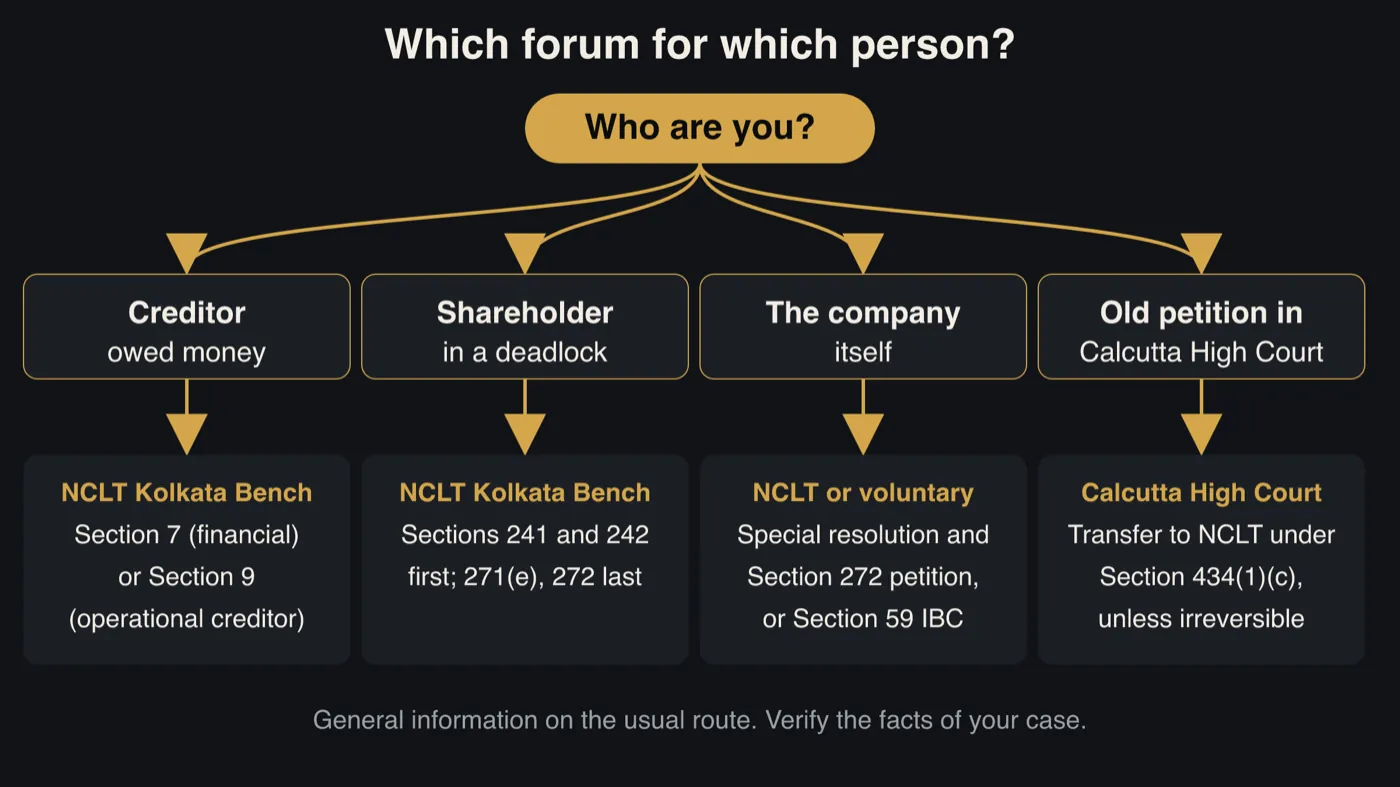
Winding up ends the life of a company. A Tribunal orders it, a liquidator takes charge of the assets, the debts are paid in the order the law sets, and the company is dissolved. Chapter XX of the Companies Act, 2013 governs this. In 2016 the Eleventh Schedule of the Insolvency and Bankruptcy Code (IBC) rewrote Sections 271 and 272, effective 15 December 2016. Creditors were removed from the list of petitioners, and the old ground of inability to pay debts was dropped. A creditor who is owed money now files under Section 7 or Section 9 of the IBC before the NCLT, which aims first at reviving the company and treats liquidation as a last step.
Old petitions did not all disappear. Winding-up petitions filed under the 1956 Act and served before the IBC transfer rules took effect stayed with the Calcutta High Court, where the Official Liquidator still handles many of them. The Supreme Court held in Kaledonia Jute and Fibres v. Axis Nirman and Industries (judgment of 19 November 2020) that any creditor, not only the petitioner, can ask for such a case to be moved to the NCLT. Matters that need a High Court forum can be discussed through our Calcutta High Court advocate consultation page. Please verify the current status of any specific case before acting.
The clocks that run in a winding up
These are the periods fixed by the Companies Act, 2013; actual liquidations often run longer.
Short explainers from Adv. Sudip Patra
More short explainers on our YouTube channel: Patra’s Law Chambers on YouTube ↗
Who are you in relation to the company?
Pick the option closest to your position. This is general information on the usual route, not advice on your case.
Choose one of the options above.
From petition to dissolution of the company
These are the statutory stages under Chapter XX of the Companies Act, 2013. Real liquidations often take far longer than the Act’s limits.
The petition goes in Form WIN 1 or WIN 2, with an affidavit in WIN 3. A copy goes to the Registrar, who files views within 60 days under Section 272(5). For creditor routes, see our NCLT Kolkata advocate page.
The petition is advertised in Form WIN 6 in an English and a vernacular newspaper. Under Section 274, the company files objections and a statement of affairs within 30 days, extendable by 30 days.
Under Section 273, the Tribunal may dismiss the petition, pass interim orders, appoint a provisional liquidator or order winding up. The 90-day limit is treated as directory in practice, so please verify before relying on it.
Suits against the company are stayed (Section 279). Directors hand over audited books within 30 days. The liquidator’s report on assets, liabilities and fraud is due within 60 days under Section 281.
Claims are admitted, assets are valued and sold, and proceeds are distributed under Sections 326 and 327. Creditors who are also lenders may also read our guide to financial creditors starting CIRP.
Once the affairs are fully wound up, the Tribunal passes a dissolution order under Section 302. A copy must reach the Registrar within 30 days, with a fine of up to ₹5,000 per day for default.
Three things people often get wrong, tap a card
Not today. Section 272 as substituted w.e.f. 15 December 2016 does not name creditors. A creditor uses Section 7 or 9 of the IBC before the NCLT.
It often can. Under the fifth proviso to Section 434(1)(c), a pending winding-up may be transferred to NCLT Kolkata, unless it has reached an irreversible stage. Whether assets have been sold is a key factor.
It does not. The Supreme Court held in Navinchandra Steels (2021) that a Section 7 application is an independent proceeding and can proceed even if a winding-up petition has been admitted.
Where winding-up and insolvency matters are heard
Section 271 grounds and Section 272 petitions
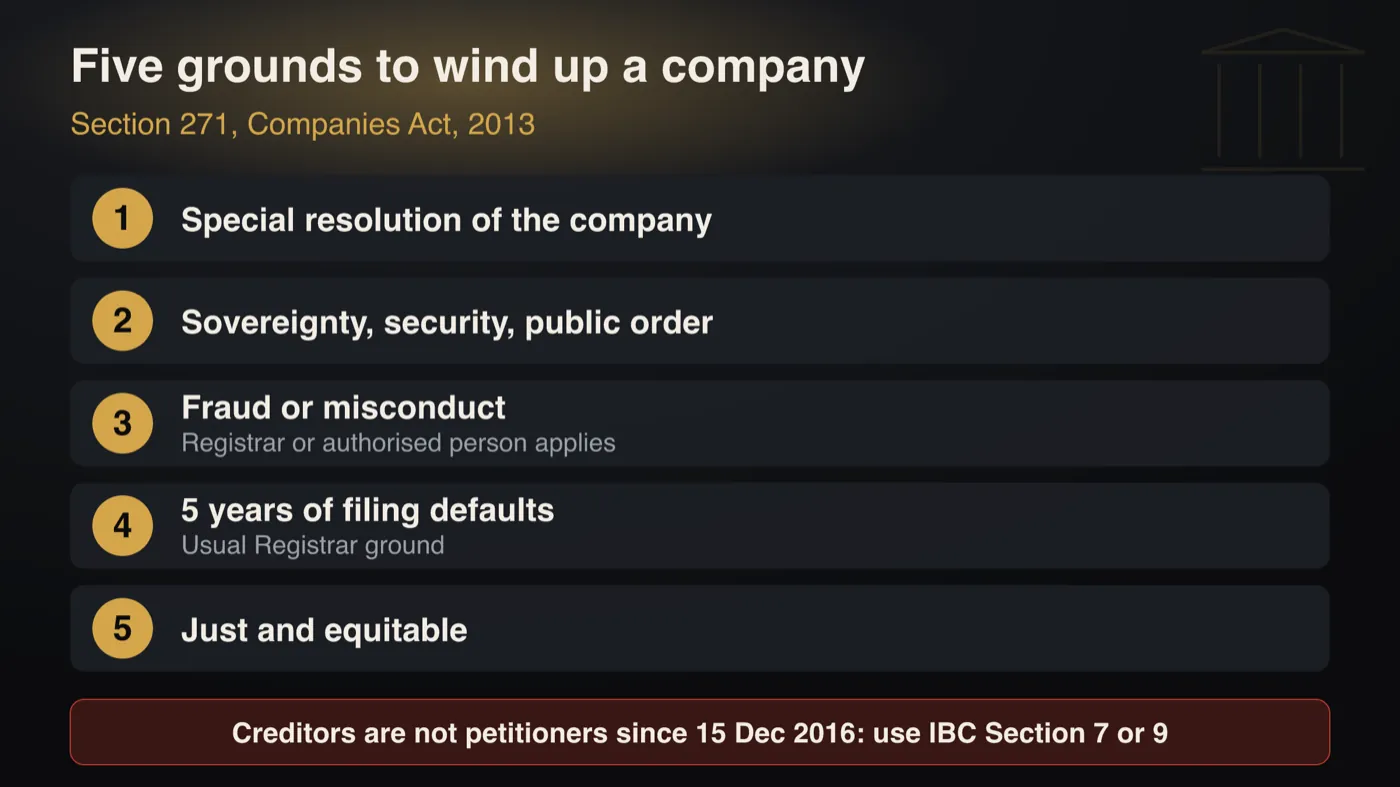
A company can be wound up on five grounds: a special resolution, acts against the sovereignty or security of India, fraud or misconduct, five years of filing defaults, or the just-and-equitable ground. Section 272 lists who can petition: the company, contributories, the Registrar, an authorised person and the Government.
IBC Sections 7 and 9 for creditors
A creditor owed money files under Section 7 as a financial creditor, or under Section 9 as an operational creditor after a Section 8 demand notice. The minimum default is ₹1 crore, which should be verified against the current notification. See our guides on financial creditor CIRP and demand notices.
Old winding-up petitions and transfer to NCLT
Petitions served before the IBC transfer rules stayed in the High Court. Under the fifth proviso to Section 434(1)(c), a party can apply to transfer one to NCLT Kolkata. The Court generally allows transfer unless the winding up has reached an irreversible stage, for example where assets have already been sold.
Responding to a petition against the company
A company facing a Section 7 application can raise points on default, limitation and maintainability. Read how this works in defending Section 7 IBC petitions. In a winding-up petition the company must file objections and a statement of affairs within 30 days, extendable by 30 days (Section 274).
From petition to dissolution
- Choose the route: IBC Section 7 or 9, Section 241/242 for oppression, a Section 272 petition, or voluntary liquidation under Section 59 IBC
- File Form WIN 1 or WIN 2 with an affidavit in Form WIN 3 (Companies (Winding Up) Rules, 2020)
- Copy to the Registrar, whose views are due within 60 days (Section 272(5)); advertisement in Form WIN 6 at least 14 days before hearing
- Order under Section 273: dismissal, interim order, provisional liquidator or winding up
- After the order: liquidator takes charge, suits are stayed (Section 279), report within 60 days (Section 281)
- Claims, sale of assets, payment in the order of Sections 326 and 327, then dissolution (Section 302)
The judgments that decide where a winding-up case goes
These Supreme Court and Calcutta High Court rulings set the rules for winding-up petitions after the IBC: who can move an old High Court case to the NCLT, when the court can refuse, and how a winding up sits alongside a Section 7 or 9 application. If your matter is pending before the NCLT Kolkata Bench or the Calcutta High Court, check the latest position before relying on any one of them.
2020
Any creditor may seek transfer to NCLT
A winding-up proceeding binds all creditors, so any creditor, and not only the petitioning creditor, is a party who can ask under the fifth proviso to Section 434(1)(c) of the Companies Act, 2013 for the case to move to the NCLT. The Transfer Rules of 2016 do not limit that proviso. The Court also said that running a High Court winding up and an IBC case side by side defeats the purpose of the Code.
2020
Transfer allowed until liquidation becomes irreversible
A Company Court can transfer a winding up to the NCLT even after it has admitted the petition. The test is whether the winding up has reached an irreversible stage, for example because assets have been sold, so that the clock cannot be set back. The Official Liquidator simply holding the assets is not enough. Until that point, the IBC’s preference for revival should be followed.
2021
IBC petition survives an admitted winding up
A Section 7 application by a financial creditor is an independent proceeding. The NCLT can admit and decide it even if a High Court has already admitted a winding-up petition against the same company. The High Court’s discretion under the fifth proviso to Section 434(1)(c) does not take away the NCLT’s jurisdiction. The Court followed Forech India Ltd. v. Edelweiss Assets Reconstruction Co. Ltd., (2019) 18 SCC 549.
2010
Winding up is not a debt-recovery tool
A winding-up petition cannot be used to force payment of a debt that the company disputes in good faith. A petition that asks for winding up but is really meant to pressure the company is an abuse of process and will be dismissed. Creditors now go to the NCLT under the IBC, but the same idea applies there: a real pre-existing dispute defeats a Section 9 application.
2022
Secured creditor's transfer plea succeeds
A secured creditor applied under the fifth proviso to Section 434(1)(c) to move a long-running Calcutta winding up to NCLT Kolkata. Applying Action Ispat, the Court found that the Official Liquidator had taken no significant steps to sell assets and that no scheme had been framed, so the matter had not become irreversible. Payments to security agencies and pending applications did not stop the transfer.
2026
Transfer possible even after winding-up order
The company was wound up in 2016, but the Division Bench upheld its transfer to the NCLT because its assets had not been sold. A security agency’s unpaid charges did not make the stage irreversible, and the agency can lodge that claim before the NCLT. The Supreme Court has since issued notice on an appeal against this judgment, so verify its current status before relying on it.
How company winding up by the Tribunal works, from petition to dissolution
Choose the correct route first
A creditor owed money files under Section 7 or Section 9 of the IBC before NCLT Kolkata. A Section 9 case needs a Section 8 demand notice first: see our operational creditor guide. A shareholder facing deadlock often uses Sections 241 and 242. A solvent company can choose voluntary liquidation under Section 59 IBC.
File the petition in the prescribed forms
Under the Companies (Winding Up) Rules, 2020, the petition is filed in Form WIN 1 or WIN 2, in triplicate, and verified by an affidavit in Form WIN 3. If the company itself petitions, it adds a statement of affairs in Form WIN 4, with figures not more than 30 days old, and concurrence affidavits in Form WIN 5. Attach the resolution, the MCA records and proof of the Section 271 ground.
Serve the Registrar and the company
Serve a copy on the Registrar of Companies, who may give views within 60 days under Section 272(5). Under Section 274, the Tribunal may direct the company to file objections and a statement of affairs within 30 days, which can be extended by another 30 days. A company that does not file loses its right to oppose the petition.
Advertise and attend the hearing
The petition is advertised in Form WIN 6 at least 14 days before the hearing, in one English and one vernacular newspaper circulating where the registered office is. In West Bengal the vernacular paper is usually Bengali. Under Section 273, the Tribunal may dismiss the petition, pass interim orders, appoint a provisional liquidator or order winding up. The Act asks for an order within 90 days of presentation.
The liquidator takes charge
After a winding-up order, the Official Liquidator or Company Liquidator takes control and the directors’ powers end. Suits against the company are stayed under Section 279 and need the Tribunal’s leave to continue. Directors must hand over audited books within 30 days, and the liquidator’s report under Section 281 is due within 60 days of the order.
Claims, sale, distribution and dissolution
Creditors file proofs of debt, and the liquidator values and sells the assets. Workmen’s dues rank equally with secured creditors under Section 326, followed by the preferential payments in Section 327. Once the accounts are final, the Tribunal passes a dissolution order under Section 302, and a copy must go to the Registrar within 30 days.
Winding up petition or IBC application?
The two proceedings differ in who can file, why, and what they aim for.
Mistakes that delay or defeat a winding-up matter
Filing a winding-up petition as a creditor Since 15 December 2016, Section 272 does not list creditors as petitioners, and inability to pay debts is no longer a ground under Section 271. A creditor should go to the NCLT under Section 7 or 9 of the IBC: see how a financial creditor starts CIRP.
Assuming an old High Court case must stay in the High Court Under Kaledonia and Action Ispat, any creditor can apply to move a pending Calcutta High Court winding up to NCLT Kolkata. Transfer is refused mainly where the case has reached an irreversible stage, usually after assets have been sold, so delay can cost you the option.
Using winding up to press for payment of a disputed debt Courts dismiss a petition that is really meant to pressure the company over a debt disputed in good faith (IBA Health). Before the NCLT, a real pre-existing dispute similarly defeats a Section 9 application, so check the paper trail before you file.
Asking for just-and-equitable winding up when another remedy exists Under Section 273(2), the Tribunal can refuse a just-and-equitable petition if another remedy is available and the petitioners are acting unreasonably in not using it. Shareholder disputes are usually tested first under the oppression and mismanagement provisions in Sections 241 and 242.
Talk through your company, creditor or shareholder position
Whether you are a creditor deciding between the IBC and a pending High Court liquidation, a shareholder facing deadlock, or a company that has received a notice, the right route depends on the facts and the documents. Patra’s Law Chambers appears before the NCLT Kolkata Bench and the Calcutta High Court. Bring the petition or notice, the company’s filings and the dates involved, and we will explain the options and the likely steps. No outcome can be promised.
Book a ConsultationEstablished by a distinguished alumnus of IIT Kharagpur, Patra’s Law Chambers stands as a beacon of legal expertise in Kolkata & Delhi. Know more →

Kolkata Office
NICCO House, 6th Floor, 2 Hare Street
Kolkata-700001 (Near Calcutta High Court)
Delhi Office
4455/5, First Floor, Gali Shahid Bhagat Singh
Main Bazar Road, Paharganj, New Delhi-110055
Contact
[email protected]
+91 890 222 4444 / +91 7003 715 325
Frequently asked questions on company winding up
Generally no. Since December 2016, Section 272 of the Companies Act, 2013 does not name creditors as petitioners. A creditor owed money files under Section 7 or Section 9 of the IBC before the NCLT. Please verify the route for your facts.
There are five: a special resolution of the company; acts against the sovereignty or security of India or public order; fraud or misconduct, on application by the Registrar or an authorised person; five consecutive years of default in filing financial statements or annual returns; and just and equitable.
Yes, for petitions under the 1956 Act that were served before the IBC transfer rules. A creditor can still apply to transfer them to NCLT Kolkata, and the Court generally allows it unless the winding up has reached an irreversible stage.
It is the test applied in Action Ispat and by the Calcutta High Court in Jessop, Abhijeet Projects and Shiva Shakti. Broadly, transfer is refused only when the liquidation is so far advanced, for example assets sold, that the clock cannot be set back.
IBC proceedings aim first at resolution of the company, with liquidation only if no plan is approved. Winding up under the Companies Act ends the company. The grounds, petitioners and time limits also differ.
Yes. In A. Navinchandra Steels v. SREI Equipment Finance (Supreme Court, 1 March 2021), the Court held that a Section 7 application is an independent proceeding and can proceed even though a High Court winding-up petition has been admitted.
The Act asks for a Tribunal order within 90 days of presentation and the liquidator’s report within 60 days of the order. Actual liquidation depends on assets, sales and claims, and can take years. No fixed timeline can be promised.
The Official Liquidator or Company Liquidator appointed under Section 275 takes charge. The directors’ powers end, they must hand over books within 30 days, and suits against the company need the Tribunal’s leave under Section 279.