Section 7 of the IBC: the NCLT no longer may admit — it must
Since 26 May 2026, a financial creditor who proves debt and default is entitled to admission within fourteen days. Solvency, viability, a pending settlement and a bigger counterclaim are no longer answers. Here is the statutory gateway as it now stands.
A collective remedy, not a recovery suit
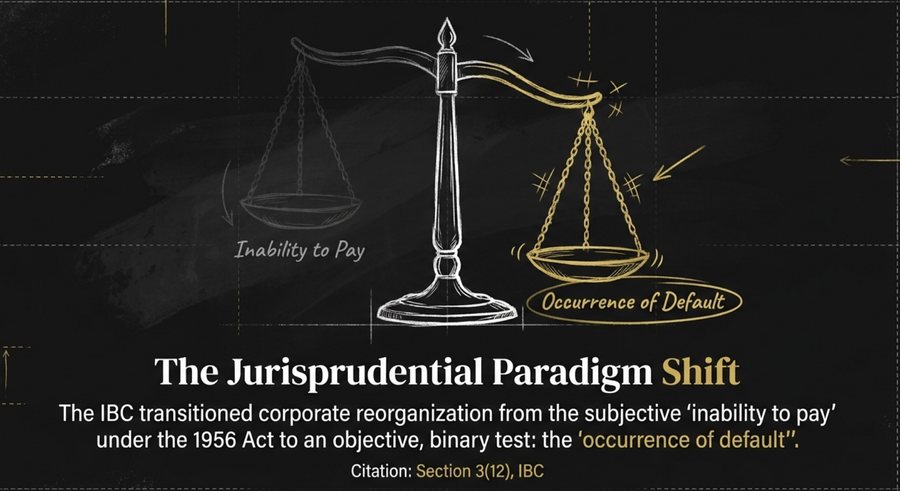
The Insolvency and Bankruptcy Code, 2016 replaced the old “inability to pay debts” enquiry under company law with something far blunter: the occurrence of default. Section 7 is the gateway through which a financial creditor — alone, jointly with others, or as a class — asks the National Company Law Tribunal to open the Corporate Insolvency Resolution Process against a corporate debtor. What follows is a proceeding in rem, meant to resolve the company’s financial distress collectively, not to recover one lender’s money. That distinction explains almost everything about how the section behaves, including why the defences that work in a civil suit fail here entirely.
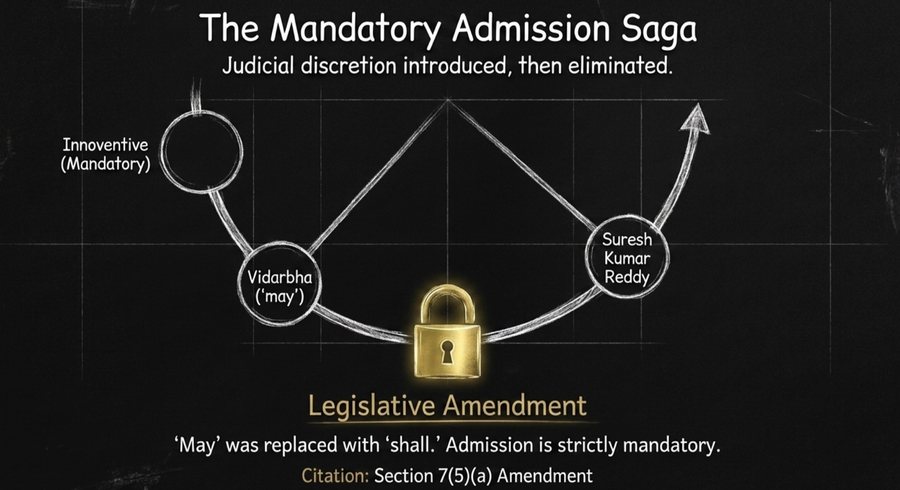
The section has been through the most turbulent decade of any provision in the Code. A rule of mandatory admission was laid down in 2018, unsettled by a single Supreme Court judgment in 2022, narrowed again in 2023, and finally closed off by Parliament in 2026. Anyone advising a lender, a promoter or a corporate guarantor today is working under a materially different provision from the one described in most commentary written before this year.
Section 4
Section 7(5)
Article 137
Whichever is less
What the Amendment Act actually changed
The Insolvency and Bankruptcy Code (Amendment) Act, 2026 — Act No. 6 of 2026 — received Presidential assent on 6 April 2026. By notification S.O. 2625(E) dated 22 May 2026, the Ministry of Corporate Affairs brought the bulk of it into force on 26 May 2026, including the provisions rewriting the admission machinery. Section 7(5) now directs the Adjudicating Authority to admit or reject within fourteen days, and an Explanation removes the discretion the Supreme Court had read into the older text. A great deal of pre-2026 writing on Section 7 is, on this point, simply out of date.
Section 7(5)(a) said the Adjudicating Authority “may” admit. Read literally in Vidarbha, this was a discretion to refuse.
The Adjudicating Authority “shall” admit once the three statutory conditions are satisfied. The discretion is gone.
The fourteen-day period in Section 7(4) governed ascertainment of default; admission itself routinely took months or years.
Fourteen days from receipt to admit or reject. If the Tribunal cannot decide within that window, it must record its reasons in writing.
Benches variously entertained solvency, going-concern viability, an unexecuted award, a pending one-time settlement and unrealised receivables.
An Explanation states that where the conditions are met, the application shall not be rejected on any other ground. The enquiry is confined to a default crossing the Section 4 threshold.
An Information Utility record was one of several ways to establish default, and was frequently contested on affidavit.
Where a financial creditor that is a financial institution files a record of default with its application, that record is sufficient to ascertain the existence of default. The proviso to Section 7(4) has been omitted.
Section 12A withdrawal with ninety per cent CoC approval, with a comparatively open window and considerable litigation about timing.
Withdrawal only after the Committee of Creditors is constituted and before the first invitation for resolution plans is issued, still on ninety per cent voting share.
Section 7 before the NCLT was the only entry point for a financial creditor seeking resolution.
Chapter IV-A introduces the Creditor-Initiated Insolvency Resolution Process, commenced out of court by notified classes of financial creditors, without a Tribunal admission order.
Would this defence have worked? Would it work now?
Pick the defence a corporate debtor raises at the admission stage. The panels show how the same argument fared under the pre-amendment text and how it fares under Section 7(5) as it now reads.
Eight years of argument, in five milestones
Tap any milestone to read what it decided and what survived it.
Financial debt, and a default that crosses the line
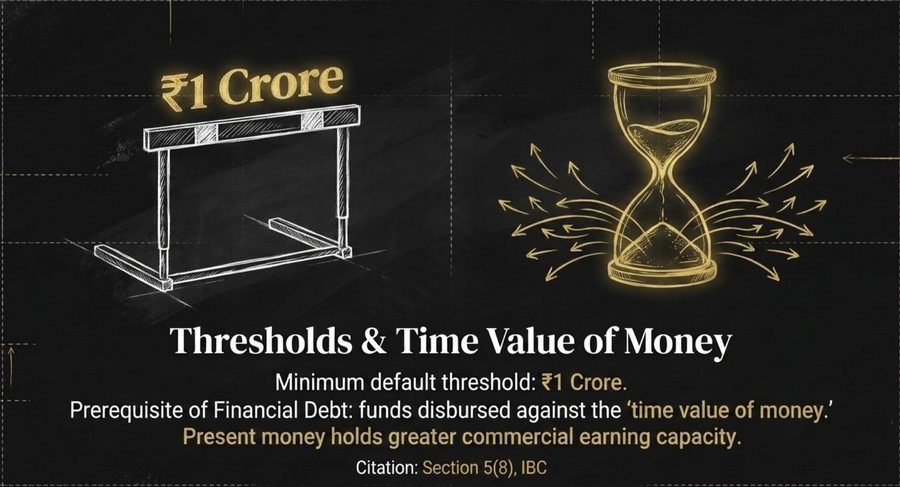
Everything in a Section 7 petition rests on two findings. First, that the money owed is a financial debt within Section 5(8) — a sum disbursed against the consideration for the time value of money. Second, that a default within Section 3(12) has occurred, in an amount of at least one crore rupees fixed by the Central Government under Section 4. The definitions run in a chain: a claim under Section 3(6) becomes a debt under Section 3(11), and Section 5(8) then isolates the financial species of that debt.
The Supreme Court drew a useful line in China Development Bank v. Doha Bank Q.P.S.C. (2024): nothing in Section 5(8) says a debt comes into existence only when a default occurs. The moment money is disbursed and owed, the lender is a financial creditor under Section 5(7) with a subsisting claim. Default under Section 3(12) is the separate trigger that unlocks Section 7. Getting this order right matters, because it determines who sits on the Committee of Creditors and who merely has a cause of action.
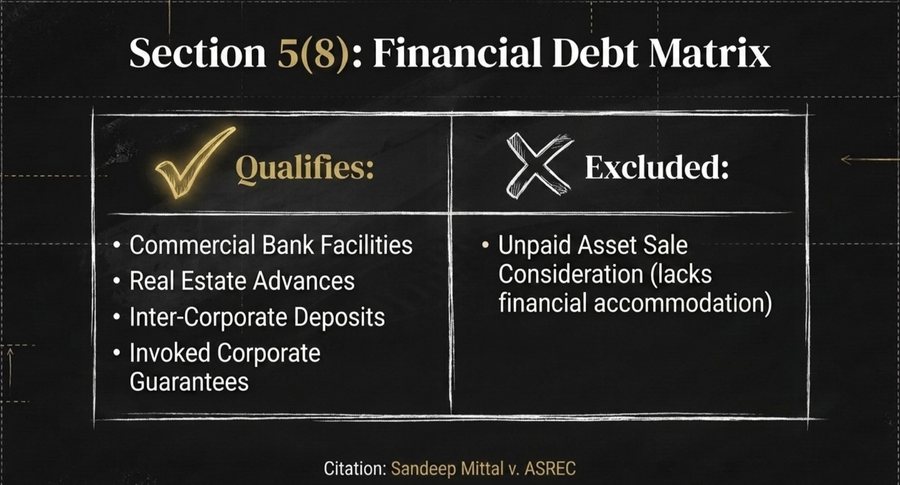
Six transactions. Which of them open Section 7?
Tap a card to turn it over. Each answer states the reason, not just the result — because the reason is what a Tribunal actually tests.
Term loan from a bank
Sanctioned facility, disbursed, carrying interest.
Tap to reveal →The paradigm case. Money disbursed against interest is disbursement against the consideration for the time value of money, squarely within Section 5(8)(a).
Homebuyer’s advance
Money paid to a developer under a real estate project.
Tap to reveal →Section 5(8)(f) deems amounts raised from allottees to have the commercial effect of a borrowing. The provisos to Section 7(1) then impose the joint-filing threshold of 100 allottees or ten per cent of the project, whichever is less.
Interest-free inter-corporate deposit
One group company advances working capital to another.
Tap to reveal →Neither the absence of a written agreement nor the absence of interest is decisive. What is tested is whether the commercial purpose was financial accommodation.
Invoked corporate guarantee
A company guaranteed a borrowing; the guarantee has been invoked.
Tap to reveal →Liabilities under an invoked guarantee, indemnity or counter-indemnity given by a corporate person fall within Section 5(8)(i). Liability crystallises on the principal’s default.
Unpaid price of an asset sold
Consideration due under a sale of assets, never paid.
Tap to reveal →A contractual sales obligation, not an amount disbursed against the time value of money. Sandeep Mittal v. ASREC (India) Ltd. puts this outside Section 5(8) — the remedy lies elsewhere.
Unpaid invoices for goods supplied
A vendor’s dues for materials delivered on credit.
Tap to reveal →This is operational debt under Section 5(21). The route is Section 8 and Section 9 — where, unlike Section 7, a genuine pre-existing dispute defeats the application.
Six gates between filing and admission
A Section 7 application does not succeed on the strength of the debt alone. It flows downward through a fixed series of statutory gates, and it stops at the first one that is shut. Close a gate below to see where the application spills out — and note how few of these gates have anything to do with the corporate debtor’s finances.
Close a gate and watch the flow stop
All six gates open by default. Tap any gate to close it. The channel below a shut gate runs dry, and the outcome panel names the objection the corporate debtor will actually take.
Six propositions that decide most Section 7 contests
Part payment is still default
Default is non-payment of a debt when the whole, or any part, or any instalment has become due and payable. A debtor who services most of a facility and misses one instalment has defaulted; the only question left is whether the unpaid amount crosses the Section 4 threshold.
Someone else’s default will do
The Explanation to Section 7(1) provides that a default includes one in respect of a financial debt owed to any other financial creditor of the same corporate debtor. This is the collective character of the process showing through: the applicant is opening a proceeding for all creditors, not enforcing a private bargain.
Disputes do not travel across
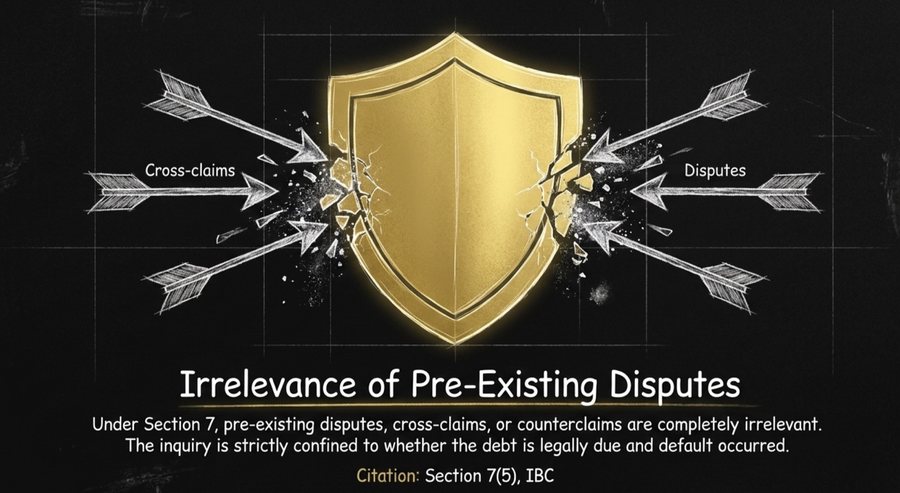
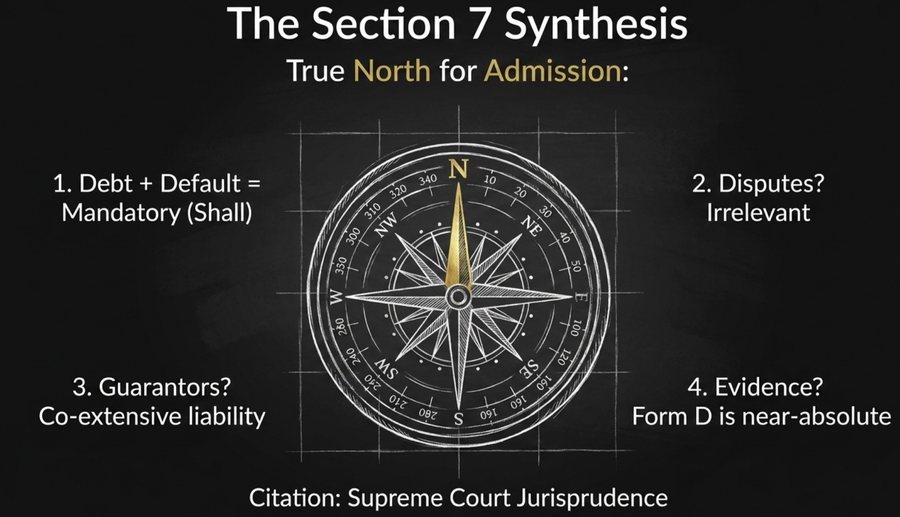
A pre-existing dispute is a complete answer to an operational creditor under Section 9. It is no answer at all under Section 7. Cross-claims, allegations of breach by the lender and counterclaims are matters for another forum; the Tribunal asks only whether the debt is legally due and whether default occurred.
The guarantor’s identity problem is not a defence
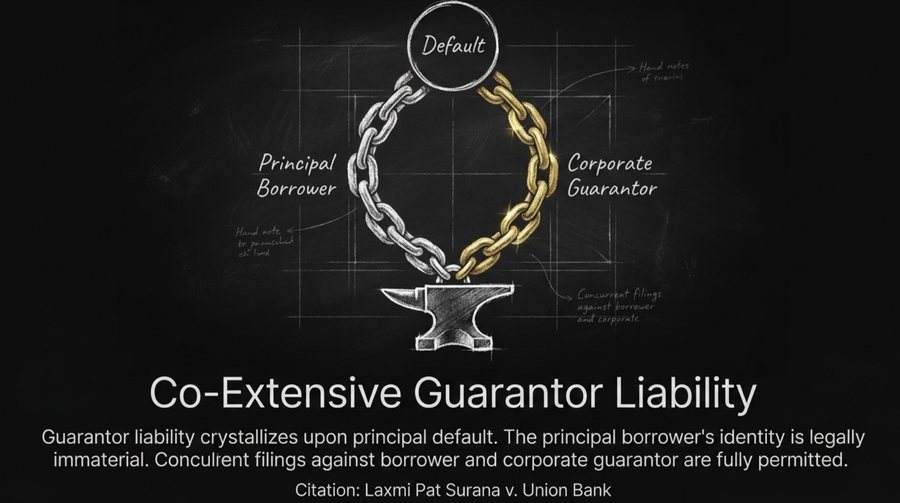
A surety’s liability is co-extensive with the principal debtor’s unless the contract says otherwise. Where the guarantor is a corporate person, it becomes a corporate debtor once the guarantee is invoked — and the legal form of the principal borrower, company or proprietorship, is immaterial.
An audited balance sheet can restart the clock
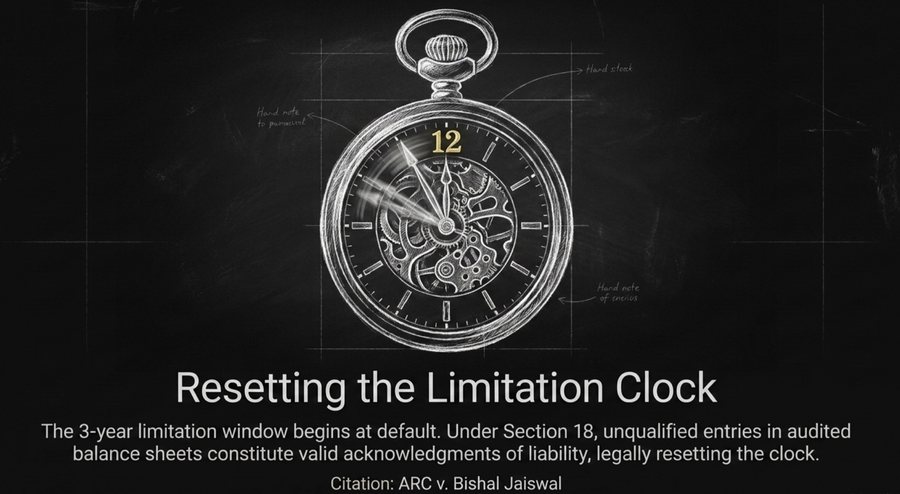
An unqualified entry acknowledging the liability in the corporate debtor’s audited accounts is an acknowledgment in writing, giving a fresh three-year period from the date of signing. The entry must be read with the auditor’s report, directors’ report and notes; a note denying or conditioning the liability destroys the acknowledgment.
A record of default now largely settles the evidence
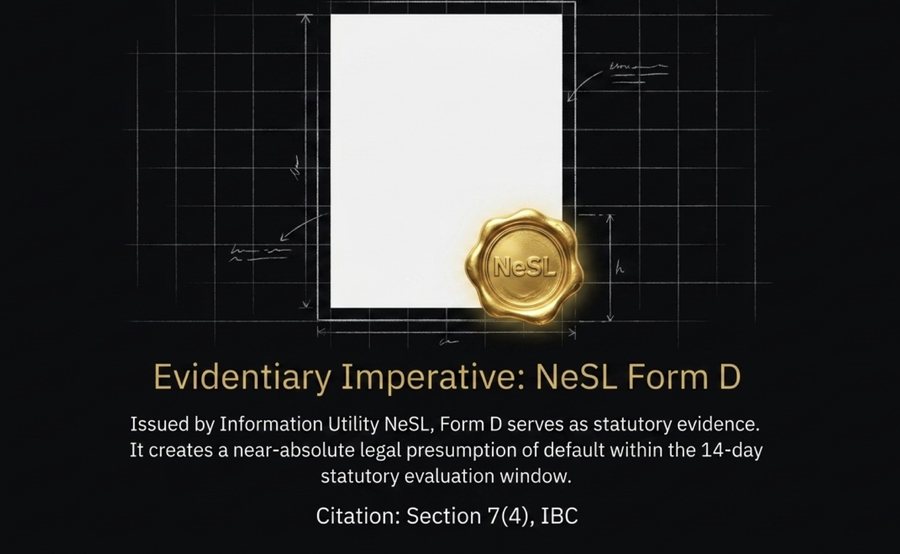
Where a financial creditor that is a financial institution files a record of default with its application, that record is sufficient to ascertain the existence of default. In practice this makes an authenticated Record of Default in Form D from the Information Utility the most valuable single document in the paperbook.
Three years from default — not from the NPA entry
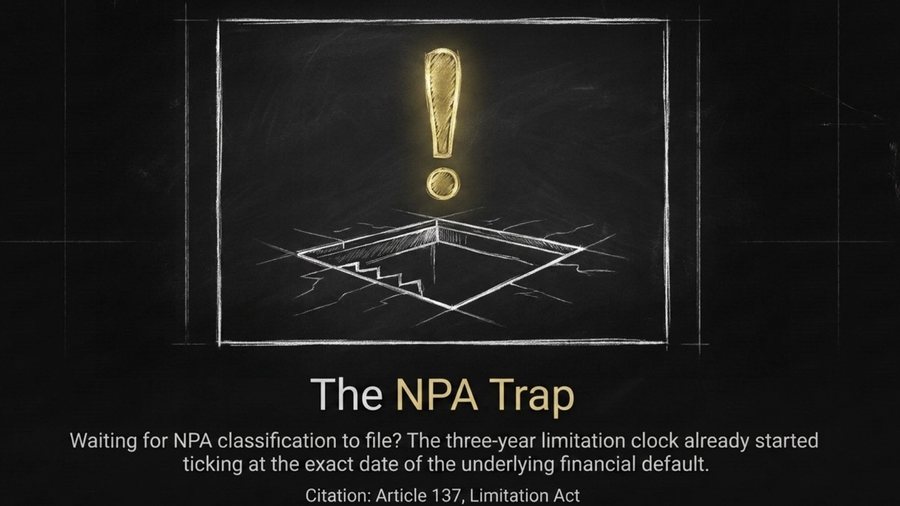
Section 238A applies the Limitation Act, 1963 to proceedings under the Code so far as may be. An application under Section 7 is governed by Article 137 of the Schedule: three years from the date the right to apply accrues, which is the date of default. Classification of the account as a non-performing asset often follows the default, and lenders who date their limitation from the NPA entry routinely file a year or more too late.
Where does your three years actually end?
Move the slider to the point you are filing from, then choose whether the corporate debtor acknowledged the liability along the way. This is an illustration of how Article 137 and Section 18 interact — it is not advice on any particular account.
One procedural relief is worth knowing. A financial creditor is not required to amend Part IV of Form 1 to bring subsequent acknowledgments on record. Balance sheets, settlement correspondence and supplementary records can be placed on file by rejoinder or supplementary affidavit, and the Tribunal is bound to consider them when deciding whether the application is within time.
The judgments that still decide these cases
The 2026 amendment closed one argument, but it did not displace the case law on financial debt, guarantees, limitation and the scope of the Tribunal’s enquiry. These rulings continue to be cited in every contested admission. Full texts of the Code and its amendments are available from the Insolvency and Bankruptcy Board of India.
2018
The foundational rule of mandatory admission
Once the Tribunal is satisfied that a financial debt exists and a default above the threshold has occurred, and the application is complete with no disciplinary proceedings against the proposed professional, it must admit. The corporate debtor may show only that no default occurred — that the debt is not due, or not payable in fact or in law. Solvency, financial health and operational disputes lie outside the enquiry.
2022
The Tribunal cannot substitute a settlement for adjudication
The Adjudicating Authority’s jurisdiction under Section 7 is confined to determining whether a default has occurred. It cannot decline to decide the application and instead push the parties towards a settlement, and it cannot compel an unwilling creditor into one.
2022
The word “may”, read literally
The corporate debtor held an unexecuted award from the electricity appellate tribunal exceeding the debt owed. Contrasting “may” in Section 7(5)(a) with “shall” in Section 9(5), the Court held the Tribunal had a discretion to defer or refuse admission and should consider the debtor’s financial health and realisable assets. Benches across the country then began weighing viability, inventory and receivables at the admission stage.
2023
Vidarbha confined to its own facts
A suspended director invoked Vidarbha to resist admission on the strength of a pending one-time settlement and liquidity strain from bank guarantee non-extension. The Court held Vidarbha turned on the peculiar fact of an adjudicated, realisable claim exceeding the debt, and did not dilute Innoventive or E.S. Krishnamurthy. Once debt and default are established, admission is the ordinary consequence.
2021
The principal borrower’s legal form is immaterial
A bank lent to a sole proprietorship; a registered company guaranteed the facilities. On default the bank invoked the guarantee and filed under Section 7 against the corporate guarantor, which argued Part II could not be invoked indirectly against a non-corporate borrower’s surety. The Court disagreed: the surety’s liability is co-extensive, a corporate guarantor becomes a corporate debtor on invocation, and creditors need not exhaust remedies against the principal first.
2020
Borrower and guarantor may be pursued together
Proceedings under Section 7 against the principal borrower and against the corporate guarantor may be maintained concurrently as well as separately. The creditor is not put to an election, though recovery across both processes cannot exceed the debt.
2021
Balance sheet entries are acknowledgments
A three-judge Bench overruled the view that accounts prepared under statutory compulsion cannot amount to voluntary acknowledgment. Entries in books of account and audited balance sheets can constitute acknowledgment under Section 18 — but must be read with the auditor’s report, directors’ report and notes, since a caveat denying or conditioning the liability defeats the acknowledgment.
2024
A debt exists before any default
Section 5(8) contains no requirement that a debt arises only on default. Disbursement and the obligation to repay make the lender a financial creditor holding a valid claim; Section 3(12) default is a separate, later trigger governing the right to initiate the process.
2024
Unpaid sale consideration is not financial debt
Amounts payable towards the purchase of assets are a contractual sales obligation. They are not disbursed against the consideration for the time value of money and involve no financial accommodation, so they fall outside Section 5(8) and cannot found a Section 7 application.
Form D and the fourteen-day window
The Information Utility framework was built under the IBBI (Information Utilities) Regulations, 2017 precisely because ascertaining default on affidavit evidence was too slow for a fourteen-day statutory window. National E-Governance Services Limited operates as the principal registered Information Utility. When default details submitted by a creditor are put to the debtor and authenticated, NeSL issues a Record of Default in Form D.
Which provision is actually yours?
Two questions. The answer tells you which chapter of the Code governs your entry into the process — a distinction that decides whether a pre-existing dispute can defeat you.
Alongside the traditional route, Chapter IV-A now creates a Creditor-Initiated Insolvency Resolution Process. Notified classes of financial creditors holding at least fifty-one per cent in value may commence it out of court by appointing a resolution professional and making a public announcement, after giving the corporate debtor at least thirty days to respond. The board stays in management under the professional’s supervision, the process runs for 150 days extendable once by 45, and it converts into a full resolution process if no plan emerges. Which corporate debtors and which classes of creditors are eligible depends on notifications the Central Government issues, so the practical reach of this route is still settling.
Filing a Section 7 application — seven stages
Fix the date of default precisely
Not the date of the NPA entry, not the date of the recall notice. Identify the instalment or demand that first went unpaid, since Article 137 runs from that day and every later step is measured against it.
Confirm the debt is financial and the amount qualifies
Trace the disbursement and the consideration for the time value of money through the facility documents. Aggregate the default to confirm it meets or exceeds one crore rupees.
Secure the Record of Default
Submit default information to the Information Utility and obtain authentication so a Form D certificate can be filed with the application. This is now the shortest path through the fourteen-day evidentiary window.
Complete Form 1 under Rule 4
Five parts: particulars of the applicant, of the corporate debtor, of the proposed interim resolution professional, of the financial debt including disbursement dates and interest computation, and the documentary evidence of default.
Obtain the professional’s written consent
The proposed interim resolution professional must consent in the prescribed form, and there must be no disciplinary proceedings pending against them. A defect here is one of only three grounds on which admission can now be refused.
Serve the corporate debtor and the Board
A copy must go to the registered office of the corporate debtor and to the Insolvency and Bankruptcy Board of India before or at the time of filing. Defective service is the most common cause of avoidable adjournment.
Press the fourteen-day timeline
Section 7(5) requires the Tribunal to admit or reject within fourteen days of receipt, recording reasons in writing if it cannot. Where the debtor raises viability, settlement or counterclaim points, the answer is now the Explanation itself.
Five mistakes that sink an otherwise strong petition
Computing limitation from the NPA date. The right to apply accrues on default. An account classified as non-performing months after the first unpaid instalment gives the petitioner months less than they think, and the objection is taken in almost every contested matter.
Relying on a qualified balance sheet entry. An entry read together with a note disputing the amount, denying liability or attaching conditions is not an unequivocal acknowledgment under Section 18. The auditor’s report and notes must be read before the acknowledgment is pleaded.
Pleading around a dispute that does not matter. Petitioners still devote pages to rebutting the debtor’s cross-claims. Under Section 7 those pages are surplusage, and they distract from the only two findings the Tribunal has to make.
Filing as an allottee without the joint threshold. An application by allottees under a real estate project must be brought jointly by not less than 100 allottees of the same project or ten per cent of them, whichever is less. A solitary homebuyer’s petition is not maintainable, however clear the default.
Treating the section as a recovery device. Section 7 opens a collective proceeding in rem. Filing it to extract payment, with no intention of seeing a resolution through, now carries a real risk: the amended Code strengthens the consequences for frivolous or vexatious initiation, and withdrawal after admission is far more tightly confined than it used to be.
Insolvency work before the NCLT and the appellate forums
Patra’s Law Chambers appears for financial creditors, corporate debtors, corporate guarantors and suspended management in proceedings under the Code — drafting and prosecuting Section 7 applications and Form 1 paperbooks, resisting admission on limitation, standing and the character of the debt, and carrying matters through to the appellate stage. The firm’s banking and recovery practice runs alongside it, covering the enforcement and debt recovery proceedings that usually precede an insolvency filing.
Book a ConsultationEstablished by a distinguished alumnus of IIT Kharagpur, Patra’s Law Chambers stands as a beacon of legal expertise in Kolkata & Delhi. Know more →

Kolkata Office
NICCO House, 6th Floor, 2 Hare Street
Kolkata-700001 (Near Calcutta High Court)
Delhi Office
4455/5, First Floor, Gali Shahid Bhagat Singh
Main Bazar Road, Paharganj, New Delhi-110055
Contact
[email protected]
+91 890 222 4444 / +91 7003 715 325
Common questions
No. Since the amended Section 7(5) came into force on 26 May 2026, the Tribunal must admit once default is established, the application is complete and no disciplinary proceedings are pending against the proposed professional. An Explanation states the application shall not be rejected on any other ground, and solvency or business viability is such a ground.
Its practical effect has been removed. M. Suresh Kumar Reddy had already confined it to its facts, and Parliament has since substituted the statutory language it rested on. A debtor arguing today that the Tribunal retains a general discretion under Section 7(5)(a) is arguing against the current text of the provision.
One crore rupees, fixed by the Central Government under Section 4 of the Code. The aggregate default must meet or exceed that figure; the total outstanding facility is not the test.
No. That defence belongs to Section 9 and operational creditors. Under Section 7 the enquiry is confined to whether the financial debt is legally due and whether default occurred. Cross-claims and counterclaims must be pursued in the appropriate forum.
Yes. Laxmi Pat Surana v. Union Bank of India holds that the legal identity of the principal borrower is immaterial. Once the guarantee is invoked, a corporate guarantor is itself a corporate debtor owing a financial debt, and the creditor need not first exhaust remedies against the principal.
The default. Article 137 of the Limitation Act gives three years from the date the right to apply accrues, which is the date of default. NPA classification usually follows and is evidence of the account’s condition, not the starting point of limitation.
It can. Under Asset Reconstruction Co. (India) Ltd. v. Bishal Jaiswal, an unqualified entry acknowledging the liability is an acknowledgment under Section 18, giving a fresh three-year period from the date of signing — provided the acknowledgment was made before the earlier period expired and is not contradicted by the auditor’s report or the notes to accounts.
It is the Record of Default issued by National E-Governance Services Limited, the principal registered Information Utility, once default information is authenticated. It is statutory evidence of default, and where a financial institution files a record of default with its application the amended Section 7 treats it as sufficient to ascertain default.
An out-of-court route added by the 2026 amendment. Notified classes of financial creditors holding at least fifty-one per cent in value can commence resolution by appointing a professional and making a public announcement, after giving the corporate debtor at least thirty days to respond. It runs for 150 days, extendable once by 45, with management left in place under supervision, and converts into a regular resolution process if no plan is approved.