DRAT Appeal in Kolkata: The Time Limit, the Pre-Deposit and What Follows
A Debts Recovery Appellate Tribunal appeal has a short limitation period and a mandatory pre-deposit. This page explains the 30-day and 45-day limits, the 50% deposit with its 25% floor, the filing steps at DRAT Kolkata and the remedies after the DRAT. Please verify every date and figure against the order and the current law before acting.
What the DRAT hears and who can appeal
The Debts Recovery Appellate Tribunal (DRAT) hears appeals against orders of the Debts Recovery Tribunal (DRT). It decides two kinds of appeal: an appeal under Section 20 of the Recovery of Debts and Bankruptcy Act, 1993 (RDB Act) against an order in a bank’s Original Application under Section 19, and an appeal under Section 18 of the SARFAESI Act, 2002 against an order on a Securization Application under Section 17. Appeals from the Kolkata DRTs lie to DRAT Kolkata. Our work on these matters is described on the Kolkata Banking & DRT Matters Advocate page, and the first-level forum is explained in DRT Kolkata: Debts Recovery Tribunal.
The two Acts work differently, and the difference decides your time limit and your deposit. Section 18 SARFAESI allows 30 days from receipt of the DRT order. Section 20(3) RDB Act allows 45 days from receipt of a copy of the order, although the proviso to that sub-section is worded inconsistently in the consolidated text, so the period must be verified against the Gazette copy of Act 44 of 2016. The deposit is also fixed by law: 50% of the debt, reducible by the DRAT, for reasons recorded in writing, to not less than 25%. The bank pays no deposit when it appeals. Read the provision itself at Section 18, SARFAESI Act and the borrower-side overview in SARFAESI Act: Borrower’s Guide.
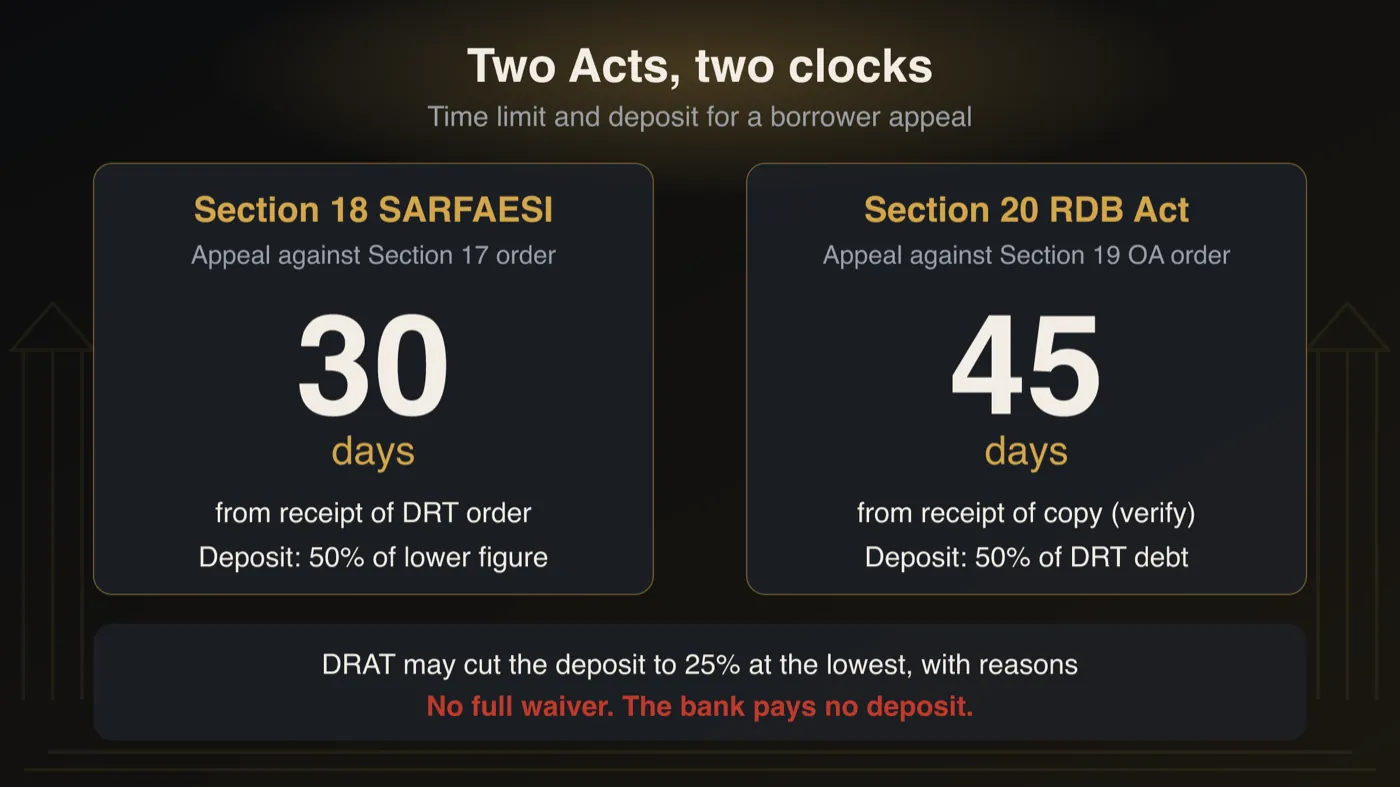
Section 20 RDB appeal and Section 18 SARFAESI appeal side by side
The DRAT hears both, but the order appealed, the time limit and the deposit base differ.
Short explainers from Adv. Sudip Patra
More short explainers on our YouTube channel: Patra’s Law Chambers on YouTube ↗
What is the latest order you have received from the DRT or DRAT?
Tap the paper that matches your situation to see the usual forum and remedy. This is general information, not advice. The right step depends on your order and papers, so verify before you act.
Choose one of the options above.
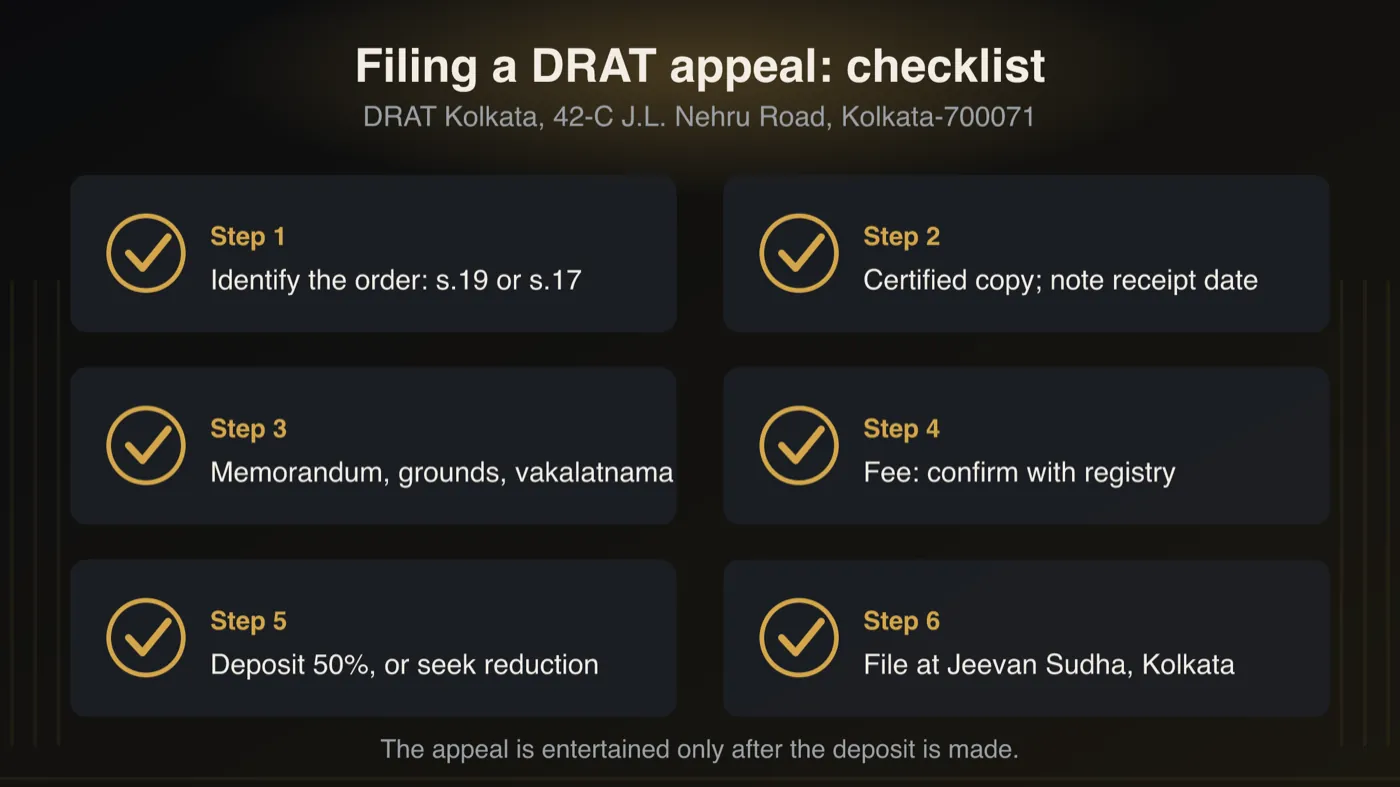
From a DRT order to a hearing before the DRAT in Kolkata
A DRAT appeal follows a fixed order of steps. The dates below are counted from the day you receive the order or its copy.
Apply for a certified copy of the DRT order straight away. Limitation runs from receipt of the order or copy, and you will need proof of the date. Read the order to see whether it came from a Section 19 case or a Section 17 SARFAESI application.
A Section 19 order goes in appeal under Section 20 of the RDB Act. A Section 17 order goes under Section 18 of the SARFAESI Act. If the matter began as a bank action against the property, read our SARFAESI guide for borrowers first.
The memorandum of appeal sets out the grounds, the impugned order, the OA or SA papers, a list of dates and the vakalatnama. File it at DRAT Kolkata, Jeevan Sudha Building, 42-C Jawaharlal Nehru Road, with the prescribed fee. If you are late, add a delay condonation application with an affidavit.
The borrower side deposits 50%, or applies to the DRAT to reduce the amount to not less than 25%, giving reasons and a financial affidavit. The appeal is entertained only after the deposit is made. Our DRT and banking page explains how these matters are usually handled.
Once the deposit is in order, the DRAT hears the prayer for stay of the DRT order or of an auction. If the bank is moving to sell the property, see how bank auctions are challenged for a stay.
There is no second statutory appeal. The remedy is a narrow writ in the Calcutta High Court, and then an SLP in the Supreme Court. See writs against SARFAESI action and SLP against a Calcutta High Court order.
Three points borrowers often get wrong. Tap a card
No. The DRAT can reduce it, but not below 25%, and it must record its reasons. The Supreme Court has held that even the High Court cannot waive it in full: Kotak Mahindra Bank v. Ambuj A. Kasliwal, (2021) 3 SCC 549.
No. The pre-deposit applies only to the borrower or debtor side. A bank appealing against a DRT order is not required to deposit anything.
Yes, for a SARFAESI appeal. In Union Bank of India v. Rajat Infrastructure Pvt. Ltd. (Supreme Court, 2 March 2020), a guarantor or mortgagor was held to stand on the same footing as the borrower.

DRAT appeals: the points that decide the outcome
30 days or 45 days, from receipt
A SARFAESI appeal under Section 18 must be filed within 30 days of receiving the DRT order; an RDB appeal under Section 20(3) within 45 days of receiving a copy (verify). Late filing needs a delay condonation application showing sufficient cause, as the Supreme Court held in Baleshwar Dayal Jaiswal v. Bank of India, (2016) 1 SCC 444.
50% of the debt, floor of 25%
Under Section 21 RDB Act the deposit is 50% of the debt determined by the DRT; under Section 18 SARFAESI it is 50% of the debt claimed or determined, whichever is less. The DRAT may reduce it to not less than 25% for recorded reasons. The pre-2016 position of 75%, with a possible waiver, no longer applies to new appeals; verify before relying on old rulings.
The deposit cannot be waived entirely
The Supreme Court has held in Narayan Chandra Ghosh v. UCO Bank, (2011) 4 SCC 548, Union Bank of India v. Rajat Infrastructure Pvt. Ltd. (2020) and Kotak Mahindra Bank v. Ambuj A. Kasliwal, (2021) 3 SCC 549, that neither the DRAT nor the High Court can dispense with it. Guarantors and mortgagors are treated like the borrower. See challenging bank auctions before the DRT.
Writ and SLP are narrow remedies
There is no further statutory appeal. A writ under Articles 226/227 is discretionary and ordinarily refused where the DRAT remedy exists, as explained in writ against SARFAESI action in the Calcutta High Court. A Special Leave Petition under Article 136 follows: see SLP against a Calcutta High Court order.
Steps and documents for a DRAT appeal
- Identify the order: Section 19 OA order (Section 20 RDB) or Section 17 order (Section 18 SARFAESI)
- Obtain a certified copy at once and note the date of receipt
- Memorandum of appeal with grounds, impugned order, list of dates and vakalatnama
- Fee under Rule 8 DRAT (Procedure) Rules, 1994 or Rule 13 Security Interest (Enforcement) Rules, 2002; confirm the amount with the registry
- Deposit 50%, or apply for reduction with a financial affidavit; the appeal is entertained only after compliance
- DRAT Kolkata sits at Jeevan Sudha, 42-C J.L. Nehru Road, Kolkata-700071; verify the floor and whether e-filing is accepted
- Related notice issues are covered in defences against a Section 13(4)/134 bank notice
DRAT appeal and pre-deposit: what the Supreme Court has held
Five Supreme Court decisions settle most DRAT appeal questions: how much must be deposited, whether it can be waived, who must pay it, and whether a late appeal can still be heard. Read them with the bare text of Section 21 RDB Act and Section 18 SARFAESI Act.
2011
Section 18 pre-deposit cannot be waived
The appeal arose from a Calcutta High Court order. The Supreme Court held that the pre-deposit under the second and third provisos to Section 18 of the SARFAESI Act is mandatory. The DRAT may reduce it to not less than 25%, but a complete waiver is beyond the Act. Its words that “no appeal shall be entertained” without the deposit are an absolute bar.
2020
Guarantors and mortgagors must also pre-deposit
The Supreme Court set aside a High Court order that had let an appeal go ahead without any deposit. At best, the DRAT can reduce the deposit to 25%, and only with reasons recorded. A guarantor or mortgagor stands on the same footing as a borrower, and the High Court cannot give directions that are contrary to the statute.
2021
High Court cannot waive the Section 21 deposit
This case was decided under Section 21 of the RDB Act. Under the provision, discretion swings only between 50% and 25% of the debt the DRT determined. The High Court has no power to waive the deposit entirely, because the appeal “shall not be entertained” without it. On the facts, the Court allowed a 25% deposit.
2015
DRAT can condone delay in SARFAESI appeals
The 30-day limit under Section 18(1) SARFAESI is not a dead end. The DRAT can condone delay for sufficient cause under the proviso to Section 20(3) of the RDB Act, which applies through Section 18(2) of the SARFAESI Act. The appellant must still explain the delay properly, and the decision is the DRAT’s to make.
2010
Use the statutory remedy before going to writ
The Supreme Court criticised High Courts for entertaining writ petitions under Article 226 against SARFAESI action when the remedies under Sections 17 and 18 were available. The DRT, and then the DRAT, is the ordinary route. A writ is an exception, kept for cases such as a patent lack of jurisdiction or a breach of natural justice.
Filing a DRAT appeal in Kolkata, step by step
Identify the order and the section
An order in an Original Application under Section 19 of the RDB Act is appealed under Section 20 of the RDB Act. An order on a securitisation application under Section 17 of the SARFAESI Act is appealed under Section 18 of the SARFAESI Act. The section decides the time limit, the fee and how the deposit is worked out.
Get the certified copy and count the days
Time runs from when you receive the order or its copy. A Section 18 SARFAESI appeal must be filed within 30 days. For a Section 20 RDB appeal, the main clause of Section 20(3) gives 45 days (verify against the Gazette text of Act 44 of 2016). Keep proof of the date you received the copy.
Draft the memorandum of appeal
Set out the grounds, a list of dates and the relief sought. Attach the impugned order, the OA or SA papers, the Section 13(2) and 13(4) notices where relevant, loan statements, valuation reports and a vakalatnama. If you are late, file a delay condonation application with an affidavit that explains each day of delay.
Pre-deposit, or apply to reduce it
Deposit 50% of the debt with the DRAT. Under Section 18 SARFAESI, this is 50% of the bank’s claim or the DRT’s figure, whichever is less. Under Section 21 RDB, it is 50% of the debt the DRT determined. Alternatively, apply for a reduction, which can go no lower than 25%, supported by a financial affidavit and the strength of your case.
Pay the fee and file at DRAT Kolkata
Pay the prescribed fee: rule 8 of the DRAT (Procedure) Rules for an RDB appeal, or rule 13 of the Security Interest (Enforcement) Rules for a SARFAESI appeal. Confirm the current amount and mode of payment with the registry. Then file at DRAT Kolkata, Jeevan Sudha Building, 42-C Jawaharlal Nehru Road, Kolkata-700071.
Admission, stay and what comes next
The appeal is entertained, and a stay of the DRT order or the auction considered, only after the deposit is made. If the DRAT dismisses the appeal, there is no further statutory appeal. The remedy is a writ before the Calcutta High Court on narrow grounds, and then an SLP in the Supreme Court.
How much of the debt must be deposited
Percentages of the debt that the borrower side must deposit, now and before the 2016 change.
Pre-deposit for a DRAT appeal (Section 18 SARFAESI Act / Section 21 RDB Act)
Which appeal, and where does it go next?
Tap each stage to see what the law says about it. This is a plain guide to the route, not advice on a particular order.
Tap a stage.
Pre-deposit estimator: 50% down to 25%
Pick the Act, enter the amounts and move the slider between 25% and 50%. The DRAT decides any reduction and must record reasons.
Enter an amount.
Estimate only. Under s.18 the base is the lower of the bank’s claim and the DRT’s figure; under s.21 it is the DRT’s figure. Neither the DRAT nor the High Court can waive the deposit fully. The tribunal decides.
Appeal deadline countdown
Choose the Act and the date you received the DRT order (or its copy). The tool shows the last day on a simple count and the days left. Confirm exact counting with the order before relying on it.
Pick a date.
Estimate only. The day of receipt is excluded. After the period the DRAT may still condone delay for sufficient cause, but it is discretionary. The tribunal decides.
Mistakes that sink a DRAT appeal
Using the wrong time limit. The 30-day limit belongs to Section 18 SARFAESI appeals, not to RDB appeals. Count from the date you received the copy, and file early rather than relying on condonation, which the DRAT grants only for a properly explained sufficient cause.
Expecting the deposit to be waived. Narayan Chandra Ghosh, Rajat Infrastructure and Kasliwal all hold that neither the DRAT nor the High Court can waive the deposit entirely. At best you get a reduction to not less than 25%, with reasons recorded in writing.
Filing a writ to avoid the deposit. A writ against a DRT order while a DRAT appeal is available is ordinarily dismissed (Satyawati Tondon). Take the statutory route through the DRT and the DRAT unless there is an exceptional ground, such as a lack of jurisdiction or a breach of natural justice.
Assuming a guarantor need not deposit. Under Section 18 SARFAESI, a guarantor or mortgagor stands on the same footing as the borrower (Rajat Infrastructure). Plan the funds before the limitation period runs out, and see our Banking and DRT matters page for how a reduction application is prepared.
Before the clock runs out on a DRT order
Limitation and the pre-deposit are the two points on which a DRAT appeal is most often lost. If a DRT order has been passed against you, bring the certified copy, the date it was received, the loan statements and the SARFAESI notices. The chambers can review the papers, explain the available remedy and forum, and advise on the deposit and on any application for delay or reduction. No outcome can be promised; each matter turns on its own facts and on the tribunal’s discretion.
Book a ConsultationEstablished by a distinguished alumnus of IIT Kharagpur, Patra’s Law Chambers stands as a beacon of legal expertise in Kolkata & Delhi. Know more →

Kolkata Office
NICCO House, 6th Floor, 2 Hare Street
Kolkata-700001 (Near Calcutta High Court)
Delhi Office
4455/5, First Floor, Gali Shahid Bhagat Singh
Main Bazar Road, Paharganj, New Delhi-110055
Contact
[email protected]
+91 890 222 4444 / +91 7003 715 325
Where a DRT order can travel
Each forum is reached in a fixed order. There is no skipping the DRAT in the ordinary case.
DRT order
An order in an OA under Section 19 or an application under Section 17 of the SARFAESI Act.
Appeal at the DRAT
Section 20 RDB Act or Section 18 SARFAESI Act, with the fee and the pre-deposit.
DRAT Kolkata decides
The DRAT hears the appeal after the deposit is made and can pass interim orders.
Writ in the Calcutta High Court
A narrow, discretionary remedy under Articles 226/227 on limited grounds.
SLP in the Supreme Court
Special leave to appeal under Article 136 of the Constitution.
Frequently asked questions about a DRAT appeal in Kolkata
DRAT stands for Debts Recovery Appellate Tribunal. It hears appeals against orders of the Debts Recovery Tribunals (DRTs). It covers orders in bank recovery cases under the RDB Act, 1993 and orders on securitisation applications under the SARFAESI Act, 2002.
An appeal under Section 18 of the SARFAESI Act must be filed within 30 days of receiving the DRT order. Section 20(3) of the RDB Act gives 45 days (verify the current text). The DRAT can condone delay for sufficient cause.
The borrower side must deposit 50% of the debt. Under Section 18 of the SARFAESI Act it is the lower of the bank’s claim and the DRT’s figure. Under Section 21 of the RDB Act it is the amount the DRT determined. The DRAT may reduce it to not less than 25%, with reasons.
No. The Supreme Court has held that neither the DRAT nor the High Court can waive the deposit entirely. See Narayan Chandra Ghosh v. UCO Bank, (2011) 4 SCC 548, Union Bank of India v. Rajat Infrastructure (2020) and Kotak Mahindra Bank v. Ambuj A. Kasliwal (2021).
No. The pre-deposit requirement applies only to the borrower or debtor side. A secured creditor or bank that files an appeal against a DRT order does not have to make this deposit.
Appeals from the DRTs at Kolkata go to DRAT Kolkata, at Jeevan Sudha Building, 42-C Jawaharlal Nehru Road, Kolkata 700071. Its jurisdiction over DRT Siliguri and the floor it sits on are to be verified. Check the current notification and registry before filing.
Ordinarily not, while the DRAT appeal is available. The Supreme Court has said the High Court should not entertain a writ against a DRT order when a statutory appeal exists. Exceptions are narrow, such as lack of jurisdiction or breach of natural justice.
There is no further statutory appeal. You can file a writ petition under Articles 226 and 227 in the Calcutta High Court on limited grounds. After that, a Special Leave Petition under Article 136 can be filed in the Supreme Court.