SARFAESI Act Explained for Borrowers: From 13(2) Notice to Auction
The SARFAESI Act lets a bank or financial institution take and sell secured property without going to court. This guide follows the process stage by stage, with the deadlines that matter, the forum for each remedy and the points that are easy to miss. It is general information, not advice on your case.
SARFAESI Act 2002: the full form, who can use it and what it allows
SARFAESI is short for the Securitisation and Reconstruction of Financial Assets and Enforcement of Security Interest Act, 2002. It allows a secured creditor, such as a bank or a notified financial institution, to enforce its security once a loan becomes a non-performing asset. The creditor can take possession of the secured property and sell it without first filing a civil suit. The borrower’s main remedy is an application under Section 17 to the Debts Recovery Tribunal (DRT) within 45 days of the step taken under Section 13(4). The Act and the Security Interest (Enforcement) Rules, 2002 can be read on India Code.
The sequence runs from a Section 13(2) demand notice, which gives 60 days to pay, to your objection under Section 13(3A), a possession notice under Section 13(4), an order under Section 14 where physical possession is needed, and finally a sale under Rules 8 and 9. Each stage has its own deadline, and some cannot be recovered once missed. For the detailed defences, read our guides on challenging a 13(2) or 13(4) notice and how to defend a Section 13(2) and 13(4) notice. If a notice has already reached you, a DRT advocate in Kolkata can review the documents with you.
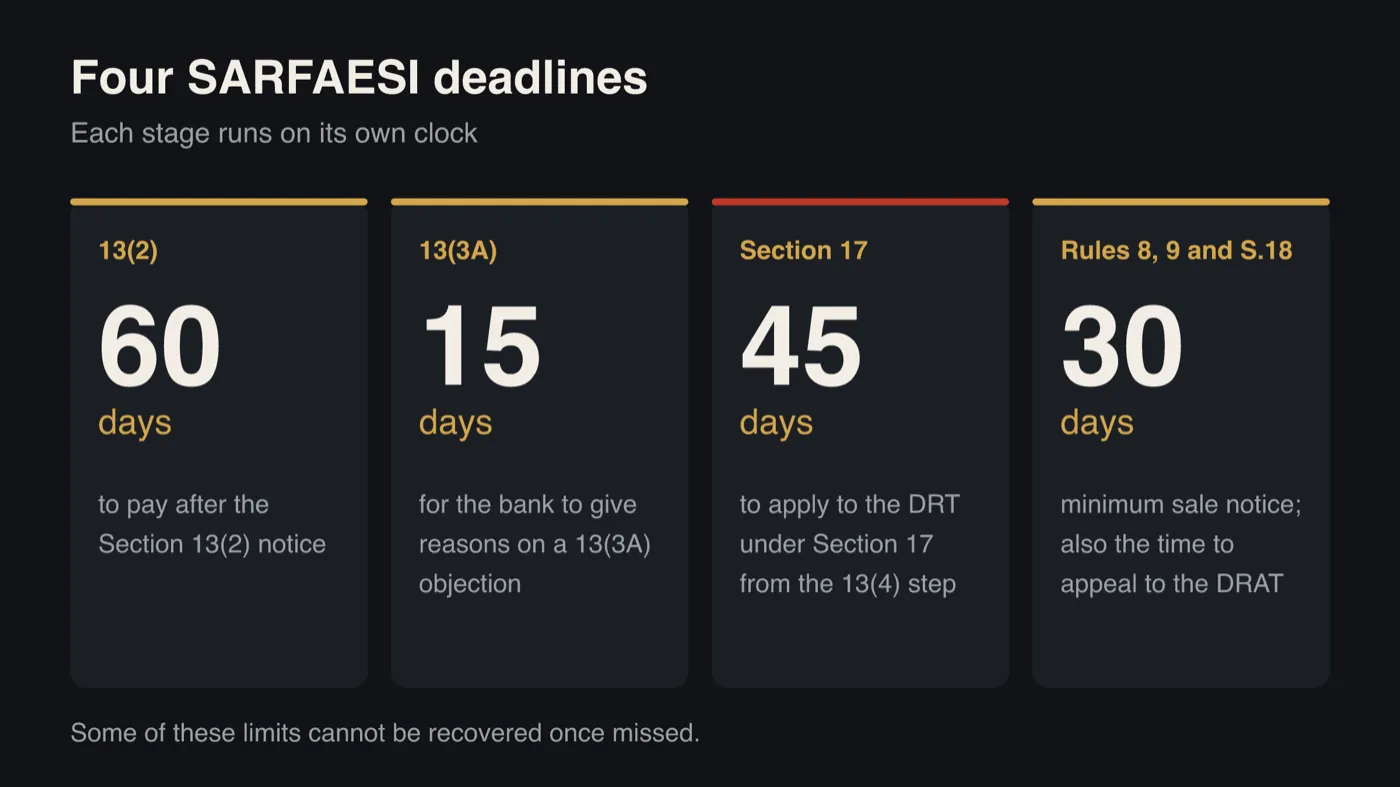
The four periods that run through a SARFAESI case
Each stage has its own clock, and missing one can close a remedy.
Which SARFAESI paper have you received from the bank?
Pick the latest paper in your hand to see the usual stage, forum and remedy. This is general information, not advice on your file.
Choose one of the options above.
The SARFAESI timeline from NPA to sale certificate
The Act lets a secured creditor act without a civil suit, but each stage has its own notice and time limit.
The bank classifies the loan as a non-performing asset under RBI norms. Only after this can it start Section 13 action.
The notice must state the amount due and the secured assets. Read it for errors in amount, parties and service. See our guide on challenging a 13(2) or 13(4) notice.
The borrower can object, and the bank must consider it and give reasons if it rejects it. The Supreme Court held this duty to be mandatory in ITC Ltd v. Blue Coast Hotels (2018) 15 SCC 99.
The bank takes possession, often symbolically under Rule 8. The 45-day period to apply to the DRT runs from this step. Read how to defend a Section 13(2) and 13(4) notice.
If physical possession is needed, the bank applies to the CMM or District Magistrate. See defending a Section 14 order. A valuation, a Rule 8(6) and 9 sale notice, the auction and the sale certificate follow, and the DRT stay on auction is often sought before the sale.
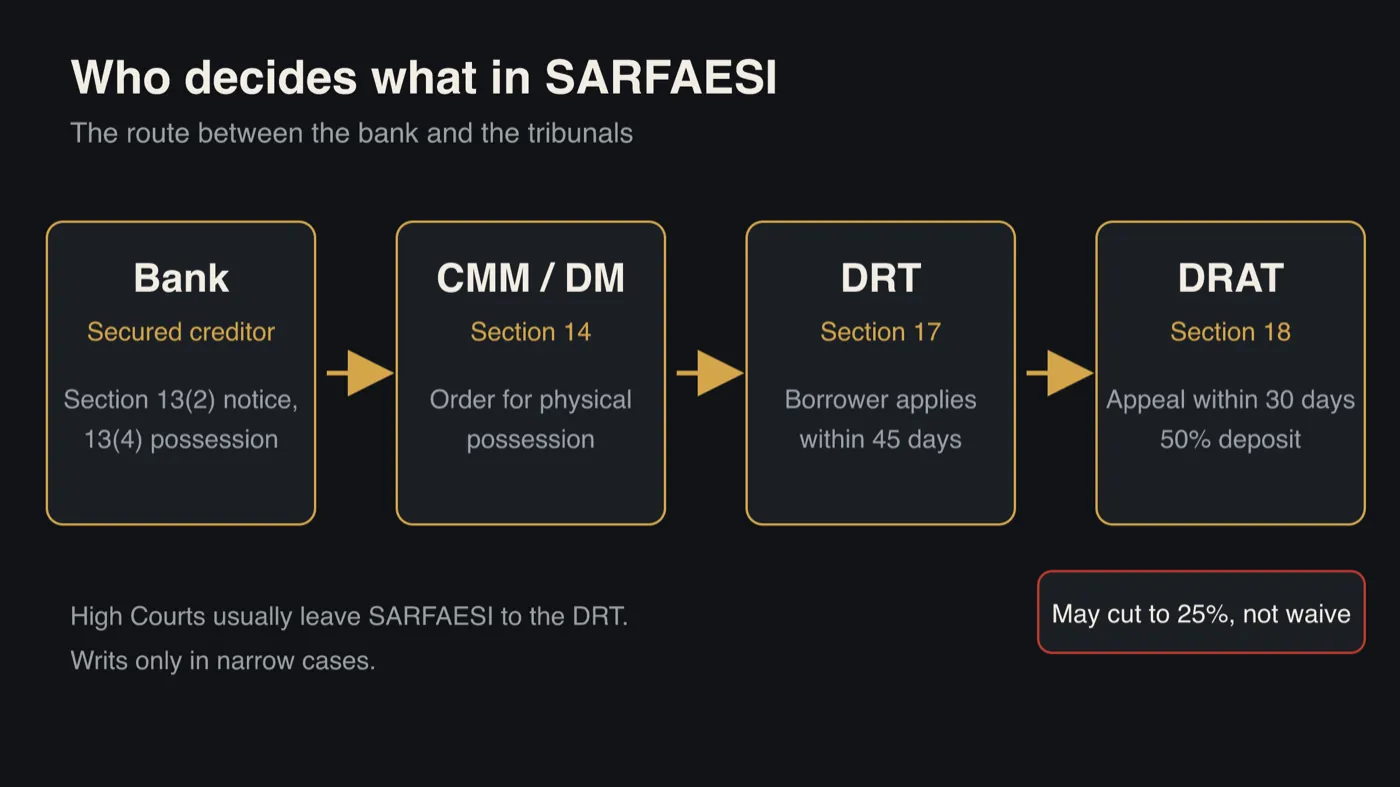
The Section 17 application goes to the DRT and the Section 18 appeal to the DRAT. A writ in the Calcutta High Court is allowed only in exceptional cases. Our DRT advocate service in Kolkata page explains how we assist with these forums.
Three SARFAESI points that change outcomes. Tap a card
Under Section 13(8), as amended in 2016, you can pay all dues, costs and charges only before the auction notice is published. Celir LLP v. Bafna Motors (2023) and M. Rajendran v. KPK Oils (2025) apply this.
The Supreme Court has said High Courts should not hear SARFAESI writs where the DRT remedy exists. This was repeated in United Bank of India v. Satyawati Tondon (2010) and PHR Invent v. UCO Bank (2024).
Rules 8 and 9 notices are mandatory, with at least 30 days’ notice of sale. Mathew Varghese v. M. Amritha Kumar (2014) 5 SCC 610 treats a failure to give them as a ground to challenge the sale.
The stages of a SARFAESI action and where each remedy sits
Demand notice and your objection
The notice must state the amount due and the assets to be enforced. Within the 60 days you may object under Section 13(3A), and the bank must consider it and give reasons. A 13(2) notice cannot be challenged before the DRT on its own. See our note on legal defences against a Section 13(4) notice.
Possession notice and the CMM/DM order
If the dues are not paid, the bank may take possession, usually symbolic possession under Rule 8. For physical possession it applies to the Chief Metropolitan Magistrate or District Magistrate under Section 14. Read how to defend a Section 14 CMM/DM order.
Valuation, sale notice and auction
The property is valued, a reserve price is fixed and at least 30 days’ sale notice is given. Under Section 13(8), as amended in 2016, the right to pay all dues and keep the property ends when the auction notice is published. Sale notice defects are recognised grounds in the DRT.
DRT application and DRAT appeal
Borrowers, guarantors, tenants and other affected persons may apply to the DRT under Section 17 within 45 days. An appeal to the DRAT under Section 18 lies within 30 days and needs a deposit of 50% of the debt, which the DRAT may reduce to 25% but not waive. A stay of a bank auction in the DRT is sought through Section 17.
When the SARFAESI Act does not apply
- Security for a debt of up to ₹1 lakh
- Agricultural land that is actually used for farming
- Cases where less than 20% of the principal and interest remains unpaid
- Larger NBFCs (assets of ₹100 crore or more) can use the Act only for debts of ₹20 lakh and above
- Check the current notifications for housing finance companies, as High Courts have differed (verify)
- Each point depends on the facts, so verify against the bare Act before relying on it
Supreme Court rulings that shape every SARFAESI case
These decisions set out what a bank must do before it sells secured property, and what a borrower can still do about it. Read the full judgment before relying on any of them in your own matter.
2004
Act upheld; 75% pre-deposit struck down
The Supreme Court upheld the SARFAESI Act. It struck down the old Section 17(2), which made a borrower deposit 75% of the claim before approaching the DRT. It also held that the bank must consider the borrower’s reply to the demand notice and give its reasons. Parliament then added Section 13(3A) in 2004.
2010
High Courts should leave SARFAESI to the DRT
High Courts should not usually hear writ petitions against SARFAESI action when Sections 17 and 18 give an effective remedy. The Court said this rule applies even more strictly to the recovery of bank dues. A three-judge bench confirmed this view in 2024, allowing writs only in narrow cases such as lack of jurisdiction or breach of natural justice.
2011
DRAT cannot waive the Section 18 deposit
This appeal came from the Calcutta High Court. The Court held that the pre-deposit in the proviso to Section 18 must be paid before the DRAT can hear the appeal. The DRAT may reduce the deposit from 50% to 25% of the debt if it records reasons, but it cannot waive it, even where the DRT has not yet decided the debt.
2014
Rule 8 and 9 sale notices are mandatory
The Court held that the notice rules in Rules 8 and 9 of the Security Interest (Enforcement) Rules, 2002 must be strictly followed before secured property is sold. The borrower must get at least 30 days’ notice of the sale. If a sale fails, the bank needs a fresh notice and cannot rely on the old one, which has lapsed.
2018
The bank must answer a 13(3A) objection
Section 13(3A) is mandatory, not a formality: the secured creditor must consider the borrower’s objection to the Section 13(2) notice and give its reasons for rejecting it. The Court also held that land that is not actually farmed, even if called agricultural, does not fall within the Section 31(i) exclusion. The bank can enforce its security against such land.
2023
Right to redeem ends at auction notice
Reading Section 13(8) as amended in 2016, the Court held that the borrower’s right to pay all dues and keep the property ends on the date the auction notice is published under Rule 9(1). Paying after that date does not stop the sale. Under the old wording, the right lasted until the sale was completed.
From demand notice to DRT appeal: the SARFAESI sequence
Section 13(2) demand notice
Once the account is classified as an NPA, the bank sends a written notice asking for the full dues within 60 days. Check that it states the amount and the secured assets, names every borrower, guarantor and mortgagor, and was served as Rule 3 requires. Keep the envelope or tracking record.
Objection under Section 13(3A)
Within the 60 days, send a written objection. You may dispute the amount, the interest or the NPA date, make a settlement offer, or point to an exclusion such as agricultural land. The bank must reply with reasons within 15 days. You cannot take the 13(2) notice alone to the DRT; see challenging a 13(2) or 13(4) notice.
Section 13(4) possession and Section 14 order
After the 60 days the bank may take possession. This is usually symbolic possession under Rule 8, with notices on the property and in two newspapers. For physical possession the bank applies to the CMM in Kolkata city or the District Magistrate elsewhere. See defending a Section 14 CMM or DM order.
Valuation, sale notice and auction
An approved valuer values the property and the bank fixes a reserve price. The bank must give at least 30 days’ sale notice to the borrower and to the public. Your right to pay everything and keep the property ends when the auction notice is published. On stays, read challenging a bank auction in the DRT.
Section 17 application to the DRT
A borrower, guarantor, tenant or other affected person may apply to the DRT within 45 days of the Section 13(4) step. In West Bengal, check whether a Kolkata DRT or DRT Siliguri covers the property under the 16 December 2025 notification. Our DRT and banking matters page describes the chamber’s work in this forum.
Appeal to the DRAT, then the High Court
An appeal under Section 18 goes to the DRAT within 30 days, with a deposit of 50% of the debt that the DRAT may reduce to 25%. A DRAT order can then be challenged by a writ petition in the Calcutta High Court. The High Court hears a direct writ only in exceptional cases.
Before and after the auction notice is published
Section 13(8), as amended in 2016, makes the date of publication the turning point.
Pre-deposit for a DRAT appeal under Section 18, SARFAESI Act
Mistakes that cost borrowers their property
Letting the 45 days run out Count 45 days from the date of the Section 13(4) step. It is not settled whether the DRT can allow a late application, so treat the limit as fixed.
Paying after the auction notice appears Since the 2016 amendment to Section 13(8), the right to redeem ends when the sale notice is published (Celir LLP, 2023). Any settlement or one-time settlement (OTS) talks must finish before that date.
Ignoring the 13(2) notice Without a written objection under Section 13(3A), later challenges are weaker. Reply within the 60 days and keep proof of delivery.
Going straight to the High Court Writ petitions are usually dismissed because the DRT remedy exists (Satyawati Tondon, 2010). Start at the DRT unless an exceptional ground, such as lack of jurisdiction, applies.
Received a SARFAESI notice? Review it before the clock runs out
The time limits in this process are short and some cannot be extended, so the first step is to read the notice, note the date of each step and collect the loan papers, the statement of account, the bank’s notices and any reply you sent. Patra’s Law Chambers appears before the DRT, the DRAT and the Calcutta High Court in banking and recovery matters. Outcomes depend on the facts and the record, and nothing here promises a result. You can read about our Calcutta High Court writ practice or book a consultation to discuss your documents.
Book a ConsultationEstablished by a distinguished alumnus of IIT Kharagpur, Patra’s Law Chambers stands as a beacon of legal expertise in Kolkata & Delhi. Know more →

Kolkata Office
NICCO House, 6th Floor, 2 Hare Street
Kolkata-700001 (Near Calcutta High Court)
Delhi Office
4455/5, First Floor, Gali Shahid Bhagat Singh
Main Bazar Road, Paharganj, New Delhi-110055
Contact
[email protected]
+91 890 222 4444 / +91 7003 715 325
Frequently asked questions on the SARFAESI Act
It is the Securitisation and Reconstruction of Financial Assets and Enforcement of Security Interest Act, 2002. It lets banks and notified financial institutions take possession of and sell secured property, without a civil suit, once the loan becomes an NPA.
The notice gives 60 days from its date to pay the full amount demanded. If the borrower does not pay, the bank may take a step under Section 13(4). A reasoned objection under Section 13(3A) can be sent inside this period.
Not by itself. The DRT remedy under Section 17 opens once a Section 13(4) step is taken. Until then, the usual step is a written objection under Section 13(3A), which the bank must consider and answer with reasons within 15 days.
Section 17(1) allows 45 days from the date the Section 13(4) step was taken. Whether the DRT can condone delay beyond 45 days is unsettled, so treat the period as fixed and file early, verifying the date of the step.
Yes, if Rules 8 and 9 are followed, including at least 30 days’ notice of sale. A CMM or District Magistrate order under Section 14 is needed only when the bank wants official help to take physical possession.
Under Section 13(8), as amended in 2016, the borrower can pay all dues, costs and charges before the notice for public auction, tender or private treaty is published. After publication, the right to redeem ends. Verify the date from the newspaper notice.
Section 18 requires a deposit of 50% of the debt claimed by the secured creditor or found by the DRT, whichever is less. The DRAT may reduce it to 25% with reasons but cannot waive it, as held in Narayan Chandra Ghosh v. UCO Bank.
Section 31 excludes agricultural land and security for a debt up to Rs 1 lakh. It also excludes cases where less than 20% of principal and interest is unpaid. For larger NBFCs, a higher minimum debt applies by notification, so check the current figure.