Analysis of Review Jurisdiction in the Supreme Court of India
Creditor and contributor of this article:
Patra’s Law Chambers:
About Us:
Patra’s Law Chambers is a law firm with offices in Kolkata & Delhi, offering comprehensive legal services across various domains. Established in 2020 by Advocate Sudip Patra (Advocate, Supreme Court of India & Calcutta High Court) an alumnus of the Prestigious Rajiv Gandhi School of Intellectual Property Law, IIT Kharagpur ,with Post Graduate diploma in Business Law from IIM Calcutta, the firm specializes in Civil, Criminal, Writs,High Court Matters, Trademark, Copyright, Company, Tax, Banking, Property disputes, Service law, Family law, and Supreme Court matters.You can know more about us in here
Delhi Office:
House no: 4455/5, First Floor, Ward No. XV, Gali Shahid
Bhagat Singh, Main Bazar Road, Paharganj, New Delhi-110055
Kolkata Office:
NICCO HOUSE, 6th Floor, 2, Hare Street, Kolkata-700001 (Near Calcutta High Court)
Website: www.patraslawchambers.com
Email: [email protected]
Phone: +91 890 222 4444/ +91 7003 715 325
Resources: REVIEW JURISDICTION IN THE SUPREME COURT OF INDIA.pdf
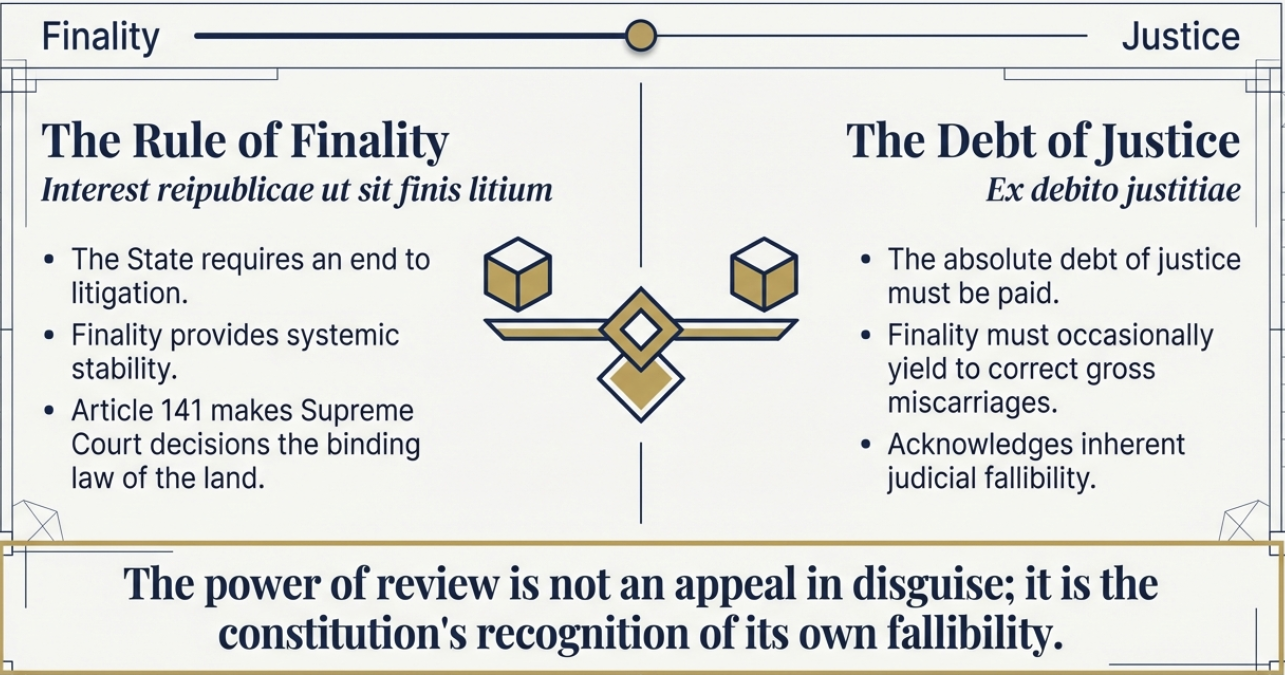
The judicial architecture of India, established under a written Constitution, positions the Supreme Court as the final arbiter of law and the ultimate protector of fundamental rights. In this capacity, the Court’s decisions carry the weight of finality and the force of law under Article 141 of the Constitution. However, the legal system acknowledges that the pursuit of absolute finality must occasionally yield to the higher demand for absolute justice. This acknowledgment is manifested in the power of the Supreme Court to review its own judgments and orders, a specialized jurisdiction primarily anchored in Article 137 of the Constitution of India.1 This review power is not intended to provide a second opportunity for a losing litigant to re-argue their case, nor is it an appeal in disguise; rather, it is a narrow, corrective mechanism designed to rectify patent errors that would otherwise lead to a gross miscarriage of justice.3 The evolution of this power reflects a sophisticated balance between the principle of interest reipublicae ut sit finis litium—that it is in the interest of the State that there be an end to litigation—and the principle of ex debito justitiae, which mandates that the debt of justice must be paid even at the cost of finality.6
The Constitutional Architecture: Article 137 and the Regulation of Power
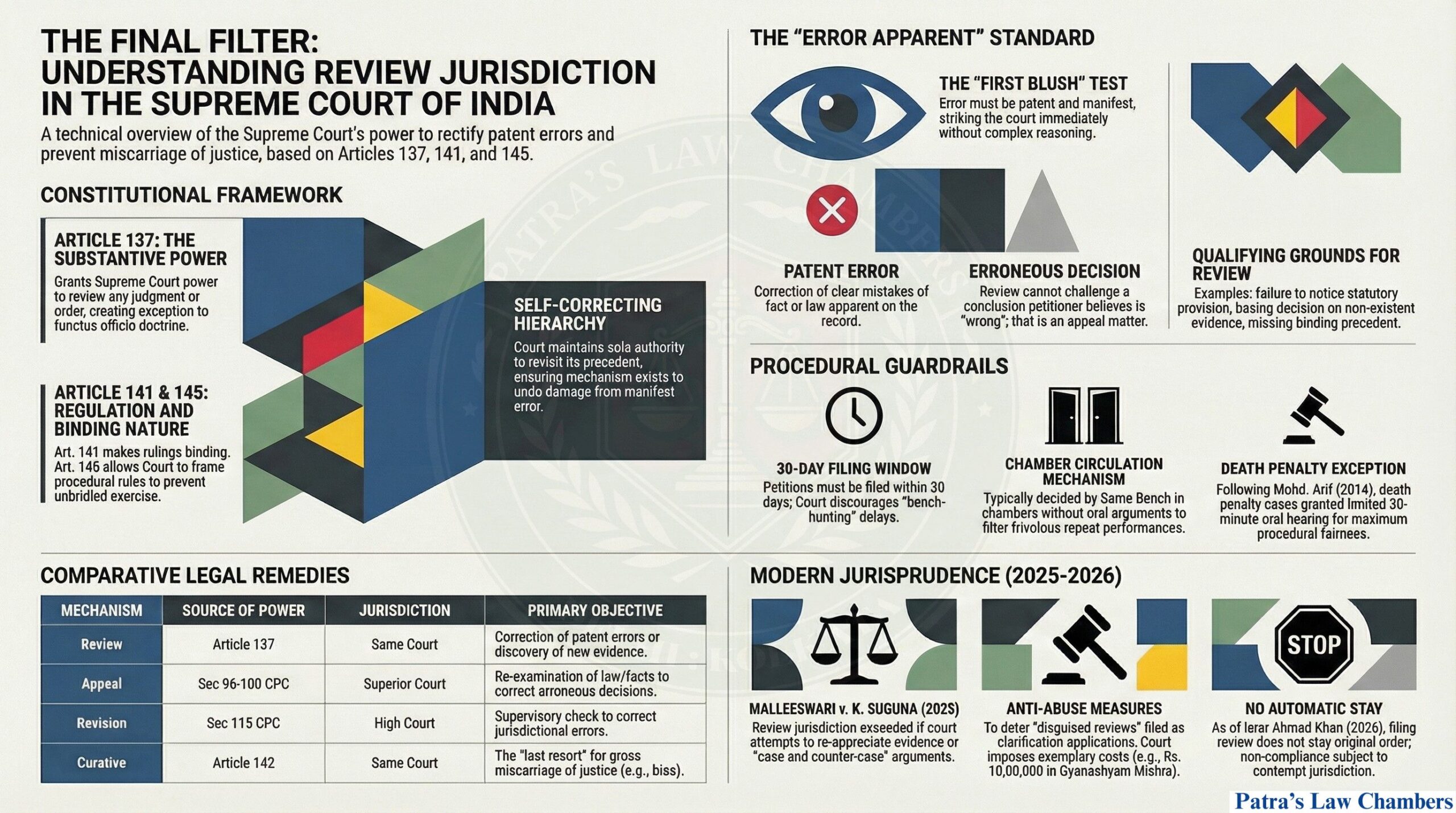
The power of the Supreme Court to review its own decisions is a departure from the traditional common law doctrine of functus officio, which holds that once a court has delivered its final judgment and signed the decree, its authority over the matter is exhausted and it cannot revisit the merits of the decision.9 Article 137 was explicitly incorporated into the Constitution to carve out a limited exception to this doctrine for the highest court, recognizing that as the court of last resort, there is no higher forum to correct its fallibility.1 The article provides that, subject to the provisions of any law made by Parliament or any rules made under Article 145, the Supreme Court shall have the power to review any judgment pronounced or order made by it.1
The phrasing of Article 137 is significant for its layered approach to regulation. It subordinates the review power to two separate authorities: Parliamentary legislation and the Supreme Court’s own rule-making power under Article 145.1 In the absence of a specific Act of Parliament governing the review of Supreme Court decisions, the jurisdiction is governed by the Supreme Court Rules, 2013, which replaced the 1966 rules.13 This regulatory framework ensures that the review power is not exercised in an unbridled manner but is confined within predictable and strict procedural boundaries. The necessity of such power is rooted in the “compulsion of judicial conscience” to correct errors, as famously noted in M.S. Ahlawat v. State of Haryana, because to perpetuate an error in the final court would be to institutionalize injustice.2
The constitutional framework also contemplates the interaction between Article 137 and Article 141. While Article 141 makes the law declared by the Supreme Court binding on all courts within the territory of India, Article 137 ensures that if the law declared is itself based on a manifest error, the Court has the mechanism to undo the damage.1 This creates a self-correcting hierarchy where the Supreme Court remains the sole authority capable of revisiting its own precedent, thereby maintaining the stability of the legal order while allowing for necessary refinement.
| Constitutional Provision | Legal Function and Scope |
| Article 137 | Primary source of substantive power for the Supreme Court to review its own judgments and orders. 1 |
| Article 141 | Declares Supreme Court judgments as binding law; review ensures this law remains accurate and just. 11 |
| Article 145 | Grants the Court power to frame procedural rules, including those governing review petitions. 3 |
| Article 129 | Declares the Supreme Court as a ‘Court of Record’, inherently possessing powers to correct its records. 16 |
| Article 142 | Grants plenary power to do ‘complete justice’, often invoked alongside review to rectify errors. 15 |
Procedural Harmonization: The Supreme Court Rules and the Code of Civil Procedure
The practical exercise of review jurisdiction is detailed in Order XLVII of the Supreme Court Rules, 2013.13 These rules harmonize the constitutional grant of power with the long-established principles of civil procedure. Rule 1 of Order XLVII explicitly states that in civil proceedings, an application for review shall be entertained only on the grounds mentioned in Order XLVII Rule 1 of the Code of Civil Procedure (CPC), 1908.13 This incorporation of the CPC grounds is vital because it provides a predictable standard of “reasonable doubt” and “patent error” that has been interpreted by courts for over a century.
Section 114 of the CPC provides the substantive right of review to any person aggrieved by a decree or order from which an appeal is allowed but not preferred, or from which no appeal is allowed.5 However, Section 114 does not itself list the grounds; it refers back to the limitations provided in Order 47 Rule 1 of the CPC.19 These grounds are limited to the discovery of new and important matter or evidence, a mistake or error apparent on the face of the record, or any other sufficient reason.1 In the context of the Supreme Court, these grounds are applied with even greater rigor to maintain the finality of the apex court’s verdicts.
The rules also prescribe a strict time limit for filing a review petition. Under Order XLVII Rule 2, a petition must be filed within thirty days from the date of the judgment or order sought to be reviewed.3 While the Court possesses the discretionary power to condone delays under the Limitation Act or its inherent powers, it has recently expressed severe dissatisfaction with litigants who deliberately wait for a judge’s retirement before filing a delayed review—a practice aimed at “bench-hunting” for a more sympathetic composition.21
The Anatomy of an Error: Defining the “Apparent on the Face of the Record” Standard
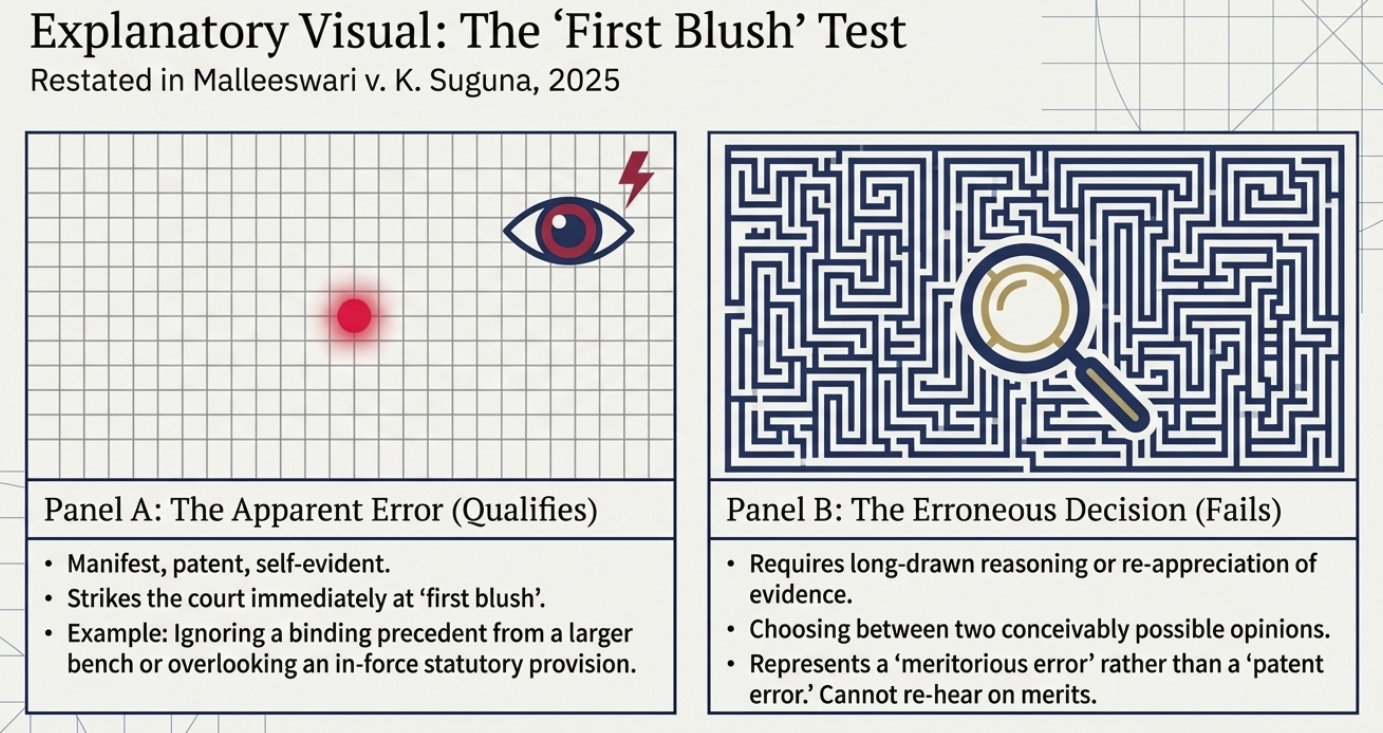
The most critical and frequently litigated ground for review is the existence of an “error apparent on the face of the record”.2 The judiciary has spent decades refining this definition to distinguish it from a mere “wrong decision” or an “erroneous conclusion.” An error is deemed “apparent” only when it is patent, manifest, and does not require a long-drawn process of reasoning to be identified.2 In the recent Restatement of Principles in Malleeswari v. K. Suguna (2025), the Supreme Court emphasized that an error is not apparent if it has to be established by complex arguments on points where two opinions are conceivably possible.4
The “First Blush” test is often employed: if the error strikes the court immediately upon looking at the record, it qualifies for review.2 For instance, if the court failed to notice a statutory provision that was clearly in force, or if it based its decision on a document that was not part of the evidence, or if it missed a binding precedent from a larger bench, these are considered errors apparent on the face of the record.3 Conversely, if the court has weighed the evidence and reached a conclusion that the petitioner believes is incorrect, that is an “erroneous decision” which is the subject matter of an appeal, not a review.2 A review court does not sit in appeal over its own order, and a re-hearing of the matter on merits is strictly impermissible.4
The 2025 decision in Malleeswari further clarified that review jurisdiction is exceeded if the court attempts to substitute its view by re-appreciating the evidence or the “case and counter-case” of the parties.4 This highlights the protective nature of the review power—it is a shield against accidental judicial fallibility, not a sword for re-litigating a lost cause. The distinction between a “meritorious error” and a “patent error” is the boundary that prevents the Supreme Court from falling into an infinite loop of litigation.
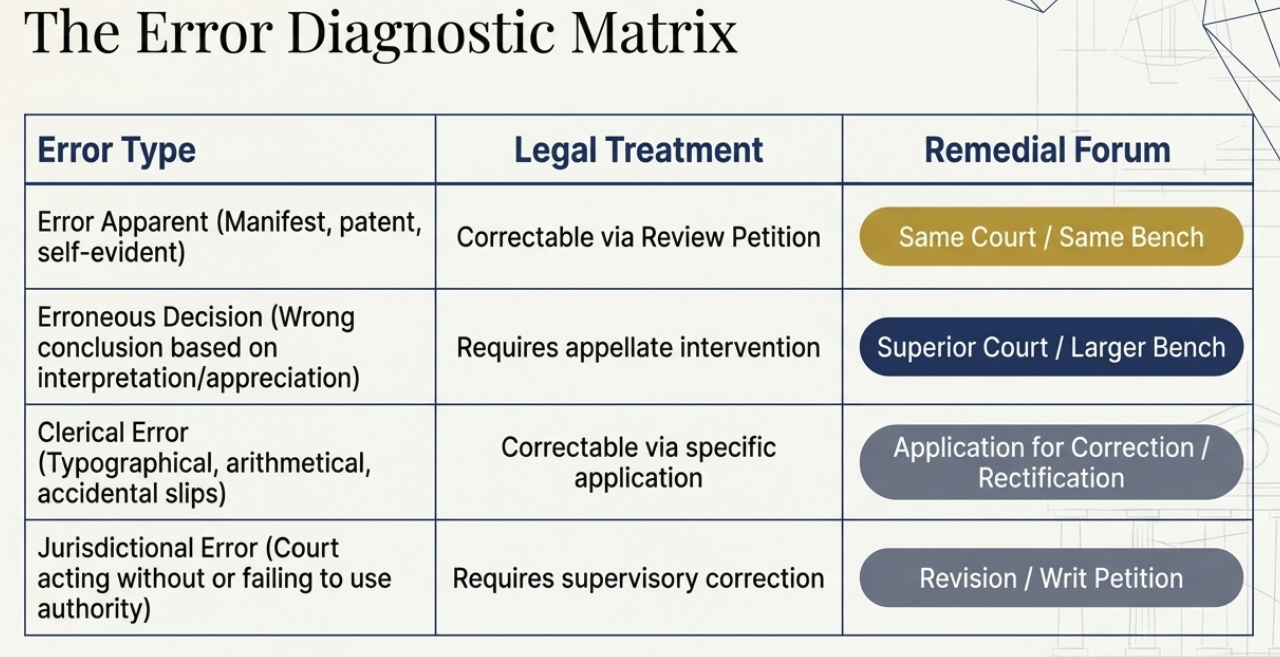
| Type of Error | Legal Treatment | Remedial Forum |
| Error Apparent | Manifest, patent, self-evident error of fact or law. 2 | Review Petition (Same Court) 2 |
| Erroneous Decision | Wrong conclusion based on interpretation or appreciation. 2 | Appeal (Superior Court/Larger Bench) 27 |
| Clerical Error | Typographical, arithmetical, or accidental slips. 10 | Application for Correction/Rectification 27 |
| Jurisdictional Error | Court acting without authority or failing to use it. 19 | Revision/Writ Petition 26 |
The Dichotomy of Civil and Criminal Review: Differing Thresholds of Justice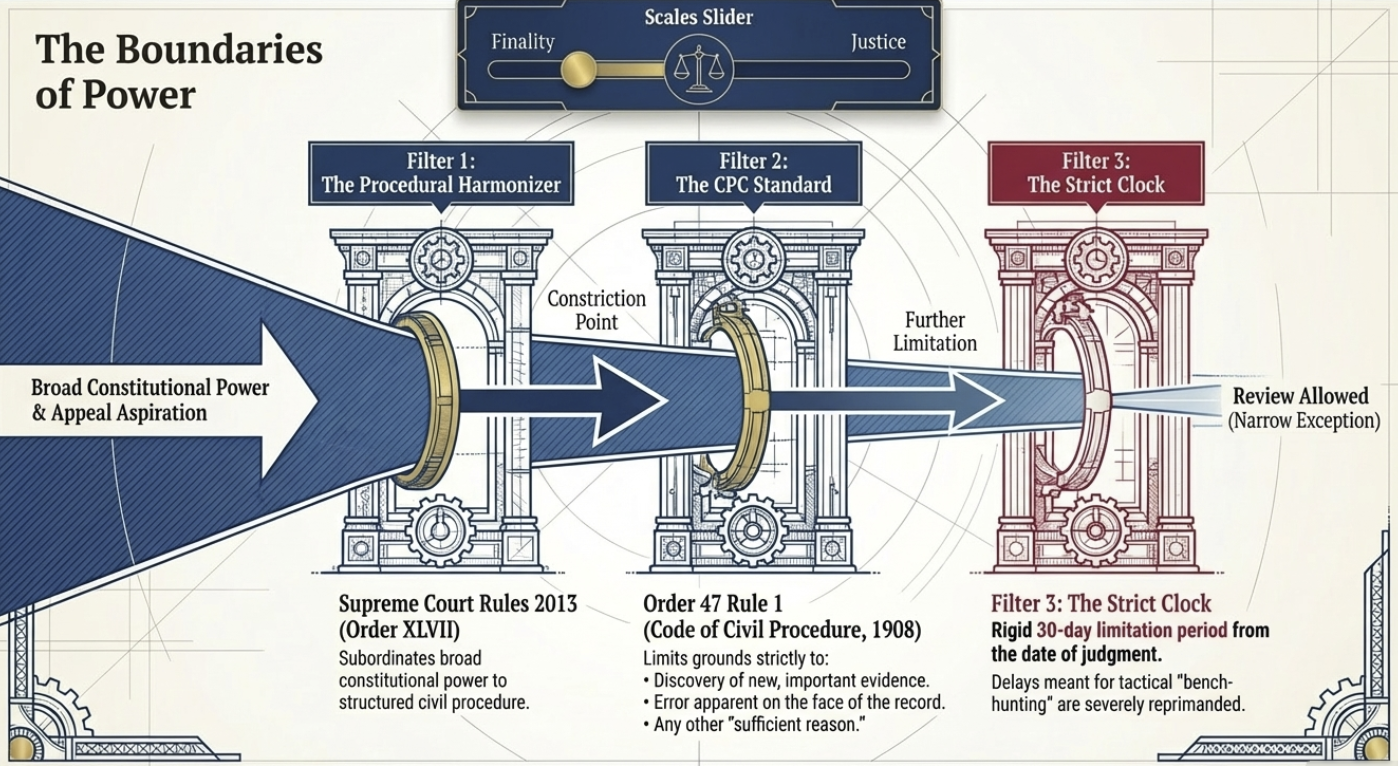
A significant nuance in the Supreme Court’s review power lies in the distinction between civil and criminal proceedings. While civil reviews can be sought on the broad grounds of Order 47 Rule 1 CPC, criminal reviews are subject to a much tighter constraint.2 Under the Supreme Court Rules, a review in a criminal case is maintainable only on the ground of an error apparent on the face of the record.2 This reflects the high premium placed on finality in criminal law, where the freedom and life of individuals are at stake, and where the legal system must provide a definite end to the prosecution process.
In criminal law, Section 362 of the CrPC imposes a near-absolute bar on any court altering or reviewing its signed judgment, except to correct clerical or arithmetical errors.10 While Article 137 of the Constitution allows the Supreme Court to override this bar, the Court exercises this power with extreme caution. In Vikram Bakshi v. R.P. Khosla (2021/2025), the Supreme Court reaffirmed that once a criminal judgment is signed, the court becomes functus officio.10 The judgment systematized the five exceptional circumstances where a criminal court might revisit its order, even without an express statutory review power, such as when the order was obtained by fraud on the court, when there was a lack of inherent jurisdiction, or when a palpable mistake caused significant prejudice.29
The sensitivity of criminal cases, particularly those involving the death penalty, led to a landmark shift in procedure. In Mohd. Arif @ Ashfaq v. The Registrar, Supreme Court of India (2014), the Court held that in cases where the death penalty is awarded, it is necessary to accord an oral hearing in open court for the review petition, limited to thirty minutes.13 This is an exception to the general rule that review petitions are decided by circulation in chambers without oral arguments, emphasizing that when a human life is at stake, the principle of finality must be tempered by the most rigorous procedural fairness.13
The Doctrine of the “Same Bench” and the Circulation Mechanism
The procedural unique characteristic of a review petition in the Supreme Court is the “circulation” mechanism. Unlike most legal proceedings that involve open-court arguments, a review petition is, as far as practicable, circulated to the same bench of judges that delivered the original judgment.3 This is based on the logic that the judges who originally decided the case are best equipped to recognize if they have committed a patent error or overlooked a material fact.22
This “Same Bench” rule is codified in Order XLVII Rule 3 of the Supreme Court Rules, 2013.13 However, the reality of judicial retirement often necessitates the constitution of a new bench. If one or more judges of the original bench have retired, the Chief Justice of India assigns the review to a new bench.13 This transition has occasionally been critiqued for encouraging “bench-hunting,” where litigants delay their review filings until a particular judge retires, hoping that a newly constituted bench might take a different view on the merits—a practice the Court described in Vanashakti v. Union of India as an abuse of process.21
The circulation procedure is intended to save the Court’s time and filter out frivolous petitions.17 Only if a majority of the judges on the bench find that there is a prima facie error apparent on the record will they issue a notice and, if necessary, list the matter for an oral hearing in open court.13 This mechanism ensures that the Court’s limited resources are not consumed by repetitive arguments that have already been considered and rejected.
The Evolution of Judicial Restraint: From Sow Chandra Kante to Kamlesh Verma
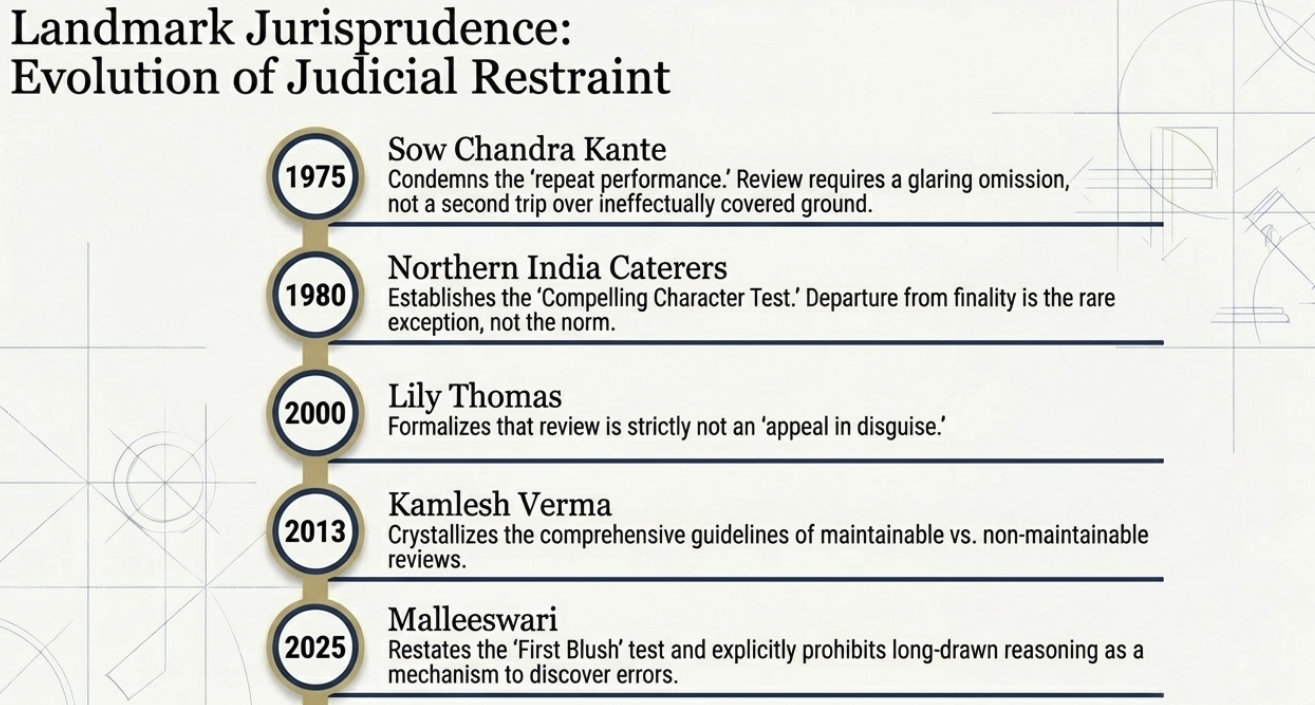
The jurisprudential history of review petitions is marked by a consistent effort by the Supreme Court to discourage the “repeat performance” of arguments. In the classic case of Sow Chandra Kante v. Sheikh Habib (1975), Justice V.R. Krishna Iyer noted with characteristic eloquence that a review is a “serious step and reluctant resort to it is proper only where a glaring omission or patent mistake has crept in”.37 He warned that a “second trip over ineffectually covered ground” is insufficient and that the review petition should not be used as a “passport” for a repeat performance of overruled arguments.37
This philosophy was further entrenched in Northern India Caterers (India) Ltd. v. Lt. Governor of Delhi (1980), where the Court held that the principle of finality is the norm, and departure from it is justified only by “circumstances of a substantial and compelling character”.3 The Court clarified that if its attention was not drawn to a material statutory provision, it would review its judgment, but not simply because the petitioner wants a “fresh decision”.3
By the time of Kamlesh Verma v. Mayawati (2013), the principles governing review jurisdiction were crystallized into a comprehensive summary. The Court emphasized that a review is not an appeal in disguise and that the mere possibility of two views on a subject is not a ground for review.23 These cases collectively establish that while the power of review is wide enough to correct errors, it is narrow enough to prevent the re-opening of decided issues based on a change in counsel or a subsequent realization of a better argument.
| Leading Case | Key Legal Doctrine Established |
| Sow Chandra Kante (1975) | Condemned “repeat performance” and insisted on “glaring omission” for review. 37 |
| Northern India Caterers (1980) | Established the “substantial and compelling character” test for departure from finality. 3 |
| Lily Thomas (2000) | Ruled that review is not an “appeal in disguise” and is not an inherent power. 2 |
| Kamlesh Verma (2013) | Provided a comprehensive list of what constitutes a maintainable vs. non-maintainable review. 23 |
| Malleeswari (2025) | Restated the “First Blush” test; prohibited “long-drawn reasoning” to find an error. 4 |
Contemporary Challenges: Disguised Reviews and the Abuse of Process
A modern challenge to the integrity of the review mechanism is the increasing tendency of litigants to file “miscellaneous applications” for clarification, modification, or recall of judgments.35 These applications are often “disguised reviews” intended to circumvent the chamber circulation procedure and obtain an oral hearing in open court.35 The Supreme Court has repeatedly deprecated this practice as an abuse of the judicial process.
In Gyanashyam Mishra and Sons Pvt. Ltd. v. Edelweiss Asset Reconstruction Company Ltd. (2022), the Court found that such applications were a “total abuse of process of law” and wasted valuable judicial time.35 To signal its intolerance for such maneuvers, the Court imposed exemplary costs of Rs. 10,00,000/- (Ten Lakhs) on the applicants.35 The logic is simple: what cannot be done directly (seeking a merit-based re-hearing via review) cannot be permitted to be done indirectly via a modification plea.35
The doctrine of substance over nomenclature governs these cases. If the substance of a “clarification” plea is a request for the Court to change its mind on the merits, it will be treated as a review petition and subjected to the same rigorous threshold.35 Similarly, the Court has held that a “recall” application can only be maintained in exceptional circumstances, such as when the order was passed without jurisdiction or obtained by fraud, but not because the party is unhappy with the outcome.35
The Extraordinary Remedy: Curative Jurisdiction and the Debt of Justice
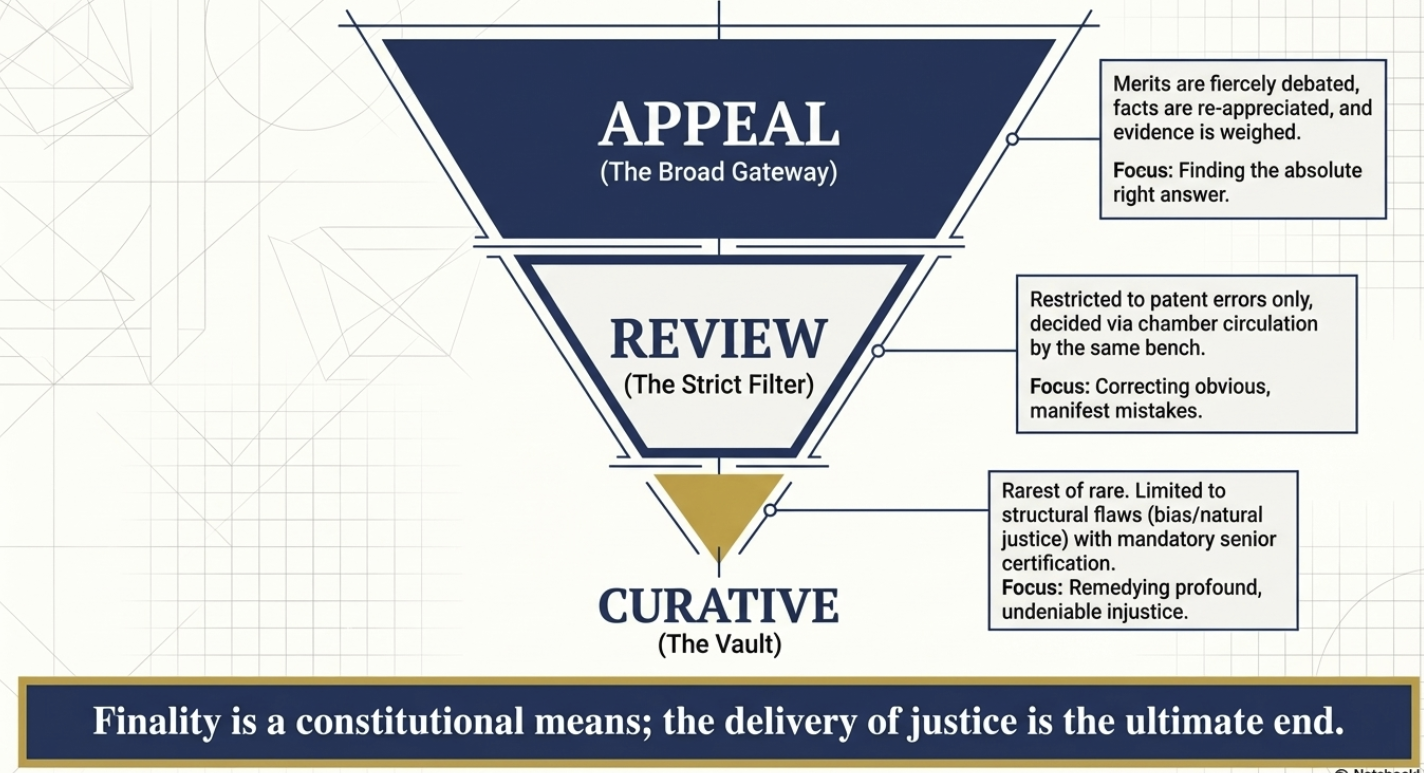
When even the review petition is dismissed, and a gross miscarriage of justice remains unaddressed, the Indian legal system provides one final, extraordinary remedy: the Curative Petition. This concept was judicially evolved in Rupa Ashok Hurra v. Ashok Hurra (2002) as a response to the question of whether a final judgment could be challenged under Article 32.16 The Court ruled that while Article 32 cannot be used to challenge its own judgments, the Court’s “inherent power” under Article 142 and Article 129 allows it to “cure” a gross miscarriage of justice.16
The curative petition is the “last resort” and is available on extremely narrow grounds: violation of principles of natural justice (such as a party not being served notice) or an apprehension of bias (where a judge failed to disclose a conflict of interest).8 To ensure its rarity, the Court mandated that a curative petition must be accompanied by a certificate from a Senior Advocate regarding the fulfillment of these criteria.16 Like review petitions, curative petitions are first circulated in chambers to the three senior-most judges and the judges who passed the original judgment.11 Only if this multi-judge panel finds a compelling case for reconsideration will the matter be listed for a hearing.
This jurisdiction represents the ultimate triumph of ex debito justitiae over the finality of judgment.6 However, the Court has warned that curative petitions should not be used as a “second review” or a “third trip” over the same ground. It is an extraordinary remedy for extraordinary injustice, designed to be used “very sparingly” in the rarest of rare cases.8
Navigating the Corrective Maze: Comparison with Appeal, Revision, and Reference
To correctly invoke the review power, a professional must distinguish it from other corrective mechanisms under the CPC and the Constitution. Each serves a distinct purpose and operates under different jurisdictional rules.
| Mechanism | Source of Power | Jurisdiction | Primary Objective |
| Review | Article 137 / Order 47 CPC | Same Court (Same Judge) | Correction of patent errors or new evidence. 26 |
| Appeal | Statutory (Sections 96-100 CPC) | Superior Court (New Bench) | Re-examination of law and facts to correct erroneous decisions. 27 |
| Revision | Section 115 CPC | High Court | Supervisory check to correct jurisdictional errors by subordinate courts. 26 |
| Reference | Section 113 CPC | High Court | Consultative opinion on a legal doubt during a pending case. 44 |
| Presidential Reference | Article 143 Constitution | Supreme Court | Advisory opinion on questions of public importance referred by the President. 45 |
While review is “inward” (back to the same judge), appeal is “upward” (to a higher court), and revision is “supervisory” (by a High Court over a lower court).26 A particularly unique mechanism is the Presidential Reference under Article 143, where the President of India seeks the Supreme Court’s advisory opinion on a question of law or fact.45 Interestingly, in the 2025 Presidential Reference regarding the Governor of Tamil Nadu’s delay in bill assent, the Court noted that while Article 143 is advisory, its opinion can “influence” or effectively overrule a prior decision if necessary, serving as a high-level alternative to the review process in constitutional matters.15
Contemporary Trends and 2025-2026 Jurisprudence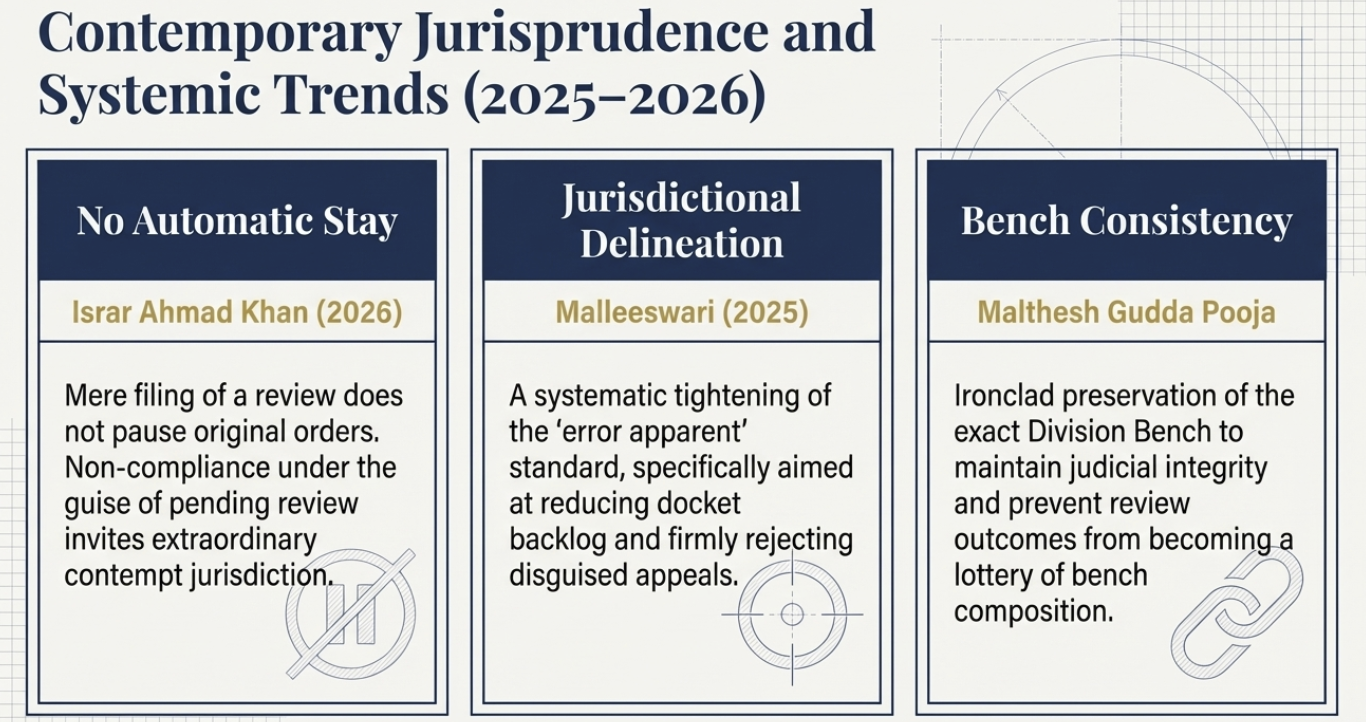
The recent years have seen a sharpening of the Court’s approach to review petitions. In the 2025-2026 period, several cases have reinforced the limits of this power. For instance, in Israr Ahmad Khan v. Richa Sharma (2026), the Court emphasized that the mere filing of a review petition does not act as a stay on the implementation of the original order.47 Contemnors who fail to comply with orders under the guise of a pending review are subject to the Court’s “extraordinary and inherent contempt jurisdiction”.47 This clarifies that review is a legal remedy, not a tactical shield for non-compliance.
Furthermore, the 2025 decision in Malleeswari v. K. Suguna restated that “the approach to the error pointed out warrants a review of the precedents on the point,” suggesting that the Court is becoming more systematic in applying the “error apparent” standard.5 This trend toward “jurisdictional delineate” is intended to reduce the backlog of review dockets and focus judicial resources on cases where a genuine patent error has occurred.
The Court is also increasingly addressing “bench consistency” issues. In Malthesh Gudda Pooja v. State of Karnataka, the Supreme Court upheld the importance of the same Division Bench hearing the review, unless original members are completely unavailable due to death or retirement.34 This preserves the “judicial integrity” of the original decision-making process and prevents the review from becoming a lottery based on bench composition.23
Future Trajectories and the Finality of the Highest Court
The power of the Supreme Court to review its own order remains a cornerstone of the Indian judicial system, embodying the humility of a court that acknowledges its own fallibility. As the Court navigates the complexities of modern litigation—ranging from massive corporate disputes like the Vodafone tax case to sensitive constitutional references on federal structure—the review petition serves as the final filter for truth.12
The future of review jurisdiction likely lies in greater procedural efficiency and stricter gatekeeping. The imposition of high costs for frivolous applications, the mandatory certification by AoRs and Senior Advocates, and the “circulation” mechanism are all designed to protect the “precious public time” of the apex court.35 However, the window for correcting a “manifest wrong” will never be completely closed, as the duty to “do full and effective justice” is a constitutional mandate that transcends the convenience of finality.3
Ultimately, the power of review is a testament to the fact that in the eyes of the Indian Constitution, the finality of a judgment is a means, and the delivery of justice is the end. Article 137 ensures that the Supreme Court of India remains not only the most powerful court in the land but also the most reflective, possessing the constitutional courage to say, when necessary, that it was wrong and to set the law right for the nation.1
Frequently Asked Questions: Review Jurisdiction of the Supreme Court of India
Q: What is the Review Jurisdiction of the Supreme Court? A: Under Article 137 of the Indian Constitution, the Supreme Court has the specialized power to review its own judgments and orders. This is a narrow, corrective mechanism meant to rectify patent errors that would otherwise cause a gross miscarriage of justice. It is not an appeal in disguise, nor is it a second opportunity for a losing litigant to re-argue their case.
Q: What are the grounds for filing a review petition? A: The grounds differ based on the type of proceeding. For civil proceedings, the grounds are based on the Code of Civil Procedure (CPC) and include the discovery of new and important evidence, a mistake or error apparent on the face of the record, or any other sufficient reason. For criminal cases, the threshold is much stricter; a review is maintainable only on the ground of an error apparent on the face of the record.
Q: What does “error apparent on the face of the record” mean? A: The Supreme Court uses the “First Blush” test to determine this. An error is considered apparent only if it is manifest, patent, and strikes the court immediately upon looking at the record. It cannot be established through complex arguments or a long-drawn process of reasoning. Examples include the court missing a binding precedent from a larger bench or failing to notice a statutory provision that was clearly in force.
Q: Is there a time limit for filing a review petition? A: Yes. Under the Supreme Court Rules, a review petition must be filed within thirty days from the date of the judgment or order that is sought to be reviewed.
Q: How are review petitions heard by the Court? A: Review petitions are uniquely handled through a “circulation” mechanism, meaning they are circulated in chambers to the “Same Bench” of judges who delivered the original judgment. They are generally decided without oral arguments in an open court. However, a major exception exists for cases where the death penalty has been awarded; in these instances, the Court allows an oral hearing in open court limited to thirty minutes.
Q: Can a litigant file other applications to get a hearing instead of a review petition? A: No. The Supreme Court has strongly condemned the practice of filing “miscellaneous applications” for clarification, modification, or recall of judgments as a way to bypass the strict review rules and secure an open-court hearing. The Court considers these “disguised reviews” to be a total abuse of the judicial process and has imposed exemplary costs—such as Rs. 10 Lakhs—on applicants who attempt this maneuver.
Q: Does filing a review petition stop the execution of the original judgment? A: No. The mere filing of a review petition does not act as a stay on the implementation of the original order. Litigants who use a pending review as a tactical shield to not comply with an order can face extraordinary contempt proceedings.
Q: What can be done if a review petition is dismissed but a severe injustice remains? A: If a review petition is dismissed, the Indian legal system offers one final, extraordinary remedy called a Curative Petition. Established as a last resort, it is available only on extremely narrow grounds, such as a violation of the principles of natural justice (e.g., a party not being served notice) or an apprehension of bias by a judge.
Works cited
- Article 137 of Indian Constitution, Interpretation, Purpose – Vajiram & Ravi, accessed on March 9, 2026, https://vajiramandravi.com/current-affairs/article-137-of-indian-constitution/
- Supreme Court Reviewing its Own Judgments | LawTeacher.net, accessed on March 9, 2026, https://www.lawteacher.net/free-law-essays/administrative-law/supreme-court-reviewing-its-own-judgments-administrative-law-essay.php
- Review Petitions in the Supreme Court, accessed on March 9, 2026, https://www.scobserver.in/journal/review-petitions-in-the-supreme-court/
- SC restates principles for Review Jurisdiction grounds | SCC Times, accessed on March 9, 2026, https://www.scconline.com/blog/post/2025/09/09/supreme-court-restates-principles-for-review-jurisdiction-grounds/
- Review Jurisdiction to be Strictly Delineated – Supreme Court Observer, accessed on March 9, 2026, https://www.scobserver.in/supreme-court-observer-law-reports-scolr/malleeshwari-vs-suguna-and-anr-review-jurisdiction-to-be-strictly-delineated-scolr-judgement/
- Curative Petition: Last Remedy in the Court of Last Resort – INTERNATIONAL JOURNAL OF LAW MANAGEMENT & HUMANITIES, accessed on March 9, 2026, https://ijlmh.com/wp-content/uploads/Curative-Petition-Last-Remedy-in-the-Court-of-Last-Resort.pdf
- The institution of litigation cannot be permitted to confer any advantage on a party by delayed action of courts – Supreme Court | LAW RESOURCE INDIA, accessed on March 9, 2026, https://indialawyers.wordpress.com/2011/08/14/the-institution-of-litigation-cannot-be-permitted-to-confer-any-advantage-on-a-party-by-delayed-action-of-courts-supreme-court/
- r _……_ H – S3waas, accessed on March 9, 2026, https://cdnbbsr.s3waas.gov.in/s3ec0490f1f4972d133619a60c30f3559e/documents/aor_notice_circular/15.pdf
- Reference, Revision And Review – Legal Services India, accessed on March 9, 2026, https://www.legalservicesindia.com/article/2580/Reference,-Revision-And-Review.html
- Criminal court cannot review or recall their own judgments except for clerical errors, accessed on March 9, 2026, https://www.theedulaw.in/content/judgements/219/Criminal-court-cannot-review-or-recall-their-own-judgments-except-for-clerical-errors-
- 1 POWER TO REVIEW Under Article 137 of the constitution the Supreme Court has power to review any judgment pronounced or order, accessed on March 9, 2026, https://plutusias.com/wp-content/uploads/2024/10/POWER-OF-HIGH-COURT.pdf
- Review petition – Wikipedia, accessed on March 9, 2026, https://en.wikipedia.org/wiki/Review_petition
- Review Petition – Supreme Court Practice – Aegis Legal LLP, accessed on March 9, 2026, https://www.aegislegalllp.com/supreme-court-practice/review-petition.html
- Review Jurisdiction – Saral Legal Solutions, accessed on March 9, 2026, https://sarallegalsolutions.com/review-jurisdiction/
- The Supreme Court’s Decision on the Presidential Reference – Sanskriti IAS, accessed on March 9, 2026, https://www.sanskritiias.com/current-affairs/the-supreme-courts-decision-on-the-presidential-reference
- MANU_SC_0910_2002 – Manupatra Academy, accessed on March 9, 2026, http://www.manupatracademy.com/LegalPost/MANU_SC_0910_2002
- Indian Judiciary – S3waas, accessed on March 9, 2026, https://cdnbbsr.s3waas.gov.in/s3ec0490f1f4972d133619a60c30f3559e/uploads/2024/07/annual_report_2016-17.pdf
- Jurisdiction – Supreme Court of India, accessed on March 9, 2026, https://www.sci.gov.in/jurisdiction/
- An Analysis of powers of Review and Revision vested in Courts under Code of Civil Procedure, 1908 – MCO Legals, accessed on March 9, 2026, https://www.mcolegals.in/kb/An-Analysis-of-powers-of-Review-and-Revision-vested-in-Courts-under-Code-of-Civil-Procedure-1908.pdf
- Review Under The Code Of Civil Procedure, 1908 – IJCRT.org, accessed on March 9, 2026, https://www.ijcrt.org/papers/IJCRT2511067.pdf
- When benches start undoing benches – Supreme Court Observer, accessed on March 9, 2026, https://www.scobserver.in/journal/when-benches-start-undoing-benches/
- Re-Viewing Review Powers of the Supreme Court [Guest Post …, accessed on March 9, 2026, https://indconlawphil.wordpress.com/2026/02/19/re-viewing-review-powers-of-the-supreme-court-guest-post/
- [The Viewpoint] How final are decisions of the Supreme Court? – Bar and Bench, accessed on March 9, 2026, https://www.barandbench.com/view-point/how-final-are-decisions-of-the-supreme-court
- 24-12-2025 (txt) – Delhi High Court, accessed on March 9, 2026, https://delhihighcourt.nic.in/app/showFileJudgment/68024122025MATFC1602022_115933.txt
- 2013 ALL SCR 3411, Kamlesh Verma Vs. Mayawati & Ors. – NearLaw, accessed on March 9, 2026, https://nearlaw.com/PDF/SC/2013/2013-ALL-SCR-3411.html
- Reference, Review and Revision: An Insider Zinger to Unlock CPC, accessed on March 9, 2026, https://blog.ipleaders.in/reference-review-revision/
- Appeal, Review, Revision, Recall Explained | PDF | Judgment (Law) – Scribd, accessed on March 9, 2026, https://www.scribd.com/document/912992456/Difference-Between-Appeal-Review-Revision-Recall-1756693630
- What is Difference between Appeal and Revision – Testbook, accessed on March 9, 2026, https://testbook.com/key-differences/difference-between-appeal-and-revision
- Criminal Courts Can’t Reopen Their Own Judgments! – LILY THOMAS, accessed on March 9, 2026, https://lilythomas.net/criminal-courts-cant-reopen-their-own-judgments/
- Review of Review Not Maintainable: Indian Law Guide – SupremeToday AI, accessed on March 9, 2026, https://supremetoday.ai/issue/review-of-review-not-maintainable:-indian-law-guide
- Recall of Criminal Orders Beyond Clerical Errors Impermissible – Supreme Court Observer, accessed on March 9, 2026, https://www.scobserver.in/supreme-court-observer-law-reports-scolr/recall-of-criminal-orders-beyond-clerical-errors-impermissible-vikram-bakshi-v-r-p-khosla-perjury-application/
- Reaffirming the Finality of Criminal Orders: Supreme Court Clarifies Review Power under Section 362 CrPC and the Criminal Nature of Section 340 Proceedings – CaseMine, accessed on March 9, 2026, https://www.casemine.com/commentary/in/reaffirming-the-finality-of-criminal-orders:-supreme-court-clarifies-review-power-under-section-362-crpc-and-the-criminal-nature-of-section-340-proceedings/view
- Curative – Rarest Of Rare Case; An Extraordinary Jurisdiction Of …, accessed on March 9, 2026, https://www.livelaw.in/articles/curative-rarest-rare-case-extraordinary-jurisdiction-supreme-court-253701
- Malthesh Gudda Pooja v. State Of Karnataka: Establishing Bench Consistency in Review Petitions – CaseMine, accessed on March 9, 2026, https://www.casemine.com/commentary/in/malthesh-gudda-pooja-v.-state-of-karnataka:-establishing-bench-consistency-in-review-petitions/view
- Part I. Is ‘Recall’ of a final judgment of Supreme Court permissible …, accessed on March 9, 2026, https://advmuditjain.com/2023/05/08/is-recall-of-a-final-judgment-of-supreme-court-permissible-no/
- What are curative petitions and how to draft them – Lawsikho Blog, accessed on March 9, 2026, https://lawsikho.com/blog/what-is-curative-petition-and-how-to-draft-it/
- Sow Chandra Kanta And Another vs Sheik Habib on 13 March, 1975 – Indian Kanoon, accessed on March 9, 2026, https://indiankanoon.org/doc/1626241/
- Sow Chandra Kante And Another v. Sheikh Habib . | Supreme Court Of India – CaseMine, accessed on March 9, 2026, https://www.casemine.com/judgement/in/5609abb4e4b014971140d128
- Sow Chandra Kante vs Sheikh Habit – 1975 Supreme(SC) 116, accessed on March 9, 2026, https://supremetoday.ai/doc/judgement/00100016601
- Can You Seek Modification & Review of Same Order Simultaneously? – Supreme Today AI, accessed on March 9, 2026, https://supremetoday.ai/issue/can-you-seek-modification-%26-review-of-same-order-simultaneously%3F
- Supreme Court Establishes Precedent on Preventing Abuse of Process in Filing Repetitive Applications for Recall – CaseMine, accessed on March 9, 2026, https://www.casemine.com/commentary/in/supreme-court-establishes-precedent-on-preventing-abuse-of-process-in-filing-repetitive-applications-for-recall/view
- Rupa Ashok Hurra v. Ashok Hurra, AIR 2002 SC 177 – Aashayein Judiciary, accessed on March 9, 2026, https://www.alec.co.in/judgement-page/rupa-ashok-hurra-v-ashok-hurra-air-2002-sc-177
- Extraordinary Power of the Supreme Court: Curative Petition – IJFMR, accessed on March 9, 2026, https://www.ijfmr.com/papers/2024/4/25312.pdf
- Review, Revision, and Reference in Civil Procedure: Mechanisms for Reconsideration, accessed on March 9, 2026, https://thelaw.institute/introduction-to-law/civil-procedure-reconsideration-mechanisms-review-revision/
- Advisory Jurisdiction of Supreme Court Under Article – 143 – INTERNATIONAL JOURNAL OF LAW MANAGEMENT & HUMANITIES, accessed on March 9, 2026, https://ijlmh.com/wp-content/uploads/Advisory-Jurisdiction-of-Supreme-Court-Under-Article-%E2%80%93-143.pdf
- PRESIDENTIAL REFERENCES AND THE ADVISORY JURISDICTION OF THE SUPREME COURT: SCOPE, PRECEDENTS, AND CONSEQUENCES – Indian Journal of Integrated Research in Law, accessed on March 9, 2026, https://ijirl.com/wp-content/uploads/2025/06/PRESIDENTIAL-REFERENCES-AND-THE-ADVISORY-JURISDICTION-OF-THE-SUPREME-COURT-SCOPE-PRECEDENTS-AND-CONSEQUENCES.pdf
- Israr Ahmad Khan vs Ms. Richa Sharma on 24 February, 2026 – Indian Kanoon, accessed on March 9, 2026, https://indiankanoon.org/doc/179471194/