- Post-mortem report is a statutory, forensic cornerstone under the BNSS 2023 for proving cause and manner of death.
- Validate procedural requisites: police requisition, Inquest Panchanama, and WB Form No. 5371 before autopsy.
- Use post-mortem lividity and rigor mortis patterns to challenge alleged time since death and body movement claims.
- Differentiate ante-mortem versus post-mortem wounds via vital reaction to dispute staging or tampering.
- Exploit stomach contents, organ findings, and viscera preservation to corroborate or refute timelines and poisoning hypotheses.
- Interpret ligature mark morphology to distinguish suicidal hanging from homicidal strangulation.
- Cross-examine experts on margins of error for TSD, chain of custody, and methodological limits of tests like the diatom analysis.
A Comprehensive Guide to Post-mortem Examination Interpretation For Trial Advocates in West Bengal
Creditor and contributor of this article:
Patra’s Law Chambers:
About Us:
Patra’s Law Chambers is a law firm with offices in Kolkata & Delhi, offering comprehensive legal services across various domains. Established in 2020 by Advocate Sudip Patra (Advocate, Supreme Court of India & Calcutta High Court) an alumnus of the Prestigious Rajiv Gandhi School of Intellectual Property Law, IIT Kharagpur ,with Post Graduate diploma in Business Law from IIM Calcutta, the firm specializes in Civil, Criminal, Writs,High Court Matters, Trademark, Copyright, Company, Tax, Banking, Property disputes, Service law, Family law, and Supreme Court matters.You can know more about us in here
Kolkata Office:
NICCO HOUSE, 6th Floor, 2, Hare Street, Kolkata-700001 (Near Calcutta High Court)
Delhi Office:
House no: 4455/5, First Floor, Ward No. XV, Gali Shahid
Bhagat Singh, Main Bazar Road, Paharganj, New Delhi-110055
Website: www.patraslawchambers.com
Email: [email protected]
Phone: +91 890 222 4444/ +91 7003 715 325
RESOURCES: INFOGRAPHICS.PDF

The post-mortem examination, historically termed an autopsy, serves as the ultimate diagnostic bridge between clinical medicine and the pursuit of criminal justice. Within the Indian legal framework, particularly following the transformative shift from the Code of Criminal Procedure (CrPC) to the Bharatiya Nagarik Suraksha Sanhita (BNSS), 2023, the forensic autopsy has evolved from a mere corroborative document to a statutory pillar of investigation. For the criminal lawyer, the post-mortem report (PMR) is far more than a medical certificate; it is a complex narrative of a victim’s final moments, a chemical record of their physiological state, and a mechanical blueprint of the violence they endured. Understanding the nuances of this document—from the biochemical kinetics of rigor mortis to the ballistics of an exit wound—is essential for determining whether a death should be categorized as murder under Section 103 of the Bharatiya Nyaya Sanhita (BNS) or as a rash and negligent act under Section 106. This report provides an exhaustive analysis of forensic pathology tailored for legal professionals, focusing on the interpretation of autopsy findings, the structural integrity of the PMR, and the strategic exploitation of medical evidence in the courtroom.
The Statutory Evolution and Procedural Mechanics of the Autopsy
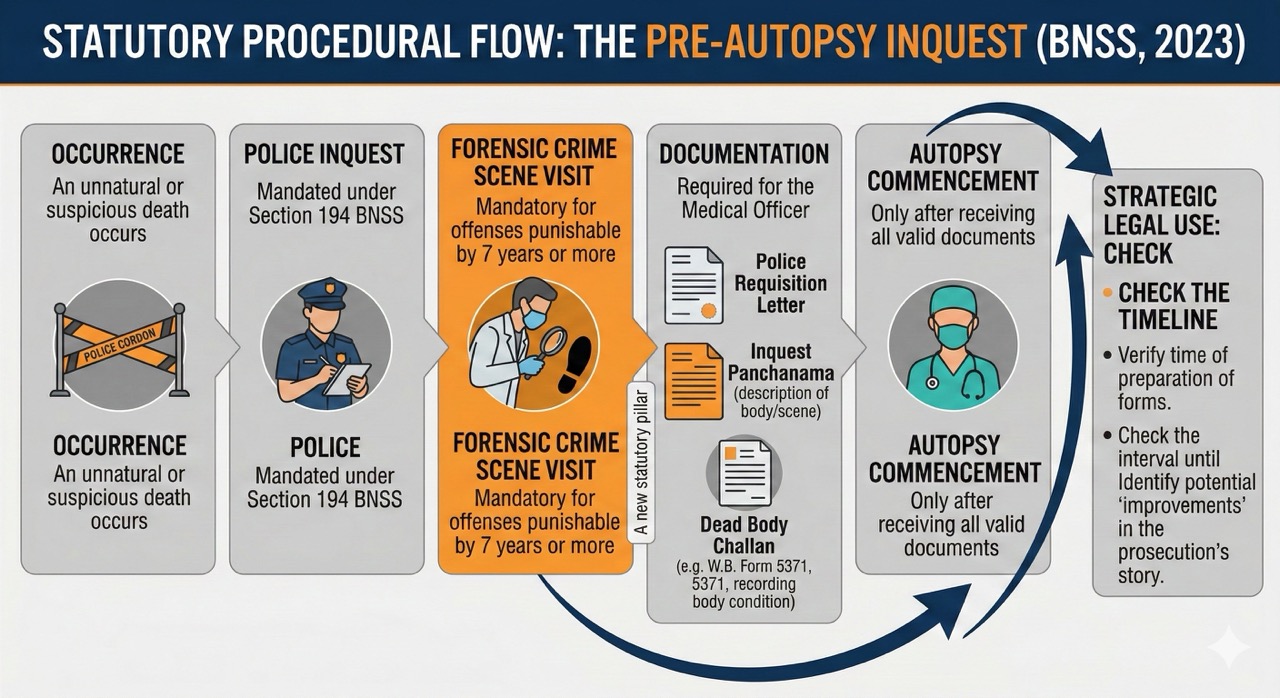
The legal authority to conduct a post-mortem examination is derived from the state’s necessity to investigate unnatural or suspicious deaths. Under Section 194 of the BNSS (formerly Section 174 of the CrPC), the police are mandated to conduct an inquest whenever a person dies by suicide, is killed by another, or dies under circumstances raising a reasonable suspicion of foul play.1 The BNSS 2023 has significantly intensified the role of forensics, making it a statutory requirement for forensic experts to visit crime scenes for offenses punishable by seven years or more.3 This shift ensures that the post-mortem examination is no longer an isolated event in a morgue but the culmination of a scientific process that begins at the scene of the occurrence.
The procedural prerequisites for a valid autopsy are rigid. Before a medical officer can make the first incision, they must be in possession of specific documents: the police requisition letter, the Inquest Panchanama (a description of the body and scene as found by the police), and the Dead Body Challan.2 In West Bengal, for instance, the absence of the WB Form No. 5371 (the challan used to dispatch the body) has been identified by higher courts as a critical procedural lapse that can jeopardize the integrity of the medical findings, as this form records the condition of the body and the articles sent to the doctor.5 For the criminal lawyer, checking the timeline between the preparation of these forms and the commencement of the autopsy is the first step in identifying potential tampering or “improvement” of the prosecution’s case.
Anatomy of the Post-Mortem Report: Deciphering the Standard Columns
A post-mortem report is structured to provide a comprehensive anatomical and physiological survey of the deceased. While formats vary slightly across states—such as the W.B. Form No. 5372 or the model form proposed by the National Human Rights Commission (NHRC)—the core columns remain consistent and each carries distinct legal weight.6
Identification and Case Particulars
The initial columns record the date and hour of dispatch and arrival at the morgue, and most importantly, the time the examination began. A significant delay between death and the autopsy can lead to advanced decomposition, which obscures internal injuries and complicates the estimation of the time since death (TSD).9 The identification of the body by relatives or acquaintances is a critical fact; a failure in identification can lead to a “John Doe” or “Jane Doe” scenario, potentially detaching the medical evidence from the specific victim named in the First Information Report (FIR).2
External Examination and Post-Mortem Changes
The “External Appearance” column requires the doctor to note the state of nutrition, the presence of post-mortem lividity, and the extent of rigor mortis.
- Post-Mortem Lividity (Livor Mortis): This is the pooling of blood in the dependent parts of the body due to gravity after the cessation of circulation.11 If the lividity is found on the back of a victim who was discovered face down, it is an irrefutable indication that the body was moved after death, suggesting a secondary crime scene or tampering.12
- Rigor Mortis: The stiffening of muscles follows a predictable pattern (Nysten’s Law), usually appearing in the eyelids and jaw first before moving to the trunk and limbs.13 The degree of rigor helps the lawyer challenge the prosecution’s timeline; if the prosecution alleges death occurred two hours before discovery, but the PMR shows well-established rigor in the lower limbs, the medical evidence contradicts the witness testimony.13
The Injuries Column: Ante-Mortem vs. Post-Mortem
One of the most litigated sections of the PMR is the description of wounds. The doctor must specify the type, size, shape, and depth of each injury.6 For a defense lawyer, the absence of “vital reaction”—such as bruising, blood clots, or inflammation—around a wound is a signal that the injury was inflicted after death.11 Post-mortem injuries are often orange-yellow and lack the hemorrhagic infiltration seen in ante-mortem wounds.11 This distinction is vital in “staged” crime scenes where a perpetrator might inflict wounds on a corpse to suggest a struggle that never occurred.
Internal Examination: The Three Cavities
The internal examination involves opening the cranium (head), thorax (chest), and abdomen. The medical officer must document the weight and condition of every major organ.6
- The Cranium: Observations of the scalp, skull, and brain are recorded. A “heat hematoma” caused by fire can mimic a traumatic epidural hematoma, but they are distinguished by their radiodensity and relationship to the venous sinuses.16
- The Thorax and Abdomen: This section records the state of the lungs, heart, and abdominal viscera. The condition of the stomach contents is a frequently utilized data point for estimating TSD. The presence of partially digested rice or dal can pinpoint the death to within 2 to 4 hours of the victim’s last meal.15
| PMR Column / Section | Forensic Significance | Strategic Legal Use |
| Time of Arrival vs. Time of PM | Indicators of decomposition rate. | Challenge TSD and reliability of internal findings. |
| Post-Mortem Lividity | Gravity-based blood pooling. | Detect if the body was moved post-death. |
| Condition of Stomach Contents | Level of digestion of last meal. | Corroborate or refute eyewitness timelines of death. |
| State of Genital Organs | Signs of trauma, secretions, or tears. | Essential for proving/disproving sexual assault (BNS Sec. 64). |
| Fractures & Dislocations | Bone integrity and site of impact. | Distinguish between accidental falls and homicidal assault. |
Analysis of the Post-Mortem Framework (W.B. Form No. 5372)

The provided document is West Bengal Form No. 5372, the standard template used for medico-legal autopsies in the state [3, 4]. For a lawyer, every field in this form represents a potential point of cross-examination.
1. Administrative and Identification Data
The top section includes the U.D. (Unnatural Death) Case No. and the Police Station.
-
Time of Death vs. Time of PM: In this specific form, death occurred on 05/03/2025 at an unspecified time, and the PM was conducted on 06/03/2025 at 02:20 PM. Lawyers must check the Post-Mortem Interval (PMI). A delay of over 24 hours in a tropical climate like India can lead to decomposition, which obscures internal findings
[5, 6]. -
Information Furnished by Police: This column summarizes the alleged history. If the doctor’s findings (e.g., finding a “natural disease”) contradict this police narrative, the prosecution’s theory of foul play is immediately weakened
[7, 8].
2. External Appearance and Rigor Mortis
The “External Appearance” column in this form describes the body as “thin built” with “corneas hazy” and “R.M. (Rigor Mortis) present all over.”
-
Legal Tip: Rigor mortis typically follows Nysten’s Law, appearing in the eyelids/jaw first and taking approximately 12 hours to fully develop in India
[9, 10]. If the PMR states RM is present all over, yet the police claim the person was killed only two hours before the body was found, the medical evidence refutes the prosecution’s timeline[9, 11].
3. Internal Findings: Trauma vs. Disease
The provided form is an excellent example of a Pathological (Natural) Cause of Death identified during a criminal investigation.
-
Thorax (Lungs & Heart): The report notes “lungs congested, densely adherent with pleura… exudates pus.” This indicates a severe infection like pneumonia.
-
Heart: Recorded at 550g (normal is roughly 250-350g) with “biventricular hypertrophy and dilatation.” This suggests a chronic heart condition.
-
Abdomen: The stomach contains “partly digested food (300g).”
Legal Strategy: Stomach contents are vital for Time Since Death (TSD). A full stomach suggests death occurred within 2–4 hours of the last meal
[6]. If the defense can prove the victim ate at 8 PM, a PM finding of “partly digested food” makes a 4 AM murder allegation highly improbable.
Comprehensive Classification of Injuries

In criminal law, the nature of the injury determines whether an act falls under Section 103 BNS (Murder), Section 106 BNS (Negligence), or Section 115/116 BNS (Hurt/Grievous Hurt) “.
1. Mechanical Injuries
These result from physical force and are the most common in criminal cases “.
-
Abrasions (Scrapes): Superficial loss of the epidermis. “Linear” abrasions (scratches) often indicate struggle or resistance, especially on the neck (throttling) or thighs (sexual assault) “.
-
Contusions (Bruises): Effusion of blood under the skin without a break. Their color indicates age: Red (fresh), Blue (1–3 days), Green (4–5 days), Yellow (7–10 days) “.
-
Lacerations (Tears): Caused by blunt force (e.g., a lathi). Characterized by irregular, jagged margins and “tissue bridging” inside the wound “.
-
Incised Wounds (Cuts): Caused by sharp weapons. Margins are clean-cut. A “tailing” effect indicates the direction of the blow “.
-
Stab Wounds: Deeper than they are wide. The shape of the wound helps identify the weapon (e.g., a “wedge-shaped” wound indicates a single-edged knife) “.
2. Thermal and Chemical Injuries
-
Thermal Burns: Ante-mortem burns show a “line of redness” and high protein content in blisters. A “boxer” position (pugilistic attitude) is a thermal artifact and does not necessarily prove the victim was alive during the fire “.
-
Chemical/Corrosive Injuries: Result from acids or alkalis. Corrosives like sulfuric acid cause charring and “softening” of the stomach lining “.
Forensic Markers for Specific Causes of Death
| Cause of Death | Key Forensic Markers (The “Smoking Gun”) | Legal Significance |
| Hanging | Oblique, non-continuous ligature mark; high on the neck [12]. |
Usually Suicidal (Exception 5 to Sec 101 BNS). |
| Strangulation | Horizontal, continuous mark; fracture of the hyoid bone (in older victims) [12, 13]. |
Almost always Homicidal (Sec 103 BNS). |
| Drowning | Froth cone at mouth/nose; Diatom Test (diatoms in bone marrow) [14, 15]. |
Distinguishes accidental drowning from “dumping” a body in water. |
| Gunshot | Entrance: Abrasion ring, inverted edges. Exit: Stellate shape, everted edges [16, 17]. |
Identifies range (contact, near, distant) and direction of fire. |
| Poisoning | Garlicky smell (Aluminum Phosphide); Kerosene smell (Organophosphorus) “. | Requires airtight Viscera “Chain of Custody” for conviction [18, 19]. |
Asphyxial Deaths: Hanging, Strangulation, and the Mechanics of the Neck

Asphyxia occurs when the body is deprived of oxygen, and in forensic practice, deaths involving the neck are among the most difficult to classify. The distinction between suicidal hanging and homicidal strangulation often rests on the morphological features of the ligature mark.17
The Ligature Mark and Hanging
In suicidal hanging, the ligature mark is typically situated high up in the neck, above the thyroid cartilage. It is characterized by an oblique, non-continuous path, often leaving a “gap” at the point of suspension or knot.17 The skin in the groove may become dry and parchment-like (parchmentization) over time.17 A crucial ante-mortem sign in hanging is the presence of “friction burns” and heaping of the epithelium at the margins of the mark, indicating that the body was suspended while the heart was still beating.17
Strangulation and Throttling
Homicidal strangulation, whether by ligature or by hand (throttling), typically produces a horizontal, continuous mark that completely encircles the neck, often at or below the level of the thyroid cartilage.17 In manual throttling, the autopsy will reveal crescent-shaped “fingernail abrasions” and deeper contusions of the neck muscles.19 The fracture of the hyoid bone is a highly suggestive—though not exclusive—indicator of homicidal strangulation, particularly in victims older than 40 whose hyoid bones have ossified and become more brittle.19
Drowning and the Controversy of the Diatom Test
Drowning is defined as death from respiratory impairment due to submersion in liquid.21 External signs like the “froth cone” (a fine, white, tenacious foam at the mouth) and “cadaveric spasm” (the victim clutching grass or sand from the water bed) are strong indicators of ante-mortem drowning.21
The “Diatom Test” is the primary ancillary test used to confirm drowning. Diatoms are microscopic, silica-walled algae found in water. If a victim is alive when they inhale water, diatoms pass through the alveolo-capillary barrier and enter the systemic circulation, eventually lodging in deep tissues like the bone marrow, liver, and brain.23 If a dead body is thrown into water, diatoms might enter the lungs passively but cannot reach the bone marrow because the circulation has ceased.23 However, defense lawyers frequently challenge this test due to the risk of “false positives” from contamination or the ingestion of diatoms in food, or “false negatives” if the drowning medium (like a bathtub or a sterile pool) lacks diatoms.19
Firearm Injuries: Ballistics and Wound Morphology
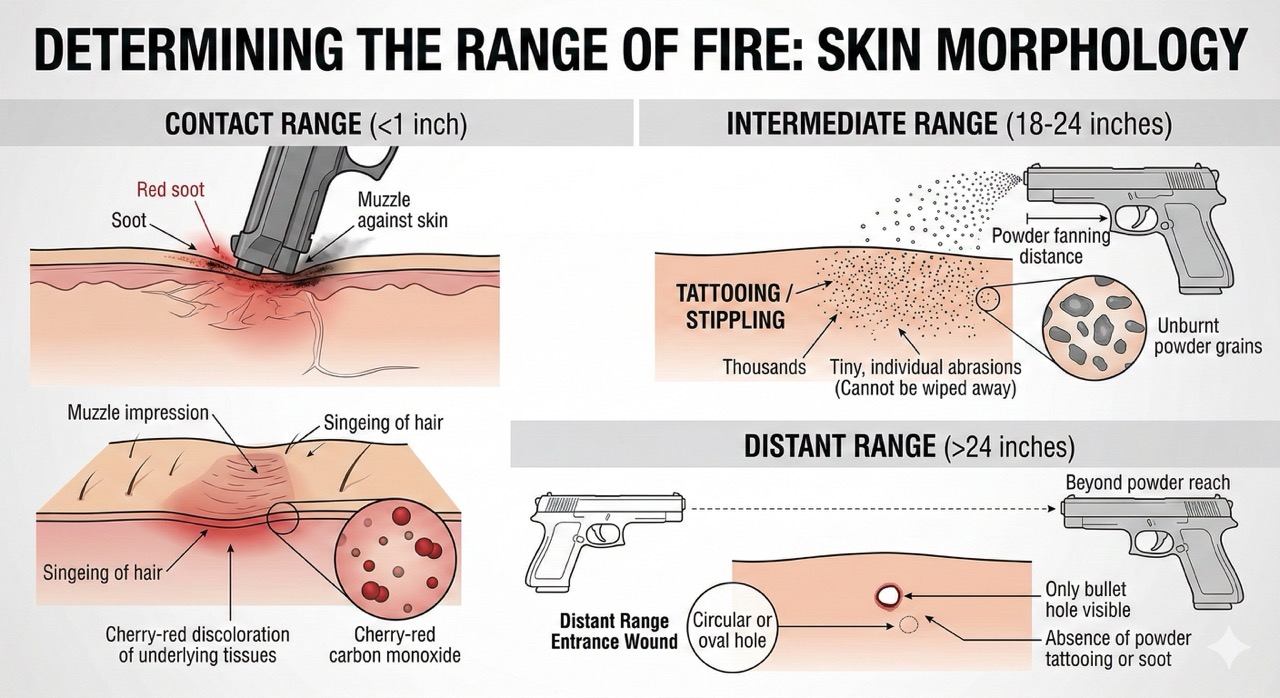
Gunshot wounds require a meticulous reconstruction of the range and direction of fire. The projectiles fired from rifled firearms (revolvers, pistols, rifles) leave distinct signatures on the skin and internal tissues.25
Entrance vs. Exit Wounds
An entrance wound is generally characterized by an “abrasion ring” (a rim of scraped skin) and is often smaller and more regular than the exit wound.25 As the bullet enters, it stretches the skin before perforating it, creating this ring. In contrast, an exit wound is typically larger, irregular or “stellate,” and lacks an abrasion ring unless the skin was “shored” by a firm object like a belt or a wall during exit.27
Determining the Range of Fire
The lawyer must analyze the PMR for secondary features of firearm discharge:
- Contact Range: The muzzle is held against the skin. Autopsy findings include a muzzle impression, singeing of hair, and “cherry-red” discoloration of the underlying tissues due to carbon monoxide from the discharge gases.25
- Intermediate Range: Within 18 to 24 inches, unburnt powder grains strike the skin, causing “tattooing” or “stippling”—thousands of tiny, individual abrasions that cannot be wiped away.25
- Distant Range: Beyond the range of powder and soot, only the bullet hole itself is visible.29
For the criminal lawyer, the range of fire is often the difference between a claim of “accidental discharge during a struggle” (contact or near-contact) and “premeditated execution” (distant range).27
| Firearm Injury Feature | Entrance Wound | Exit Wound |
| Size | Often smaller than the bullet caliber. | Usually larger and more destructive. |
| Margins | Inverted (pushed inward). | Everted (pushed outward). |
| Abrasion Ring | Present. | Absent (unless shored). |
| Tattooing/Soot | Present if within range. | Absent. |
| Shape | Circular or oval. | Stellate, slit-like, or irregular. |
Thermal Injuries and the “Silent Killer”: Burns and Smoke Inhalation

In fire-related deaths, the forensic pathologist’s most critical task is to determine if the victim was alive at the onset of the fire. This is a recurring theme in dowry death cases under Section 80 of the BNS (formerly 304B IPC).
Vitality Signs in Burnt Bodies
The presence of a “line of redness” around a burn and blisters containing serous fluid with high protein content are indicators of an ante-mortem burn.16 However, the most reliable evidence of life during a fire is the presence of soot in the respiratory tract. A person breathing during a fire will inhale soot particles, which can be found in the trachea, bronchi, and even deep within the lungs.16 If the airway is clean, it is highly likely the victim was dead before the fire was set.20
Carbon Monoxide Poisoning
Carbon monoxide (CO) has an affinity for hemoglobin that is roughly 240 times higher than that of oxygen.30 This leads to the formation of carboxyhemoglobin (COHb), which prevents oxygen transport and causes cellular asphyxiation. At autopsy, this manifests as a characteristic “cherry-red” discoloration of the skin, muscles, blood, and internal organs.11 A COHb concentration exceeding 50% is generally considered fatal and confirms that the individual died in the fire.16
Forensic Toxicology: The Jurisprudence of Poisoning and Drinking

Poisoning remains a preferred method for “secret” homicides. The systematic examination of a poisoning case relies on the clinical diagnosis (if the victim survived long enough), the scene of the occurrence, and the post-mortem findings.33
Classification and Indicators of Poisoning
Poisons are typically classified by their physiological action. Corrosives like sulfuric acid or caustic soda cause extensive “softening” and charring of the stomach lining.34 Irritants like arsenic may produce a “velvety” redness of the gastric mucosa and, in chronic cases, “Aldrich-Mees lines” (white bands) across the fingernails.34 Neurotoxic poisons like opioids cause pinpoint pupils (miosis) and non-specific signs of hypoxia.34
For any lawyer handling a poisoning case, the “Chemical Examiner’s Report” is the pivot. The medical officer must preserve the viscera in a specific manner: the stomach and its contents, a portion of the small intestine, 500 grams of the liver, and half of each kidney.6 These samples must be preserved in saturated saline or rectified spirit, and the “chain of custody” from the morgue to the Forensic Science Laboratory (FSL) must be airtight.36
The Legal Status of Alcohol Consumption
Alcohol (ethanol) consumption is frequently documented in PM reports, often as a “smell of alcohol” in the stomach contents.38 However, the presence of alcohol carries different legal implications depending on whether it is found in the victim or the accused.
- In the Victim: High BAC levels can be used by the defense to argue for contributory negligence in accidents or to suggest the victim was in a state of “vulnerability” that led to a different cause of death (e.g., choking on vomit while intoxicated).38
- In the Accused: Sections 23 and 24 of the BNS deal with the “General Exception” of intoxication. While involuntary intoxication (being drugged without knowledge) can excuse a criminal act, voluntary intoxication is rarely a defense.40 Under Section 24 BNS, a voluntarily intoxicated person is presumed to have the same “knowledge” of their act as a sober person, though the court must still independently establish “intention” (mens rea) from the surrounding circumstances.41
| BAC Level (mg/100ml) | Physiological Effect | Legal Significance in India |
| <30 | Minimal impairment. | Legal limit for driving (Sec. 185 MV Act). |
| 30 – 100 | Mild euphoria, slowed reflexes. | Potential for reckless driving charges (BNS Sec. 281). |
| 100 – 200 | Slurred speech, ataxia, emotional instability. | Evidence of significant intoxication. |
| >300 | Stupor, potential for coma/death. | Can lead to death by respiratory failure. |
Trial Strategies: Cross-Examining the Forensic Expert
The cross-examination of the medical officer who conducted the autopsy is the “crucible of truth” in a criminal trial. A lawyer must move beyond the “conclusions” and probe the “basis” of the expert’s opinion.44
Challenging the Time Since Death
The TSD is almost always an estimate with a “margin of error” of several hours. Defense lawyers should grill the expert on the “Standard Deviation” of their estimate. If the doctor says death occurred between 12 PM and 2 PM, the lawyer should ask: “Is it scientifically possible, given the temperature was 40 degrees Celsius, that death could have occurred at 10 AM?”.13 Since heat speeds up chemical reactions, rigor mortis and decomposition occur faster in tropical climates, often leading doctors to “overestimate” how long a body has been dead.15
Identifying “Negative” and “Obscure” Autopsies
Sometimes, a complete autopsy fails to reveal a cause of death. This is known as a “negative autopsy”.36 This can occur in cases of vagal inhibition (reflex cardiac arrest from a minor blow), electrocution, or poisoning by certain rare plant toxins that leave no trace.34 For the prosecution, a negative autopsy is a hurdle; for the defense, it is a tool to argue that the cause of death is “inconclusive” or natural, thereby creating reasonable doubt.44
Ocular vs. Medical Evidence: The Primacy Rule
In Indian jurisprudence, there is a complex relationship between the testimony of eyewitnesses (ocular evidence) and the findings of the doctor (medical evidence). If the medical evidence completely negates the ocular evidence—for example, if a witness says the victim was shot from 50 feet, but the doctor finds a contact wound—the prosecution’s case is severely weakened.1 However, minor variances do not lead to rejection of the case; courts acknowledge that witnesses may be under stress and their descriptions of the mechanics of an assault may not be as precise as a surgical report.1
Conclusion: The Integrated Perspective for the Criminal Lawyer
The post-mortem report is a biological document with profound legal consequences. It provides the empirical foundation for charging an individual with murder, culpable homicide, or negligence. For the criminal lawyer, the report must be read in conjunction with the Inquest Panchanama, the scene of the crime photographs, and the chemical examiner’s findings. A professional approach requires the lawyer to verify the chain of custody of every sample, from the ligature material found around a neck to the viscera bottles sent to the lab.
By mastering the forensic indicators of burning, gunshot wounds, asphyxia, and poisoning, and by understanding the legal presumptions surrounding alcohol and intoxication under the BNS, the practitioner can transform the “dry facts” of an autopsy into a compelling courtroom narrative. Whether for the prosecution seeking to prove that an injury was “sufficient in the ordinary course of nature to cause death,” or for the defense seeking to highlight “post-mortem artifacts” or “TSD inconsistencies,” the post-mortem report remains the most significant evidentiary document in the adjudication of human life and death. The shift to the BNSS and BNS has only heightened this importance, mandating a higher standard of forensic literacy for the modern criminal lawyer.
Works cited
- Unveiling the Evidentiary Power of Post Mortem Reports in Legal …, accessed on March 1, 2026, https://thelaw.institute/criminal-justice-administration/post-mortem-reports-evidentiary-power-legal-proceedings/
- Clinical Autopsy vs Medicolegal Autopsy – PMC – NIH, accessed on March 1, 2026, https://pmc.ncbi.nlm.nih.gov/articles/PMC4925615/
- The Bharatiya Nagarik Suraksha Sanhita, 2023 – PRS India, accessed on March 1, 2026, https://prsindia.org/billtrack/the-bharatiya-nagarik-suraksha-sanhita-2023
- The Efficacy of Forensic Investigation in the Indian Criminal Justice System: A Critical Study, accessed on March 1, 2026, https://lexscriptamagazine.com/the-efficacy-of-forensic-investigation-in-the-indian-criminal-justice-system-a-critical-study/
- RG Kar rape-murder case hearing: What is the … – Telegraph India, accessed on March 1, 2026, https://www.telegraphindia.com/west-bengal/rg-kar-rape-murder-case-hearing-what-is-the-missing-form-that-the-supreme-court-has-asked-the-bengal-govt-to-provide/cid/2046849
- Untitled – NHRC, accessed on March 1, 2026, https://nhrc.nic.in/assets/uploads/act_rule_sop_guideline/Revised%20format%20of%20post-mortem%20examination.pdf
- West Bengal Post-Mortem Report Format | PDF | Skull | Human Anatomy – Scribd, accessed on March 1, 2026, https://www.scribd.com/document/854214138/Blank-Pm-Report-Arambagh
- Supreme Court: Post Mortem Reports Must Use Printed Forms?, accessed on March 1, 2026, https://supremetoday.ai/search/post-mortem-report-printed-form-supreme-court
- Viscera Preservation in Medical Board Autopsies: Timelines, Outcomes, and Systemic Inefficiencies in Toxicological Analysis – PMC, accessed on March 1, 2026, https://pmc.ncbi.nlm.nih.gov/articles/PMC12541232/
- Carbon Monoxide Poisoning in Putrefied Corpses: A Difficult Diagnosis – MDPI, accessed on March 1, 2026, https://www.mdpi.com/2673-6756/6/1/5
- Forensic pathology, accessed on March 1, 2026, https://librepathology.org/wiki/Forensic_pathology
- Rigor mortis in an unusual position: Forensic considerations – PMC, accessed on March 1, 2026, https://pmc.ncbi.nlm.nih.gov/articles/PMC3657962/
- Role of Rigor Mortis in Assessment of Time Since Death – Semantic Scholar, accessed on March 1, 2026, https://pdfs.semanticscholar.org/2f1d/191b171f8ad1d45df5bcea63f8a958526981.pdf
- Rigor Mortis Test – 1 | PDF | Skeletal Muscle – Scribd, accessed on March 1, 2026, https://www.scribd.com/document/933747861/Rigor-Mortis-Test-1
- Methods of Estimation of Time Since Death – StatPearls – NCBI Bookshelf, accessed on March 1, 2026, https://www.ncbi.nlm.nih.gov/books/NBK549867/
- Homicides Disguised as Fire Deaths – PMC, accessed on March 1, 2026, https://pmc.ncbi.nlm.nih.gov/articles/PMC10417010/
- An autopsy study of ligature mark in 634 cases of suicidal hanging …, accessed on March 1, 2026, https://ijfmts.com/archive/volume/6/issue/4/article/2281
- Indicators of strangulation in medico-legal assessments: A scoping review, accessed on March 1, 2026, https://www.rmv.se/wp-content/uploads/Bilaga-1-Rattsmedicinalverkets-artikel-accepterat-manus-i-Forensic-Science-International.pdf
- Diatom-Positive Cadaver: Drowning or Homicide? – PMC – NIH, accessed on March 1, 2026, https://pmc.ncbi.nlm.nih.gov/articles/PMC8553277/
- Burnt to blazes: homicidal act of strangulation with post mortem burn …, accessed on March 1, 2026, https://ijfcm.org/archive/volume/9/issue/4/article/14652
- Investigation of Drowning Deaths: A Practical Review – PMC – NIH, accessed on March 1, 2026, https://pmc.ncbi.nlm.nih.gov/articles/PMC6474464/
- Diagnosis of Drowning and the Value of the Diatom Test in Veterinary Forensic Pathology, accessed on March 1, 2026, https://pmc.ncbi.nlm.nih.gov/articles/PMC6868027/
- View of Medico-legal Significance of Diatoms Detection in Different Organs of Drowning Victims, accessed on March 1, 2026, https://medicopublication.com/index.php/ijfmt/article/view/3149/2944
- Forensic significance in the cases of drowning deaths: An elaborative study – ijfmts, accessed on March 1, 2026, https://ijfmts.com/archive/volume/6/issue/4/article/2276
- Introduction to Wounding Mechanism When a projectile strikes the human body, it depresses and compresses the skin, flesh and bon, accessed on March 1, 2026, https://www.bhu.ac.in/Content/Syllabus/Syllabus_300620200420080007.pdf
- Gunshot Wounds Forensic Pathology – StatPearls – NCBI Bookshelf, accessed on March 1, 2026, https://www.ncbi.nlm.nih.gov/books/NBK556119/
- Gunshot Wound Patterns: A Narrative Review From a Forensic Medical Perspective – PMC, accessed on March 1, 2026, https://pmc.ncbi.nlm.nih.gov/articles/PMC12791185/
- The Ins and Outs of Gunshot Wounds – Lablogatory, accessed on March 1, 2026, https://labmedicineblog.com/2023/09/22/the-ins-and-outs-of-gunshot-wounds/
- FORENSIC EXAMINATION OF GUNSHOT WOUND FATALITIES | Office of Justice Programs, accessed on March 1, 2026, https://ojp.gov/ncjrs/virtual-library/abstracts/forensic-examination-gunshot-wound-fatalities
- Smoke inhalation in forensic investigations | Applied Sciences | Research Starters – EBSCO, accessed on March 1, 2026, https://www.ebsco.com/research-starters/applied-sciences/smoke-inhalation-forensic-investigations
- An autopsy case of carbon monoxide poisoning: A case report – IP Int J Forensic Med Toxicol Sci – ijfmts, accessed on March 1, 2026, https://ijfmts.com/archive/volume/8/issue/1/article/2326
- Suicide by Inhalation of Carbon Monoxide in a Residential Fire – ResearchGate, accessed on March 1, 2026, https://www.researchgate.net/publication/7680523_Suicide_by_Inhalation_of_Carbon_Monoxide_in_a_Residential_Fire
- Assessment and Diagnosis of Poisoning with Characteristics Features in Living or Dead, accessed on March 1, 2026, https://www.researchgate.net/publication/328956624_Assessment_and_Diagnosis_of_Poisoning_with_Characteristics_Features_in_Living_or_Dead
- Forensic Toxicology MODULE No. 24: Diagnosis of Poisoning SUBJECT FORENSIC SCIENCE, accessed on March 1, 2026, https://epgp.inflibnet.ac.in/epgpdata/uploads/epgp_content/S000016FS/P000697/M010654/ET/1516252700FSC_P10_M24_e-text.pdf
- Last 5 Year PYQs in Forensic Medicine – PrepLadder, accessed on March 1, 2026, https://www.prepladder.com/neet-pg-study-material/previous-years-question-papers/last-5-year-pyqs-in-forensic-medicine
- Viscera Preservation in Autopsy Cases | PDF – Scribd, accessed on March 1, 2026, https://www.scribd.com/presentation/376958109/Preservation-of-Viccera
- Medico-Legal Work – High Court of Delhi, accessed on March 1, 2026, https://delhihighcourt.nic.in/files/2024-04/courtrulefile_wap7cr9z.pdf
- Alcohol in Deceased’s Stomach: Post-Mortem Legal Insights – Supreme Today AI, accessed on March 1, 2026, https://supremetoday.ai/issue/alcohol-stomach-deceased-post-mortem
- Alcohol in PM Report: Bars Insurance Claims? – Supreme Today AI, accessed on March 1, 2026, https://supremetoday.ai/issue/alcohol-in-pm-report:-bars-insurance-claims
- Section 23 BNS: Act of Person Incapable of Judgment Due to Intoxication – Testbook, accessed on March 1, 2026, https://testbook.com/judiciary-notes/section-23-bns
- Section 24 BNS 2023: Offence Requiring Intent or Knowledge committed under Intoxication, accessed on March 1, 2026, https://testbook.com/judiciary-notes/section-24-bns
- Laws And Punishments For Drunk Driving In India – B&B Associates LLP, accessed on March 1, 2026, https://bnblegal.com/article/laws-and-punishments-for-drunk-driving-in-india/
- Drink and Drive: A Breach of Social Duty and Legal Sanction – Lessons from the Ghatkopar Tragedy, accessed on March 1, 2026, https://dmlegalservices.in/drink-and-drive-a-breach-of-social-duty-and-legal-sanction-lessons-from-the-ghatkopar-tragedy/
- Law 101: Legal Guide for the Forensic Expert | More Ways to Reduce Vulnerability on Cross-Examination | National Institute of Justice, accessed on March 1, 2026, https://nij.ojp.gov/nij-hosted-online-training-courses/law-101-legal-guide-forensic-expert/trial/cross-examination/more-ways-reduce-vulnerability-cross-examination
- POSTMORTEM CHANGES AND TIME OF DEATH – Pennsylvania State Coroners’ Association, accessed on March 1, 2026, https://www.pacoroners.org/Uploads/Topics%20of%20Interest/Postmortem%20Changes.pdf
- 7 Common Mistakes Regarding Autopsy Reports – Death Investigation Training Academy, accessed on March 1, 2026, https://ditacademy.org/7-common-mistakes-regarding-autopsy-reports/
- Role of Doctors in Dispensation of Criminal Justice – S.S. UPADHYAY, accessed on March 1, 2026, https://lawhelpline.in/wp-content/uploads/2024/01/Role_of_Doctors_in_Dispensation_of_Criminal_Justice.pdf