Appeal from an NCLT Order to NCLAT: Limitation and Grounds
The time limit for appealing an NCLT order depends on the law under which it was passed. Insolvency orders follow Section 61 of the IBC, and Companies Act orders follow Section 421. This guide sets out both clocks, who may appeal, the grounds, the forum and the e-filing steps, and ends with a date calculator.
Which law governs your NCLAT appeal
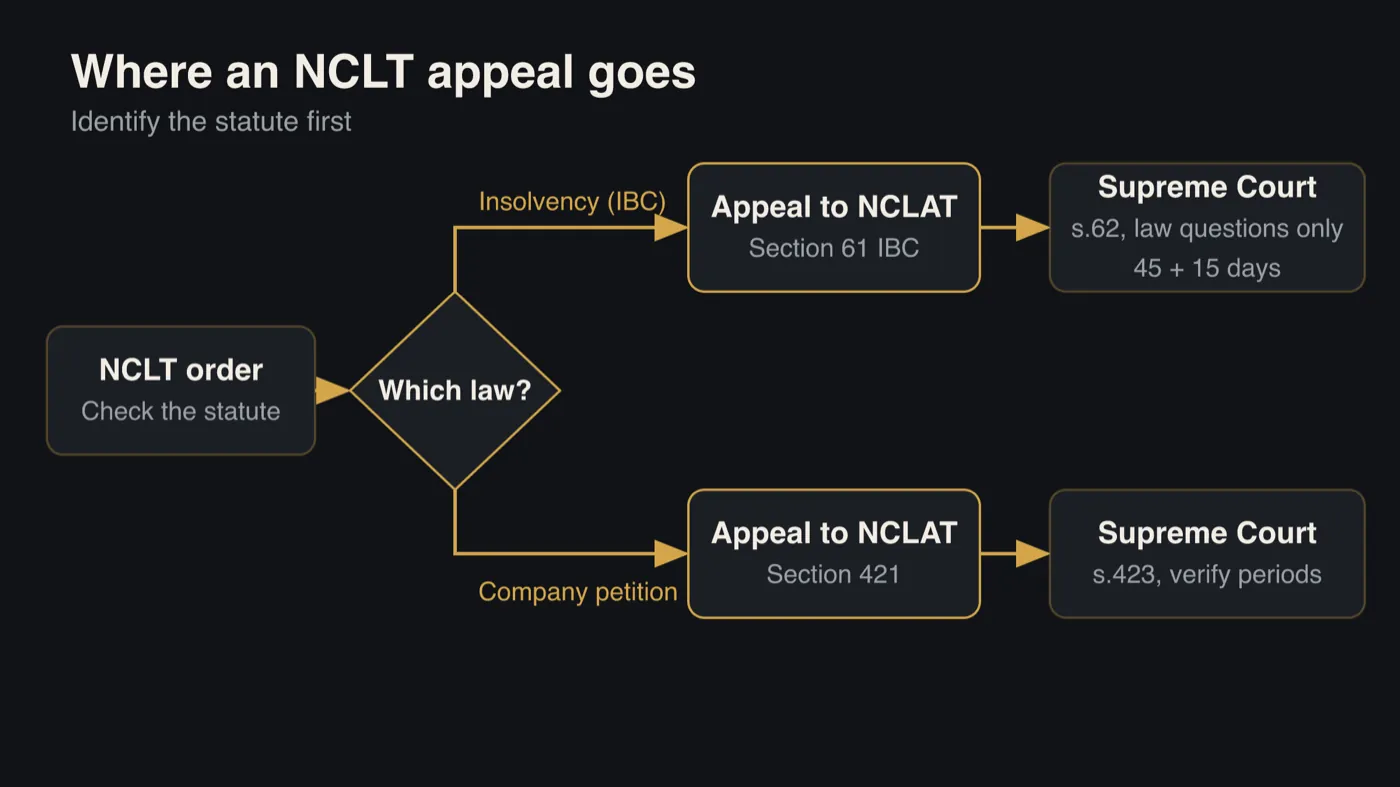
An appeal from the National Company Law Tribunal goes to the National Company Law Appellate Tribunal (NCLAT). The first question is which statute the NCLT order was made under. An appeal against an order in insolvency proceedings lies under Section 61 of the Insolvency and Bankruptcy Code, 2016. An appeal against an order in a company petition, such as oppression, mismanagement or a scheme, lies under Section 421 of the Companies Act, 2013. The two regimes have different time limits and a different starting point, and mixing them up is a common reason appeals are lost. For orders passed by the NCLT Kolkata benches, the first step is to identify the statute and the date of the order.
Under the IBC, the period is 30 days from pronouncement, with at most 15 more days if sufficient cause is shown. Under Section 421(3) of the Companies Act, it is 45 days from the date a copy of the order is made available, with up to 45 more days. The Supreme Court has held that NCLAT cannot go beyond these outer limits (see *Tata Steel Ltd. v. Raj Kumar Banerjee*, 2025 INSC 639). Please verify the current text of the sections and the NCLAT Rules on the official site, nclat.gov.in, before relying on any date. If the order arose from a Section 7 petition, our note on defending Section 7 IBC petitions explains the stage before the appeal.
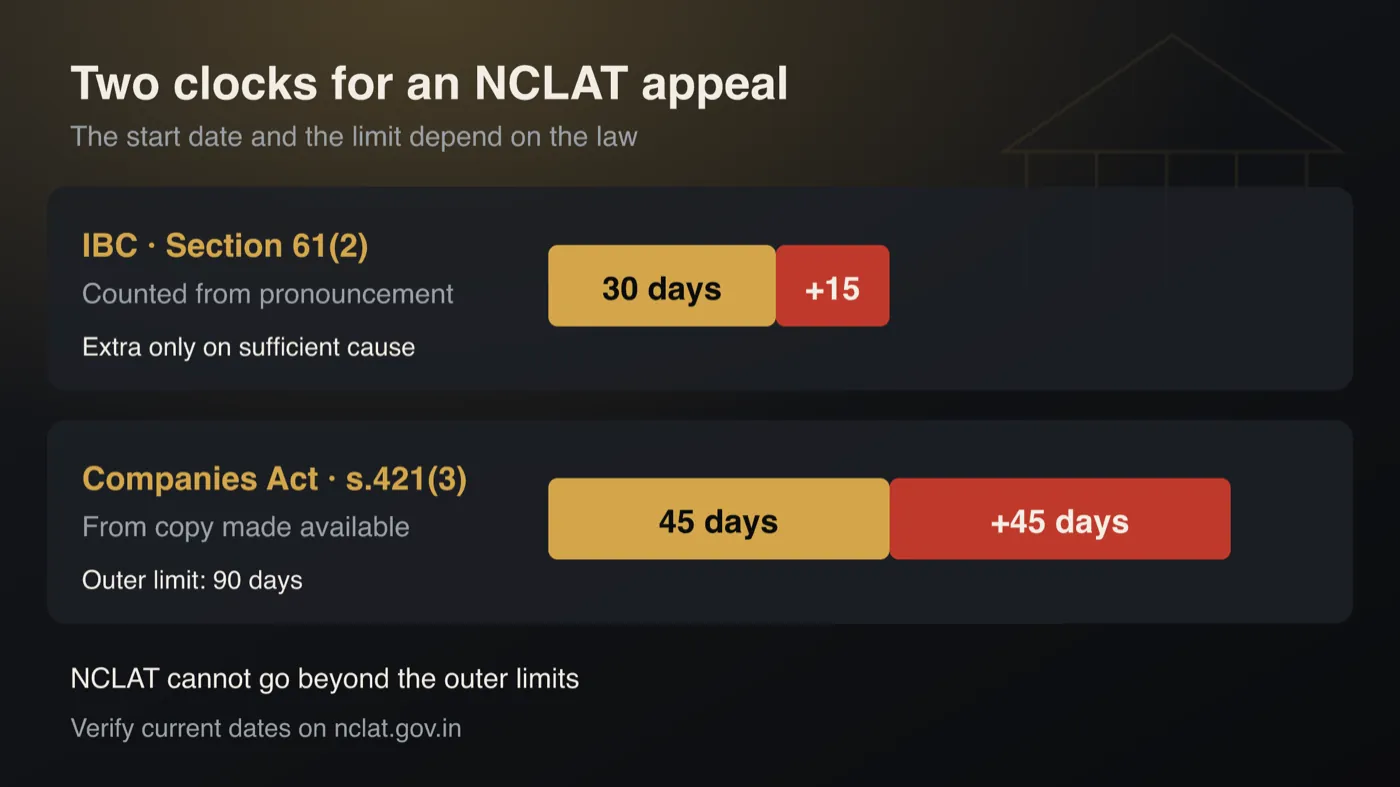
How many days do you have?
The IBC and the Companies Act run on different clocks, so identify the Act under which the order was made first.
Short explainers from Adv. Sudip Patra
More short explainers on our YouTube channel: Patra’s Law Chambers on YouTube ↗
Which NCLT order are you looking at?
Pick the kind of order you have received. This is general information, not advice. The time limit and the grounds depend on the exact order and its date, so verify both against the certified copy.
Choose one of the options above.
From an NCLT order to NCLAT, step by step
A general outline of how an appeal from the NCLT Kolkata Bench usually moves. Check dates and rules against the order and the current NCLAT Rules.
Record whether the order was pronounced in open court or only uploaded. Under the IBC, time runs from pronouncement, or from upload if it was not pronounced in court. Diary day 30 and day 45 at once.
Apply even if a free copy has been issued. Time for the certified copy is excluded under s.12(2) of the Limitation Act only if you actually applied for it. For your NCLT stage, see NCLT Kolkata advocate.
A suspended director files in their own name. Creditors and others must show they are aggrieved. Appeals against plan approval or liquidation are confined to s.61(3) and s.61(4) grounds.
Memorandum of appeal, grounds, list of dates, certified copy, affidavit and authority go on efiling.nclat.gov.in. Add an application for condonation of delay only if you are filing between day 31 and day 45.
Re-file quickly once the registry notes defects, because delay in re-filing is scrutinised. NCLAT then hears admission, issues notice and takes replies. The appeal goes to the Principal Bench, New Delhi; verify this on nclat.gov.in.
A civil appeal under s.62 IBC lies only on a question of law. Our Supreme Court advocate consultation page explains how such matters are taken up.
Three common misunderstandings about NCLAT appeals. Tap a card
Under the IBC, time runs from pronouncement, not from receipt of the certified copy. Under s.421(3) Companies Act, it runs from the date a copy is made available.
Not beyond the outer limit. The Supreme Court held in Tata Steel v. Raj Kumar Banerjee (2025 INSC 639) that NCLAT cannot condone delay beyond 45 days in an IBC appeal, even on equitable grounds.
After admission, the resolution professional represents the company. In Nitendra Kumar Tomer v. Unox S.P.A. (2026 INSC 356), an appeal in the company’s name by a suspended director was held incompetent.
NCLAT appeals we handle
Appeals in insolvency matters
Appeals against admission or rejection of Section 7, 9 or 10 petitions, approval of a resolution plan under Section 61(3), and liquidation orders under Section 61(4). Time runs from pronouncement of the order, with a hard outer limit of 45 days. The decisions are collected in our note on IBC Supreme Court judgments.
Appeals in company petitions
Appeals against NCLT orders in oppression and mismanagement, rectification of registers, scheme and similar company matters. The period is 45 days from the date a copy of the order is made available, with up to 45 more days. Section 5 of the Limitation Act does not extend this, and no appeal lies from a consent order under Section 421(2).
Suspended directors, creditors and other aggrieved persons
Section 61(1) allows any person aggrieved to appeal. Once a petition is admitted, a suspended director should appeal in their own name. An appeal filed in the name of the corporate debtor after an interim resolution professional is appointed has been held incompetent (*Nitendra Kumar Tomer v. Unox S.P.A.*, 2026 INSC 356). Verify the full text before relying on it.
Next step after NCLAT
An IBC order of NCLAT can be taken to the Supreme Court only on a question of law, within 45 days with up to 15 more on sufficient cause. For this stage, see our Supreme Court advocate consultation page. Companies Act matters go under Section 423, whose periods should be verified.
Documents and steps for an NCLAT appeal
- Apply for the certified copy of the NCLT order at once, even if a free copy has been issued. Time for the certified copy is excluded only if it was applied for (Section 12(2), Limitation Act).
- Memorandum of appeal with grounds, list of dates and synopsis, with the certified copy as required by Rule 22, NCLAT Rules, 2016.
- Affidavit, vakalatnama, and a board resolution where the appellant is a company.
- NCLT pleadings and documents as annexures, with index and page numbers.
- Application for condonation of delay, only if filing between day 31 and day 45 (IBC) or day 46 and day 90 (Companies Act).
- E-file on efiling.nclat.gov.in, pay the fee online and note the diary number. Verify the fee and any hard-copy requirement on the official site.
Supreme Court rulings on NCLAT appeals and limitation
These Supreme Court decisions set the time limits and the filing rules for an appeal from an NCLT order to NCLAT. Each summary below is a short note. Read the full judgment, or ask us to check it, before you rely on any of them.
2021
IBC appeal time runs from pronouncement
A three-judge bench held that the limitation period under Section 61(2) of the Insolvency and Bankruptcy Code, 2016 starts when the NCLT pronounces its order. Section 421(3) of the Companies Act counts from the date a copy is made available, and the Code deliberately leaves those words out. A party who was present cannot claim that time ran only from the day they learnt of the order or received a copy.
2023
Unpronounced orders run from upload date
If the NCLT pronounces its order in open court, limitation runs from that day. If the order is not pronounced but only uploaded later, time runs from the date of upload. The exclusion under Section 12(2) of the Limitation Act helps only an appellant who actually applied for a certified copy in time. Rule 22 of the NCLAT Rules, 2016 requires a certified copy.
2025
No certified-copy application, no exclusion
The Supreme Court upheld NCLAT’s dismissal of an appeal as time-barred. Time spent waiting for a certified copy is excluded only if the appellant applied for one. Having a free copy of the order does not do away with that requirement, so an appellant who never applied cannot add the waiting time to the 30 + 15 days under Section 61(2) of the Code.
2025
No condonation beyond 45 days
NCLAT has no power to admit a Section 61 appeal filed after 30 days plus the further 15 days, not even on grounds of fairness or hardship. Section 4 of the Limitation Act did not help, because the registry was open on the last day. The Court set aside NCLAT’s order condoning the delay, relying on Kalpraj Dharamshi v. Kotak Investment Advisors.
2018
Section 421(3): 45 + 45 days only
For an appeal under Section 421(3) of the Companies Act, 2013, the proviso allows a second period of no more than 45 days, and that wording is mandatory. Section 5 of the Limitation Act cannot extend the time any further. NCLAT was right to dismiss an appeal filed nine days after the outer limit had passed.
2026
Suspended director must appeal in their own name
Once an insolvency petition is admitted, only the interim resolution professional can act for the corporate debtor. An appeal filed by a suspended director in the company’s name was held incompetent. NCLAT was wrong to let the director amend it into their own name after limitation had expired. A director has to appeal individually within the 30 + 15 days.
How to appeal an NCLT Kolkata order to NCLAT
Diary the dates on the day of the order
Note whether the NCLT pronounced the order in open court or only uploaded it. Under Section 61 of the Code, day 30 and day 45 are counted from that date. For a Companies Act order under Section 421(3), count 45 and 90 days from the date a copy was made available.
Apply for a certified copy at once
Apply to the NCLT Kolkata registry for a certified copy straight away, even if you already have a free copy. Keep a record of the date you applied and the date the copy was ready. Only that application lets you exclude the waiting time under Section 12(2) of the Limitation Act (A. Rajendra, 2025).
Choose the right appellant and forum
After admission, a suspended director files in their own name, not the company’s. A creditor, guarantor or other person must show they are aggrieved by the order. NCLAT sits at New Delhi (Principal Bench) and Chennai, and the Chennai bench hears the southern states. Check on nclat.gov.in which bench takes appeals from Kolkata.
Prepare the memorandum of appeal
The appeal papers are: the memorandum of appeal, a list of dates, the grounds, a certified copy of the impugned order, an affidavit, a vakalatnama, a board resolution if the appellant is a company, and the NCLT pleadings as annexures. Appeals against a resolution plan or a liquidation order are limited to the grounds in Section 61(3) or 61(4).
E-file and cure defects quickly
File online at efiling.nclat.gov.in under the correct case type, upload bookmarked PDFs, pay the fee and note the diary number. If you are filing between day 31 and day 45, add an application for condonation of delay. Check the current fee and the hard-copy rules with the registry, and cure any defects without delay.
Next stage: Supreme Court under Section 62
An appeal from NCLAT to the Supreme Court lies only on a question of law. Section 62 of the Code allows 45 days, plus at most 15 more on sufficient cause. Apply for NCLAT’s certified copy as soon as the order is passed. For Companies Act matters, check the time limits under Section 423 before you file.
IBC appeal versus Companies Act appeal
The forum is the same, but the clock and its starting point are not.
Pre-deposit for an NCLAT appeal against a CCI order requiring payment (second proviso to Section 53B(2), Competition Act, 2002). This applies only to appeals from the Competition Commission. No such pre-deposit was found for IBC or Companies Act appeals; verify the current text before filing.
NCLAT appeal date calculator
Choose the law under which the NCLT order was made, enter the start date and, if you applied for a certified copy, the days it took. The tool shows the last day of the normal period and the outer limit.
- Select the law (IBC or Companies Act).
- Enter the date of pronouncement (IBC) or the date a copy was made available (Companies Act).
- If you applied for a certified copy, enter the days it took to be ready. Otherwise leave 0.
- Press Calculate.
This is an estimate for understanding only. The exact dates, holidays and the tribunal’s view of your case decide the result. Verify the dates with an advocate before filing.
Where does the appeal go, and within what time?
Pick the order you wish to challenge. The tool shows the forum, the section and the usual time limit. Verify the details on the official sites before filing.
This is a general guide, not advice on your case. Whether a bench is the right forum, and the exact limitation, must be verified before filing.
Mistakes that end an NCLAT appeal before it is heard
Waiting for the certified copy without applying for it The waiting time is excluded only if a certified copy was actually applied for. Holding a free copy, or simply waiting, does not stop the clock (Kalate, 2023; A. Rajendra, 2025).
Filing on day 46 or later in an IBC appeal NCLAT cannot condone even one day beyond 30 + 15 days. A portal problem, a plea of fairness or Section 5 of the Limitation Act will not save a late appeal (Tata Steel, 2025).
Filing in the company's name after the insolvency petition is admitted A suspended director’s appeal filed in the corporate debtor’s name is incompetent from the start. It cannot be corrected once the time limit has passed (Tomer, 2026).
Mixing up the IBC and Companies Act time limits An insolvency order follows the 30 + 15 day rule, counted from pronouncement. An order under the Companies Act, such as one in an oppression and mismanagement case, follows 45 + 45 days from when a copy is made available.
Discuss an NCLT order you wish to challenge
If you have received an order from an NCLT bench, the date of pronouncement and the date a copy was made available decide what can still be done. Bring the order, the date it was uploaded or pronounced, and any certified copy application. We will read the papers, identify the correct statute and forum, and explain the options and the time limits. Each matter turns on its own facts, and no outcome can be promised.
Book a ConsultationEstablished by a distinguished alumnus of IIT Kharagpur, Patra’s Law Chambers stands as a beacon of legal expertise in Kolkata & Delhi. Know more →

Kolkata Office
NICCO House, 6th Floor, 2 Hare Street
Kolkata-700001 (Near Calcutta High Court)
Delhi Office
4455/5, First Floor, Gali Shahid Bhagat Singh
Main Bazar Road, Paharganj, New Delhi-110055
Contact
[email protected]
+91 890 222 4444 / +91 7003 715 325
Papers to have ready for the NCLAT appeal
A general list of what an e-filed appeal usually needs. Check it against the current NCLAT Rules and filing checklist.
Rule 22 of the NCLAT Rules, 2016 requires it, and the date you applied for it matters for limitation.
For plan approval or liquidation orders, confine the grounds to s.61(3) or s.61(4) IBC.
A short chronology from the NCLT filing to the order, with the pronouncement date marked.
A vakalatnama or authorisation, and a board resolution where the appellant is a company.
Petition, replies and key documents, indexed and page-numbered as bookmarked PDFs.
Only if you are filing between day 31 and day 45 under the IBC, with an affidavit stating sufficient cause.
File on efiling.nclat.gov.in. The fee is reported as Rs 5,000 per appeal, so verify it against the current schedule.
Frequently asked questions on appeals from the NCLT to NCLAT
Section 61(2) IBC gives 30 days from pronouncement of the order. NCLAT may admit the appeal for a further period of up to 15 days if sufficient cause is shown. It cannot go beyond 45 days in all.
Yes. Under s.421(3) of the Companies Act, 2013, the period is 45 days from the date a copy of the order is made available, with up to 45 more days on sufficient cause. Verify the current text of the section.
It is excluded under s.12(2) of the Limitation Act only if you actually applied for a certified copy, and only for the time taken to prepare it. Relying on a free copy does not earn the exclusion.
No. The Supreme Court held in Tata Steel Ltd. v. Raj Kumar Banerjee (2025 INSC 639) that NCLAT cannot condone delay beyond the 45-day outer limit in s.61(2) IBC, however good the reason.
None was found for IBC appeals under s.61 or for Companies Act appeals under s.421; verify the current text. A 25% deposit applies to appeals against Competition Commission penalty orders under s.53B of the Competition Act, 2002.
A suspended director may appeal in their own name, within 30 + 15 days. An appeal filed in the name of the corporate debtor after the interim resolution professional is appointed was held incompetent in Nitendra Kumar Tomer (2026 INSC 356).
NCLAT sits at New Delhi (Principal Bench) and Chennai. The Chennai Bench covers the southern region, so appeals from Kolkata are understood to go to New Delhi. Verify this on nclat.gov.in before filing.
A civil appeal to the Supreme Court under s.62 IBC, on a question of law only, within 45 days, plus up to 15 more on sufficient cause. For Companies Act matters, s.423 applies; verify its periods.