The Nanavati Case: A Navy Officer, Three Shots and a Jury That Said Not Guilty
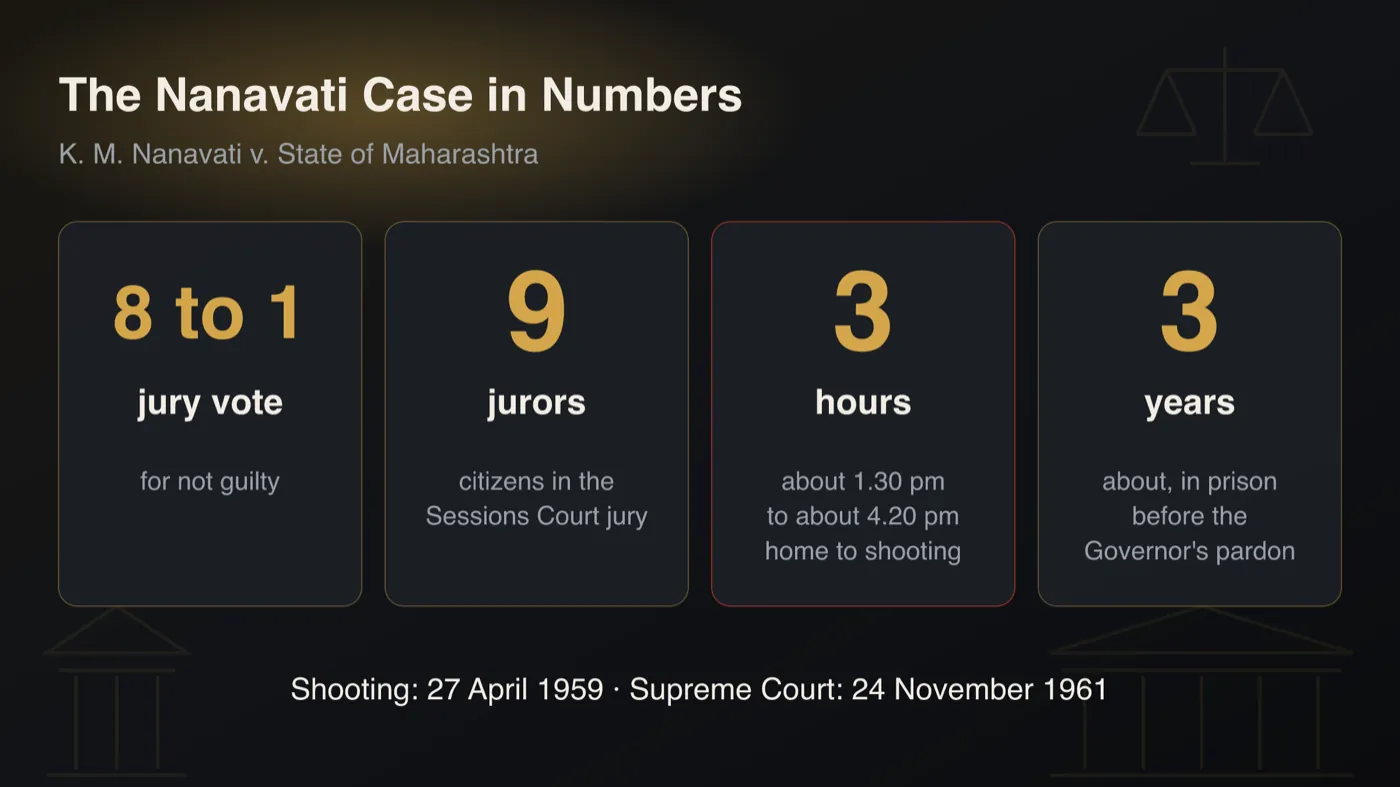
On 27 April 1959 a naval officer shot a Bombay businessman dead and gave himself up. A jury of nine acquitted him by 8 to 1, yet the Supreme Court upheld his conviction for murder. The case is about a clock: the hours between a confession and a gunshot, which still decide every plea of provocation in an Indian murder trial.
Nanavati Case Explained: A Navy Officer, Three Shots and the Jury Verdict
Bombay, 27 April 1959. A naval officer walks into a block of flats with a brown paper packet under his arm. Inside it are a service revolver and six bullets. Three shots ring out, a man lies dead, and the officer drives straight to the authorities to give himself up. Months later a jury of nine ordinary citizens hears the case, and eight of them say: not guilty. The Sessions Judge refused to accept that verdict and referred the matter to the Bombay High Court, which convicted the officer of murder. The Supreme Court upheld that conviction on 24 November 1961.
Most people remember the Nanavati case as a scandal, and some wrongly remember it as the case that ended jury trials in India. Read as a lawyer reads it, it is about when anger stops being sudden. The rule it settled now sits in Exception 1 to Section 101 of the Bharatiya Nyaya Sanhita, 2023 (see the Act on India Code). For a criminal matter that turns on provocation, intention or the burden of proof, see our criminal law consultation page, and for arrest-related advice see FIR and arrest advice.
Four questions a court asks about provocation
Justice Subba Rao explained the Indian law of grave and sudden provocation in four points.
Would a reasonable man lose control?
A man of the same class of society, placed in the same situation as the accused.
Can words amount to provocation?
Words and gestures, not only acts, can in some situations qualify, and a confession of adultery can be such a word.
What was the mental background?
The victim’s earlier conduct can be taken into account, so the court looks at the whole history.
Is the blow traced to the passion?
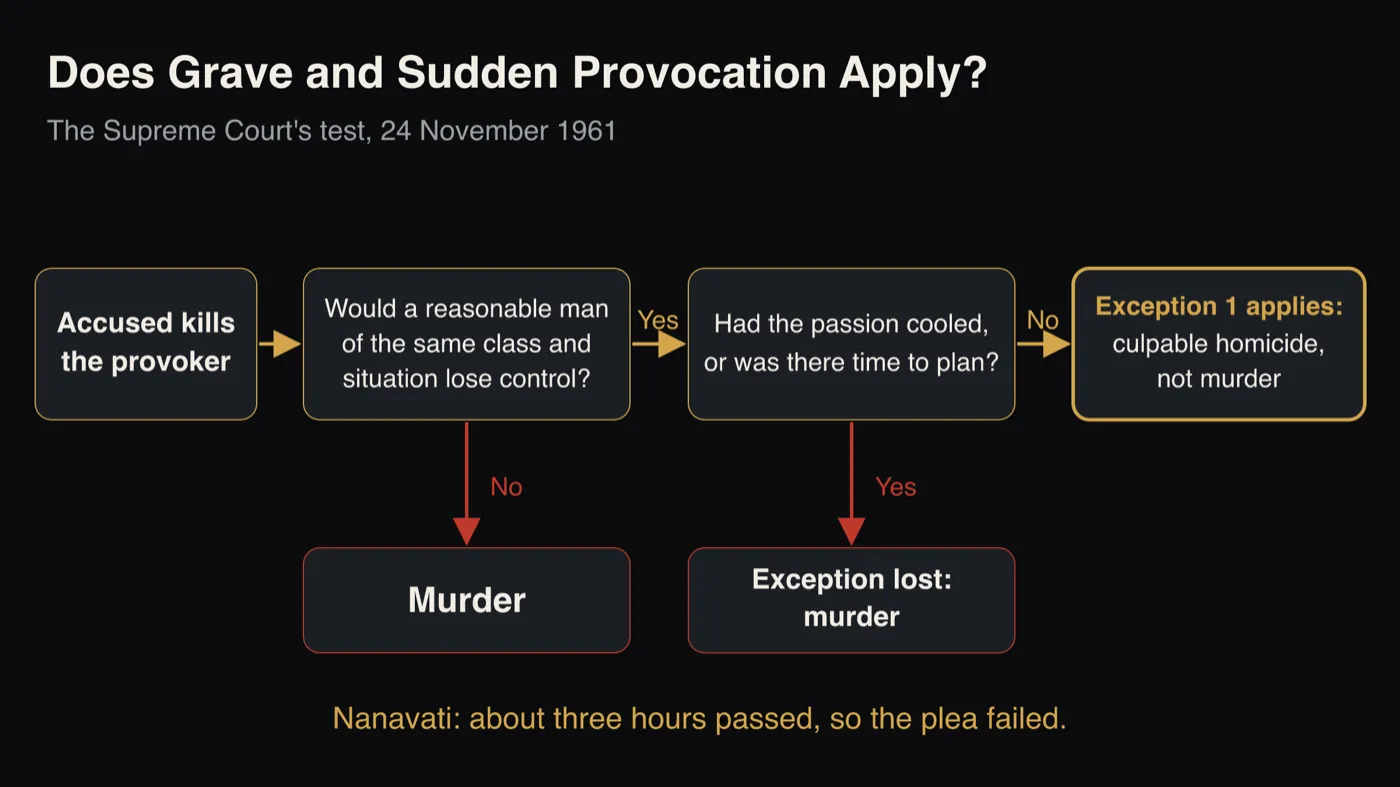
If the passion cooled by lapse of time, or there was room for planning, the exception is lost.
Short explainers from Adv. Sudip Patra
More short explainers on our YouTube channel: Patra’s Law Chambers on YouTube ↗
Which of these looks most like the situation you are reading about?
The Nanavati rule is applied to many different facts. Pick the one nearest to your question to see which part of the law it touches. This is general information, not advice.
Choose one of the options above.
How one shooting travelled through three authorities
From a Bombay flat to the Supreme Court and a Governor’s pardon, the dates below follow the case as set out in the article.
Commander Nanavati shot Prem Ahuja at Ahuja’s flat in Bombay and then gave himself up. He was charged with murder under Section 302 of the Indian Penal Code. The defence was accident, and in the alternative grave and sudden provocation.
A jury of nine heard the case before Sessions Judge Ratilal Bhaichand Mehta and returned a verdict of not guilty by 8 to 1. The judge found the verdict perverse and referred the case to the High Court under Section 307 of the CrPC, 1898.
Justice Shelat and Justice Naik found that the jury had been misdirected on the law. They convicted Nanavati of murder and sentenced him to imprisonment for life. Serious criminal matters of this kind are handled by our criminal lawyer team in Kolkata.
In K. M. Nanavati v. State of Bombay, AIR 1961 SC 112, a Constitution Bench held by majority that the Governor could not suspend the sentence once the matter was pending before the Supreme Court. Justice Kapur dissented.
Justice Subba Rao, writing for the bench with Justice S. K. Das and Justice Raghubar Dayal, dismissed the appeal (AIR 1962 SC 605). Appeals of this kind are argued before the Supreme Court.
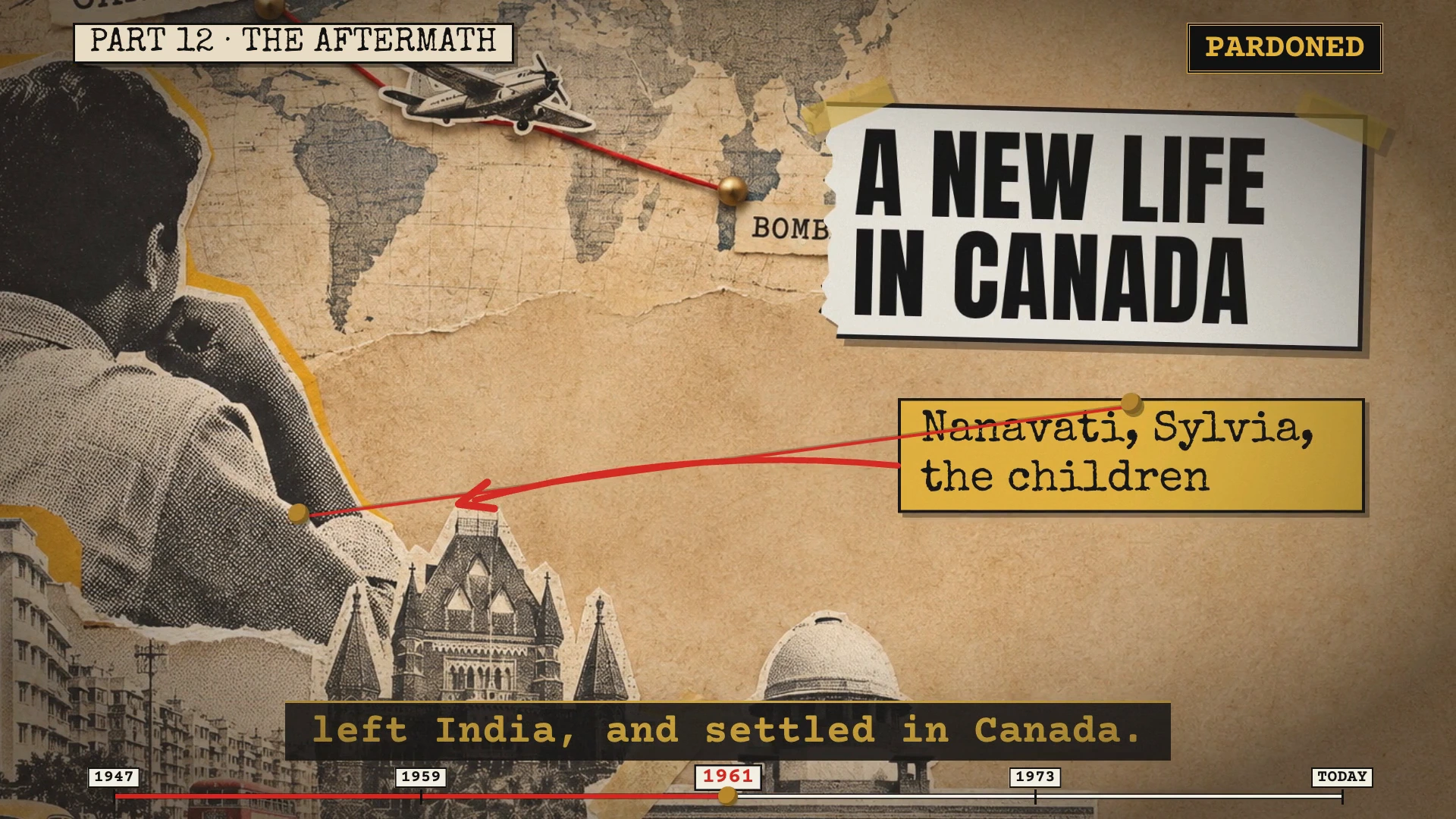
The Governor of Maharashtra, Vijaya Lakshmi Pandit, granted a pardon after about three years in prison. Prem Ahuja’s sister gave her written consent. Nanavati and his family then settled in Canada.
Three lessons from the Nanavati case: tap a card
Courts look at what the accused did between the provocation and the act. A drive, an errand, a weapon fetched and a search for the victim each show thought, which is the opposite of sudden passion.
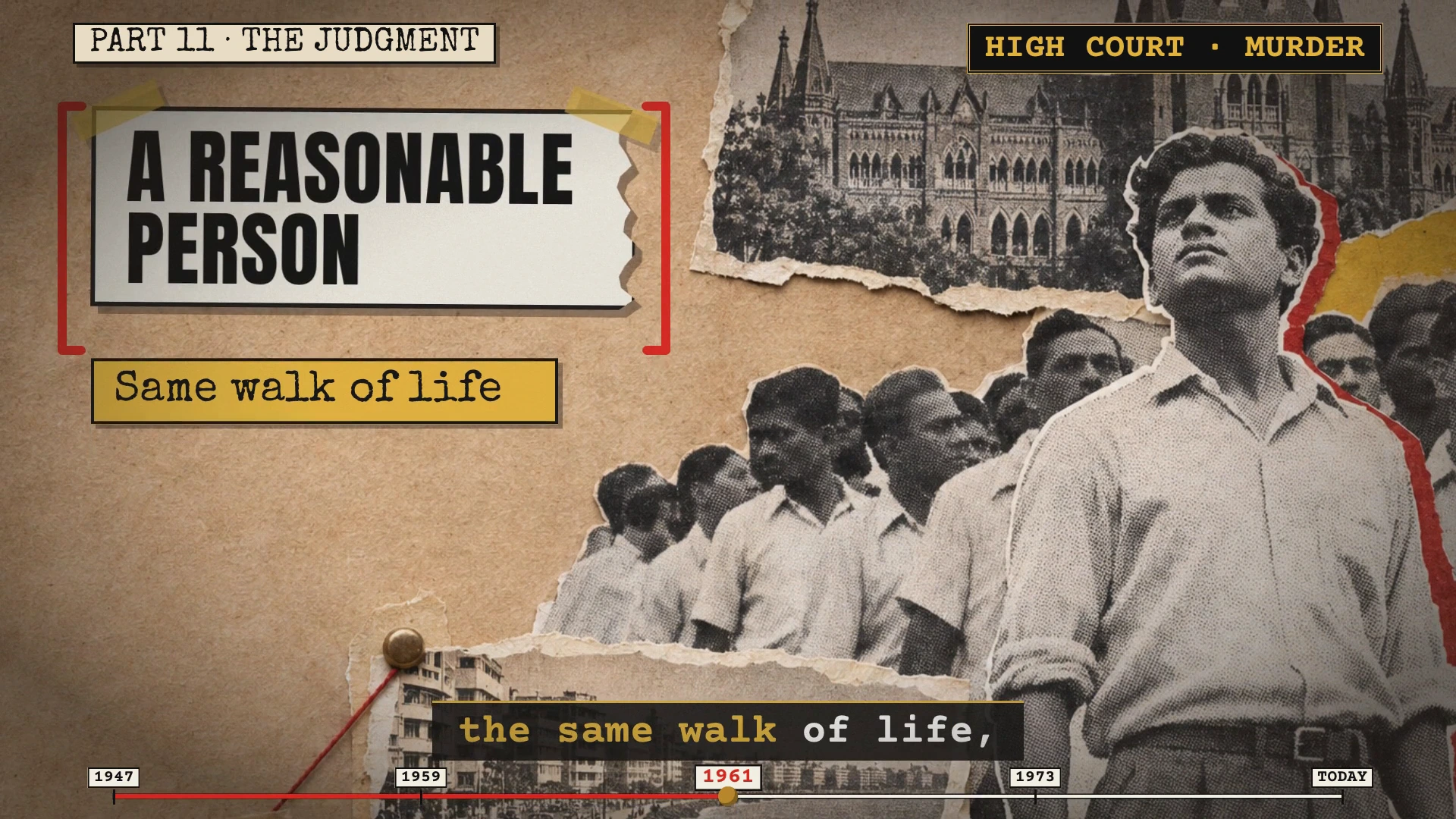
The question is not whether this person was upset. It is whether a reasonable person of the same class of society, in the same situation, would have lost self-control.
Rallies, a tabloid and toy revolvers could not change what the evidence showed. A case is decided on the law and the record, not on who the public likes.
Four Legal Lessons from the Nanavati Case
Grave and sudden provocation
Culpable homicide is not murder if the offender, deprived of self-control by grave and sudden provocation, kills the person who provoked. The Supreme Court asked whether a reasonable man of the same class of society, in the same situation, would have lost self-control.
The law forgives a moment, not an afternoon
The fatal act must be traced to the passion caused by the provocation. If the passion has cooled with time, or the accused had room for planning, the exception is lost. A drive, an errand and a weapon fetched each show thought, not sudden rage.
The burden on an accused who pleads an exception
The prosecution must prove the killing, and that burden never shifts. But an accused who relies on an exception such as accident or provocation must bring material to show his case falls within it. Inconsistent defences weaken each other.
A perverse jury verdict could be referred
The old Code let a Sessions Judge refer a jury’s verdict to the High Court if he thought it necessary in the interests of justice. The High Court and then the Supreme Court found the jury had been misdirected on the law. This procedure has no counterpart today.
Five points for any provocation defence
- Anger alone is not a defence; it must still be sudden when the act is done.
- Time is evidence: what the accused did between the provocation and the act is examined.
- The test is objective: a reasonable person of the same walk of life, in the same situation.
- Build the defence carefully from the first statement; an accident story and a provocation story weaken each other.
- Public opinion is not a verdict: the rallies, the tabloid and the crowd could not change the record.
The Nanavati case in four judgments
One shooting produced four decisions, from the Bombay High Court up to the Supreme Court. Together they set the cooling-time test that Indian courts still apply to grave and sudden provocation, now under Exception 1 to Section 101 BNS.
1961
Anger must still be sudden
A three-judge bench (Subba Rao J. writing, with S. K. Das and Raghubar Dayal JJ.) set the reasonable man test: a person of the same class of society, in the same situation, must lose self-control. Words such as a confession of adultery can be provocation. About three hours, a trip to the ship and a revolver obtained on a false pretext gave time to cool. The Court upheld the murder conviction.
1961
A misdirected jury's verdict cannot stand
The same judgment held that the High Court was right to step in on the Section 307 CrPC 1898 reference. The jury had not been told that under Section 105 of the Evidence Act the accused must bring his case within an exception such as accident (Section 80 IPC). Nanavati’s own admissions had been treated as circumstantial evidence, and Sylvia’s letters were never explained to the jury.
1960
Verdict set aside, guilty of murder
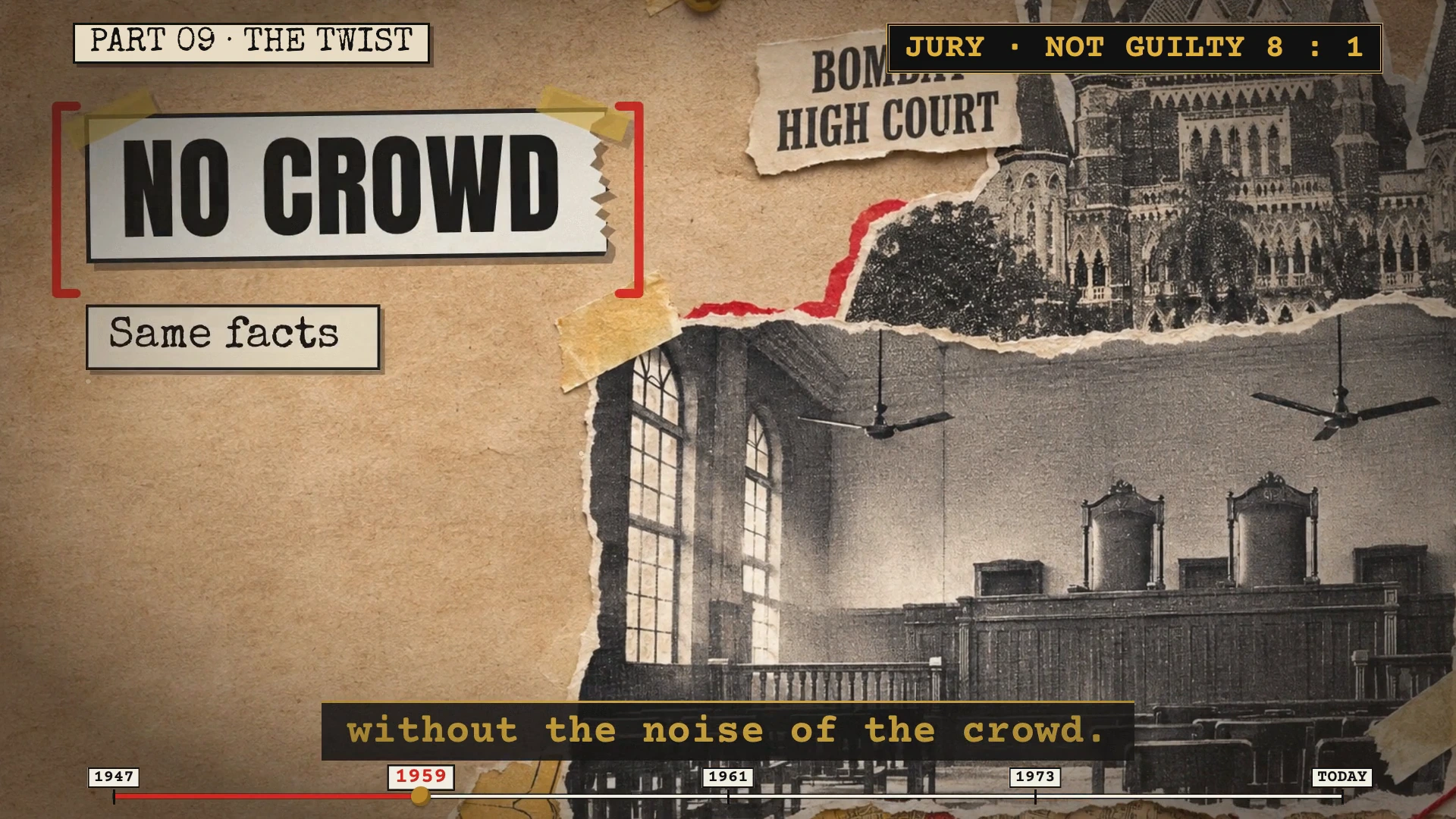
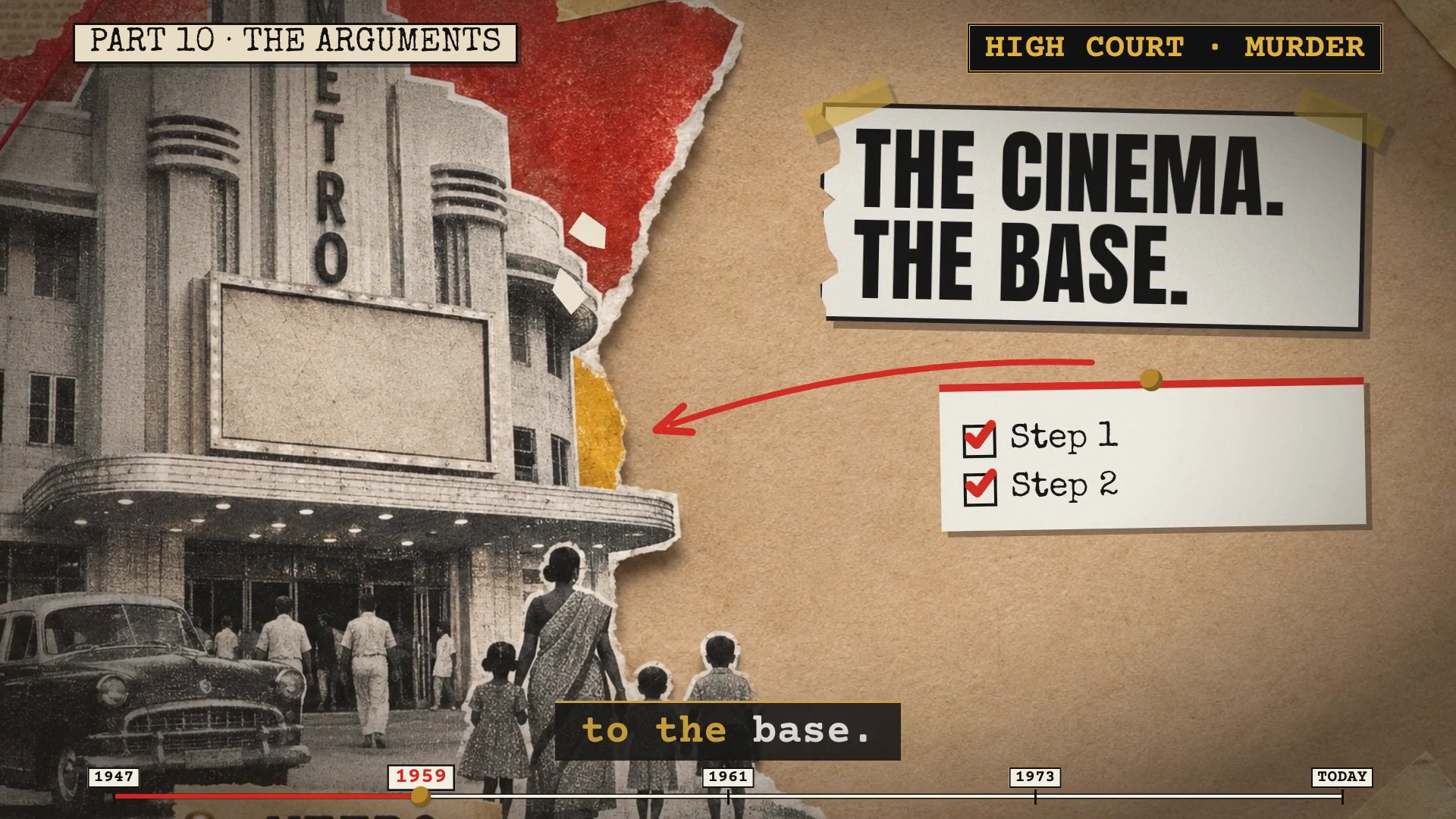
The Sessions Judge found the 8 to 1 verdict of not guilty perverse and referred the whole case to the High Court. Looking at the same facts without the crowd, the Division Bench found the jury had been misdirected on the law. It held that a man who leaves his family at a cinema and collects a gun is not acting in sudden rage. It convicted him of murder and sentenced him to imprisonment for life.
1960
The Governor's order reaches the High Court
On the same day as the conviction, the Governor of Bombay suspended the sentence under Article 161 so that Nanavati could stay in naval custody. That order created an unusual situation, and a Full Bench of the Bombay High Court, led by Chief Justice Chainani, was formed to deal with it. This is the first round of the clash between the Governor’s clemency power and the courts.
1960
No suspension while the appeal is pending
On 5 September 1960 a Constitution Bench held by majority, with Kapur J. dissenting, that the Governor could not suspend the sentence under Article 161 for the period the matter was pending before the Supreme Court. Once the appeal was before it, the Supreme Court’s own rules governed whether the accused had to surrender. The ruling marks a limit on the clemency power while a case is still in court.
How the case travelled from a jury to the Supreme Court
Surrender and charge under Section 302 IPC
After the shooting on 27 April 1959, Nanavati went to the Provost Marshal of the Western Naval Command and then to Deputy Commissioner of Police John Lobo. He was charged with murder under Section 302 IPC, today Section 103 BNS. His defence was accident, and in the alternative grave and sudden provocation under Exception 1 to Section 300 IPC.
Jury trial in the Sessions Court
Sessions Judge Ratilal Bhaichand Mehta sat with a jury of nine in the Sessions Court of Greater Bombay. The judge explained the law and the jury decided the facts. The jury returned a verdict of not guilty by 8 to 1.
Reference under Section 307 CrPC 1898
The judge believed no reasonable jury could reach that verdict on the evidence. He used his power under Section 307 of the old Code to refer the whole case to the Bombay High Court in the interests of justice. Nothing like this exists today: the CrPC of 1973 and the BNSS of 2023 have no jury trials.
Conviction by the High Court
On 11 March 1960 Justice Shelat and Justice Naik found that the jury had been misdirected. On the evidence they convicted Nanavati of murder and sentenced him to imprisonment for life. The same day, the Governor suspended the sentence under Article 161, which led to separate proceedings on that order.
Appeal dismissed by the Supreme Court
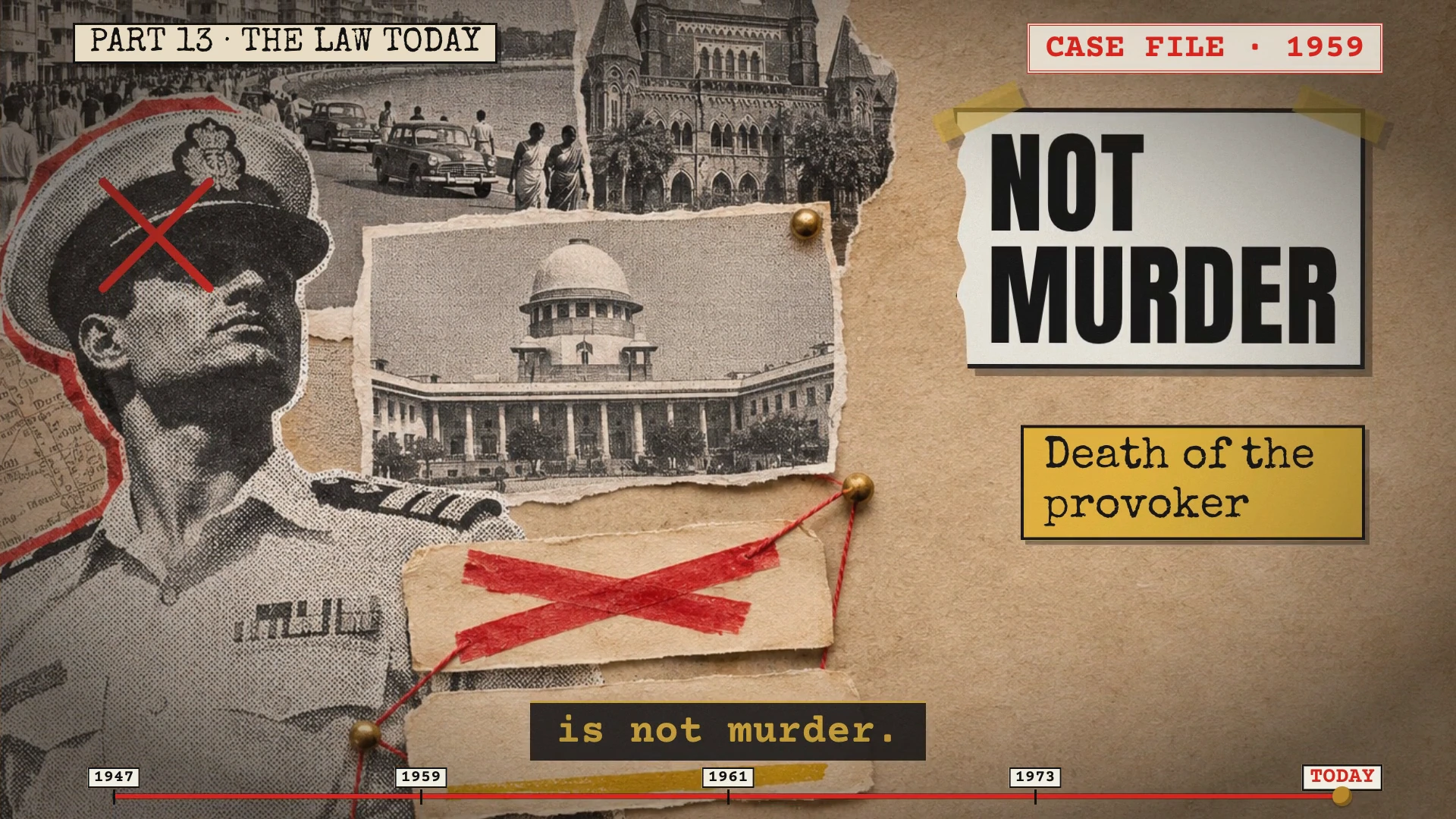
On 24 November 1961 the Supreme Court upheld the High Court’s power to step in, applied the reasonable man and cooling-time tests, and called the killing deliberate and calculated. The appeal was dismissed and the conviction for murder stood.
Pardon under Article 161
After about three years in prison, the Governor of Maharashtra, Vijaya Lakshmi Pandit, granted a pardon, with the written consent of Prem Ahuja’s sister Mamie. The pardon was an act of clemency by the executive. It did not undo the conviction, and it did not change the law the courts had laid down.
What the jury saw and what the judges found
The same facts were read very differently once the noise of the crowd was gone.
The Nanavati Case at a Glance
The facts and the court record in one place, in the order the case moved: trial, reference, High Court, Supreme Court, pardon.
The Day of 27 April 1959, Step by Step
The case turned on time. These are the steps as the Supreme Court’s judgment records them; each one counted against the plea of sudden provocation.
The Supreme Court held that about three hours had passed and there was sufficient time to regain self-control. It called the killing a deliberate and calculated one.
The Supreme Court's Test for Grave and Sudden Provocation
On 24 November 1961 Justice Subba Rao explained the Indian law in four simple points. Tap a point to read it.
In plain words: the law forgives a moment, not an afternoon. Every hour that passes and every careful step taken counts against the accused. The Court also found misdirections to the jury: the burden under Section 105 of the Evidence Act on a plea of accident (Section 80 IPC) was not explained, Nanavati’s admissions were wrongly treated as circumstantial evidence, and Sylvia’s letters to Ahuja were not explained in the charge.
Nanavati Case Law Then and Now: IPC to BNS
The Indian Penal Code was replaced by the Bharatiya Nyaya Sanhita, 2023 on 1 July 2024. The rule tested in the Nanavati case moved, but it did not change. Compare each provision side by side.
The exception still has its limits: it does not apply if the accused sought out or voluntarily provoked the quarrel as an excuse to kill, or to provocation given by a public servant lawfully doing his duty or in the lawful exercise of the right of private defence. Whether the provocation was grave and sudden is a question of fact on the evidence in each case.
Nanavati Case: Frequently Asked Questions
Short answers to the questions people ask most about the case. Tap a question to read the answer.
Sources
- K. M. Nanavati v. State of Maharashtra, Supreme Court of India, judgment of 24 November 1961, AIR 1962 SC 605 : 1962 Supp (1) SCR 567 (MANU/SC/0147/1961)
- K. M. Nanavati v. State of Bombay, Supreme Court of India, 5 September 1960, AIR 1961 SC 112 : (1961) 1 SCR 497 (Governor’s suspension of sentence under Article 161)
- State v. Kawas Manekshaw Nanavati, Bombay High Court (Full Bench), 30 March 1960, AIR 1960 Bom 502
- Bharatiya Nyaya Sanhita, 2023 (Sections 18, 100, 101, 103 and 105); Bharatiya Sakshya Adhiniyam, 2023 (Section 108); Bharatiya Nagarik Suraksha Sanhita, 2023
- Indian Penal Code, 1860; Code of Criminal Procedure, 1898 and 1973; Indian Evidence Act, 1872
- K. M. Nanavati v. State of Maharashtra, Wikipedia (shooting, prosecution, public support, release and the jury-trial myth, citing Jaffe in the Economic and Political Weekly)
Disclaimer: This page is for general legal awareness and academic discussion only. It does not constitute personalised legal advice, and outcomes in any individual matter depend on the facts of the case and judicial discretion. Please consult a qualified advocate for advice specific to your situation.
Where a provocation defence goes wrong
Treating anger as a defence in itself Exception 1 to Section 101 BNS covers only a person who kills while actually deprived of self-control by grave and sudden provocation. The law forgives a moment, not an afternoon.
Ignoring what happened between the provocation and the act Courts count every step: a drive, an errand, a weapon fetched, a search for the victim. In Nanavati, about three hours and a revolver obtained on a false pretext showed time to cool and room to plan.
Running two stories that cancel each other out Claiming an accident and also provocation weakens both pleas. An accused who relies on an exception must bring material to prove it under Section 108 BSA (earlier Section 105 Evidence Act), so the defence has to be built consistently from the very first statement.
Counting on public opinion Tabloid support, rallies and even a jury acquittal could not save a verdict reached on a wrong understanding of the law. A case is decided on the law and the record, not on who the crowd likes.
From our practice
Facing a Murder or Culpable Homicide Charge?
Whether a plea of provocation, accident or private defence is available depends on the facts, the timing and the evidence from the very first statement. Patra’s Law Chambers advises on criminal matters before the Calcutta High Court and the Supreme Court of India. For legal consultation, call +91 890 222 4444 or visit www.patraslawchambers.com. Every matter is assessed on its own facts, and no outcome can be promised.
Book a ConsultationEstablished by a distinguished alumnus of IIT Kharagpur, Patra’s Law Chambers stands as a beacon of legal expertise in Kolkata & Delhi. Know more →
Kolkata Office
NICCO House, 6th Floor, 2 Hare Street
Kolkata-700001 (Near Calcutta High Court)
Delhi Office
4455/5, First Floor, Gali Shahid Bhagat Singh
Main Bazar Road, Paharganj, New Delhi-110055
Contact
[email protected]
+91 890 222 4444 / +91 7003 715 325
The votes and the bench, at a glance
The jury was nearly unanimous, yet three judges of the Supreme Court reached the opposite result.
Frequently asked questions about the Nanavati case
K. M. Nanavati v. State of Maharashtra concerns Commander Kawas Manekshaw Nanavati, who shot Prem Ahuja in Bombay on 27 April 1959 after his wife confessed an affair. A jury acquitted him 8 to 1, the High Court convicted him of murder, and the Supreme Court upheld that on 24 November 1961 (AIR 1962 SC 605).
The Sessions Judge found the verdict perverse and referred the case to the Bombay High Court under Section 307 of the old Criminal Procedure Code. The High Court and the Supreme Court found that the jury had been misdirected on the law, and held on the evidence that the killing was deliberate, not sudden.
It is provocation serious enough to make a reasonable person of the same background lose self-control, with the act done before there is time to cool down. The offence is then culpable homicide not amounting to murder. Today this is Exception 1 to Section 101 BNS, earlier Exception 1 to Section 300 IPC.
The Supreme Court asked whether a reasonable man of the same class of society as the accused, placed in the same situation, would have been so provoked as to lose self-control. The killing must also be traced to that passion, before it has cooled by lapse of time.
Yes, the rule has moved but not changed. Exception 1 to Section 101 BNS replaced Exception 1 to Section 300 IPC from 1 July 2024. Punishment for the lesser offence falls under Section 105 BNS, earlier Section 304 IPC, and for murder under Section 103 BNS, earlier Section 302 IPC.
No, that is a common myth. Juries were used in some trials for a few more years. Jury trials were finally left out of the Code of Criminal Procedure in 1973, and the Bharatiya Nagarik Suraksha Sanhita of 2023 has none either.
The prosecution must always prove the killing beyond reasonable doubt. But an accused who relies on an exception, such as provocation or accident, must bring material to show his case falls within it. This rule was Section 105 of the Evidence Act and is now Section 108 of the BSA.
Rustom (2016) is a fictionalised film inspired by the Nanavati case. Earlier films, Yeh Rastey Hain Pyar Ke (1963) and Achanak (1973), also drew on it. The real case was decided in the courts, and the law it settled is still applied today.