Money Recovery Suit in Kolkata: Summary Suit or Ordinary Suit, Limitation, Interest and Court Fee
A money claim can be filed as a fast summary suit under Order XXXVII CPC or as an ordinary suit. Which route is open depends on your paper, the amount and the defendant. This guide covers the route, the limitation clock, the interest you can claim and the court fee in West Bengal.
Which route fits your money claim?
A money recovery suit asks a civil court to order the defendant to pay a sum owed, with interest. A summary suit under Order XXXVII of the Code of Civil Procedure, 1908 is available only for a debt or liquidated demand based on a bill of exchange, hundi, promissory note, written contract, enactment, guarantee or an assigned receivable. The defendant cannot defend as of right. They must appear within 10 days and then apply for leave to defend within 10 days of the summons for judgment. Any other claim, such as a friendly cash loan with no paper, a claim for damages or one needing accounts, goes by the ordinary suit.
Before filing, three checks matter: whether the claim is still within time, whether it is a commercial dispute of ₹3 lakh or more that needs pre-institution mediation under Section 12A of the Commercial Courts Act, 2015 (see the Pre-Institution Mediation Rules, 2018), and what court fee applies. For mediation, MSMED and Hubtown in depth, read our page on commercial disputes in Kolkata. For the fee, use the court fee calculator for West Bengal. For a matter to be filed in the High Court, see our Calcutta High Court advocate page.
Key time limits in a money recovery suit
Short, strict periods apply to the defendant in a summary suit, and longer ones to appeals; verify each against the current law before relying on it.
Short explainers from Adv. Sudip Patra
More short explainers on our YouTube channel: Patra’s Law Chambers on YouTube ↗
What does your money claim look like today?
The right route depends on the paper behind the claim, whether the sum is fixed, and who owes it. This is general information, not advice on your file.
Choose one of the options above.
How a money recovery suit moves, from first check to decree
A typical path for a summary suit is shown below. An ordinary suit follows the same early steps and then moves into written statement, issues and evidence.
Fix the date from which the three years run: the loan date, delivery, end of the credit period, or the close of the year of the last admitted entry. Collect agreements, invoices, challans, bank records and any signed acknowledgment.
Demand the principal and say that interest will be claimed; this supports an interest claim under the Interest Act, 1978. If a cheque bounced, run the s.138 NI Act timeline in parallel, see cheque bounce matters.
Apply for pre-institution mediation through the Legal Services Authority under s.12A of the Commercial Courts Act, 2015. For more on mediation and the MSMED route, see commercial disputes in Kolkata.
In a summary suit the plaint carries the Order XXXVII inscription, and the defendant must enter appearance within 10 days of service. Court fee is ad valorem; check the amount with the court fee calculator and verify it against the current Schedule.
After appearance, the plaintiff serves a summons for judgment, and the defendant has 10 days to apply for leave to defend. If no leave is sought or leave is refused, a decree can follow forthwith; if leave is granted, the suit proceeds like an ordinary suit.
A decree is enforced under Order XXI CPC by attachment and other modes, and an appeal lies within the period fixed by law. For the appeal route, see civil appeals in the Calcutta High Court.
Three money-claim points people often get wrong, tap a card
The three years run from the date the loan was made (Articles 19 and 21), not from the date you ask for it back. Counting from the demand is a common and costly error.
A bare ledger balance usually does not make a summary suit. Signed invoices, balance confirmations and acknowledgment letters are stronger, and interest should be kept to what was agreed in writing.
After IDBI Trusteeship v Hubtown (2017) and B.L. Kashyap v JMS Steels (2022), leave to defend is the ordinary rule and refusal the exception. Where part of the amount is admitted, leave depends on depositing it.

Money recovery matters we handle
Summary suits on written contracts
Claims for a fixed sum on a written contract, invoice accepted in writing, promissory note, bill, guarantee or assigned receivable. The plaint carries the Order 37 inscription and the case moves through summons, summons for judgment and the leave-to-defend stage.
Ordinary suits for recovery
For loans proved by bank records and messages, oral terms, damages, accounts or weak documents. These cases are tried on issues and evidence. Attachment before judgment under Order 38 Rule 5 is considered only where assets are being disposed of.
Limitation and acknowledgment review
Fixing the date from which time runs under Articles 1, 14, 15, 18, 19, 21, 22, 55 or 113, and checking whether a signed acknowledgment under Section 18 or a written part-payment under Section 19 gives a fresh period.
Legal notice, interest and execution
A demand notice that claims principal and interest, Section 80 CPC notice where Government is the debtor, a parallel Section 138 NI Act step for a bounced cheque, and execution of the decree under Order 21.
Where a money suit is filed in Kolkata (verify current limits)
- Small Causes Court, within its pecuniary limit (verify the current limit)
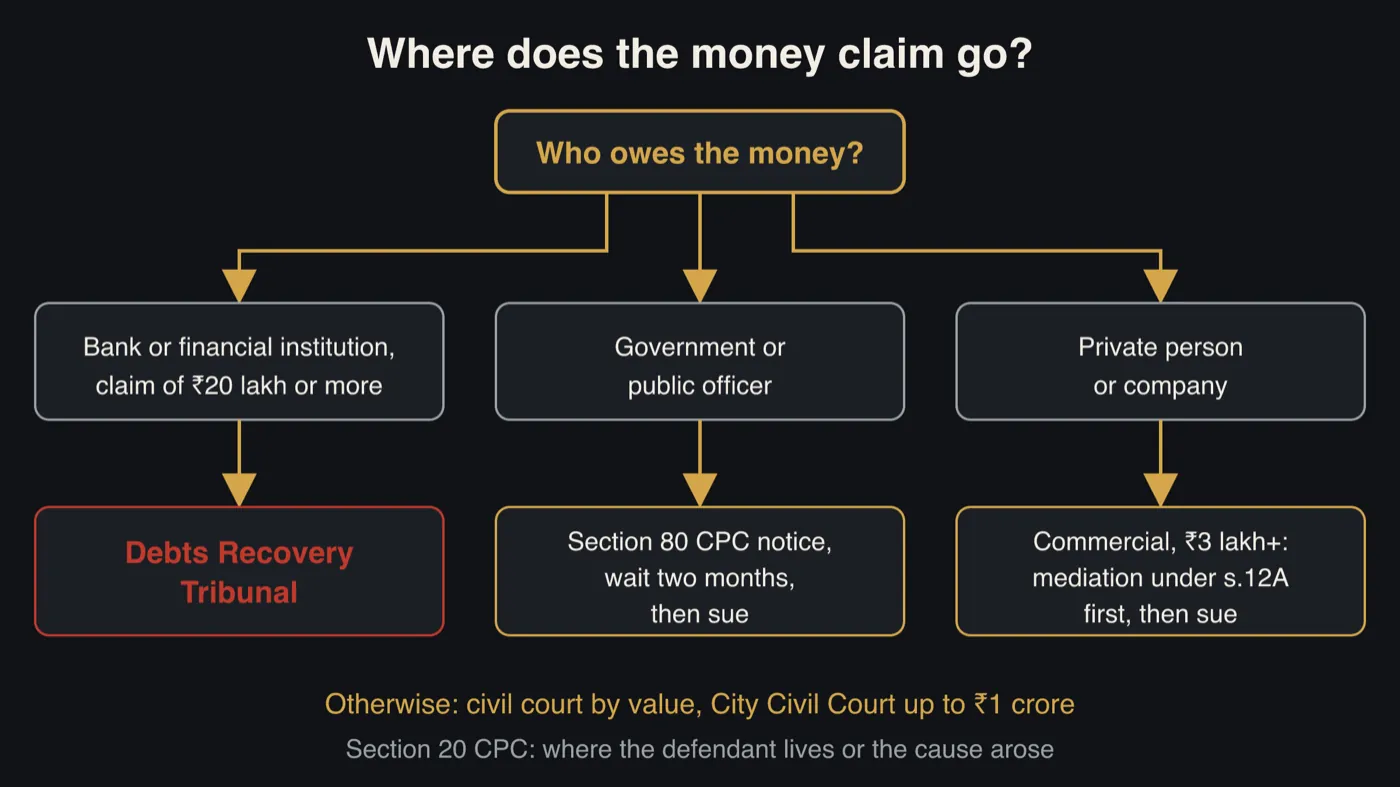
- City Civil Court, up to ₹1 crore after the 2013 amendment
- Calcutta High Court Original Side above ₹10 lakh, shared with the City Civil Court up to ₹1 crore
- Commercial disputes go to the designated Commercial Courts or the High Court Commercial Division, as notified
- On the Original Side, Chapter XIIIA of the Original Side Rules also gives a summary procedure for listed categories
- Bank and financial institution claims above ₹20 lakh belong before the DRT, not a civil court
Supreme Court rulings that shape a money recovery suit
These rulings decide whether a defendant gets leave to defend, whether mediation must come first, how long the creditor has, and how much interest the court can award. Each citation below was checked against published reports. Read the full text before you rely on any of them.
2016
New test for leave to defend
In a summary suit on a guarantee, the Supreme Court held that the old Mechelec guidelines no longer fit the amended Order XXXVII Rule 3. Under the new test, a substantial defence gets unconditional leave. A plausible but improbable defence gets leave on conditions such as a deposit. A frivolous or vexatious defence gets no leave. Any admitted amount must be deposited.
2022
Leave is the rule, refusal the exception
In a summary suit over steel supplied for a construction project, the Supreme Court said that granting leave to defend, with or without conditions, is the ordinary rule. Refusing leave is an exception, kept for a defence that is practically nothing. The lower courts had called the contractor’s defence frivolous without enough basis. The appeal was allowed and leave was granted.
2022
Section 12A mediation is mandatory
The Supreme Court held that pre-institution mediation under Section 12A of the Commercial Courts Act, 2015 is mandatory, not optional. A commercial suit filed without it, where no urgent interim relief is contemplated, is liable to be rejected under Order VII Rule 11 CPC. The declaration operates for suits filed from 20 August 2022.
2025
Older suits without mediation are not rejected
This case began as a Rs. 8.73 crore money suit in the Commercial Court at Alipore, filed without pre-institution mediation. The Supreme Court said Section 12A is mandatory but that rejection applies only going forward. Suits filed before 20 August 2022 without mediation are not to be rejected on that ground and may be kept pending while mediation is tried. A copy was sent to all High Courts.
2021
Balance-sheet entries can acknowledge a debt
The Supreme Court held that a debt shown in a company’s signed balance sheet can be an acknowledgment of liability under Section 18 of the Limitation Act, 1963. That starts a fresh limitation period. The notes to the accounts and the auditor’s report must be read with the balance sheet, because they may show that a particular entry is not an acknowledgment.
2001
How Section 34 CPC interest works
A Constitution Bench explained the words principal sum adjudged in Section 34 CPC. Interest that was lawfully capitalised before the suit can form part of the principal on which the court grants further interest. Interest during the suit and after the decree is at the court’s discretion, which must be used fairly and reasonably. It is not fixed automatically by the contract rate.
How a money recovery suit moves, from limitation check to decree
Check limitation before anything else
Most money claims have three years, but the start date depends on the claim. A loan, even one payable on demand, runs from the date it was given (Articles 19 and 21). Goods run from delivery or from the end of the credit period (Articles 14 and 15). A signed acknowledgment or a written record of part payment made in time starts a fresh period (Sections 18 and 19).
Collect documents and send a demand notice
Gather the agreement, promissory note, invoices with acknowledgment, ledger, bank records and messages. For electronic records, prepare the certificate under Section 63 of the Bharatiya Sakshya Adhiniyam, 2023. A written demand that says interest will be claimed supports interest under Section 3 of the Interest Act, 1978. Before suing the Government, two months’ notice under Section 80 CPC is required.
Mediate first if the claim is commercial and Rs. 3 lakh or more
For a commercial dispute of Rs. 3 lakh or more where no urgent interim relief is genuinely needed, apply for pre-institution mediation through the Legal Services Authority under Section 12A of the Commercial Courts Act, 2015. The time spent in mediation is left out when limitation is counted. More detail is on our commercial disputes page.
Choose the route and the court
Use an Order XXXVII summary suit for a fixed sum based on a written contract, negotiable instrument, enactment, guarantee or assigned receivable. Choose an ordinary suit where the terms were oral, damages are claimed or accounts must be taken. Pay ad valorem court fee on the amount claimed (check it on our court fee calculator) and file in the court with the right pecuniary and territorial jurisdiction.
Summary suit: 10 days to appear, then 10 days to seek leave
The defendant must enter appearance within 10 days of the summons. The plaintiff then serves a summons for judgment with a supporting affidavit. The defendant has 10 days from that service to apply for leave to defend. If no application is made, or leave is refused, the plaintiff gets a decree straight away. If leave is granted, possibly on a deposit, the suit goes to trial.
Decree, execution and appeal
A decree is enforced under Order XXI CPC by attachment, garnishee orders and, as a last resort, arrest. The decree-holder has 12 years to execute it (Article 136). A commercial appeal must be filed within 60 days under Section 13(1A). A non-commercial appeal to the High Court has 90 days, and an appeal to the district court has 30 days.
Summary suit or ordinary suit?
The two routes differ in who must seek the court’s permission to proceed and what the claim can rest on.
Route chooser: summary suit or ordinary suit?
Answer the four questions and press the button. The result is a general pointer to the route to examine, not advice on your documents.
Limitation clock: when does your three years end?
Enter the date from which time runs and, if you have one, the date of a signed acknowledgment or written part payment. The tool adds three years and any mediation time.
- Enter the date time starts: loan date, delivery date, end of the credit period, or close of the year of the last admitted entry.
- If a signed acknowledgment or written part payment was made before the first period ended, enter its date.
- If pre-institution mediation was done, enter the days it took.
Mistakes that sink money claims
Counting limitation from the date you asked for repayment. For a loan payable on demand, Article 21 runs the three years from the day the money was lent, not from the demand. Section 5 condonation of delay does not apply to suits, so a late plaint is dismissed under Section 3.
Filing a summary suit on a bare ledger balance or an oral loan. Order XXXVII needs a fixed sum backed by a written contract, instrument, enactment or guarantee. Unsigned running-account balances, cash loans without paper and claims for interest nobody agreed to are often sent to the ordinary-suit route.
Treating a UPI or bank credit as a fresh start for limitation. Section 19 needs the part payment to be shown in writing signed by, or in the hand of, the payer. A bank entry on its own may not be enough, so keep the message or acknowledgment that came with it.
Adding an urgent-relief prayer only to skip mediation. Courts look past a disguised urgency plea in a commercial suit and can reject the plaint. If the debtor really is disposing of assets, set out that evidence and ask for attachment before judgment under Order XXXVIII Rule 5. Where a cheque was given and dishonoured, look at the cheque bounce timeline as well.
Talk through your recovery claim
Every money claim turns on its paper, its dates and the defendant. Bring the agreement or messages, invoices or bank records, any notice already sent and the dates of the last payment or acknowledgment. We will tell you which route is open, whether the claim is in time, whether mediation applies and what court fee to expect. The advice is based on your documents and the current law, and no outcome can be promised.
Book a ConsultationEstablished by a distinguished alumnus of IIT Kharagpur, Patra’s Law Chambers stands as a beacon of legal expertise in Kolkata & Delhi. Know more →

Kolkata Office
NICCO House, 6th Floor, 2 Hare Street
Kolkata-700001 (Near Calcutta High Court)
Delhi Office
4455/5, First Floor, Gali Shahid Bhagat Singh
Main Bazar Road, Paharganj, New Delhi-110055
Contact
[email protected]
+91 890 222 4444 / +91 7003 715 325
How court fee grows with the claim in West Bengal
Fee is charged on the amount claimed and is capped; these figures come from the site’s calculator and must be checked against the current Schedule.
Frequently asked questions about money recovery suits in West Bengal
It is a civil suit asking the court to order the defendant to pay a sum owed, with interest where claimed. It can be filed as a summary suit under Order XXXVII CPC or as an ordinary suit, depending on the claim and the documents available.
No. Order XXXVII covers suits on bills of exchange, hundis and promissory notes, and claims for a debt or liquidated demand on a written contract, an enactment, a guarantee, or an assigned receivable. Claims on oral terms, damages or accounts need an ordinary suit.
Generally three years from the date the loan was made, even if it is repayable on demand (Articles 19 and 21, Limitation Act, 1963). A signed written acknowledgment (s.18) or a written record of part payment (s.19) before expiry starts a fresh period. Section 5 condonation does not apply to suits.
Usually three years from delivery (Article 14), or from the end of the agreed credit period (Article 15). For a running mutual account, it runs from the close of the year of the last admitted entry (Article 1). Verify the right Article for your facts.
Not for a private money suit. It matters in practice: a written demand saying interest will be claimed supports interest under the Interest Act, 1978, and a cheque bounce complaint needs a statutory notice. Against the Government, a two-month notice under Section 80 CPC is mandatory.
In an Order XXXVII suit, the defendant must apply for the court’s permission to contest within 10 days of the summons for judgment. Leave is the ordinary rule where a triable issue exists, sometimes on a deposit. Without leave, the plaintiff can get a decree forthwith.
For a commercial dispute of ₹3 lakh or more, yes, under s.12A of the Commercial Courts Act, 2015, unless genuine urgent interim relief is needed. The Supreme Court held this mandatory in Patil Automation (2022). Mediation time is excluded from limitation. Private non-commercial claims are not covered.
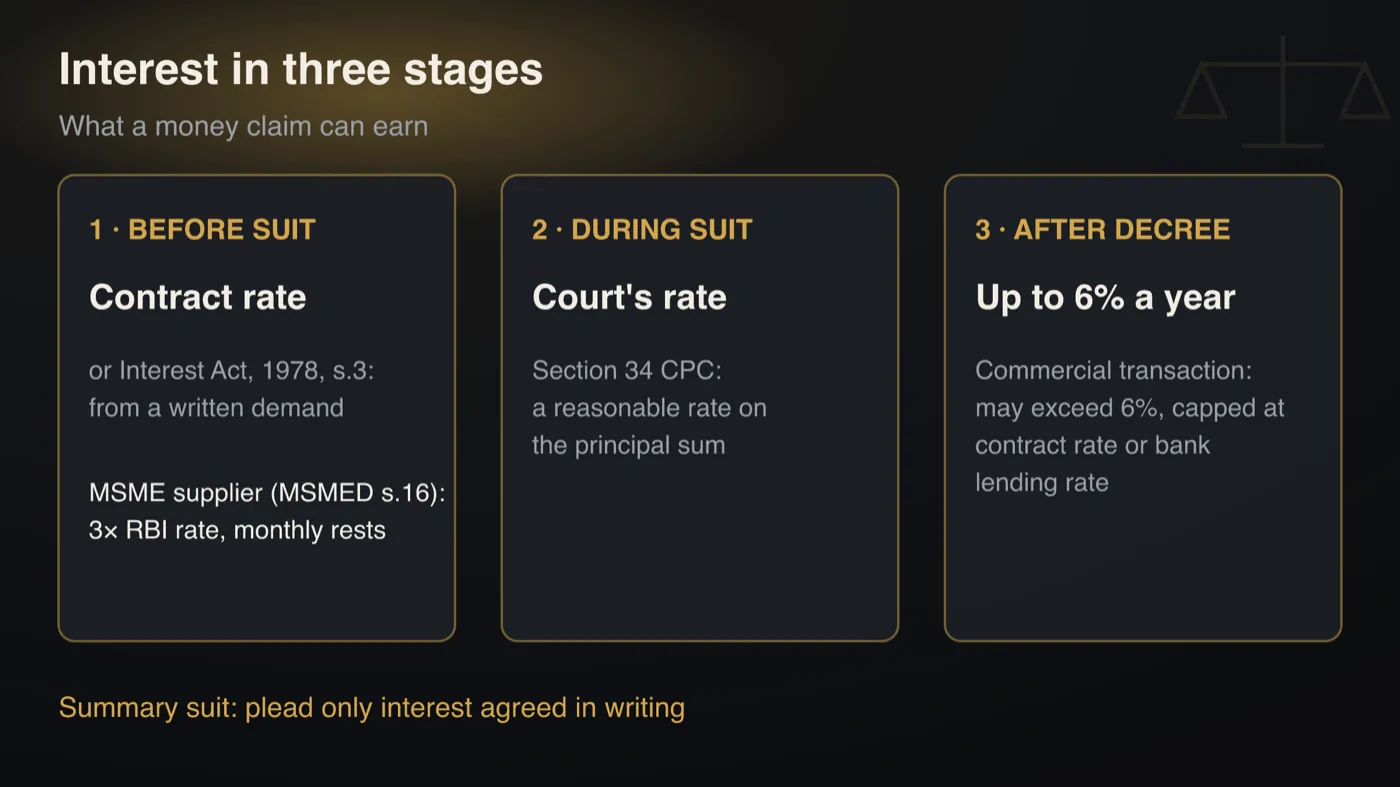
Before the suit, interest may follow the contract, the Interest Act, 1978 from a written demand, or MSMED s.16 for covered dues. During the suit, interest is at the court’s discretion under s.34 CPC. After the decree it is ordinarily up to 6% a year, and can be higher in commercial transactions.