Commercial Disputes Lawyer in Kolkata: Recovery Suits and MSME Dues
Unpaid invoices, broken supply contracts and partnership disputes follow a stricter procedure under the Commercial Courts Act, 2015. Sudip Patra argues these matters himself in the Calcutta High Court’s Commercial Division, the City Civil Court and the district Commercial Courts. Supreme Court matters are filed through his Supreme Court connection.
What counts as a commercial dispute, and where it is heard
A commercial dispute under Section 2(1)(c) of the Commercial Courts Act, 2015 arises from a business transaction such as supply of goods or services, construction, distribution, franchising, partnership or shareholder agreements, intellectual property or insurance. Since the 2018 amendment the specified value is only ₹3 lakh, so many ordinary recovery claims now fall in this category. A property dispute qualifies only if the property is used exclusively in trade or commerce. Disputes of this kind go to a Commercial Court or to the Commercial Division of the High Court, and they follow a stricter version of the Code of Civil Procedure.
In Kolkata, the forum depends on the value of the claim. A West Bengal notification of 20 March 2020 gives the City Civil Court at Calcutta and the Calcutta High Court’s Commercial Division concurrent jurisdiction in the middle band, and district Commercial Courts sit at Alipore, Rajarhat, Asansol and Siliguri. The exact value slabs should be verified against the Gazette before filing. The Act itself can be read on the Department of Legal Affairs website. Filing in the High Court is electronic; see our note on e-filing at the Calcutta High Court.
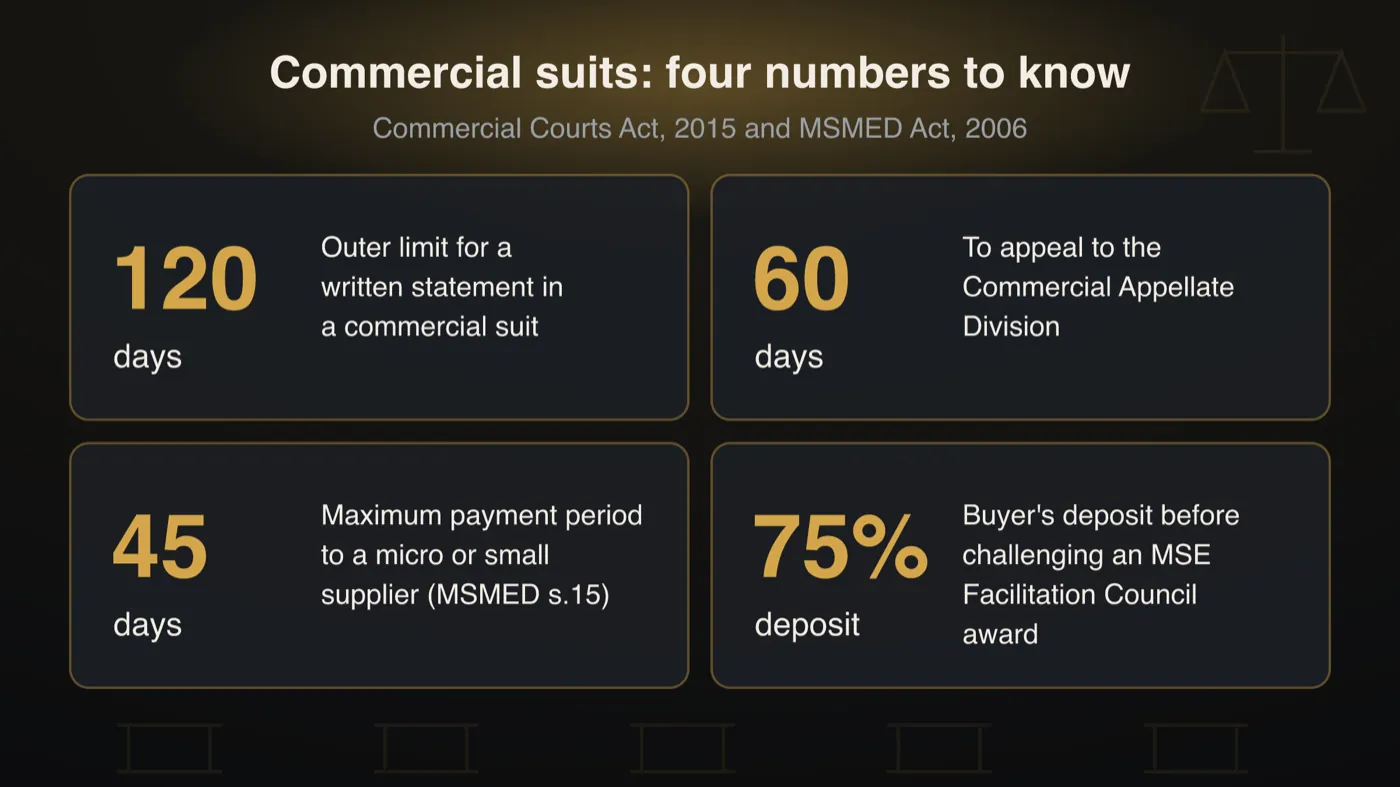
The time limits that matter most
These are the statutory periods most often missed in commercial recovery cases.
Videos from Adv. Sudip Patra
More short explainers on our YouTube channel: Patra’s Law Chambers on YouTube ↗
What is your situation with the unpaid dues or the dispute?
Pick the line closest to your position. This is general information on the usual forum and first step, not advice on your papers.
Choose one of the options above.
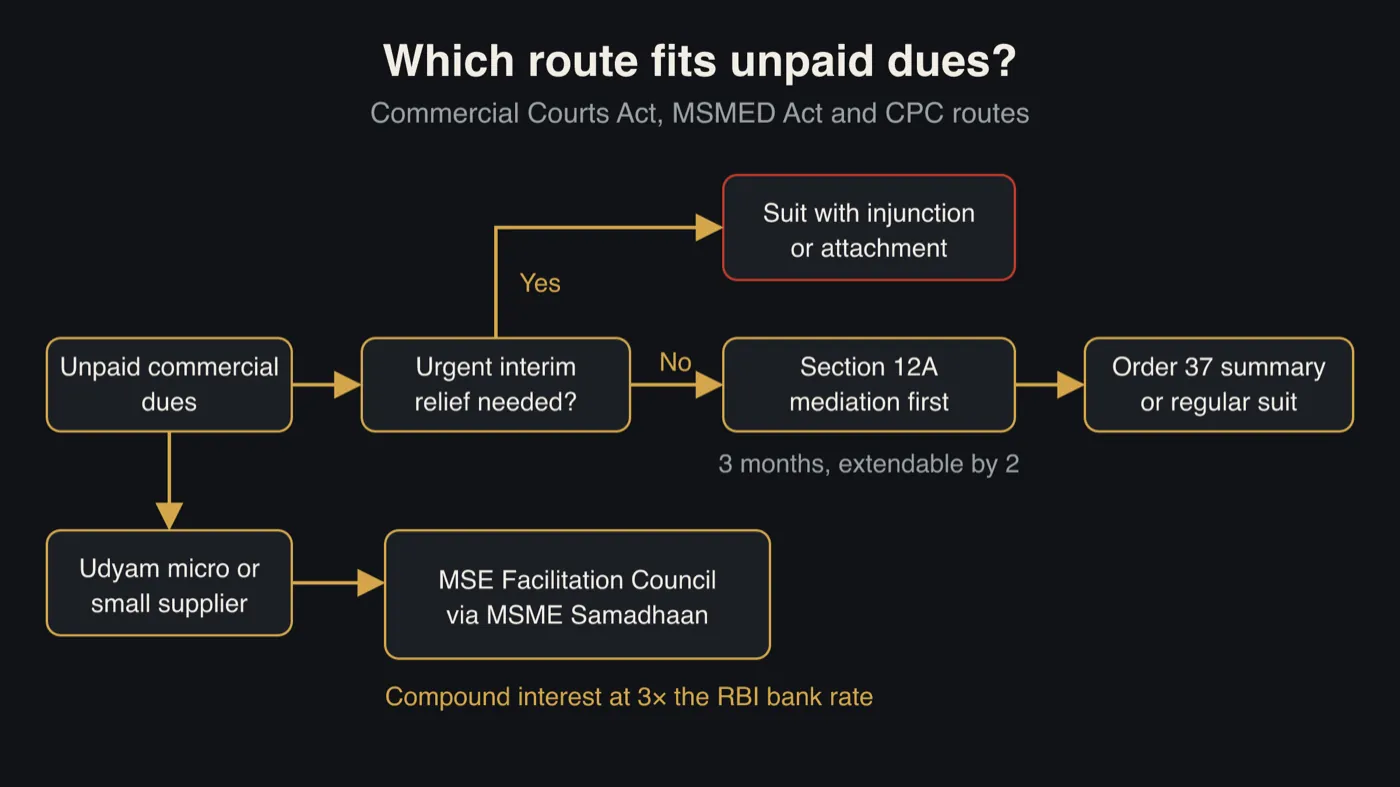
How a commercial recovery case usually moves
This is the usual order of a recovery claim in Kolkata. The route changes if the claim goes to the MSE Facilitation Council or to arbitration.
Contract, invoices, delivery proof, GST records, ledger and messages acknowledging the dues are collected, and the claim value and Udyam status are checked. A demand notice is not required by statute, but it records the amount and interest claimed. It can also draw a written acknowledgement that restarts limitation under Section 18 of the Limitation Act, 1963.
Under Section 12A the applicant applies in Form-1 to the Legal Services Authority. If the other side does not join, a non-starter report is issued and the suit can be filed. A settlement is treated like an arbitral award on agreed terms.
The plaint carries a statement of truth, the list of documents and the mediation report or the urgency plea. Which court hears it depends on the value, so see the Calcutta High Court e-filing guide for how High Court filing works.
The defendant files a written statement within the strict window. In an Order 37 suit the steps are appearance within 10 days and a leave-to-defend application within 10 days of the summons for judgment.
The court fixes a timetable at the case management hearing. Documents are admitted or denied, evidence is often led by affidavit, and witnesses abroad may be allowed to depose by video conference. Written arguments follow.
Appeals lie to the Commercial Appellate Division, as explained in the Calcutta High Court civil appeals guide. A decree is enforced by execution under Order 21 CPC.
Three points that catch people out. Tap a card
For MSME delayed-payment claims, the supplier’s registration date against the contract date can decide whether the Act applies. A trader registered on Udyam is not a supplier for this purpose.
Asking for an injunction does not automatically skip Section 12A mediation. The court looks at whether urgent relief is really contemplated, and the plaintiff must show it.
A buyer who wants to challenge an MSE Facilitation Council award must first deposit 75% of the awarded amount under Section 19 of the MSMED Act. The Supreme Court has held this is mandatory, though payment in instalments may be allowed.

Recovery of dues and commercial suits: the routes
Pre-institution mediation
Unless a suit contemplates urgent interim relief, mediation through the Legal Services Authority must be tried first. It runs for 3 months, extendable by 2, and the time is excluded from limitation. In Patil Automation v. Rakheja Engineers, (2022) 10 SCC 1, the Supreme Court held that it is mandatory.
Summary suits for liquidated debts
A faster route for claims on written contracts, accepted invoices, cheques, hundis and promissory notes. The defendant must appear within 10 days and then obtain leave to defend. The plaint must state that it is filed under Order 37. Choosing it has consequences for summary judgment under Order XIII-A, so the choice needs care.
MSME delayed payments and MSME Samadhaan
A micro or small supplier registered on Udyam can claim unpaid dues before the MSE Facilitation Council through the MSME Samadhaan portal. Section 16 provides compound interest at three times the RBI bank rate. Registration date and the supplier’s category (not a trader) decide whether this route is open.
Injunctions and attachment before judgment
Where assets are being moved or a sale is imminent, a temporary injunction or attachment before judgment may be sought with the plaint. A prima facie case and a real risk must be shown on specific facts. Urgency is examined at the time of filing, so it cannot be pleaded as a formality.
After the first order, and alongside the suit
- Appeal to the Commercial Appellate Division within 60 days, only against orders listed in Order 43 CPC and decrees (Section 13).
- Civil revision against interlocutory orders of a Commercial Court is barred by Section 8; the point is raised in the appeal from the decree.
- Special leave petition under Article 136, filed through the firm’s Supreme Court connection; see SLP under Article 136.
- Dishonoured cheques: a parallel complaint under Section 138 of the NI Act; see cheque bounce matters.
- Undisputed operational debt of ₹1 crore or more: see the IBC guide for operational creditors.
- The DRT is open only to banks and financial institutions, not to trade creditors; see DRT matters for that contrast.
Supreme Court rulings that govern commercial suits and MSME recovery
These Supreme Court decisions set the rules a Kolkata commercial suit or MSME claim is decided by: mediation before suit, strict filing deadlines, leave to defend, and the buyer’s deposit. Each citation was checked against published reports. Read the full judgment before relying on any one of them.
2022
Section 12A mediation is mandatory
The Supreme Court held that pre-institution mediation under Section 12A of the Commercial Courts Act, 2015 is mandatory. A commercial suit that does not contemplate urgent interim relief and is filed without first going through mediation must be rejected under Order VII Rule 11 CPC. The Court made the rejection rule apply to suits filed from 20 August 2022 onwards.
2025
Rejection for skipping mediation is prospective
This case came from a 2019 money suit in the Commercial Court at Alipore. The Supreme Court repeated that Section 12A is mandatory, but held that a suit filed before 20 August 2022 cannot be rejected only because mediation was not tried. Such suits can be sent to mediation instead. The ruling matters for older commercial suits still pending in West Bengal.
2019
120 days for written statement is final
In a commercial suit, the defendant must file the written statement within 30 days, and the court may extend this to no more than 120 days from service of summons. The Supreme Court held this outer limit mandatory. After 120 days the defendant loses the right to file a written statement, and a late one cannot be taken on record.
2016
How leave to defend is decided
This ruling sets out the principles under the amended Order XXXVII Rule 3 CPC. Leave to defend, with or without conditions, is the ordinary rule, and refusing it is the exception. A substantial defence or a fair triable issue earns unconditional leave. A plausible but improbable defence may get leave on conditions such as a deposit or security.
2019
Property must actually be used commercially
Under Section 2(1)(c)(vii) of the Commercial Courts Act, a dispute over an agreement about immovable property is a commercial dispute only if the property is actually used, at the time, exclusively in trade or commerce. Property that is only intended or ready for business use does not qualify, and the suit belongs in an ordinary civil court.
2022
75% pre-deposit under Section 19 is mandatory
A buyer who wants to challenge an award of the Micro and Small Enterprises Facilitation Council under Section 34 of the Arbitration and Conciliation Act must first deposit 75% of the awarded amount, as Section 19 of the MSMED Act, 2006 requires. The Supreme Court held this deposit mandatory, not directory, though the court may allow it to be paid in instalments.
How a commercial recovery claim moves in Kolkata
Check the dispute, its value and the route
First confirm that the transaction is a commercial dispute under Section 2(1)(c) of the Commercial Courts Act and that the specified value is Rs. 3 lakh or more. Then check the contract for an arbitration clause, whether the seller has Udyam registration and when it was obtained, and whether a cheque has been dishonoured.
Send a demand notice
No statute requires a demand notice, but it is very useful in practice. It puts on record the principal, the invoices and the interest claimed. A written reply admitting the dues is an acknowledgement under Section 18 of the Limitation Act, 1963, which restarts the three-year limitation period.
Pick the forum that fits the claim
A micro or small supplier may apply to the MSE Facilitation Council through the MSME Samadhaan portal. Other claims go by arbitration or a commercial suit. For a dishonoured cheque, a complaint under Section 138 NI Act can run alongside; see the cheque bounce lawyer in Kolkata page.
Pre-institution mediation under Section 12A
Unless the suit genuinely needs urgent interim relief, apply in Form-1 to the Legal Services Authority. Mediation must finish within three months, which the parties can extend by two. A settlement is enforceable like an arbitral award. If the other side does not take part, a non-starter report is issued and you can file the suit.
File the plaint and press interim relief
The plaint must carry a statement of truth, a document list with a declaration under Order XI, and either the mediation report or a pleading of urgency. An Order XXXVII suit must say so on its face. Where assets may be moved, file an injunction application (Order XXXIX) or an attachment application (Order XXXVIII Rule 5) at the same time. Filing in the High Court is electronic; see Calcutta High Court e-filing.
Trial, judgment and appeal
After the written statement come the case management hearing under Order XV-A, admission and denial of documents, evidence and written arguments. Judgment is due within 90 days of the end of arguments. An appeal lies to the Commercial Appellate Division within 60 days. A further challenge is a special leave petition; see Supreme Court advocate consultation.
Unpaid dues: which remedy fits
A simple order of questions that usually points to the forum, subject to the facts and documents.
Is the supplier a registered MSE?
Registered on Udyam before the contract and not a trader: the MSE Facilitation Council route under Section 18 of the MSMED Act may be open.
Is there a dishonoured cheque?
A cheque returned unpaid may support a complaint under Section 138 of the Negotiable Instruments Act, 1881, alongside a civil claim.
Is there an arbitration clause?
If the contract has one and the MSMED route is not available, the dispute may have to go to arbitration.
Mediation under Section 12A
Otherwise the plaintiff applies for pre-institution mediation, unless urgent interim relief is genuinely needed.
Summary or ordinary commercial suit
A fixed sum on a written contract can go under Order 37; other claims go as an ordinary commercial suit.
Pre-deposit a buyer must make before challenging an MSE Facilitation Council award (Section 19, MSMED Act, 2006)
Mistakes that cost parties their commercial case
Pleading urgency only to skip mediation Courts look at whether the urgency was real when the suit was filed, and the burden is on the plaintiff. If it was a pretext, the plaint can be rejected under Order VII Rule 11 CPC. Plead specific facts, such as assets being moved or a sale about to happen, and file the injunction application with the plaint.
Missing the 120-day written statement limit In a commercial suit no court can extend the time beyond 120 days from service of summons (SCG Contracts). Defendants should note the date summons was served and file well before the 30-day mark.
Choosing Order XXXVII for the wrong claim A summary suit is only for a debt or liquidated sum backed by a written contract, an accepted invoice, a cheque or a promissory note. A suit filed under Order XXXVII also cannot later seek summary judgment under Order XIII-A, so choose the procedure carefully at the start.
Getting Udyam registration after the contract Under the Supreme Court’s view in Mahakali Foods, a supplier registered only after the contract may lose the MSMED Act’s interest and Facilitation Council remedies for that contract. A larger bench is now considering this question, so register before you contract and keep the certificate date on record.
Discuss a commercial dispute or unpaid dues
If you are owed money, or have been served with a commercial suit or an MSE Facilitation Council reference, bring the contract, invoices, delivery papers, ledger and any messages acknowledging the dues. The route, forum and deadlines are explained after the papers are seen. Outcomes depend on the facts and the evidence, and nothing can be promised. Fees are discussed at the consultation. Clients outside India can be advised by video call, and a properly executed power of attorney lets most stages proceed without travelling.
Book a ConsultationEstablished by a distinguished alumnus of IIT Kharagpur, Patra’s Law Chambers stands as a beacon of legal expertise in Kolkata & Delhi. Know more →

Kolkata Office
NICCO House, 6th Floor, 2 Hare Street
Kolkata-700001 (Near Calcutta High Court)
Delhi Office
4455/5, First Floor, Gali Shahid Bhagat Singh
Main Bazar Road, Paharganj, New Delhi-110055
Contact
[email protected]
+91 890 222 4444 / +91 7003 715 325
Order 37 summary suit and ordinary commercial suit
The choice depends on whether the sum is fixed and backed by writing.
Frequently asked questions about commercial disputes and recovery cases in Kolkata
It is a dispute from a business transaction listed in Section 2(1)(c) of the Commercial Courts Act, 2015, such as supply, construction, distribution, partnership, IP or insurance, with a specified value of ₹3 lakh or more. Property disputes qualify only if the property is used exclusively in trade or commerce.
Yes, under Section 12A, unless the suit contemplates urgent interim relief. Mediation goes through the Legal Services Authority, lasts 3 months (extendable by 2 with consent), and the time is excluded when counting limitation. The Supreme Court held it mandatory in Patil Automation (2022).
It depends on the claim value. Under the West Bengal notification of 20.03.2020, the City Civil Court and the High Court Commercial Division have concurrent jurisdiction for ₹10 lakh to ₹1 crore. District Commercial Courts sit at Alipore, Rajarhat, Asansol and Siliguri. Please verify the exact slabs.
It is a fast-track suit for a fixed sum due on a written contract, accepted invoice, cheque, bill of exchange or promissory note. The defendant cannot defend as of right and must obtain leave to defend within 10 days of service of the summons for judgment.
If you are a micro or small manufacturer or service provider registered on Udyam before the contract, you may apply to the MSE Facilitation Council through MSME Samadhaan. The buyer must pay within 45 days of acceptance, and interest runs at three times the RBI bank rate, compounded monthly.
Most money claims have a 3-year limitation under the Limitation Act, 1963, counted from delivery, the end of the credit period or the due date. A written acknowledgement or part payment restarts the period. Please do not wait for the last months.
In a commercial suit the defendant loses the right to file a written statement after 120 days from service, as the Supreme Court held in SCG Contracts (2019). The suit can then move towards judgment on the plaintiff’s case.
Yes. A properly executed power of attorney, notarised and apostilled or consularised abroad, allows someone here to act for you. Filing is electronic and evidence by video conference may be allowed, so many stages need no travel.