Comprehensive Analysis of Confidential Reports in the Indian Army: Regulatory Framework, Adverse Review Procedures, and Judicial Redressal through the Armed Forces Tribunal
Creditor and contributor of this article:
Patra’s Law Chambers:
About Us:
Patra’s Law Chambers is a law firm with offices in Kolkata & Delhi, offering comprehensive legal services across various domains. Established in 2020 by Advocate Sudip Patra (Advocate, Supreme Court of India & Calcutta High Court) an alumnus of the Prestigious Rajiv Gandhi School of Intellectual Property Law, IIT Kharagpur ,with Post Graduate diploma in Business Law from IIM Calcutta, the firm specializes in Civil, Criminal, Writs, High Court Matters, Trademark, Copyright, Company, Tax, IT, GST & Customs, Banking & DRT, Property disputes, Service law & CAT & High Court related service matters, Military Law, Family law, and Supreme Court matters. You can know more about us in here
Kolkata Office:
NICCO HOUSE, 6th Floor, 2, Hare Street, Kolkata-700001 (Near Calcutta High Court)
Delhi Office:
House no: 4455/5, First Floor, Ward No. XV, Gali Shahid
Bhagat Singh, Main Bazar Road, Paharganj, New Delhi-110055
Website: www.patraslawchambers.com
Email: [email protected]
Phone: +91 890 222 4444/ +91 7003 715 325
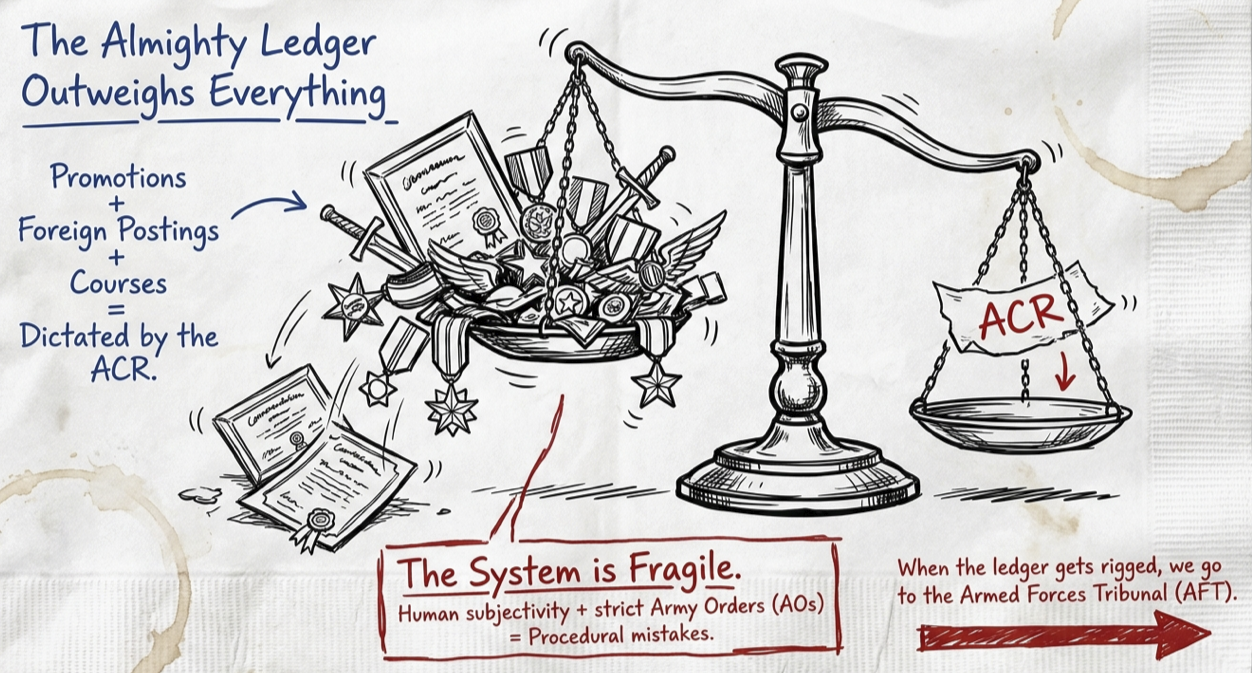
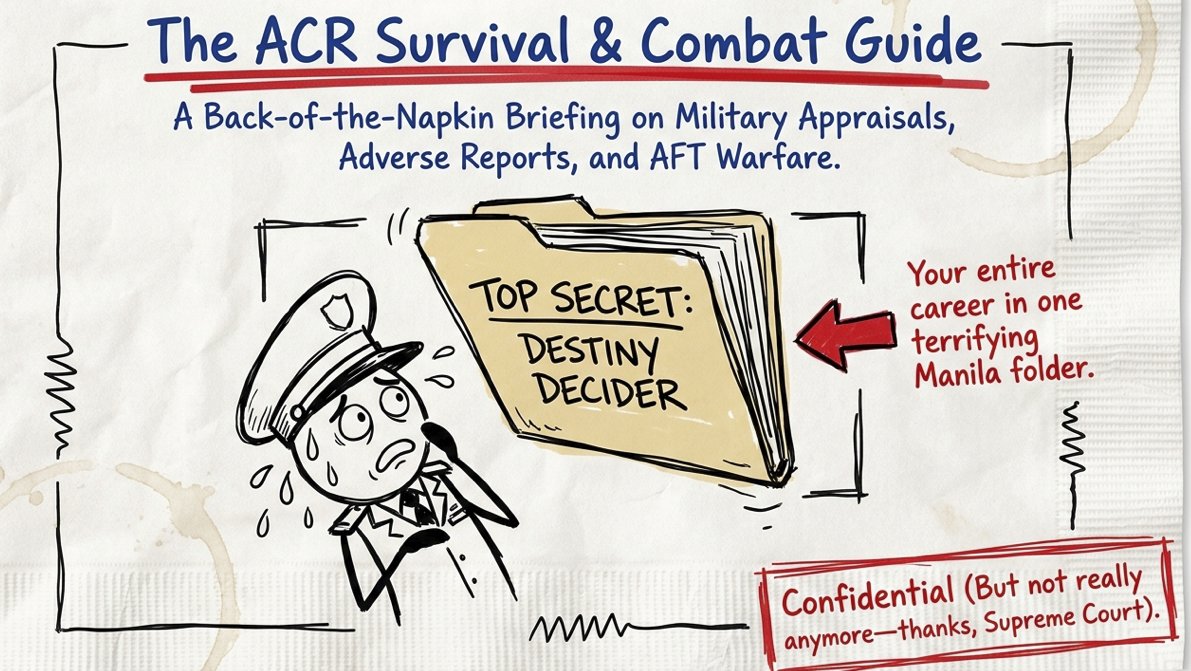
The system of Confidential Reports (CRs) in the Indian Army represents a sophisticated and multidimensional mechanism designed to evaluate professional competence, leadership potential, and character traits. Far from being a mere administrative ledger, the Annual Confidential Report (ACR) functions as the definitive architect of an individual’s career trajectory, influencing every facet from promotion and empanelment to selection for prestigious courses and foreign assignments. For both the officer cadre and the ranks of Junior Commissioned Officers (JCOs) and Non-Commissioned Officers (NCOs), the integrity of the ACR process is safeguarded by stringent Army Orders (AOs). However, the human element involved in reporting often introduces complexities such as subjectivity, bias, and procedural lapses, which have led to a robust body of jurisprudence emanating from the Armed Forces Tribunal (AFT) and the Supreme Court of India.
Foundations of the Reporting System: The MS Branch and Regulatory Architecture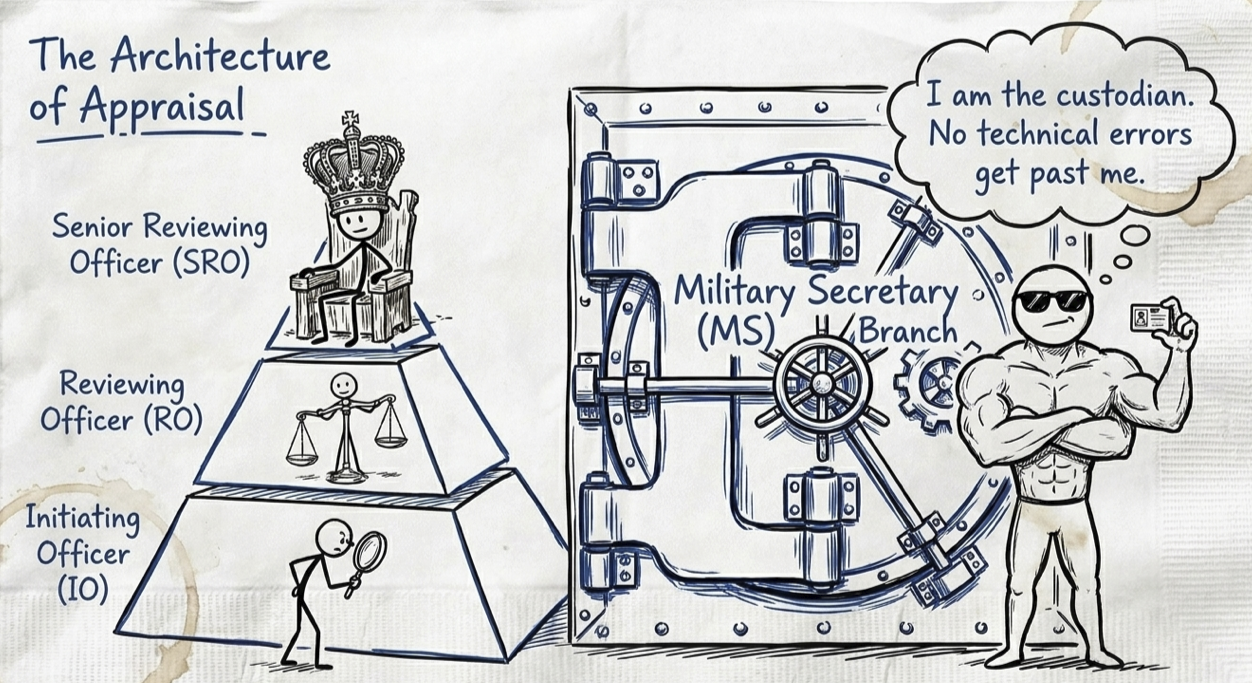
The Military Secretary’s (MS) Branch at the Integrated Headquarters of the Ministry of Defence (Army) serves as the primary custodian of the officer appraisal system. The reporting system is governed by a series of foundational documents, most notably the transition from the legacy AO 45/2001/MS to AO 02/2016/MS, and most recently, the promulgation of AO 05/2024/MS.1 This evolution reflects the Army’s shift toward modernization, specifically the implementation of the electronic Confidential Report (e-CR) system, which aims to enhance transparency and reduce the clerical errors inherent in paper-based filings.1
The objective of a Confidential Report is clearly defined: it must provide an unbiased, performance-based assessment of an officer’s competence and potential.1 To achieve this, the reporting chain typically involves three tiers: the Initiating Officer (IO), who is the immediate superior; the Reviewing Officer (RO), who provides a secondary layer of moderation; and the Senior Reviewing Officer (SRO), who acts as a balancer to ensure consistency across the reporting unit or formation.1
Classification and Typology of Reports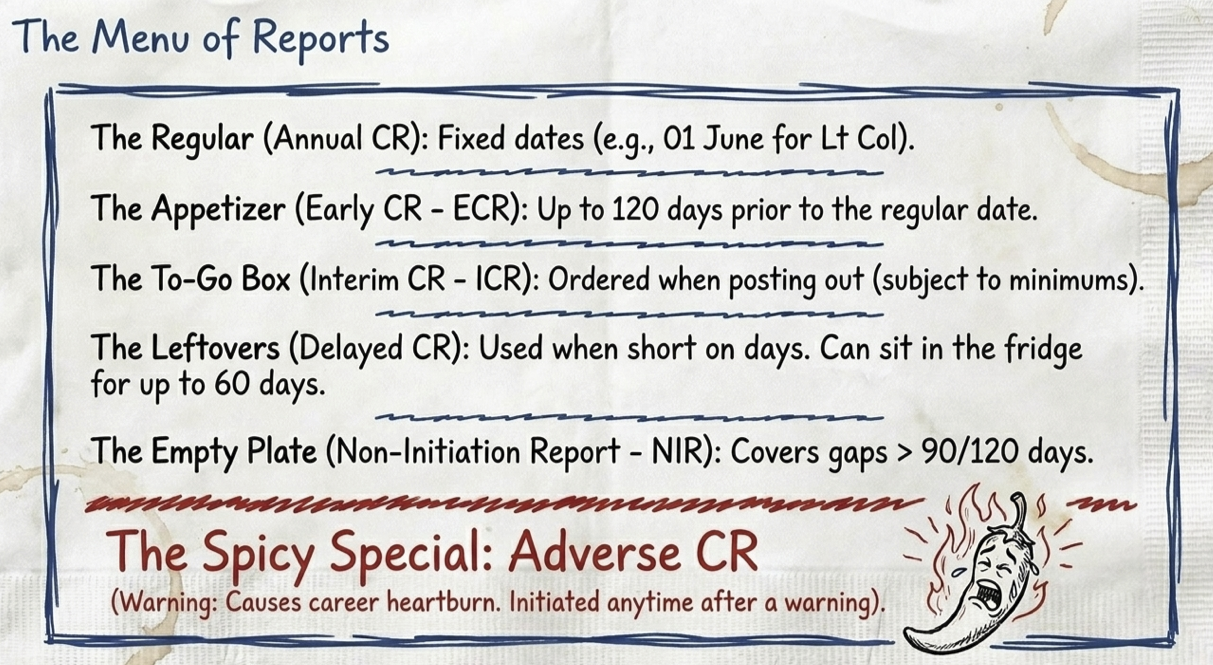
The Army utilizes different types of reports based on administrative contingencies and service events. Understanding these classifications is vital for identifying whether a report is within the “reckonable profile” for selection boards.
| Report Type | Purpose and Context | Timing Requirements |
| Annual Confidential Report (ACR) | Standard yearly assessment based on rank. | Fixed dates (e.g., 01 June for Lt Col).1 |
| Early Confidential Report (ECR) | Initiated when a reporting event occurs shortly before the ACR date. | Up to 120 days prior for officers.1 |
| Interim Confidential Report (ICR) | Generated due to posting out of the Ratee or Reporting Officer. | Subject to physical service minimums.1 |
| Delayed Confidential Report | Used when the Ratee has not yet met the physical service requirement on the due date. | May be delayed up to 60 days.1 |
| Adverse Confidential Report | Records unsatisfactory service or a significant drop in performance. | Can be initiated at any time following a warning.1 |
| Review Confidential Report | A follow-up report ordered by the MS Branch to monitor improvement. | Usually after 180 days or 90/120 days physical service.1 |
| Non-Initiation Report (NIR) | Formal record (IAFI-1123-C) explaining why no report was earnable. | Covers gaps exceeding 90/120 days.1 |
Procedural Rigor: Physical Service and Reporting Channels
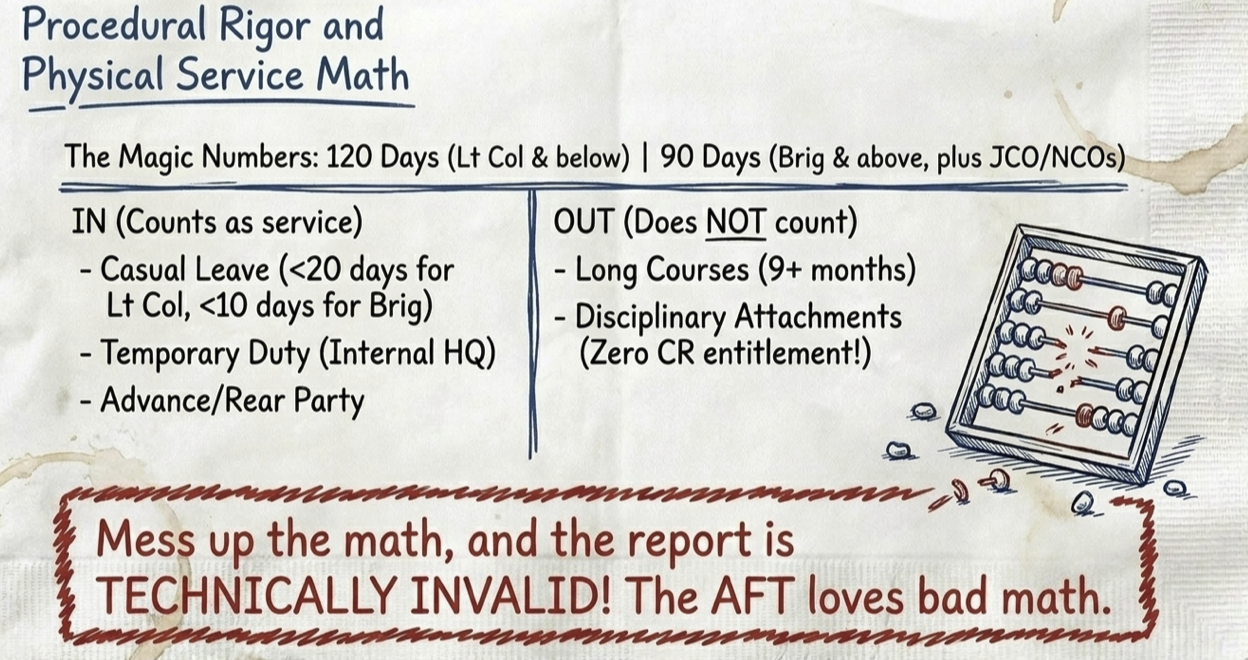
The technical validity of a Confidential Report is contingent upon the fulfillment of physical service requirements. This is intended to ensure that the reporting officer has had sufficient time to observe the Ratee’s performance in a professional setting. Under the latest guidelines in AO 05/2024/MS, the minimum physical service required for a valid report for officers up to the rank of Colonel is 120 days, while for Brigadiers and above, the threshold is 90 days.1 For JCOs and NCOs, the standard remains 90 days.1
Calculating Physical Service: Inclusions and Exclusions
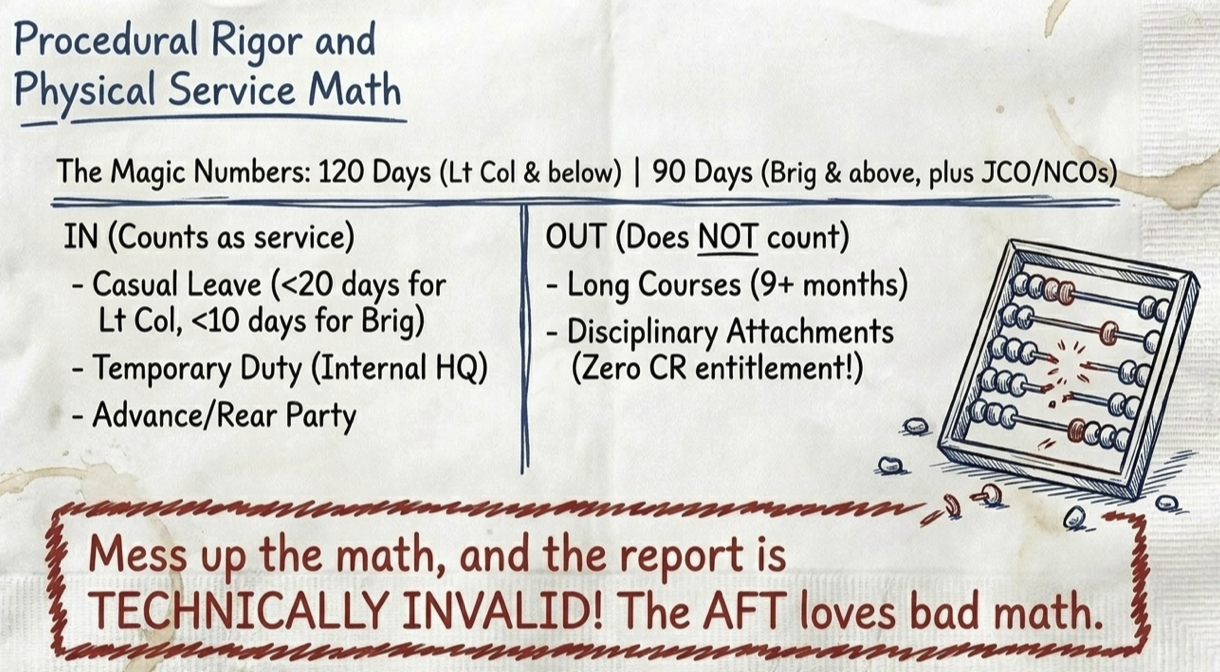
The calculation of physical service is a frequent point of contention in AFT litigation. As per Appendix D of the relevant AOs, certain periods are included or excluded from the count to maintain fairness.
| Activity | Inclusion Status | Limitation/Condition |
| Casual Leave / Hospitalization | Included | Only if below 20 days (Lt Col/below) or 10 days (Brig/above).1 |
| Temporary Duty (Internal HQ) | Included | When visiting subordinate formations within jurisdiction.1 |
| Advance / Rear Party Duties | Included | Counts toward service at the respective station.1 |
| Handing / Taking Over | Included | Only for the officer handing over the appointment.1 |
| Long Courses (9+ months) | Excluded | Gaps covered by course reports; NIR not required.1 |
| Disciplinary Attachment | Excluded | Officers attached for disciplinary purposes are not entitled to a CR.1 |
Failure to accurately calculate these dates often results in “technical invalidity,” a ground on which many officers successfully challenge their reports before the AFT.2
The Reporting Chain and Officiating Incumbents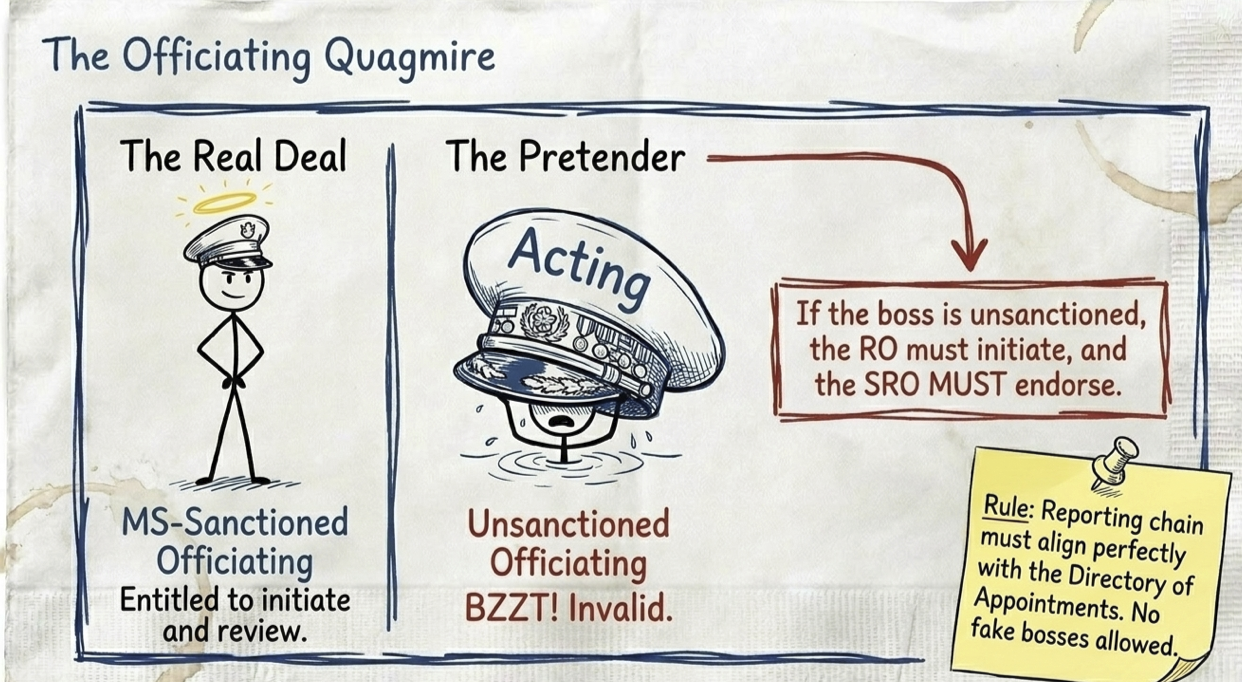
The reporting chain must align with the Directory of Appointments. A report initiated by an officer who was not the designated IO or RO according to the sanctioned channel is considered invalid.1 Specific provisions apply to “Officiating Incumbents.” An officer appointed to officiate by the MS Branch is entitled to initiate and review CRs as per the officiating appointment.1 However, if the officiating is not sanctioned by the MS Branch, the RO typically initiates the report, and the endorsement of the SRO becomes mandatory to ensure objectivity.1
The Adverse Confidential Report: Mechanics of Professional Condemnation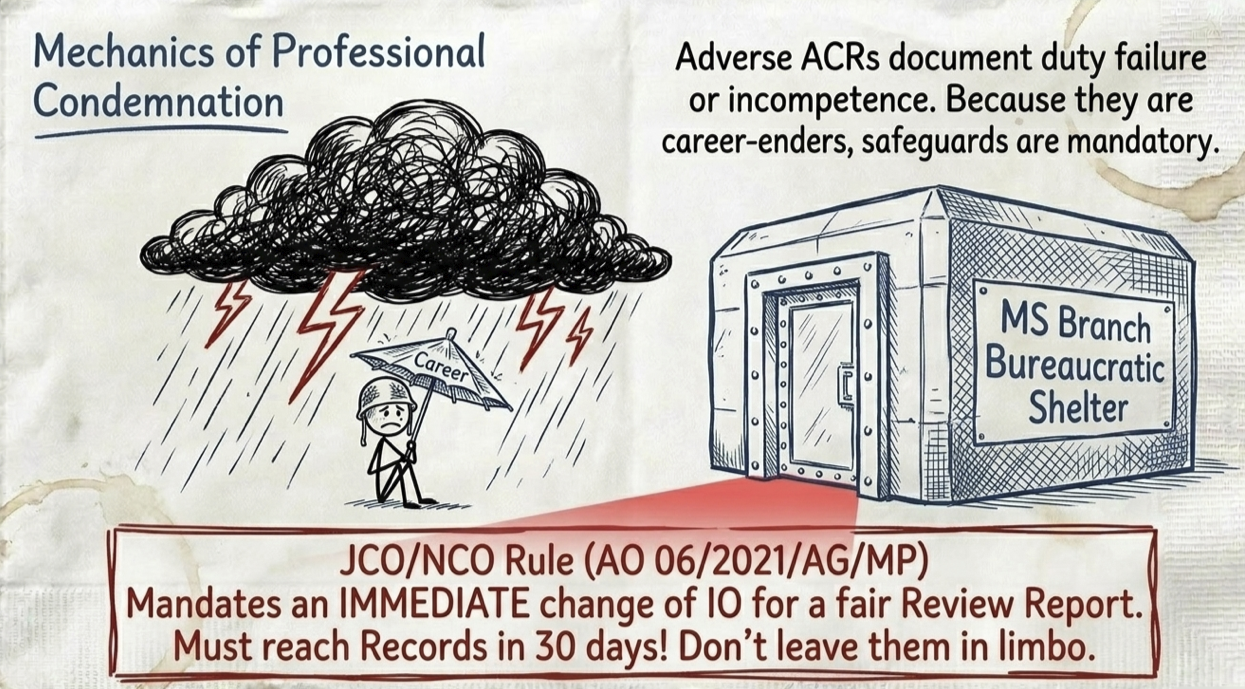
The initiation of an Adverse ACR is an extreme measure intended to document a failure in duty, professional incompetence, or character traits detrimental to the service. Because of its career-ending potential, the MS Branch has embedded several layers of protection to ensure the process is not used as a tool for personal vendetta.
The Improvement Window: Written Warning and Improvement Period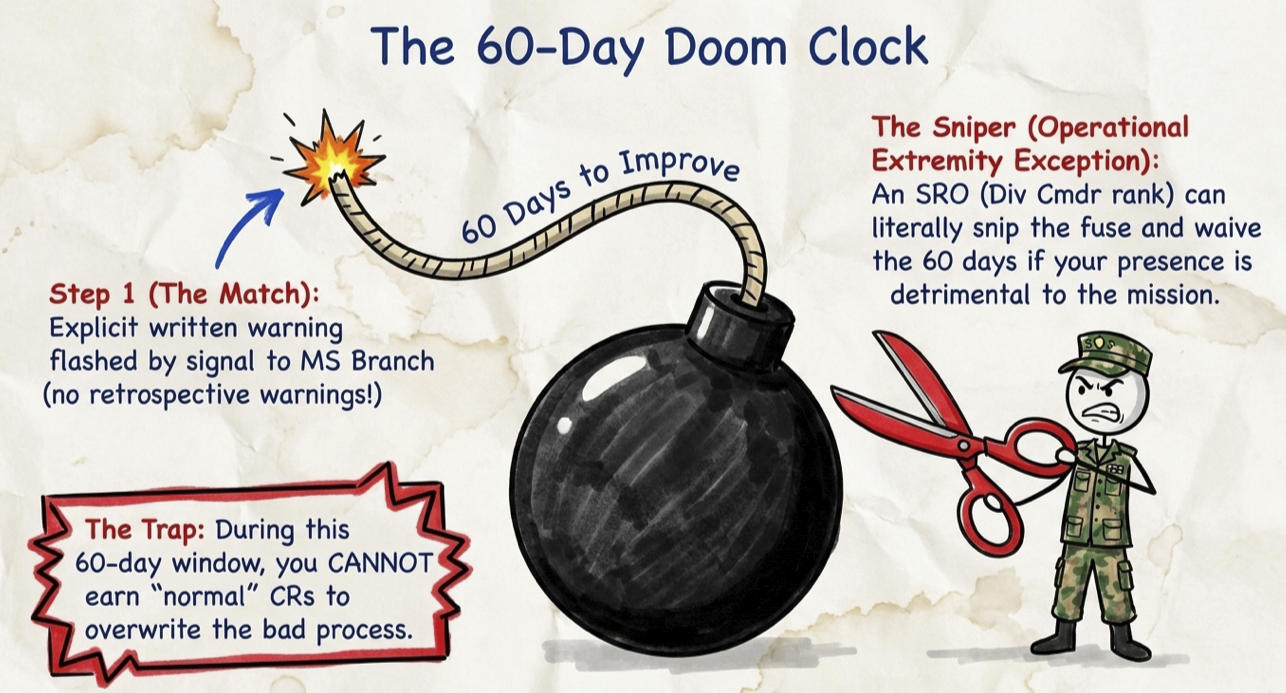
The most critical safeguard is the mandatory 60-day warning period. Before an Adverse CR can be initiated, the officer must be warned in writing about specific shortcomings. This warning must explicitly state that it is being issued for the purpose of an Adverse CR.1 The notification must be flashed to the MS Branch and next higher HQ by signal to prevent retrospective creation of warnings.1
Following the warning, the officer is granted 60 days to show improvement. This period is calculated based on the same rigorous standards as physical service.1 If the officer shows the desired improvement, the warning may be vacated. If not, the Adverse CR is initiated. Crucially, during this 60-day window, the Ratee is not entitled to earn any other type of CR, ensuring that a “normal” report cannot overwrite the adverse process while it is in progress.1
Waiver of Safeguards in Operational Extremity
In cases of gross professional failure in operational environments or situations where the continued presence of the officer is detrimental to the mission, the SRO (not below Divisional Commander rank) may waive the 60-day warning and the physical service minimums.1 Such waivers must be signed personally by the sanctioning authority and are subjected to intense scrutiny by the MS Branch and subsequently the AFT.1
The Role of the Reviewing Officer in Adverse Cases
For JCOs and NCOs, AO 06/2021/AG/MP mandates that upon the initiation of an Adverse Report, the individual must be placed under a different IO immediately to allow for a fair “Review Report”.1 The Review Report must reach the Records Office within 30 days of initiation to ensure that the individual’s status is not left in administrative limbo.1
The Doctrine of Communication: From Secrecy to Transparency
Historically, the military maintained a “closed” portion of the ACR that was never shown to the officer unless it contained specifically defined adverse remarks. This culture of secrecy was fundamentally challenged by the Supreme Court of India in the landmark case of Dev Dutt v. Union of India (2008).5
Landmark Judgment: Dev Dutt v. Union of India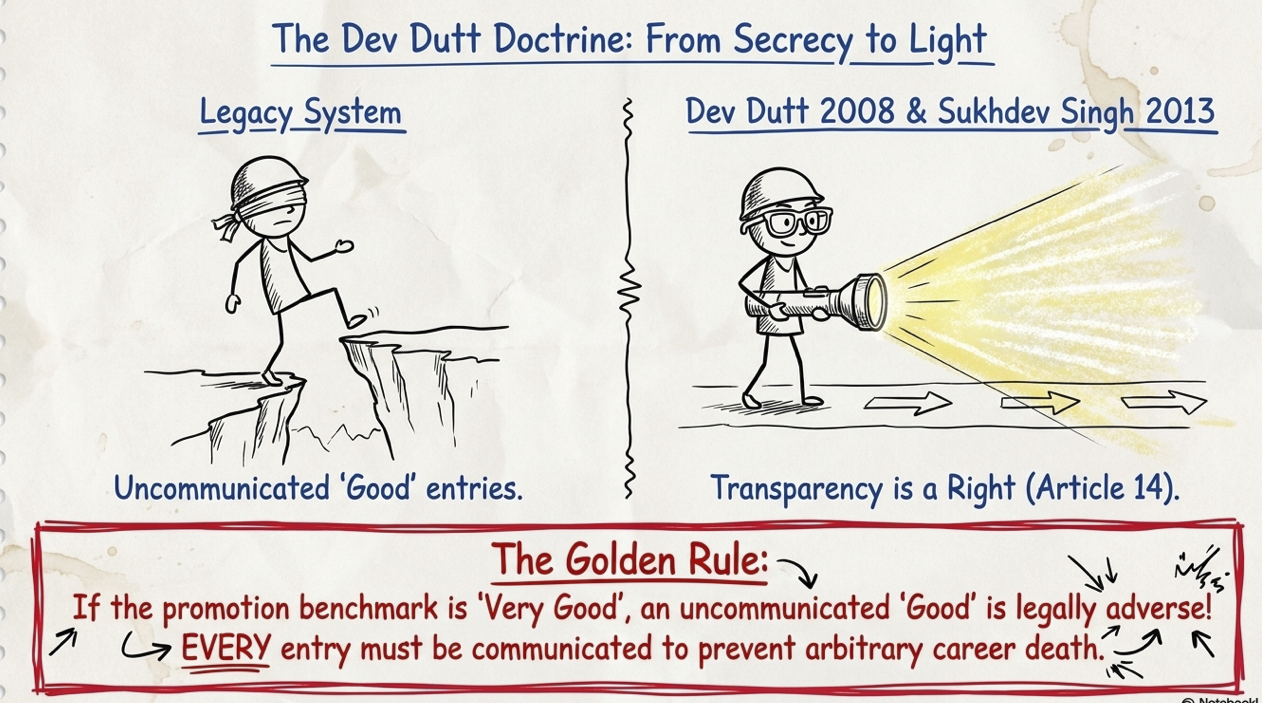
The Court ruled that the non-communication of a “Good” entry, when the benchmark for promotion was “Very Good,” essentially acted as an adverse entry. The Dev Dutt principle establishes that:
- Transparency is a Right: Every entry (Outstanding, Very Good, Good, Average, or Poor) must be communicated to the employee.5
- Natural Justice: Communication allows the individual to represent against a grading that may be inconsistent with their performance.
- Arbitrariness: A grading that is not communicated but is used to deny a promotion is arbitrary and violative of Article 14 of the Constitution.6
While the military initially argued that this rule did not apply to the armed forces due to their unique hierarchical structure, the Supreme Court in Sukhdev Singh v. Union of India (2013) reinforced the Dev Dutt ratio, asserting its broader applicability across all state services to uphold morale and fairness.5
Current Communication Standards in the Army
Currently, the open portion shown to the Ratee includes figurative assessments in Personal Qualities (PQs), Demonstrated Performance Variables (DPVs), and the pen-picture.1 Assessments from the second or higher levels (RO/SRO) are only shown if they are “Average” or below (e.g., 6 or less in legacy forms, or 4 or less in newer forms) or if they contain specific adverse remarks.1 Negative recommendations for promotion or Permanent Commission (PC) must be communicated in writing before they can be acted upon by a selection board.8
Internal Redressal: The Administrative Battleground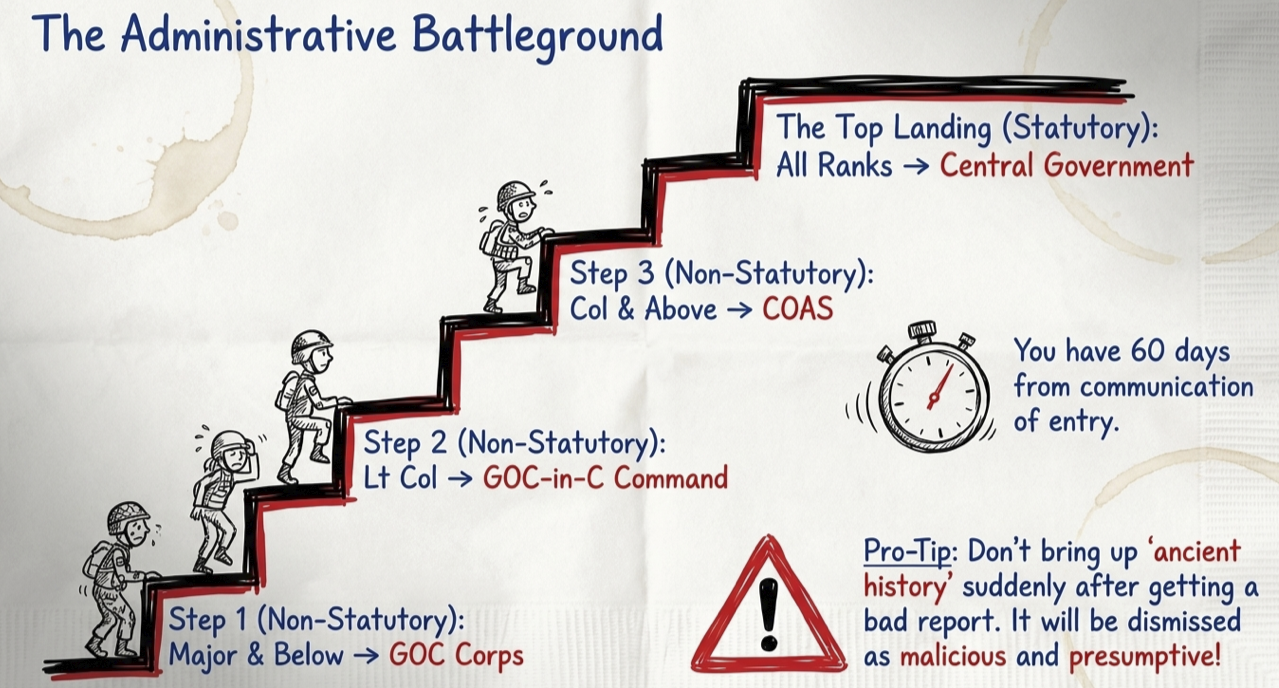
Before an officer can approach the Armed Forces Tribunal, they are generally expected to exhaust the internal redressal mechanisms provided under the Army Act.
Statutory and Non-Statutory Complaints
The procedure for complaints is defined by Paragraph 364 of the Regulations for the Army and supplementary AOs such as AO 13/2006/PS.1
| Complaint Type | Authorized Authority | Target Audience |
| Non-Statutory (Maj/Below) | GOC Corps | Officers within Corps jurisdiction.1 |
| Non-Statutory (Lt Col) | GOC-in-C Command | Field formation officers.1 |
| Non-Statutory (Col/Above) | COAS | Senior officers or those outside Command jurisdiction.1 |
| Statutory (All Ranks) | Central Government | Final administrative appeal under Army Act Sec 27.1 |
Timelines and “Fresh Facts”
The standard limitation for filing a Non-Statutory complaint is 60 days from the date of communication of the entry or the declassification of promotion board results.1 If a Statutory Complaint is filed after the rejection of a Non-Statutory one, the authorities will only call for fresh comments from the Reporting Officers if “fresh facts” have been brought to light.1 It is important to note that allegations against Reporting Officers for incidents occurring long before the ACR was initiated are often dismissed as “presumptive” or “malicious,” specifically if the officer waited until receiving an adverse report to complain.1
Challenging ACRs before the Armed Forces Tribunal (AFT)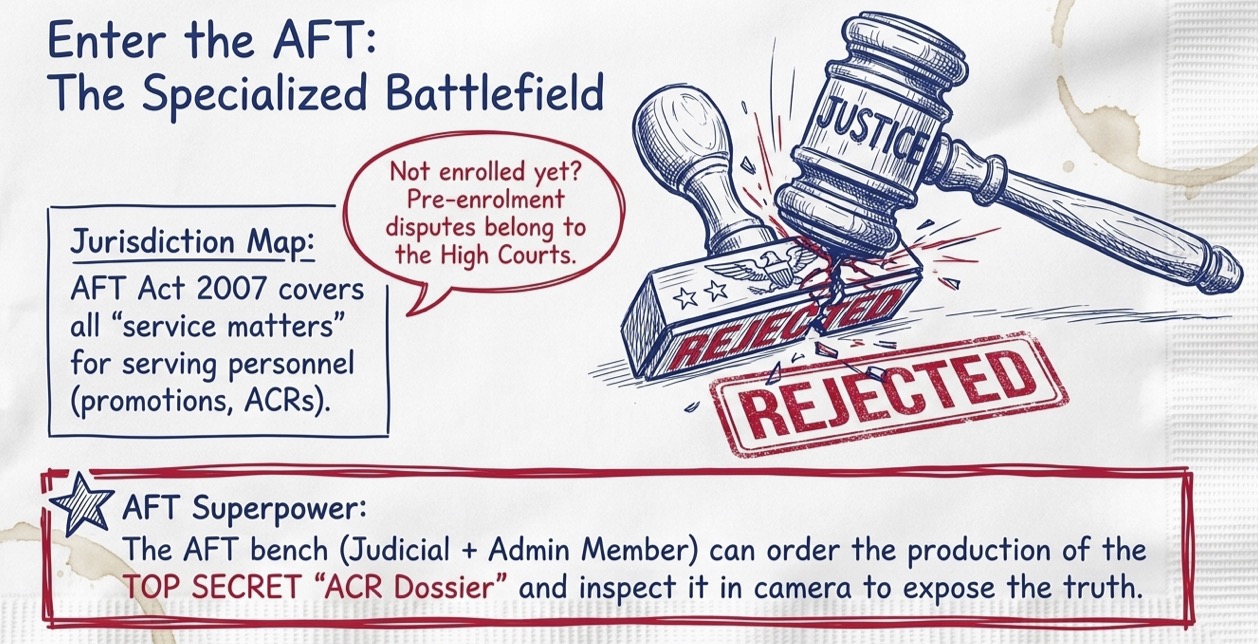
The Armed Forces Tribunal Act, 2007, revolutionized military justice by providing a specialized judicial forum for “service matters,” defined under Section 3(o) to include everything from remuneration and commission to promotion and ACRs.11
Jurisdiction and Maintainability
The AFT has the power to adjudicate disputes once a person becomes “subject to the Army Act.” Disputes occurring prior to enrollment (e.g., recruitment stage) fall outside the AFT’s exclusive jurisdiction and are amenable to the writ jurisdiction of High Courts.11 For serving personnel, the AFT is the primary forum for challenging an ACR that has caused non-empanelment.
Grounds for Challenge in the AFT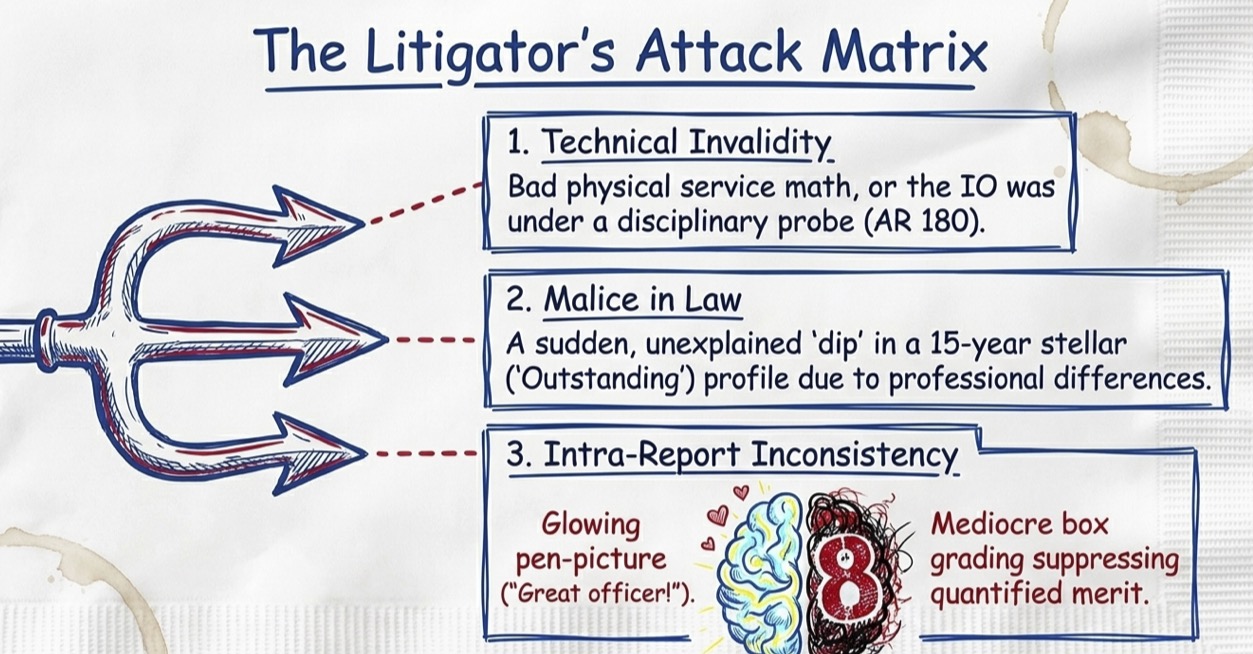
Successful challenges in the AFT generally fall into three categories:
1. Technical and Procedural Invalidity
This includes cases where a report was initiated by an officer who was debarred due to a disciplinary case. Under AO 05/2024/MS, an IO or RO who has reached the stage of “formal cognizance” of an offense (Summary of Evidence or Court of Inquiry under AR 180) is prohibited from endorsing ACRs for those directly or indirectly involved in the case.1 In Lt Col Sham Dev Kangotra v. Union of India, the AFT set aside reports where the IO was involved in a disciplinary case and the reports were initiated with extreme delay, indicating a biased attitude.4
2. Subjectivity, Bias, and Malice
While subjective evaluation is inherent in any appraisal, “malice in law” occurs when an assessment is intentionally lukewarm to prevent an officer’s promotion without a performance-based justification. The AFT often looks for a “dip” in a previously consistent profile. For example, if an officer has 15 years of “Outstanding” reports followed by a “High Average” report from a specific IO with whom they had professional differences, the Tribunal may infer bias.14
 3. Internal Inconsistency
This occurs when the “Pen Picture” (the descriptive narrative) is glowing and recommends the officer for higher rank, but the numerical box-grading is an ‘8’ (Above Average) instead of a ‘9’ (Outstanding).14 In an inflationary reporting environment, such inconsistency is often seen as a deliberate attempt to keep the officer out of the competitive quantified merit list.17
Production and Production of Service Records
A unique power of the AFT is its ability to call for the “complete service record” and the “ACR Dossier” of the applicant.17 While these are privileged documents, the AFT bench (comprising a Judicial Member and an Administrative Member, usually a retired Major General) inspects them in camera to verify the applicant’s claims of bias or inconsistency.20 The Tribunal often compares the applicant’s profile against the “last empanelled officer” of their batch to determine if the impugned ACR was the sole cause of the supersession.17
Interim Orders and Preservation of Status Quo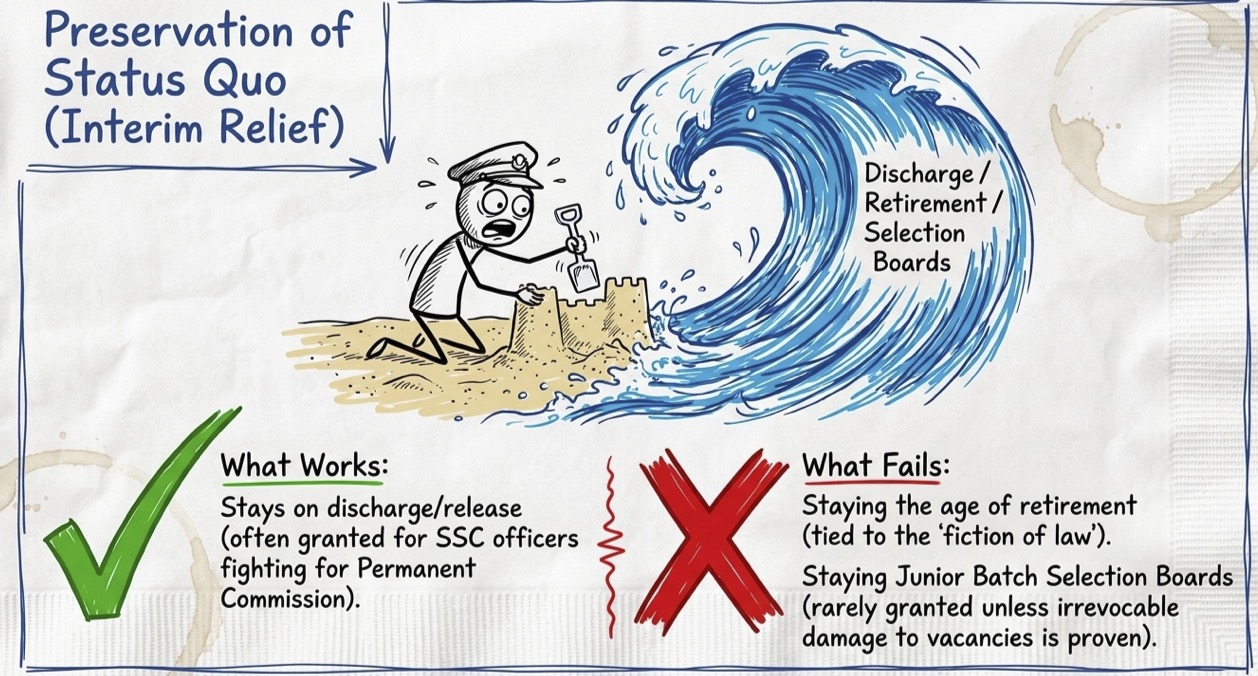
A critical aspect of AFT litigation is the prayer for interim relief, governed by the principles of a prima facie case, the balance of convenience, and the avoidance of irreparable loss.21
Stay of Discharge or Retirement
Short Service Commission (SSC) officers frequently seek stays on their release from service while their challenge against the denial of a Permanent Commission is pending. In several cases, the AFT has allowed officers to continue in service and retain government accommodation as an interim measure.23 However, the Tribunal is often reluctant to stay the age of retirement, as retirement is linked to the “fiction of law” regarding date of birth and rank.25
Stay on Selection Boards
Aggrieved officers may pray that the Selection Board for the junior batch not be held or its results not declassified until their own profile is corrected. While often requested, such stays are rarely granted unless the applicant can prove that the vacancy they are competing for will be permanently utilized by the junior batch, causing irrevocable damage.22
Appellate Jurisprudence: Appealing AFT Judgments
The AFT Act provides for a direct appeal to the Supreme Court of India under Sections 30 and 31.27 However, this is not an unconditional right.
The “Point of Law of General Public Importance”
Except for cases of contempt, an appeal to the Supreme Court is maintainable only if the AFT certifies that the case involves a “point of law of general public importance”.18 If the AFT refuses this certificate, the party must file a Special Leave Petition (SLP) under Article 136 of the Constitution.13
The High Court vs. Supreme Court Debate
For a period following Union of India v. Major General Shri Kant Sharma (2015), the High Courts were effectively barred from entertaining writ petitions against AFT orders, as a statutory appeal to the SC existed.28 However, because the Supreme Court only hears cases with “points of law of general public importance,” many individual service grievances were left without an effective appellate forum. Recent judicial trends have seen a re-emergence of the High Court’s jurisdiction under Article 226 as a part of the “Basic Structure” of the Constitution, ensuring that military personnel have access to judicial review for personal service matters.13
Strategic Insights for Litigants and Legal Practitioners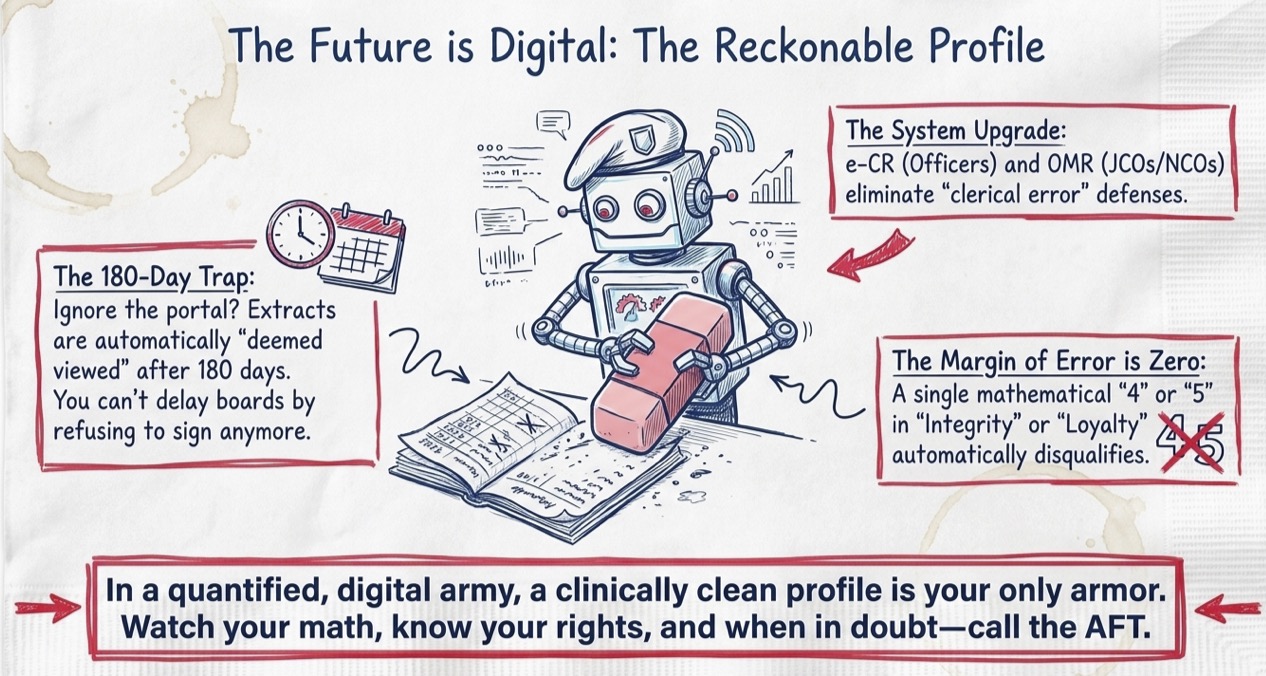
The success of a challenge against an Adverse or Subjective ACR depends on clinical precision in drafting and the ability to correlate procedural lapses with the resulting injury to the career.
Key Success Factors in AFT ACR Litigation
| Factor | Strategic Implementation |
| Exhaustion of Remedies | Ensure that either a decision on the Statutory Complaint is received or 180 days have passed since its filing.20 |
| Inconsistency Arguments | Focus on “Intra-Report Inconsistency” where the pen-picture and box-grading do not align.14 |
| Comparative Merit | Pray for the production of selection board records to see if “Value Judgment” marks were used to suppress the quantified merit.20 |
| The “Benchmark” Ratio | Use the Dev Dutt ratio to argue that any uncommunicated entry below the promotion benchmark is legally invalid.29 |
| Bias and Malice | Do not just allege bias; provide specific dates, telephone records, or inquiry proceedings that show a conflict of interest with the IO.31 |
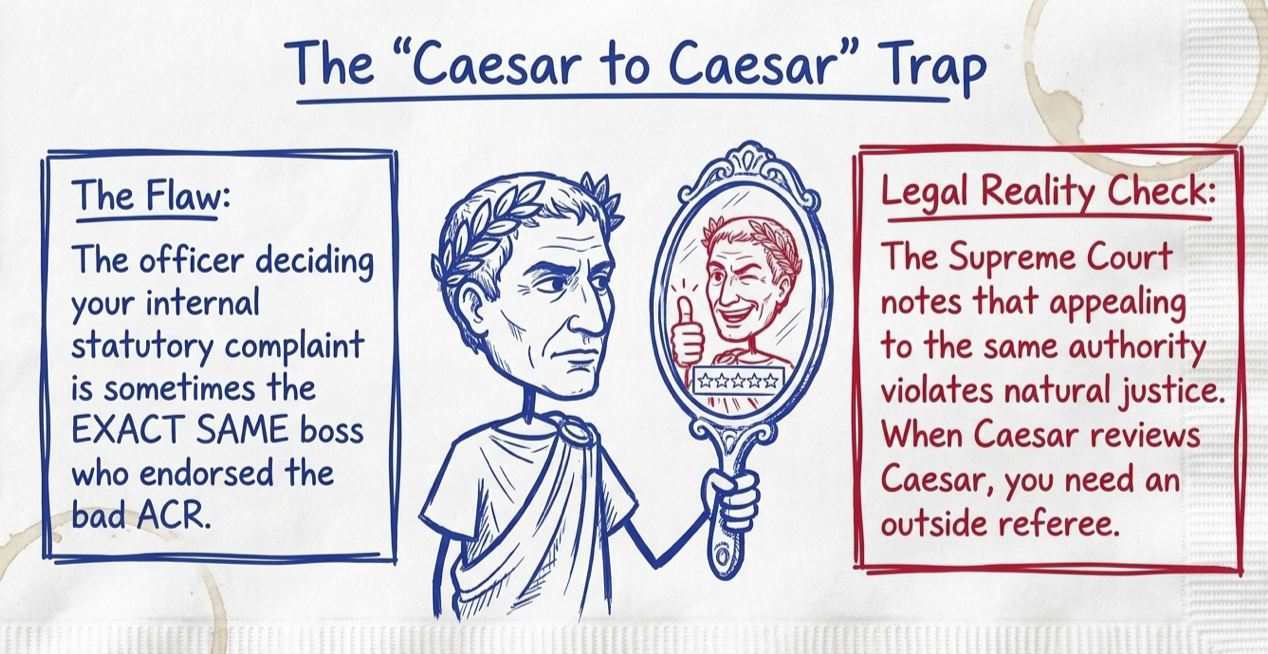
The “Caesar to Caesar” Doctrine
A common ground for challenging the rejection of an internal complaint is that the officer who decided the complaint was also the one who endorsed the impugned ACR. The Supreme Court has noted that this constitutes “an appeal from Caesar to Caesar,” violating the core tenets of fairness and necessitating judicial intervention by the AFT.7
The Modern e-CR and OMR Environment: Future Outlook
The transition to digital appraisal systems (e-CR for officers and OMR for JCOs/NCOs) represents a significant hurdle for those seeking to tamper with records.1 In the e-CR module, extracts of the open portion are automatically available to the Ratee on the portal. If these extracts are not viewed within 180 days, they are “deemed viewed,” a provision intended to prevent individuals from delaying selection boards by refusing to sign their reports.1
For JCOs and NCOs, the OMR system ensures that the figurative assessment is captured directly by software, minimizing the “clerical errors” that were once a common excuse for unfilled columns or incorrect data.1 However, this mathematical precision also means that a single “Average” mark (calculated as a 4 or 5) in a critical quality like “Loyalty” or “Integrity” can automatically disqualify an individual from an honorary commission, regardless of the rest of the report.1
Synthesis and Conclusion
The Indian Army’s Confidential Report system is a robust yet fragile ecosystem. Its robustness lies in its detailed regulatory framework (AO 05/2024/MS and AO 06/2021/AG/MP), which defines every step from the mandatory 90-day physical service to the 60-day improvement warning for adverse entries.1 Its fragility, however, is exposed by the inherent subjectivity of the reporting chain and the competitive “pyramidal” structure of the Army, where even a minor “dip” in a profile can lead to permanent supersession.7
Judicial intervention by the Armed Forces Tribunal and the Supreme Court has introduced much-needed transparency into this once-opaque system. The mandate for communication established in Dev Dutt and Sukhdev Singh ensures that no officer is blind-sided by a “benchmark” report that they never had the chance to contest.5 Furthermore, the AFT’s power to inspect confidential dossiers has ensured that “professional victimization” can be identified and corrected.17
For personnel seeking to challenge an ACR, the path is clear: one must demonstrate a violation of the “technical validity” of the report or an “internal inconsistency” that defies the principles of objectivity. As the Army moves toward an increasingly quantified merit-based system, the figurative marks in an ACR have become more valuable than ever. Maintaining a clean and consistent “reckonable profile” is not merely an administrative requirement but the primary defense of a soldier’s professional life. The Armed Forces Tribunal remains the vital arbiter in this delicate balance, ensuring that the requirements of military discipline do not trample upon the constitutional guarantees of fairness and natural justice..4
Works cited
- AO 5-2024-MS offrs CR compressed.pdf
- ARMED FORCES TRIBUNAL CHANDIGARH REGIONAL BENCH AT CHANDIMANDIR OA No. 589 of 2011 Brig Rajesh Madan … Petitioner Vs Union o, accessed on April 29, 2026, https://www.aftdelhi.nic.in/benches/chandigarh_bench/judgments/court_1/september2012/OA_589_of_2011.pdf
- OA 461/2014 – Col KC Saklani – Armed Forces Tribunal, accessed on April 29, 2026, https://www.aftdelhi.nic.in/assets/judgement/2016/OA/OA%20461-2014.pdf
- OA 546/2022 – Armed Forces Tribunal, accessed on April 29, 2026, https://aftdelhi.nic.in/assets/judgement/2025/OA/OA%20546-2022.pdf
- Mandatory Communication of ACR Entries Ensuring Fairness: Sukhdev Singh v. Union Of India – CaseMine, accessed on April 29, 2026, https://www.casemine.com/commentary/in/mandatory-communication-of-acr-entries-ensuring-fairness:-sukhdev-singh-v.-union-of-india/view
- Dev Dutt vs Union Of India & Ors on 12 May, 2008 – Indian Kanoon, accessed on April 29, 2026, https://indiankanoon.org/doc/801705/
- Sukhdev Singh vs Union Of India & Ors on 23 April, 2013 – Indian Kanoon, accessed on April 29, 2026, https://indiankanoon.org/doc/9665019/
- OA 1686/2022 – Armed Forces Tribunal, accessed on April 29, 2026, https://www.aftdelhi.nic.in/assets/judgement/2023/OA/OA%201686-2022.pdf
- Permanent Commission for Women Officers in Armed Forces – Supreme Court Observer, accessed on April 29, 2026, https://www.scobserver.in/supreme-court-observer-law-reports-scolr/sucheta-edn-v-union-of-india19626/
- Structure and Role of Indian Army | PDF | Division (Military) | Brigade – Scribd, accessed on April 29, 2026, https://www.scribd.com/document/837398970/NCC-Precis-1-1
- Army Recruitment Disputes Prior to Enrolment Not Within AFT Jurisdiction: MP High Court, accessed on April 29, 2026, https://lawbeat.in/news-updates/army-recruitment-disputes-prior-to-enrolment-not-within-aft-jurisdiction-mp-high-court-1562711
- THE ARMED FORCES TRIBUNAL ACT, 2007 ARRANGEMENT OF SECTIONS – India Code, accessed on April 29, 2026, https://www.indiacode.nic.in/bitstream/123456789/2077/1/A2007-55.pdf
- REPORTABLE IN THE SUPREME COURT OF INDIA CIVIL APPELLATE JURISDICTION CIVIL APPEAL NO.447 OF 2023 UNION OF INDIA & ORS. …A, accessed on April 29, 2026, https://api.sci.gov.in/supremecourt/2014/17311/17311_2014_2_1501_42904_Judgement_21-Mar-2023.pdf
- OA 804/2023 WITH MA 1268/2023 – Armed Forces Tribunal, accessed on April 29, 2026, https://aftdelhi.nic.in/assets/judgement/2024/OA/OA%20804-2023%20Gopal%20Kapoor.pdf
- IN THE ARMED FORCES TRIBUNAL, PRINCIPAL BENCH NEW DELHI T.A NO. 295 OF 2009 (WRIT PETITION (C) NO. 5389 OF 2008) COL. RAM NIWAS,, accessed on April 29, 2026, https://aftdelhi.nic.in/assets/judgement/2010/TA/TA-295-2009%20Col%20Ram%20Niwas%20vs%20Union%20of%20india%20and%20ors.pdf
- court no.1 – armed forces tribunal principal bench: new delhi – oa 326/2021, accessed on April 29, 2026, https://aftdelhi.nic.in/assets/judgement/2025/OA/OA%20326-2021.pdf
- court no. 1 – Armed Forces Tribunal, accessed on April 29, 2026, https://aftdelhi.nic.in/assets/judgement/2024/MA/MA%2086-2017.pdf
- OA 1999/2021 – Armed Forces Tribunal, accessed on April 29, 2026, https://aftdelhi.nic.in/assets/judgement/2023/OA/OA%201999-2021.pdf
- OA 1559/2023 – Armed Forces Tribunal, accessed on April 29, 2026, https://aftdelhi.nic.in/assets/judgement/2024/OA/OA%201559-2023.pdf
- Applicant – Armed Forces Tribunal, accessed on April 29, 2026, https://www.aftdelhi.nic.in/assets/judgement/2022/OA/OA%201640-2018.pdf
- Interim Orders and Stay Applications: Requesting interim relief from SC – LawyerChennai.com, accessed on April 29, 2026, https://www.lawyerchennai.com/interim-orders-and-stay-applications-requesting-interim-relief-from-sc/
- O R D E R – Armed Forces Tribunal, accessed on April 29, 2026, https://www.aftdelhi.nic.in/assets/pending_cases/2023/OA/OA%201650-2023-04-07-2023.pdf
- ARMED FORCES TRIBUNAL, REGIONAL BENCH, MUMBAI ORIGINAL APPLICATION NO. 74 OF 2018 With MA 64/2021 (for vacating interim order), accessed on April 29, 2026, https://aftdelhi.nic.in/benches/mumbai_bench/judgments/September2021/OA%2074%20of%202018.pdf
- 1 (OA No.86 of 2015) – Armed Forces Tribunal, accessed on April 29, 2026, https://aftdelhi.nic.in/benches/chandigarh_bench/judgments/court_2/december2015/OA_86_of_2015.pdf
- court no. 1, armed forces tribunal, accessed on April 29, 2026, https://www.aftdelhi.nic.in/assets/judgement/2020/MA/OA%20996-2020.pdf
- court no. 1, armed forces tribunal, accessed on April 29, 2026, https://aftdelhi.nic.in/assets/judgement/2023/OA/OA%201298-2022.pdf
- Section 30 in The Armed Forces Tribunal Act, 2007 – Draft Bot Pro, accessed on April 29, 2026, https://app.draftbotpro.com/doc/40368195
- Appeals under the Armed Forces Tribunal Act, 2007 – iPleaders, accessed on April 29, 2026, https://blog.ipleaders.in/appeals-under-the-armed-forces-tribunal-act-2007/
- ARMED FORCES TRIBUNAL, REGIONAL BENCH, KOCHI, accessed on April 29, 2026, https://aftdelhi.nic.in/benches/kochi_bench/judgments/january2016/OA%2061%20of%202015.pdf
- ARMED FORCES TRIBUNAL, REGIONAL BENCH CHANDIGARH ATCHANDIMANDIR -.- TA 112 of 2013 (arising out of WP 3953 of 1998 Sep 23 , 2, accessed on April 29, 2026, https://aftdelhi.nic.in/benches/chandigarh_bench/judgments/court_2/Sep2022/TA%20112%20of%202013.pdf
- court no. 2 – Armed Forces Tribunal, accessed on April 29, 2026, https://www.aftdelhi.nic.in/assets/judgement/2023/MA/OA%20125-2022.pdf
- OA 1256/2022 – Armed Forces Tribunal, accessed on April 29, 2026, https://aftdelhi.nic.in/assets/judgement/2023/OA/OA%201256-2022.pdf
- OA 922/2022 with MA 1217/2022 – Armed Forces Tribunal, accessed on April 29, 2026, https://www.aftdelhi.nic.in/assets/judgement/2023/OA/OA%20922-2022.pdf
- court no. 1 – armed forces tribunal principal bench, new delhi – oa 1413/2022, accessed on April 29, 2026, https://aftdelhi.nic.in/assets/judgement/2024/OA/OA%201413-2022.pdf