Army Pension After Premature Discharge: Qualifying Service and AFT
Short of 15 years by a few months? The Pension Regulations for the Army allow a shortfall of up to 12 months to be condoned in some cases. This guide explains service, invalid and disability pension and the route to the Armed Forces Tribunal.
Army Pension Rules: What Premature Discharge Means for Your Pension
For JCOs and Other Ranks, Para 47 of the Pension Regulations for the Army, 2008 (Part I) says the minimum qualifying service for a service pension is 15 years. Many soldiers leave earlier, by medical invalidment, at their own request, or on administrative grounds, and are told they have no pension. That answer is not always the end of the matter. In Union of India v. Balakrishnan Mullikote (2026 INSC 286) the Supreme Court read these Regulations closely; you can read the judgment on the Supreme Court website.
Three questions decide most claims: how long you actually served after rounding off, whether the shortfall is 12 months or less so that Para 44 condonation can be asked for, and how you left service. Pension is a service matter under s. 3(o) of the Armed Forces Tribunal Act, 2007, so a rejected claim can be taken to the Tribunal. Our page on an Armed Forces Tribunal advocate in Kolkata explains how we handle these matters, and the guide to filing cases in the AFT covers the filing process. For related benefits, read our guide to disability pensions for armed forces personnel and the service element of disability pension.
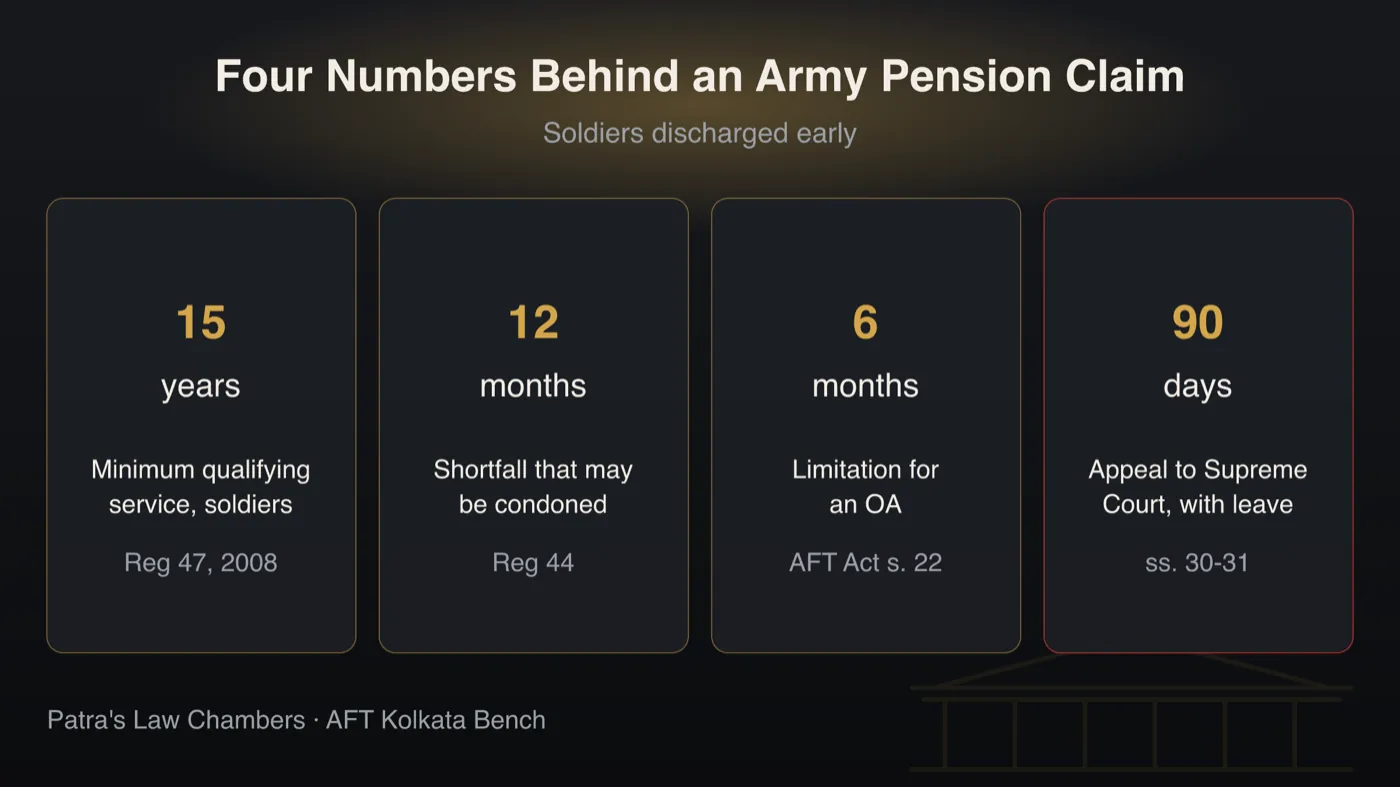
The periods that matter in an AFT pension case
Each period runs from a different event, so note the date of every order and reply.
Short explainers from Adv. Sudip Patra
More short explainers on our YouTube channel: Patra’s Law Chambers on YouTube ↗
Which army pension question fits your situation?
Pick the option closest to your case. This is general information, not advice, and every case turns on its own service record.
Choose one of the options above.
From rejected pension claim to the Armed Forces Tribunal
This is the usual route for a pension dispute after discharge. Dates run from the final order, so keep every letter and proof of dispatch.
Gather the discharge book, discharge order, service particulars and the Records Office’s qualifying-service calculation. Do the arithmetic yourself, rounding off first, then check whether the gap is 12 months or less.
Write to the OIC Records of your regiment or corps, with a copy to PCDA (Pensions), Prayagraj. Ask specifically for rounding off and condonation under Para 44. Keep proof of dispatch.
A JCO or Other Rank may file a statutory complaint under s. 26 of the Army Act, and disability matters have their own first-appeal committee. Verify whether the Tribunal expects this step in your type of pension claim.
Under s. 21(2) of the AFT Act, a final rejection, or 6 months of silence, means the departmental remedies are deemed used. See our guide to filing cases in the AFT.
File the OA under s. 14 before the Regional Bench, Kolkata, within the s. 22 period. A late filing needs an application for condonation of delay under s. 22(2). Our AFT advocate page explains how matters are handled.
An appeal lies to the Supreme Court with leave under ss. 30 and 31 of the AFT Act, within 90 days. Leave is first sought from the AFT within 30 days. A writ in the Calcutta High Court is also used in practice.
Three points army pension claims turn on, tap a card
Para 18 treats 3 months or more, but under 6, as a half year. The Supreme Court directed that Note 5 of the 1987 MoD letter be applied before any shortfall is condoned.
Para 44 (2008) allows a shortfall of up to 12 months to be condoned. The Supreme Court held in Balakrishnan Mullikote (2026) that a ministry letter cannot cut this down. It is a discretionary power.
In Union of India v. Sgt Girish Kumar (2026), the Supreme Court described pension as neither a bounty nor an ex gratia payment. Whether arrears are capped at 3 years remains argued in service pension cases.

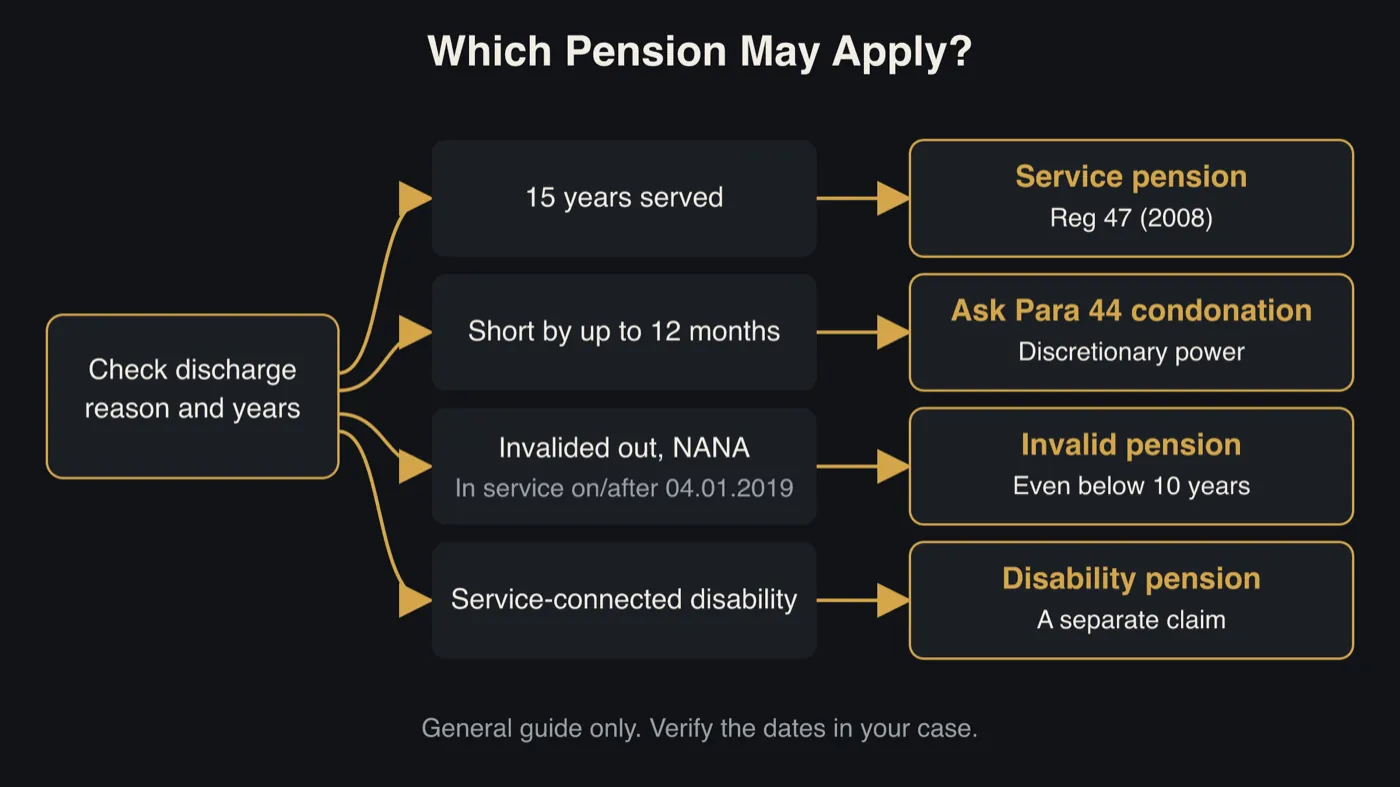
Service, Invalid and Disability Pension: Which One Applies
15 years of qualifying service
Payable to soldiers with 15 years’ service under Reg 47 (2008). Rounding off under Para 18 and Note 5 of the MoD letter of 30.10.1987 is worked out first. A shortfall of up to 12 months may then be condoned under Para 44, which is a discretionary power.
Medical invalidment, NANA disability
Where a soldier is invalided out for a disability neither attributable to nor aggravated by service, invalid pension applies. Under the MoD decision of July 2020 it is payable below 10 years if the person was in service on or after 04.01.2019. Verify the dates in your case.
Service-connected disability
Disability pension has a disability element and a service element, and turns on attributability to service. It is a separate claim from service pension. Our guides on disability pension and the service element explain the test in detail.
Shortfall of up to 12 months
Para 44 (2008) lets the authority condone up to 12 months. Its text excludes own-request discharge, invaliding below 15 years and special pension cases, yet the Supreme Court allowed condonation to voluntary retirees in Surender Singh Parmar (2015) and Mullikote (2026).
Papers to gather for a pension claim
- Discharge book and discharge order with its stated reason
- Service particulars and the Records Office’s qualifying service calculation
- Every representation, with proof of dispatch
- The rejection letter or PPO
- Medical board proceedings (RMB/IMB) in invalidment cases
- ID proof, PAN and bank details for release of arrears
Army pension rulings that decide qualifying service and arrears
These Supreme Court and Calcutta High Court decisions control how the Records Office, PCDA (Pensions) and the Armed Forces Tribunal work out qualifying service, the 12-month condonation and arrears. Read each one against your own discharge record.
2026
Up to one year's shortfall can be condoned
The Supreme Court held that Defence Security Corps personnel can ask for condonation of a shortfall of up to one year for a second service pension. Service is first worked out with the rounding-off rules, and only then is any remaining gap condoned. The Government cannot amend or override the Pension Regulations through executive letters. The Court left the three-year arrears question open.
2015
Round off first, then condone the gap
A sailor who retired voluntarily before 15 years had his service rounded off. The remaining shortfall of up to 12 months was then condoned under the Ministry of Defence instruction of 14.08.2001. The ruling is followed for Army personnel because Regulation 125(a) of the Army Pension Regulations is worded the same way. Courts and tribunals can direct condonation where the authority has failed to use its power.
2019
No condonation after disciplinary discharge
A DSC soldier was discharged for indiscipline. Even after one year’s relaxation, he was still short of the service needed, so he got no pension. The case shows that condonation is a discretionary power and that the service record counts. In Mullikote (2026) the Supreme Court said Chhatar Pal was decided on its own facts and did not overrule Parmar.
2026
Disability pension arrears not cut to three years
The Supreme Court dismissed the Union’s appeals and held that arrears of disability pension cannot be limited to three years before the claim was filed. It treated Ram Avtar as a judgment in rem and held that Tarsem Singh, (2008) 8 SCC 648, did not help the Union on these facts. Expect the Union to keep relying on Tarsem Singh in other pension claims.
2025
Invalid pension despite under ten years' service
A Division Bench led by Acting Chief Justice Sujoy Paul dismissed the Union’s writ against an Armed Forces Tribunal order. The order had granted lifelong invalid pension to a DSC soldier who was discharged on medical grounds with less than ten years of DSC service. The Court held that the ten-year minimum did not stand in the way where the disability was permanent.
From pension rejection to the Armed Forces Tribunal, Kolkata
Collect the service record
Get the discharge book, the discharge order showing the reason (own request, medical, administrative or end of engagement), the service particulars and the Records Office’s qualifying service calculation. Do the sum yourself: round off first, then check whether the gap left is 12 months or less.
Make a written representation
Write to the Officer-in-Charge, Records, of your regiment or corps, and send a copy to PCDA (Pensions), Prayagraj. Ask in clear words for rounding off and for condonation of the shortfall under Regulation 44 of the Pension Regulations for the Army, 2008 (Regulation 125 of the 1961 version). Keep proof that you sent it.
Wait for a final decision
Under section 21 of the Armed Forces Tribunal Act, 2007, the Tribunal does not normally admit a case until your departmental remedy is used up. That happens when a final order rejects your representation, or when six months pass with no reply. Silence for six months counts as a rejection.
File an Original Application under section 14
Pension is a service matter under section 3(o). Present the Original Application before the Armed Forces Tribunal Regional Bench, Kolkata, with an affidavit, a vakalatnama, the rejection letter, every representation with proof of dispatch, the discharge papers, the qualifying service sheet and any medical board proceedings.
Watch the six-month limit
Section 22 gives six months from the final order, or from the end of the six-month wait. If you are late, file a separate application under section 22(2) explaining each period of delay. Monthly pension is a continuing claim, but delay can still limit how far back the arrears go.
Challenge an adverse order
An appeal to the Supreme Court lies under sections 30 and 31 only with leave and only on a point of law of general public importance. Leave is asked for first from the Tribunal. In practice, a writ petition before the Calcutta High Court under Article 226 is also used against Tribunal orders.
Is your service short of 15 years? Work it out in this order
The Supreme Court has directed that rounding off is applied before any condonation is considered.
Note actual service
Take years, months and days from the discharge book and service particulars.
Apply rounding off
Apply Para 18 and Note 5 of the 1987 MoD letter to the fraction of a year.
Measure the gap to 15 years
Compare the rounded service with the 15 years in Para 47.
Is the gap 12 months or less?
If yes, condonation under Para 44 can be asked for.
Check the exceptions
Own-request discharge, invaliding under 15 years and special pension cases need separate arguments.
Represent, then approach the AFT
Ask the Records Office in writing, and go to the Tribunal if rejected.
Which Pension May Apply to You?
Choose how you left service and your length of service to see which pension to look at first. It is a general guide and not advice on your papers.
Result
Choose your details and press the button.
A general guide only, for a soldier under the Pension Regulations for the Army. It does not replace a reading of your discharge order and medical board papers. This is an estimate; the authorities and the Tribunal decide. Verify before relying on it.
Qualifying Service Shortfall Checker
Enter your actual service and how you left. The tool rounds off, finds the shortfall from 15 years and tells you whether Para 44 condonation can be asked for.
- Enter your actual service as shown in the discharge book.
- Choose how you left service.
- Press Check to see the rounding and the shortfall.
Result
Enter your service and press Check.
Illustration only, for a soldier (JCO or Other Rank) under the Pension Regulations for the Army. Rounding follows the half-year rule of Para 18 as the Supreme Court directed it to be applied in Balakrishnan Mullikote (2026); verify the exact Note 5 working on your own record. This is an estimate of the legal position; the authorities and the Tribunal decide.
From Rejection to the Tribunal: Timeline
The usual order of steps from a rejected pension claim to the Armed Forces Tribunal and beyond.
Periods are as stated in the AFT Act, 2007. This is an estimate of the usual path; verify against your own dates and have the rejection letter read.
Mistakes that cost veterans their pension
Accepting the Records Office calculation without checking it Rounding off often adds months to your service. Work out the figure yourself before you conclude that the gap is more than one year.
Assuming voluntary discharge closes the door The wording of Regulation 44 leaves out discharge at one’s own request, yet the Supreme Court allowed condonation in Parmar and Mullikote. Each claim turns on its own record, so ask for it in writing.
Going to the Tribunal before the representation is decided Section 21 normally requires a final rejection or six months of silence first. Filing too early invites an objection that the case is premature.
Confusing service, invalid and disability pension Condonation under Regulation 44 does not help a person invalided out with less than 15 years. That claim is for invalid pension, and disability pension depends on whether the disability is attributable to or aggravated by service. Plead the right one.
Pension Claim Rejected? Have Your Papers Read
A pension rejection is not always final. The record, the exact discharge reason and your dates decide whether Para 44 condonation, invalid pension or an Armed Forces Tribunal application is open to you. We review the discharge papers, work out the qualifying service and advise on the representation and the OA. Time limits are short, so keep proof of every letter sent. No outcome can be promised, since each case is decided on its own record.
Book a ConsultationEstablished by a distinguished alumnus of IIT Kharagpur, Patra’s Law Chambers stands as a beacon of legal expertise in Kolkata & Delhi. Know more →

Kolkata Office
NICCO House, 6th Floor, 2 Hare Street
Kolkata-700001 (Near Calcutta High Court)
Delhi Office
4455/5, First Floor, Gali Shahid Bhagat Singh
Main Bazar Road, Paharganj, New Delhi-110055
Contact
[email protected]
+91 890 222 4444 / +91 7003 715 325
Service pension and invalid pension compared
The reason for leaving service and the length of service decide which one applies.
Frequently asked questions on army pension and the AFT
For JCOs and Other Ranks, Para 47 of the Pension Regulations for the Army, 2008 sets the minimum qualifying service at 15 years, unless otherwise provided. For officers, 20 years is generally cited, but verify the regulation text for your case.
Possibly. Rounding off can bring the service to 14½ years, and a shortfall of up to 12 months can be condoned under Para 44. Condonation is discretionary, so the discharge reason and service record matter.
The text of Para 44 excludes discharge at one’s own request. The Supreme Court has still allowed condonation in some such cases (Surender Singh Parmar; Balakrishnan Mullikote). It was refused where discipline and a poor record were involved.
Invalid pension for under 10 years’ service is available under a July 2020 Ministry of Defence decision, if you were in service on or after 04.01.2019. The Calcutta High Court upheld it for a 2019 discharge. Verify the order against your dates.
The Records Office of your regiment or corps initiates the claim, and PCDA (Pensions), Prayagraj sanctions it. A rejection from either is the usual starting point for a representation and, later, an Original Application.
Ordinarily yes. Section 21 of the AFT Act expects departmental remedies to be used first. They are deemed used once a final order rejects your representation, or 6 months pass without a final order.
Six months under s. 22 of the AFT Act, from the final order or from the end of the 6-month wait. Delay can be condoned for sufficient cause under s. 22(2). Pension is a continuing claim, but arrears may be limited.
The Regional Bench of the Armed Forces Tribunal at Kolkata hears matters from West Bengal. Verify the current address and territorial coverage on the Tribunal’s website before filing.