Appeal Against an Armed Forces Tribunal Order in the Supreme Court: Sections 30 and 31
A Special Leave Petition does not lie against an Armed Forces Tribunal order, because Article 136(2) bars it. The law gives a statutory appeal under Sections 30 and 31 of the AFT Act, 2007, which needs leave, and since 2023 a writ before the High Court is also open in limited cases. Short time limits apply, so the route should be chosen early.
How to challenge an AFT order after the Tribunal has decided
An appeal to the Supreme Court from a final decision of the Armed Forces Tribunal lies under Section 30(1) of the Armed Forces Tribunal Act, 2007, but only “subject to the provisions of section 31”. That means leave is needed. Leave is granted by the Tribunal, which must certify that a point of law of general public importance is involved, or by the Supreme Court if it finds the point is one it ought to consider. The one appeal as of right is against an order punishing for contempt under Section 30(2), within 60 days. No appeal lies against an interlocutory order.
A Special Leave Petition under Article 136 is not available, because Article 136(2) excludes tribunals constituted under a law relating to the Armed Forces. In Union of India v. Parashotam Dass (21 March 2023), a three-judge bench held that the High Courts can hear Article 226 writs against AFT orders, overruling the 2015 decision in Shri Kant Sharma. Most AFT cases are personal service matters such as pension, promotion or discharge, so this writ route matters. If you are weighing these options, our Armed Forces Tribunal advocate page explains how such matters are handled, and the position on Special Leave Petitions under Article 136 is explained separately.
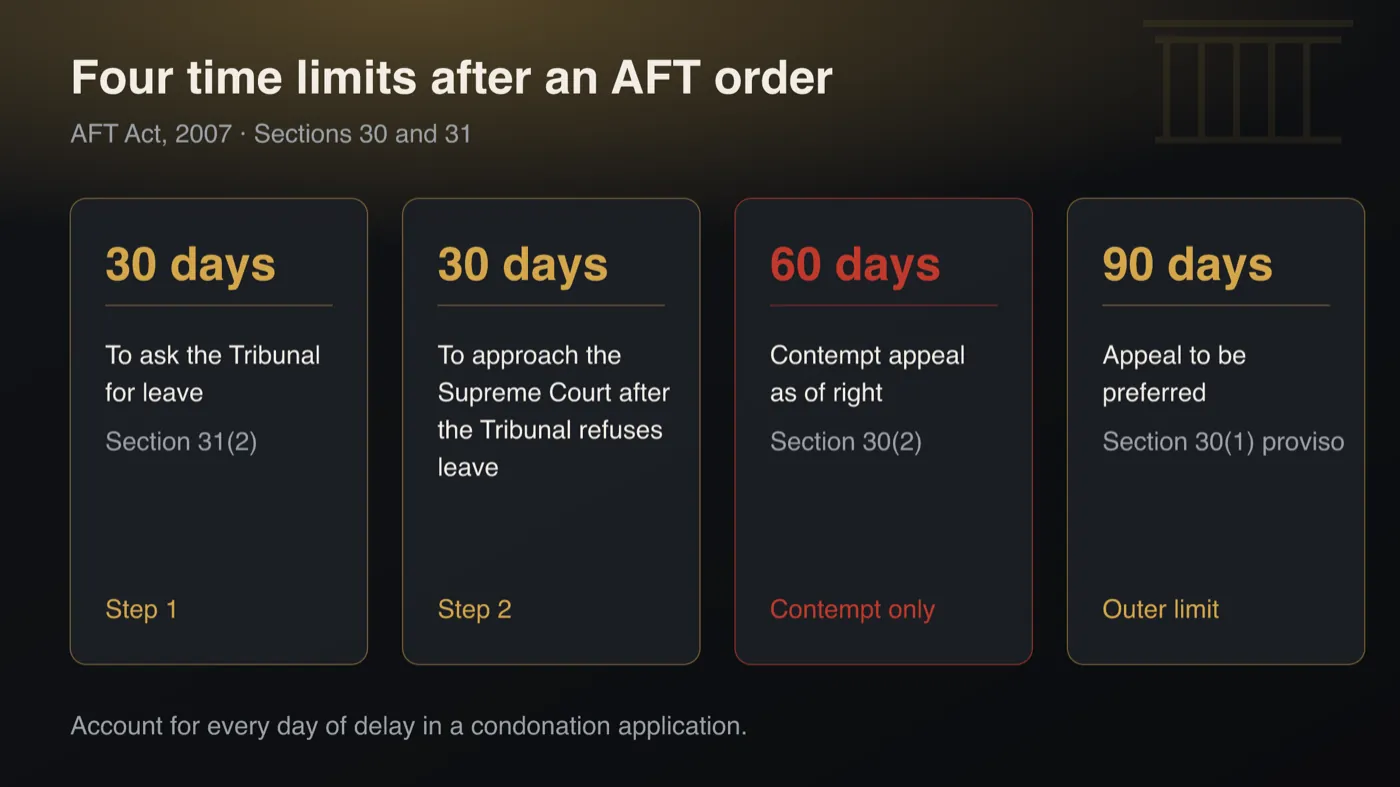
The four time limits for an AFT appeal
Each limit runs from a different event, so check which one applies to you.
Short explainers from Adv. Sudip Patra
More short explainers on our YouTube channel: Patra’s Law Chambers on YouTube ↗
What kind of Armed Forces Tribunal order do you have?
The route after an AFT order depends on what kind of order it is. This is general information, not advice on your case, so verify the facts with an advocate before acting.
Choose one of the options above.
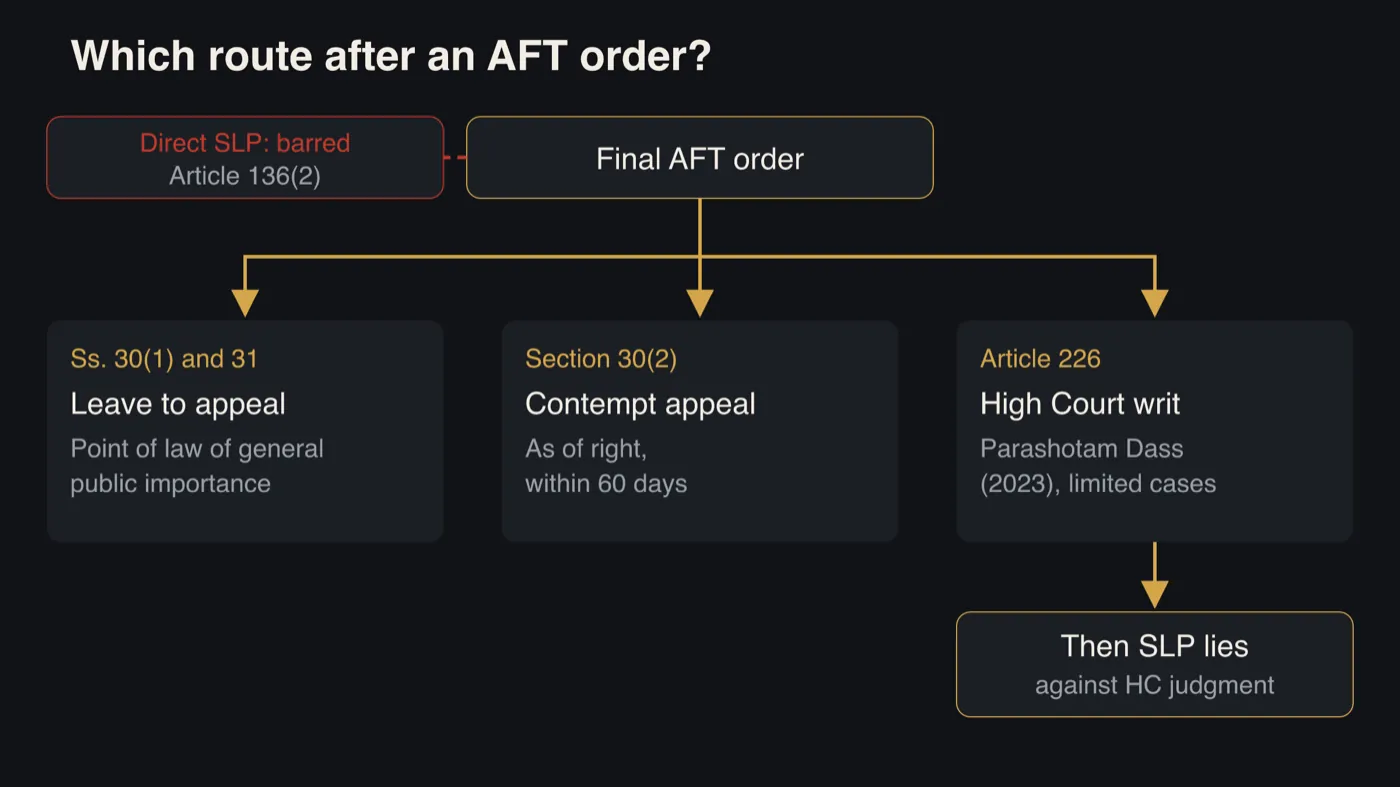
From the AFT order to the Supreme Court or High Court
This is the usual order of steps after a final decision of the Armed Forces Tribunal. Verify each date against your own order.
Apply at once for a certified copy of the final order. The time limits run from the date of the decision. For orders of the Kolkata Regional Bench, see our AFT advocate in Kolkata page.
A contempt order goes by appeal as of right. A final order with a real question of law goes by the s.31 leave route. A personal service grievance may suit a High Court writ, as in filing a writ petition in the Calcutta High Court.
Under s.31(2), ask the Tribunal for leave and a certificate within 30 days of its decision. You can ask orally when the order is pronounced or by a separate application. State the exact question of law and why it matters beyond your own case.
The Supreme Court held in Union of India v. Brigadier P.S. Gill (2012) that you cannot go straight to it for leave without first asking the Tribunal. If the Tribunal refuses, apply to the Supreme Court within 30 days. The appeal itself must be preferred within 90 days of the decision. Our Supreme Court advocate consultation page explains filing.
The appeal is filed as a civil appeal (or criminal appeal for court-martial or contempt matters) with an application for leave under s.31(1). Add a delay-condonation application if you are late. Court fee and the governing rules should be verified.
If you chose the writ route and lose, an SLP lies against the High Court judgment, as Rojer Mathew (2020) explains. Our guide to Article 136 SLPs explains why the same bar does not apply there.
Three things people get wrong about AFT appeals. Tap a card
Article 136(2) bars special leave against Armed Forces tribunals. The route is the statutory appeal under ss.30 and 31, or a High Court writ.
Not first. In Union of India v. Brigadier P.S. Gill (2012), the Supreme Court held that the party must ask the Tribunal for leave before approaching the Supreme Court under s.31.
That view of Shri Kant Sharma (2015) was overruled in Parashotam Dass (2023). The High Court can hear an Article 226 writ, but only on narrow grounds and not as a second appeal.
The routes open after an AFT order
Leave to appeal on a point of law
A final AFT order can be taken to the Supreme Court with leave. The Tribunal must certify a point of law of general public importance, or the Supreme Court itself must consider the point fit to be heard. The Tribunal must be asked first (Union of India v. Brigadier P.S. Gill, (2012) 4 SCC 463). Verify the exact question of law before applying.
Contempt orders: appeal as of right
An order or decision of the Tribunal punishing for contempt can be appealed to the Supreme Court as of right, within 60 days from the date of the order. While that appeal is pending, the punishment can be suspended and an appellant in confinement released on bail under Section 30(3).
Writ petition after Parashotam Dass
The High Court can act where there is a denial of a fundamental right, a jurisdictional error or an error apparent on the face of the record. It does not sit as a court of second appeal. Territorial jurisdiction depends on the cause of action, so verify the forum. See our guide to filing a writ petition in the Calcutta High Court.
SLP only after a High Court writ
Article 136(2) bars a direct SLP against an AFT order. But the Constitution Bench in Rojer Mathew v. South India Bank Ltd., (2020) 6 SCC 1 (para 215), said an appeal to the Supreme Court against the High Court’s judicial review under Article 226 is not prohibited. So an SLP can follow a High Court judgment on the writ.
What goes wrong in these appeals
- Going straight to the Supreme Court for leave without first asking the Tribunal: the appeal is not maintainable (P.S. Gill, 2012).
- Asking for leave only at the review stage: in Bijender Singh v. Union of India, 2025 INSC 549, the Tribunal had declined the oral request and the Supreme Court granted leave much later, so ask when the main order is pronounced.
- Treating a personal service grievance as a point of general public importance: the Supreme Court has called Section 31 “undoubtedly restrictive” (Parashotam Dass, para 27).
- Asking the court to re-weigh facts: leave was refused in a 2019 matter where the Tribunal’s view was a plausible one. Verify the case title before relying on it.
- Delay without explanation: the windows are 30, 60 and 90 days, so every day of delay should be accounted for in a condonation application.
What the Supreme Court has held on appeals from AFT orders
Five decisions explain how an Armed Forces Tribunal order can be challenged: the leave route under Sections 30 and 31, the bar on an SLP under Article 136(2), and the High Court writ that has been available again since 2023.
2012
Ask the Tribunal for leave first
The Supreme Court held that, apart from contempt orders under Section 30(2), there is no vested right of appeal against a final AFT decision. A party cannot go straight to the Supreme Court for leave under Section 31(1). The Tribunal must be asked for a certificate first. The appeals were dismissed, but the parties were left free to follow the Section 31 route.
2015
Article 136(2) bars special leave
The Court confirmed that Article 136(2) bars a special leave petition against an order of a tribunal set up under a law relating to the Armed Forces. The only way to the Supreme Court is the appeal under Section 30, with leave under Section 31. The judgment’s further view that High Courts should not hear Article 226 writs against AFT orders was overruled in 2023.
2019
SLP lies from the High Court
The Constitution Bench explained that Article 136(2) stops a direct appeal to the Supreme Court from an armed forces tribunal. It does not stop an appeal against a High Court judgment given under Article 226 on that tribunal’s order. So once a High Court decides a writ against an AFT order, a special leave petition can be filed against the High Court’s judgment.
2023
High Courts can hear writs against AFT orders
A three-judge Bench held that Shri Kant Sharma does not lay down the correct law, and that Article 226 is not restricted as such. It said Section 31 is restrictive and that most service disputes are personal to the litigant. A High Court may step in where there is a denial of a fundamental right, a jurisdictional error, or an error apparent on the face of the record.
2025
Leave granted and delay condoned
The AFT had refused an oral request for leave. The Supreme Court then granted leave under Section 31(1), condoned the delay in filing, and allowed the soldier’s appeal for disability pension. It directed that the disability element be paid at 50 percent from 1 January 1996. Leave is still granted where there is a real question of law.
How to challenge an AFT order, step by step
Get a certified copy and note the date
Apply for a certified copy of the final AFT order as soon as it is pronounced. Write down the date of the decision, because it starts the 30-day and 90-day clocks. Matters from West Bengal, Bihar, Jharkhand, Odisha and the Andaman and Nicobar Islands are heard by the Kolkata Regional Bench (verify the address and jurisdiction with the Bench).
Choose the right route
For an order punishing for contempt, appeal as of right under Section 30(2) within 60 days. For a final order that raises a real question of law, use the leave route under Section 31. For a personal grievance involving a jurisdictional error or an error apparent on the record, consider an Article 226 writ (see the writ petition guide for the Calcutta High Court).
Ask the Tribunal for leave within 30 days
Ask the AFT for leave, and for its certificate that a point of law of general public importance is involved. The request can be made orally when the order is pronounced, or by an application within 30 days of the decision (Section 31(2)). Set out the exact question of law and explain why it matters beyond your own case.
If refused, apply to the Supreme Court within 30 days
If the Tribunal refuses leave, apply to the Supreme Court within 30 days of the refusal, and file the appeal within 90 days of the decision (Section 30(1)). How the 30-day and 90-day periods fit together in registry practice is not settled in what we found, so verify it for your case. An SLP is not the route: see our SLP and Article 136 explainer.
File through an Advocate-on-Record
The appeal is filed in the Supreme Court through an Advocate-on-Record, together with the application for leave. Include certified copies of the AFT order and the refusal order, the OA and the replies, a list of dates, the questions of law, an affidavit, and a delay-condonation application if the filing is late. Court fees under the Supreme Court Rules, 2013 must be verified.
Ask for interim protection
In a contempt appeal, the Supreme Court, or the Tribunal itself, can suspend the punishment or release a confined appellant on bail (Section 30(3)). In a leave matter, ask for a stay in the leave application itself. Our Armed Forces Tribunal advocate in Kolkata page explains how we help with AFT matters.
How a leave appeal moves forward
The statutory route from an AFT final order to the Supreme Court runs in this order.
Final AFT decision
Only final orders can be appealed, and interlocutory orders cannot.
Ask the Tribunal for leave
Apply within 30 days and ask for a certificate on a point of law of general public importance.
Tribunal grants or refuses
A certificate lets the appeal go forward under s.31(1).
If refused, apply to the Supreme Court
The application must be made within 30 days of the refusal.
Appeal filed through an AOR
The appeal is filed with the leave application, and a delay application if needed.
Which route fits your AFT order?
Choose the kind of order and whether a real question of law is involved. The tool shows the route the AFT Act and the Supreme Court’s rulings point to. It is a guide only; your own papers decide the actual route.
1. What kind of order did the Tribunal pass?
2. Does your case raise a question of law that matters beyond your own facts?
This is a general guide, not advice on your case. The Tribunal and the courts decide each matter; verify the law and the dates against your certified copy.
Time limit calculator from the AFT decision date
Enter the date of the Tribunal’s decision. The tool counts 30, 60 and 90 days from that date. It is an estimate only and does not account for any exclusion of time; verify the dates for your matter.
- Pick the date the AFT decided the case.
- Press Calculate.
- Read each date and what it is for.
This is an estimate. The Tribunal and the Supreme Court decide the actual limitation, and whether Section 5 of the Limitation Act applies to Section 31 should be verified.
Mistakes that cost the right to challenge an AFT order
Filing an SLP under Article 136 Article 136(2) bars special leave against an AFT order, so the petition will not be heard. Use the statutory appeal under Sections 30 and 31, or a writ in the High Court.
Going straight to the Supreme Court for leave In P.S. Gill the Supreme Court held that a party must first ask the Tribunal for leave. If you skip that step, the appeal is not maintainable and the time you lose may not come back.
Treating a personal grievance as a point of law of general public importance A dispute about your own pension figure, promotion or ACR rarely meets the Section 31 test. In such a case the Article 226 writ recognised in Parashotam Dass is often the more realistic forum.
Missing the 30, 60 and 90-day windows These windows are short. The Supreme Court has condoned delay where the case was strong, but each day of delay must be explained. Do not count on condonation.
Discuss your AFT order before the clock runs out
The days after an Armed Forces Tribunal order are the ones that count: the request for leave, the choice between a statutory appeal and a High Court writ, and the documents for each. Bring the certified copy of the AFT order, the Original Application and the replies, and the dates of pronouncement and receipt. Your papers will be read and the available routes explained, with the time limits that apply to your matter. No result can be promised, and every route depends on the facts and the law as it stands on the day you file.
Book a ConsultationEstablished by a distinguished alumnus of IIT Kharagpur, Patra’s Law Chambers stands as a beacon of legal expertise in Kolkata & Delhi. Know more →

Kolkata Office
NICCO House, 6th Floor, 2 Hare Street
Kolkata-700001 (Near Calcutta High Court)
Delhi Office
4455/5, First Floor, Gali Shahid Bhagat Singh
Main Bazar Road, Paharganj, New Delhi-110055
Contact
[email protected]
+91 890 222 4444 / +91 7003 715 325
Section 31 leave appeal or Article 226 writ
The two routes differ in forum, gateway and what comes next.
Frequently asked questions about appeals from an Armed Forces Tribunal order
No. Article 136(2) of the Constitution excludes orders of tribunals constituted under a law relating to the Armed Forces. The route is a statutory appeal under section 30 with leave under section 31 of the AFT Act, 2007, or a writ petition in the High Court.
Yes, but only against an order of the Tribunal punishing for contempt. Section 30(2) gives an appeal as of right to the Supreme Court, to be filed within 60 days from the date of the order appealed against.
Under section 31(2), the application to the Tribunal must be made within 30 days of its decision. If the Tribunal refuses, the application to the Supreme Court must be made within 30 days of that refusal. The appeal itself is to be preferred within 90 days of the decision.
Not without first asking the Tribunal. In Union of India v. Brigadier P.S. Gill, (2012) 4 SCC 463, the Supreme Court held that the aggrieved party cannot approach it directly for leave under section 31(1) and must first apply to the Tribunal.
It is a legal question that affects people beyond the parties, such as how a rule or a line of judgments is to be read. A dispute only about your own facts, such as the pension amount in your case, usually does not qualify. Each case is judged on its own facts.
No appeal lies under section 30. The second proviso to section 30(1) says there is no appeal against an interlocutory order of the Tribunal. A High Court writ may be considered in a suitable case, so verify the facts with an advocate first.
Yes. In Union of India v. Parashotam Dass (2023), the Supreme Court held that High Courts can hear Article 226 writs against AFT orders. Relief is limited to a denial of a fundamental right, a jurisdictional error or an error apparent on the record.
Yes. The Constitution Bench in Rojer Mathew v. South India Bank Ltd., (2020) 6 SCC 1, noted that Article 136(2) does not prohibit an appeal to the Supreme Court against the High Court’s judicial review under Article 226. An SLP lies against the High Court judgment.