University and College Teachers in West Bengal: Writ Remedies Explained
Appointment, approval, pay, promotion and removal disputes of university and aided-college teachers are tested against the University Acts, the WBCSC Act and the UGC Regulations, 2018. This page explains who governs your service and when a writ under Article 226 is the right step.
Who governs a teacher's service in West Bengal?
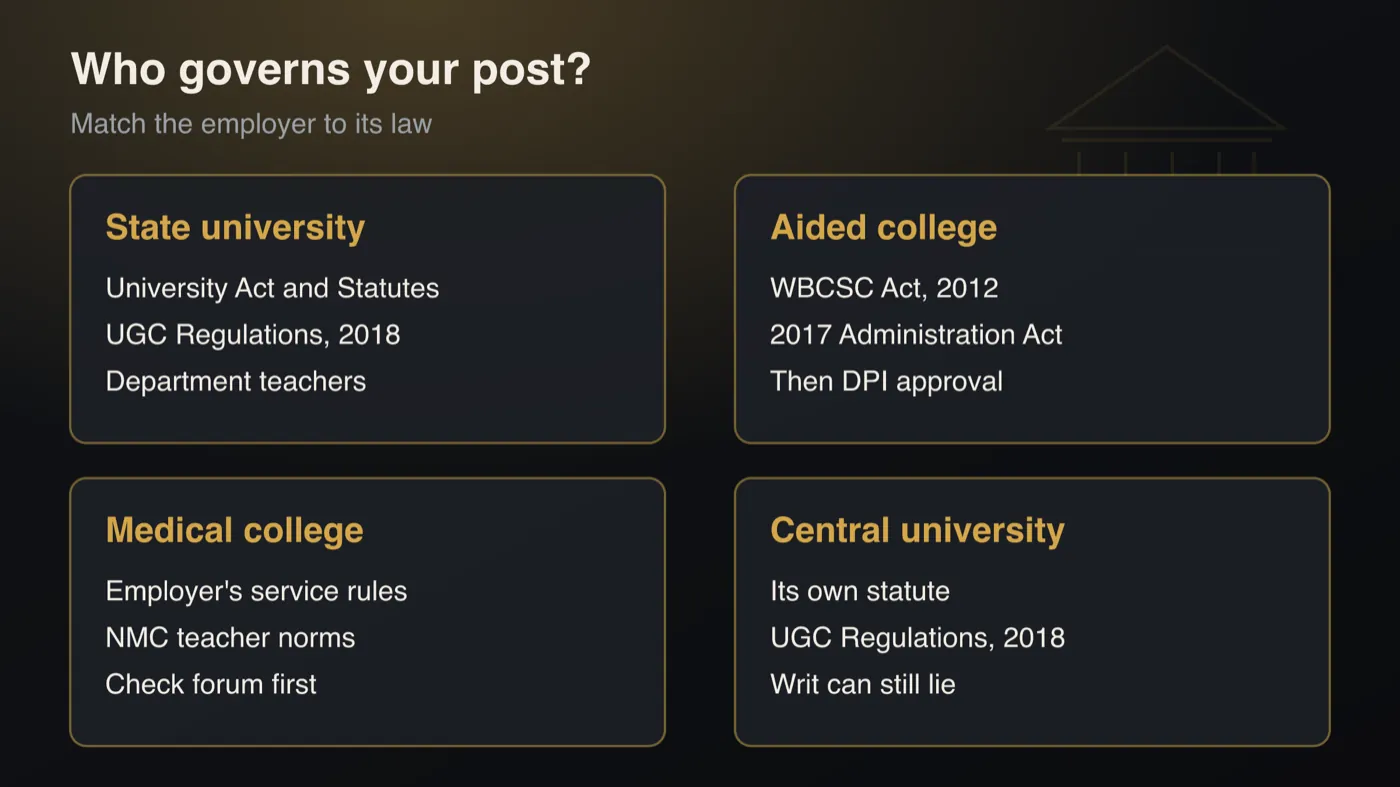
A teacher’s remedy starts with identifying the employer. Assistant Professors up to Principals in government-aided colleges are appointed by the Governing Body, but only on the recommendation of the West Bengal College Service Commission (WBCSC). The sources are the WB College Service Commission Act, 2012 and section 10 of the WB Universities and Colleges (Administration and Regulation) Act, 2017. University department teachers are appointed under each university’s own Act and Statutes. Approval and pay then run through the DPI or the Higher Education Department.
State universities are statutory bodies and count as “State” under Article 12. Even aided colleges can be answerable in a writ because they perform a public function, as the Supreme Court held in Andi Mukta (1989) 2 SCC 691. Whether the matter is an appointment, a pending approval, a CAS promotion or a removal, the petition must rest on the right statute and name the right respondents. Our service matters page and the guide on when to file a writ in the Calcutta High Court explain the wider choice of forum.
How a college teacher is appointed and where disputes begin
Each stage in an aided-college appointment is a point where a dispute may arise.
Vacancy and advertisement
The West Bengal College Service Commission advertises the post under the 2012 Act.
Selection by the Commission
Qualifications and committee composition are tested against the UGC Regulations, 2018.
Recommendation
The Commission recommends candidates to the college.
Governing Body appoints
Section 10 of the 2017 Act allows appointment only on that recommendation.
DPI approval
Approval of the appointment and pay fixation, where delay or refusal often leads to a writ.
Short explainers from Adv. Sudip Patra
More short explainers on our YouTube channel: Patra’s Law Chambers on YouTube ↗
What is your problem as a teacher in West Bengal?
Pick the closest description to see the forum and the usual first step. This is general information, not advice on your papers.
Choose one of the options above.
From the problem to the Calcutta High Court
A usual path for a teacher’s service dispute. Every matter differs, so the order and timing depend on the papers.
Find out whether you are a university, aided-college, medical-college or central-university teacher. The governing Act, the rules and the authority that decides all follow from this.
Gather the advertisement, application, appointment letter, approval or refusal orders, pay-fixation orders, score sheets and replies. Selection-committee minutes can be sought under RTI where needed.
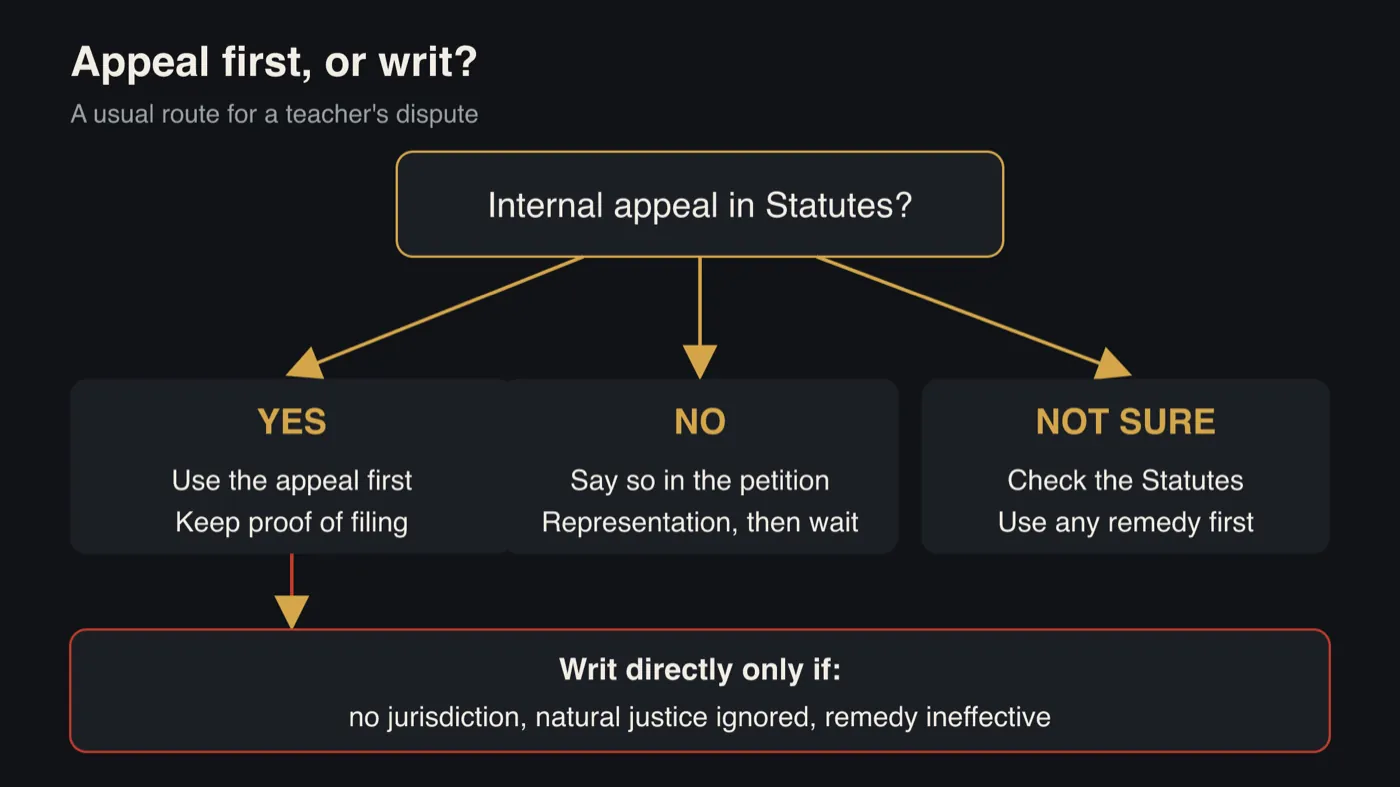
Where the Statutes give an appeal, file it. If no remedy exists, or it would be futile, the petition should say so plainly. For the wider picture, see service matters.
A written representation creates a record of demand and refusal. It does not extend the time to approach the court indefinitely.
The petition goes to the Calcutta High Court, with the State, the DPI, the university or Governing Body, the Service Commission and any selected candidates as parties. Read when to file a writ petition and the service matter writ guide.
The court usually calls for affidavits and may pass interim directions. Many approval and pay matters end with a direction to decide by a reasoned order within a fixed time. An intra-court appeal may lie to the Division Bench.
Three points courts keep returning to – tap a card
State universities are statutory bodies and count as State under Article 12. Even aided colleges and deemed universities can be reached because they perform a public function (Andi Mukta, 1989; Janet Jeyapaul, 2015).
No fixed limitation period applies to a writ, but unexplained delay can defeat it. A challenge to a selection should be made before appointees settle in.
Once a selection process starts, the eligibility criteria generally cannot be changed unless the rules allow it (Tej Prakash Pathak, Constitution Bench, 2024). Read its exceptions before relying on it.

Where teacher writs usually arise
Appointment and selection committee defects
A selection committee missing a required member, or an appointment made outside the WBCSC route, can be challenged. In Mandeep Singh v. State of Punjab (2025), the Supreme Court quashed the recruitment of 1,091 Assistant Professors made contrary to UGC Regulations the State had adopted. Selected candidates must be joined as respondents.
Approval and pay fixation pending
When approval or pay fixation is withheld or delayed, courts commonly direct the DPI or the university to decide by a reasoned order within a fixed time. A written representation and a reasonable wait should come first. Read more in our guide to the service matter writ petition.
CAS, promotion and SACT claims
CAS disputes turn on the correct table, the date of eligibility and whether the State adopted the scheme. SACT teachers are placed under the 23 December 2019 scheme in two categories. Regularisation claims face hurdles, so the route and the papers need careful checking.
Suspension, removal and discipline
Removal is tested against the Statutes or service rules, the approving authority, natural justice and proportionality. Where the Statutes give an internal appeal, courts usually expect it to be used first, unless jurisdiction or natural justice is in issue.
Papers that usually matter in a teacher writ
- Advertisement or recruitment notice and your application
- Selection committee constitution and minutes
- WBCSC recommendation and appointment letter
- DPI approval or refusal and pay-fixation orders
- CAS or API score sheets and your representations
- Charge-sheet, inquiry report and punishment order, in removal cases
Supreme Court rulings that decide university and college teacher writs
These decisions settle whether a university or aided college is answerable in a writ, when the UGC Regulations bind a State, and how strictly the courts enforce a lawful selection process. Each citation was checked against published reports. Read the full text before you rely on any paragraph.
1989
Aided colleges answer writs for public duties
Teachers of a closed aided college run by a trust claimed salary arrears and terminal benefits. The Supreme Court held that a mandamus under Article 226 can issue to any person or authority performing a public duty, including a trust running an aided college. It also said mandamus will not lie where the rights are purely private and the management owes no public duty.
2022
An appointment contrary to UGC norms cannot stand
On a quo warranto petition, the Supreme Court quashed the appointment of the Vice-Chancellor of Sardar Patel University because it did not follow the UGC Regulations, which Gujarat had adopted. A later bench has noticed that this ruling sits uneasily with Kalyani Mathivanan (2015) 6 SCC 363. Verify the current position before you rely on it against a State that has not adopted the Regulations.
2022
The State cannot take over the Chancellor's power
The Supreme Court upheld the Calcutta High Court’s decision setting aside the State’s reappointment of the Calcutta University Vice-Chancellor. Under the Calcutta University Act, 1979, the power to reappoint lies with the Chancellor, and the State cannot remove that requirement by notification. The Court also noted that the UGC Regulations would apply. Who decides, and under which statute, must be checked in every university case.
2025
Adopted UGC Regulations bind the State's recruitment
The Supreme Court set aside the appointment of 1,091 Assistant Professors and 67 Librarians in Punjab government colleges. The State had replaced the UGC selection method, which it had adopted, with a multiple-choice test and had bypassed the Public Service Commission. The Court held the adopted UGC Regulations binding and directed a fresh selection under the 2018 Regulations.
2024
Eligibility cannot change once selection starts
A Constitution Bench held that once a recruitment process begins, the eligibility criteria cannot be changed midway unless the governing rules allow it. Any change the rules do permit must still meet Article 14’s tests of transparency and non-arbitrariness. Teachers can rely on this where a new cut-off or an extra condition is added after the advertisement. Read the exceptions in the judgment before quoting it.
2014
Unexplained delay can defeat a service writ
The Supreme Court set aside a High Court order reinstating an employee who had waited about four years to challenge his removal. It held that delay and laches must not be lightly brushed aside, and that the writ court must weigh any explanation offered for the delay. No fixed limitation applies to a writ, but a teacher who waits too long may be turned away.
Filing a teacher's writ in the Calcutta High Court, step by step
Identify the employer and the law that governs the post
University department teachers fall under their University Act, Statutes and the UGC Regulations, 2018. Aided college teachers fall under the West Bengal College Service Commission Act, 2012, the West Bengal Universities and Colleges (Administration and Regulation) Act, 2017 and DPI approval. Medical college teachers fall under the NMC norms. The governing law decides your grounds and your forum.
Use or record the internal remedy
If the University Statutes give an appeal against punishment, or a representation lies to the DPI, the Higher Education Department or WBCSC, use it first. If no remedy exists, if it would be futile, or if the authority acted without jurisdiction or ignored natural justice, say so plainly in the petition.
Make a written representation and keep proof
A dated representation, with proof that it was delivered, records your demand and its refusal or the silence that followed. This record is the basis for a mandamus. A representation does not stop the clock, so move to court if no reasoned decision comes within a reasonable time.
Collect the papers, using RTI where needed
Gather the advertisement, your application, the selection-committee constitution and minutes, the WBCSC recommendation, the appointment letter, DPI approval or refusal, pay-fixation orders, CAS/API score sheets, your representations, and any charge-sheet, inquiry report and punishment order. Add extracts of the relevant Statute and UGC Regulation.
File the W.P.A. and join every necessary party
File a writ petition (W.P.A.) under Article 226 on the appellate side, through e-filing if you prefer. Usual respondents are the State, the DPI, the university or Governing Body, WBCSC, UGC where its Regulations are in issue, and every selected candidate whose appointment you challenge. The Calcutta High Court Advocate Consultation page explains how the firm takes up such matters.
Affidavits, hearing and appeal
The bench usually calls for an Affidavit-in-Opposition and a Reply, may pass an interim order, and then hears the case. Many approval and pay writs end with a direction to decide by a reasoned order within a fixed time. A party dissatisfied with the single-judge order may file an intra-court appeal (MAT) before the Division Bench.
Internal appeal versus a writ in the High Court
Both can be open to a teacher, but the usual order differs.
Which route applies to your dispute?
Pick your employer and the kind of dispute, then say whether the Statutes give an internal appeal. The tool shows the governing law, the papers to gather and whether to appeal first.
- Choose where you teach.
- Choose the kind of dispute.
- Say whether an internal appeal exists, then press the button.
Mistakes that sink teacher writs
Not joining the selected candidates A challenge to someone else’s appointment without making that person a respondent is a common reason a petition fails. Name every appointee whose selection you attack, and serve them.
Waiting too long to file No statute fixes a period for a writ, but courts dismiss stale challenges, especially once the appointees have settled into their posts. File within months of the order or the final refusal, and explain any gap honestly.
Skipping the appeal under the University Statutes Where the Statutes provide an internal appeal against a punishment, the High Court usually sends the teacher back to it. Go straight to the writ court only if you can plead lack of jurisdiction, a breach of natural justice or a remedy that would not work.
Assuming the UGC Regulations bind the State for every post The Supreme Court treats the Regulations as binding where the State has adopted them, as in Gambhirdan and Mandeep Singh. The position for a State that has not adopted them is still contested. Check the State’s adoption notification for your post before you build the case on it.
Talk to Patra's Law Chambers about a teacher service matter
If your appointment, approval, pay or promotion is in dispute, bring the order, the recruitment papers and your representations to a consultation. The chamber will read them against the governing statute, explain the forum and the documents needed, and tell you plainly what a writ can and cannot do. No outcome or timeline can be promised. See also our Calcutta High Court advocate page.
Book a ConsultationEstablished by a distinguished alumnus of IIT Kharagpur, Patra’s Law Chambers stands as a beacon of legal expertise in Kolkata & Delhi. Know more →

Kolkata Office
NICCO House, 6th Floor, 2 Hare Street
Kolkata-700001 (Near Calcutta High Court)
Delhi Office
4455/5, First Floor, Gali Shahid Bhagat Singh
Main Bazar Road, Paharganj, New Delhi-110055
Contact
[email protected]
+91 890 222 4444 / +91 7003 715 325
Documents usually needed for a teacher's writ
The papers that most often decide whether a service writ can be framed properly.
Shows the post, the qualifications asked for and what you applied for.
Shows the statutory route that was followed.
Shows the exact decision being challenged.
Needed for promotion and career advancement disputes.
Shows demand, refusal and the date from which delay is counted.
Needed in removal and discipline cases.
The provisions the argument rests on, checked for the current text.
Frequently asked questions on university and college teachers' writs in West Bengal
Yes. State universities are created by statute and are treated as State under Article 12 of the Constitution. Aided colleges can also be reached under Article 226 because they perform a public function. Purely contractual disputes with an unaided private body may be sent to other remedies.
In government-aided colleges the Governing Body appoints, but only on the recommendation of the West Bengal College Service Commission, under section 10 of the 2017 Administration and Regulation Act read with the 2012 Commission Act. Approval then runs through the DPI. An appointment outside this route can be challenged.
Generally they are treated as binding on qualifications and selection-committee composition, especially where a State has adopted them. The Supreme Court’s decisions on state universities have not been uniform, so verify the position for the particular post before relying on them.
Ordinarily yes, where the University Statutes provide an appeal. Alternative remedy is a rule of discretion, not a bar. The High Court may still hear you if the authority lacked jurisdiction, natural justice was ignored or the remedy would be ineffective.
No fixed period is set by statute, but unexplained delay can lead to dismissal. File promptly after the order or the final refusal. Recurring pay claims may survive, but arrears are often limited to about three years before filing. Verify how the bench applies this.
Yes, but you must join the selected candidate as a respondent and show a defect in the process, such as a wrongly constituted committee. A preference for your own marks is not enough. Not joining the selected candidate is a common reason such petitions fail.
The court commonly directs the DPI or the university to decide by a reasoned order within a fixed time, and may quash an unreasoned refusal. It does not promise any particular result on the merits. A written representation first helps create the record.
Lien is the right to keep a permanent post while serving elsewhere for a period. Whether it applies, and for how long, depends on the university’s Statutes and the service rules governing your post. Verify the rule that applies to you before taking leave or a new post.