IBC Supreme Court Judgments: Insolvency Rulings on Sections 7, 9 and 60 August to October 2026
The Insolvency and Bankruptcy Code changed on 26 May 2026, and the Supreme Court has since ruled on default, limitation and the NCLT’s powers. This note explains what was held and what it means for creditors, companies and guarantors, with a Kolkata focus.
What the Supreme Court and the 2026 amendment changed in IBC practice
The Insolvency and Bankruptcy (Amendment) Act, 2026 (Act No. 6 of 2026) received assent on 6 April 2026, and most of it came into force on 26 May 2026 under MCA notification S.O. 2625(E). The substituted Section 7(5) is reported to say that the NCLT “shall” admit a financial creditor’s application once default is shown, the application is complete and no disciplinary proceeding is pending against the proposed resolution professional. That removes the discretion read into the section in Vidarbha Industries v. Axis Bank (2022) 8 SCC 352. Please verify the exact wording in the Gazette and on the IBBI notifications page.
Within the research window, the Supreme Court decided Deepak Raheja v. Omkara Assets Reconstruction on 15 October 2026. It held that a company’s profitability is no answer to a Section 7 petition, and that an authenticated Information Utility record is first-tier proof of default. On 12 August 2026, in Srinivasa Reddy Velagala v. Sravanthi Infratech, it held that a contract still running does not give a fresh cause of action for an old default under Section 9. This page summarises these rulings, the NCLAT and Kolkata decisions around them, and the practical checks for a creditor or a debtor. It is informative only. Check every ruling against the judgment text before relying on it. If you are weighing a filing or a defence, our NCLT Kolkata advocate page explains how we appear in these matters.
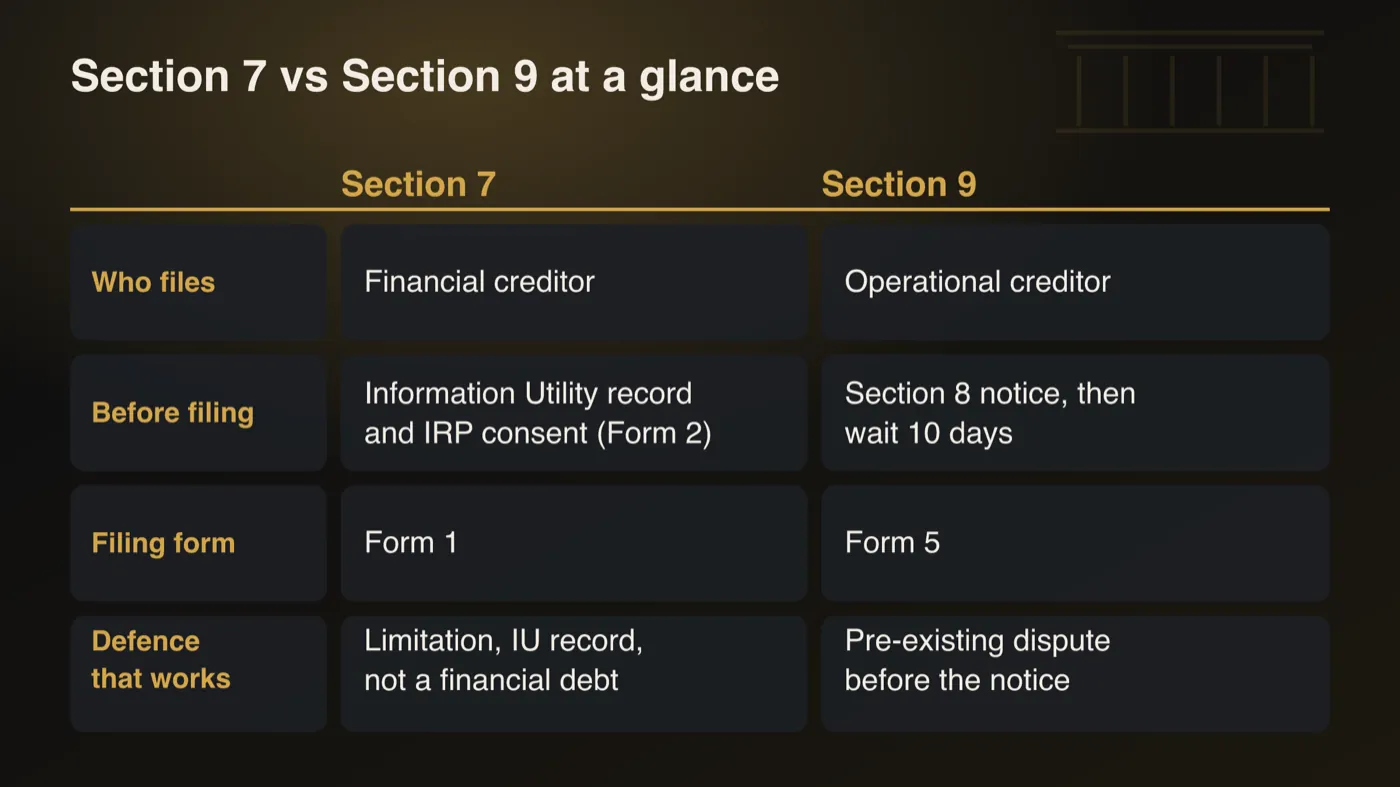
The four IBC time limits that matter most
Short statutory periods decide many IBC cases, so check each against the date of the order or notice.
Short explainers from Adv. Sudip Patra
More short explainers on our YouTube channel: Patra’s Law Chambers on YouTube ↗
Which IBC paper or situation are you dealing with?
Pick the option closest to your position to see the usual forum and next step. This is general information about the Insolvency and Bankruptcy Code, 2016, not advice on your case.
Choose one of the options above.
From default to appeal: how an IBC case moves
The usual path of a Section 7 or Section 9 case, based on the Code and the 2026 rulings. Dates and details depend on the facts of each case.
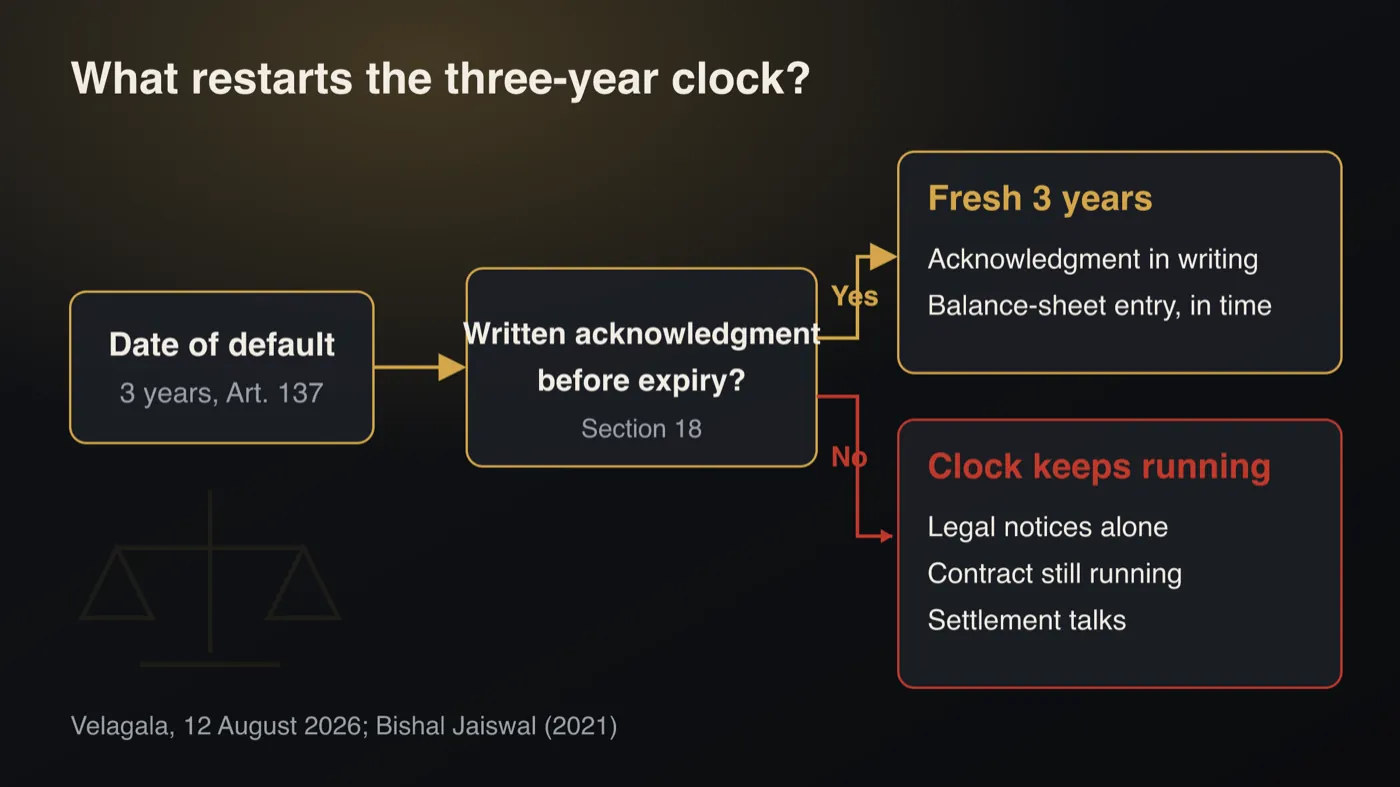
The default must be at least ₹1 crore on the filing date. Limitation is three years under Article 137 of the Limitation Act, 1963, applied by S.238A of the IBC. Only a written acknowledgment made before expiry (S.18) gives a fresh period.
An operational creditor serves a notice under S.8 in Form 3 or 4. The debtor has 10 days to pay or show a pre-existing dispute. See the guide for operational creditors for the notice and Form 5 documents.
A financial creditor files under S.7 with the Information Utility record of default and the proposed IRP’s consent. Read how a financial creditor starts CIRP. The forum is the bench covering the registered office under S.60(1).
The amended Act is reported to require a decision within 14 days, with reasons if later, and 7 days to cure defects. Debtors preparing a response can see defending Section 7 petitions. Verify the exact wording against the Gazette.
Once the petition is admitted, a moratorium applies and suits against the company are barred. Withdrawal is possible under S.12A with a 90% vote of the Committee of Creditors, and a private settlement alone does not undo admission.
An appeal lies to the NCLAT under S.61 and then to the Supreme Court under S.62, counted from the date of the order. For forum questions in Kolkata, see the firm’s NCLT Kolkata page.
Three ideas that no longer work in IBC cases: tap a card
In Deepak Raheja v. Omkara ARC (15 October 2026) the Supreme Court held that profitability is no answer to a Section 7 petition. The trigger is default, and an authenticated IU record is first-tier proof.
In Srinivasa Reddy Velagala v. Sravanthi Infratech (12 August 2026) the Supreme Court held that a subsisting contract does not give a fresh cause of action for an old default. Notices without a written acknowledgment also do not extend limitation.
The Supreme Court held in September and October 2026 that time to appeal an NCLAT order runs from the date of the order. Waiting for a certified copy does not save a late appeal.

Four questions these rulings answer
Is default enough, or can the NCLT still refuse?
After 26 May 2026, the amended Section 7(5) is reported to require admission where default is shown and the application is complete. Deepak Raheja treats default as a historical event and the amount as something settled later in the claims process. Verify the Gazette wording.
Is the operational debt in time and undisputed?
Velagala holds that a running contract and unacknowledged legal notices do not extend limitation. Unliquidated damages need adjudication before they count as operational debt. GLS Films asks only whether a plausible pre-existing dispute exists.
Which bench, and how far does its power go?
Filing lies before the NCLT bench with jurisdiction over the registered office. Guarantor cases go to the bench hearing the company’s CIRP. Under Section 60(5), Gloster Ltd v. Gloster Cables limits the NCLT where the dispute does not arise from or relate to the insolvency.
When does the time to appeal start?
The Supreme Court held in September and October 2026 that time to appeal an NCLAT order runs from the date of the order, not from receipt of the certified copy. Section 61 gives 30 days plus up to 15, and Section 62 gives 45 days plus up to 15.
Before you file or defend an IBC petition
- Confirm the default is at least ₹1 crore on the filing date, and check whether principal was paid down before the order (Loknath Prasad Gupta, NCLAT).
- Count three years from default and look for any written acknowledgment under Section 18 of the Limitation Act made before expiry.
- Section 7: obtain the Information Utility record, loan documents and the proposed professional’s consent.
- Section 9: serve the Section 8 demand notice, wait 10 days and check for any earlier dispute record.
- Confirm every case citation against the source judgment, since the Supreme Court has set aside orders built on non-existent precedents.
IBC Supreme Court judgments that now decide Sections 7, 9 and 60
These six Supreme Court rulings answer most questions that come up when a Section 7 or Section 9 petition is admitted or opposed. Each summary comes from the reported judgment, so read the full text before you rely on it in a pleading.
2026
Profitability is no answer to default
A bench of Dipankar Datta and Augustine George Masih, JJ. held that under Section 3(12) of the Code, default is what triggers insolvency, not balance-sheet weakness. Positive EBITDA did not save GSTAAD Hotels or Neo Capricorn Plaza. A dispute over the exact amount does not defeat default once more than the threshold has fallen due and is unpaid. The amount itself is settled later, in the claims process.
2026
A running contract does not revive old dues
J.B. Pardiwala and Manoj Misra, JJ. held a 2018 Section 9 application time-barred because the dues had fallen due in 2011-12. A contract that is still in force does not create a continuing cause of action under Article 137 of the Limitation Act, 1963. Legal notices without a written acknowledgment by the debtor do not extend time. Unliquidated damages must be decided by the proper forum first.
2026
A plausible dispute is enough, with no mini-trial
The Supreme Court restored the NCLT’s dismissal of a Section 9 petition. Complaints in writing about defective consignments and a police complaint made before the demand notice showed a genuine pre-existing dispute. The NCLT asks only whether the dispute is real and not spurious, hypothetical or illusory. It does not decide whether the defence will succeed, and the NCLAT was wrong to test the merits.
2026
Section 60(5) cannot decide trademark title
J.B. Pardiwala and K.V. Viswanathan, JJ. held that the NCLT’s residuary power under Section 60(5) of the IBC did not allow it to declare that the disputed “Gloster” trademark belonged to the corporate debtor. A title dispute between rival private claimants that does not arise from or relate to the insolvency belongs before the ordinary courts, not the insolvency tribunal.
2017
Pre-existing dispute test for operational creditors
This is the base case for every Section 9 defence. Once the debtor shows a notice of dispute, or a dispute that existed before the Section 8 demand notice, the NCLT must reject the application. A pending suit or arbitration is not required. The tribunal looks only for a plausible dispute that needs further investigation and does not decide the contract dispute itself.
2021
Balance-sheet entries can extend limitation
A three-judge bench held that a debt shown in the corporate debtor’s balance sheet can amount to a written acknowledgment under Section 18 of the Limitation Act, 1963, if it is made before the limitation period runs out. That starts a fresh three-year period for a Section 7 application. Whether a particular entry counts as an acknowledgment depends on the facts of each case.
From default to admission: how a Section 7 or 9 case moves
Check the threshold and limitation
The default must be at least ₹1 crore under Section 4 on the date the NCLT decides, so a part-payment of principal before the order can defeat admission. You have three years from default under Article 137. Look for written acknowledgments, including balance sheets, made before that time ran out. Notices and settlement talks do not restart it.
File before the right NCLT bench
Under Section 60(1), file before the bench with jurisdiction over the corporate debtor’s registered office. For companies in West Bengal that is usually the Kolkata Bench, but check the current territorial list on nclt.gov.in. A personal guarantor’s case goes to the bench already hearing the company’s insolvency (Section 60(2)). Our NCLT Kolkata practice page explains how we handle these matters.
Financial creditor: Form 1 under Section 7
Attach the Information Utility record of default, the loan and sanction documents, a statement of account certified under the Bankers’ Books Evidence Act, any acknowledgments, and the proposed IRP’s written consent in Form 2. Our Section 7 guide for financial creditors explains each document.
Operational creditor: demand notice, then Form 5
Serve the Section 8 demand notice in Form 3 or Form 4 and wait 10 days for payment or a notice of dispute. Then file Form 5 under Section 9 with invoices, the ledger, an affidavit that no dispute notice was received, and TDS or GST records. Our operational creditor guide covers the demand notice in detail.
Hearing, defects and the admission order
The NCLT is to decide within 14 days and record its reasons if it takes longer. The applicant gets 7 days to cure defects. On admission a moratorium under Section 14 begins and an interim resolution professional takes charge. Under amended Section 7(5), check the notified Gazette text to see whether admission is now mandatory once default is proved.
Appeal within the statutory period
An appeal to the NCLAT lies under Section 61 within 30 days, which can be extended by up to 15 days. An appeal from the NCLAT to the Supreme Court lies under Section 62 within 45 days, also extendable by up to 15 days. The Supreme Court has held that time runs from the date of the order, not from when you receive the certified copy.
Section 7(5) admission: before and after 26 May 2026
The 2026 amendment is reported to change how the NCLT approaches admission, so verify the Gazette text.
Mistakes that sink IBC petitions and defences
Pleading that the company is profitable After *Deepak Raheja*, solvency or positive EBITDA is no defence to a Section 7 petition. A defence that can work raises limitation, challenges the authentication of the Information Utility record, or argues the claim is not a financial debt. Our page on defending Section 7 IBC petitions covers these grounds.
Treating a legal notice or a running contract as a fresh start Only a written acknowledgment by the debtor, made before limitation expires, gives a fresh period under Section 18 of the Limitation Act. Reminders, a contract that is still in force and broken settlement talks do not restart the clock.
Raising the dispute only after the demand notice The Section 9 defence needs a dispute that existed before the Section 8 notice, shown by emails, minutes, complaints or a pending case. A dispute first raised in reply to the notice usually fails. This defence does not apply to Section 7 petitions.
Waiting for the certified copy before appealing Time for a Section 62 appeal runs from the date the NCLAT pronounces its order. Track the date the order is uploaded and file within the statutory period instead of waiting for the certified copy.
Talk through your IBC position with a Kolkata advocate
Whether you are a creditor weighing a Section 7 or Section 9 filing, or a company or guarantor responding to a notice or petition, the first step is to check limitation, the amount of default and the documents. We appear before the NCLT, the NCLAT and the Supreme Court. Outcomes depend on the facts and documents in each case, and nothing here is a promise of result. Share the papers you have and we can tell you what the next step looks like.
Book a ConsultationEstablished by a distinguished alumnus of IIT Kharagpur, Patra’s Law Chambers stands as a beacon of legal expertise in Kolkata & Delhi. Know more →

Kolkata Office
NICCO House, 6th Floor, 2 Hare Street
Kolkata-700001 (Near Calcutta High Court)
Delhi Office
4455/5, First Floor, Gali Shahid Bhagat Singh
Main Bazar Road, Paharganj, New Delhi-110055
Contact
[email protected]
+91 890 222 4444 / +91 7003 715 325
Section 9 in five steps: from unpaid invoice to NCLT filing
The usual path for an operational creditor, using the periods in the Code. Each step depends on the facts, so verify against the statute.
Check limitation and threshold
The default must be at least ₹1 crore and within three years under Article 137 of the Limitation Act, 1963.
Serve the Section 8 demand notice
Send the notice in Form 3 or Form 4 to the corporate debtor.
Wait 10 days
The debtor may pay or show a pre-existing dispute under Section 8(2).
File Form 5 under Section 9
File before the NCLT bench covering the registered office, with invoices, ledger and an affidavit that no dispute notice was received.
Admission and appeal
The NCLT is to decide within 14 days. An appeal lies to the NCLAT within 30 days under Section 61.
Frequently asked questions on IBC Supreme Court judgments (Sections 7, 9 and 60)
For applications decided after 26 May 2026, the amended Section 7(5) is reported to say “shall” admit if default has occurred, the application is complete and no disciplinary proceeding is pending against the proposed IRP. This reduces the discretion recognised in Vidarbha Industries. Verify the wording against the Gazette.
No. In Deepak Raheja v. Omkara Assets Reconstruction (Supreme Court, 15 October 2026), the Court held that default, not profitability or positive EBITDA, is the trigger. A debtor may instead challenge the Information Utility record, limitation, or whether the debt is a financial debt.
Three years from the date of default, under Article 137 of the Limitation Act, 1963, which S.238A of the IBC applies. It can be extended only by a written acknowledgment of the debt made before the period expires, under S.18 of the Limitation Act.
No. In Srinivasa Reddy Velagala v. Sravanthi Infratech (12 August 2026), the Supreme Court held that a subsisting contract is not a continuing cause of action, and legal notices without a written acknowledgment by the debtor do not extend time.
The pre-existing dispute defence belongs to Section 9, for operational debt. The NCLT asks only whether a plausible dispute existed before the demand notice, not who will win (Mobilox; GLS Films, April 2026). Section 7 turns on financial debt and default, so the question there is different.
Only through Section 12A, after the Committee of Creditors is constituted and before plans are invited, with a 90% vote. The NCLAT has said a settlement after admission does not by itself set the admission aside (Vijaybhai Detroja, 2026).
Under Section 60(2), proceedings against a corporate or personal guarantor are filed before the NCLT bench where the company’s CIRP or liquidation is pending. The NCLAT applied this in Kamlesh Rani Singla (September 2026). Verify the territorial jurisdiction of the Kolkata bench on nclt.gov.in.
From the date of the order, not from when a certified copy is obtained, according to Supreme Court rulings in September and October 2026. Appeal under Section 62 is within 45 days, with up to 15 more days if sufficient cause is shown.