How to File a Case in the Armed Forces Tribunal
A step-by-step guide to the Armed Forces Tribunal (AFT): which application to file, the bench, the time limits, the documents and the remedies after the Tribunal. It covers service matters under Section 14 and court martial appeals under Section 15 of the AFT Act, 2007.
What the Armed Forces Tribunal hears, and how a case reaches it
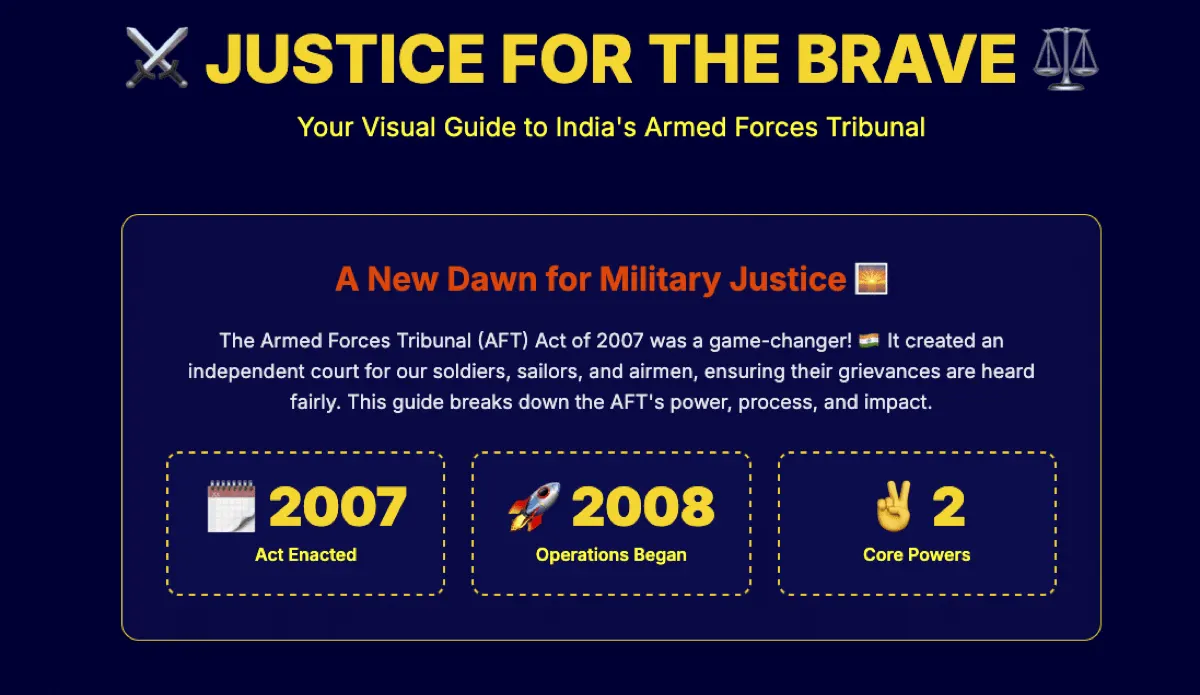
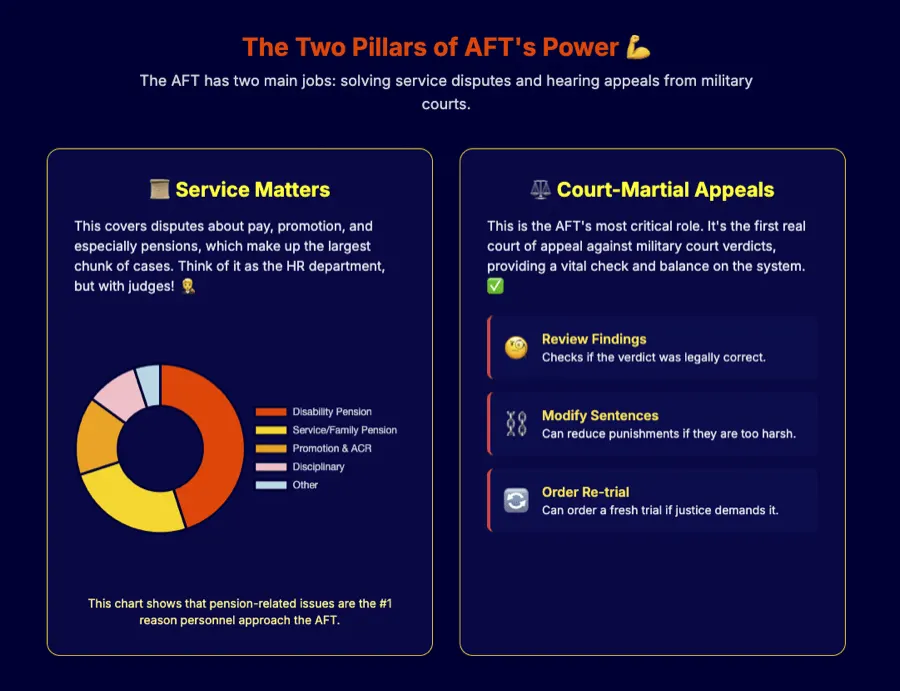
The Armed Forces Tribunal (AFT) was created under the Armed Forces Tribunal Act, 2007 and has two main jobs. Under Section 14 it decides service matters such as pay, pension, promotion, seniority and discharge. Under Section 15 it hears appeals against the orders, findings and sentences of courts martial. Before the Tribunal existed, these disputes mostly went to the High Courts in writ jurisdiction, where the evidence could not be re-examined in the way an appellate forum can. This guide explains which application to file, where to file it, in what time and with which papers.
Each route has its own limitation, paperwork and next step. An Original Application (OA) is filed for a service grievance. An appeal under Section 15 is filed against a court martial. The Kolkata Regional Bench hears matters from West Bengal, Bihar, Jharkhand, Odisha and the Andaman and Nicobar Islands (verify the current territorial notification). Please read this page with our notes on courts of inquiry, adverse ACRs and disability pension, and see our AFT advocate in Kolkata page. Facts differ from case to case, so verify every date and document with the Registry or counsel.
What is the latest paper or order you have received?
Pick the option closest to your situation to see the forum and the usual first step. This is general information, not legal advice, and your facts may point elsewhere.
Choose one of the options above.
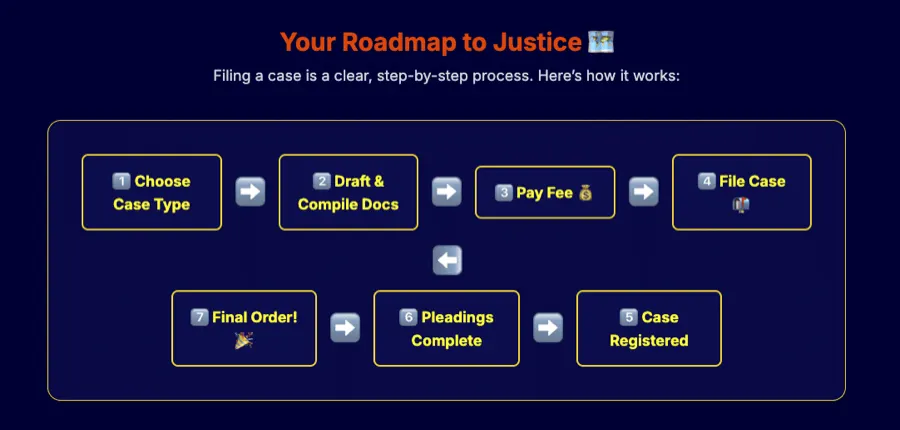
How a case moves through the Armed Forces Tribunal
A typical path for an Original Application. Court martial appeals follow the same filing rules, with extra steps before and after.
Get the impugned order, service and medical records, and proof of any representation or statutory complaint you made. For a court martial, apply in writing for attested copies of the proceedings straight away.
Use an OA for service matters (Section 14) or an appeal for court martial orders (Section 15). Under Rule 6, file where you are or were last posted, or where the cause of action arose. Ex-servicemen may file where they ordinarily reside. The Kolkata bench’s remit is covered on our AFT advocate in Kolkata page.
Rule 4 of the AFT (Procedure) Rules, 2008 asks for Form I in triplicate, with an attested copy of the order, a paper book and an index. Add a vakalatnama and a separate application with an affidavit if you need condonation of delay. Verify the current fee and mode of payment with the Registry.
The Tribunal issues notice to the Union of India, which files a reply. You may file a rejoinder. The Tribunal has civil court powers to call for documents and summon witnesses, and in a court martial appeal it may receive evidence under Section 17.
If the order is not complied with, the Tribunal’s contempt jurisdiction can be invoked. If you disagree, the Supreme Court route lies under Section 30 and, where required, Section 31. Our SLP guide explains that stage.
Three things that surprise first-time applicants, tap a card
Section 14 is for service matters such as pay, pension and promotion. Section 15 is for appeals against court martial orders.
In an appeal against a court martial, the Tribunal is not limited to errors of jurisdiction. Union of India v. Major R. Metri (2022) confirms it may reappreciate evidence, and Section 15(6) lets it substitute a finding or reduce a sentence.
Section 3(o) leaves transfers and postings with the services. Do not plan an OA around a posting order alone, and verify the rest of the exclusions before you file.
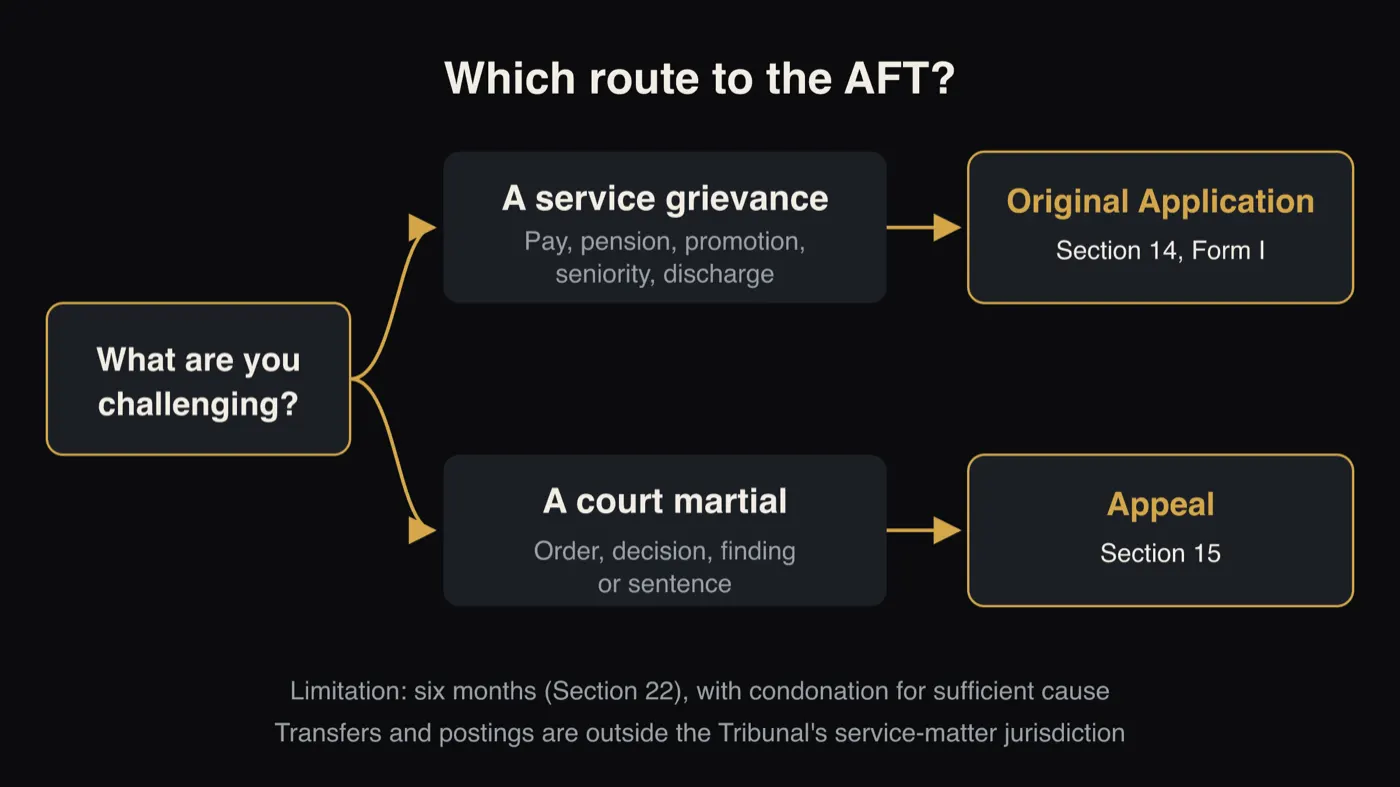
The routes into the Armed Forces Tribunal
Original Application for service matters
An OA is the usual route for disputes about pay, allowances, pension, promotion, seniority, discharge and similar conditions of service. It is filed on Form I in the prescribed compilations. Transfers and postings are outside the Tribunal’s service-matter jurisdiction.
Appeal against a court martial
Any person aggrieved by an order, decision, finding or sentence of a court martial may appeal. The grounds are in Section 15(4). The Tribunal can also substitute a finding or reduce a sentence under Section 15(6), and can grant bail under Section 15(3).
Remedies within the service and limitation
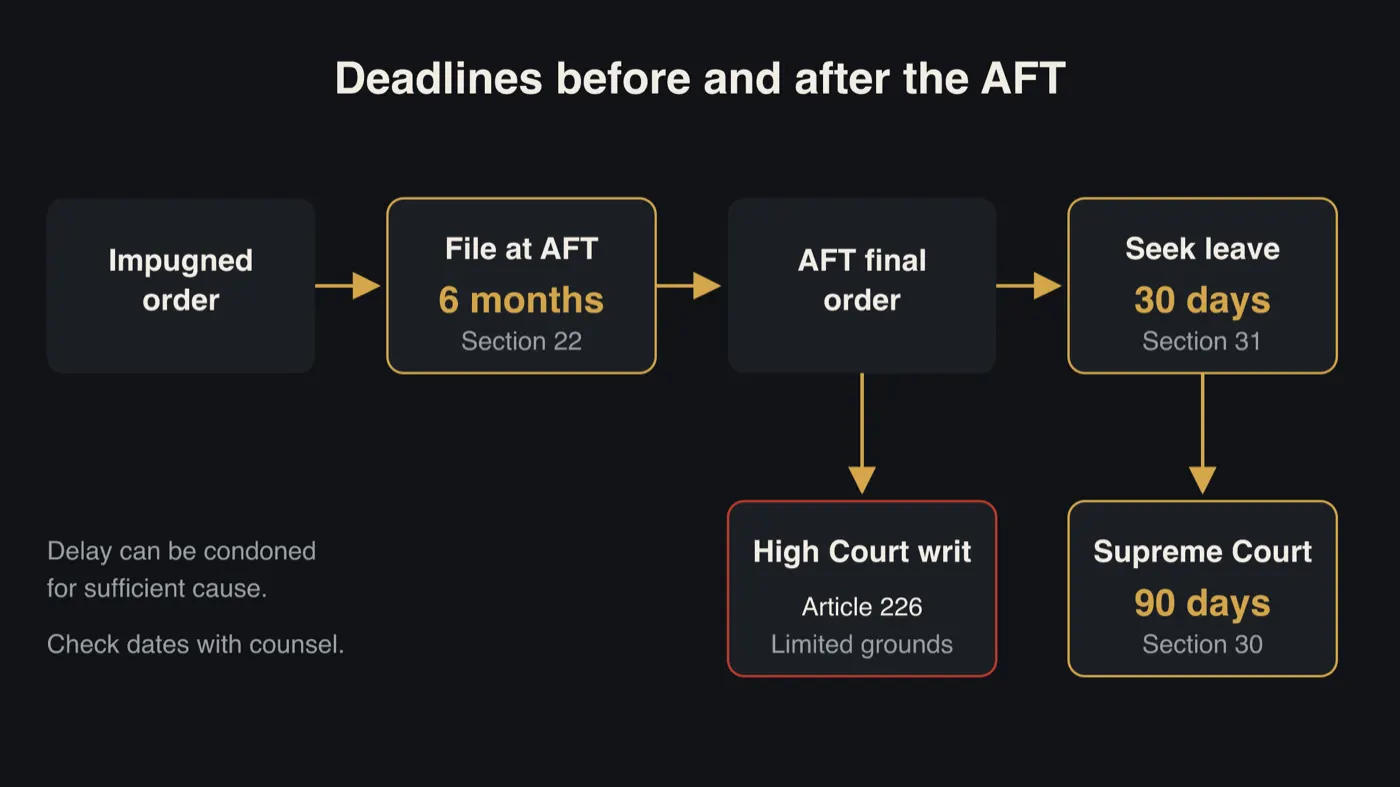
Internal remedies such as a Section 164 petition under the Army Act, 1950 are optional for a court martial appeal. The Act sets six months for applications, with condonation for sufficient cause. A pending petition is a weak reason for delay, so verify the dates with counsel early.
After the Tribunal
A final order of the AFT can be taken to the Supreme Court under Section 30, and leave under Section 31 is needed. A writ petition under Article 226 against an AFT order is also maintainable on limited grounds after Union of India v. Parashotam Dass (2023).
Documents commonly needed to file
- The impugned order, such as the discharge, dismissal, pension rejection or court martial order, with an attested copy
- Service records, pension papers and the representations made, with the replies received
- For a court martial appeal: the charge-sheet, summary of evidence, proceedings, findings, sentence and confirmation order
- Any Section 164 petition, with its reply, if one was filed
- A separate condonation application with an affidavit, if there is a delay
- Vakalatnama, affidavit and identity proof
Leading judgments on court martial appeals to the Armed Forces Tribunal
These six decisions shape how the AFT and the higher courts deal with court martial challenges and service grievances. Each citation below was checked against the Supreme Court record or a law report. Read the full judgment before relying on it in your own case.
1982
No appeal from court martial: a glaring lacuna
A three-judge bench held that Army Act provisions inconsistent with Part III are read as made under Article 33. It called the absence of even one appeal against a court martial verdict a glaring lacuna and urged at least one review by a judicial forum. This observation is usually cited as the starting point of the Armed Forces Tribunal Act, 2007.
1987
Biased court and shocking sentence vitiate trial
A signalman was tried by a Summary Court Martial held by the same Commanding Officer he had complained against. Applying the real-likelihood-of-bias test, the Supreme Court held the proceedings coram non judice. It added that a sentence so disproportionate to the offence that it shocks the conscience is open to review. The Court quashed the SCM and ordered reinstatement.
1990
No reasons needed at confirmation stage
The Constitution Bench held that quasi-judicial authorities must ordinarily give reasons. Under the Army Act, however, reasons are excluded by necessary implication for the confirming authority and for the Central Government when it rejects a post-confirmation petition under Section 164(2). The aggrieved person can still challenge the order before the High Court or the Supreme Court.
2022
AFT may reappreciate court martial evidence
The Supreme Court confirmed that in an appeal under Section 15 the AFT may re-examine the evidence to decide whether a finding is legally unsustainable or rests on a material irregularity. It upheld the AFT’s view that a conviction resting only on an uncorroborated extra-judicial confession, which was not shown to be voluntary, could not stand.
2023
High Court writ lies against AFT orders
A three-judge bench overruled Major General Shri Kant Sharma, (2015) 6 SCC 773, on this point. Following L. Chandra Kumar, it held that nothing in law bars a High Court from hearing an Article 226 writ against an AFT order. High Courts are expected to use self-restraint and look mainly at Part III violations, jurisdictional error or an error apparent on the record.
2025
AFT can substitute finding and reduce punishment
The AFT found the bribery charge not proved, substituted a finding under Section 63 of the Army Act, and reduced dismissal to compulsory retirement with pensionary benefits. The Supreme Court upheld this use of the Tribunal’s powers under Section 15 of the AFT Act. The case shows that substitution can sometimes save an officer’s pension.

How to file a case in the Armed Forces Tribunal, step by step
Get the full record in writing
As soon as the trial ends or the impugned order is passed, apply in writing for attested copies. These include the convening order, charge-sheet, summary of evidence, findings, sentence and confirmation order (for an SCM, the promulgation order and the Section 162 review). Keep proof of every application. Without the record, you cannot show the grounds.
Choose the correct route: OA or appeal
Service matters such as pay, pension, promotion or discharge go by Original Application under Section 14 of the AFT Act, 2007. A court martial order, finding or sentence is challenged by appeal under Section 15. The Section 3(o) definition of service matters excludes an SCM unless the punishment is dismissal or imprisonment for more than three months.
Diary limitation from day one
Section 22 allows six months from the final order. Where a petition is pending without an order, the six months run from when six months have passed since the petition. A petition under Section 164 of the Army Act is optional, so do not wait for its outcome. If you are late, file a separate condonation application with an affidavit under Rule 8(9) of the AFT (Procedure) Rules, 2008, explaining every period of delay.
Pick the right bench
Under Rule 6 you file where you are posted or were last posted, or where the cause of action arose. Ex-servicemen may file where they ordinarily reside. The Kolkata Regional Bench covers West Bengal, Bihar, Jharkhand, Odisha and the Andaman and Nicobar Islands; Sikkim goes to Guwahati.
Draft and file in Form I
File the application or appeal in Form I, in triplicate, in two compilations, with an index in duplicate (Rule 4). Mark annexures A-1, A-2 and so on, and attach a vakalatnama (Rule 9). The Rule 7 fee is Rs 250 (Rs 500 for a joint application). Verify the current fee and payment mode with the Registry. File separate MAs for bail under Section 15(3) or suspension of sentence under Section 15(6)(e).
Hearing and onward remedies
At the hearing, the Tribunal may call for the original record and receive evidence under Section 17. Against its final order, an appeal lies to the Supreme Court under Section 30 within 90 days, with leave under Section 31. An SLP under Article 136 or a writ in the Calcutta High Court is also possible.
Common mistakes that weaken an AFT case
Waiting for the Section 164 petition to be decided The Army Act sets no time limit for deciding these petitions, but the AFT limitation keeps running. Once six months have passed, a pending petition is a weak explanation for the delay.
Filing an OA when a Section 15 appeal is needed, or the other way round A court martial verdict and a service grievance follow different routes with different grounds. For example, a GCM convening order has been treated as a Section 14 matter. Choosing the wrong route loses time and can confuse the reliefs.
Not getting the court martial record before drafting Grounds based on the plea of guilty, the Section 130 objection to members or the 96-hour warning under Rule 34 can only be shown from the record. Apply for attested copies at once and keep proof that you applied.
Pleading only that the sentence is harsh Courts interfere on proportionality only where a sentence shocks the conscience (Ranjit Thakur; R.K. Sharma). Key your grounds to Section 15(4)(a) to (c), which cover legal unsustainability, a wrong decision on a question of law and a material irregularity. Use Section 15(6)(b) for sentence grounds.
Discuss your Armed Forces Tribunal matter with the chambers
If you or a family member is considering an Original Application or a court martial appeal before the Armed Forces Tribunal, bring the impugned order, the dates and the service papers to a consultation. We will go through the forum, the limitation and the documents with you in plain terms. Every case turns on its own facts, so no outcome can be promised. You can write to us or visit the Kolkata or Delhi chamber.
Book a ConsultationEstablished by a distinguished alumnus of IIT Kharagpur, Patra’s Law Chambers stands as a beacon of legal expertise in Kolkata & Delhi. Know more →

Kolkata Office
NICCO House, 6th Floor, 2 Hare Street
Kolkata-700001 (Near Calcutta High Court)
Delhi Office
4455/5, First Floor, Gali Shahid Bhagat Singh
Main Bazar Road, Paharganj, New Delhi-110055
Contact
[email protected]
+91 890 222 4444 / +91 7003 715 325
Frequently asked questions about filing cases in the Armed Forces Tribunal
AFT stands for Armed Forces Tribunal. It was set up under the Armed Forces Tribunal Act, 2007 to hear service matters of the Army, Navy and Air Force, and to hear appeals against court martial orders. Its principal bench is in New Delhi, with regional benches across the country.
Service matters under Section 14, such as pay, pension, promotion, seniority, discharge and dismissal, and appeals under Section 15 against court martial orders. Transfers and postings are excluded. Whether your dispute qualifies depends on its facts, so verify the order before filing.
Section 22 of the AFT Act, 2007 generally fixes six months from the final order, or from six months after a representation that went unanswered. The Tribunal can condone delay for sufficient cause on a separate application with an affidavit. Verify your dates with counsel.
Under Rule 6 you may file where you are or were last posted, where the cause of action arose, or, for ex-servicemen, where you ordinarily live. The Kolkata Regional Bench covers West Bengal, Bihar, Jharkhand, Odisha and the Andaman & Nicobar Islands.
Yes, in court martial appeals. Section 15(3) allows bail for a person in military custody, except where there are reasonable grounds to believe guilt for an offence punishable with death or life imprisonment. Section 15(6)(e) lets the Tribunal suspend a sentence of imprisonment.
The Rules allow filing in person, but drafting grounds, reliefs and condonation applications is technical. Most applicants engage an advocate who practises before the Tribunal. A first consultation is general information only and carries no promise of any result.
An appeal lies to the Supreme Court under Section 30 within 90 days, with leave under Section 31 where required, or under Article 136. A writ under Article 226 in the High Court is also possible after Parashotam Dass (2023), on limited grounds.
Do not assume so. The Act sets no time limit for Section 164 petitions, and benches apply the six-month rule of Section 22 in practice. A pending petition is a weak explanation for delay. File in time and ask counsel to verify the position.